



About this worksheet
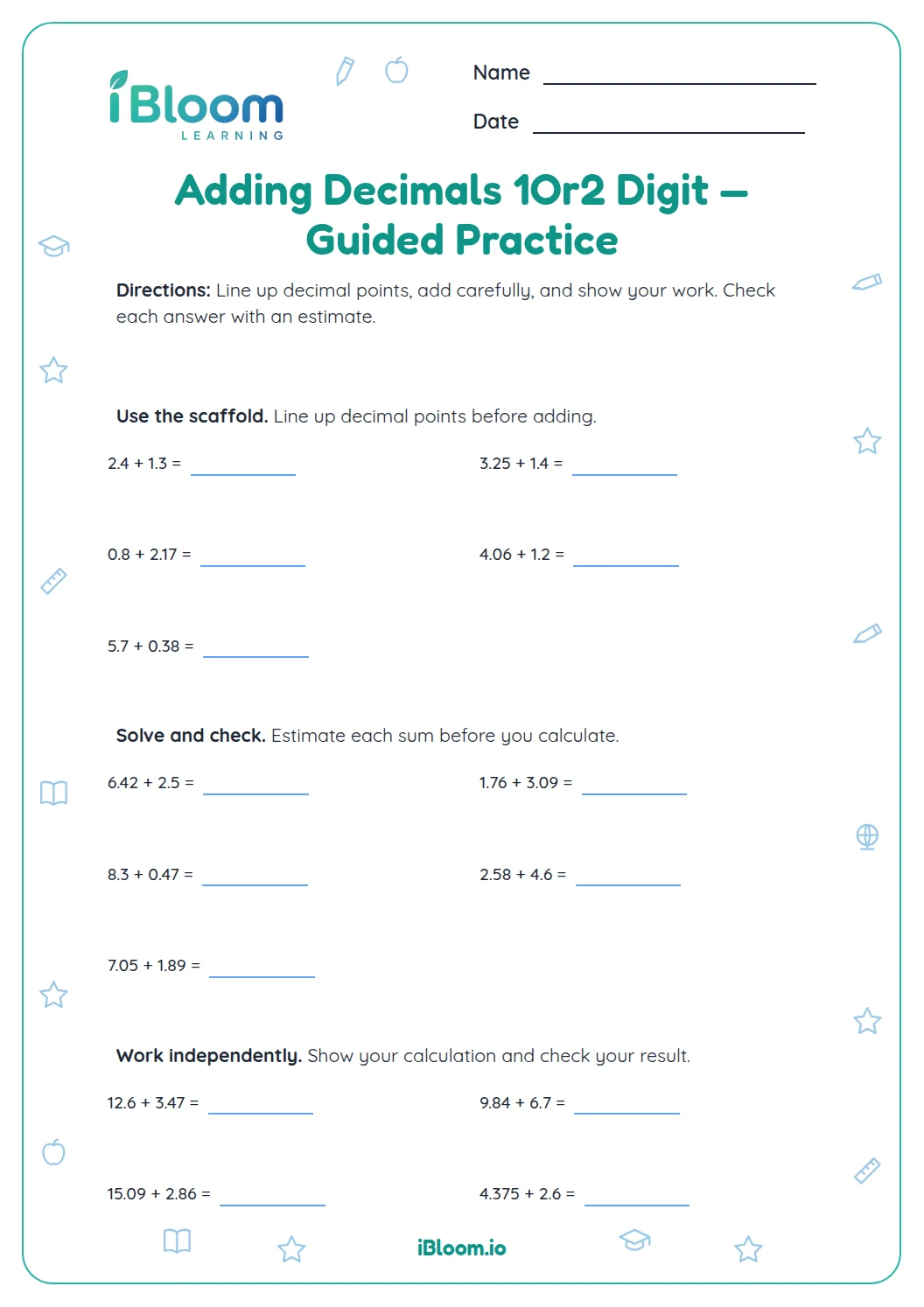
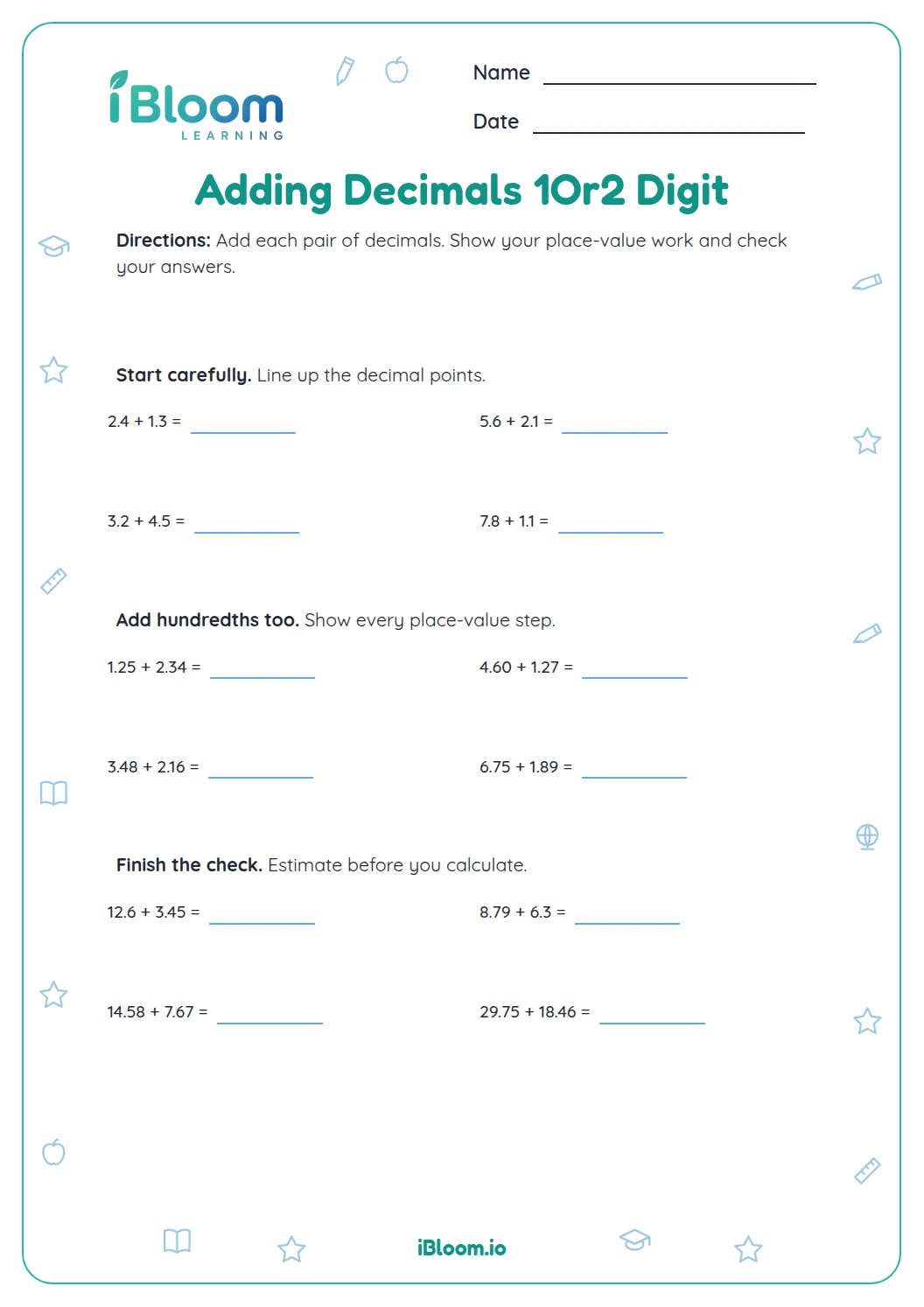
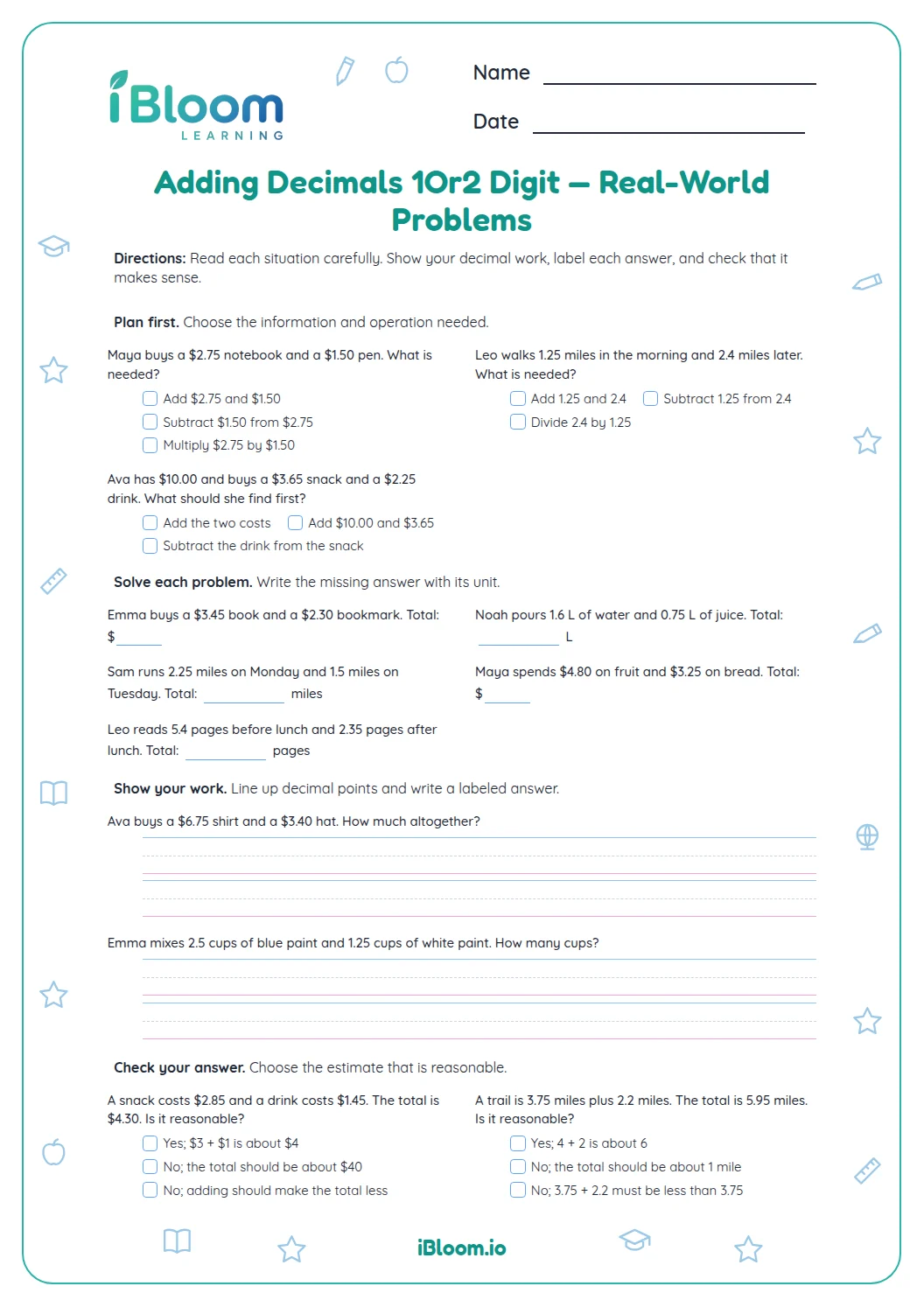
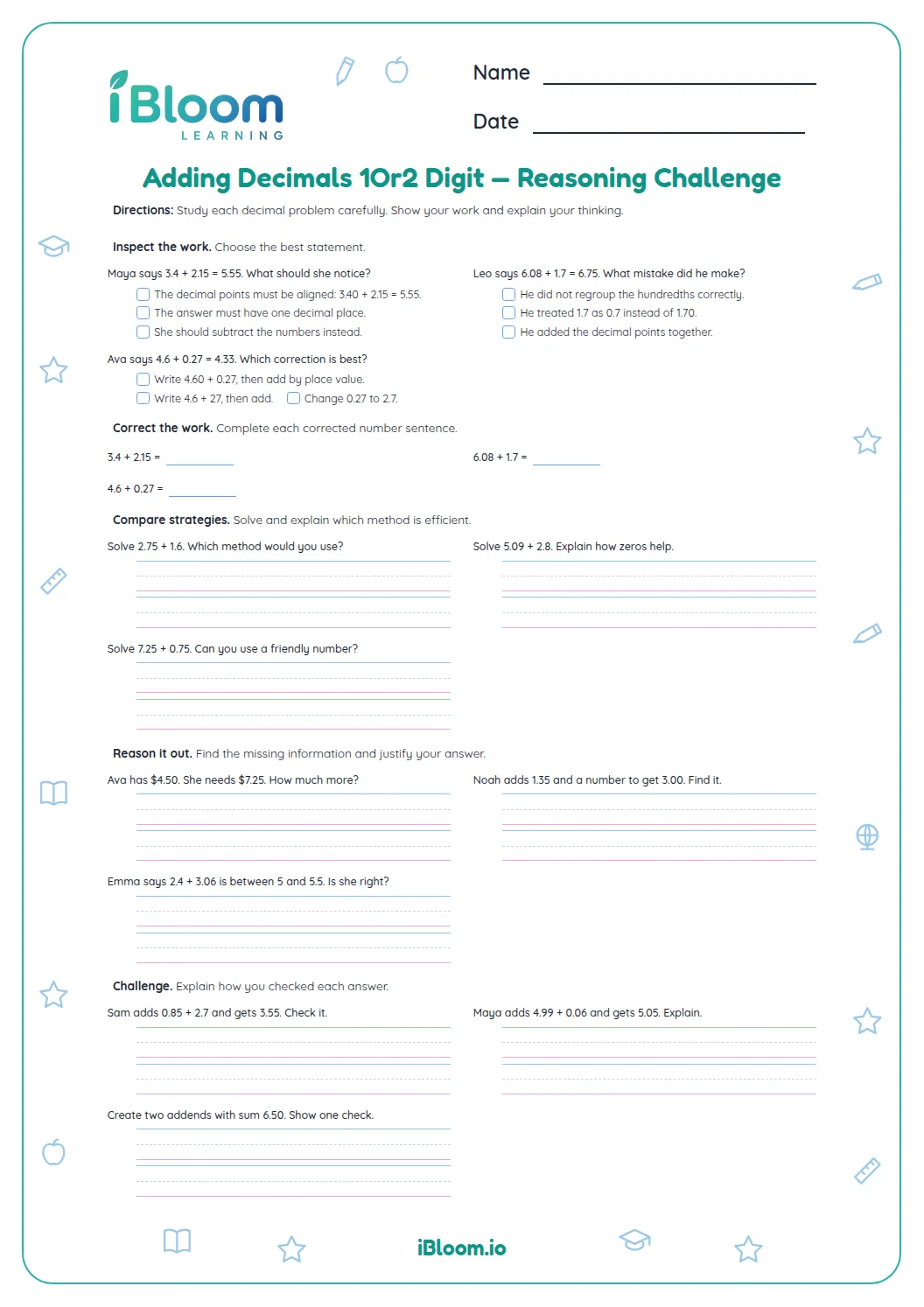
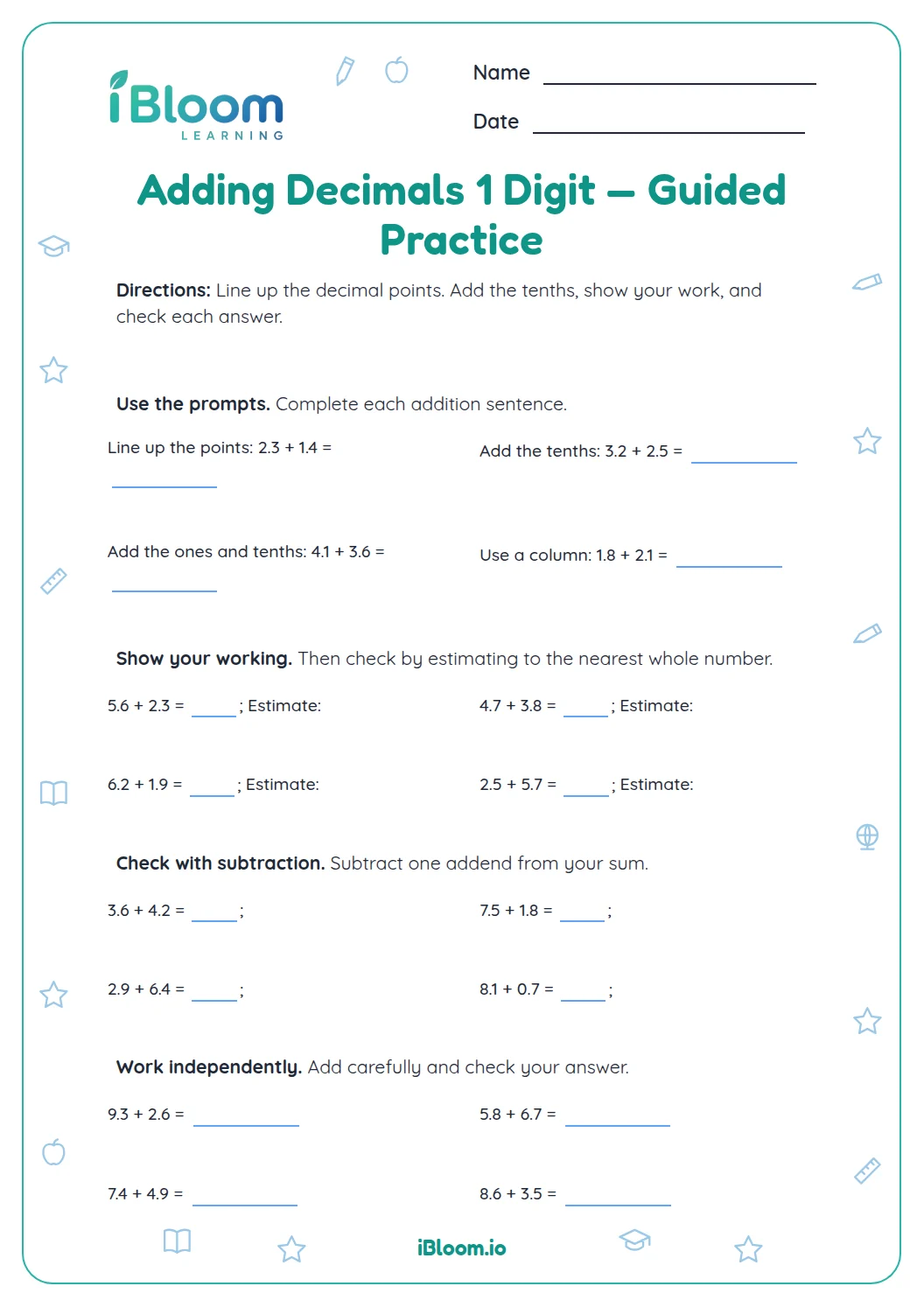
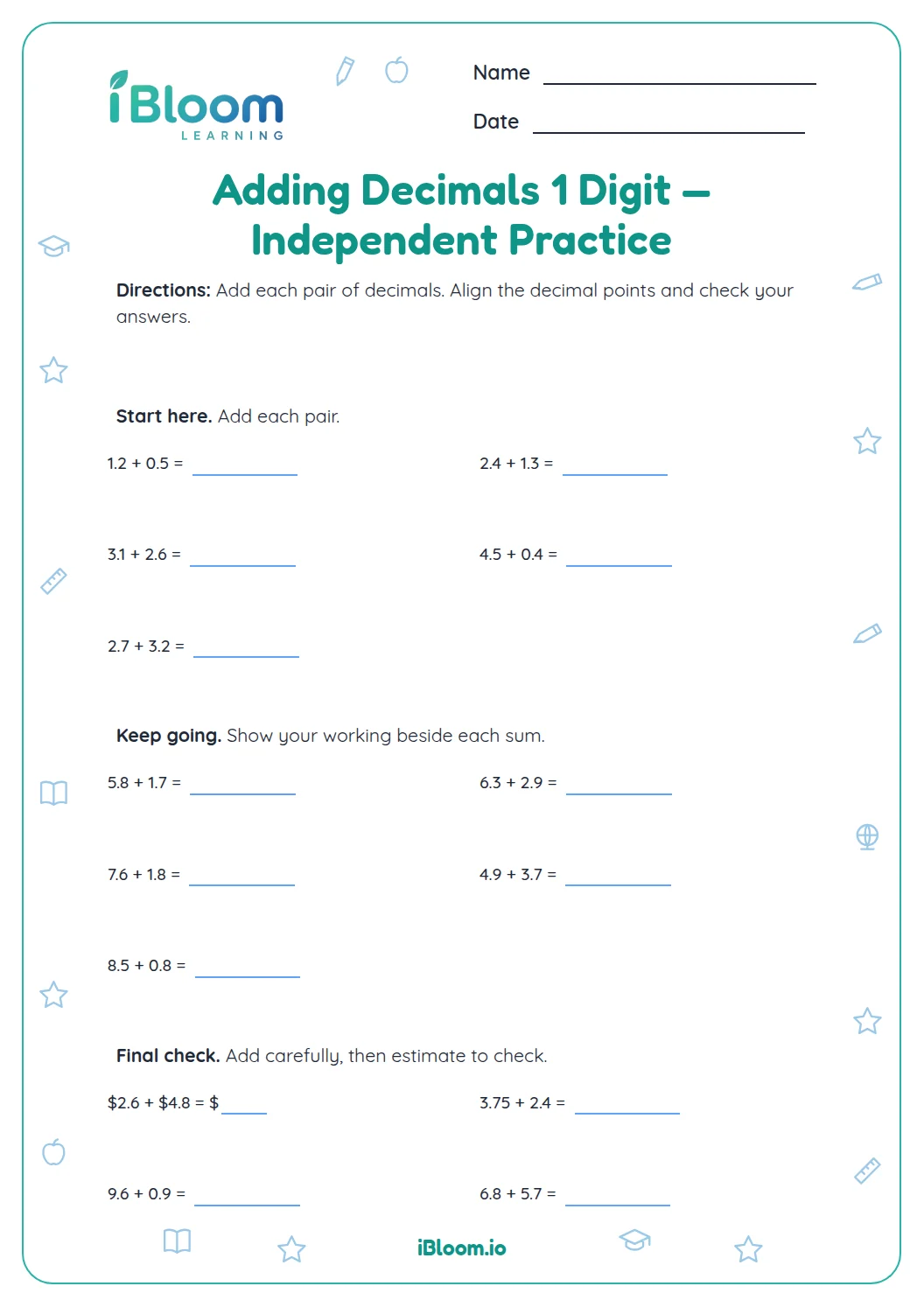
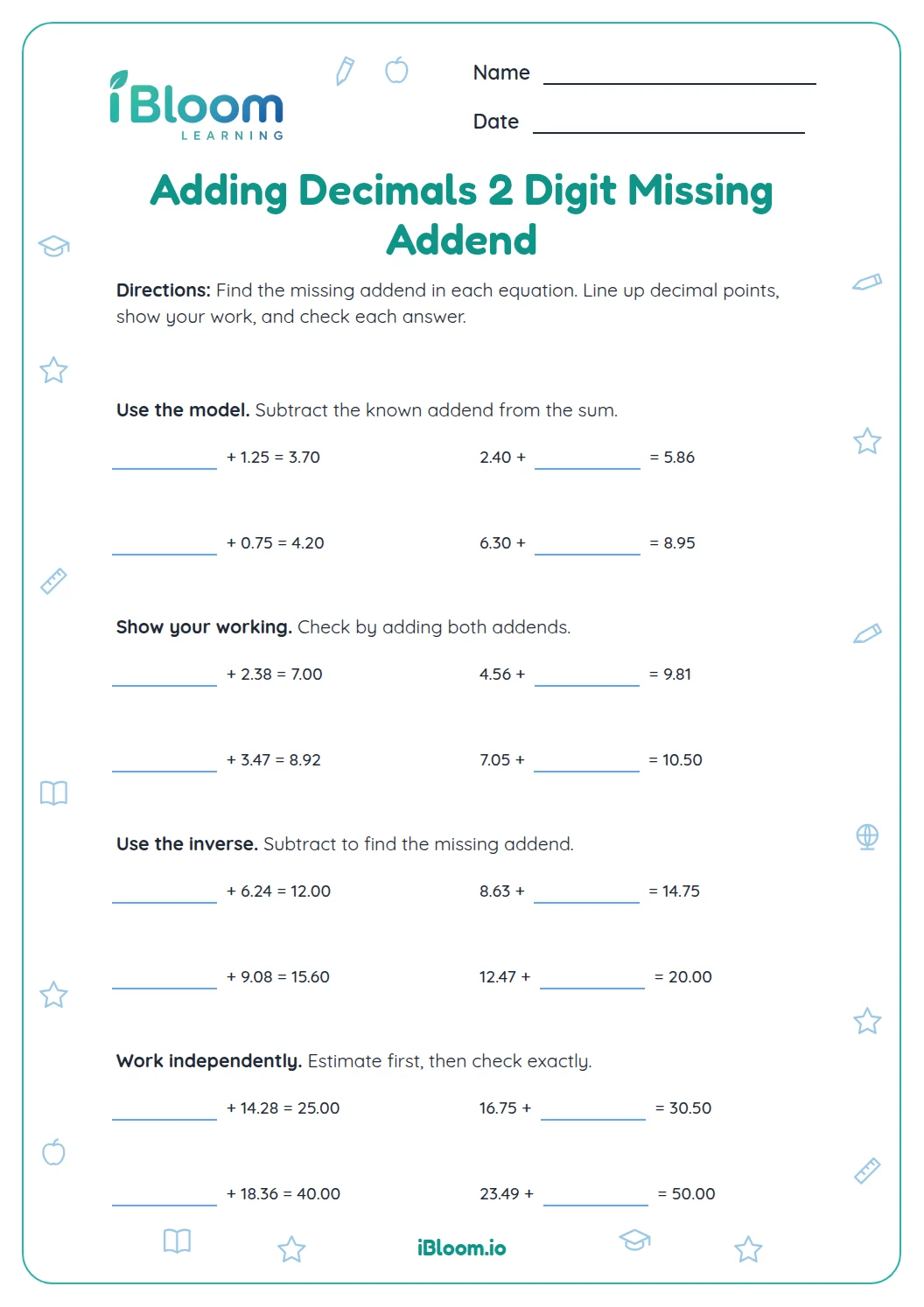
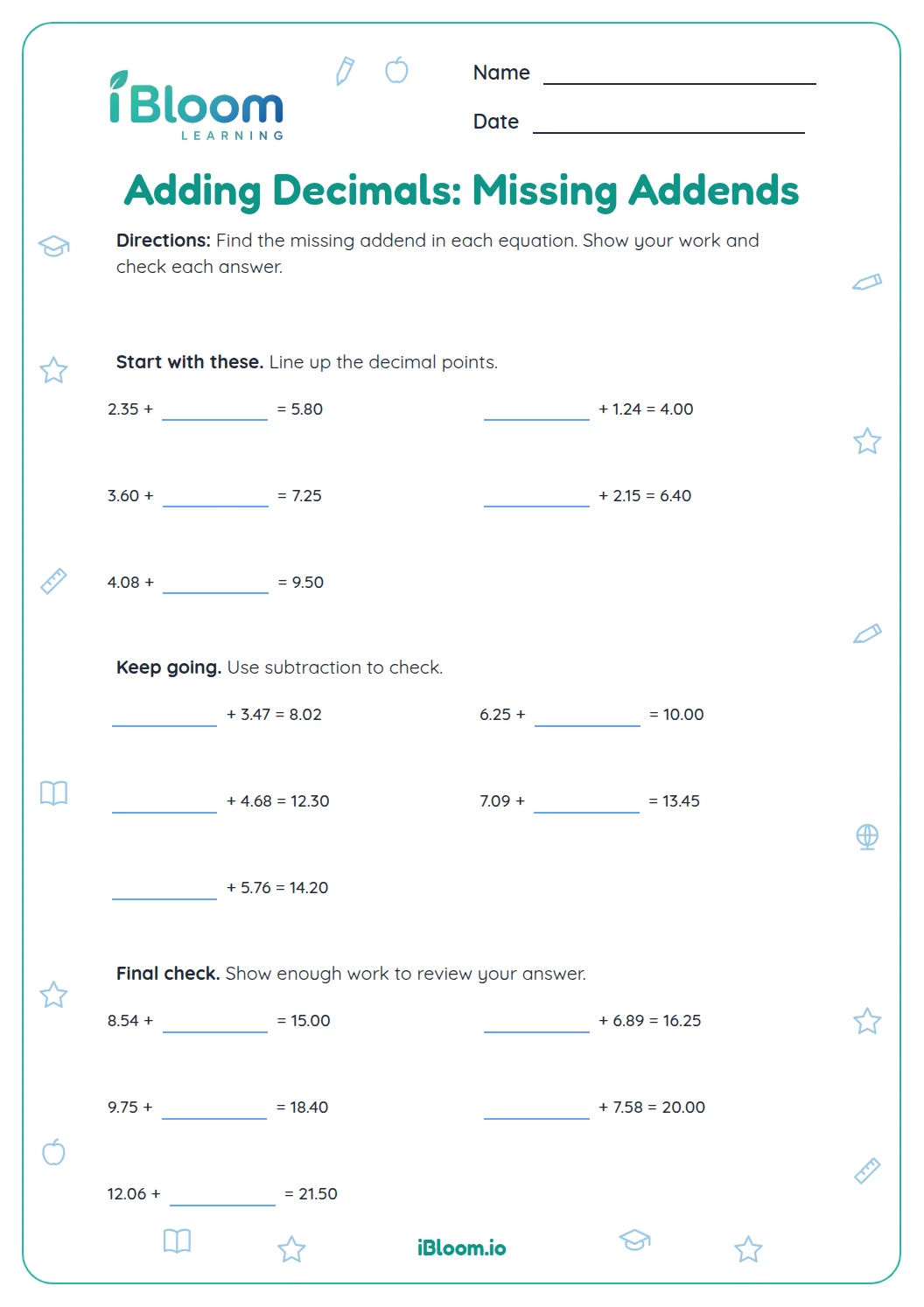
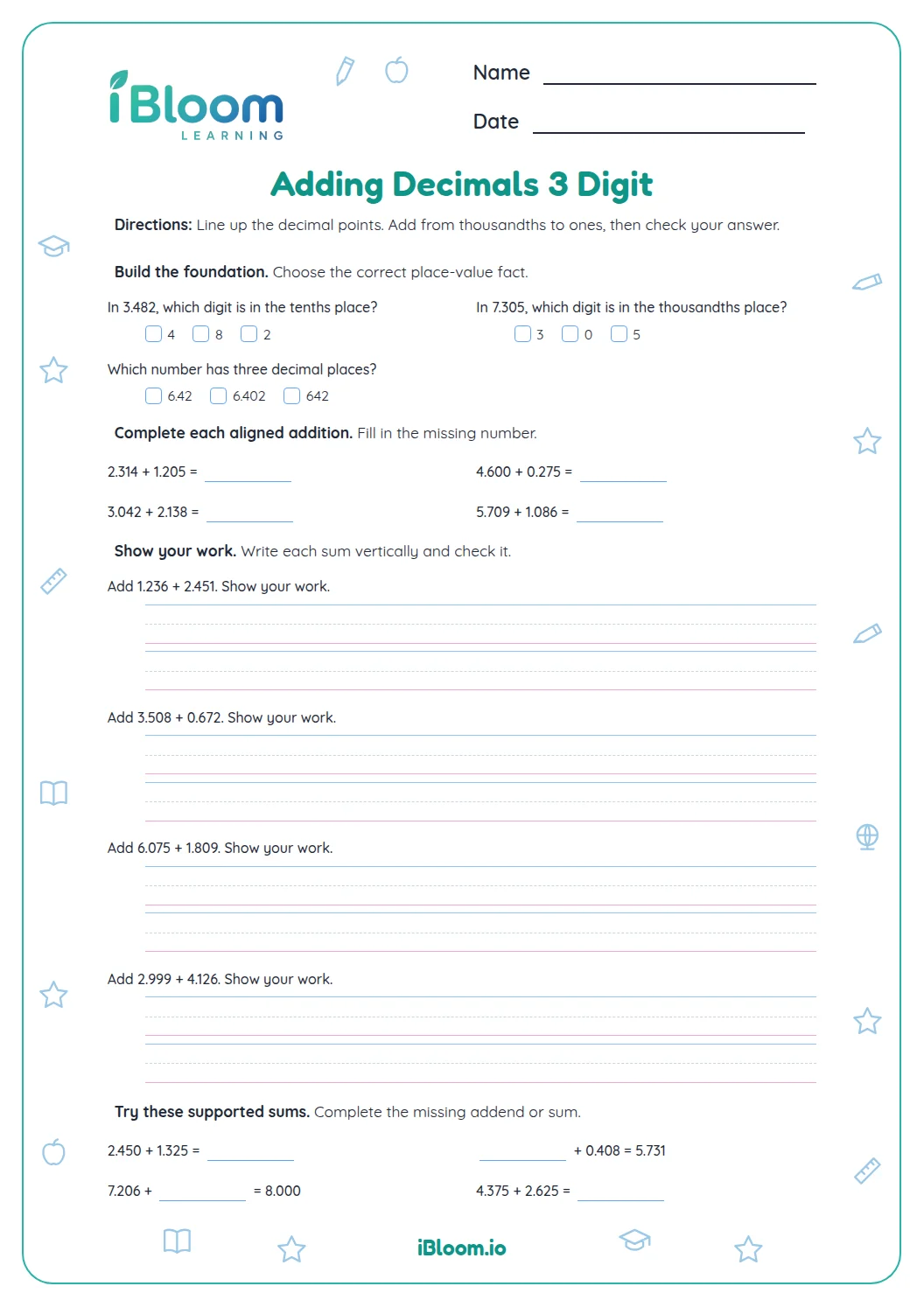
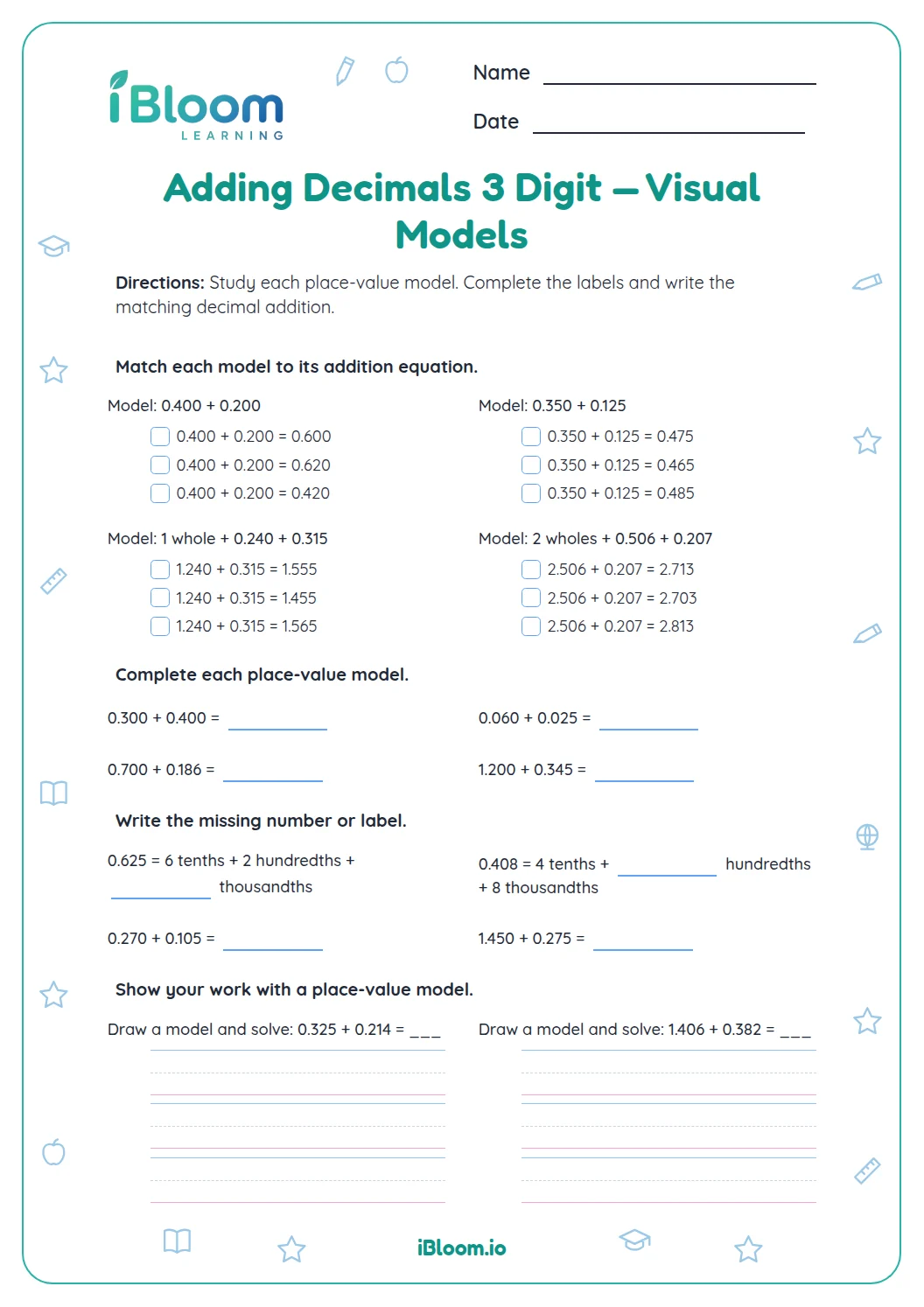
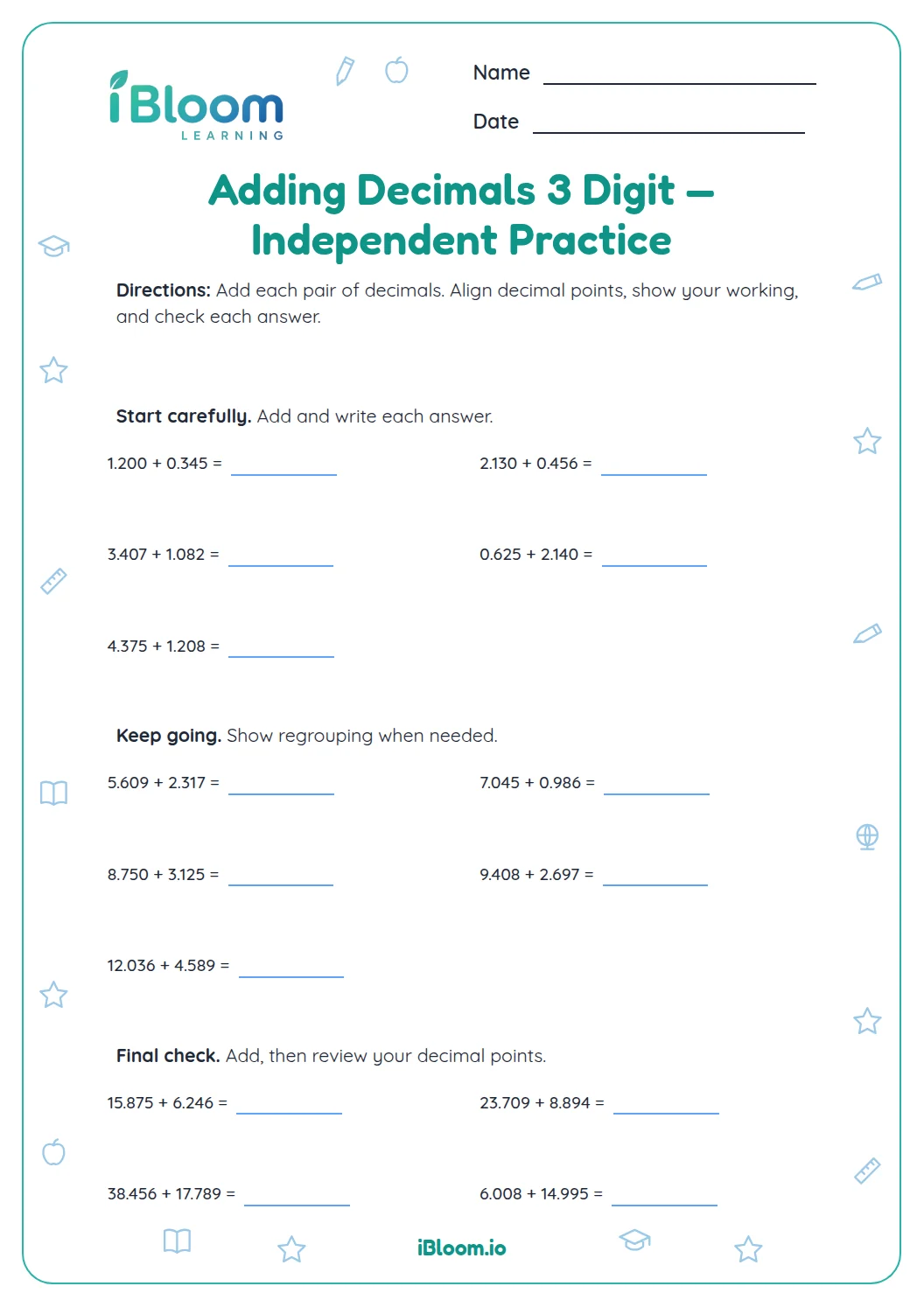
This Grade 5 printable practices adding decimals through hundredths. Children solve four sums with tenths or hundredths models, add four more decimal pairs, and use addition in four short measurement and recipe situations. The models shade the combined amount, giving students a way to check the sum while they connect tenths and hundredths to decimal notation. A separate answer key lists all 14 results.
Aligned to 5.NBT.B.7
How do tenths and hundredths models show a sum?
A tenths strip divides a whole into ten equal parts; a hundredths grid divides it into 100 squares. In the first four items, the shaded amount represents the sum, so combine the addends by place value and compare the result with the model. For 0.25 + 0.30, 25 hundredths plus 30 hundredths is 55 hundredths, or 0.55.
- 10.25 + 0.30
- 225 hundredths + 30 hundredths
- 3= 55 hundredths = 0.55
What is a reliable way to add decimal numbers?
Write addends with decimal points aligned. Add hundredths to hundredths and tenths to tenths; use a zero placeholder when it helps, as in 0.6 = 0.60. Regroup when a place-value total reaches ten.
How do decimal sums fit real situations?
The last five questions put decimal addition in everyday contexts. Add the amounts, then include the unit named in the story. A reasonable check is that a sum of positive amounts is greater than either addend.
How to use this worksheet
- 1Read the decimal places in each model before writing a sum.
- 2Line up decimal points in written calculations.
- 3Add a zero to make tenths and hundredths easy to compare.
- 4In each story, include the unit in your answer.
- 5Estimate the sum to catch a misplaced decimal point.
Common mistakes and quick fixes
The mistake
Adding digits in different place values as if they were alike.
The fix
Line up decimal points so tenths match tenths and hundredths match hundredths.
The mistake
Dropping a zero and changing the amount, such as reading 0.5 as 0.05.
The fix
Say the place value aloud: 0.5 is five tenths, or 0.50.
The mistake
Forgetting to regroup 10 hundredths as 1 tenth.
The fix
Check whether the hundredths total is ten or more and carry to the tenths place.
Common Core alignment
The models and written calculations connect decimal sums to place value.
Add decimals to hundredths with models and place-value strategies.
On this sheet: Children add decimal amounts using tenths and hundredths models, written sums, and story problems.
Show the official wordingHide the official wording
Add, subtract, multiply, and divide decimals to hundredths, using concrete models or drawings and strategies based on place value, properties of operations, and/or the relationship between addition and subtraction; relate the strategy to a written method and explain the reasoning used.
What to practice next
Make more practice
Further reading
Questions parents and teachers ask
What decimal places appear on the worksheet?
The sheet uses tenths and hundredths. Four questions pair an addition sentence with a shaded tenths strip or hundredths grid; the remaining questions use written sums and short stories. Students use the models to connect the decimal places with the combined amount.
How should children read a hundredths grid?
Each small square is one hundredth. In 0.25 + 0.30, the addends total 55 hundredths, so the answer is 0.55. The shaded model shows that combined amount. A tenths strip uses ten equal parts, so each part stands for one tenth.
Why can I write 0.6 as 0.60?
Both decimals represent six tenths. The zero in the hundredths place does not change the value, but it can help line up the numbers when adding hundredths. Adding a zero can help line up 0.6 with hundredths without changing its value.
What should answers to the word problems include?
Include the total and the unit named in the story: meters, liters, miles, cups, or feet. The key uses abbreviations for several units. Adding the amounts first and checking the unit afterward helps keep a correct decimal sum connected to the situation.
Does the worksheet include an answer key?
Yes. The separate key gives the answer to each of the 14 questions, including the model sums and the units for the story problems. Compare the model totals with the written sums, and check that decimal points stay aligned when adding.