




About this worksheet
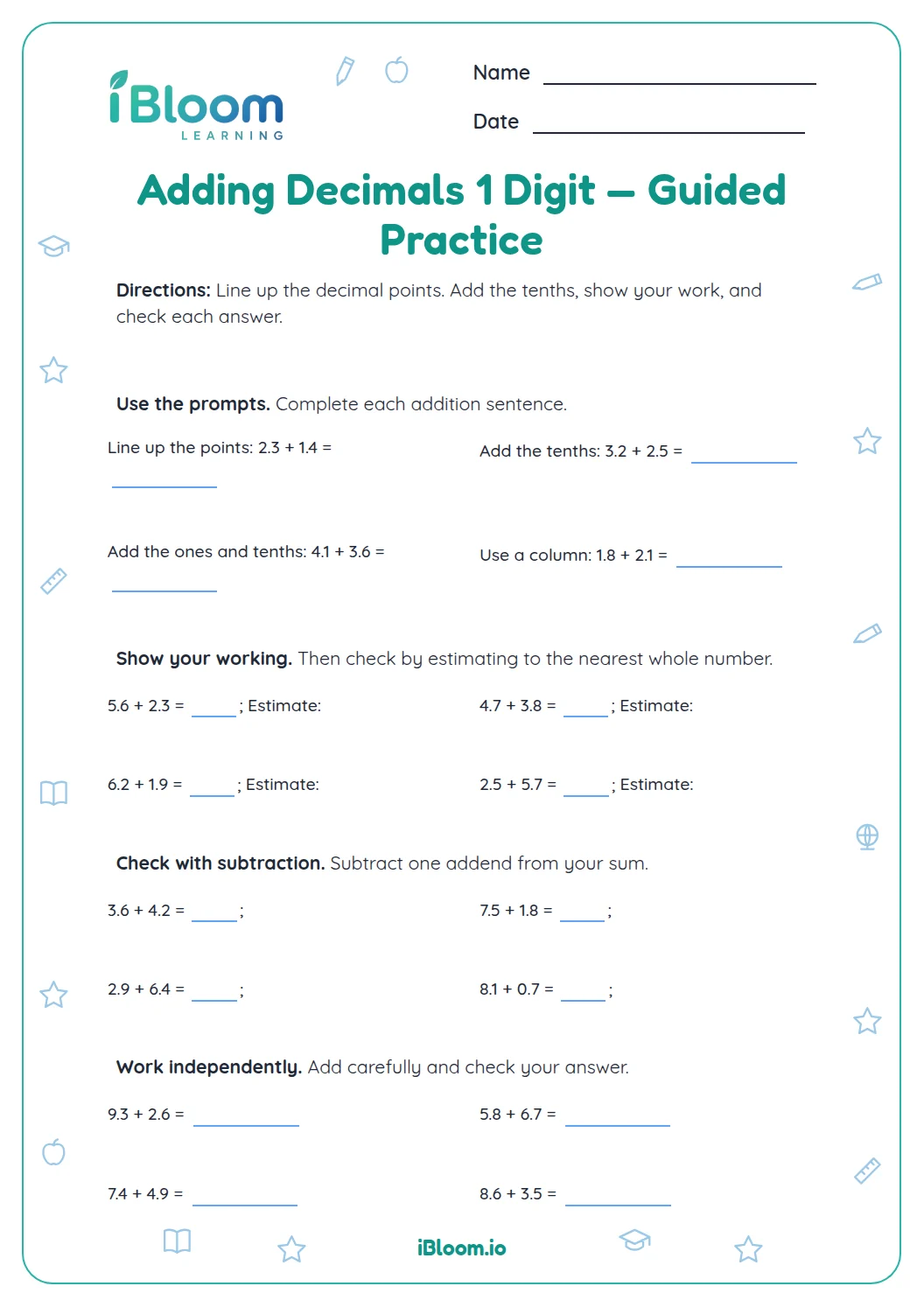
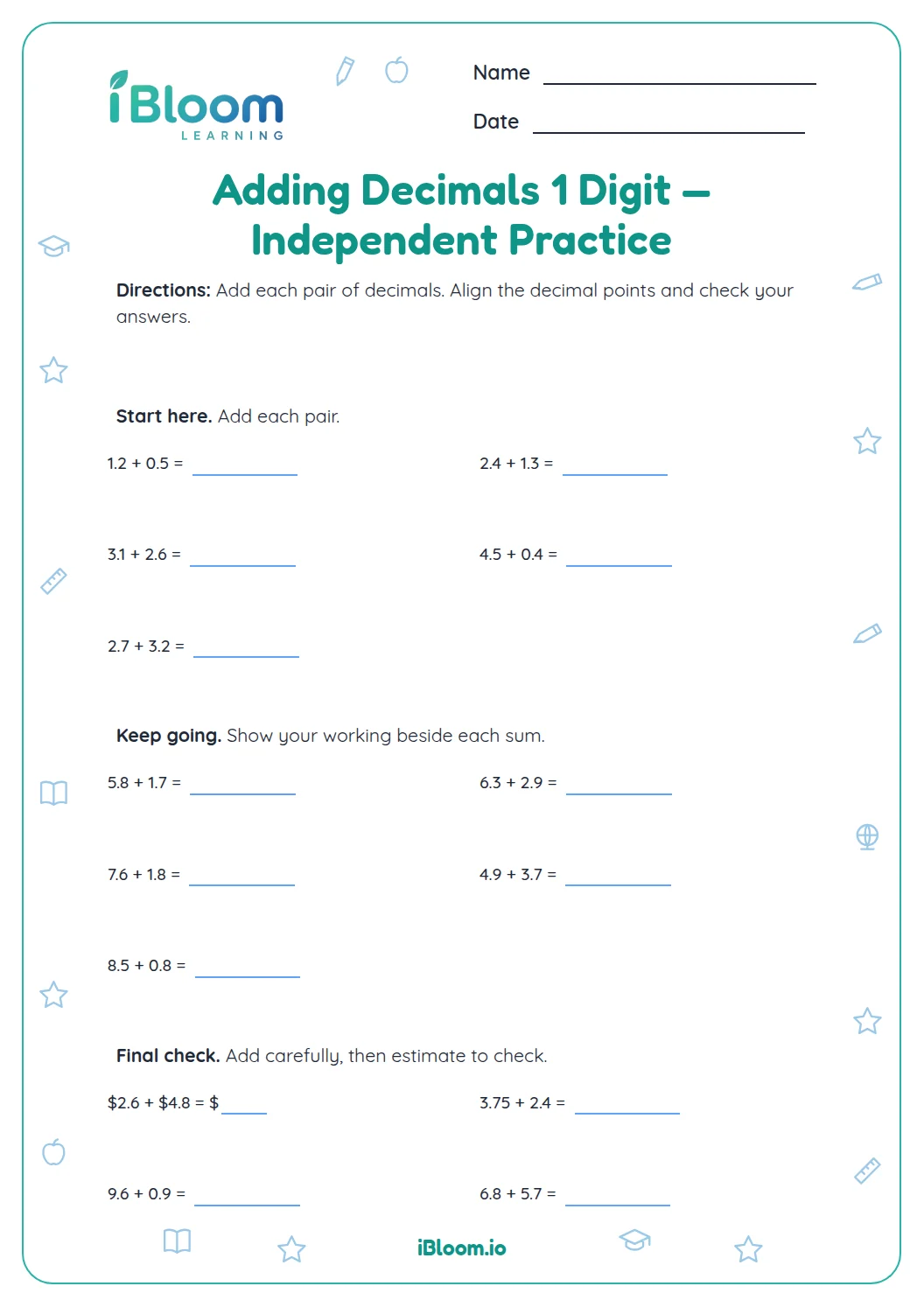
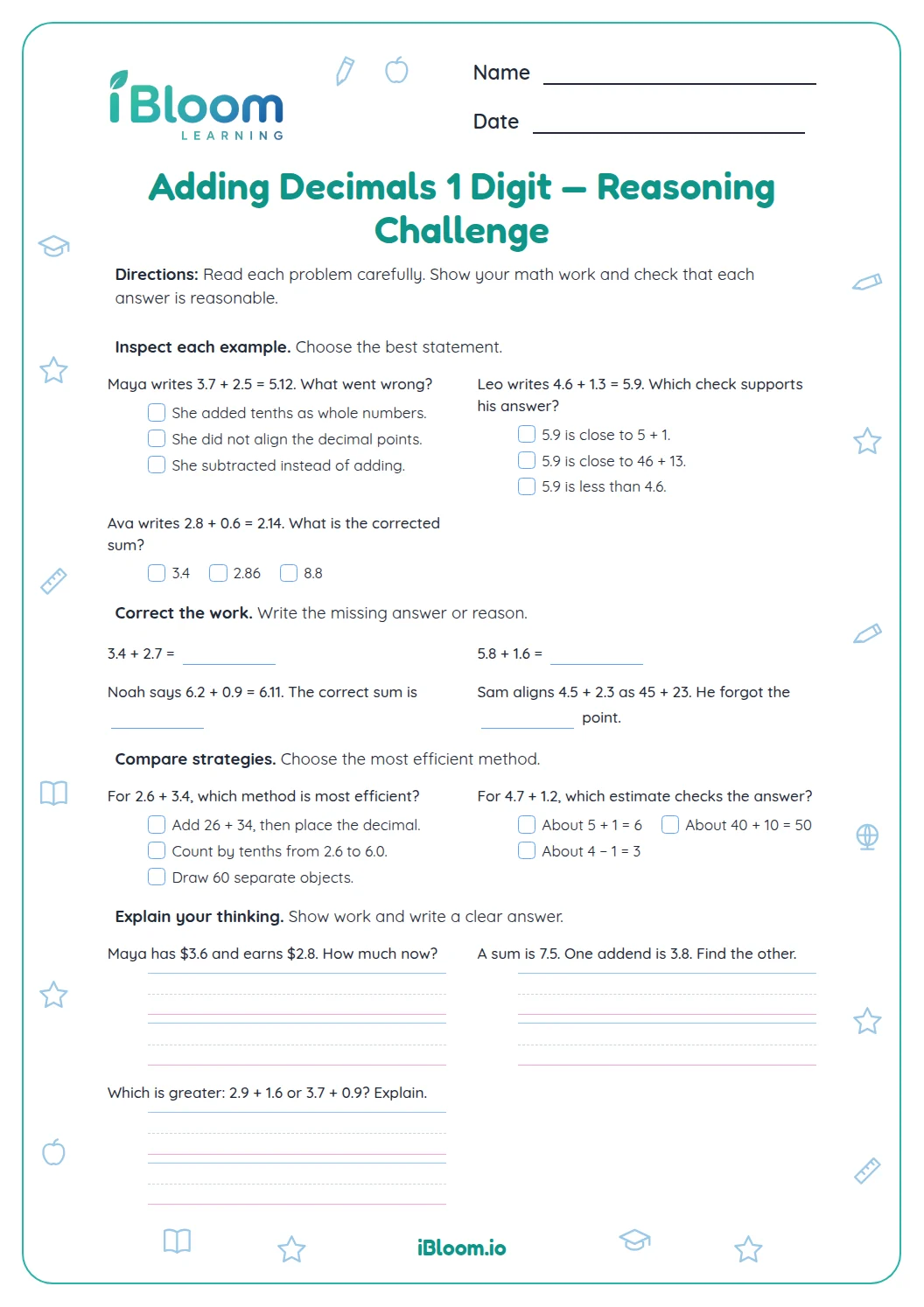
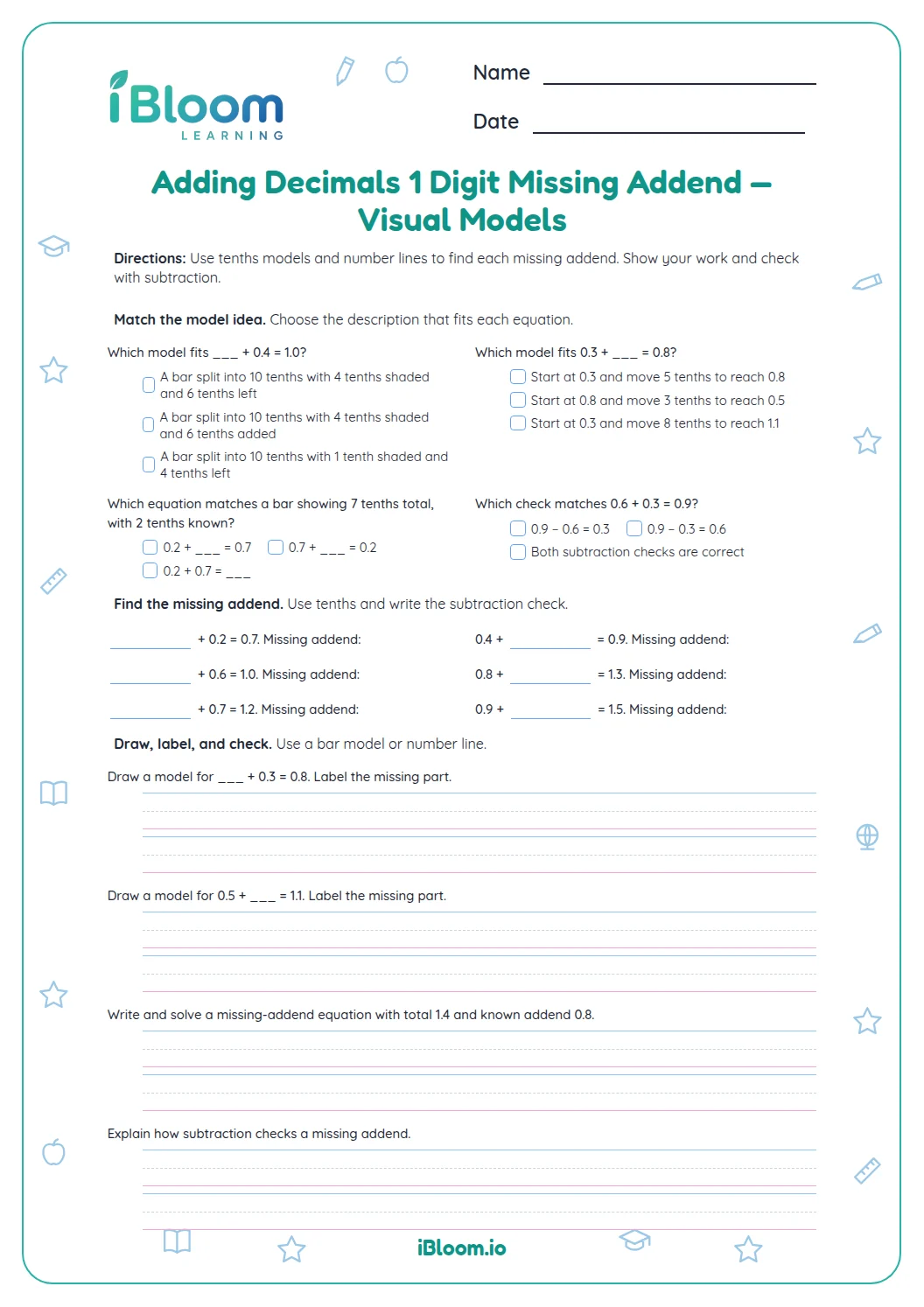
This free Grade 5 worksheet introduces decimal addition with tenths. Students read shaded tenths, select and write sums, and add decimal amounts in measurement and everyday situations. Some sums cross one whole, giving students a chance to connect tenths to the next whole number. The practice supports CCSS 5.NBT.B.7, and a separate answer key lists all 16 results.
Aligned to 5.NBT.B.7
What does one digit after the decimal point represent?
The first place to the right of the decimal point is the tenths place. A 0.4 strip has four of ten equal parts shaded. When adding tenths, combine the tenths and keep their place value.
In question 1, 0.4 + 0.3 means four tenths plus three tenths. That makes seven tenths, or 0.7.
- 10.4 + 0.3 = 0.7
- 2Four tenths plus three tenths equals seven tenths.
What happens when the tenths add to ten or more?
Ten tenths make one whole. For 0.8 + 0.5, combine eight tenths and five tenths to get 13 tenths. Regroup 10 tenths as 1 whole, leaving 3 tenths: 1.3.
The same idea works when the addends already include whole numbers. Add the tenths, regroup if needed, and then combine the whole-number parts.
- 10.8 + 0.5 = 1.3
- 213 tenths = 1 whole and 3 tenths.
How do decimal sums describe measurements?
In a story problem, identify the two amounts being combined and keep the unit in the answer. The same addition steps work for miles, meters, liters, centimeters and cups.
For the ribbon problem, 1.2 meters + 0.5 meter = 1.7 meters. The tenths combine, and the unit stays meters.
How to use this worksheet
- 1Read a model as tenths before choosing an answer.
- 2Line up the decimal points in a written sum.
- 3Add the tenths digits and regroup ten tenths as one whole when needed.
- 4Add any whole-number parts.
- 5In a story, include the unit in the final answer.
Common mistakes and quick fixes
The mistake
Adding the digits as whole numbers and writing 0.43 for 0.4 + 0.3
The fix
Both digits are tenths, so add 4 tenths and 3 tenths to get 7 tenths, or 0.7.
The mistake
Forgetting to regroup 10 tenths as one whole
The fix
Rename ten tenths as 1 whole before writing the final decimal.
The mistake
Dropping the unit in a measurement story
The fix
Keep the unit attached to the sum: for example, 1.7 meters.
Common Core alignment
The tenths models and written sums apply place-value strategies for decimal operations.
Add decimal tenths by place value and explain the written sums.
On this sheet: Students add decimals to tenths with visual models and written methods, including sums greater than one.
Show the official wordingHide the official wording
Add, subtract, multiply, and divide decimals to hundredths, using concrete models or drawings and strategies based on place value, properties of operations, and/or the relationship between addition and subtraction; relate the strategy to a written method and explain the reasoning used.
What to practice next
Make more practice
Further reading
Questions parents and teachers ask
What does the tenths place mean?
The tenths place is the first digit to the right of the decimal point. It counts parts when one whole is divided into ten equal pieces. In 0.4, the 4 means four tenths; in 0.7, the 7 means seven tenths.
How can a student add 0.8 and 0.5?
Add eight tenths and five tenths to get thirteen tenths. Rename ten tenths as one whole, with three tenths left. The sum is 1.3. The tenths strip helps show why the answer is greater than one whole using the model.
Why should decimal points line up?
Lining up decimal points keeps like place values together. In tenths addition, the tenths digits must be added to each other. Writing 0.4 + 0.3 as 0.7 preserves their place value; treating the digits as 4 and 3 would not.
What is included in the answer key?
The separate answer key lists the correct choices, each decimal sum, and the result of every measurement story. It gives the unit in context answers so students can check both the calculation and what the decimal measures in the story with several examples.
What should students practice after tenths addition?
Students can try missing-addend problems with tenths, then add decimals with hundredths and thousandths. The linked money page offers another context for decimal amounts while using the same place-value alignment and regrouping ideas in practice with several measurement units and sums.