





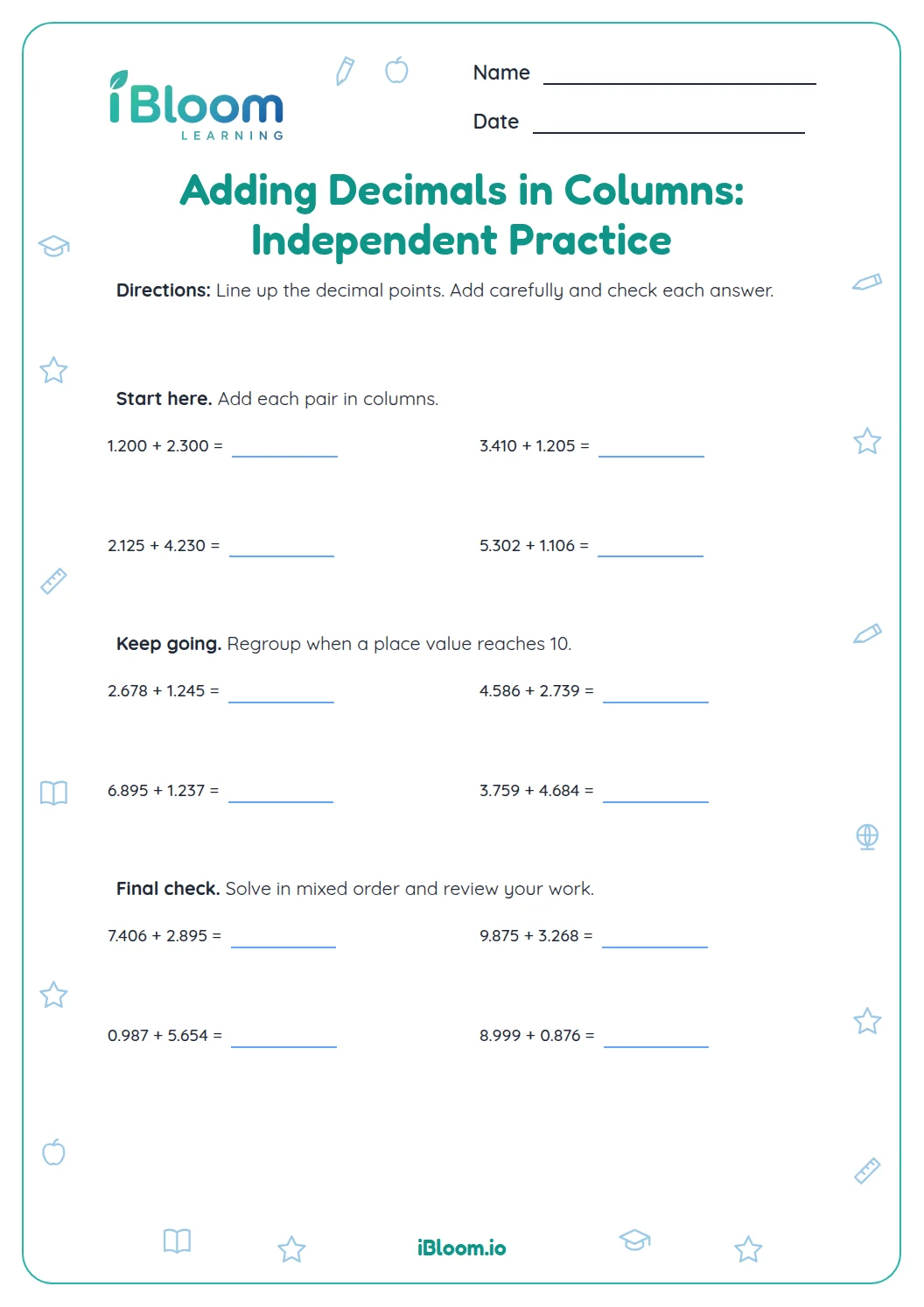
About this worksheet
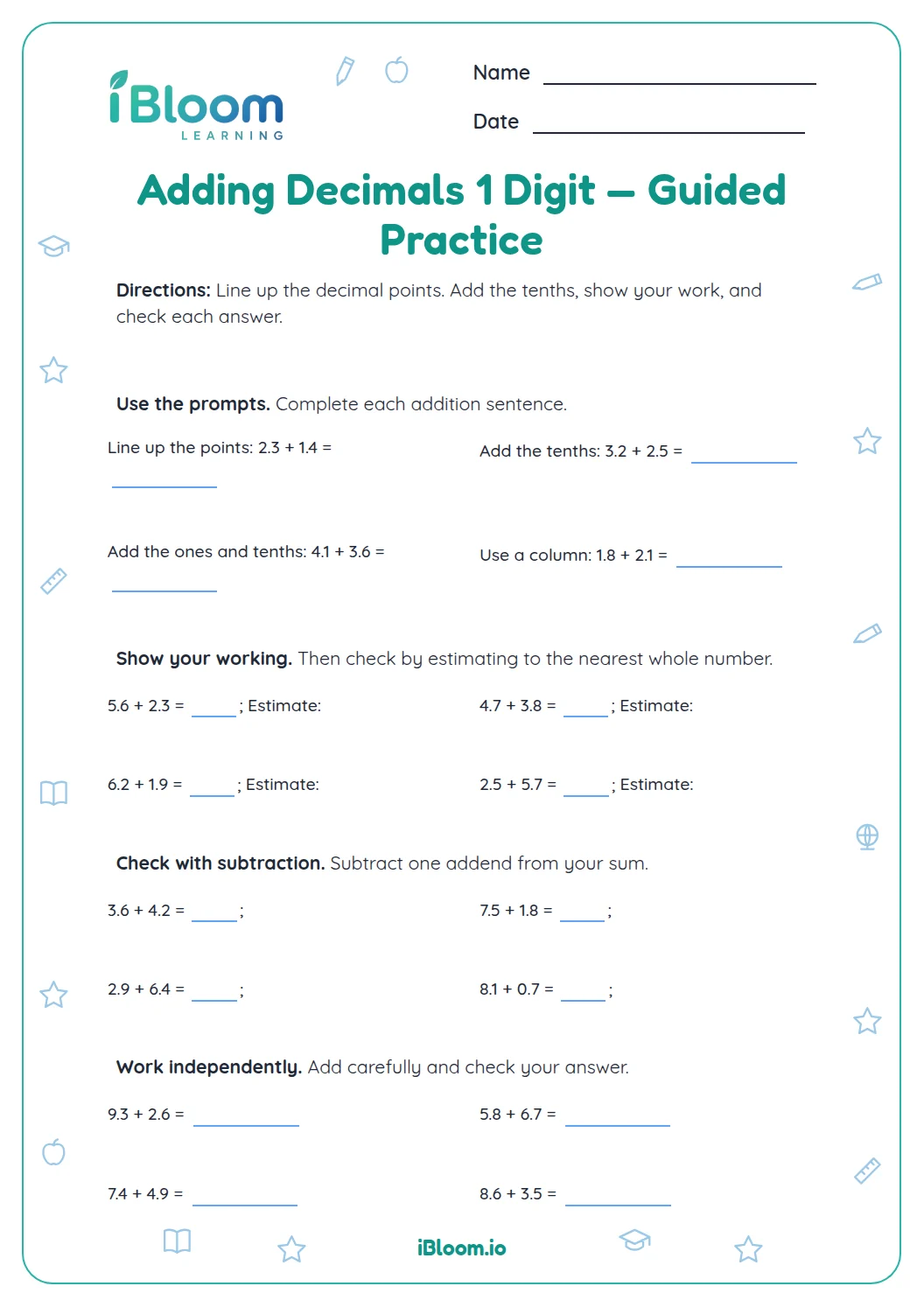
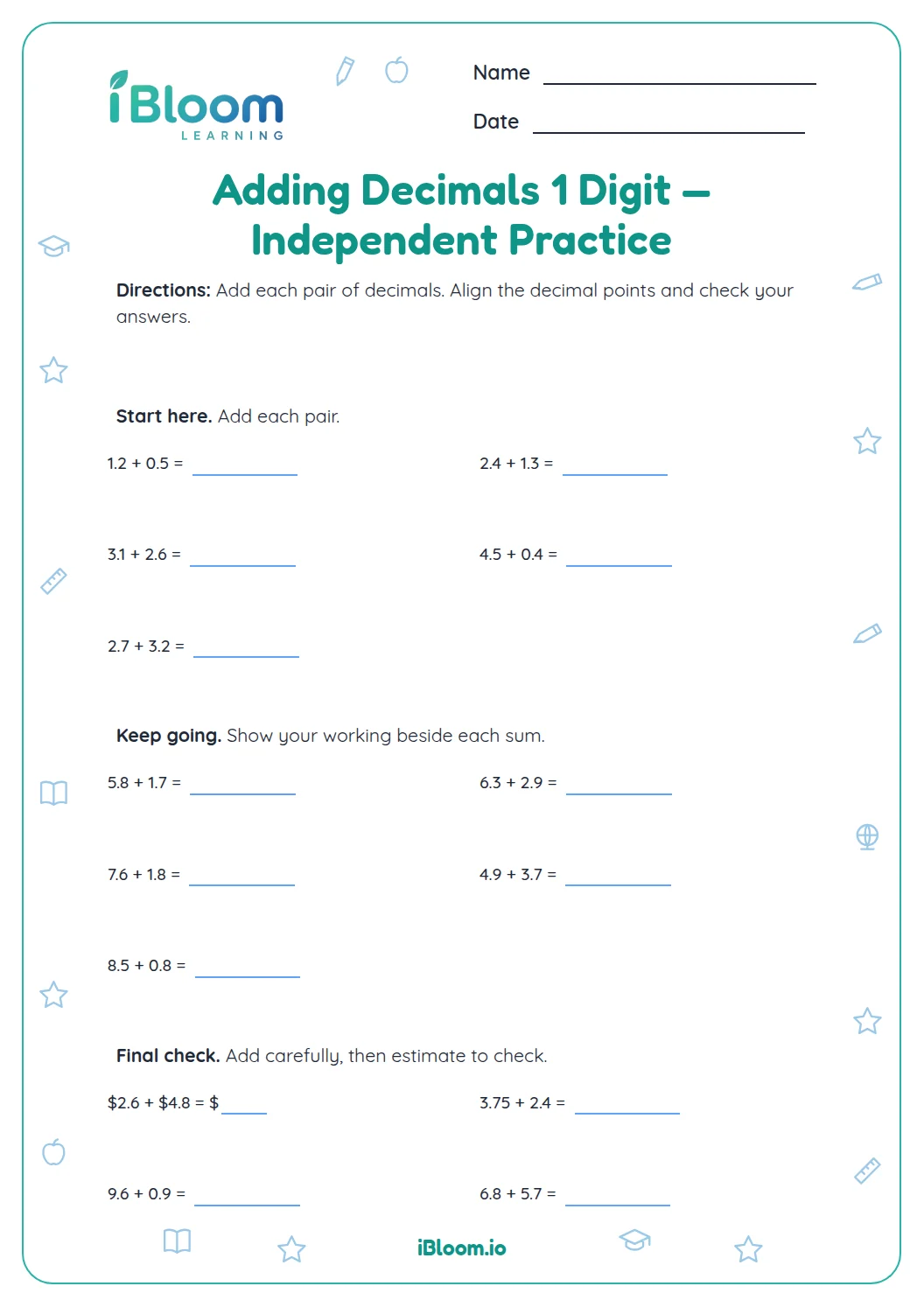
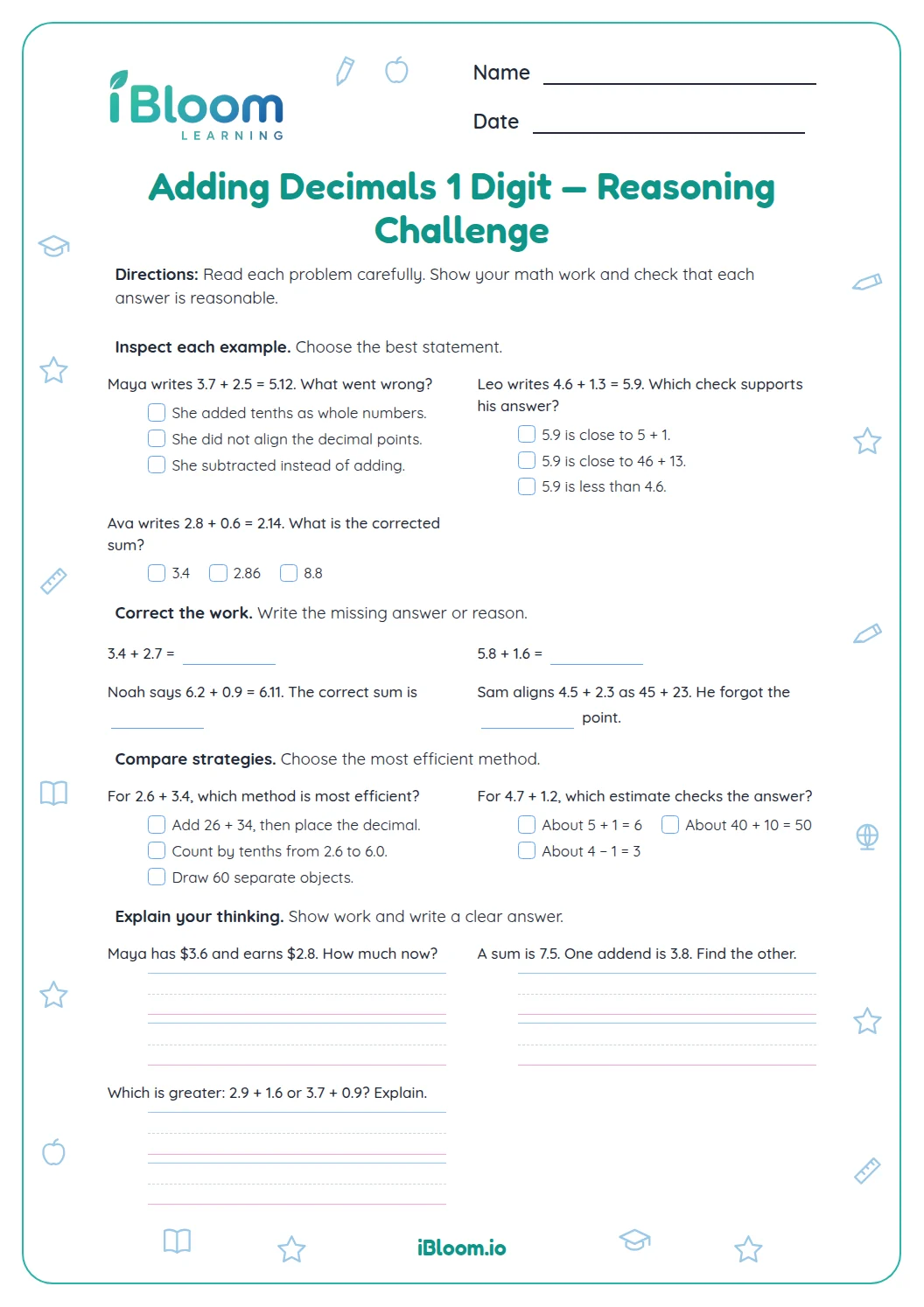
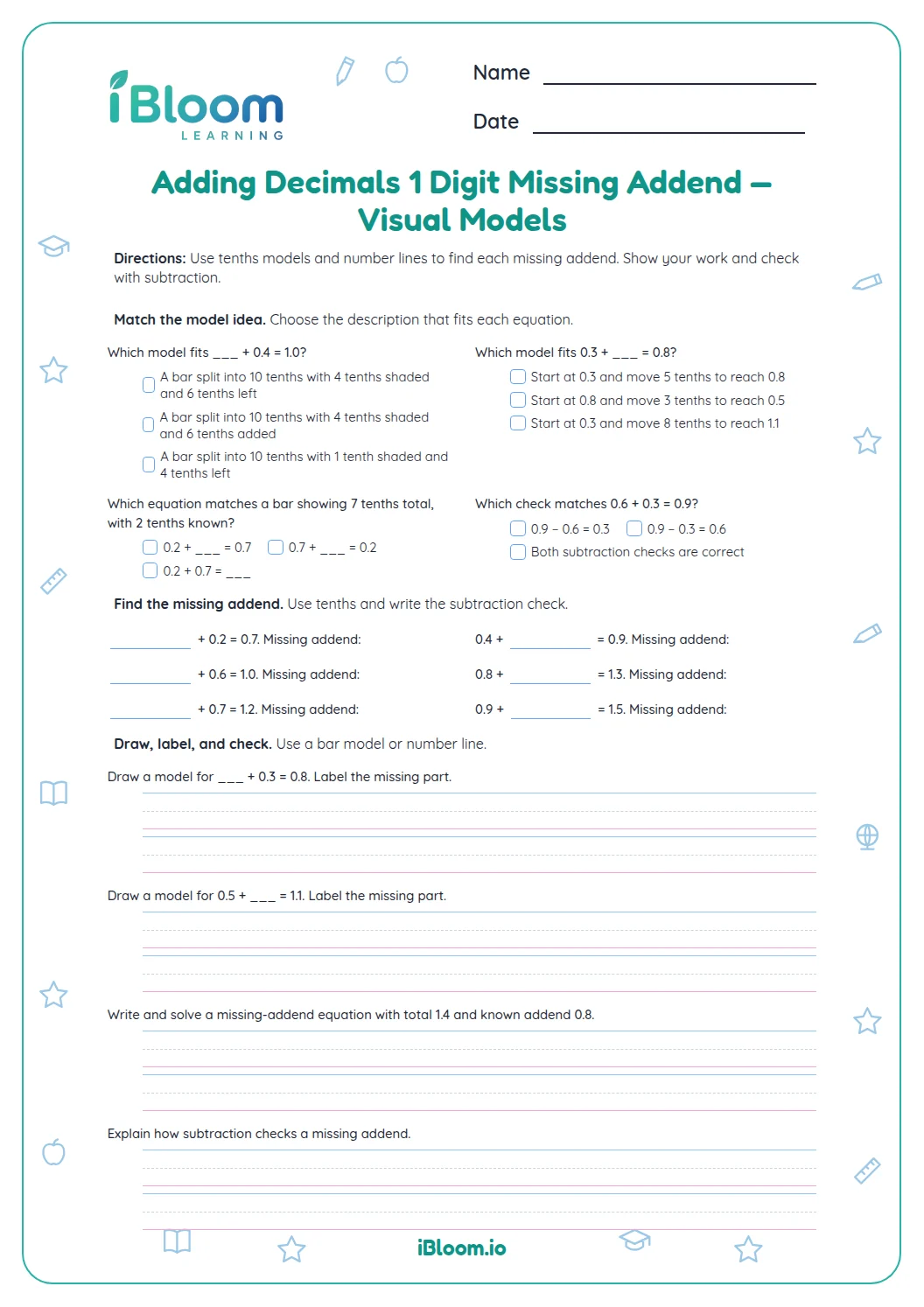
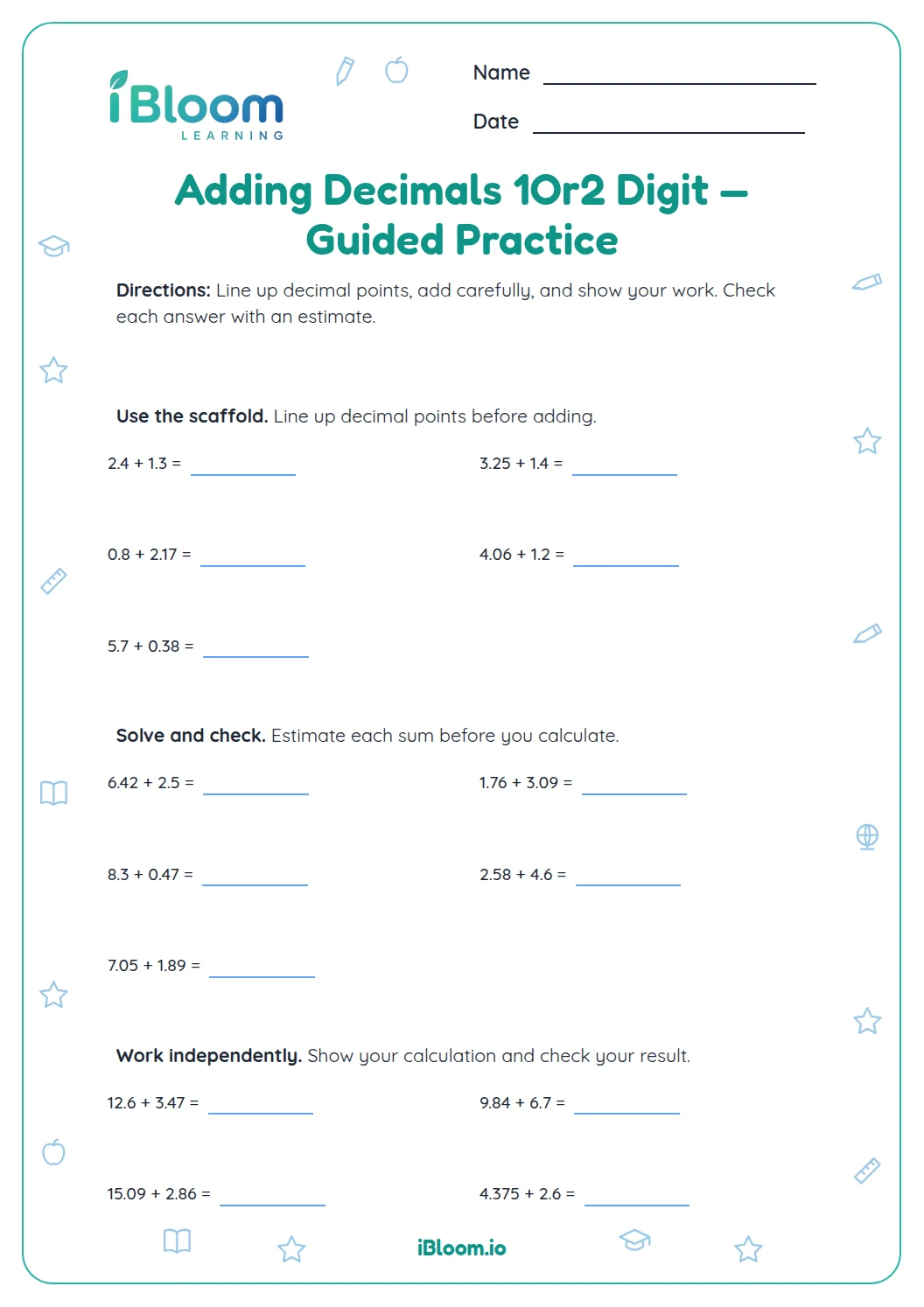
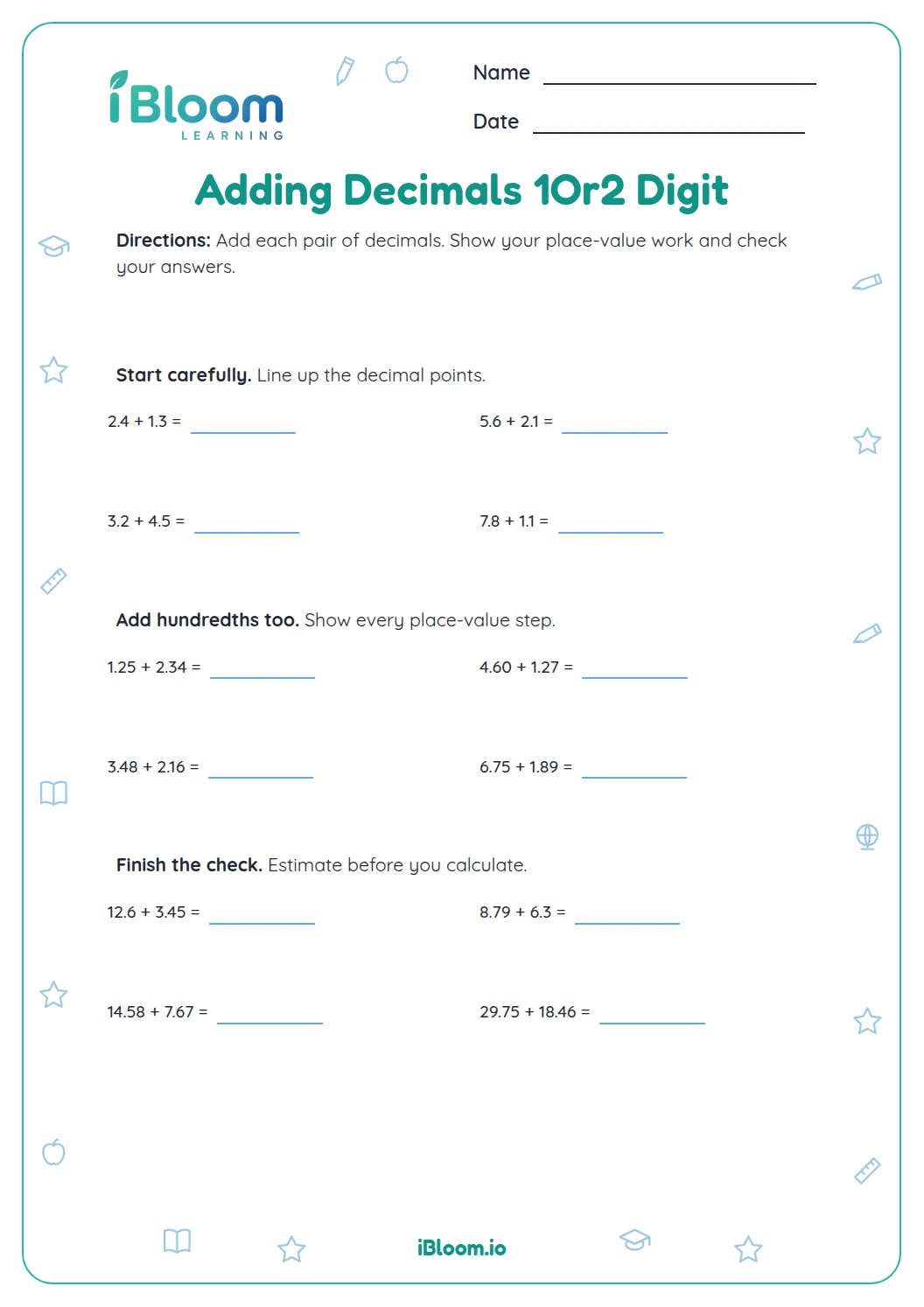
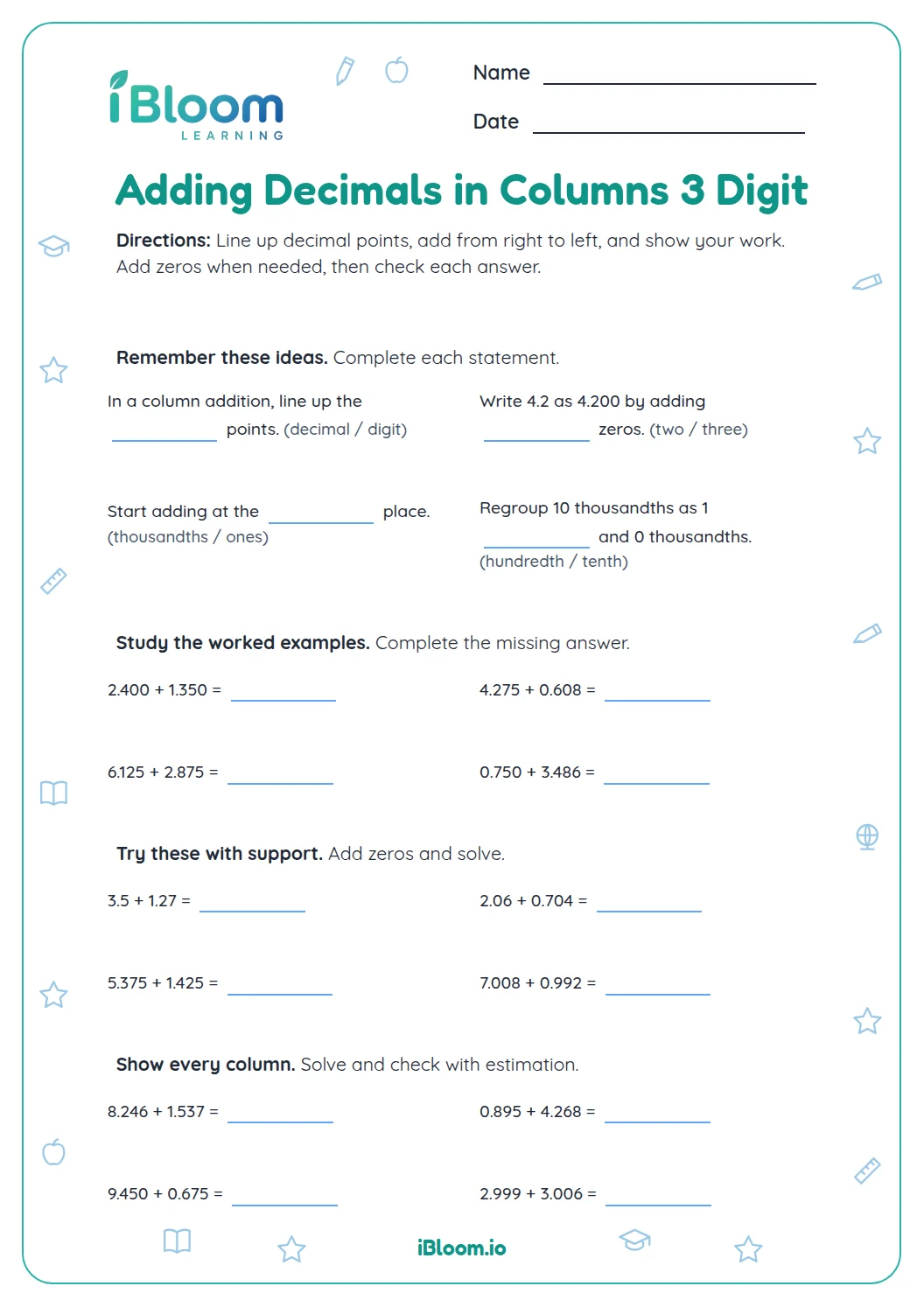
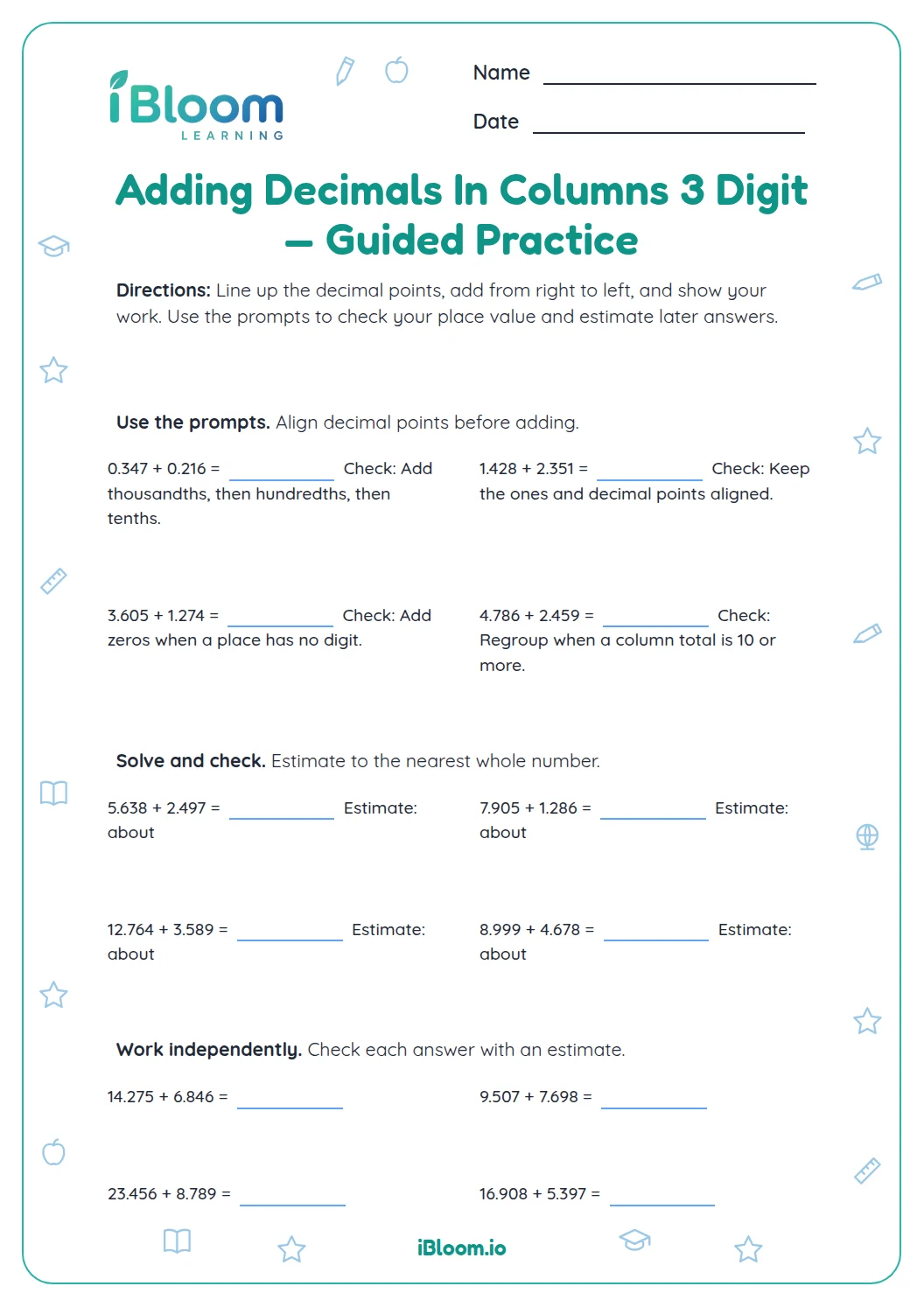
This free Grade 5 worksheet guides children through four steps for adding decimals with one digit after the decimal point: plan what to find, solve decimal sums, apply addition to short stories, and check totals with estimates. The 14 problems use money, distance, liquid, and other familiar quantities. A separate answer key lists answers for checking. The practice connects to Common Core 5.NBT.B.7.
Aligned to 5.NBT.B.7
How do you plan a decimal addition problem?
Identify the amounts and decide what total the question asks for. For question 1, the notebook and pen prices are the two amounts to combine.
How do you add tenths accurately?
Align decimal points so tenths share a column, then add each place value. In question 10, $2.6 + $1.4 = $4.0.
- 1$2.6 + $1.4
- 2$0.6 + $0.4 = $1.0
- 32 + 1 = 3
- 4Total: $4.0
How can an estimate check your sum?
Round each addend to a nearby whole number and compare that estimate with the exact total. For question 13, 3.8 + 2.1 is close to 4 + 2, or 6.
How to use this worksheet
- 1Read the story and identify the amounts.
- 2Decide which total or quantity the question asks for.
- 3Align decimal points and add matching place values.
- 4Write the unit that fits the amounts.
- 5Estimate the sum to check whether it is reasonable.
- 6Use the answer key to check each result.
Common mistakes and quick fixes
The mistake
Adding digits without lining up decimal points.
The fix
Put tenths in the same column before adding.
The mistake
Dropping a tenths digit from the answer.
The fix
Estimate the total and check that the decimal place is still present.
The mistake
Leaving off the unit in a measurement story.
The fix
Copy the unit from the amounts into the final answer.
Common Core alignment
The problems connect decimal addition strategies to written equations.
Add decimals by aligning place values and explaining the strategy.
On this sheet: These real-world problems add decimals to tenths and ask learners to show an equation and solution.
Show the official wordingHide the official wording
Add, subtract, multiply, and divide decimals to hundredths, using concrete models or drawings and strategies based on place value, properties of operations, and/or the relationship between addition and subtraction; relate the strategy to a written method and explain the reasoning used.
What to practice next
Make more practice
Further reading
Questions parents and teachers ask
What does one-digit decimal addition mean here?
Children first identify the amounts and what the question asks, then solve decimal sums, apply addition in short stories, and check totals with estimates. The four parts build from planning to checking, and the separate answer key lists the choices and calculated totals.
How many word problems are included?
The printable has 14 questions: four planning choices, five decimal sums, three application stories, and two estimate checks. A separate key gives the correct choices and totals. The sequence lets children identify what to find, calculate, apply, and check.
Should children line up decimal points?
Yes. Lining up decimal points places tenths under tenths and ones under ones. A child can then add each place and write the decimal point in the same column. An equation such as 2.4 + 1.3 keeps both amounts visible while the child combines matching place values.
What is the answer to the notebook and pen problem?
For question 10, the snack and drink cost $2.6 and $1.4. Their total is $4.0. The answer key keeps the same tenths format as the prices; this is equivalent to $4.00. An estimate of about $4 also checks that the sum is reasonable.
Why do the problems include different units?
Different settings help children recognize decimal addition in everyday measurements and money. The operation is still addition, and the unit in the answer should match the quantities being combined. For example, add the miles to miles and liters to liters so the total keeps the correct unit.
How can my child check a decimal sum?
Estimate first, then add by place value. For question 13, 3.8 + 2.1 is close to 4 + 2, or 6, so 5.9 is reasonable. The worksheet includes two multiple-choice estimate checks, and the key shows which estimate best matches each exact sum.