




About this worksheet
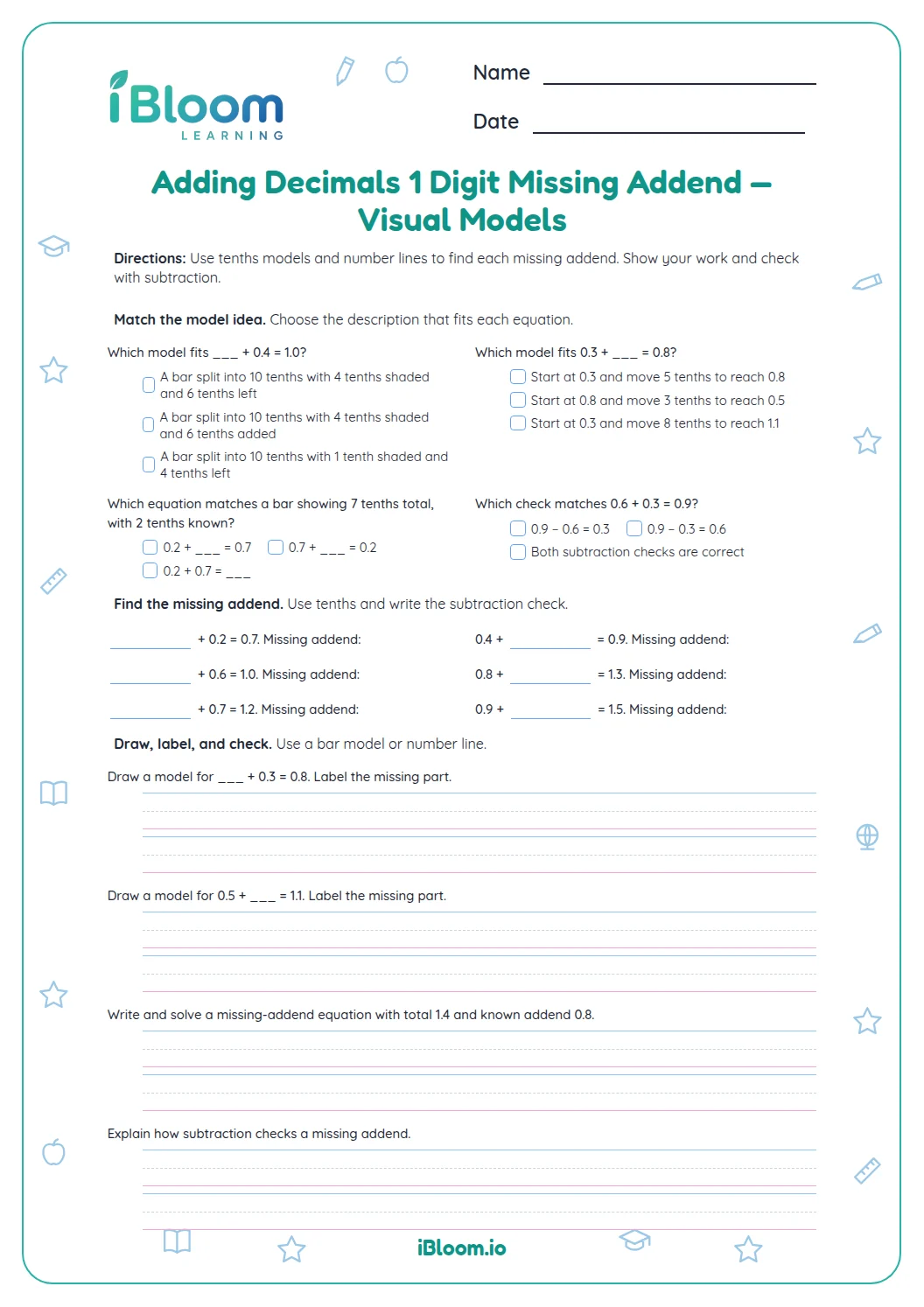
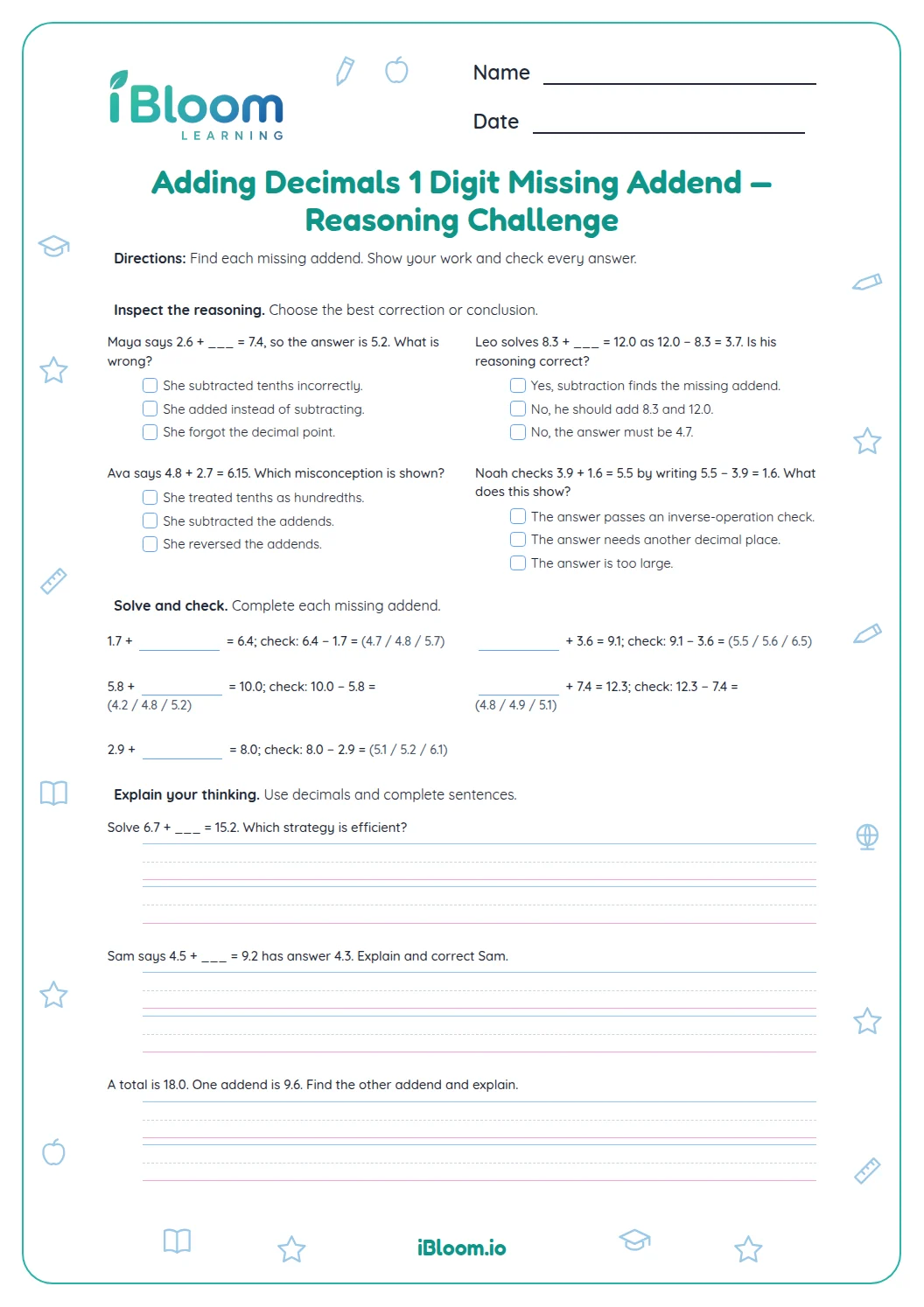
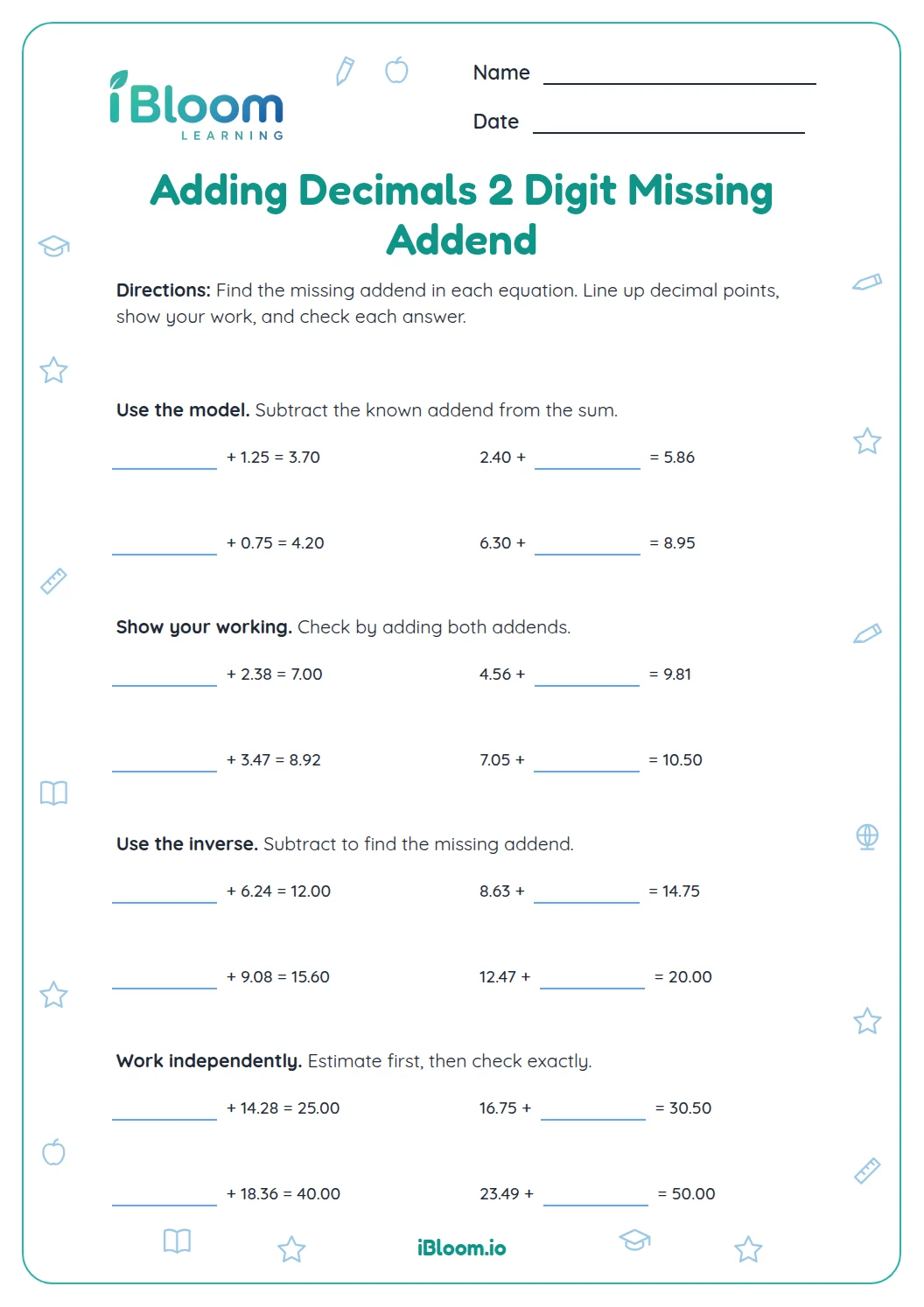
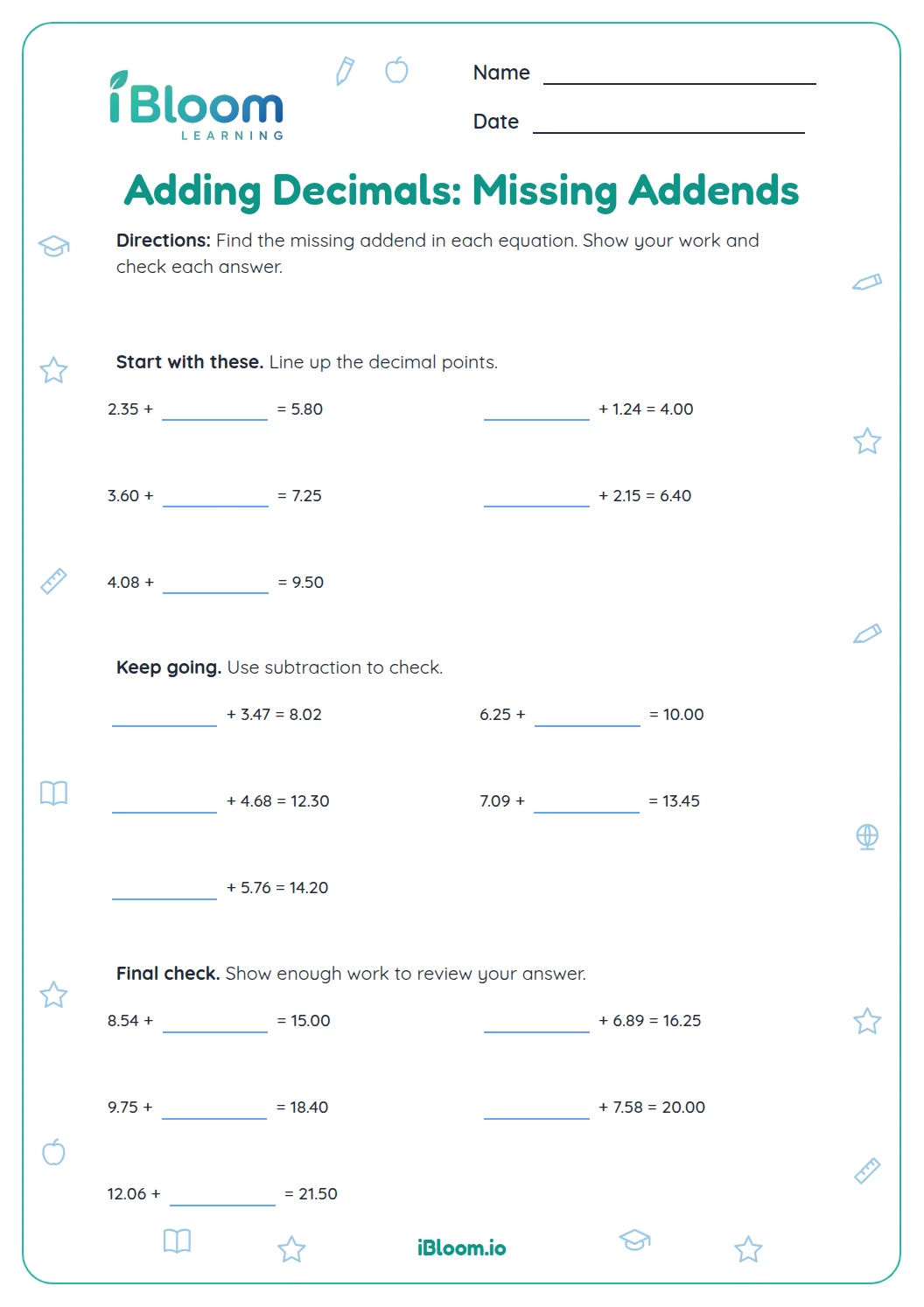
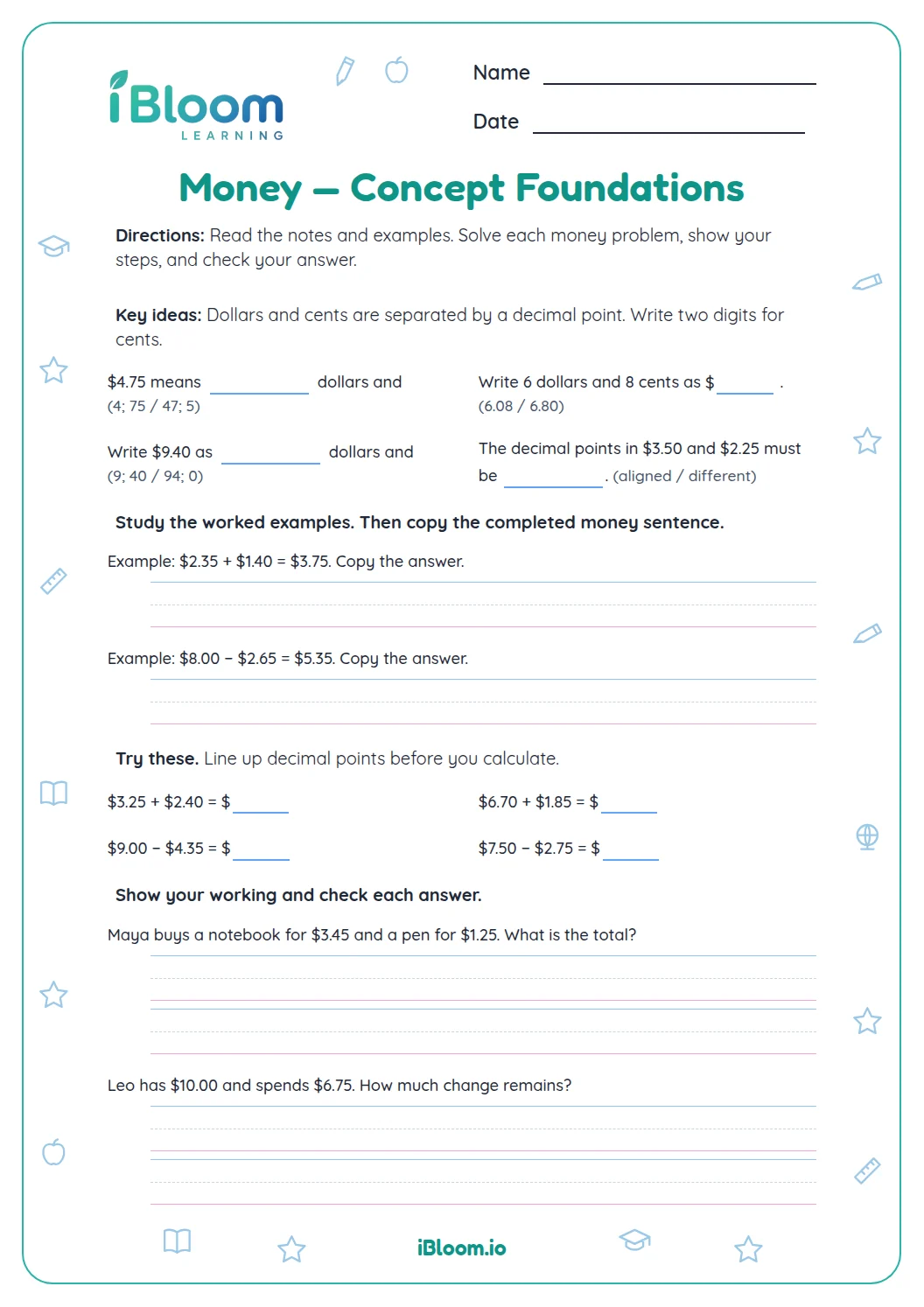
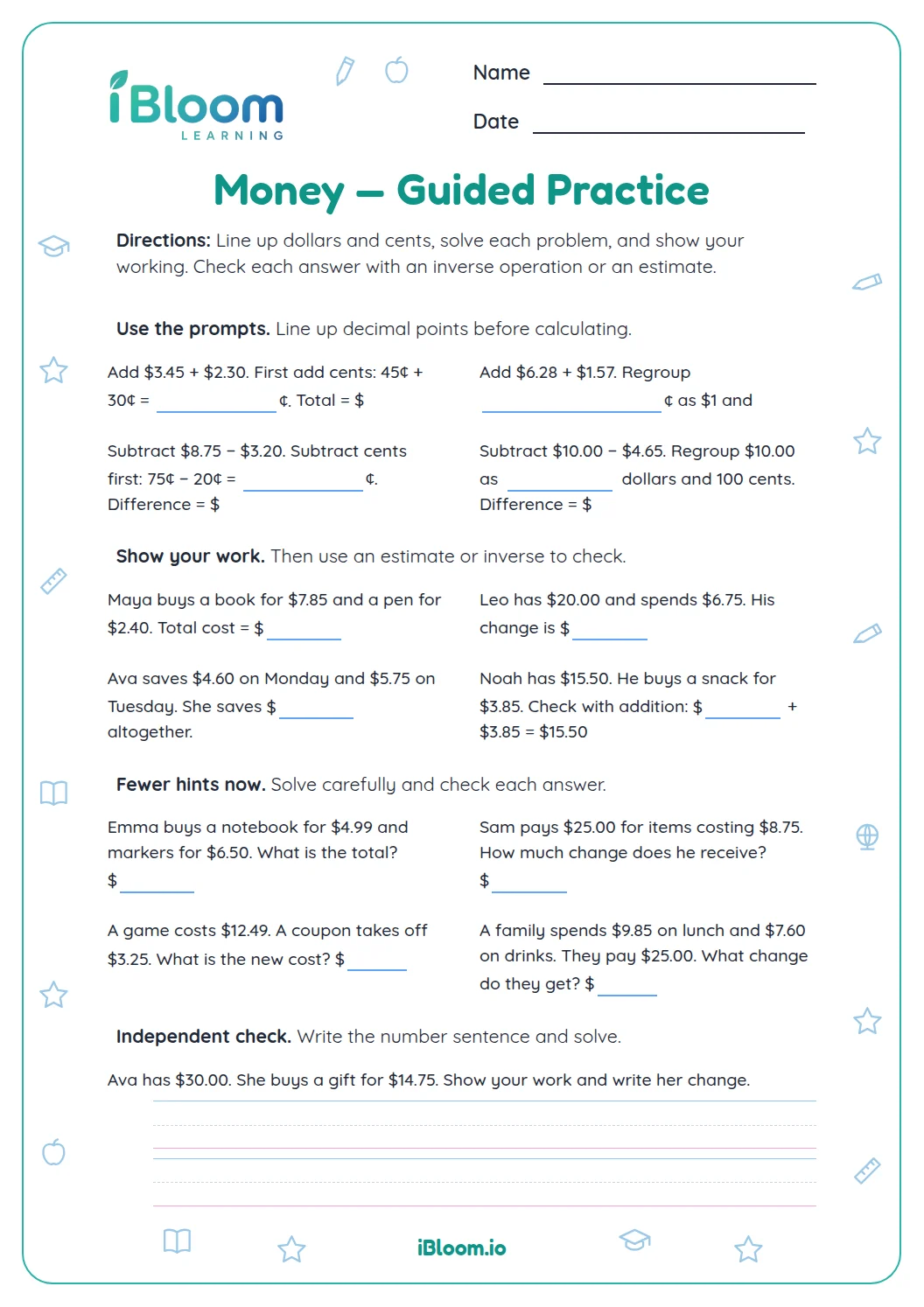
This Grade 5 printable gives students 16 missing-addend equations with tenths and four short situations. Students subtract the known addend from the total, then check by adding. The included key lists all 20 answers.
Aligned to 5.NBT.B.7
What decimal skills are practiced?
All 20 questions ask for a missing addend in tenths. Sixteen are number sentences and four apply the same reasoning in short situations. The blank appears in different places, so students identify the total and known part before subtracting.
- Read the full equation before calculating.
- Align the decimal points.
- Check the result by addition.
How can subtraction reveal the missing addend?
Addition and subtraction undo one another. If a known amount plus an unknown amount makes a total, subtract the known amount from the total to find the unknown. Keep place values aligned so tenths and hundredths stay in their columns.
- 12.4 + ___ = 5.8
- 25.8 − 2.4 = 3.4
- 3Check: 2.4 + 3.4 = 5.8
How do you check a decimal sum?
Put the missing addend back into the original equation. Add from right to left by place value, and write a zero as a placeholder if useful. In 4.25 + 3.55, the hundredths combine to 10 hundredths, which is one tenth.
How to use this worksheet
- 1Circle the total in each equation.
- 2Identify the addend that is already given.
- 3Subtract that addend from the total.
- 4Write the decimal point in the correct place.
- 5Add your answer back to check.
Common mistakes and quick fixes
The mistake
Subtracting the total from the known addend.
The fix
Use total minus known addend to find the missing part.
The mistake
Misaligning decimal places.
The fix
Line up decimal points and add placeholder zeros if needed.
The mistake
Writing a decimal point by counting digits only.
The fix
Use the place-value columns and verify by addition.
Common Core alignment
These standards describe the language and number skills practiced on this page.
Add and subtract decimals to hundredths using place-value reasoning.
On this sheet: Students find a missing decimal addend and check it by addition.
Show the official wordingHide the official wording
Add, subtract, multiply, and divide decimals to hundredths, using concrete models or drawings and strategies based on place value, properties of operations, and/or the relationship between addition and subtraction; relate the strategy to a written method and explain the reasoning used.
What to practice next
Further reading
Questions parents and teachers ask
How many equations are on the worksheet?
There are 20 questions across the worksheet pages. Sixteen are number sentences using tenths, and four put the same kind of equation in a short context. The blank appears in different places, and the answer key lists each missing addend.
Why do I subtract to find a missing addend?
Subtraction reverses addition. If one addend and the total are known, subtract the known addend from the total to find the missing amount. For example, 5.8 − 2.4 gives 3.4, and adding 2.4 + 3.4 checks the result.
Should decimal points line up?
Yes. Lining up decimal points places tenths under tenths. Students can add a zero as a placeholder when useful, such as writing 5.8 as 5.80. That makes subtraction easier to organize while preserving the value of the number.
Why are some answers written with a trailing zero?
A trailing zero can show the place value being used without changing the number. For example, 8.0 and 8 are equal, but writing 8.0 can make the tenths column clear while checking an equation with tenths. It also helps keep work aligned in columns.
What does the answer key include?
The answer key provides the missing decimal for every equation and contextual problem. Students can check by substituting the value into the original addition sentence and confirming that the two addends make the printed sum. The word problems also include the appropriate unit.