




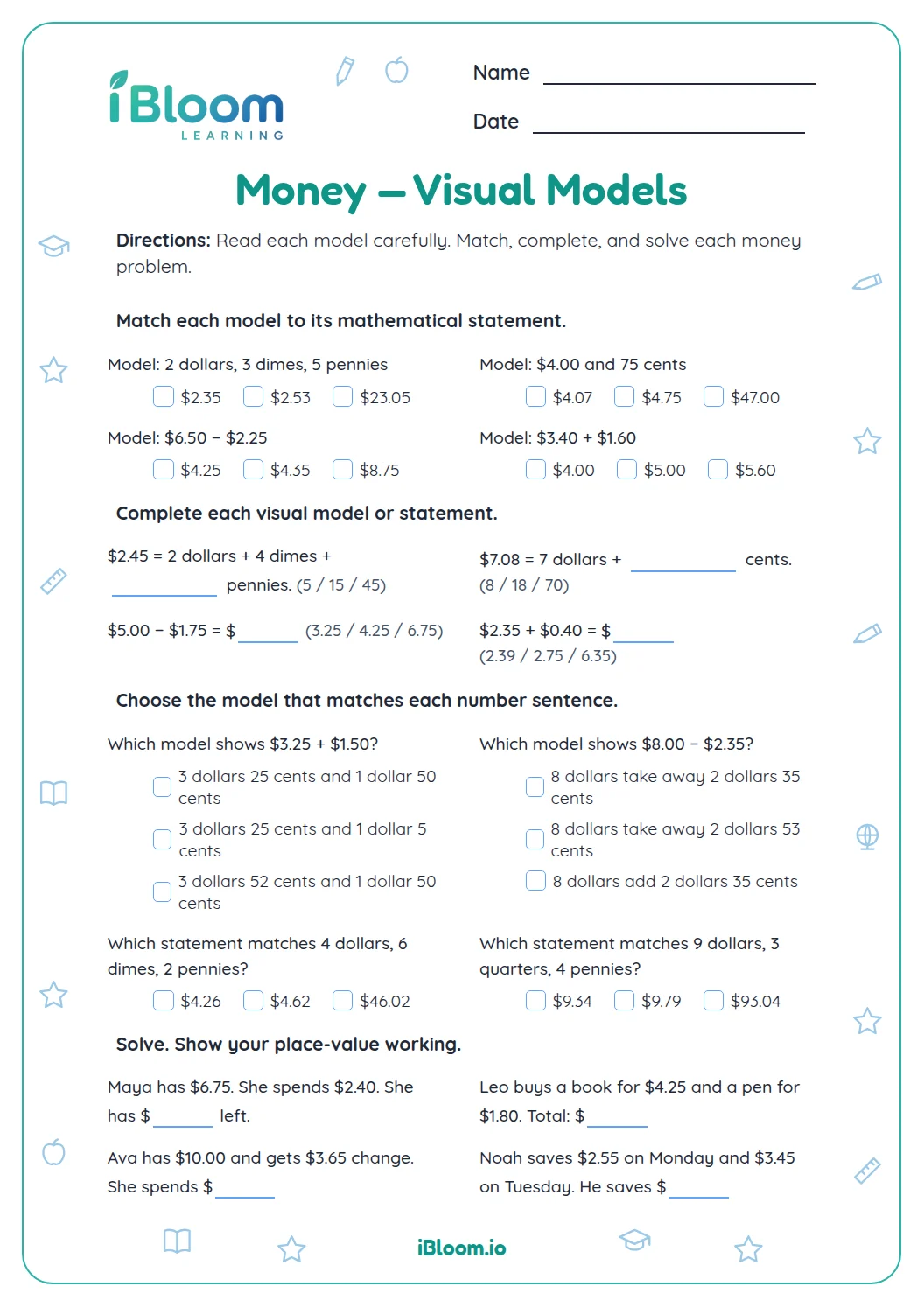
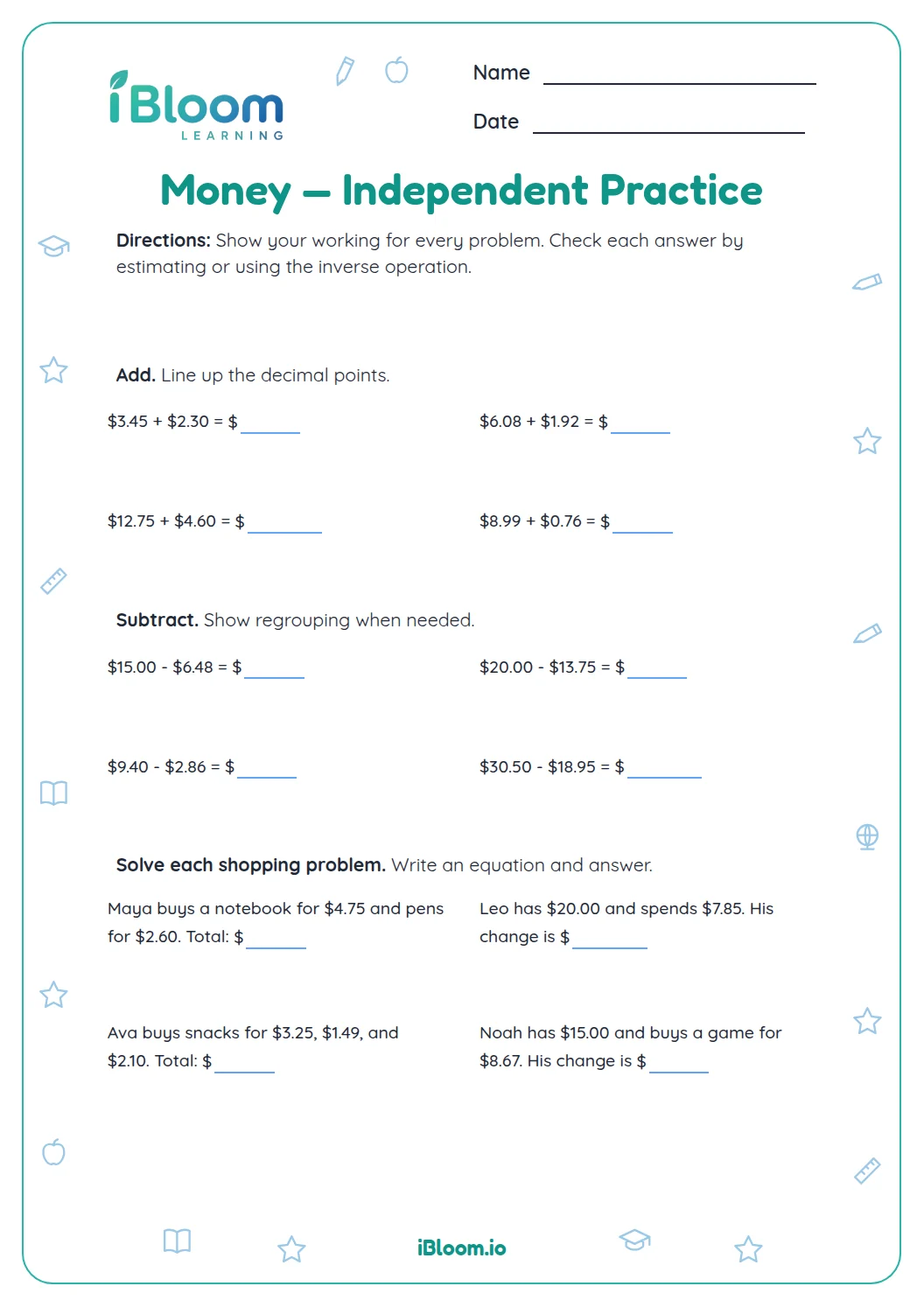
About this worksheet
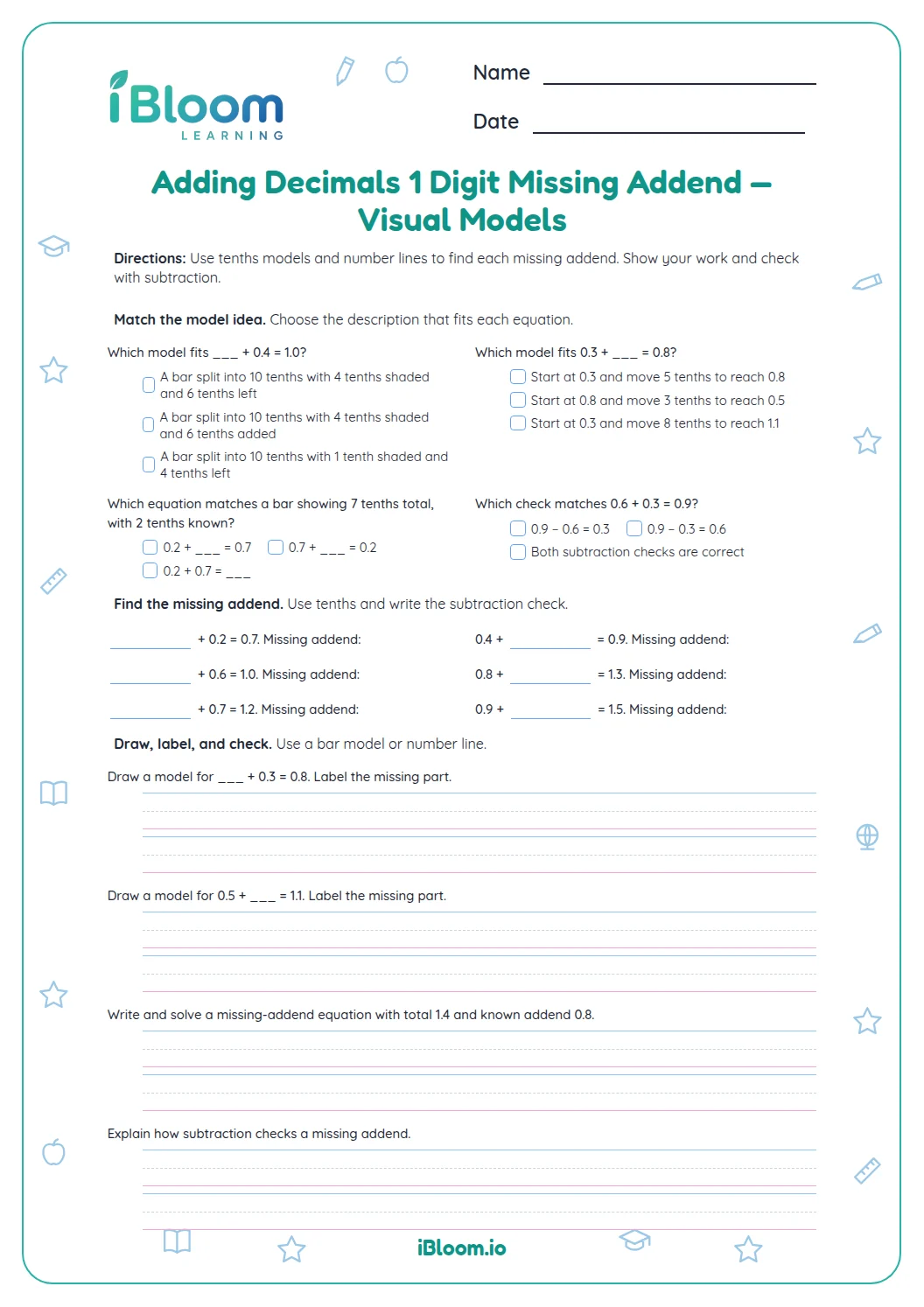
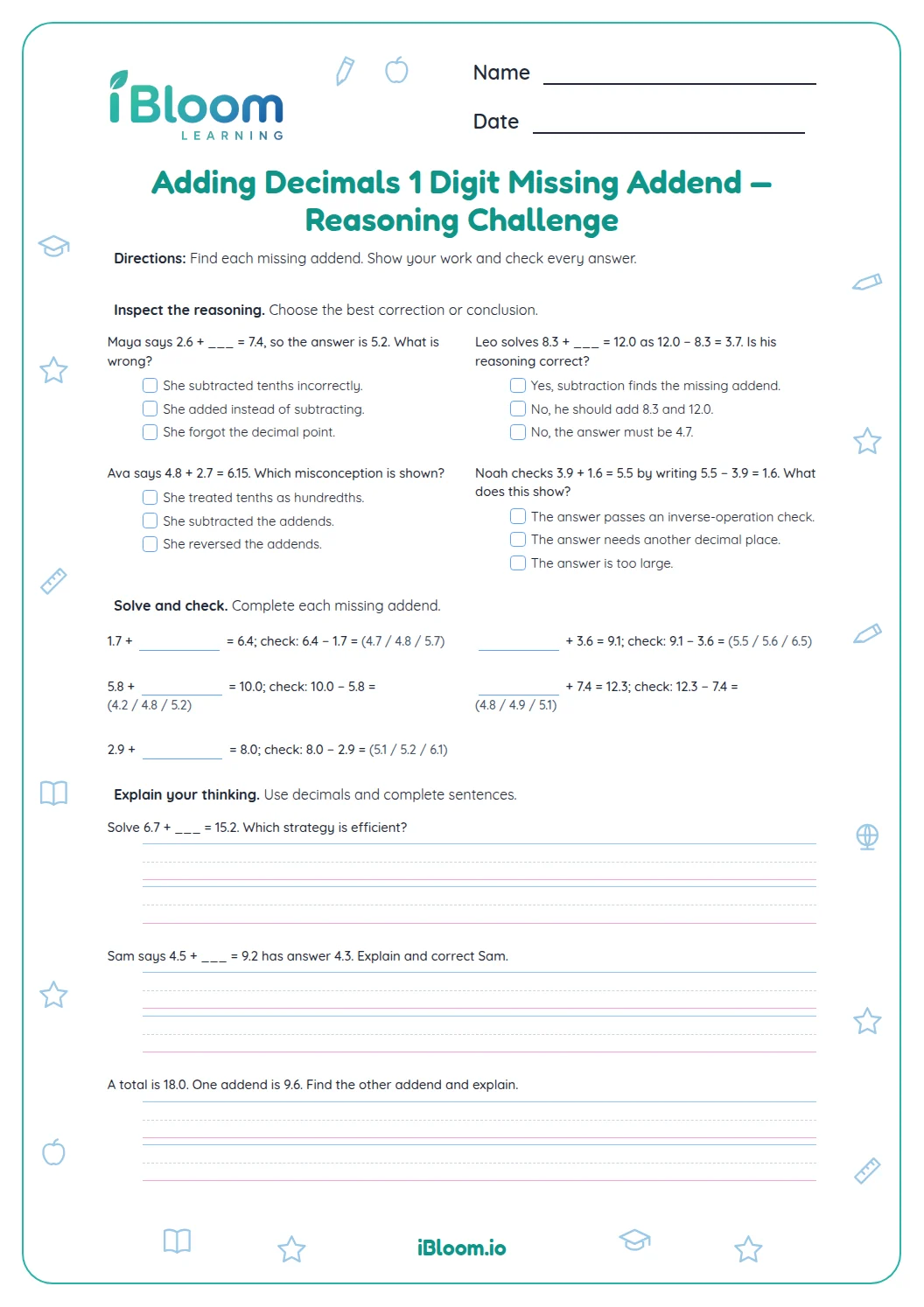
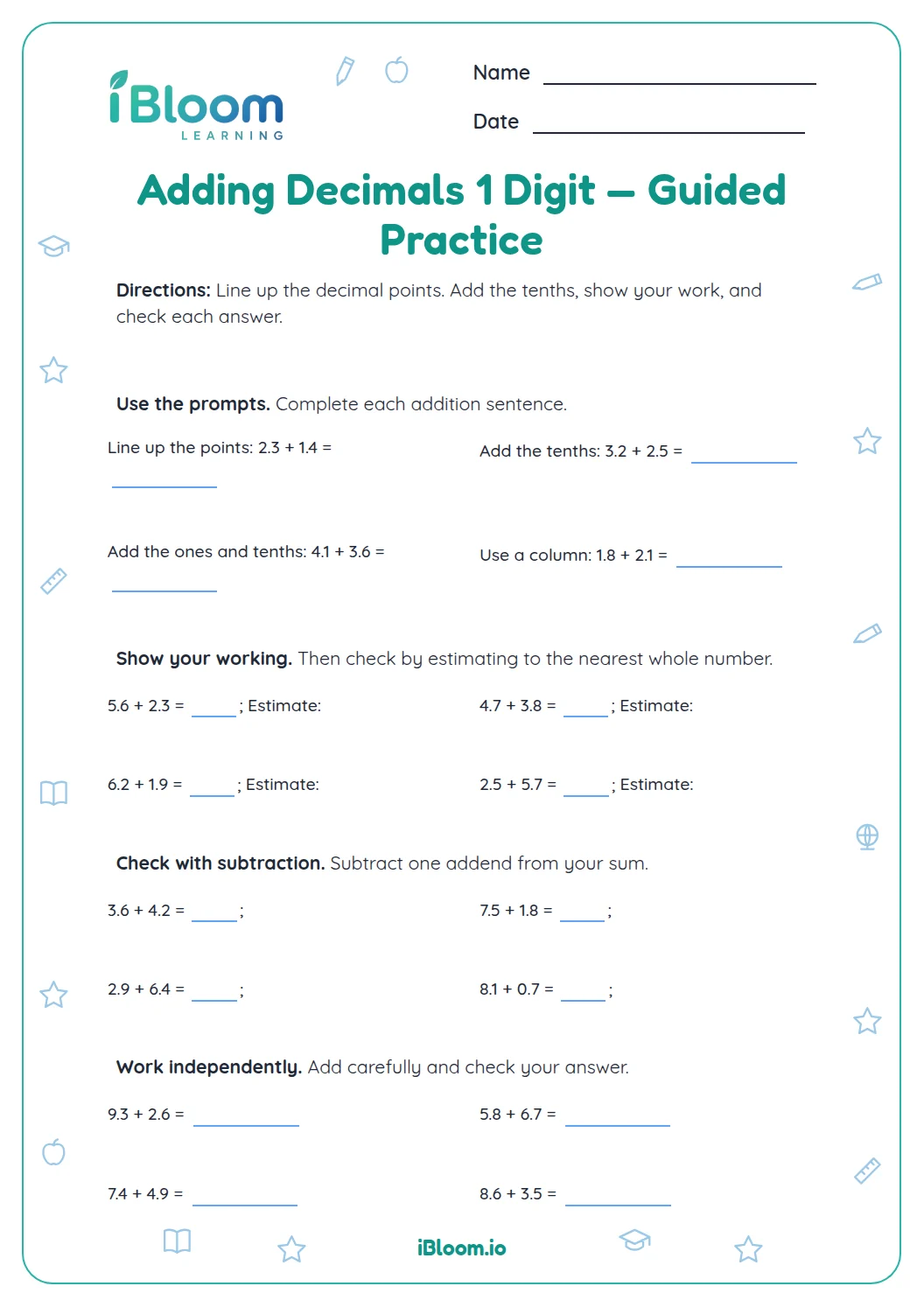
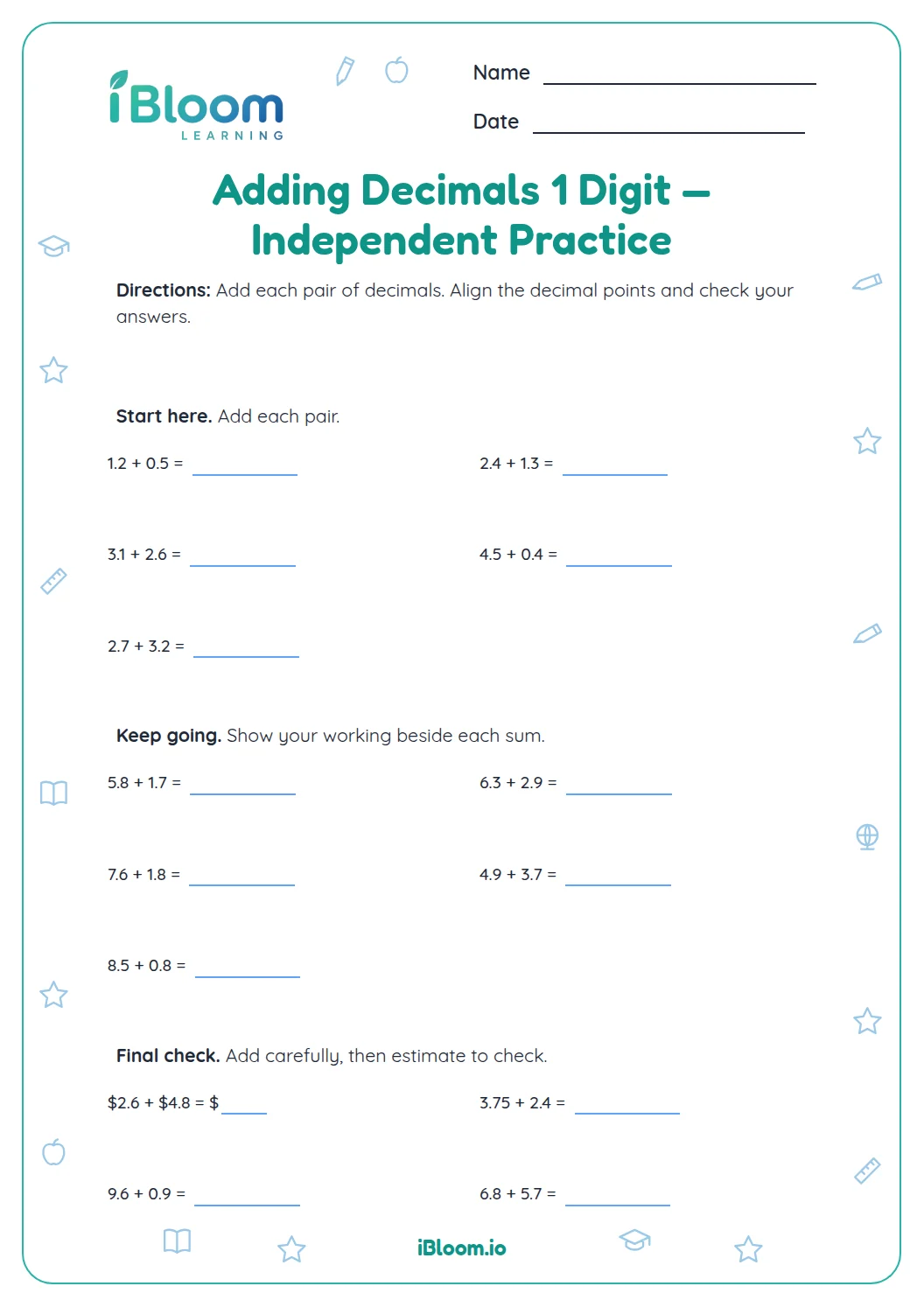
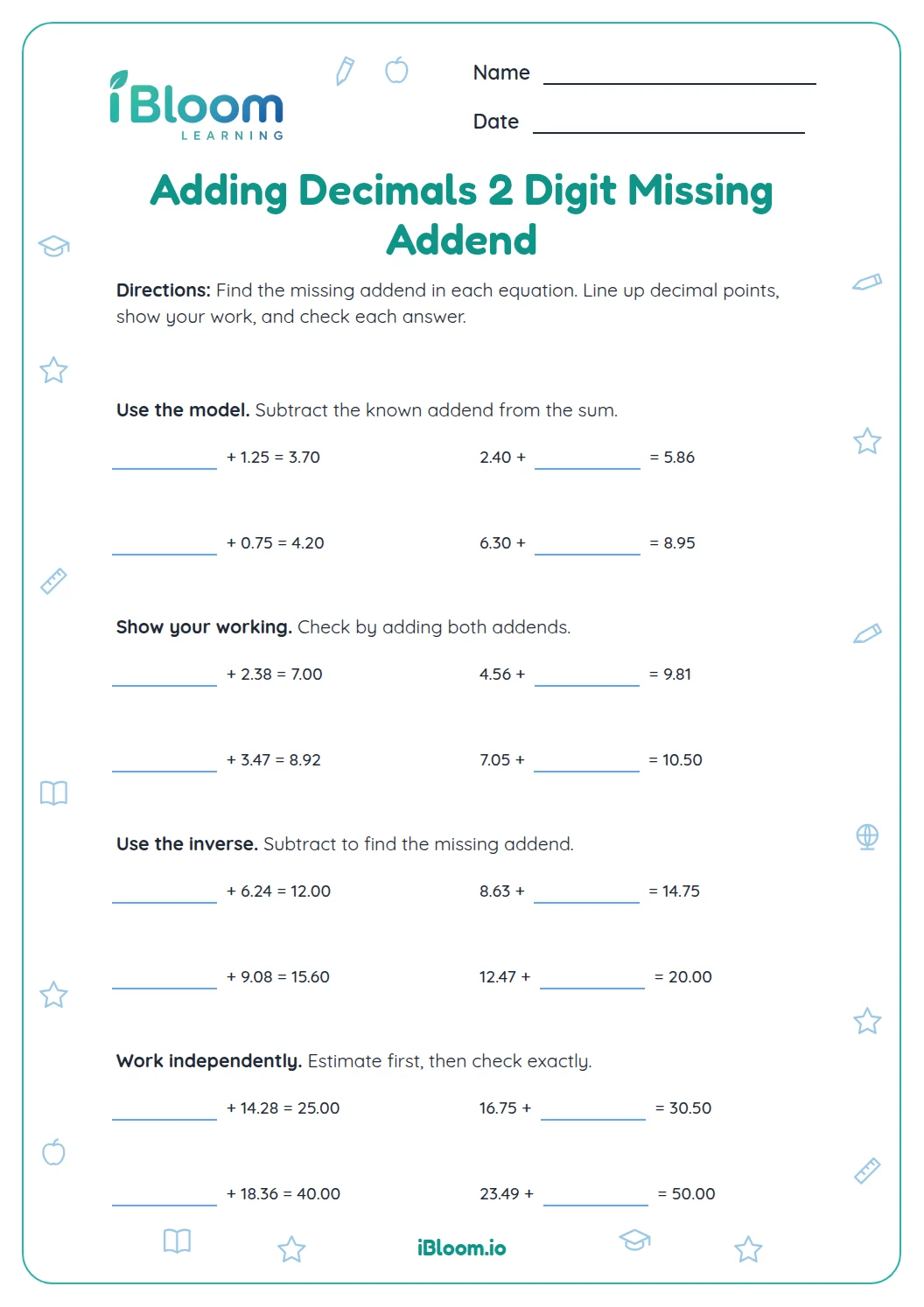
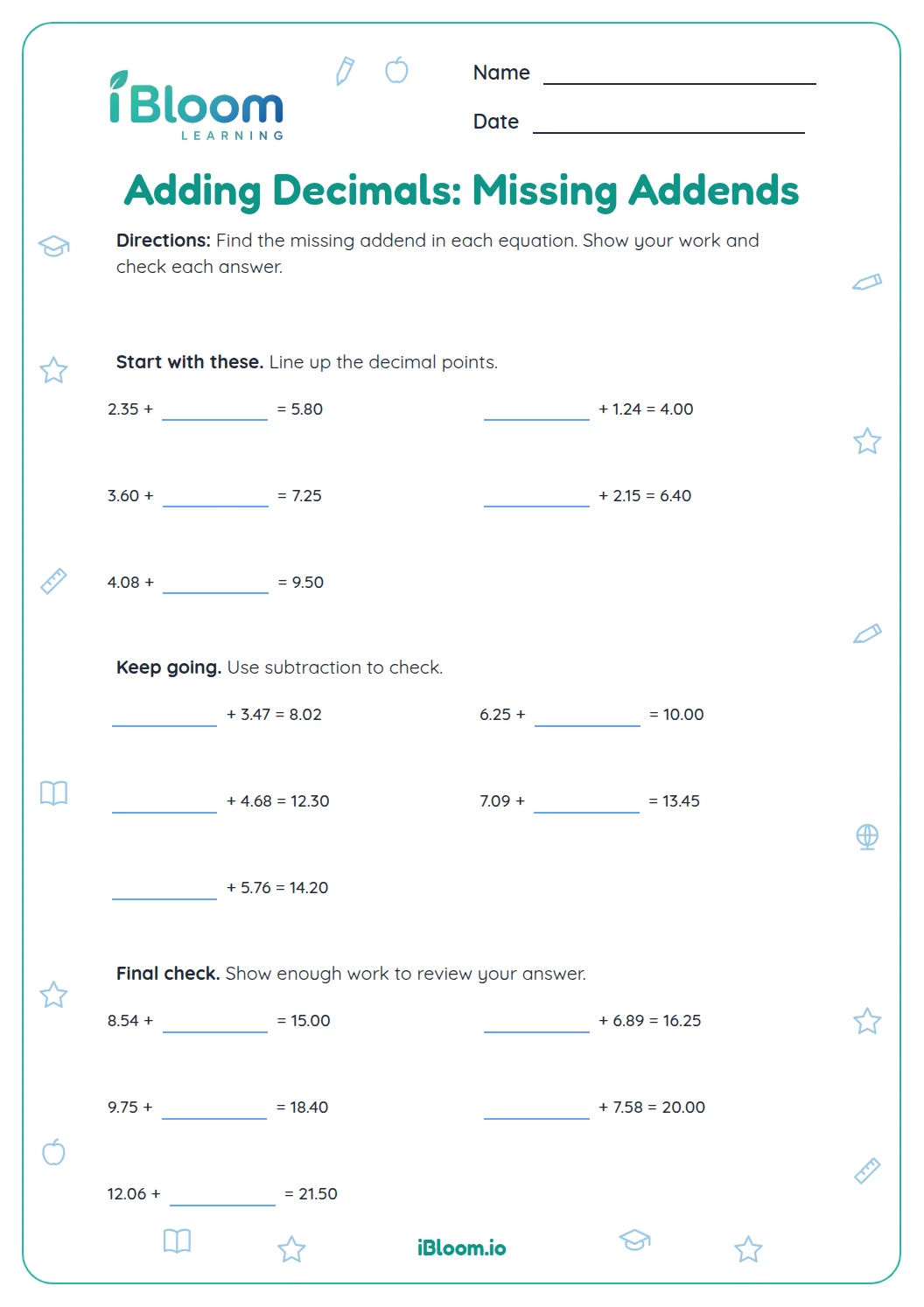
This Grade 5 worksheet focuses on addition problems with one-decimal-place missing addends. Children read situations involving miles, money, liters, pages, and other quantities, write the missing amount, and use subtraction to check the total. It contains 14 questions on two worksheet pages plus a separate two-page key. The decimal addition and subtraction work aligns with CCSS.Math.Content.5.NBT.B.7.
Aligned to CCSS.Math.Content.5.NBT.B.7
How do you find a missing addend?
When two amounts make a total, subtract the known amount from the total to find the missing amount. In question 1, 5.7 − 2.4 = 3.3, so the second walk was 3.3 miles.
- 12.4 + ___ = 5.7 miles
- 25.7 − 2.4 = 3.3
- 3Answer: 3.3 miles
How do you subtract decimal amounts?
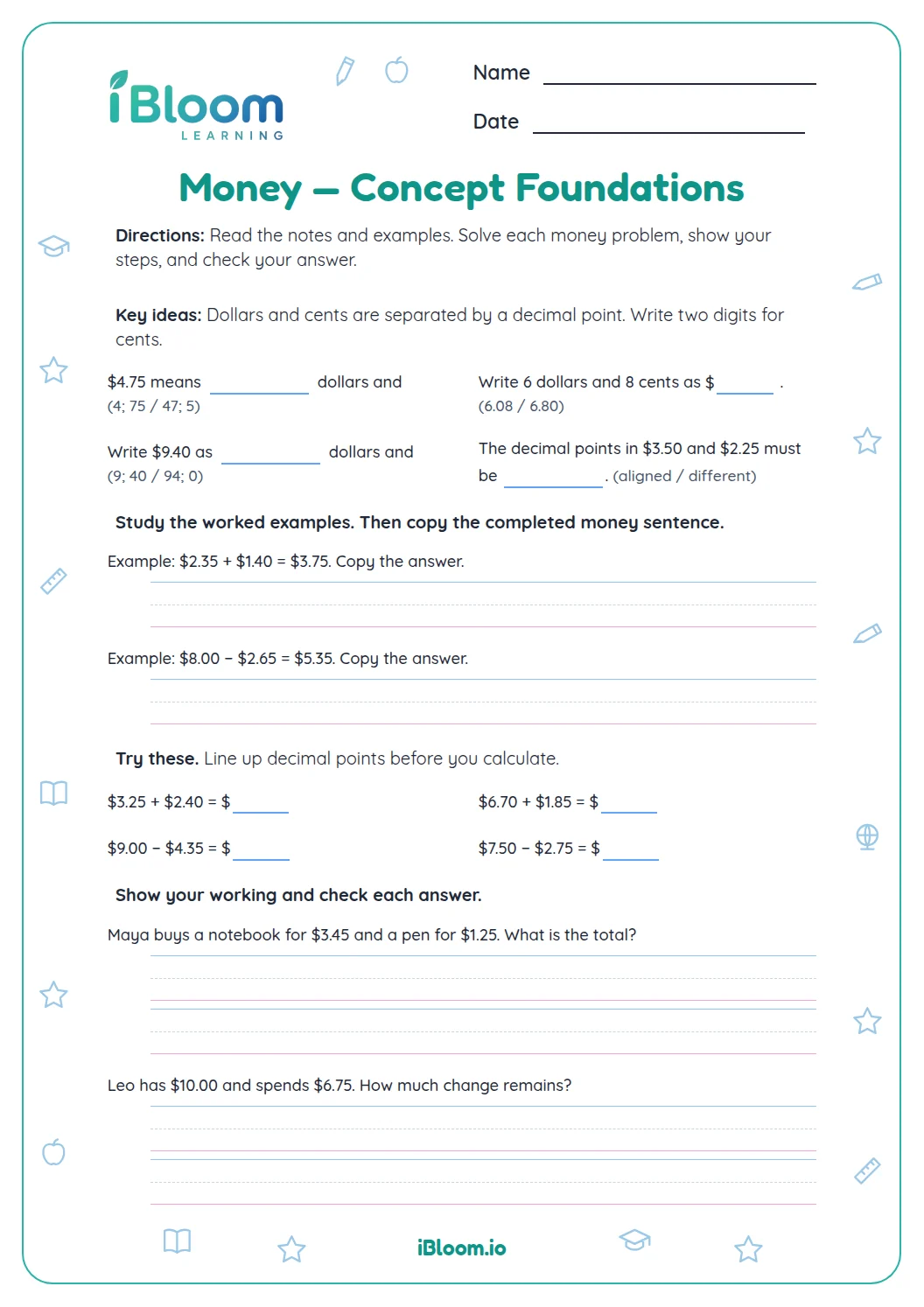
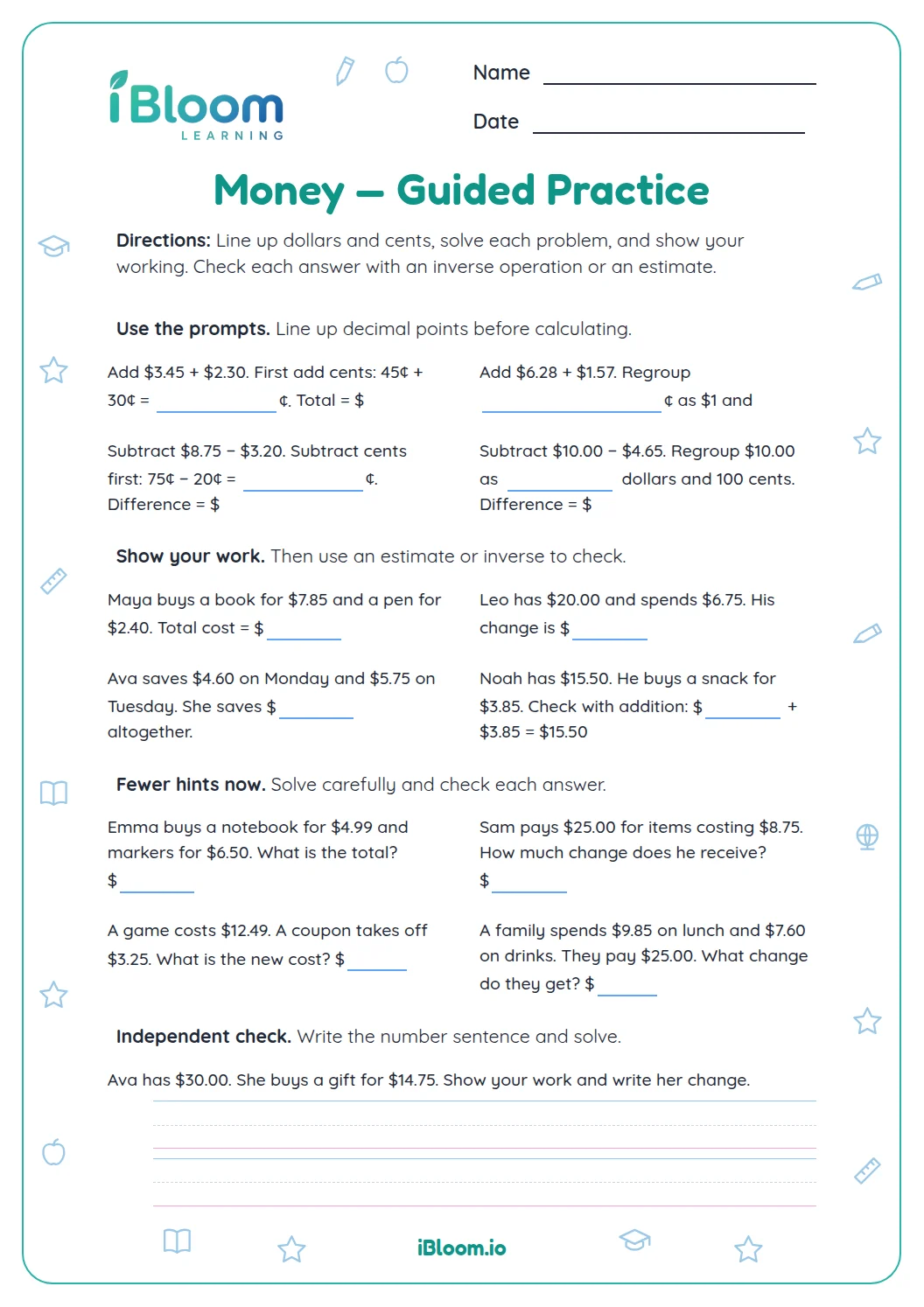
Line up the decimal points so tenths are in the same column. Subtract the known amount from the total, then write the unit requested in the story. Question 2 uses dollars and cents: $9.00 − $4.60 = $4.40.
What situations do the questions use?
The 14 items use totals for money, distance, volume, length, pages, a score, and a recipe. Each problem has one known addend and one total.
- Part A: complete missing-addend equations in context
- Part B: solve and label each missing amount
- Part C: use the inverse check and consider whether the result fits
How can you check the answer?
Add the known amount and your missing amount. The sum should equal the stated total. For example, 2.4 + 3.3 = 5.7, so the answer checks. Keep the unit consistent with the situation.
How to use this worksheet
- 1Read the directions together and name the skill in your own words.
- 2Complete the first few items slowly, explaining each choice.
- 3Work through the remaining questions independently or in a small group.
- 4Use the answer key to check each response and discuss any mismatch.
- 5Return to missed items and solve them again with the key covered.
Common mistakes and quick fixes
The mistake
Subtracting the total from the known amount.
The fix
Use total minus known addend, such as 5.7 − 2.4.
The mistake
Misaligning tenths and ones.
The fix
Write decimal points in one vertical line before subtracting.
The mistake
Giving a number without the requested unit.
The fix
Reread the question and label the answer in miles, dollars, cups, or the unit provided.
Common Core alignment
This page connects the practice activities to the following Common Core standard.
Find missing decimal addends by using subtraction and addition.
On this sheet:
Show the official wordingHide the official wording
Add, subtract, multiply, and divide decimals to hundredths, using concrete models or drawings and strategies based on place value, properties of operations, and/or the relationship between addition and subtraction; relate the strategy to a written method and explain the reasoning used.
What to practice next
Make more practice
Further reading
Questions parents and teachers ask
What does “missing addend” mean?
An addend is a number being added. A missing-addend problem gives a known amount and a total, then asks what amount completes the sum. For example, 2.4 + ___ = 5.7 is solved by subtracting 2.4 from 5.7 to get 3.3.
How many problems are included?
There are 14 real-world decimal problems across two worksheet pages, followed by a separate two-page answer key. Contexts include money, distance, volume, length, pages, points, and a recipe. Each question asks for one missing addend. Each question has one known addend and one total, so learners solve for the amount that completes the sum.
Why does the sheet ask for subtraction?
Subtraction reverses addition. If a known amount plus an unknown amount equals a total, subtract the known amount from the total. Then add the result to the known amount to confirm that it reaches the total. This check confirms that the missing amount and known amount make the original total.
How should a child line up decimals?
Write the numbers so the decimal points are directly under one another. This keeps ones, tenths, and hundredths in matching columns. Most worksheet amounts use one decimal place, while money examples show cents where needed. This column alignment is useful even when one number has a zero in the tenths place.
Does the answer need a unit?
Yes. The situations ask for amounts such as miles, dollars, liters, pages, or cups, so include the matching unit when the prompt calls for it. The key shows labeled answers to model how the number connects to the story. Read the answer aloud with the completed example to check that it fits.