


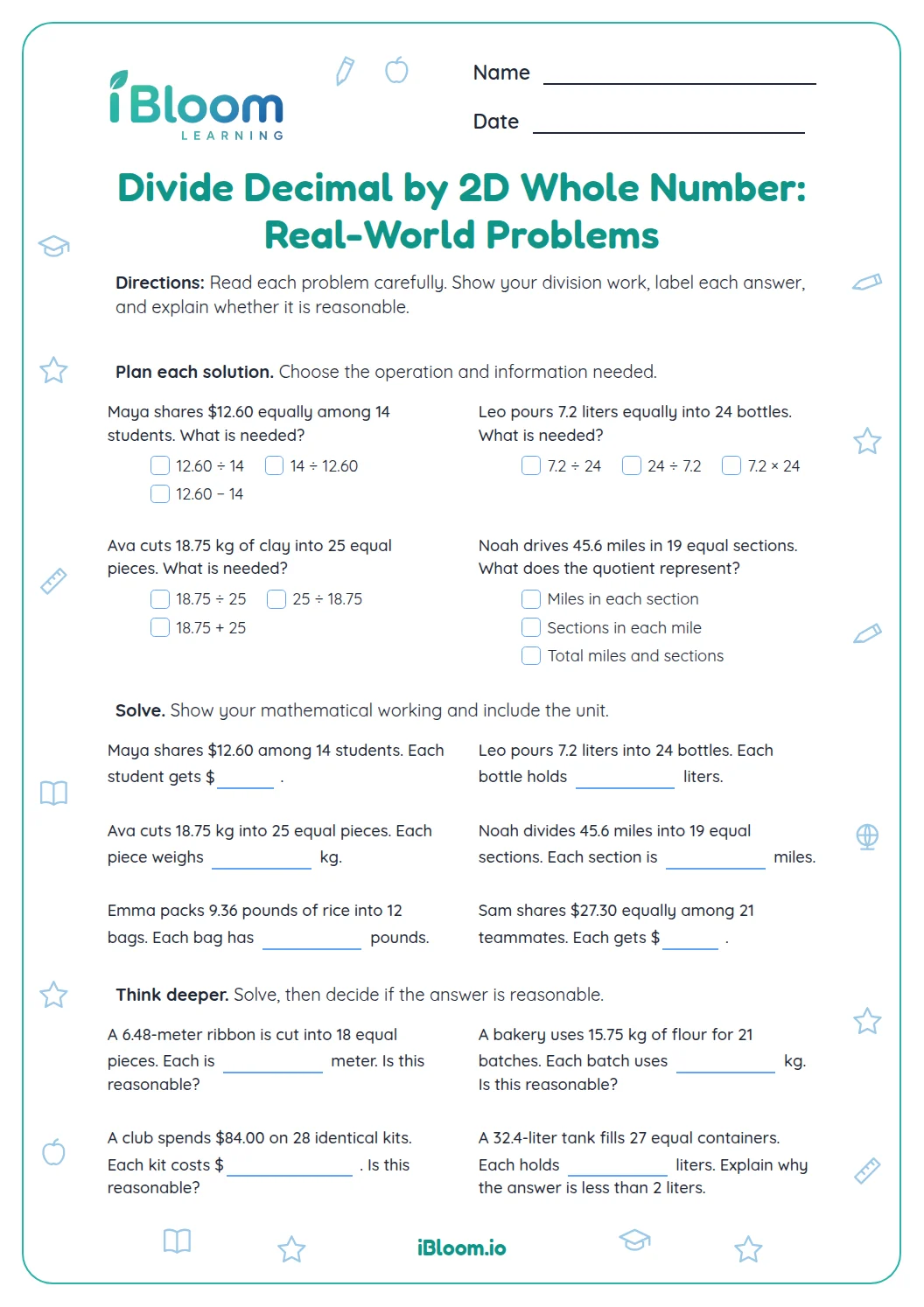
About this worksheet
Practice decimal division with two-digit divisors through exact quotients and reasonableness checks. Learners estimate, divide, catch a place-value slip, and solve sharing situations without rounding.
Aligned to CCSS 5.NBT.B.7
How can multiplication check decimal division?
Estimate the size of the quotient before dividing. For example, 8.4 is less than 12, so 8.4 ÷ 12 must be less than 1; the exact quotient is 0.7.
Multiply a quotient by its divisor to check the dividend. This also helps catch a misplaced decimal point.
What is on the worksheet?
The 15 problems cover exact decimal quotients, quotient size and multiplication checks, and measurement situations. The final two prompts ask learners to explain an error and create a checked example.
- Part A: five exact quotients
- Part B: five size and check questions
- Part C: four real-world calculations and two written explanations
How to use this worksheet
- 1Read the direction for each part before beginning.
- 2Ask the learner to explain one answer aloud and check it with the key.
Common mistakes and quick fixes
The mistake
Rushing and overlooking what the question asks.
The fix
Read the whole prompt, solve, then check that the answer fits.
The mistake
Stopping after finding a number without checking it.
The fix
Put the answer back into the original question.
Common Core alignment
This page practices the grade-level skill named below.
Add, subtract, multiply, and divide decimals to hundredths using concrete models or drawings and strategi
On this sheet: The worksheet asks learners to add, subtract, multiply, and divide decimals to hundredths using concrete models or drawings and strategies based on place value and properties of operations.
Show the official wordingHide the official wording
Add, subtract, multiply, and divide decimals to hundredths, using concrete models or drawings and strategies based on place value, properties of operations, and/or the relationship between addition and subtraction; relate the strategy to a written method and explain the reasoning used.
What to practice next
Questions parents and teachers ask
How do I check a decimal quotient?
Multiply the quotient by the divisor. For example, 0.7 × 12 = 8.4, so 8.4 ÷ 12 = 0.7 checks. The worksheet asks learners to use multiplication this way and to estimate whether a quotient is sensible before calculating.
Why can a quotient be less than 1?
When a positive dividend is smaller than its positive divisor, the quotient is less than 1. For example, 9.6 ÷ 12 must be below 1 because 9.6 is less than 12. Compare the dividend and divisor before calculating to predict the quotient size.
What is on this decimal division worksheet?
The 15 questions move from five exact quotients to quotient reasoning and then decimal division in measurement situations. One item asks learners to find and correct a decimal-place error, and the final prompt asks them to create a division example.
How should we use the answer key?
Let the learner try the division and check the result by multiplying before looking at the key. If the product does not return the dividend, revisit the place value in the quotient. The key includes model responses for the two open-ended prompts.