




About this worksheet
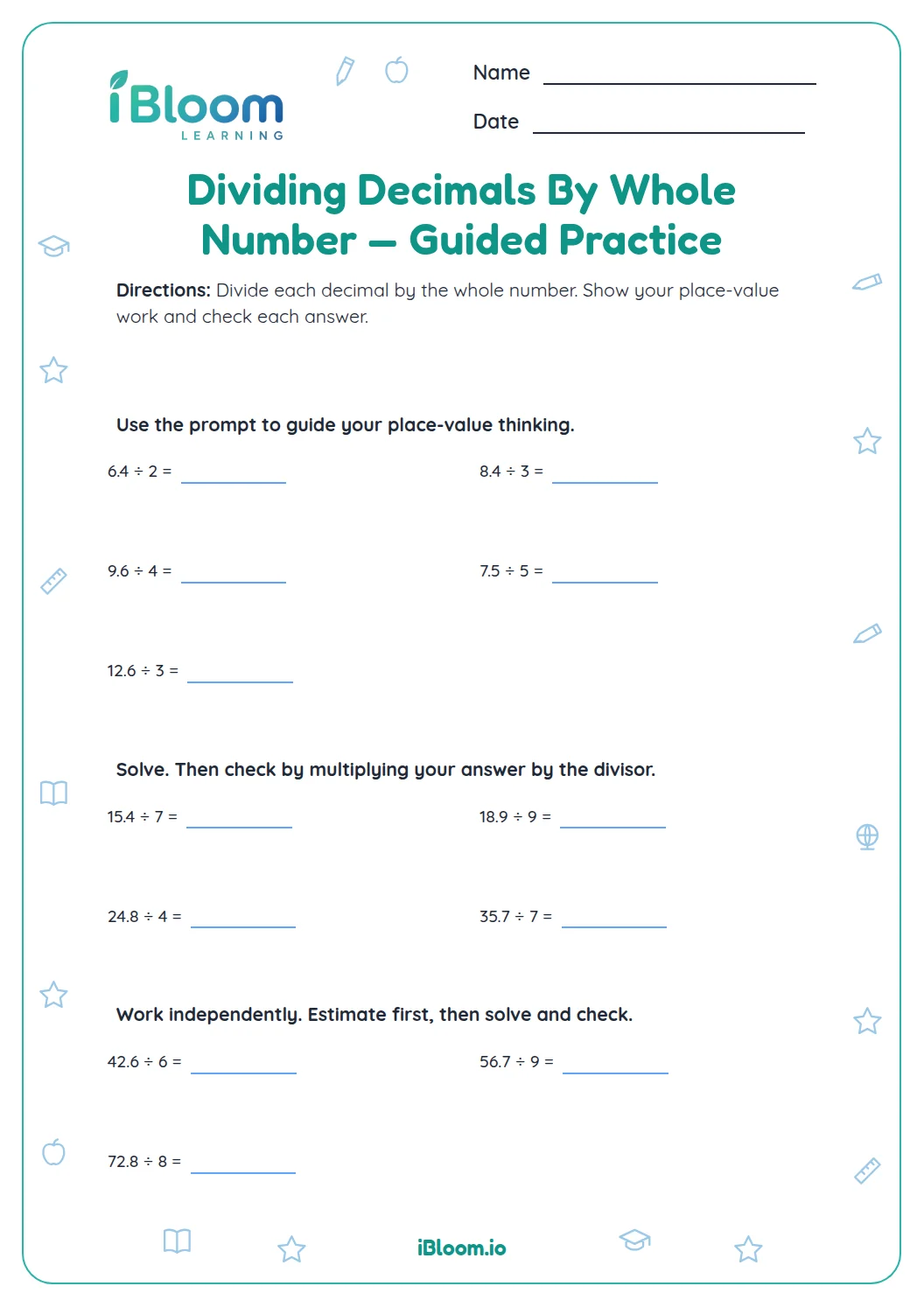
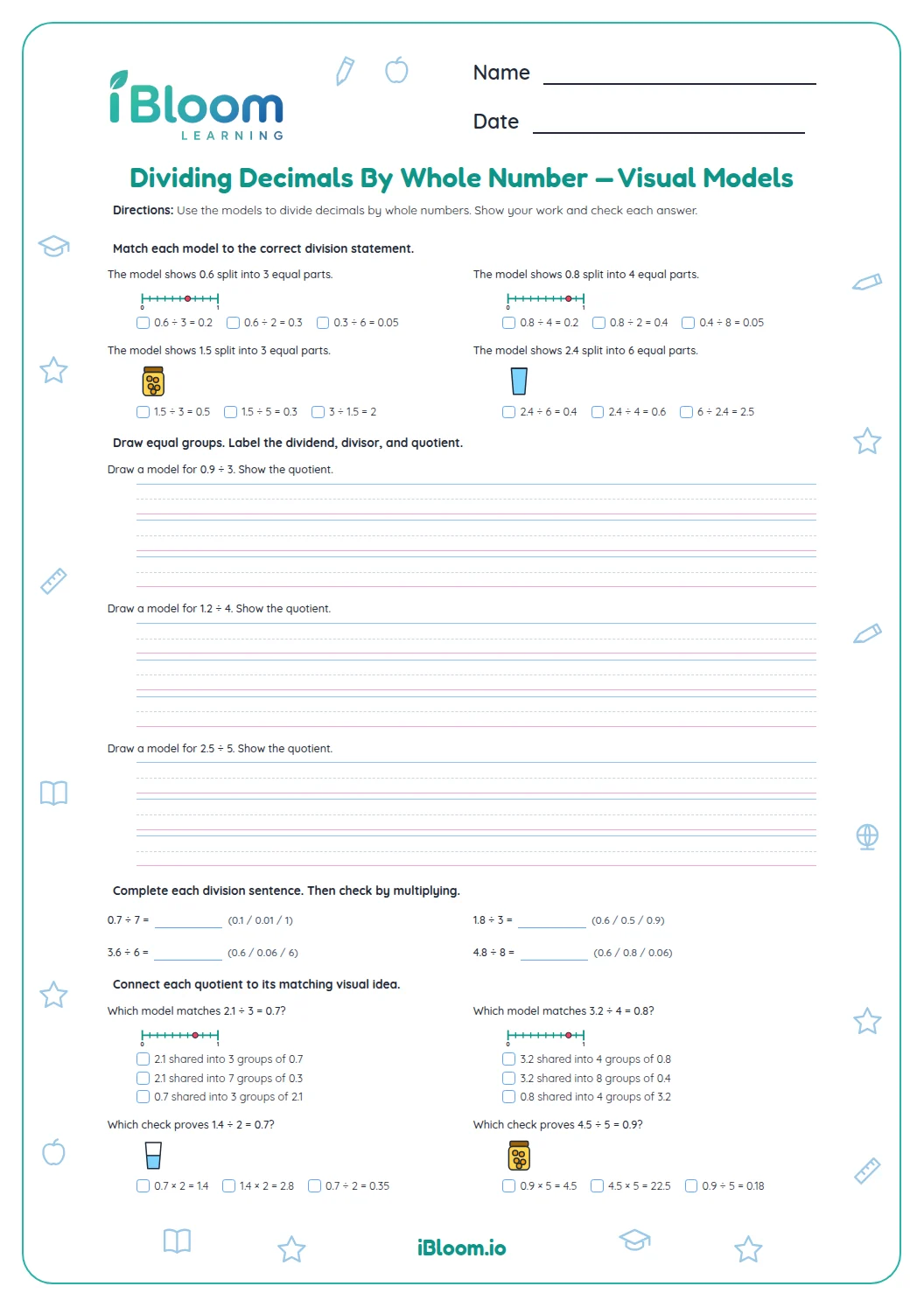
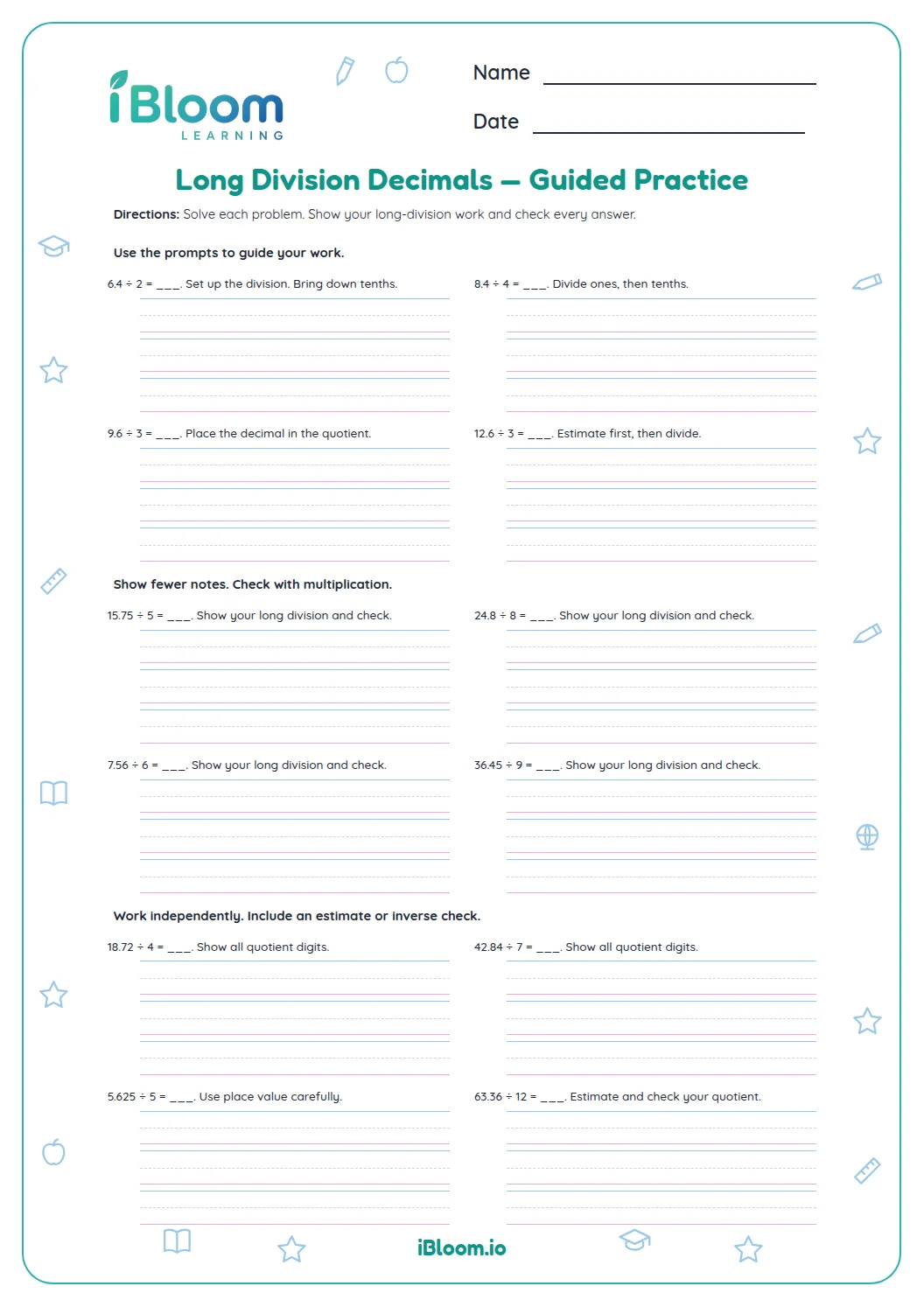
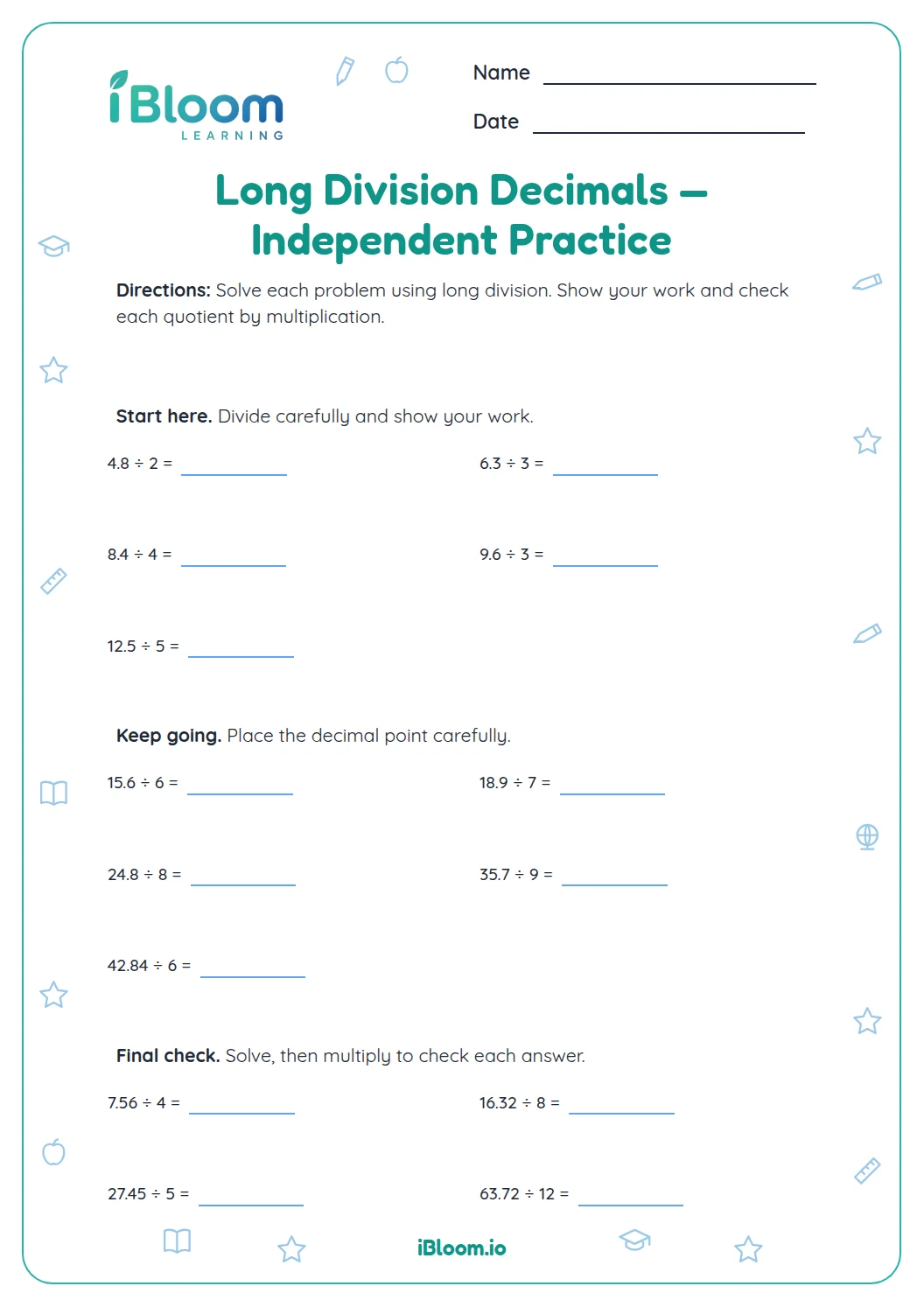
This Grade 5 math worksheet practices dividing decimal numbers by two-digit whole-number divisors without rounding. It has 14 problems: 11 quotient blanks and three items with room to show division steps. Each quotient terminates, and the answer key gives the exact decimal results. Students can check by multiplying each quotient by its divisor.
Aligned to 5.NBT.B.7
What does this worksheet include?
There are 14 questions in two parts: 11 exact-quotient blanks followed by three problems with space for division steps. All divisors are two-digit whole numbers.
Estimate the quotient before dividing. This helps catch a decimal point placed too far left or right. Then continue the written division until the quotient is exact.
- 14 questions
- Two ordered practice parts
- Separate answer key
How can students work through an example?
For example, 15.75 ÷ 25 = 0.63. Multiplying 0.63 by 25 gives 15.75, so the quotient checks.
- 115.75 ÷ 25 = 0.63
- 2Check: 0.63 × 25 = 15.75.
How can students check their work?
The key gives exact answers. For the final three questions, compare your written steps as well as the quotient.
How can practice build accuracy?
Use the answer key after attempting the questions. For any missed item, redo the comparison, place-value step, sentence clue, or equation check that applies.
How to use this worksheet
- 1Estimate the quotient to anticipate its size.
- 2Divide using place-value steps and bring down digits as needed.
- 3Continue until the quotient is exact; do not round.
- 4Place the decimal in the quotient to match the value.
- 5Multiply the quotient by the divisor to check the dividend.
Common mistakes and quick fixes
The mistake
Placing the decimal point by guesswork.
The fix
Estimate first, then check the product.
The mistake
Rounding a quotient that can be exact.
The fix
Continue dividing until the remainder is zero.
The mistake
Using a quotient that does not reproduce the dividend.
The fix
Multiply the answer by the divisor and compare.
Divide decimals exactly and connect place-value reasoning to written division.
On this sheet: Divide decimals exactly and connect place-value reasoning to written division.
Show the official wordingHide the official wording
Add, subtract, multiply, and divide decimals to hundredths, using concrete models or drawings and strategies based on place value, properties of operations, and/or the relationship between addition and subtraction; relate the strategy to a written method and explain the reasoning used.
What to practice next
Make more practice
Further reading
Questions parents and teachers ask
Do students round any answers?
No. Each problem has an exact terminating decimal quotient. Students continue the division until no remainder remains, then record the full quotient. The answer key lists exact values, including answers with three decimal places where needed. Use multiplication to confirm the result.
How many problems include working space?
Three of the 14 questions have working space for division steps. The other 11 ask students to fill in a quotient. The problems all use decimal dividends and two-digit whole-number divisors. Students may show steps beside any item as needed.
How can students check a quotient?
Multiply the quotient by the divisor. The product should match the original dividend. For example, 15.75 ÷ 25 = 0.63, and 0.63 × 25 returns 15.75. This check can reveal a decimal-place error before students move on. The separate key lets students review the result after completing the question independently.
Why do some answers have three decimal places?
Some dividends do not produce a quotient with only one or two decimal places. For example, 23.52 ÷ 32 = 0.735. Keeping all three places makes the quotient exact; rounding would change the product. The key preserves the exact values.
Should students show their work on every problem?
The final three problems provide dedicated working space and ask students to show division steps. Students may also write steps beside the earlier quotient blanks if they need room to organize place value or check a calculation. The key lists the quotients.