




About this worksheet
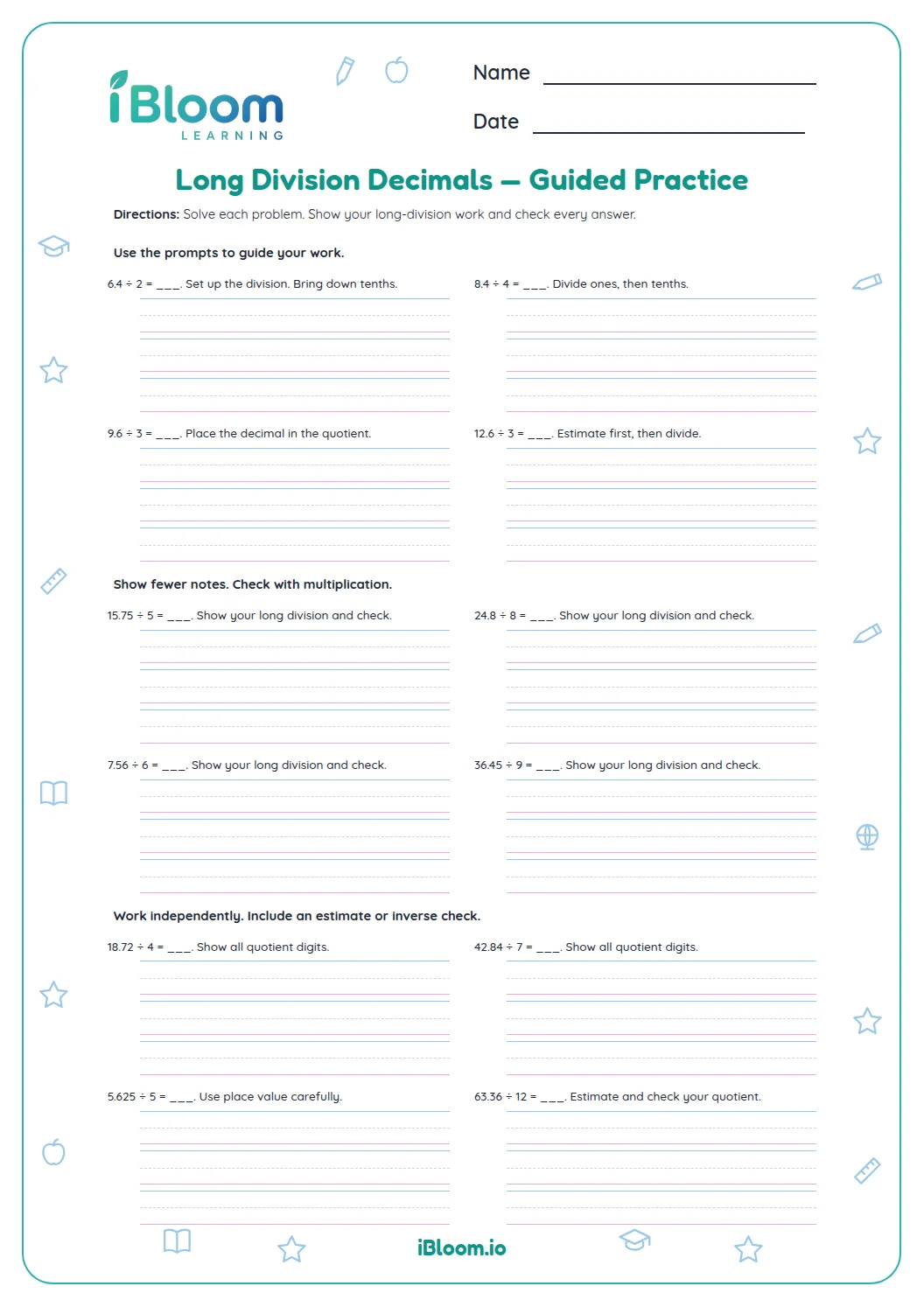
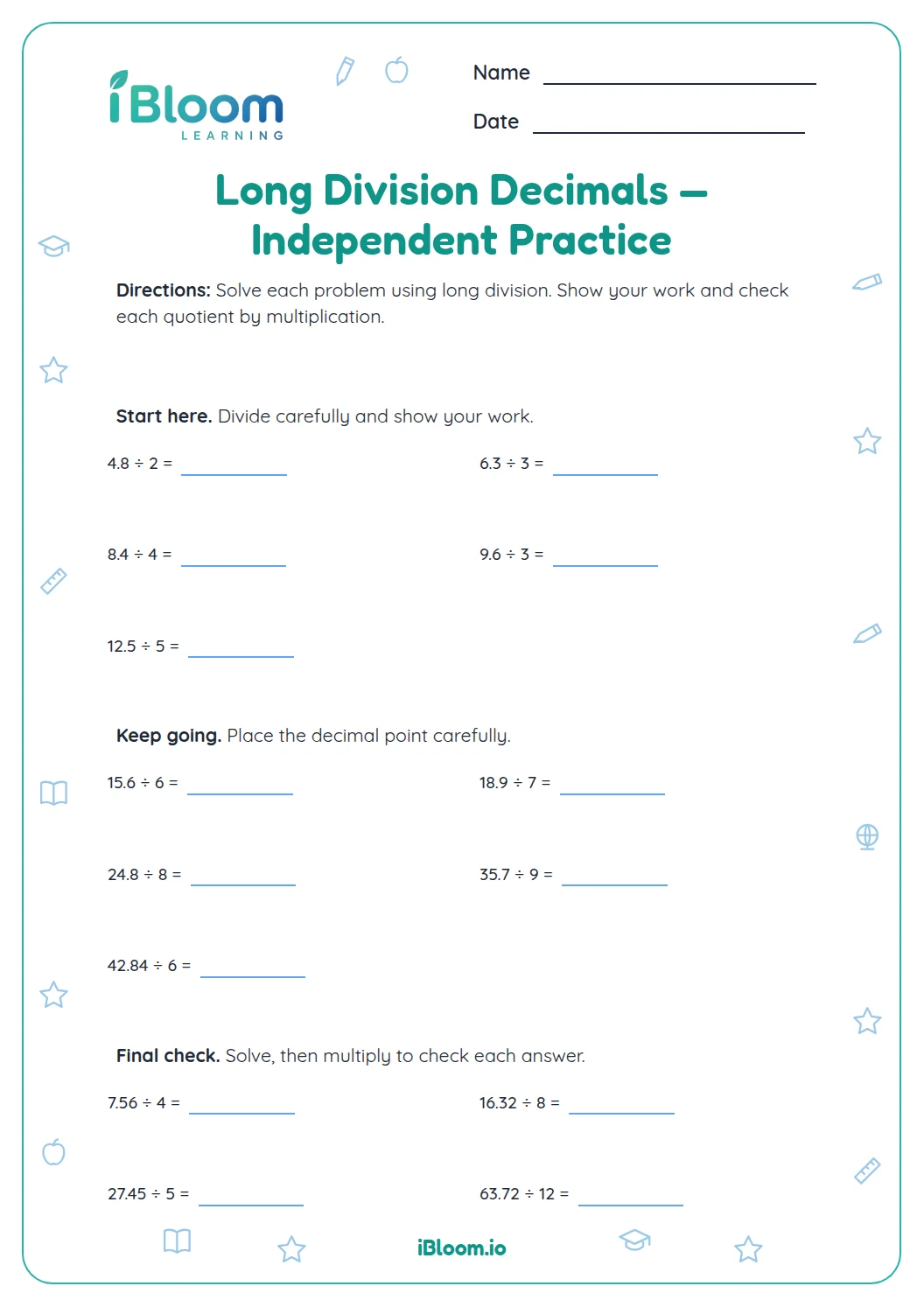
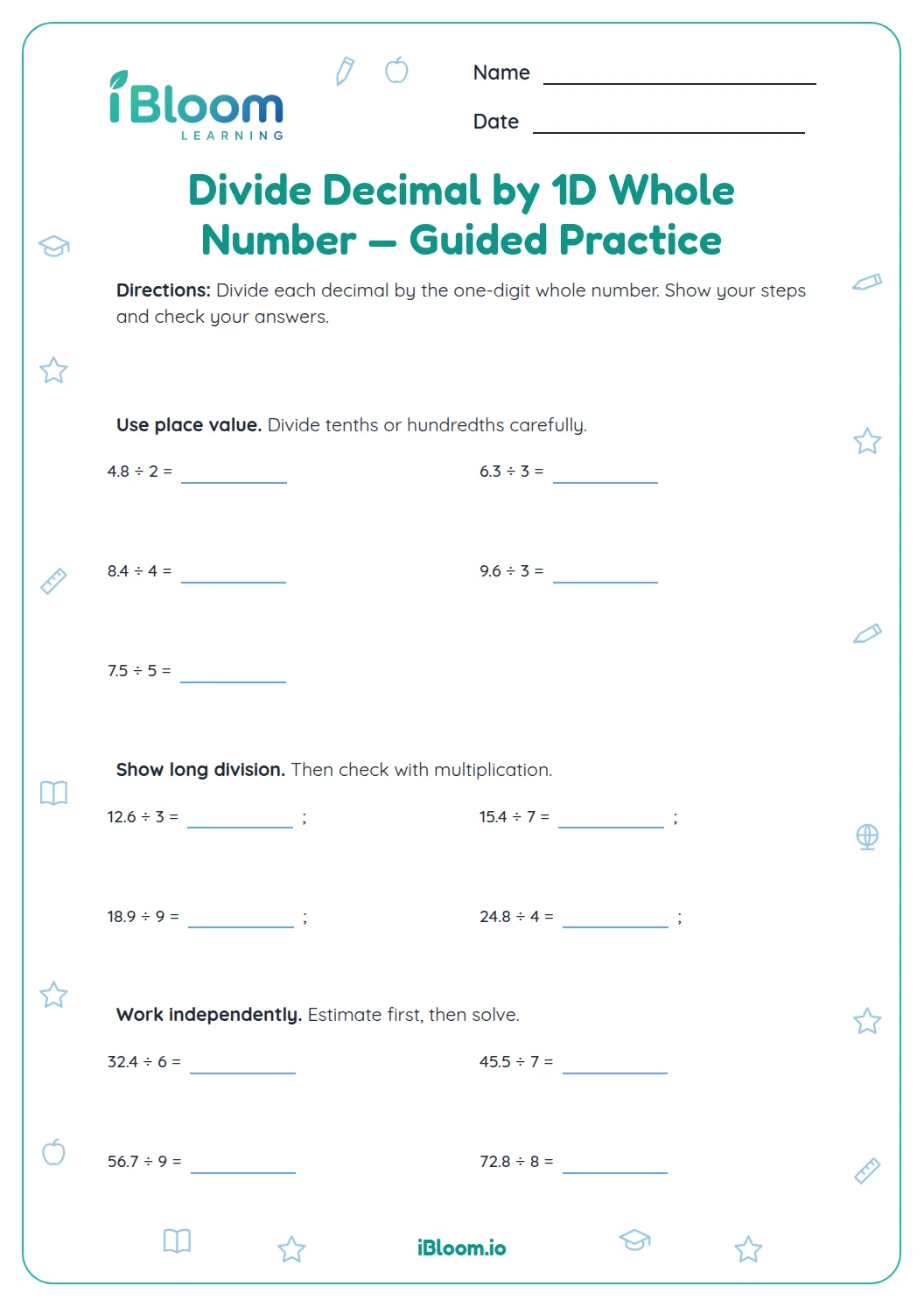
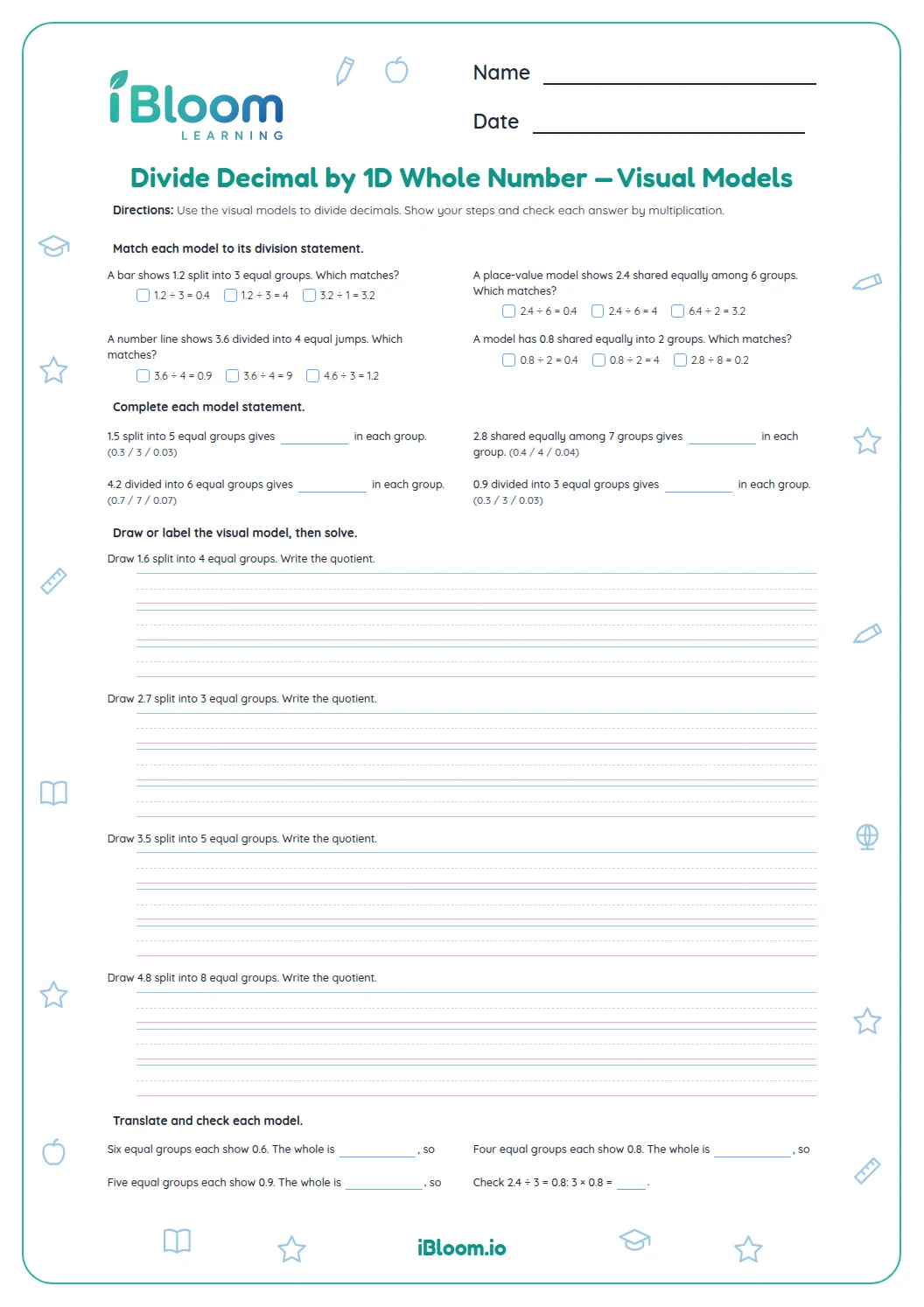
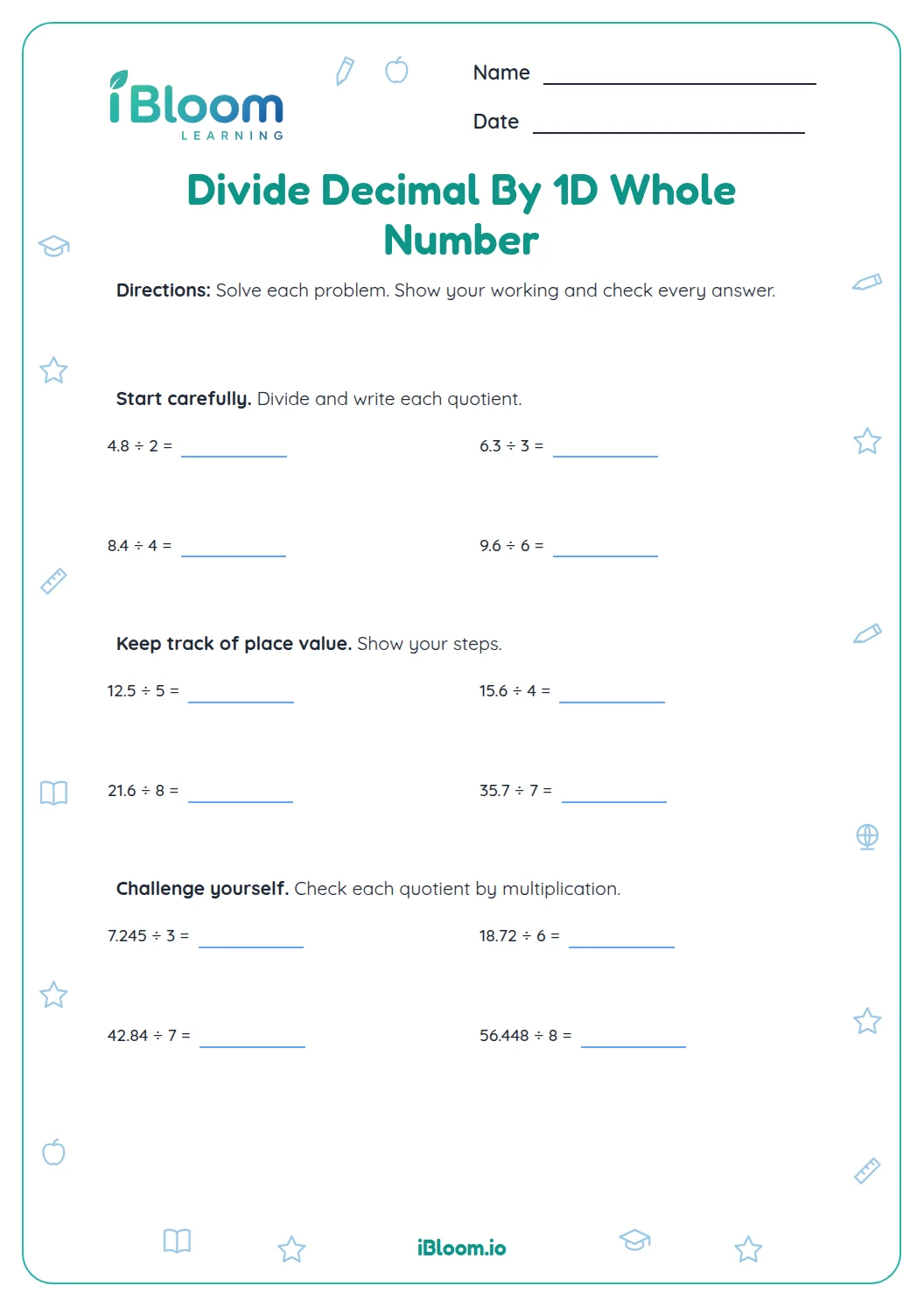
This free Grade 5 worksheet connects decimal division to equal shares of a whole. Two shaded models let students split tenths or hundredths into equal groups. Six written calculations then ask them to set up long division, including a calculation that needs an extra zero in the dividend. Two short explanations connect the written work back to place value. These 10 questions practice CCSS 5.NBT.B.7. The answer key includes model quotients, calculation answers, and sample explanations.
Aligned to 5.NBT.B.7
What does each shaded model represent?
Each complete strip or grid represents 1 whole. A strip has ten equal parts, so each part is 0.1. A grid has 100 equal squares, so each small square is 0.01. Only the shaded amount is divided.
In Part A, students mark the shaded parts into the requested number of equal groups and label each group with its decimal value. Counting shaded pieces first prevents accidentally dividing the whole outline.
- 10.24 is 24 hundredths.
- 224 hundredths ÷ 3 = 8 hundredths.
- 3One group is 0.08.
- 4Check: 3 × 0.08 = 0.24.
How do models connect to long division?
The units stay visible in a model: tenths divided into equal groups remain tenths, and hundredths remain hundredths. In long division, the quotient’s decimal point lines up with the dividend’s decimal point when the divisor is a whole number.
Part B provides working space for six calculations. The first two repeat the model divisions, 0.6 ÷ 2 and 0.24 ÷ 3, so students can compare their long-division answers with their equal groups. For 5.6 ÷ 5, write 5.60 so the remaining tenths can be regrouped as hundredths.
Why do some answers need a zero?
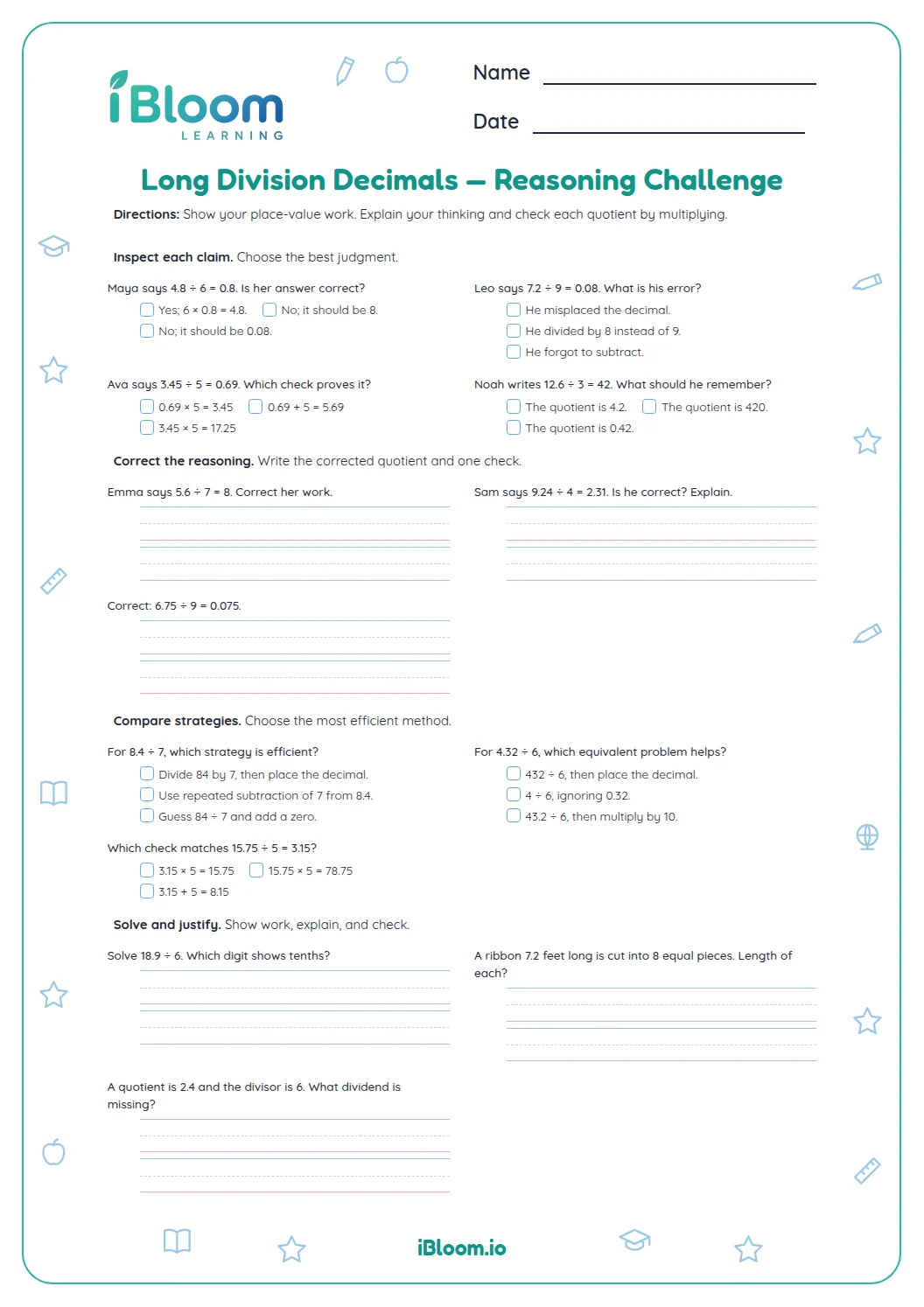
In 0.36 ÷ 6, each group gets 6 hundredths, so the quotient is 0.06. Writing 0.6 would make each group six tenths, ten times too large. Question 9 asks students to explain that distinction.
Question 10 connects the 0.24 grid to 0.24 ÷ 3. Accept wording that identifies 24 hundredths split into three equal groups of 8 hundredths. Multiplying the quotient by the divisor gives a useful final check.
How to use this worksheet
- 1Name one whole and the value of one small part in each model.
- 2Mark the shaded pieces into equal groups and write the value of one group.
- 3Set up each Part B calculation as long division in its work space.
- 4Keep the decimal point aligned and use a zero when a place has no units.
- 5Multiply each quotient by its divisor, then explain the two place-value questions.
Mistakes to notice and fix
The mistake
Dividing all 100 grid squares instead of the 24 shaded squares.
The fix
The shaded amount is the dividend. Split only those 24 hundredths into groups.
The mistake
Writing 0.36 ÷ 6 = 0.6.
The fix
Six hundredths is 0.06. Multiply by 6 to see that 0.6 would produce 3.6.
The mistake
Stopping at 1.1 when dividing 5.6 by 5.
The fix
Rename 5.6 as 5.60. Divide the remaining 10 hundredths by 5 to get 2 hundredths.
Common Core alignment
Connect equal groups in decimal models to written division and explain the place value.
On this sheet: Students partition decimal drawings, use long division, and explain the quotient using tenths and hundredths.
Show the official wordingHide the official wording
Add, subtract, multiply, and divide decimals to hundredths, using concrete models or drawings and strategies based on place value, properties of operations, and/or the relationship between addition and subtraction; relate the strategy to a written method and explain the reasoning used.
What to practice next
Make more practice
Further reading
Questions parents and teachers ask
What do the strips and grids stand for?
Every complete outline stands for 1 whole. Each strip is divided into ten equal tenths, and each grid is divided into one hundred equal hundredths. Students share only the shaded parts, then label each equal group with its decimal value beside the model.
Do students actually practice long division?
Yes, Part B asks students to set up and solve six decimal divisions using long division. It begins with 0.6 ÷ 2 and 0.24 ÷ 3, matching the models, then includes regrouping in 5.6 ÷ 5. Students can check the first two written answers against their labeled groups.
Why is 0.36 divided by 6 equal to 0.06?
The dividend is 36 hundredths, and sharing it among six groups gives 6 hundredths in each group. Six hundredths is written 0.06. A quotient of 0.6 would mean six tenths per group; multiplying that by six gives 3.6, which is larger than the dividend.
How should children mark the shaded groups?
They can draw light boundaries or label equal groups directly on each model. For the 24 shaded hundredths in question 2, each of three groups needs eight shaded squares. The groups need equal amounts; they do not need identical outlines. Then students label each group’s value.
How do I check the explanation answers?
Look for the place-value unit and the equal-group reasoning. Question 9 should explain that six hundredths is 0.06. Question 10 should connect 24 hundredths, three equal groups, and eight hundredths per group. The sample key gives concise models, but students can express the same reasoning differently.