








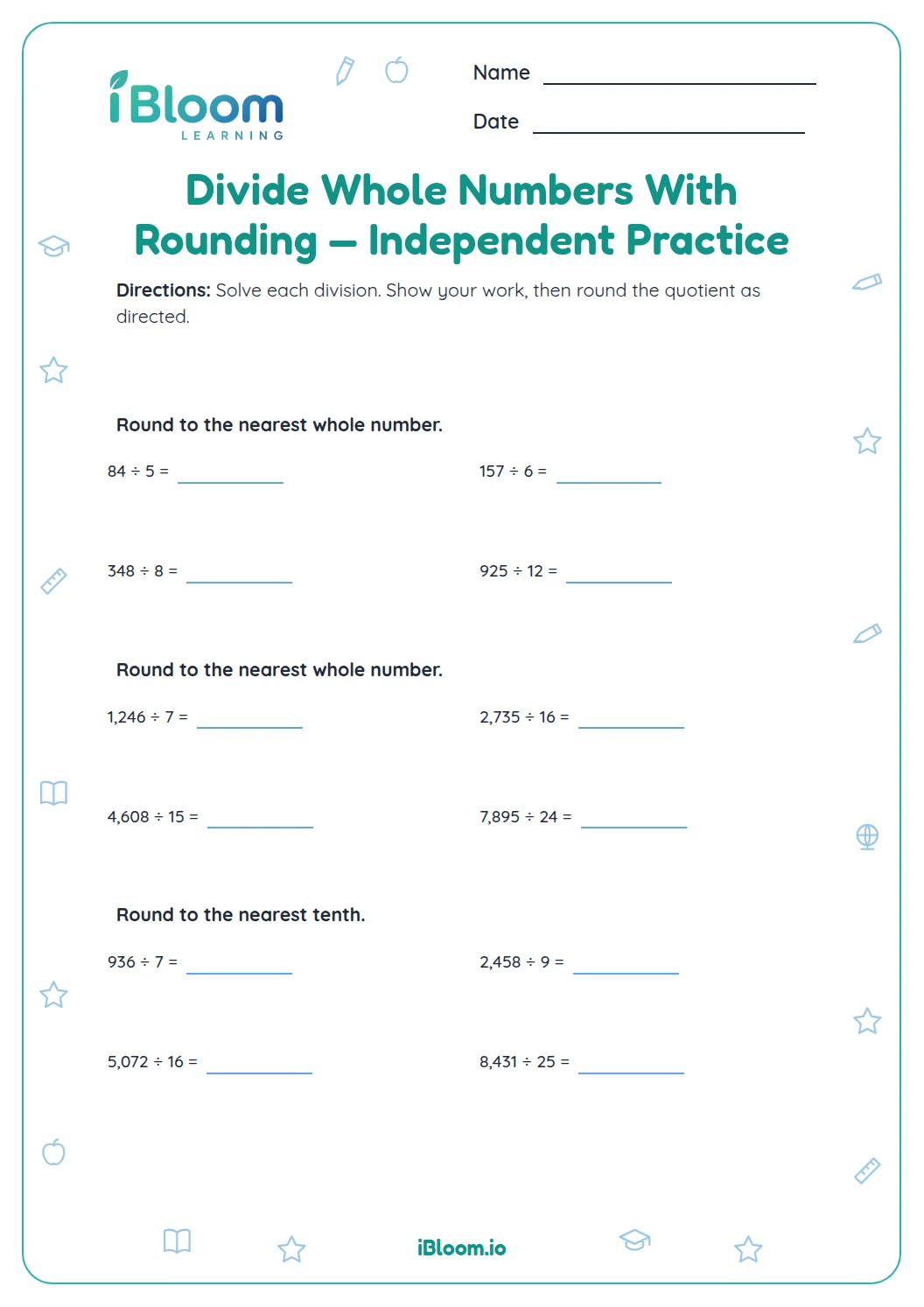
About this worksheet
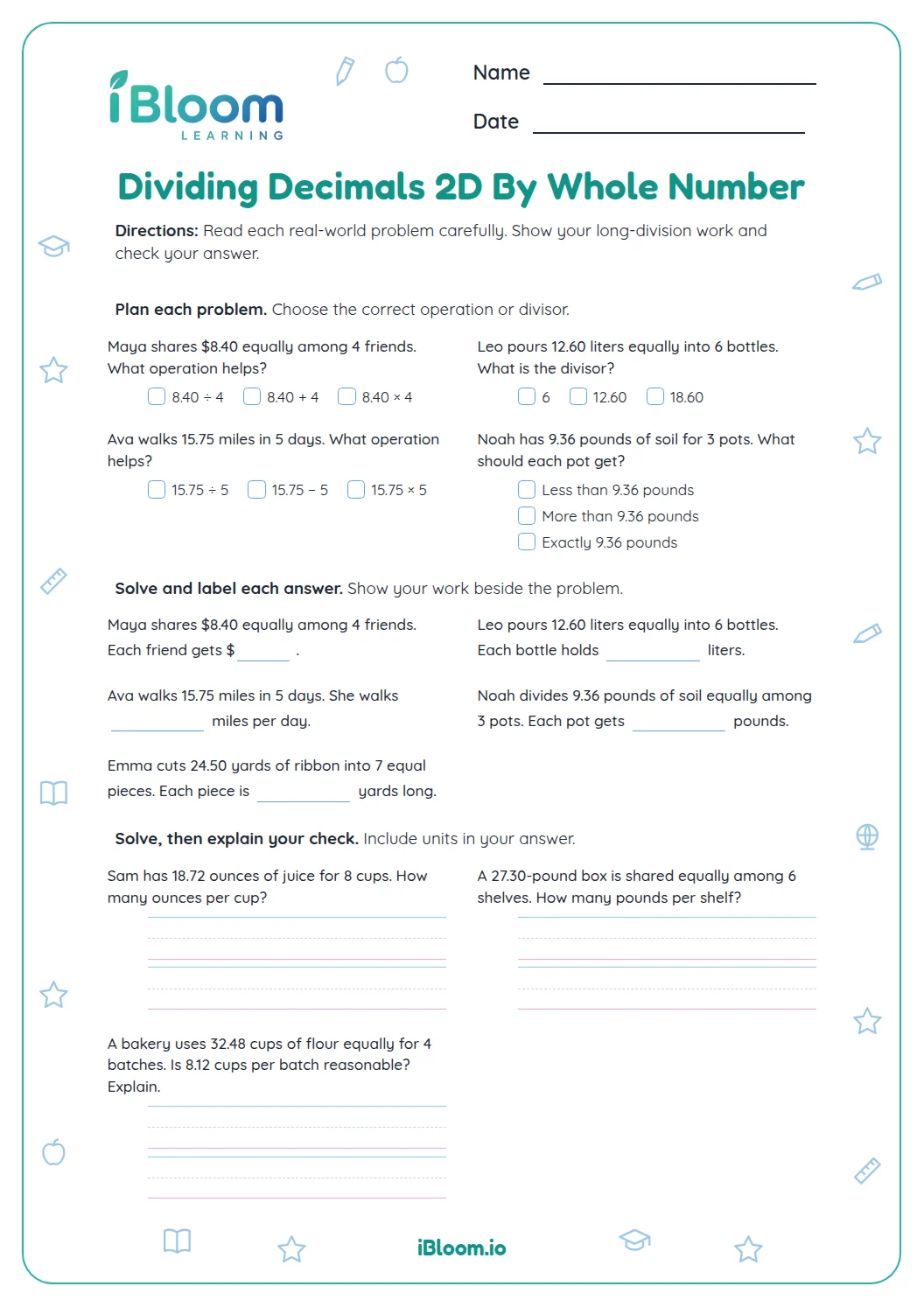
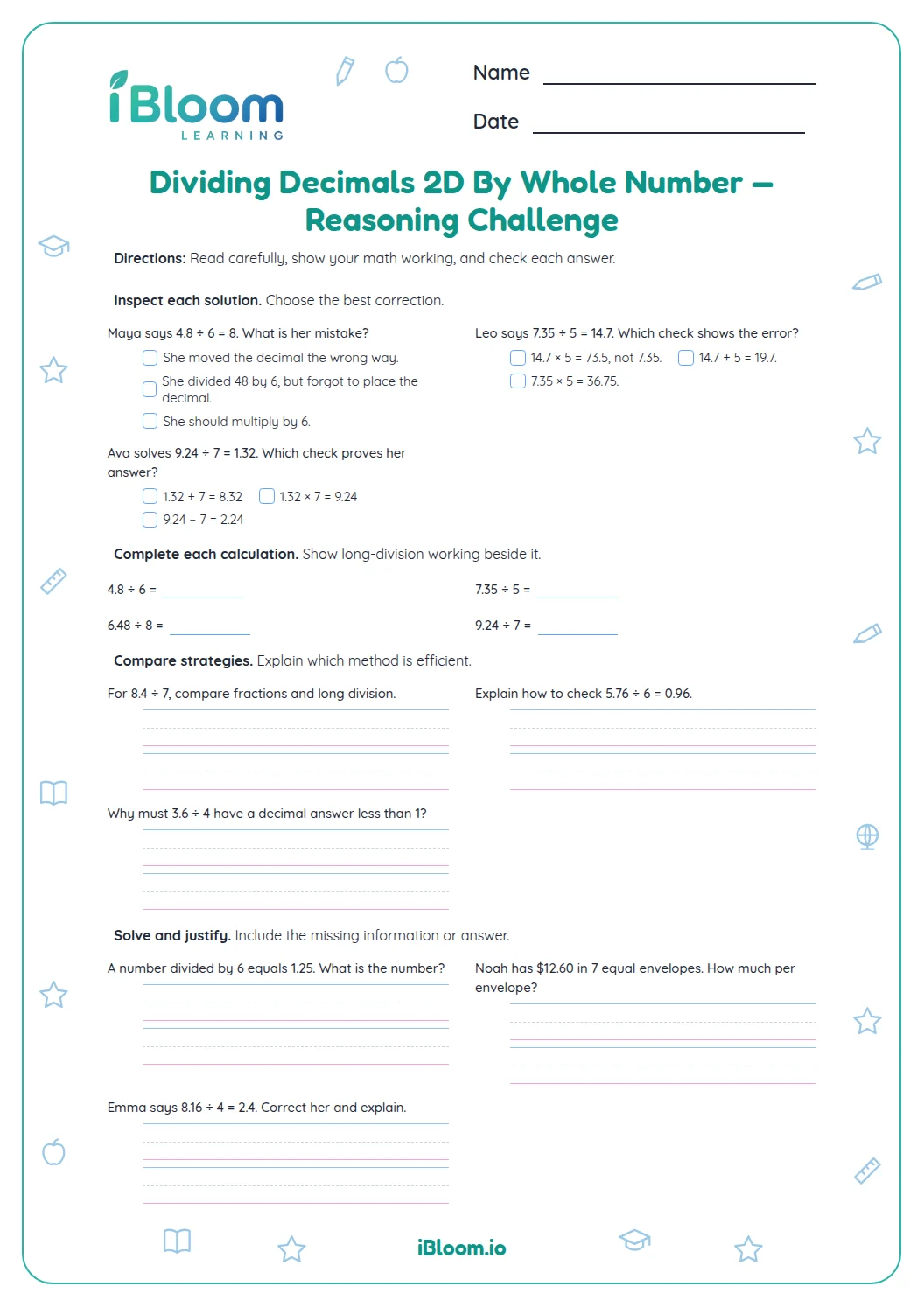
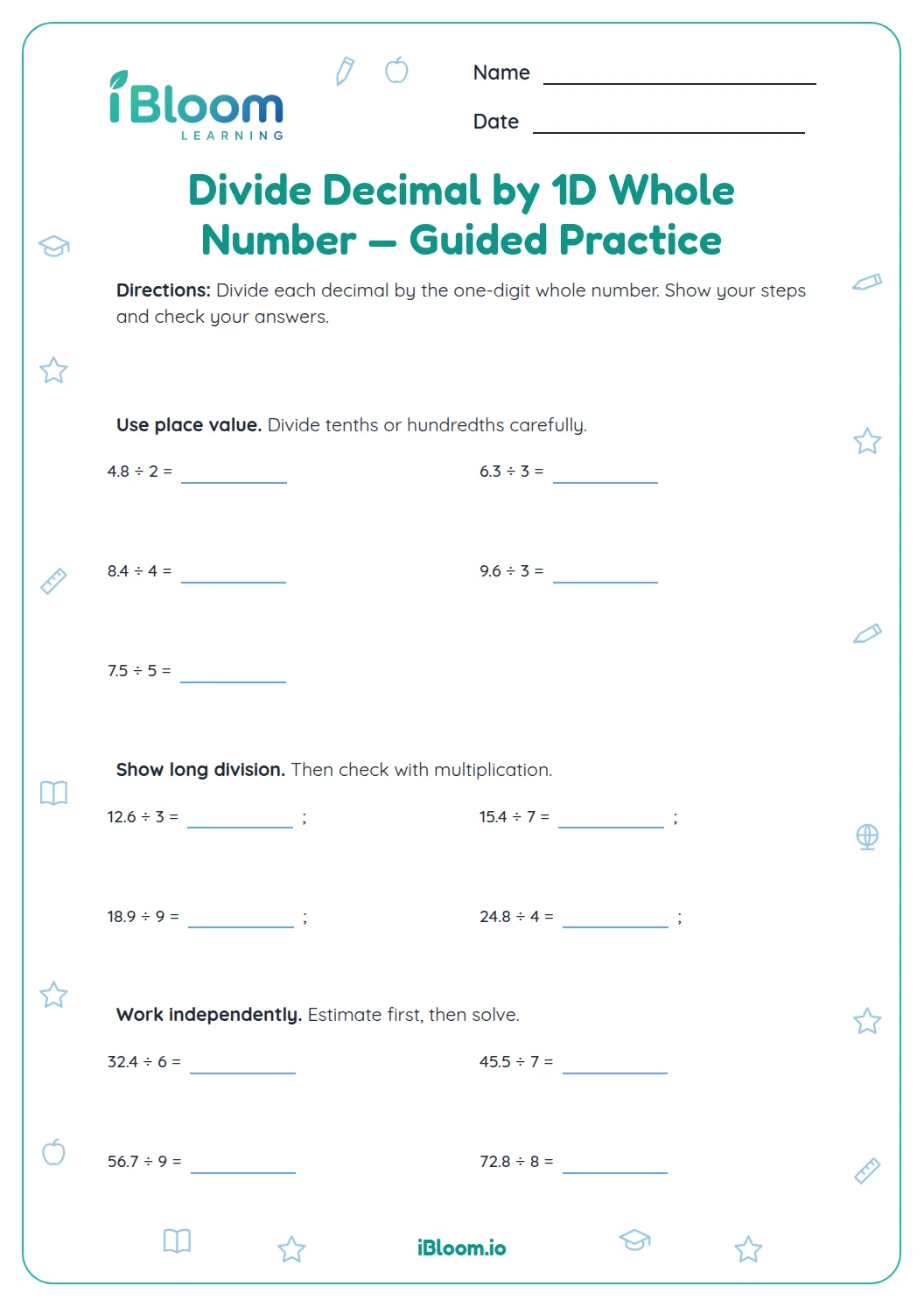
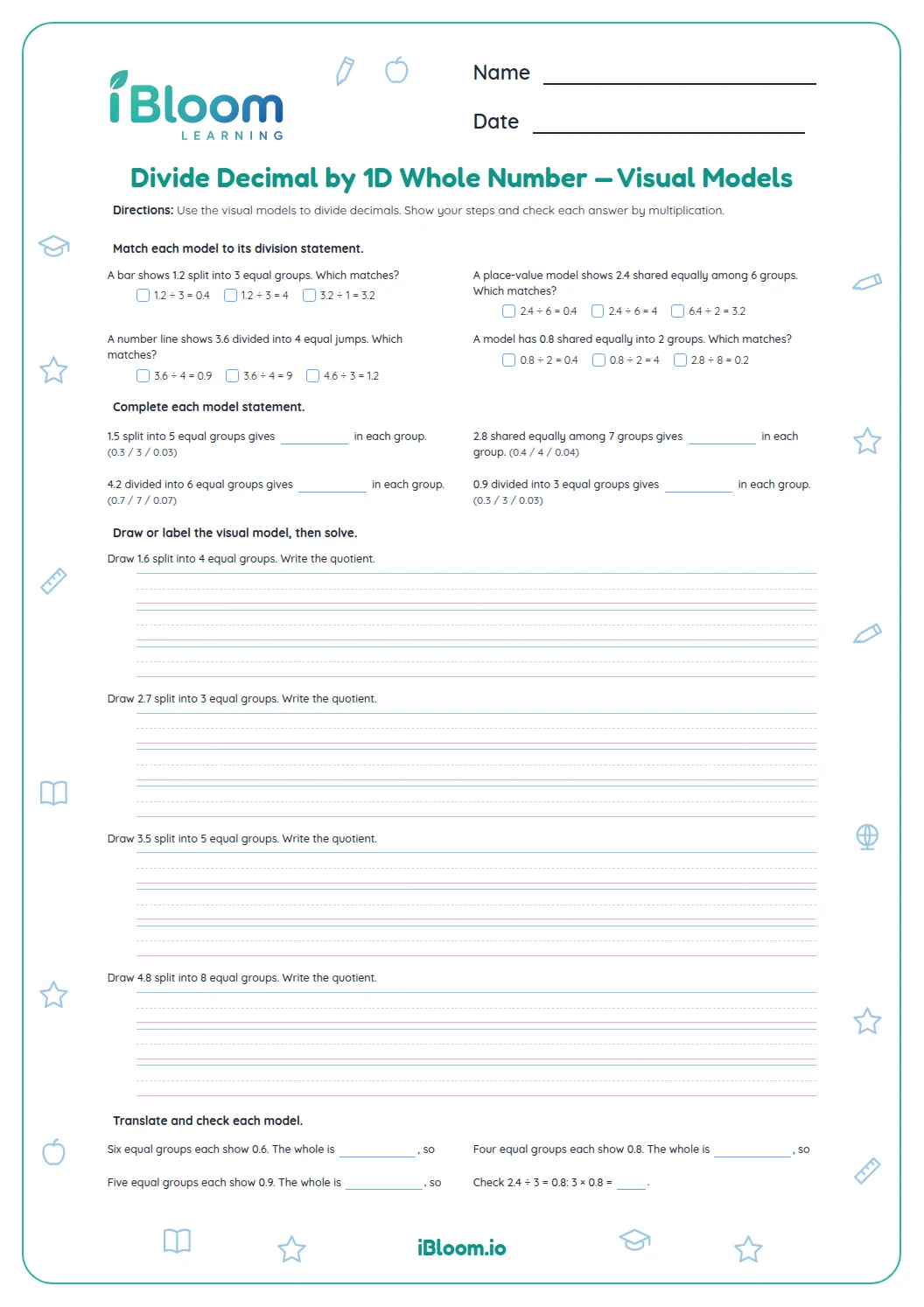
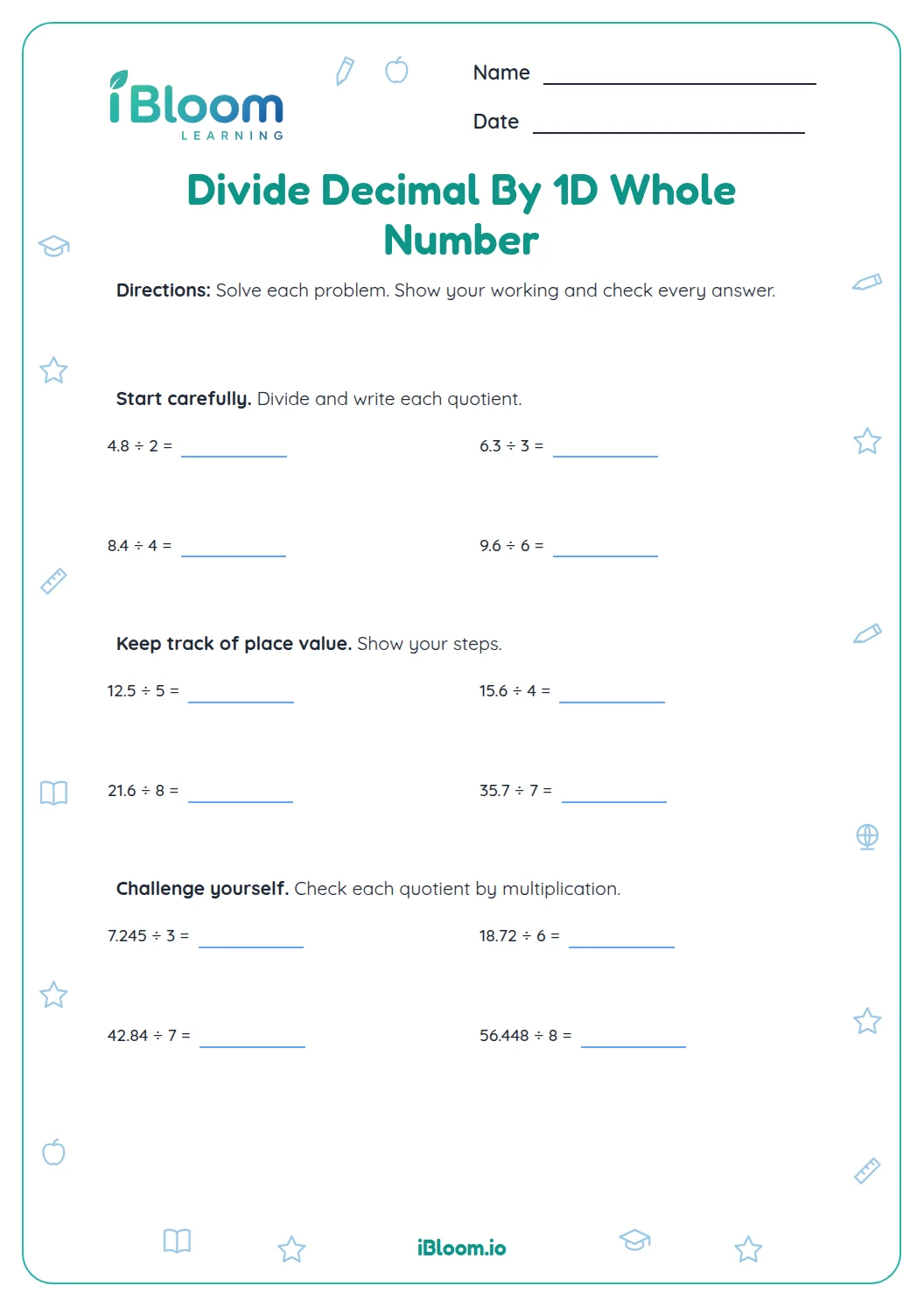
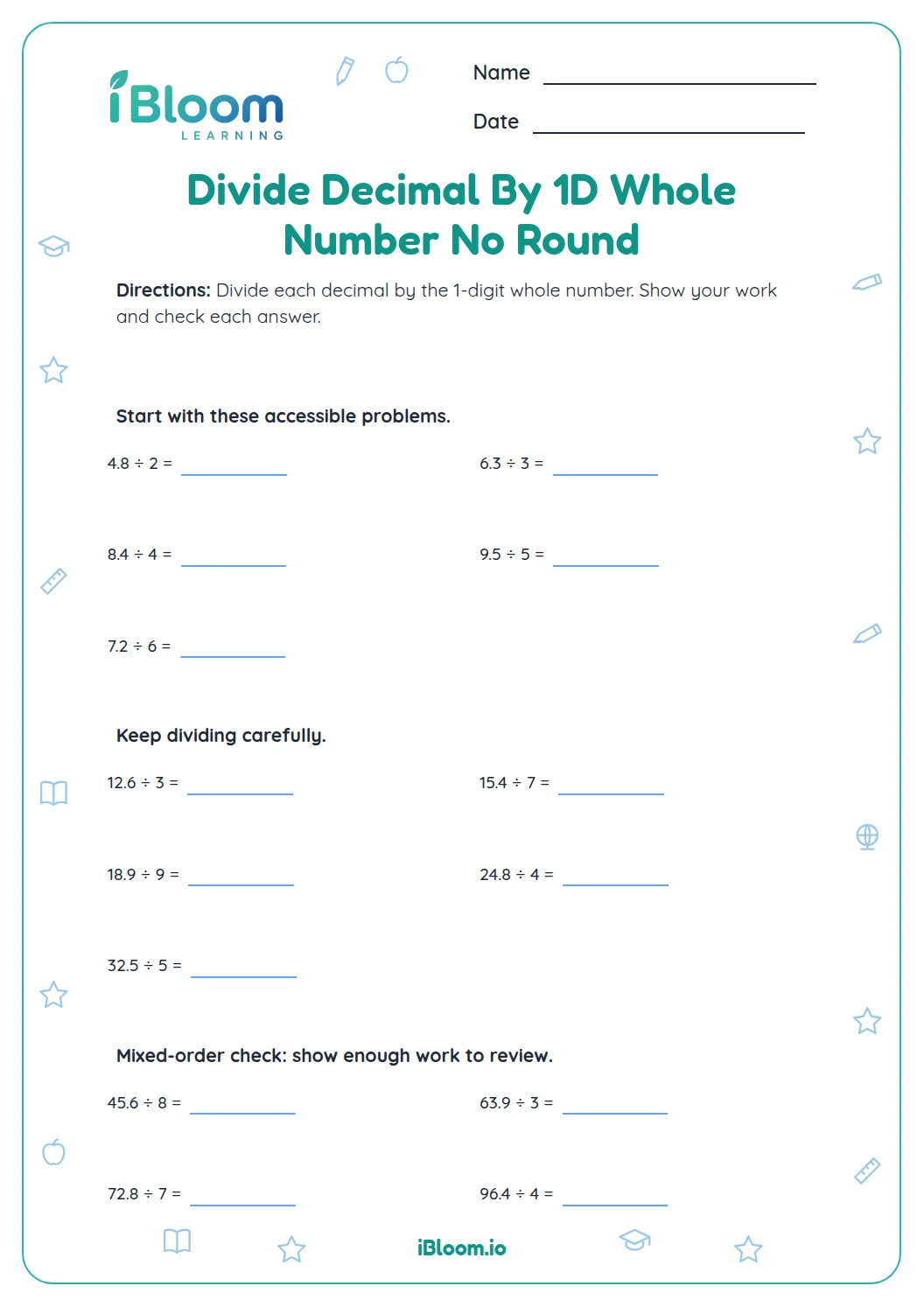
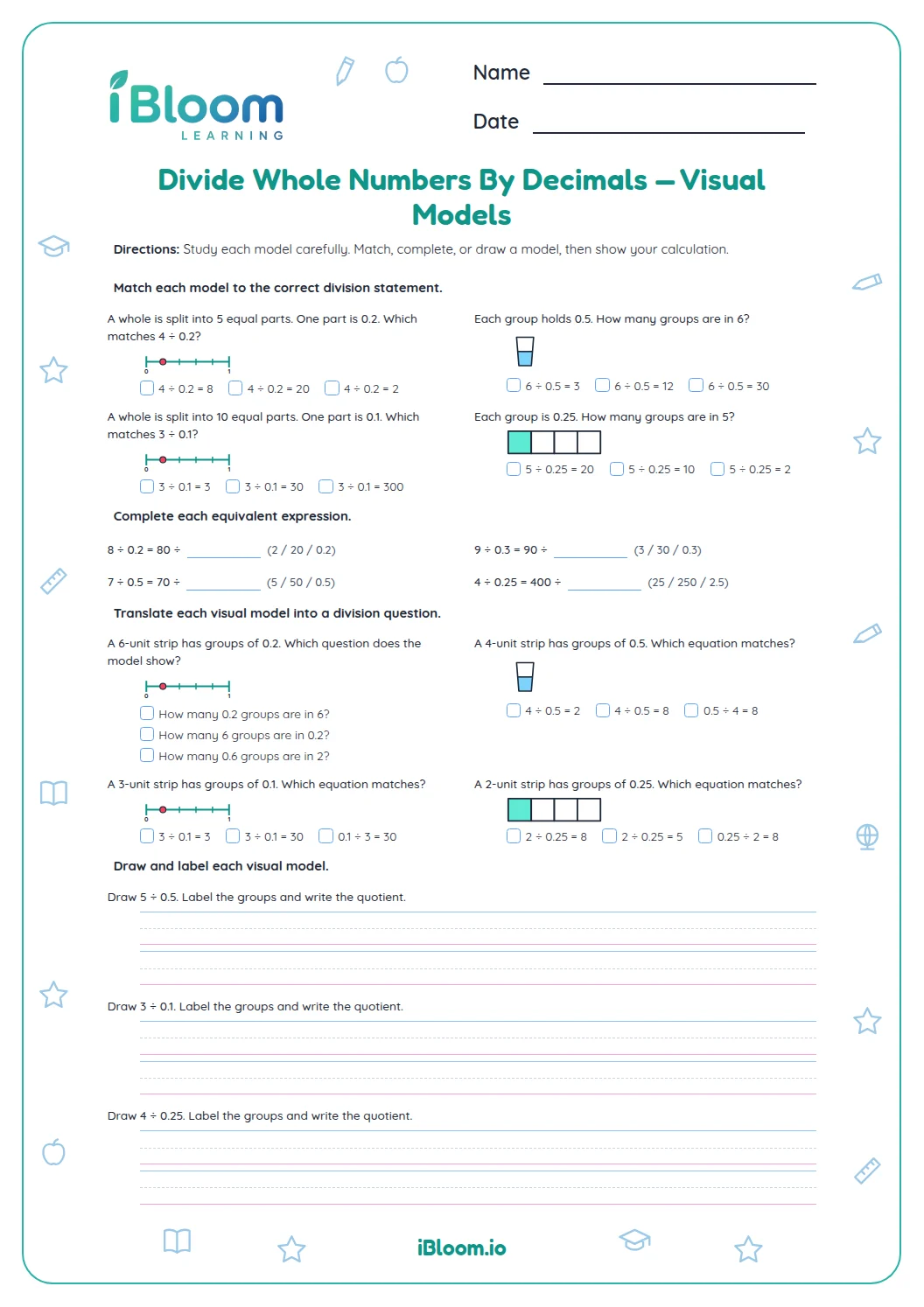
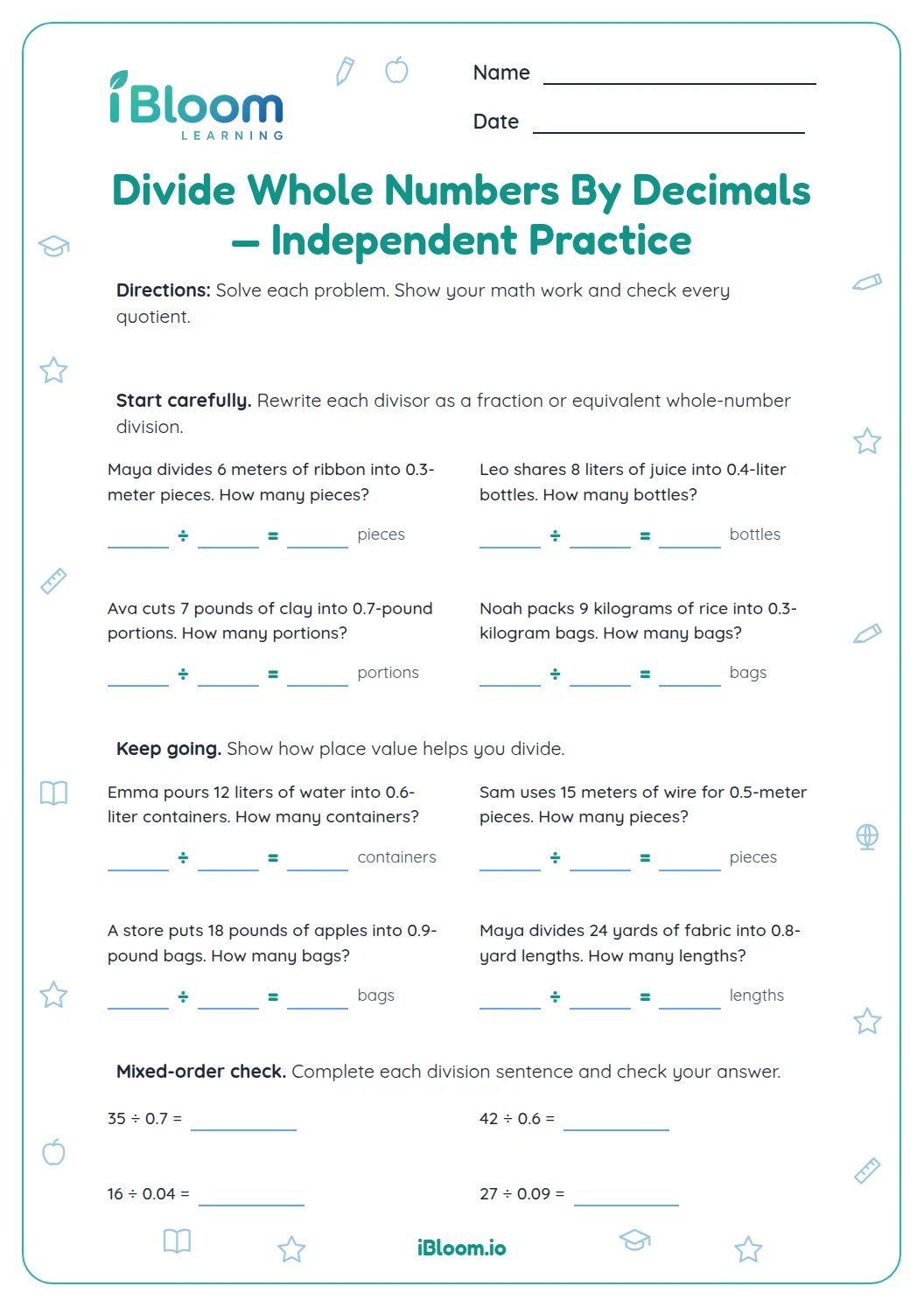
This Grade 5 worksheet practices dividing decimals to hundredths by whole numbers. Three opening questions read decimal amounts from hundredths grids; the remaining problems divide decimal dividends into equal groups and provide room to show work. It replaces the old match, label, and explain activities with model reading and written division practice. A separate answer key supports checking. It aligns with CCSS 5.NBT.B.7.
Aligned to 5.NBT.B.7
How do the hundredths grids help with division?
A hundredths grid shows the dividend as hundredths. For example, 0.84 is 84 hundredths. Sharing those hundredths equally among four groups gives 21 hundredths in each group, or 0.21. The same idea applies when the dividend is divided among a different number of groups.
- 10.84 ÷ 4
- 284 hundredths shared among 4 groups
- 321 hundredths in each group
- 4Answer: 0.21
What practice is on the worksheet?
The first three questions ask learners to read a hundredths grid and name its decimal amount. The remaining 17 items ask learners to divide decimal dividends by whole numbers, with working space on each problem.
How to divide the decimal amounts
- 1Read the dividend and the number of equal groups.
- 2For a model question, identify the hundredths shown on the grid.
- 3Share the hundredths equally among the stated groups.
- 4Write the quotient as a decimal and keep its place value clear.
- 5Use multiplication to check: quotient × groups should equal the dividend.
- 6Check all 20 responses with the answer key.
Decimal division slips to check
The mistake
Reading 84 hundredths as 0.084.
The fix
Count two decimal places: 84 hundredths is 0.84.
The mistake
Dividing the digits but placing the decimal incorrectly.
The fix
Estimate the quotient and multiply it by the divisor to check.
The mistake
Sharing unequally among the groups in the model.
The fix
Make sure every group receives the same number of hundredths.
Common Core alignment
This sheet provides practice with the mathematics described below.
Add, subtract, multiply, and divide decimals to hundredths using models or strategies.
On this sheet: The questions divide decimals to hundredths by whole numbers.
Show the official wordingHide the official wording
Add, subtract, multiply, and divide decimals to hundredths, using concrete models or drawings and strategies based on place value, properties of operations, and/or the relationship between addition and subtraction; relate the strategy to a written method and explain the reasoning used.
What to practice next
Make more practice
Further reading
Questions parents and teachers ask
How many questions are included?
There are 14 questions across worksheet pages. They move from a supported start to independent practice, then use the same skill in a slightly different form. The separate answer key gives a convenient way to check work after the learner has attempted the page.
Should children show their work?
Yes. Writing the calculation or comparison makes it easier to see how an answer was found. It also helps an adult spot whether a missed item came from choosing the wrong operation, reading the numbers incorrectly, or making a computation slip.
Is an answer key included?
Yes. The answer key is on a separate page and lists a response for each numbered item. Keep it aside while the learner works, then use it to check answers and review any step that needs another try. Pause after each item so the learner can explain the clue or calculation that supports the response.
How long should the worksheet take?
About 20 minutes is a useful starting point for this multi-part practice. Learners who benefit from talking through each example may need longer, while a familiar skill may take less time. The pages can also be completed in two short sessions.
How can I help without giving away answers?
Ask the learner to restate what is being compared or calculated, then invite them to estimate before solving. For a missed answer, point to the relevant quantity or model and ask which step should be checked. Pause after each item so the learner can explain the clue or calculation that supports the response.
Can this be used for independent practice?
Yes. The directions are written for children, and the answer key is separate for later checking. For early learners or a new concept, complete the first item together and let the learner try the remaining questions. Pause after each item so the learner can explain the clue or calculation that supports the response.