






About this worksheet
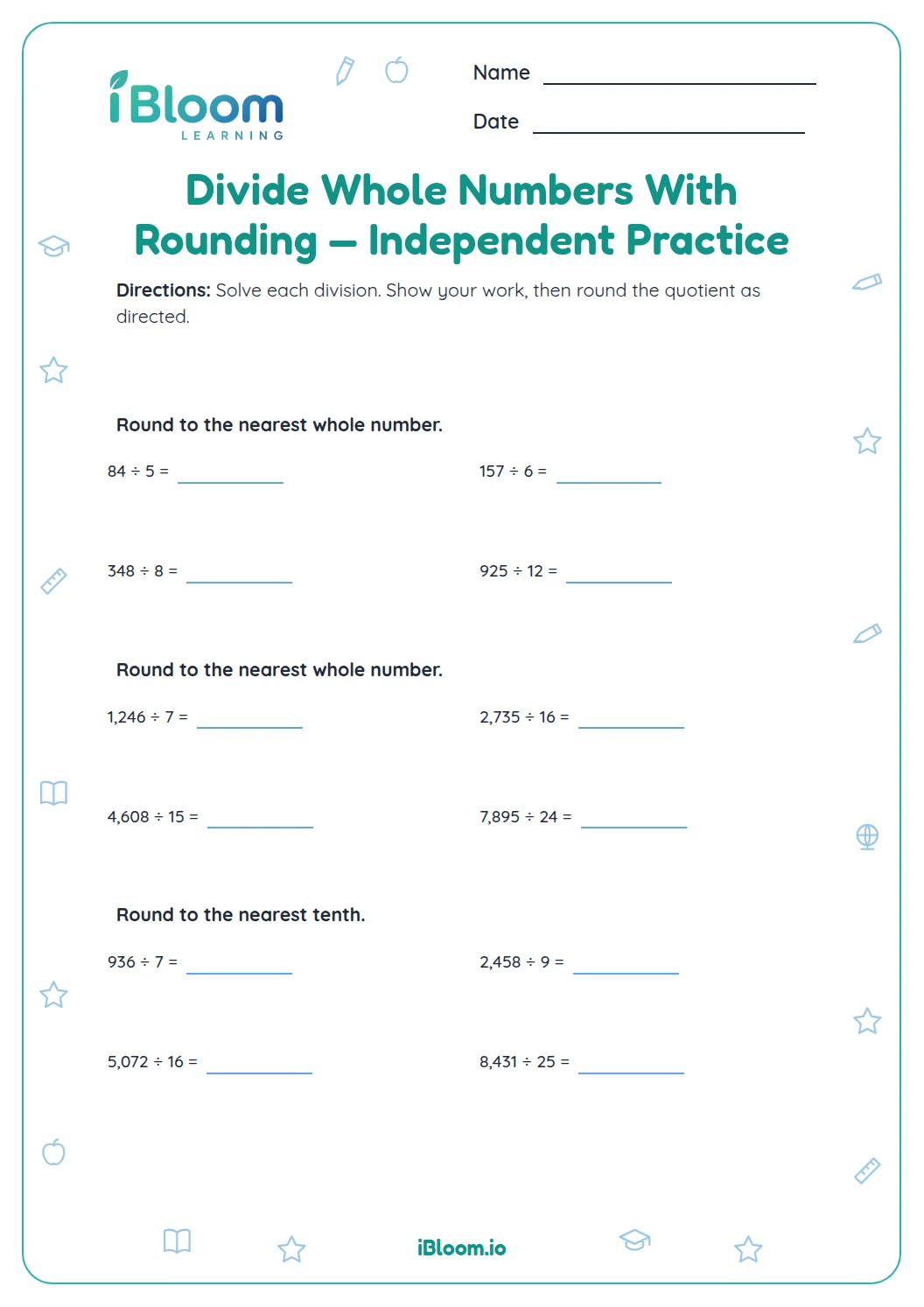
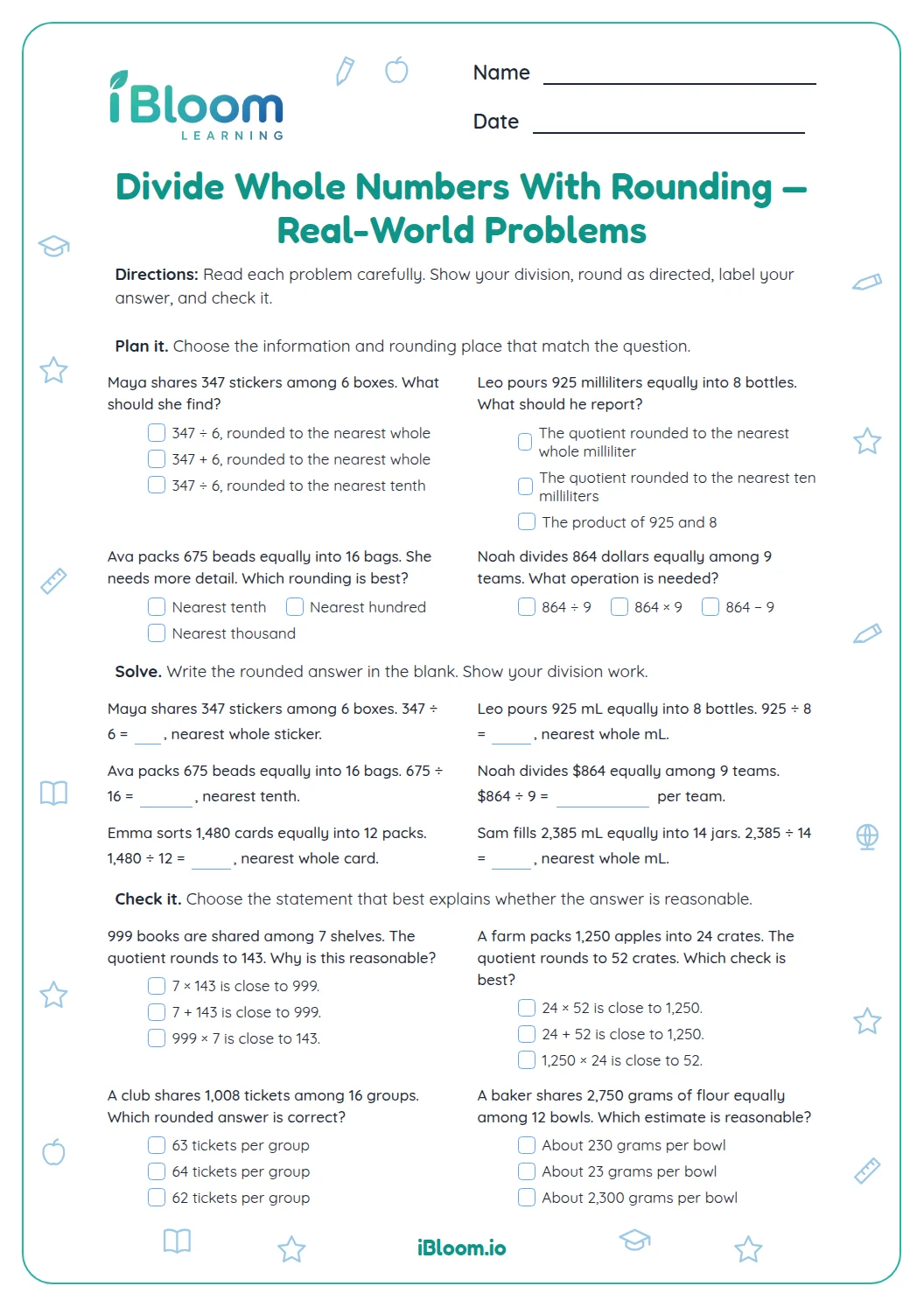
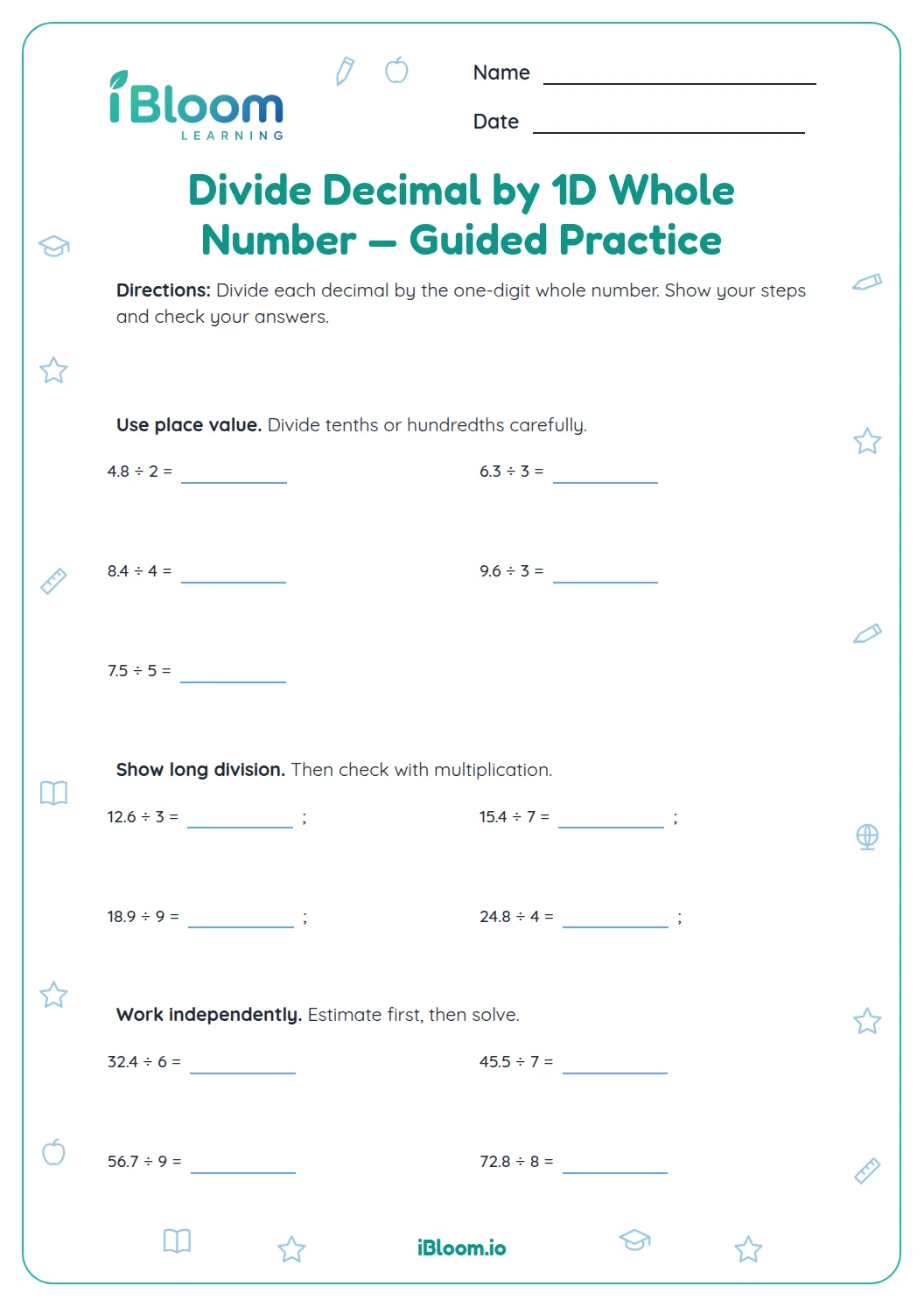
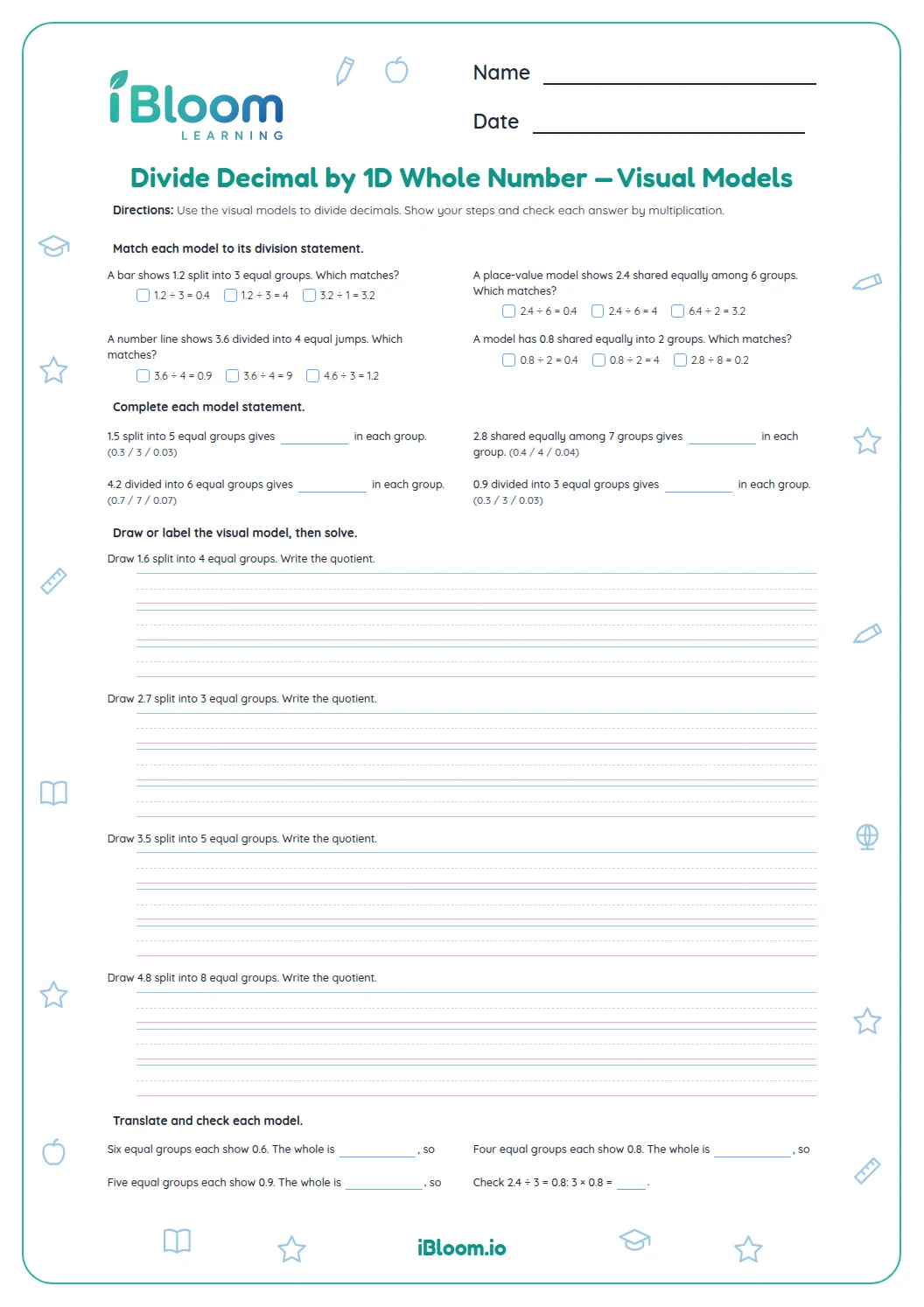
This free printable Grade 5 worksheet practices division and rounding through 16 problems. Students interpret equal-group descriptions, use quotient models, and round the result to the nearest whole number. The replacement sheet makes the models visible with arrays and number lines instead of relying only on text descriptions. A separate answer key includes the rounded results. The division work connects to CCSS 5.NBT.B.6, which asks students to find whole-number quotients and illustrate or explain calculations with equations, arrays, or area models.
Aligned to 5.NBT.B.6
How do models show the quotient?
The first four problems connect equal groups or number-line positions to division statements. In question 1, four groups of six make 24, with two more objects left over: 26 ÷ 6 = 4 R2, or about 4.3, which rounds to 4.
The next problems place quotients between whole numbers. For example, 42 ÷ 5 = 8.4 lies between 8 and 9 and is closer to 8.
- 142 ÷ 5 = 8.4
- 28.4 is less than halfway from 8 to 9.
- 3Rounded to the nearest whole number: 8.
How do you round a quotient?
Find the quotient first, then compare its decimal part with one half. A quotient below the midpoint rounds down; one at or above the midpoint rounds up. The number line helps show that distance.
How can a student check the result?
Multiply the divisor by the unrounded quotient when it is exact, or use a nearby whole-number estimate to check the division. Keep the exact quotient distinct from its rounded whole-number answer.
How to use this worksheet
- 1Read the directions and scan the whole part.
- 2Underline or name the information that matters.
- 3Choose a strategy and show the calculation.
- 4Write a complete answer with its unit when needed.
- 5Check the answer key and correct any missed step.
Common mistakes and quick fixes
The mistake
Starting to calculate before identifying what the prompt asks.
The fix
Say the unknown aloud, then choose the operation that finds it.
The mistake
Leaving off a unit or context label.
The fix
Reread the question and include the requested unit in the answer.
The mistake
Accepting an answer without checking it.
The fix
Use the inverse operation or estimate to see whether the result makes sense.
Common Core alignment
This worksheet practices the following Common Core skill.
Find whole-number quotients of whole numbers with up to four-digit dividends and two-digit divisors, using s
On this sheet:
Show the official wordingHide the official wording
Find whole-number quotients of whole numbers with up to four-digit dividends and two-digit divisors, using strategies based on place value, the properties of operations, and/or the relationship between multiplication and division. Illustrate and explain the calculation by using equations, rectangular arrays, and/or area models.
What to practice next
Make more practice
Further reading
Questions parents and teachers ask
How many problems are on the visual-model worksheet?
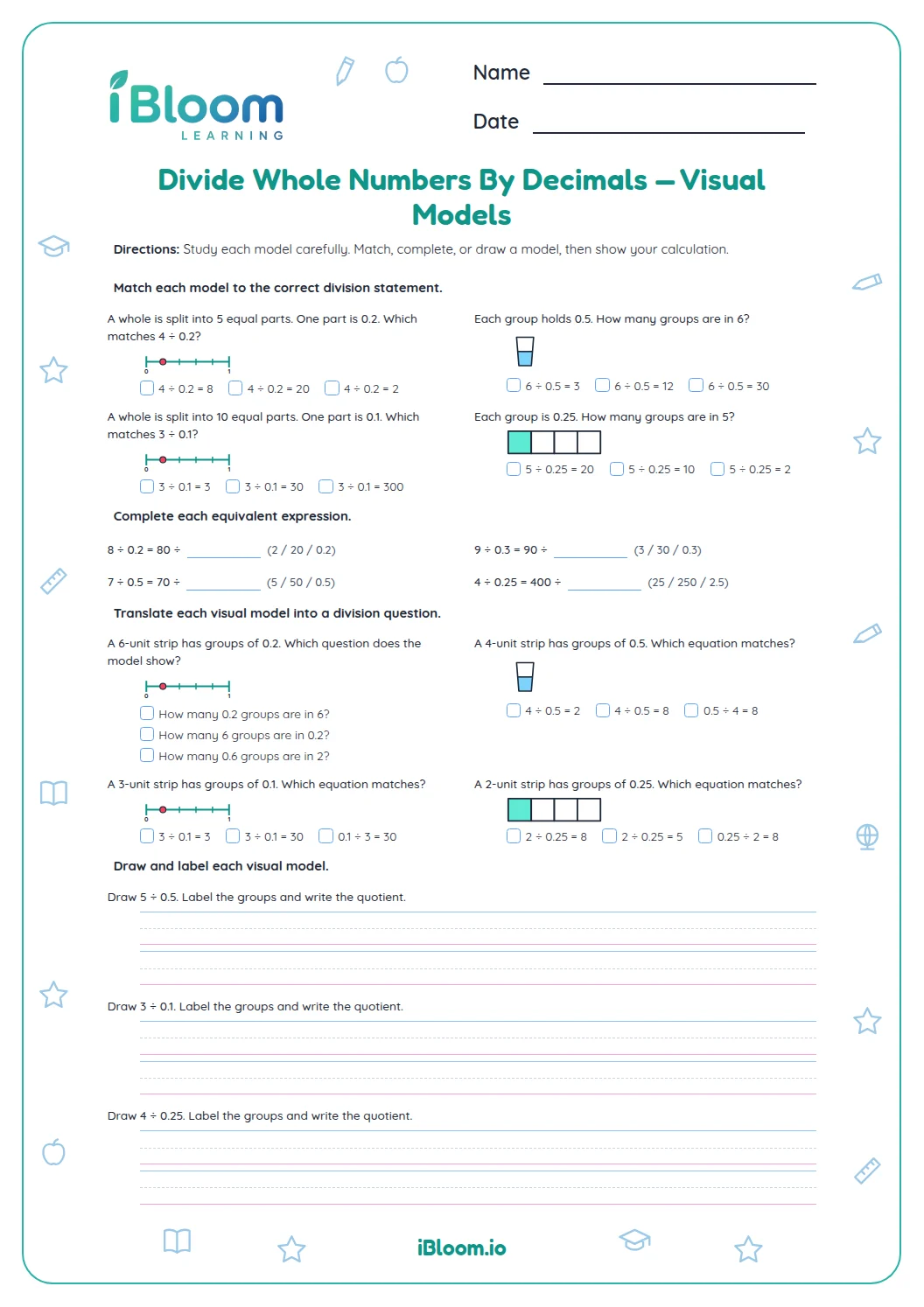
There are 16 problems across model matching, quotient rounding, and model-based division. Arrays and number lines help students connect equal groups or a quotient’s position to the division expression. The worksheet uses both visual and equation-based reasoning. Students work through the model and calculation before rounding.
How does a number line help round a quotient?
It shows the quotient’s distance from the two neighboring whole numbers. For 42 ÷ 5 = 8.4, 8.4 is closer to 8 than to 9, so it rounds to 8. The same nearest-whole-number rule applies to the other quotients. Comparing the distances is the key rounding step.
What is the answer to 19 ÷ 4 rounded to a whole number?
The exact quotient is 4.75. Since 4.75 is closer to 5 than to 4, the rounded answer is 5. The answer key gives both the rounded result and exact quotient for each calculation. Students should keep the unrounded quotient in their work.
Are visual models printed on the replacement sheet?
Yes. The replacement uses actual template arrays and number lines to make groups and quotient positions visible. The old sheet described a table, grouping model, number line, and place-value model in words; the revised page provides drawn models for students to read.
Which standard does the worksheet practice?
It aligns with CCSS 5.NBT.B.6, which includes finding whole-number quotients and illustrating or explaining calculations with equations, arrays, or area models. Students use division models and written calculations, then round the quotient. The models support the calculation rather than replace it.