



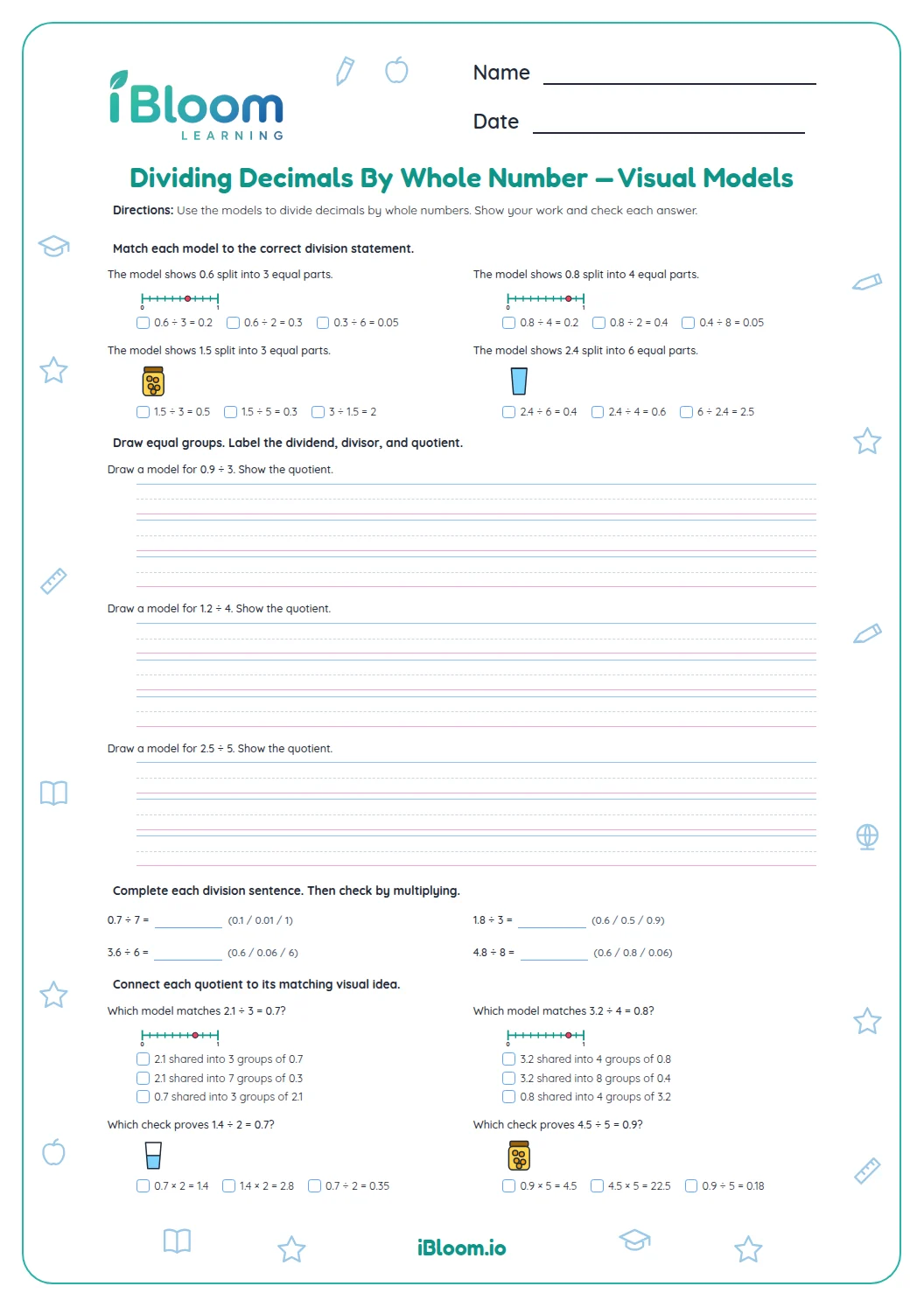

About this worksheet
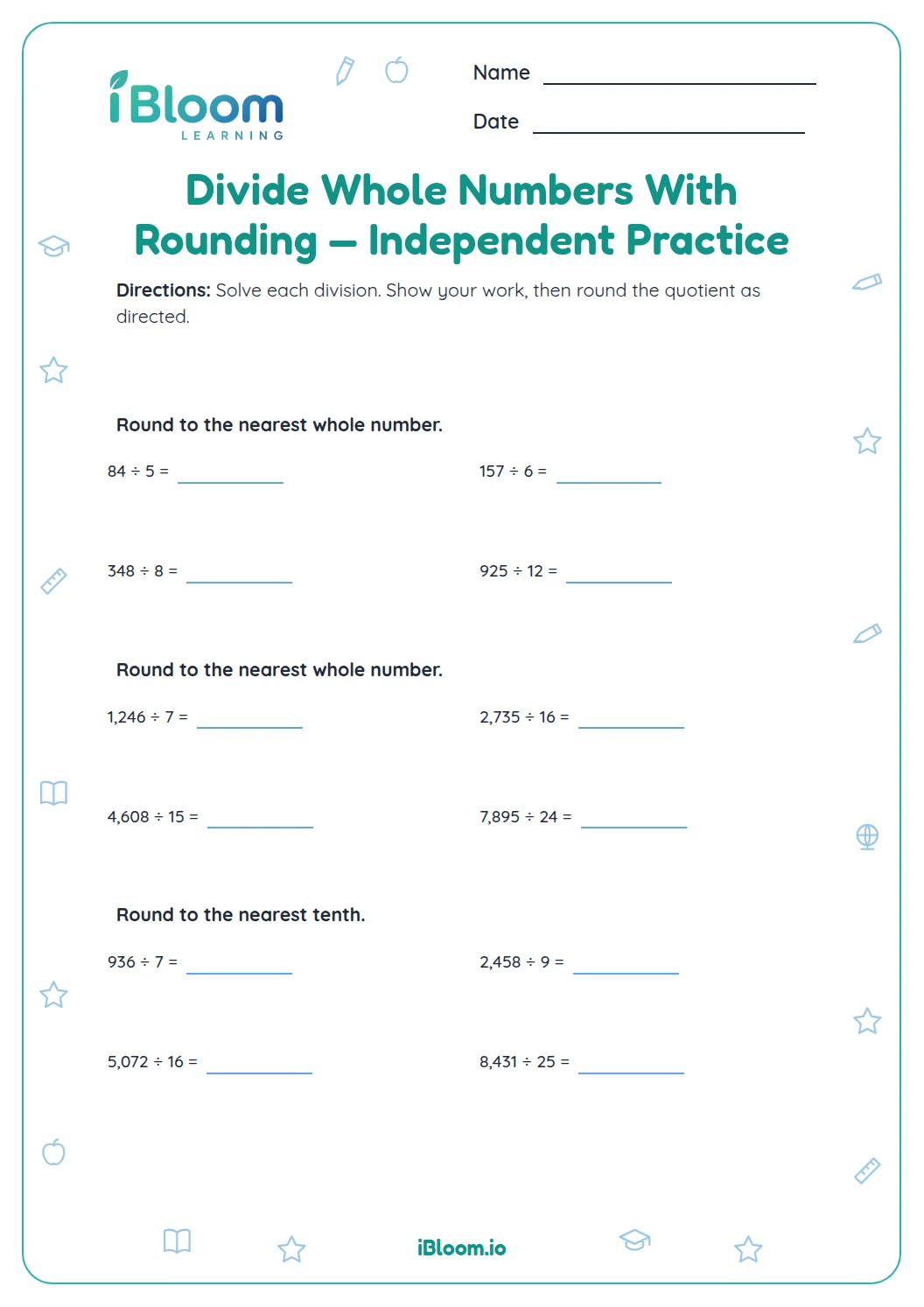
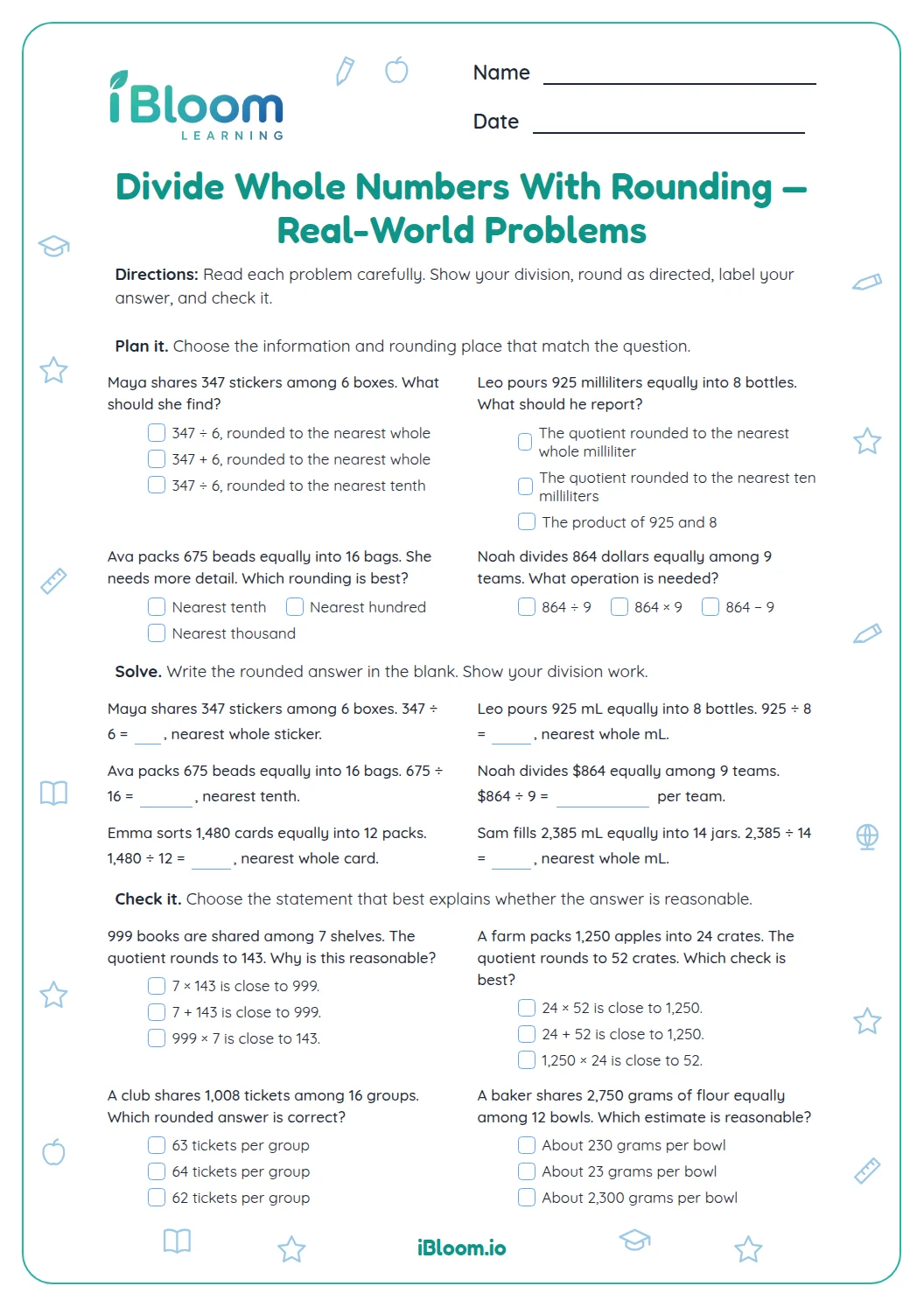
This Grade 5 reasoning challenge asks students to divide whole numbers and round each quotient only to the place named. Four claim checks are followed by six calculations and four explanation or application prompts. The problems practice whole-number division and decimal reasoning in line with CCSS 5.NBT.B.6, with a separate answer key.
Aligned to 5.NBT.B.6
How do you find a quotient before rounding?
Compute the division as accurately as the problem requires, then round to the named place. For 943 ÷ 6, the quotient is 157.166..., so the tenths digit is 1 and the hundredths digit is 6.
Because the hundredths digit is 5 or greater, 157.1 rounds up to 157.2.
- 1943 ÷ 6 = 157.166…
- 2Nearest tenth: 157.2
How can you evaluate a rounding claim?
Check both the division and the rounding step. In Question 3, 360 ÷ 16 = 22.5; to the nearest whole number, 22.5 rounds to 23.
How can a context change the answer?
A team-size question may need a whole number because people are counted in whole students. Explain what the rounded value means in its situation.
How to use this worksheet
- 1Read the requested rounding place before calculating.
- 2Estimate the quotient to check its size.
- 3Divide and keep enough digits to round correctly.
- 4Use the digit right of the named place.
- 5For a claim, decide whether the division or rounding step is incorrect.
- 6Explain what a rounded answer means in the story.
Common mistakes and quick fixes
The mistake
Rounding before dividing.
The fix
Find the quotient first, then round the quotient.
The mistake
Looking at the digit in the rounding place itself.
The fix
Check the digit immediately to its right.
The mistake
Rounding every answer to the nearest whole.
The fix
Follow the place named in each prompt, such as nearest tenth.
Common Core alignment
Students divide whole numbers and explain their calculations.
Divide whole numbers using place value and the relationship between operations.
On this sheet: Divide whole numbers using place value and the relationship between operations.
Show the official wordingHide the official wording
Find whole-number quotients of whole numbers with up to four-digit dividends and two-digit divisors, using strategies based on place value, the properties of operations, and/or the relationship between multiplication and division. Illustrate and explain the calculation by using equations, rectangular arrays, and/or area models.
What to practice next
Make more practice
Further reading
Questions parents and teachers ask
What does rounding a quotient mean?
Find the quotient first, then round it to the place named in the question. For example, 943 ÷ 6 is about 157.166…, so the tenths digit is 1 and the hundredths digit is 6. To the nearest tenth, the quotient is 157.2.
How many questions are included?
There are 14 questions: four claim checks, six quotient calculations, and four explanation or application items. They ask students to check arithmetic, round to a named place, and make sense of a quotient in context. The separate answer key gives answers and sample reasoning.
How do you round to the nearest tenth?
Keep one digit after the decimal point and inspect the hundredths digit. If it is 5 or greater, increase the tenths digit by one; otherwise leave it unchanged. In 157.166…, the hundredths digit is 6, so 157.1 rounds up to 157.2.
Why do some prompts ask students to explain?
An explanation shows whether the student divided accurately and used the requested rounding place. It also connects the result to the question, such as deciding what a quotient means for students sharing among teams. Written responses can vary; the key provides sample reasoning.
How should the bus team problem be answered?
Divide 725 students among 16 teams: 725 ÷ 16 = 45.3125. Rounded to the nearest whole number, that is about 45 students per team. The word about matters because an equal split cannot put a fraction of a student on a team.