




About this worksheet
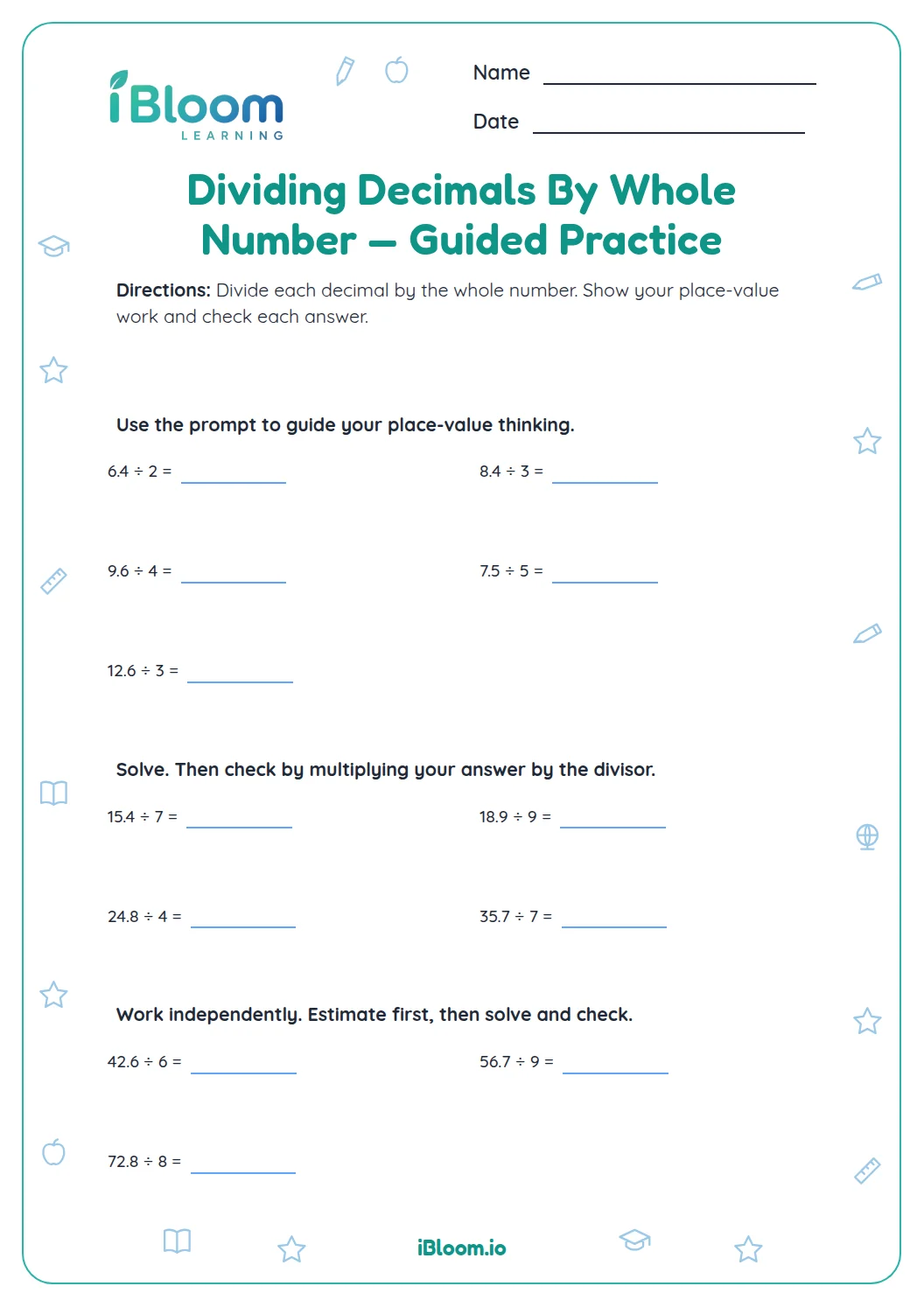
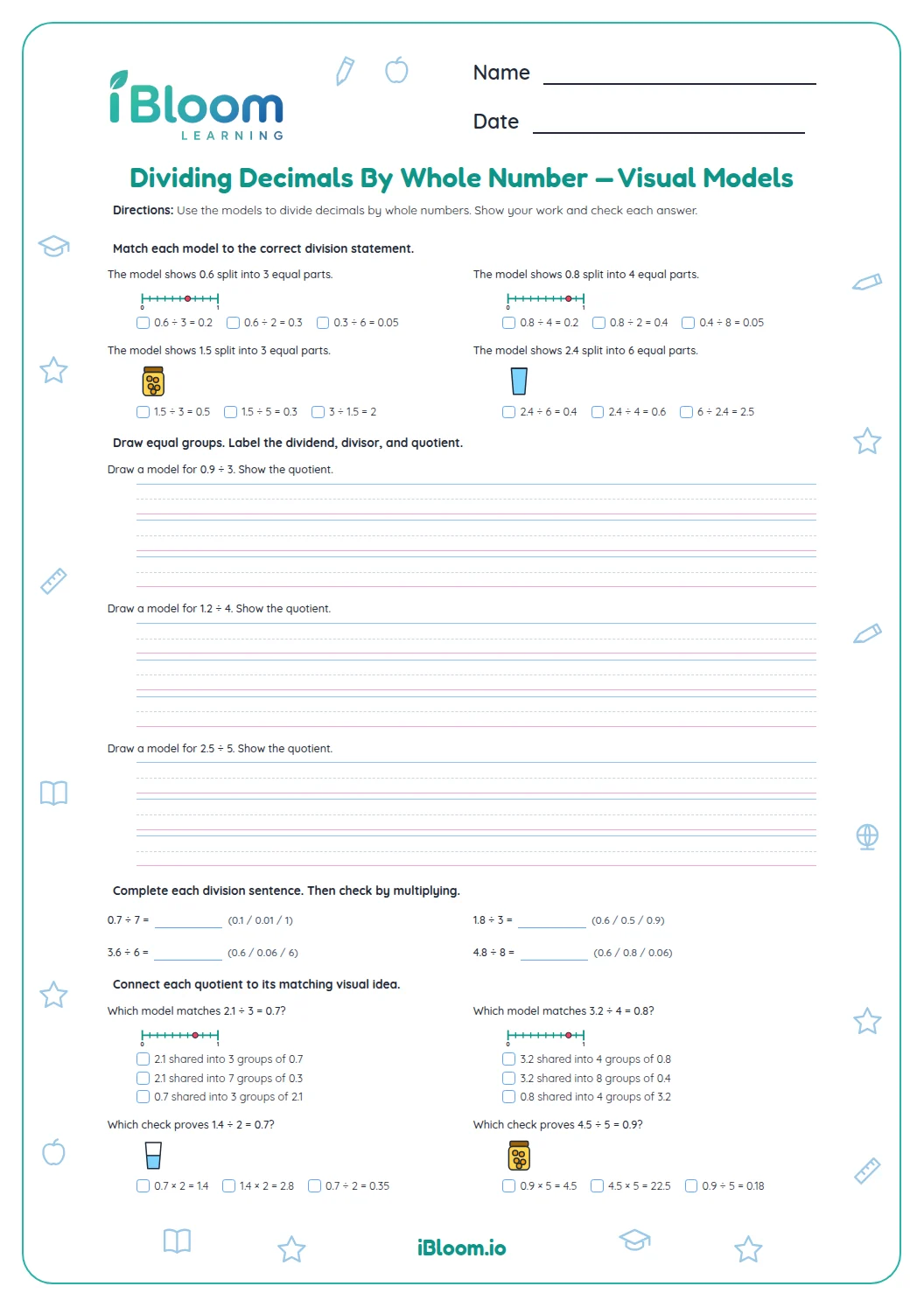
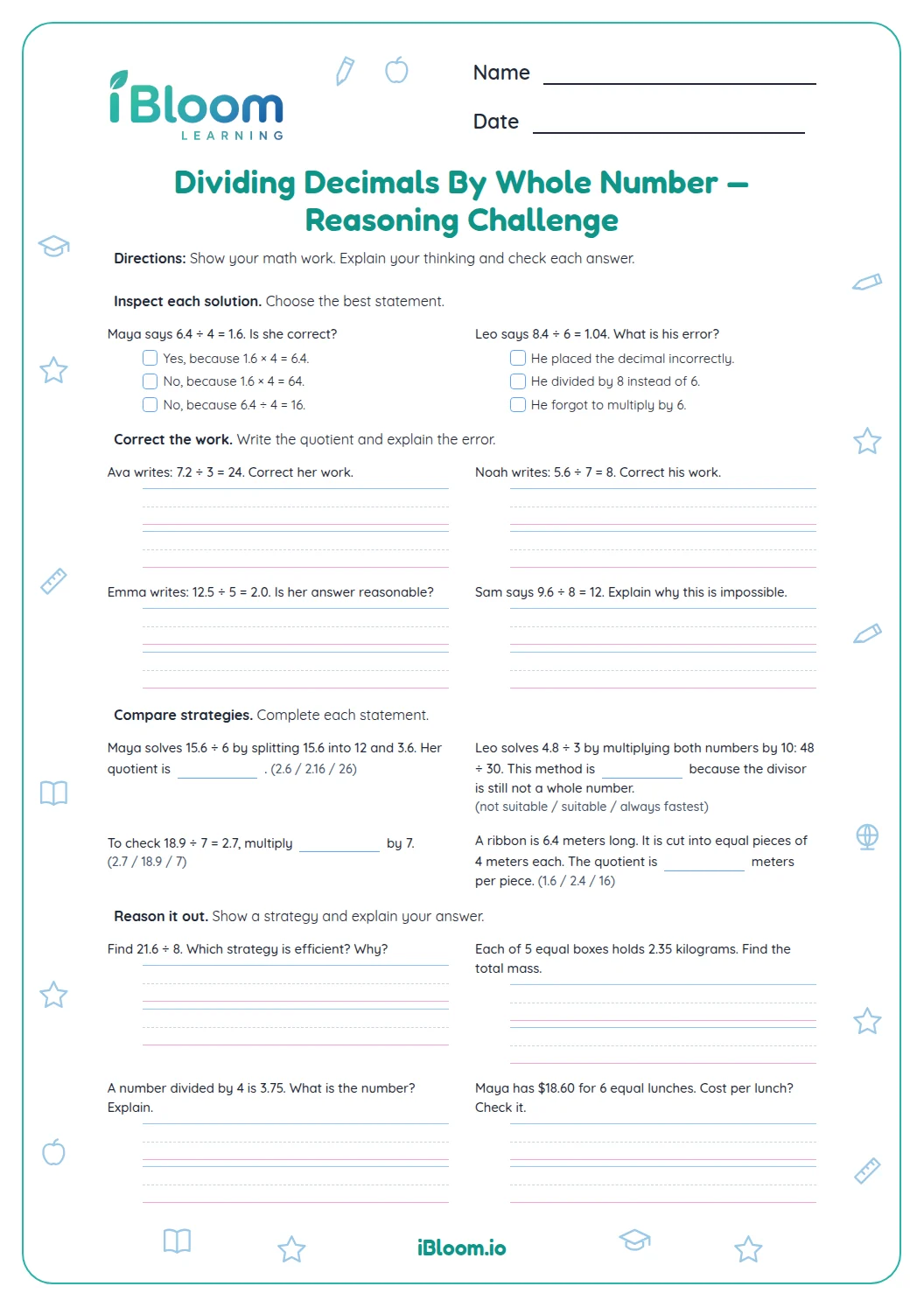
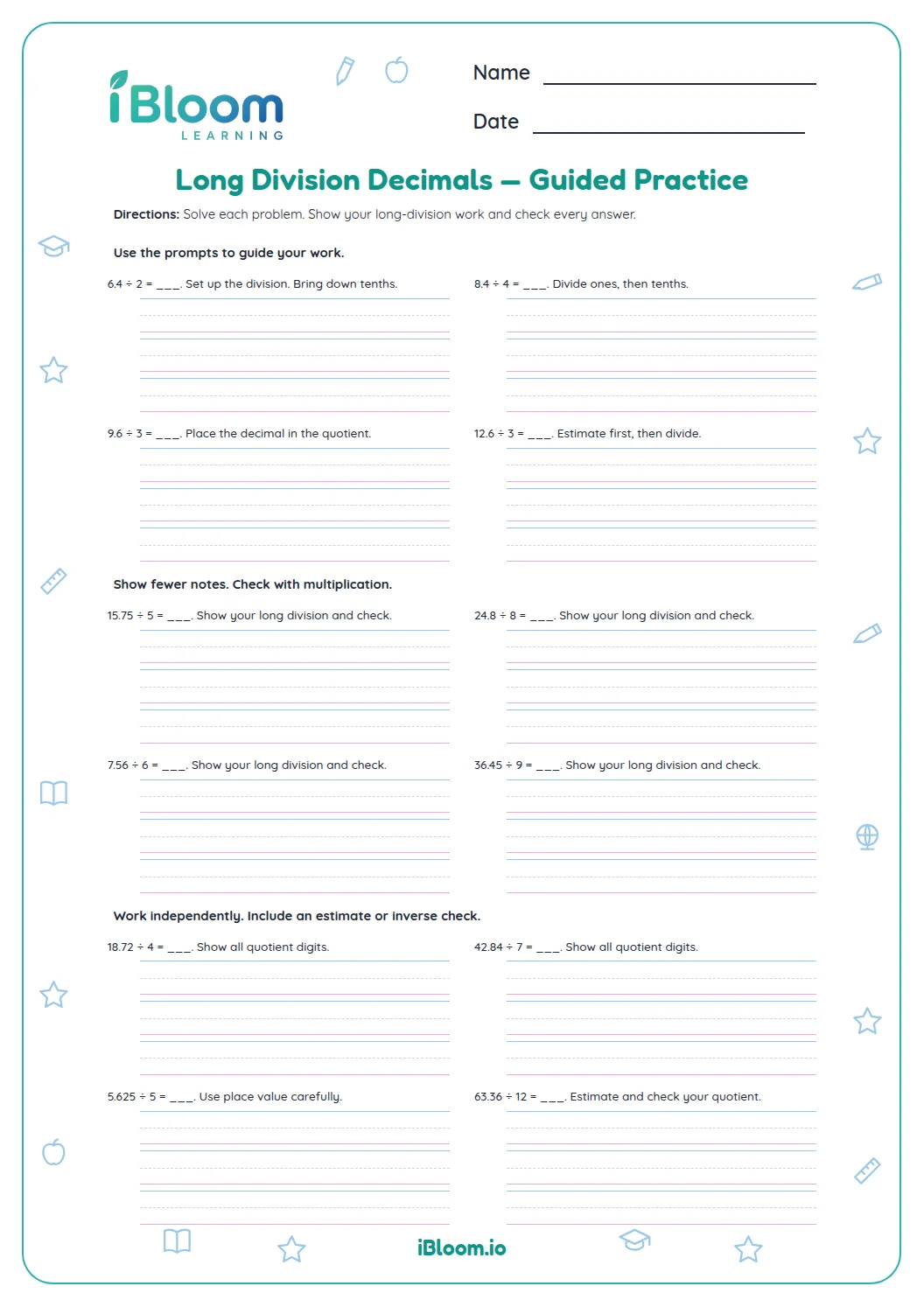
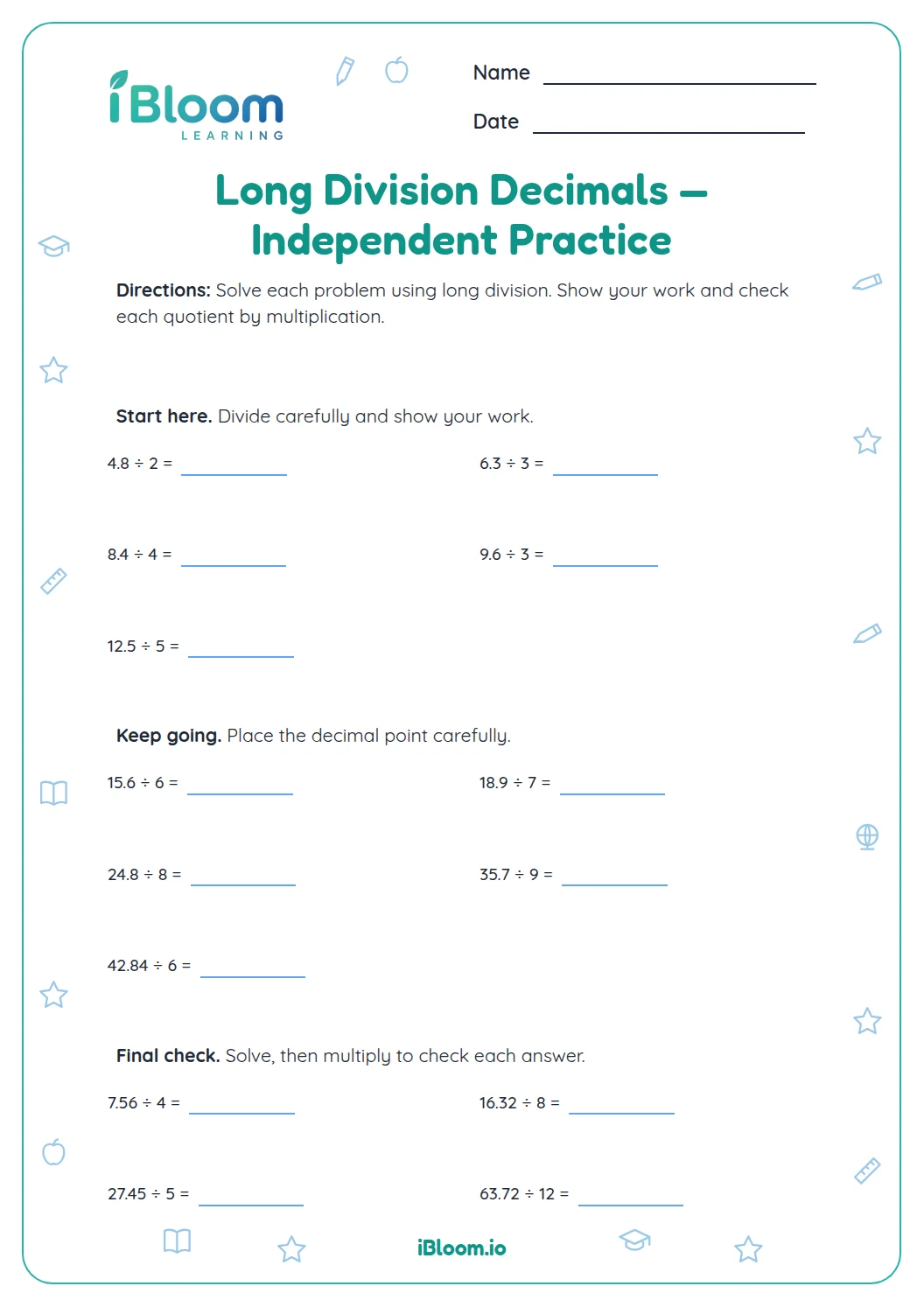
This free printable Grade 5 worksheet helps students practice decimal division foundations. It aligns with Common Core 5.NBT.B.7: divide decimals to hundredths using place value, models, and multiplication checks. The sheet moves from supported models into independent practice and applied problems. A separate answer key gives concise answers for checking each item.
Aligned to 5.NBT.B.7
What does a decimal quotient mean?
Division shares an amount into equal groups. In question 1, 4.8 ÷ 2 means sharing 4 ones and 8 tenths between 2 groups. Each group gets 2 ones and 4 tenths, or 2.4.
- 14.8 = 4 ones and 8 tenths
- 2Share each part between 2 groups.
- 3Each group gets 2 ones and 4 tenths: 2.4.
- 4Check: 2.4 × 2 = 4.8.
How do you keep the decimal places in order?
Rename the dividend in tenths or hundredths when that makes sharing easier. Keep each place value aligned in the quotient; for example, 4.32 ÷ 4 gives 1 whole and 8 hundredths, or 1.08.
How can multiplication check division?
Multiply the quotient by the divisor. The product should equal the starting decimal. Include a unit when the dividend describes a measurement, as in the ribbon problem.
How to use this worksheet
- 1Read the part heading and directions before starting.
- 2Work through Part A slowly, naming the place or operation involved.
- 3Use Part B to explain or check a strategy before writing an answer.
- 4Finish Part C independently and show calculations where space is provided.
- 5Compare each result with the answer key and correct the first step that changed the answer.
Common mistakes and quick fixes
The mistake
Dropping the decimal point in the quotient.
The fix
Line up place values and place the decimal point in the quotient above the dividend point.
The mistake
Treating tenths as whole units.
The fix
Rename the decimal in tenths and share those tenths equally.
The mistake
Accepting a quotient without checking its size.
The fix
Multiply the quotient by the divisor and compare with the original dividend.
Common Core alignment
This practice connects each question to a concrete grade-level math skill.
Divide decimals to hundredths using place value, models, and multiplication checks.
On this sheet: Divide decimals to hundredths using place value, models, and multiplication checks.
Show the official wordingHide the official wording
Add, subtract, multiply, and divide decimals to hundredths, using concrete models or drawings and strategies based on place value, properties of operations, and/or the relationship between addition and subtraction; relate the strategy to a written method and explain the reasoning used.
What to practice next
Make more practice
Further reading
Questions parents and teachers ask
What does a decimal quotient mean?
A quotient tells how much is in each equal group. For question 1, sharing 4.8 between 2 groups gives 2.4 in each group. Check by multiplying: 2.4 × 2 returns the starting amount, 4.8. Matching question numbers make checking each response straightforward.
How many questions are on this worksheet?
The worksheet has 14 questions in three parts: five one-decimal quotients, four equal-group and multiplication-check questions, and five decimal computations or applications. It includes divisions with tenths and hundredths and a separate answer key. Matching question numbers make checking each response straightforward.
How can multiplication check a division answer?
Multiply the quotient by the whole-number divisor. For question 10, 1.05 × 5 = 5.25, which matches the dividend. If the product does not match, check the quotient digits and decimal-point placement. Matching question numbers make checking each response straightforward.
Why is the answer to 4.32 ÷ 4 equal to 1.08?
Four groups of 1 whole use 4 of the 4 wholes, leaving 0 wholes. Share 32 hundredths among 4 groups: each gets 8 hundredths, so the quotient is 1.08. Multiplying 1.08 by 4 checks the result. Matching question numbers make checking each response straightforward.
Is an answer key included?
Yes. The separate answer key lists all 14 quotients and the correct equation choice. For story problems, it includes the unit so students can check both the amount in each group and what that amount measures. Matching question numbers make checking each response straightforward.