




About this worksheet
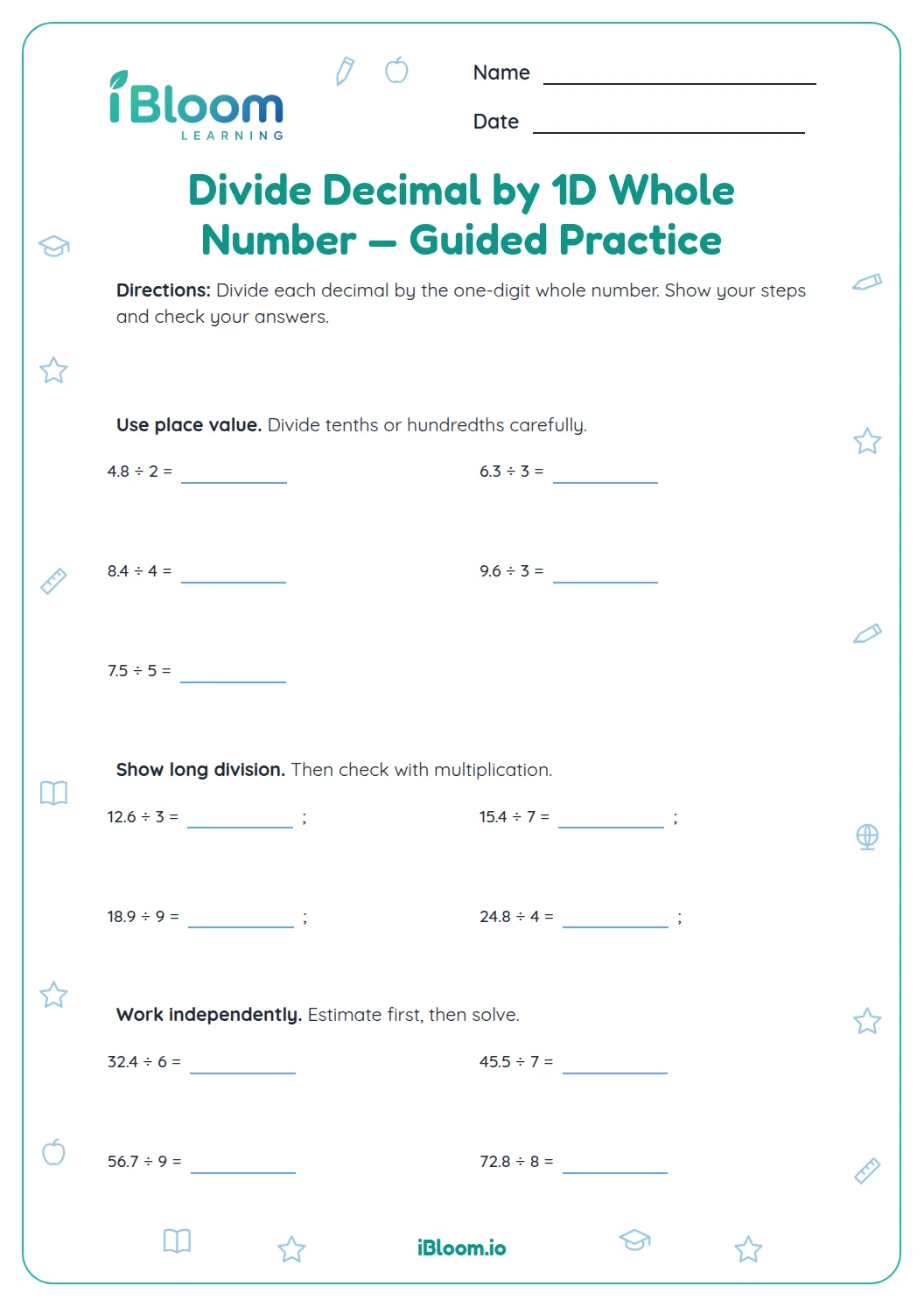
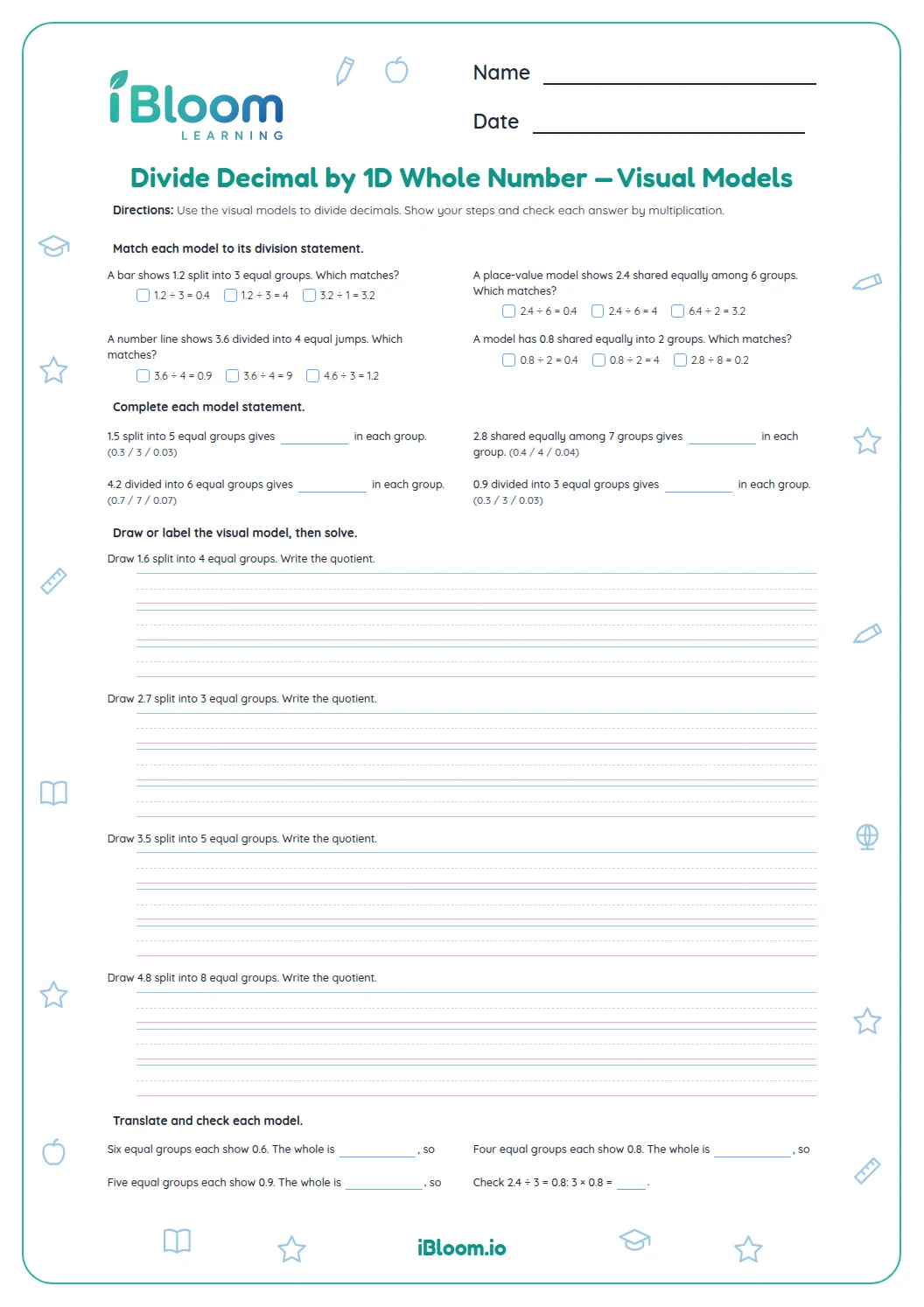
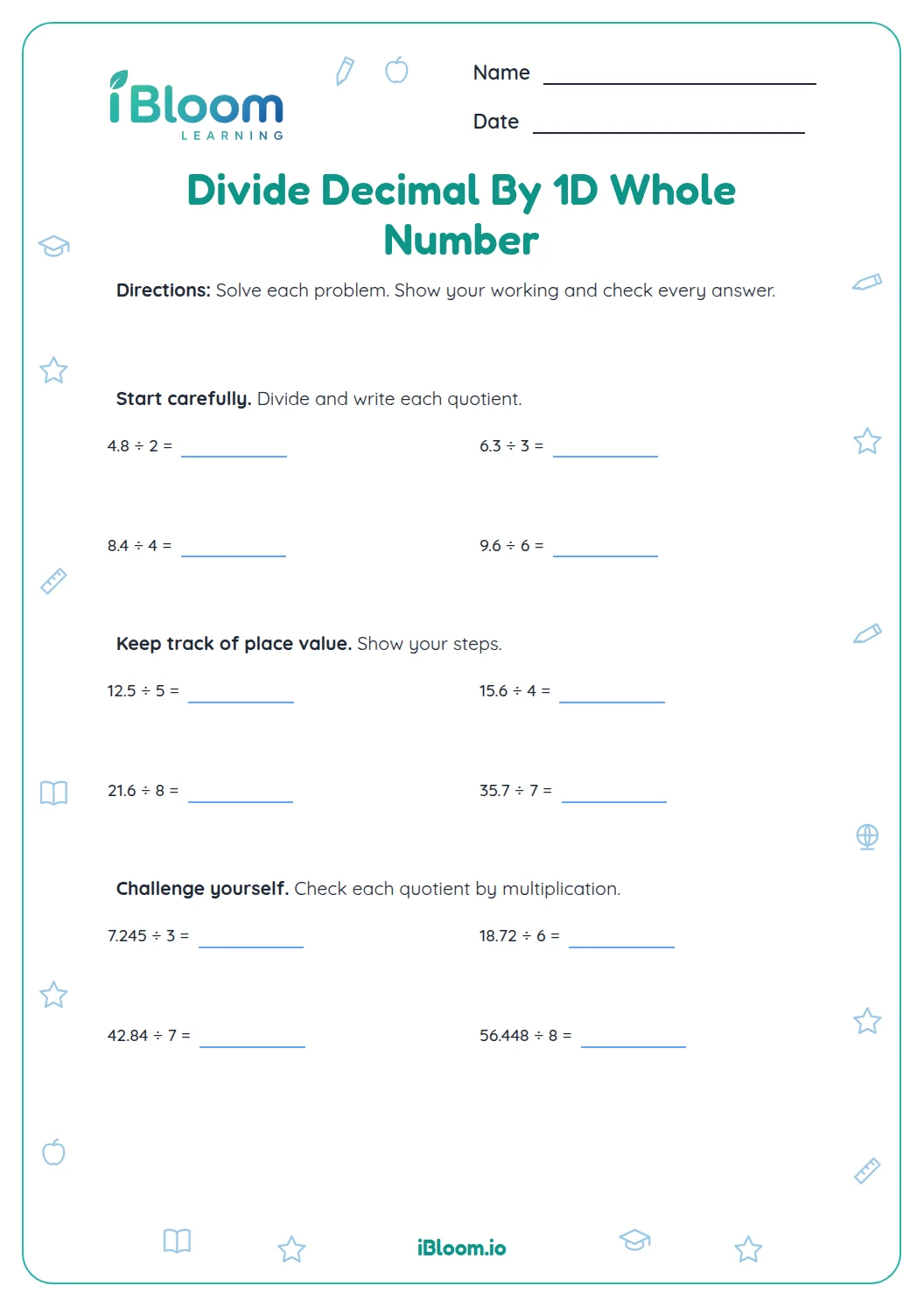
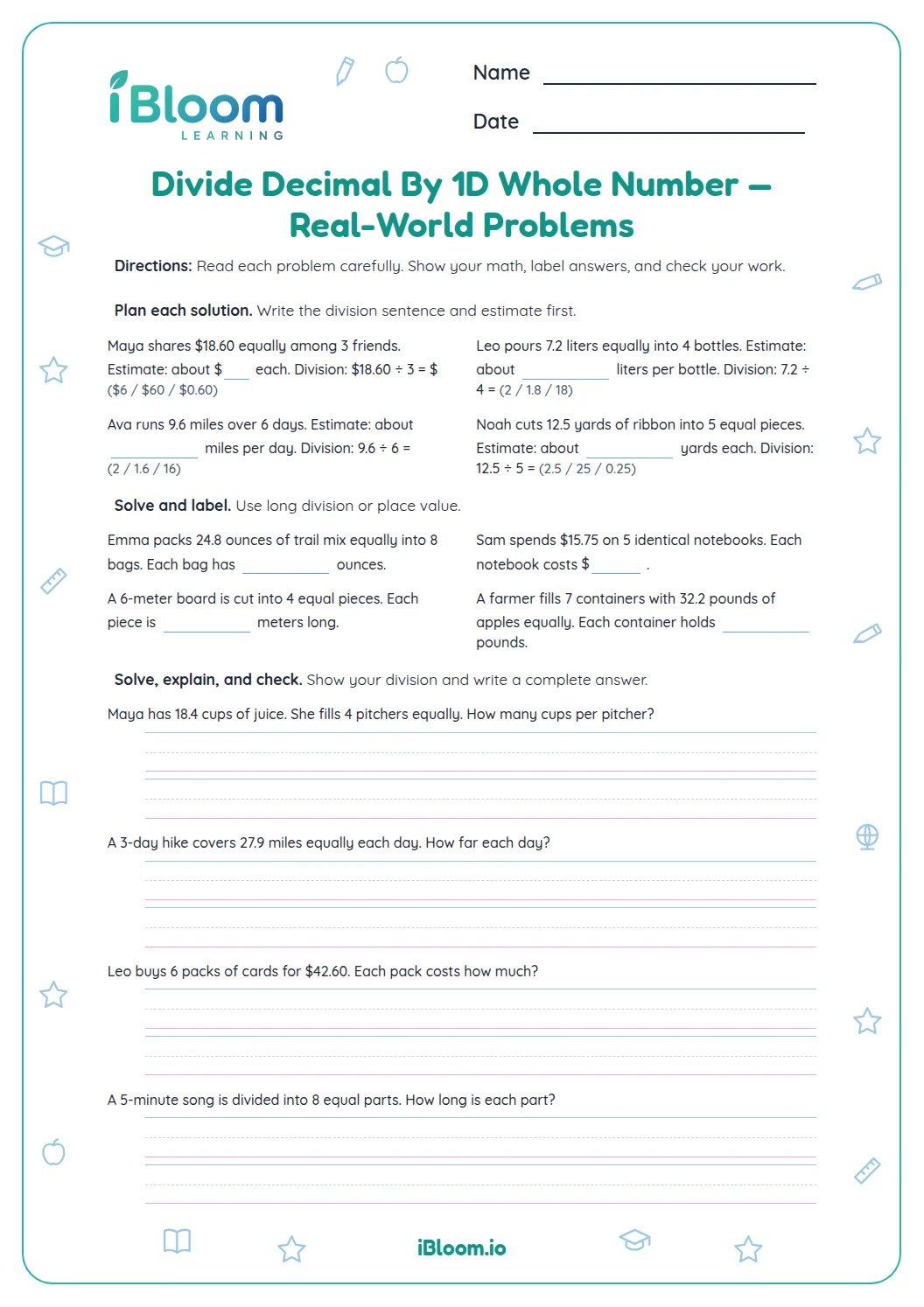
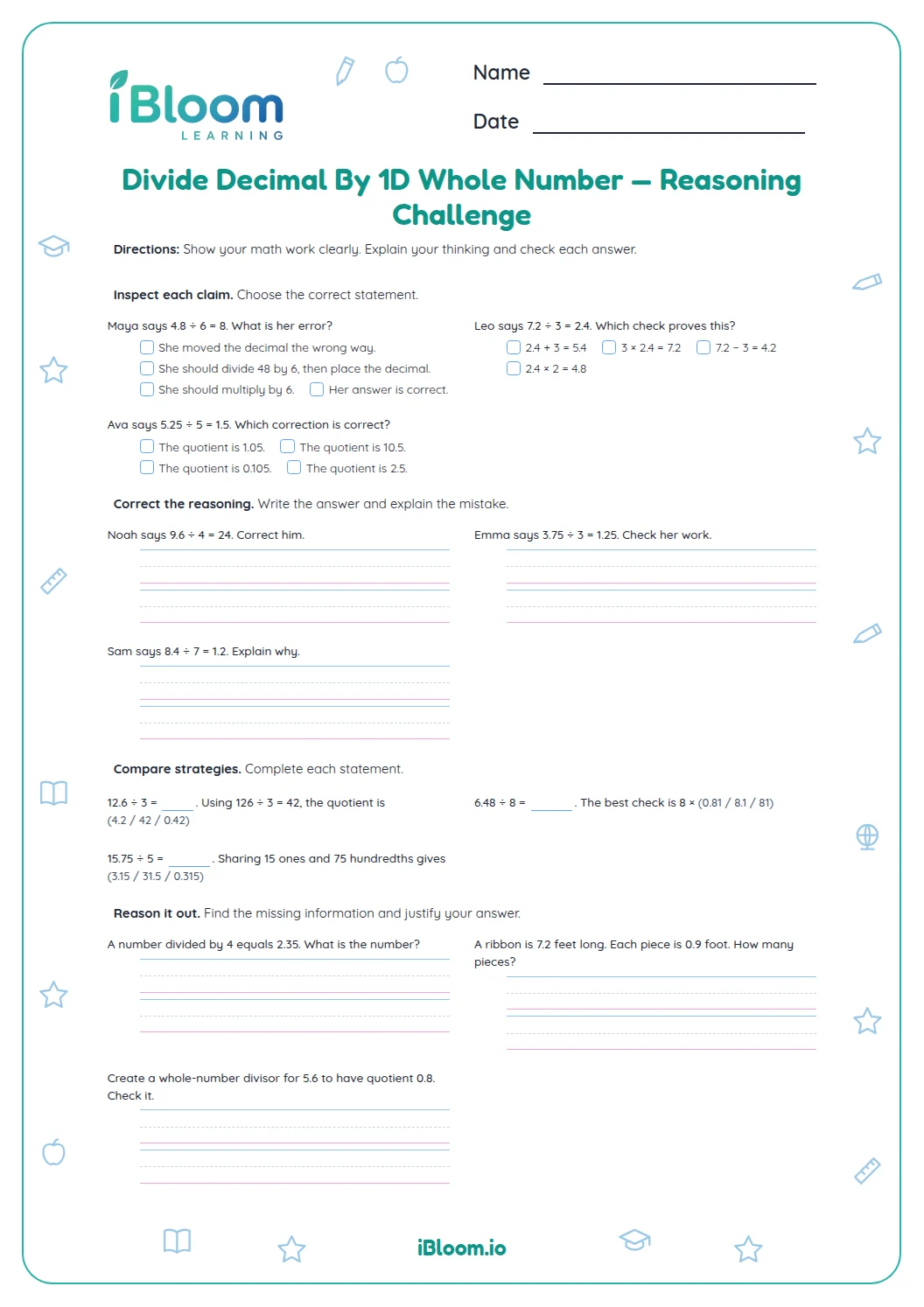
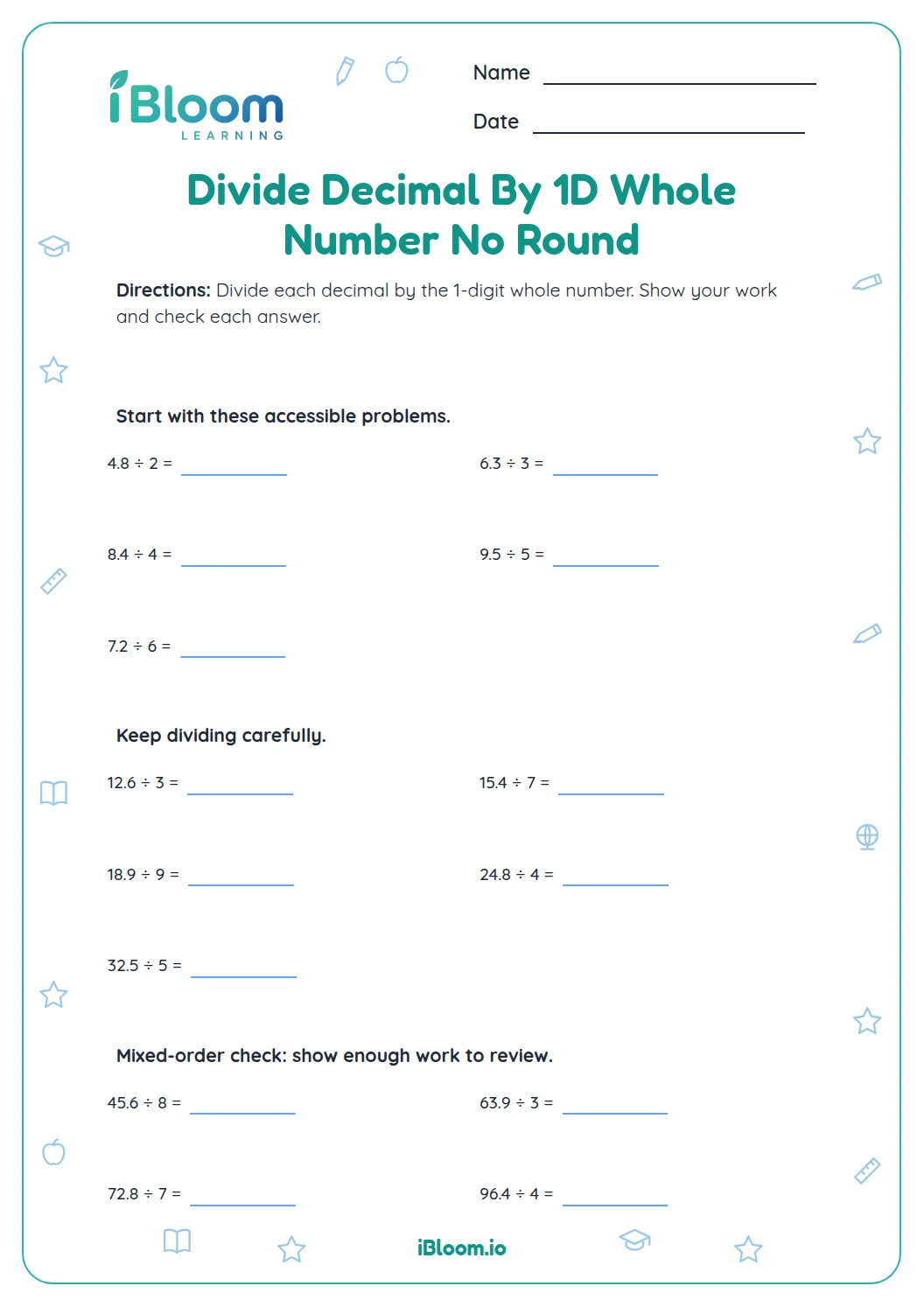
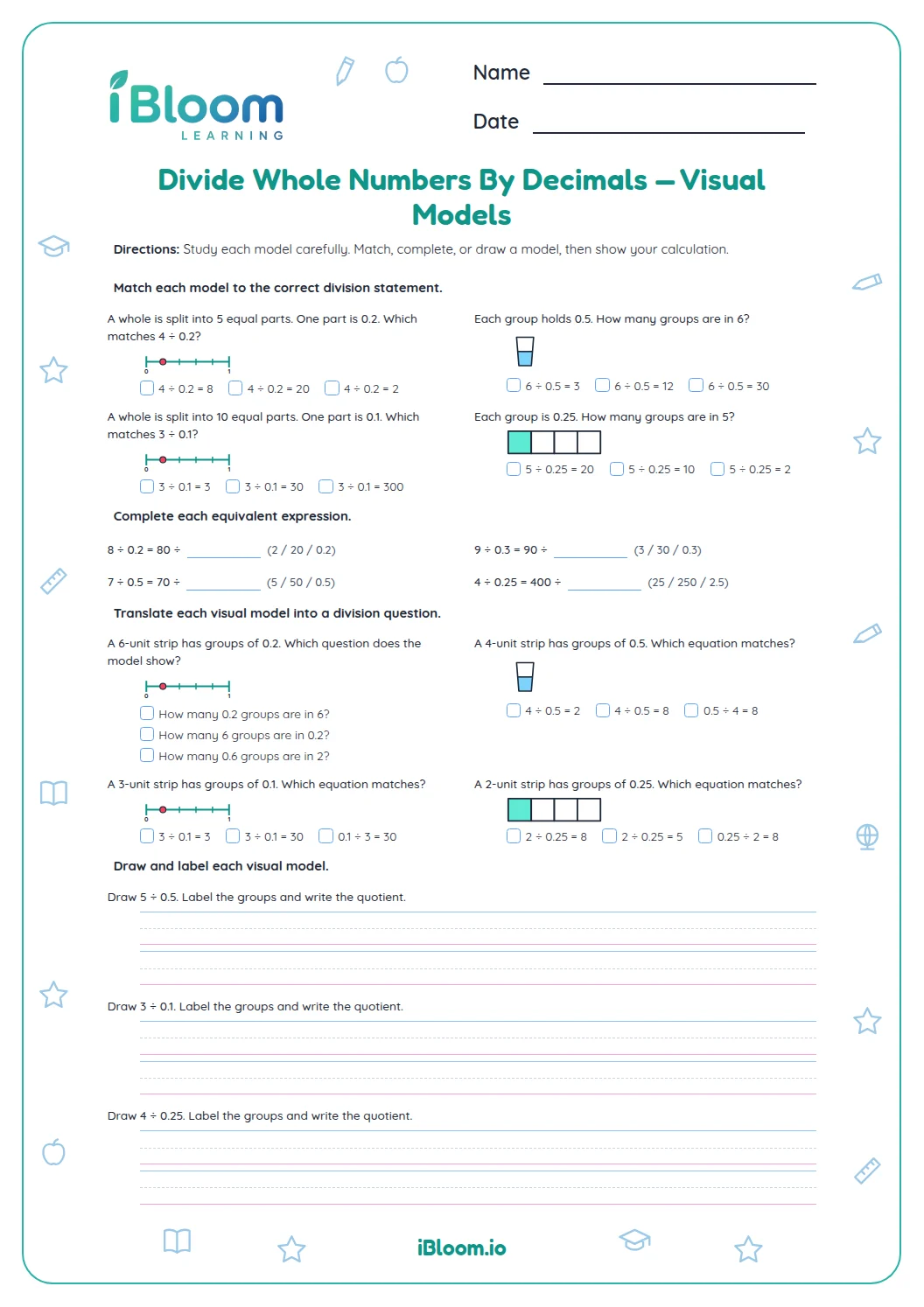
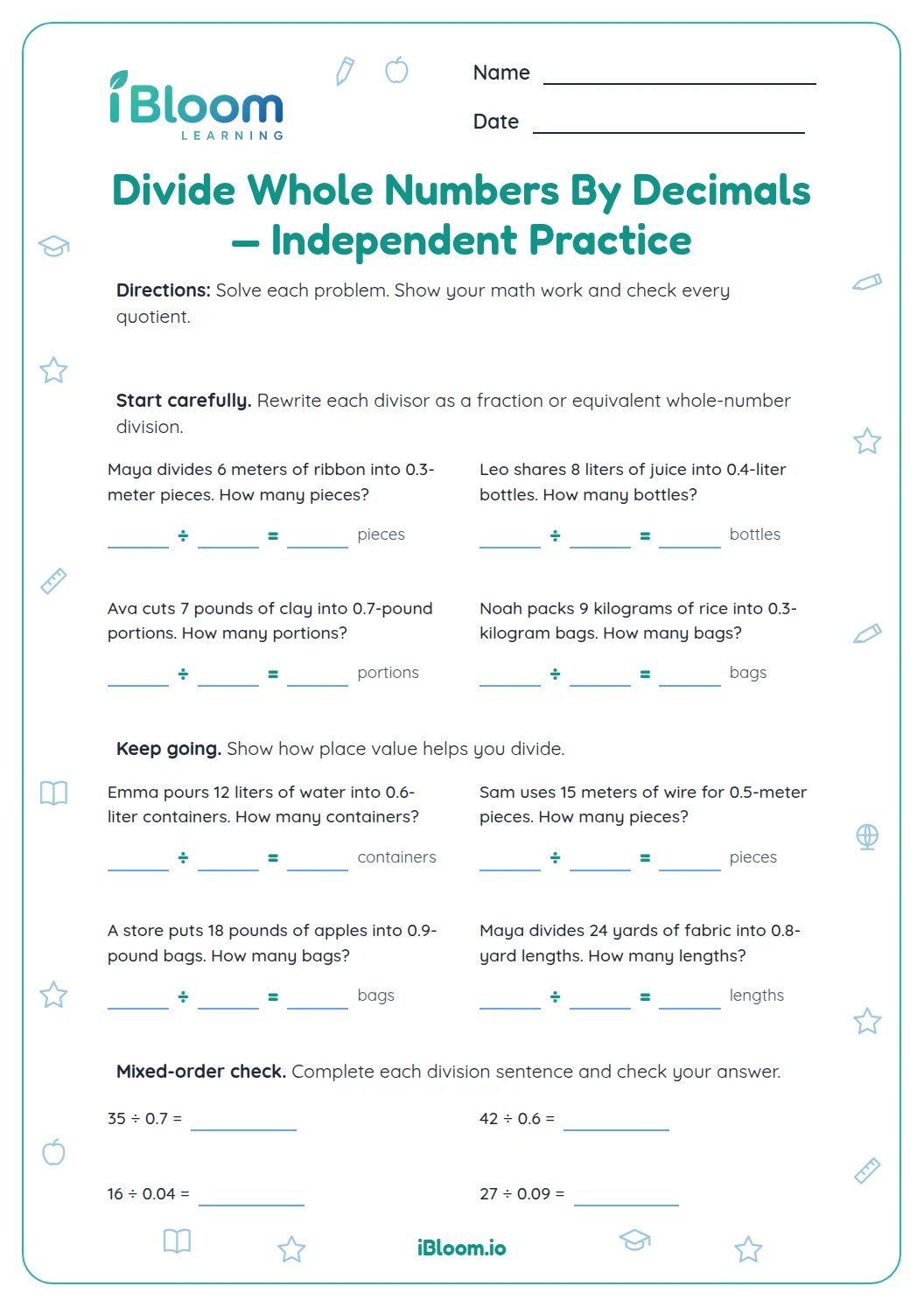
This free printable Grade 5 worksheet builds practice with divide decimal by 1d whole number - concept foundations. It practices 5.NBT.B.7. The pages include 16 questions in several formats and a separate answer key. Children can work through the parts in order, showing their thinking as they go.
Aligned to 5.NBT.B.7
Where does the decimal point go?
When dividing 4.8 by 2, think of 4.8 as 48 tenths. Dividing 48 tenths into two equal groups gives 24 tenths, or 2.4. The quotient keeps the dividend’s value.
How does the sheet build decimal division?
Questions 1–14 practice decimal quotients, including answers less than 1. The last two problems apply equal sharing to liters and meters, so include the unit in each answer.
Steps for dividing a decimal
- 1Estimate a quotient using nearby whole numbers.
- 2Divide the digits as you would in whole-number division.
- 3Place the decimal point in the quotient above the dividend’s point.
- 4Check by multiplying the quotient by the divisor.
- 5For sharing problems, attach the requested unit to the answer.
Decimal-division checks
The mistake
Putting the decimal point at the far right.
The fix
Place it in the quotient directly above the dividend’s point.
The mistake
Treating 3.6 as 36 wholes.
The fix
Read 3.6 as 36 tenths and preserve that value when sharing.
The mistake
Leaving off a unit in a context problem.
The fix
Label the quotient in liters or meters as the prompt asks.
Common Core alignment
Use place value to divide decimals to hundredths.
On this sheet: Children divide decimals by one-digit whole numbers and reason about equal sharing.
Show the official wordingHide the official wording
Add, subtract, multiply, and divide decimals to hundredths, using concrete models or drawings and strategies based on place value, properties of operations, and/or the relationship between addition and subtraction; relate the strategy to a written method and explain the reasoning used.
What to practice next
Make more practice
Further reading
Questions parents and teachers ask
How should a child use this worksheet?
Start with one item at a time. Read the direction, then look for the exact clue the question asks about. For a choice, compare every option before deciding. For a written response, use a complete thought and return to the story, model, or sentence to check it.
What is included with the printable?
The answer key is a separate checking tool. Let the learner finish a section before looking at it, then compare one response at a time. If an answer differs, reread the prompt and point to the evidence or calculation that supports a correction.
Can the practice be split into shorter sessions?
A short practice session can be split across the worksheet pages. Pause between parts to talk through one example, especially when moving from recognition to an explanation or a written answer. Resume with the next unanswered question, and return to missed items after a brief break.
What materials are helpful?
These questions focus on the named skill using varied item formats. Keep scratch paper nearby for computations or notes, and encourage the learner to explain how a clue, model, or sentence supports a response. Talking through one answer can help reveal which step needs another look.