




About this worksheet
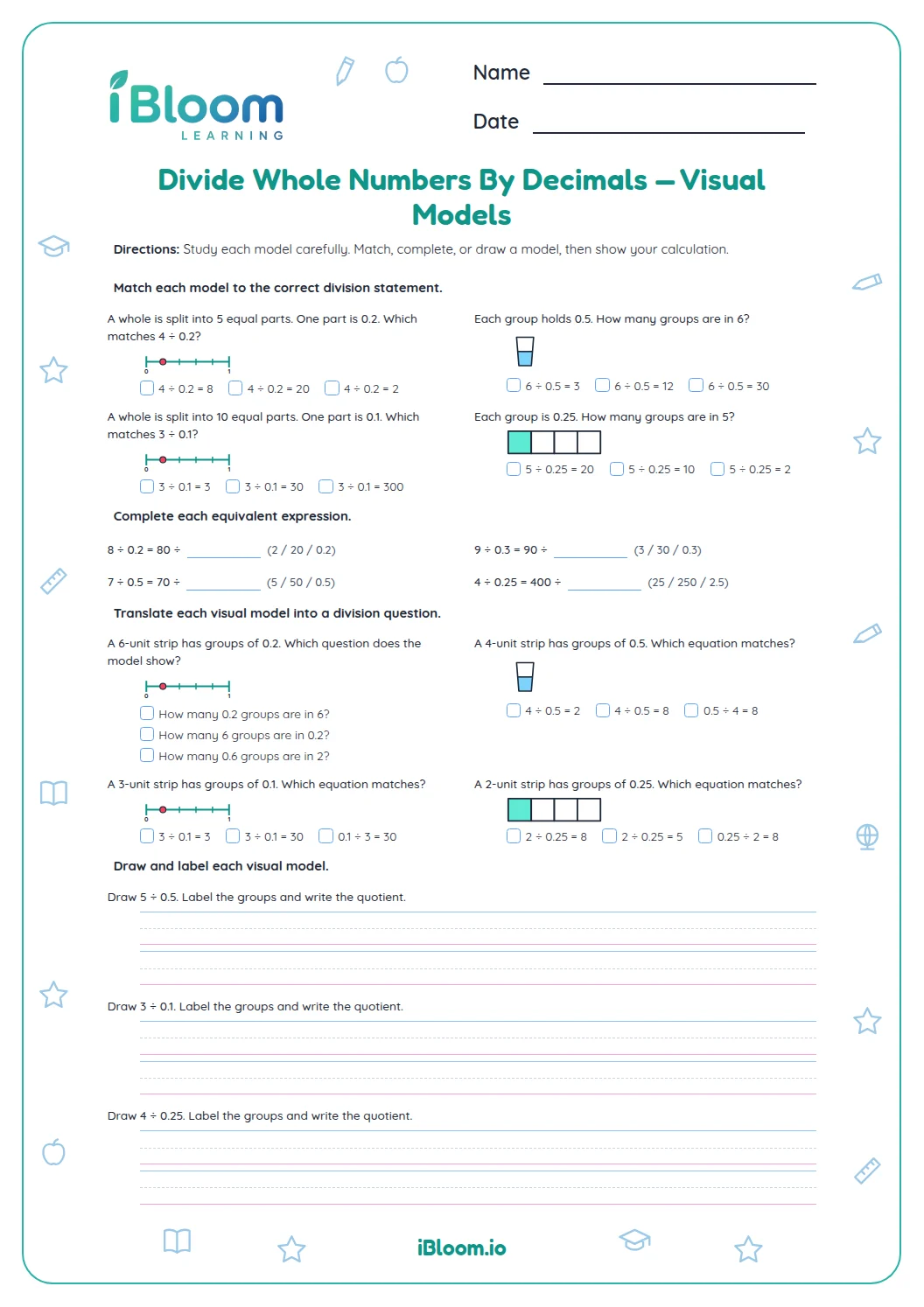
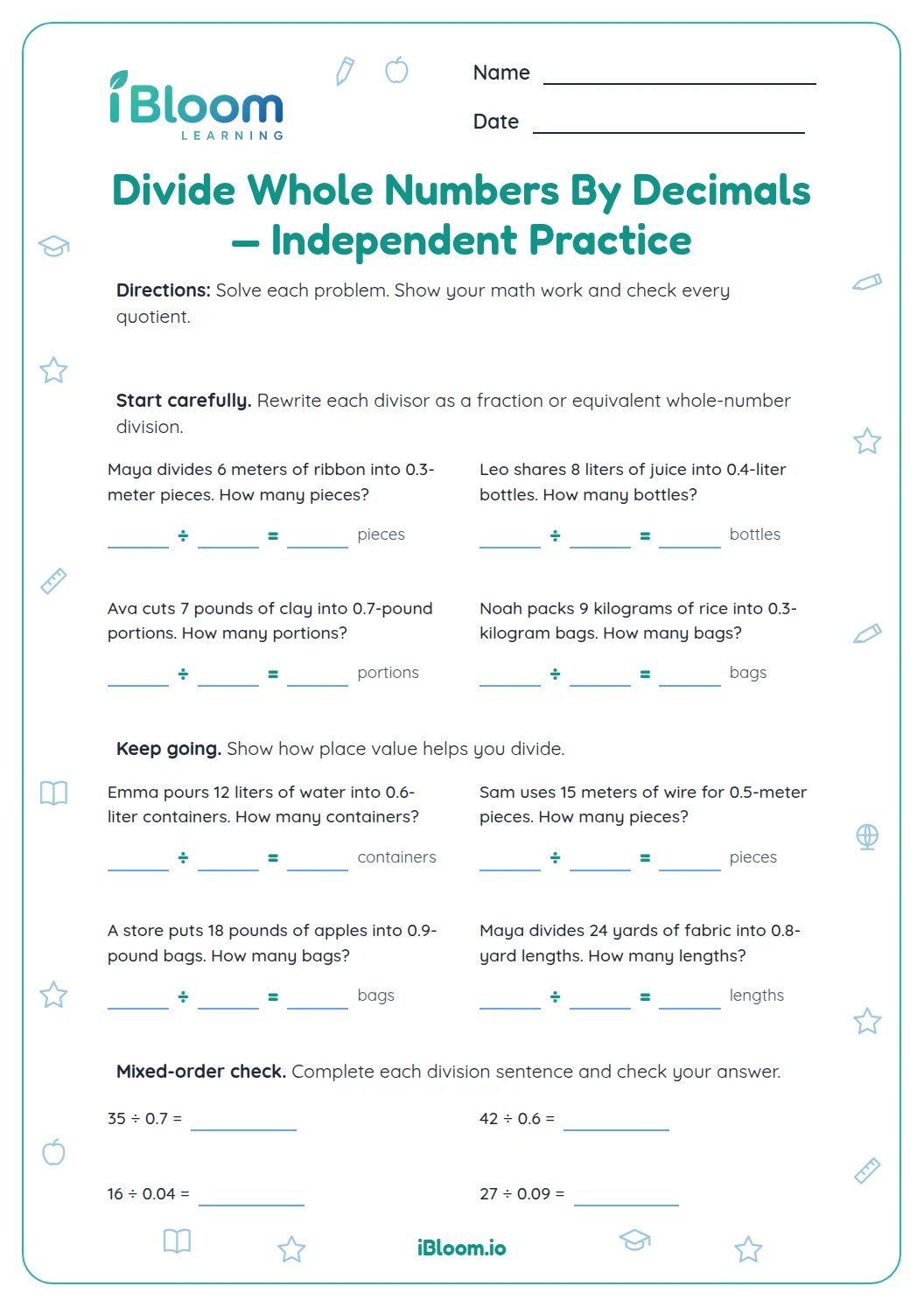
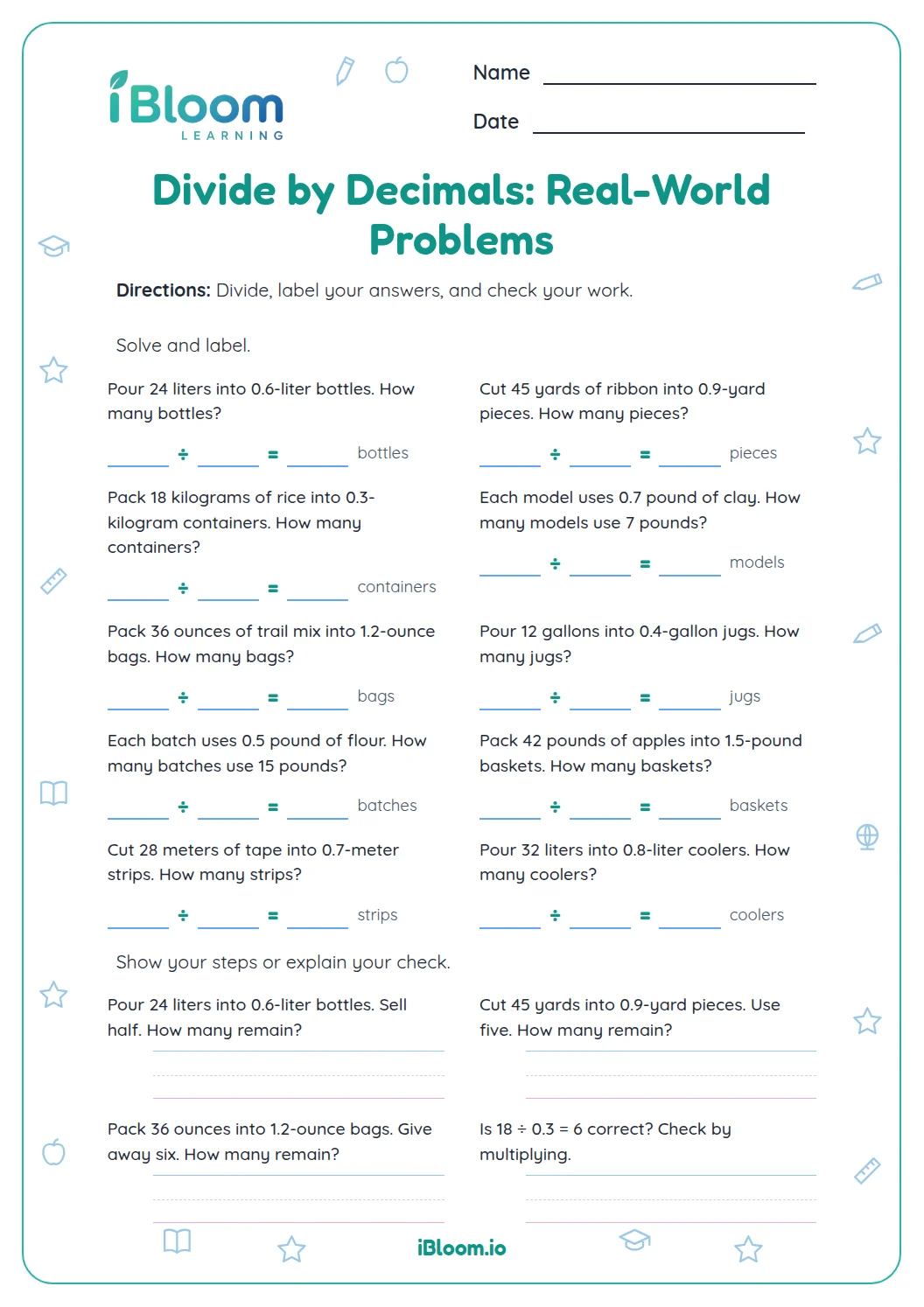
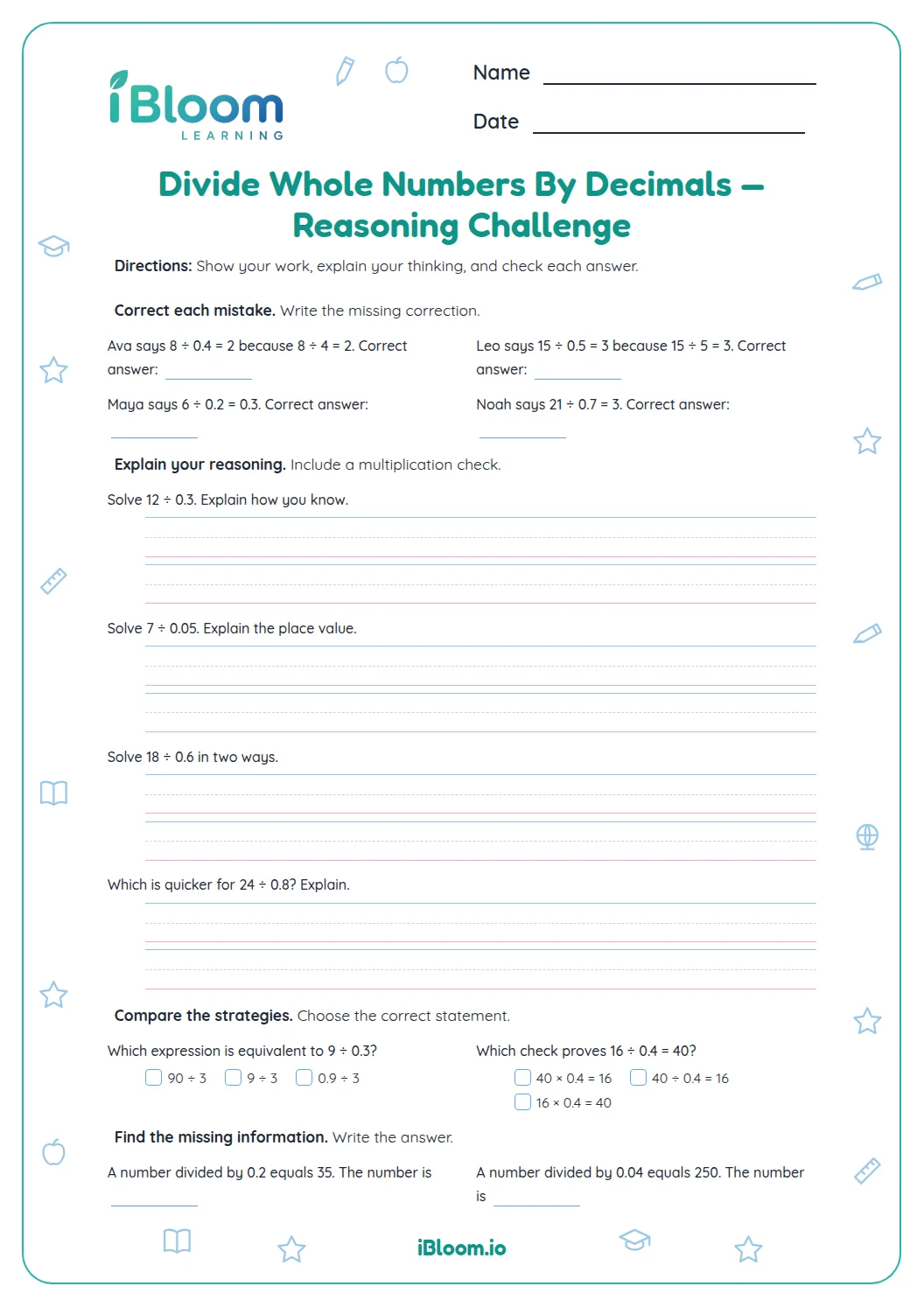
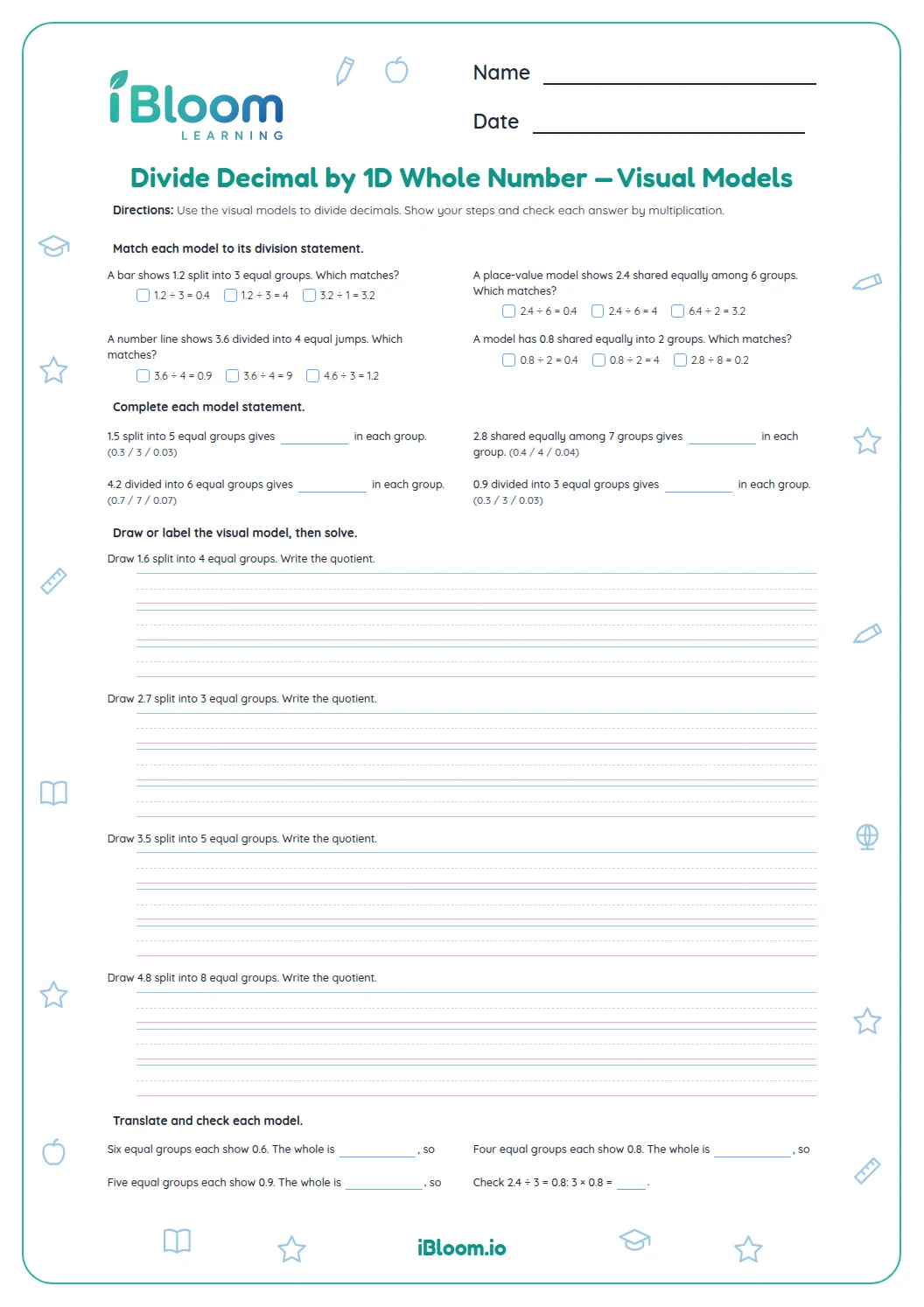
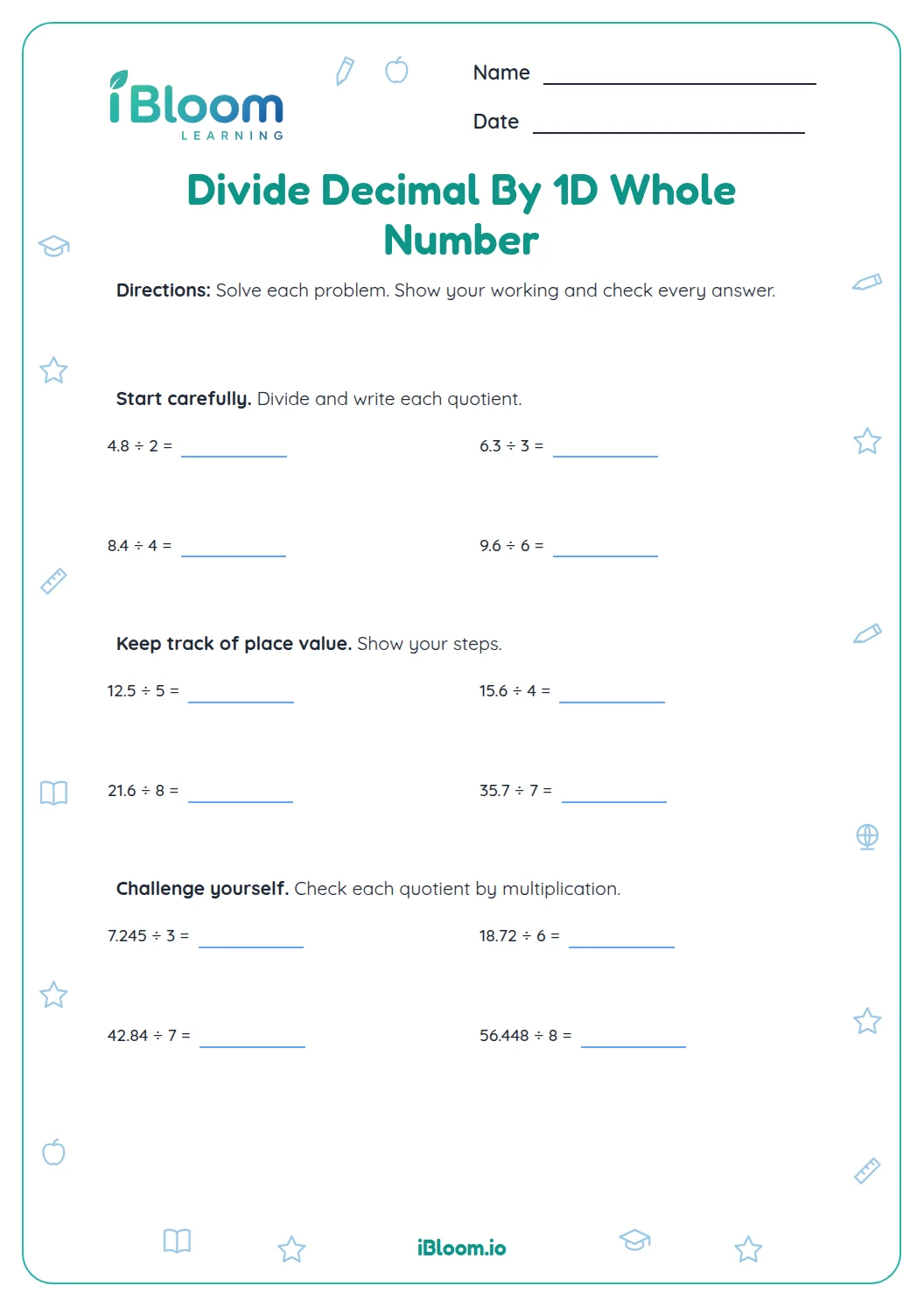
This printable builds the idea behind dividing a whole number by a decimal: multiply the dividend and divisor by the same power of 10 so the divisor becomes a whole number. Students solve eight short quotients, then apply the strategy to measurement and grouping situations. The final set adds four more grouping problems for independent practice. Three items ask for a multiplication check. The answer key lists each quotient. The work practices decimal division and place-value reasoning from Common Core 5.NBT.B.7.
Aligned to 5.NBT.B.7
Why scale both numbers?
A decimal divisor can be changed to a whole number by multiplying by 10 or 100. To keep the quotient equivalent, multiply the dividend by that same factor. For example, 4 ÷ 0.5 becomes 40 ÷ 5, which equals 8.
- 14 ÷ 0.5 = 40 ÷ 5
- 240 ÷ 5 = 8
- 3Both numbers were multiplied by 10, so the quotient stays the same.
How do tenths and hundredths affect the scale?
A divisor with one digit after the decimal point is scaled by 10; one with two decimal digits is scaled by 100. Question 7 uses 0.35, so 7 ÷ 0.35 becomes 700 ÷ 35.
How can multiplication check the result?
Multiply the quotient by the original decimal divisor. For question 9, 30 × 0.6 equals 18, which confirms that 18 ÷ 0.6 is 30.
A repeatable solving routine
- 1Count the decimal places in the divisor.
- 2Multiply both numbers by 10 or 100 to make the divisor whole.
- 3Divide the new whole-number expression.
- 4For a word problem, label the quotient with the requested unit or count.
- 5Multiply the quotient by the original divisor to check.
Common decimal-division errors
The mistake
Moving the decimal in the divisor but not the dividend.
The fix
Multiply both numbers by the same power of 10.
The mistake
Scaling 0.35 by 10 instead of 100.
The fix
Count two decimal places; 0.35 × 100 = 35.
The mistake
Checking with the scaled divisor instead of the original.
The fix
Multiply the quotient by the decimal divisor from the question.
Common Core alignment
Students use place-value reasoning to divide by decimal tenths and hundredths.
Use place-value strategies to divide decimals to hundredths.
On this sheet: Students use place-value scaling to divide whole-number dividends by decimal tenths and hundredths, then verify selected quotients by multiplication.
Show the official wordingHide the official wording
Add, subtract, multiply, and divide decimals to hundredths, using concrete models or drawings and strategies based on place value, properties of operations, and/or the relationship between addition and subtraction.
What to practice next
Make more practice
Further reading
Questions parents and teachers ask
What is the first step when dividing by a decimal?
Make the divisor a whole number by multiplying it by 10 or 100. Multiply the dividend by that same amount so the quotient stays equivalent. Then divide the new numbers and check the result with the original divisor. for every question
Why does the dividend change too?
Multiplying only the divisor changes the quotient. Scaling both numbers by the same factor creates an equivalent division expression. For example, 4 ÷ 0.5 becomes 40 ÷ 5; both expressions equal 8, so the answer stays unchanged. and check that relationship
How do students handle 0.35 as a divisor?
Because 0.35 has two decimal places, multiply both numbers by 100. The problem 7 ÷ 0.35 becomes 700 ÷ 35, which equals 20. Checking 20 × 0.35 gives 7, confirming the quotient for the original problem. in the original expression
What does the multiplication check show?
Multiplying the quotient by the original divisor should return the dividend. In question 9, 30 × 0.6 = 18, so the quotient 30 is consistent with 18 ÷ 0.6. Keep the decimal divisor from the original question in the check. for the full set
What kinds of problems are included?
Questions 1–8 focus on calculating quotients with tenths and hundredths. The remaining items include multiplication checks and everyday grouping situations with liters, meters, pounds, and kilograms. The answer key lists all 20 quotients for quick review. for added independent practice