



About this worksheet
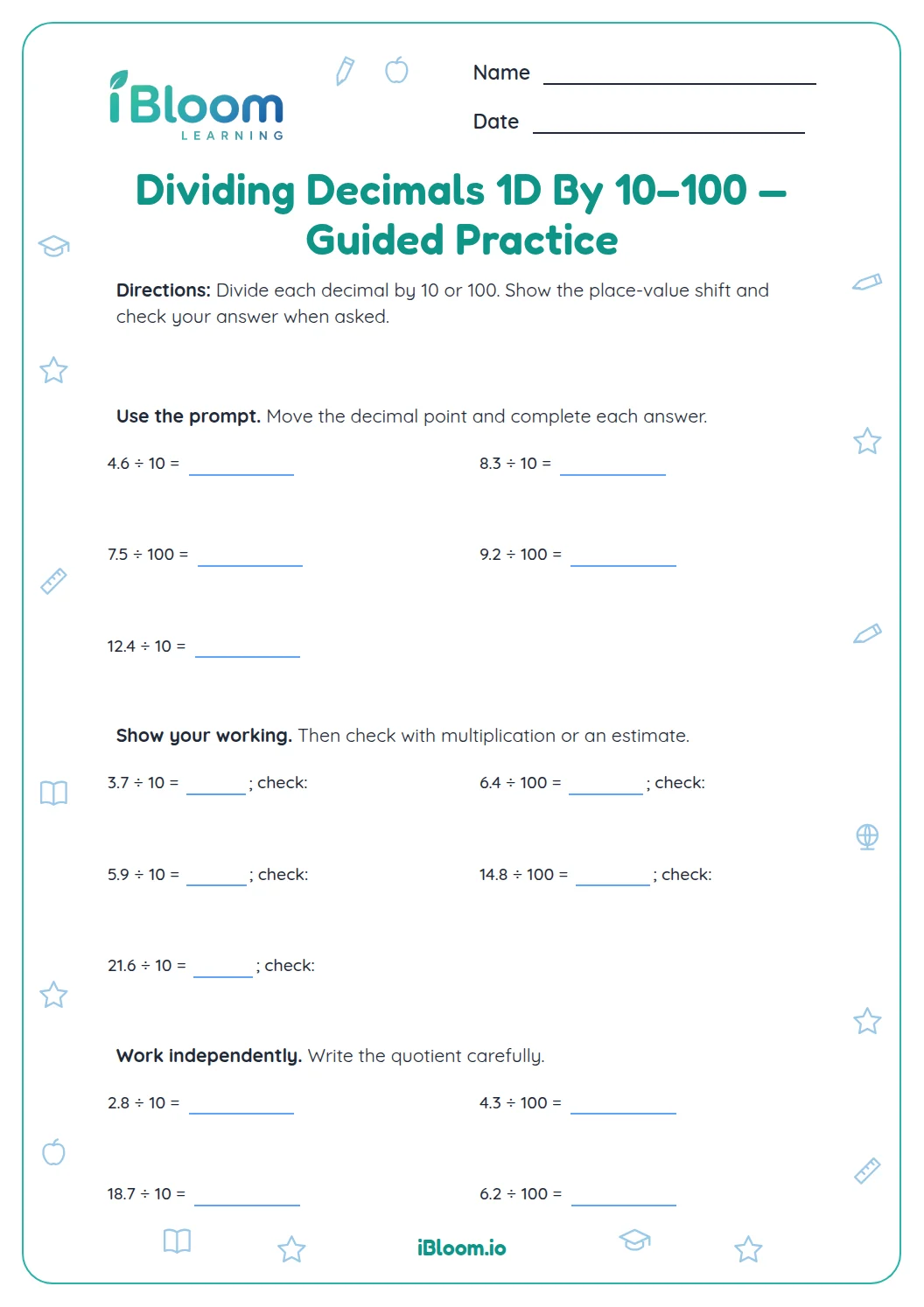
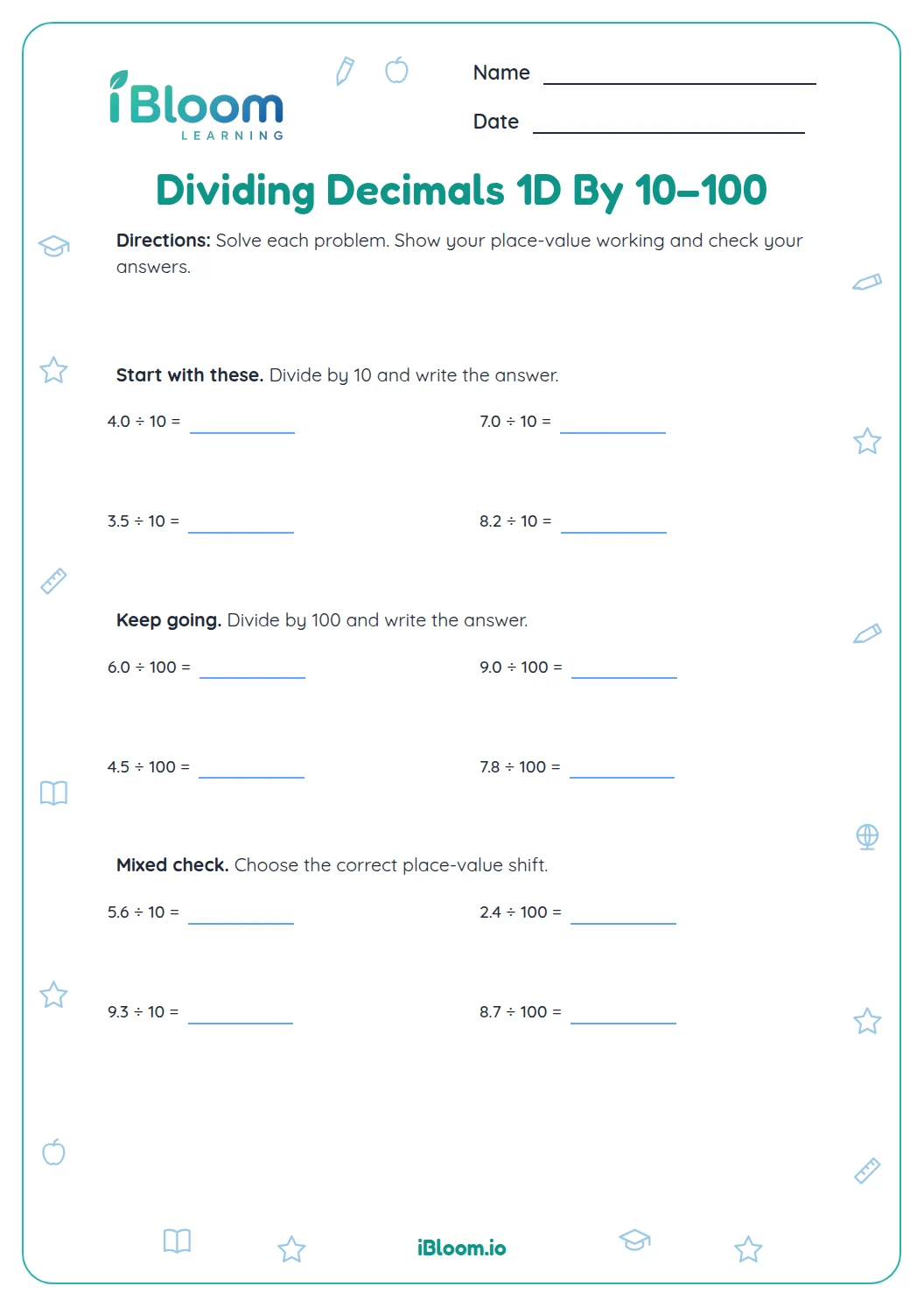
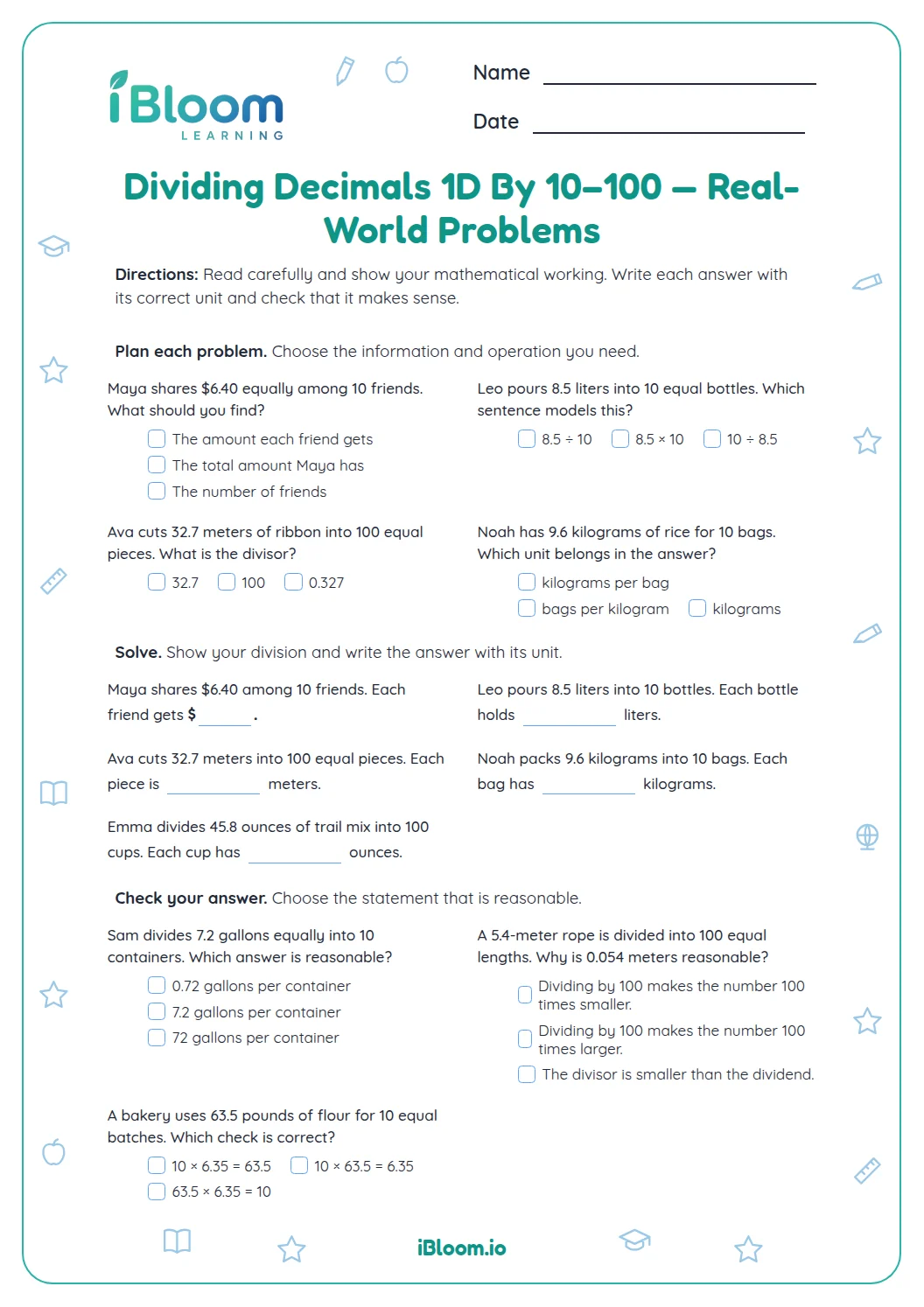
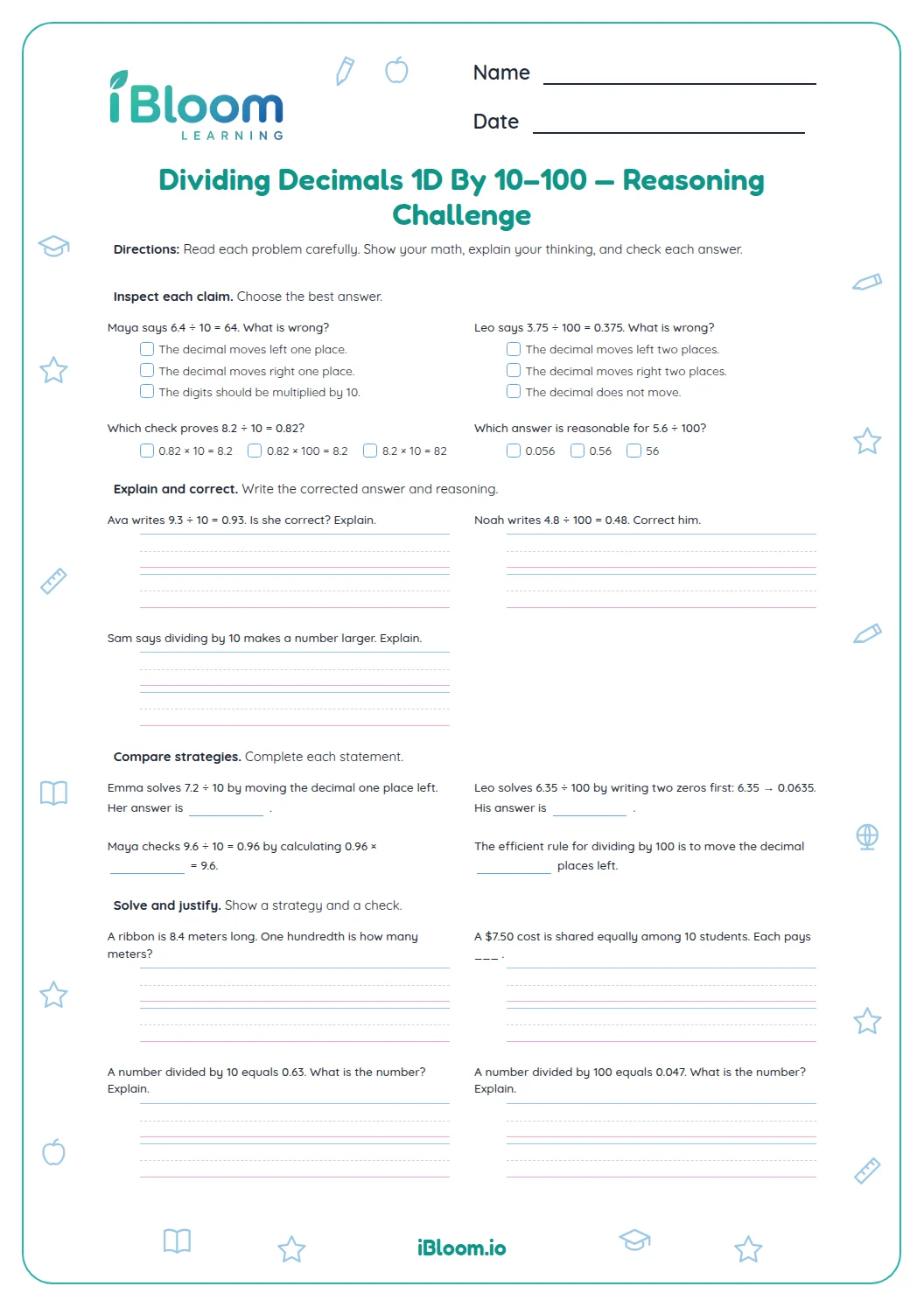
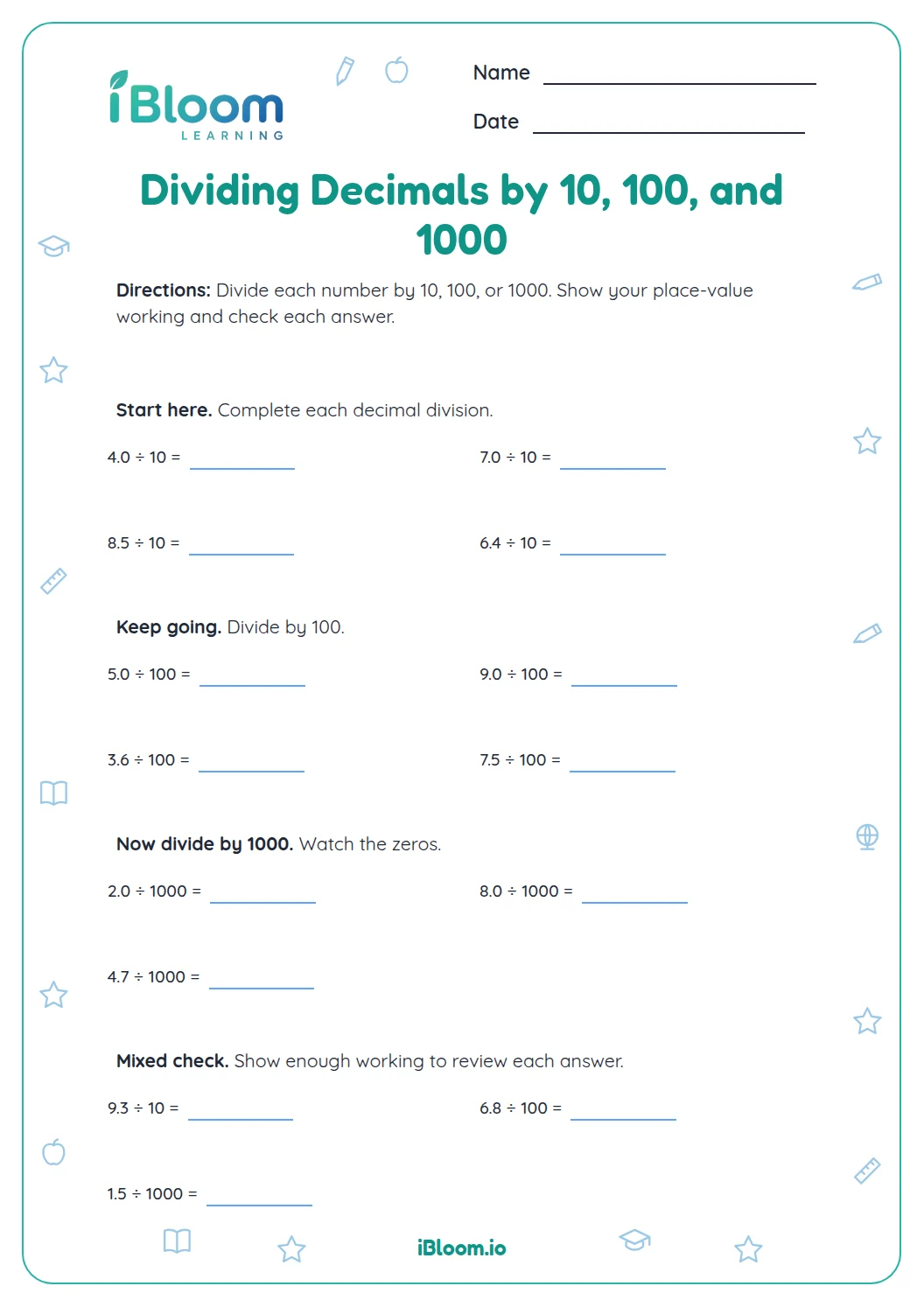
This concept practice begins with direct quotients and the place-value pattern. It then asks children to apply the rule, work backward from a quotient, and use it in simple measurement situations. Every divisor is 10 or 100.
Aligned to 5.NBT.A.2
Why does the decimal move when dividing?
Dividing by 10 makes a value one tenth as large; dividing by 100 makes it one hundredth as large. In place-value language, each digit shifts one place right for ÷ 10 and two places right for ÷ 100.
For example, 6.3 ÷ 10 is 0.63. The digits keep their values relative to one another, while each now represents a unit ten times smaller. A zero can show an empty place, as in 6.3 ÷ 100 = 0.063.
How can multiplication check a quotient?
Multiply the quotient by the divisor. If 4.8 ÷ 10 = 0.48, then 0.48 × 10 = 4.8. The inverse operation is a reliable check for both ordinary and missing-number questions.
How to use this worksheet
- 1Identify whether the divisor is 10 or 100.
- 2Shift each digit one or two places right in value.
- 3Place a zero when a place is empty.
- 4For a missing dividend, multiply the quotient by the divisor.
- 5Check a quotient by multiplying it back.
Common mistakes and quick fixes
The mistake
Moving digits left when dividing by 10 or 100.
The fix
Check that the quotient is smaller than the starting number.
The mistake
Dropping a zero in an empty place, as in 0.063.
The fix
Use a place-value chart to hold each empty place.
The mistake
Rushing past a zero or a repeated letter pattern.
The fix
Read the completed answer carefully and check each place or letter.
The mistake
Rushing past a zero or a repeated letter pattern.
The fix
Read the completed answer carefully and check each place or letter.
Common Core alignment
The questions focus on decimal place value and division by powers of ten.
Explain patterns when multiplying and dividing by powers of 10.
On this sheet: Children predict and apply the one-place and two-place shifts for division by 10 and 100.
Show the official wordingHide the official wording
Explain patterns in the number of zeros of the product when multiplying a number by powers of 10, and explain patterns in the placement of the decimal point when a decimal is multiplied or divided by a power of 10.
What to practice next
Make more practice
Further reading
Questions parents and teachers ask
Why does dividing by 100 move digits two places?
Dividing by 100 makes each digit one hundredth of its former value, so each digit moves two places to the right on a place-value chart. In 6.3 ÷ 100, the quotient is 0.063; the zero holds the empty tenths place.
How can I check a decimal quotient?
Multiply the quotient by the divisor. For example, 0.84 × 10 returns 8.4, so 8.4 ÷ 10 = 0.84. Estimating first also helps: dividing a positive amount by 10 or 100 should make it smaller. Invite your child to explain one answer aloud, then use the separate key to check the result.
Which divisors do the questions use?
The worksheet practices dividing decimals by 10 and 100. Children identify each place-value shift, calculate quotients, solve measurement examples, and find missing dividends. The answer key includes each result, including answers where a zero holds an empty place. These are the powers of ten shown in the worked examples.
How is dividing by 10 different from dividing by 100?
Dividing by 10 shifts each digit one place to the right; dividing by 100 shifts each digit two places. The worksheet asks children to identify both patterns and apply them to number sentences and measurement contexts. Invite your child to explain one answer aloud, then use the separate key to check the result.
How long will this practice take?
About 20 minutes should allow time to work through the 16 questions and check a few with multiplication. The questions progress from identifying place shifts to calculating quotients and finding a missing starting number. Check one answer from each section together.