




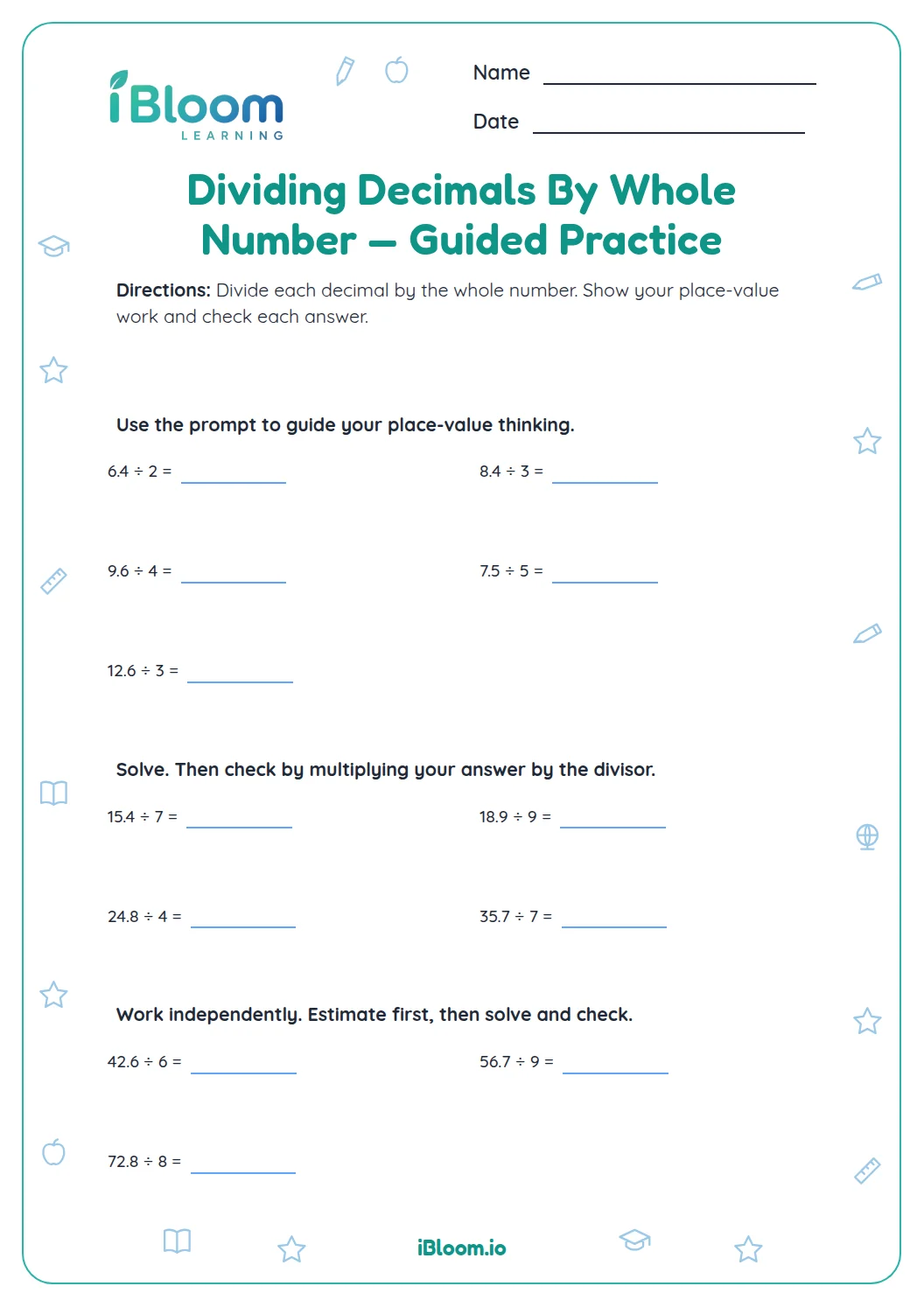
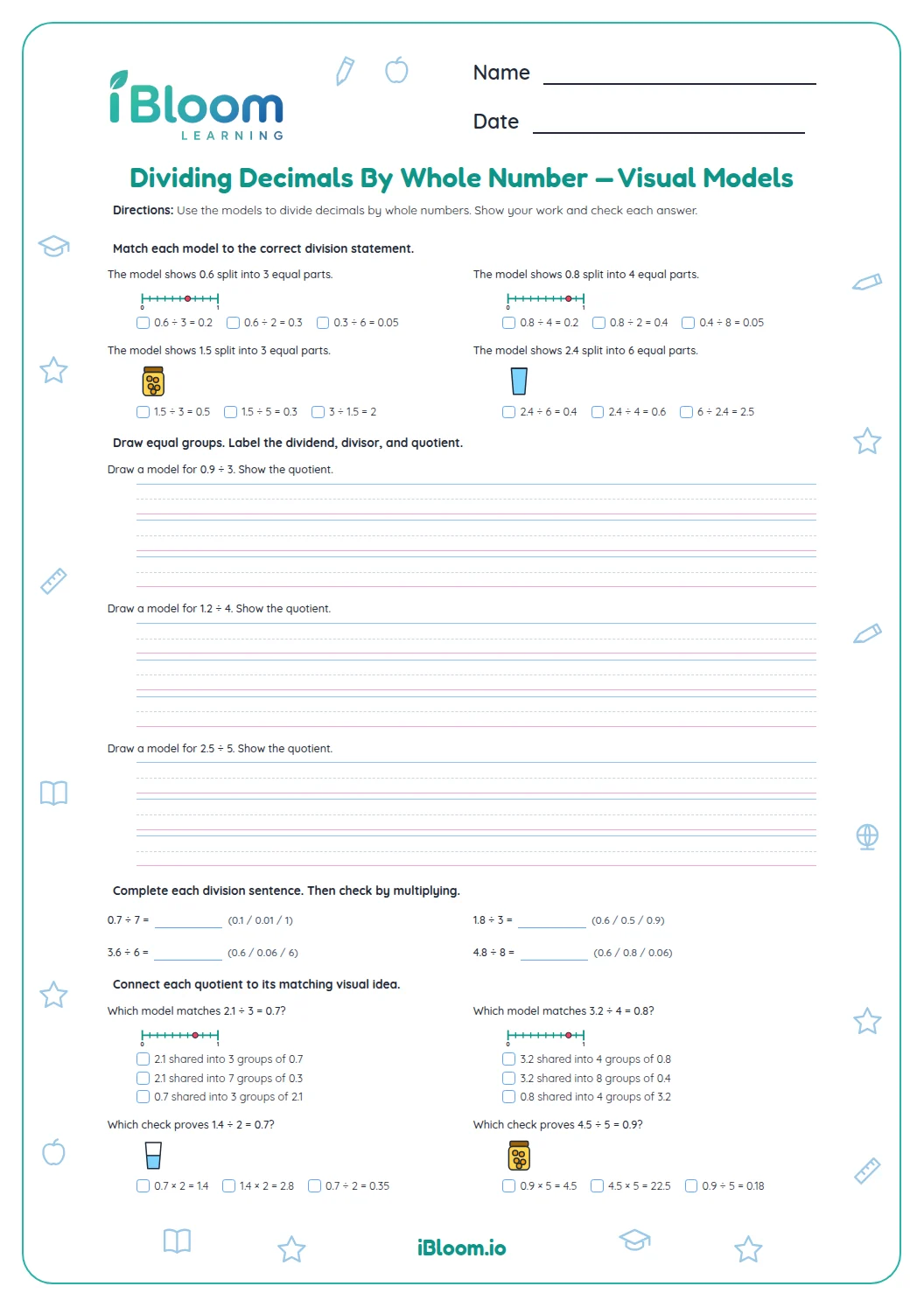

About this worksheet
This free Grade 5 decimal division worksheet builds from direct calculations to short applications and reasoning. Students divide one- and two-place decimals, track how each digit shifts when dividing by 10, 100 or 1,000, and use the quotient in equal-sharing situations. The answer key includes units for the story problems and a sample explanation for the final comparison. It is designed for guided practice after learners have seen how powers of ten affect place value.
Aligned to 5.NBT.A.2
What happens to place value?
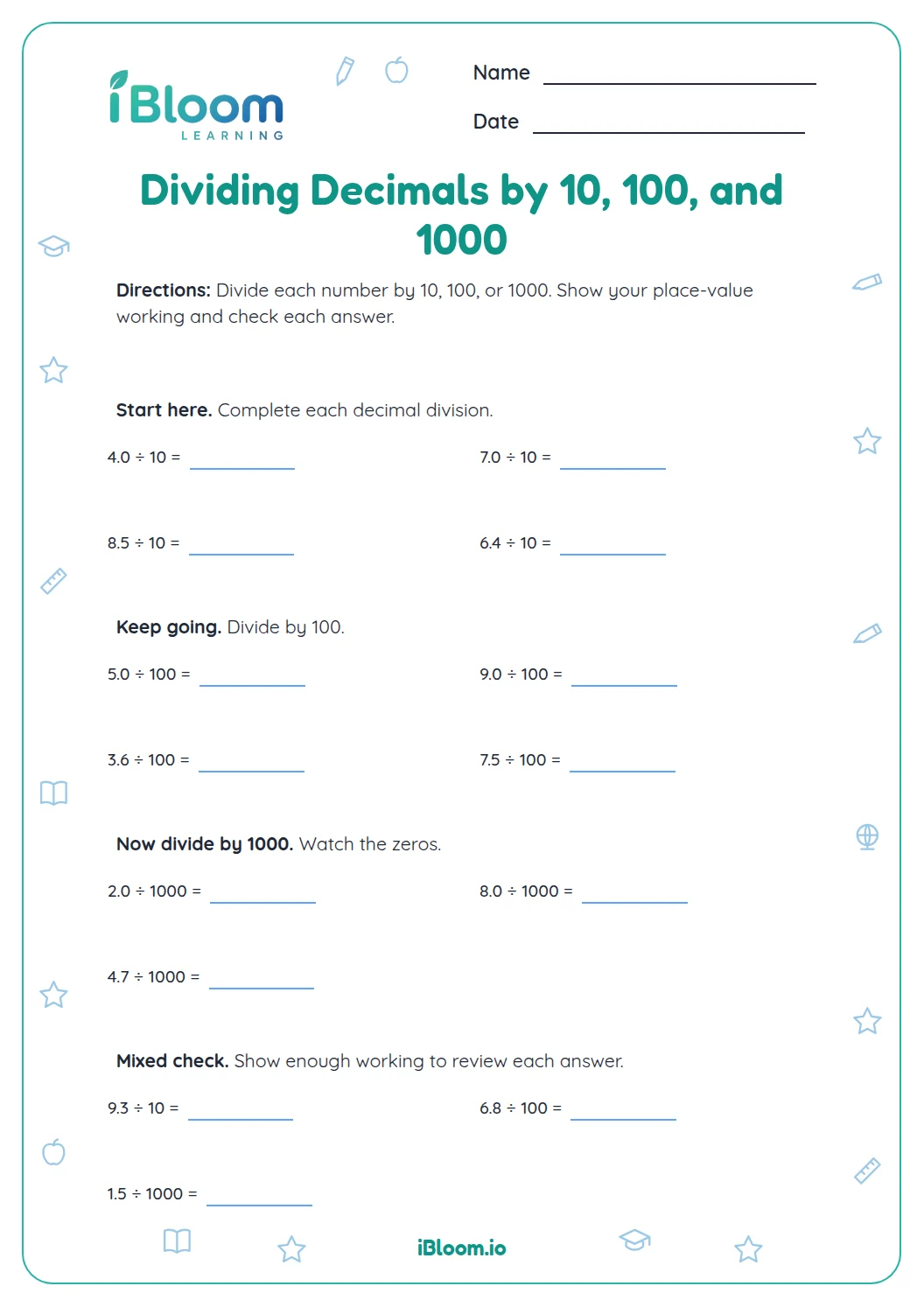
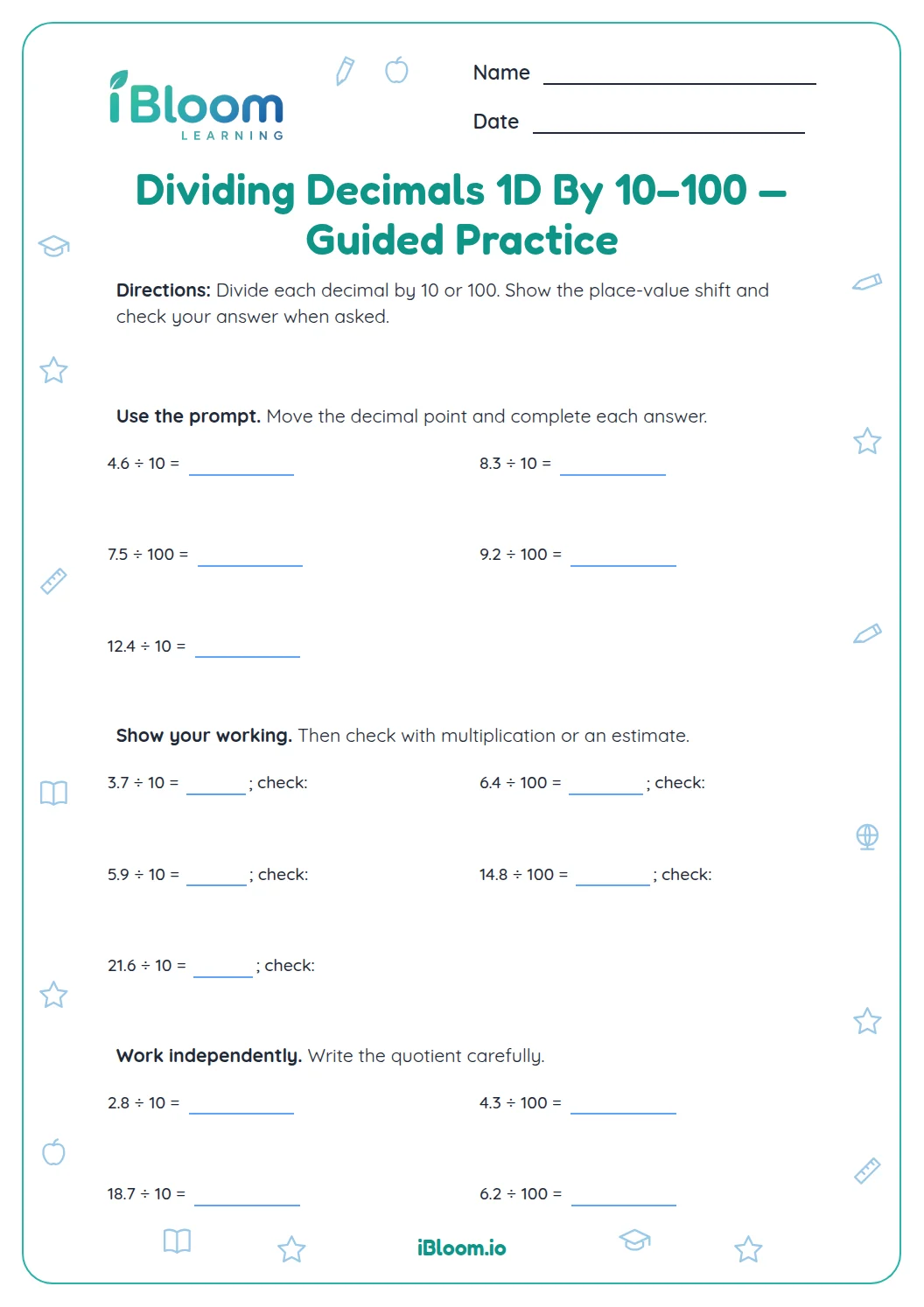
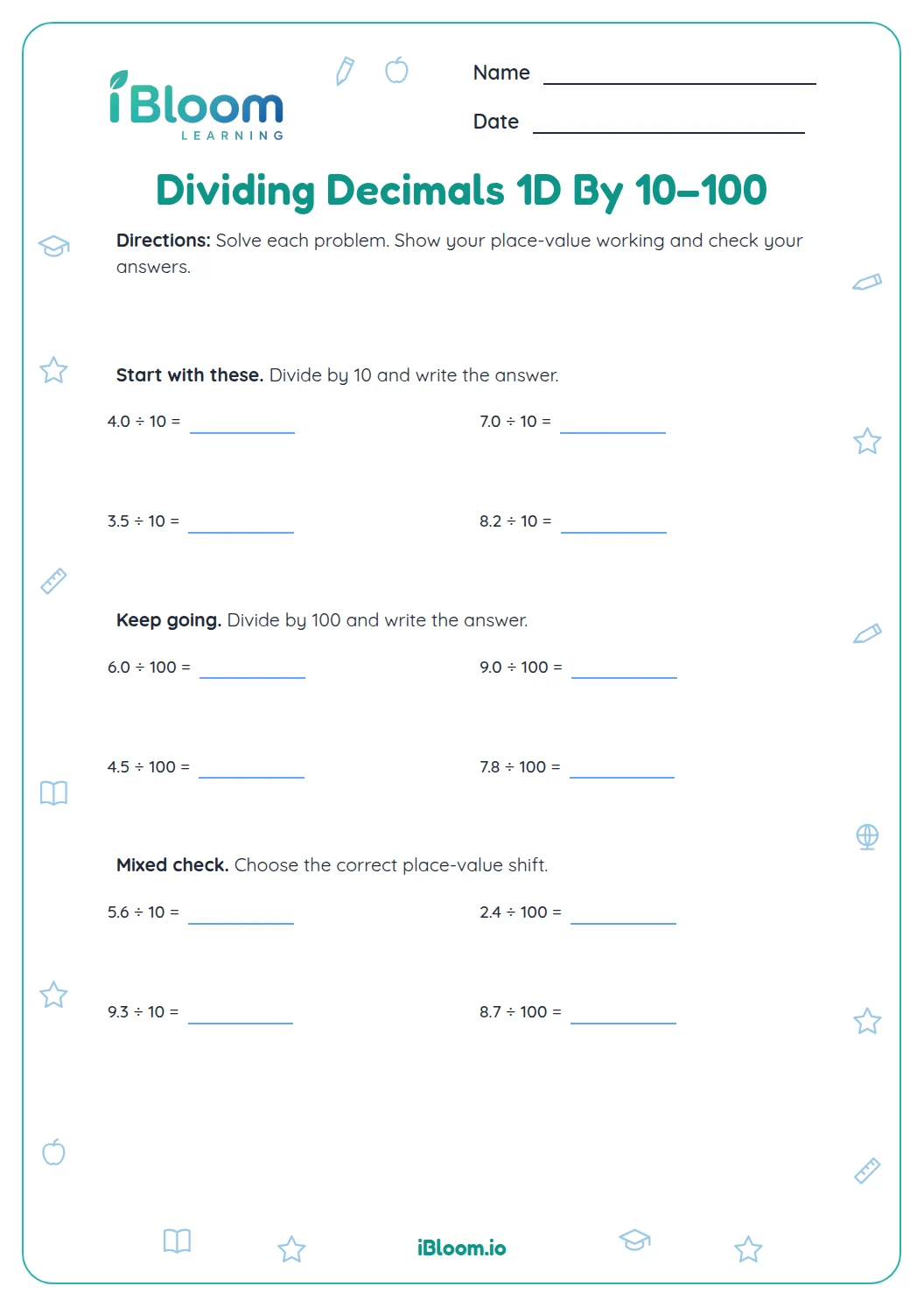
The first eight questions practice quotients and place-value choices for division by 10, 100, or 1,000. Dividing by a power of ten makes each digit worth one tenth, one hundredth, or one thousandth as much.
How does division split an amount?
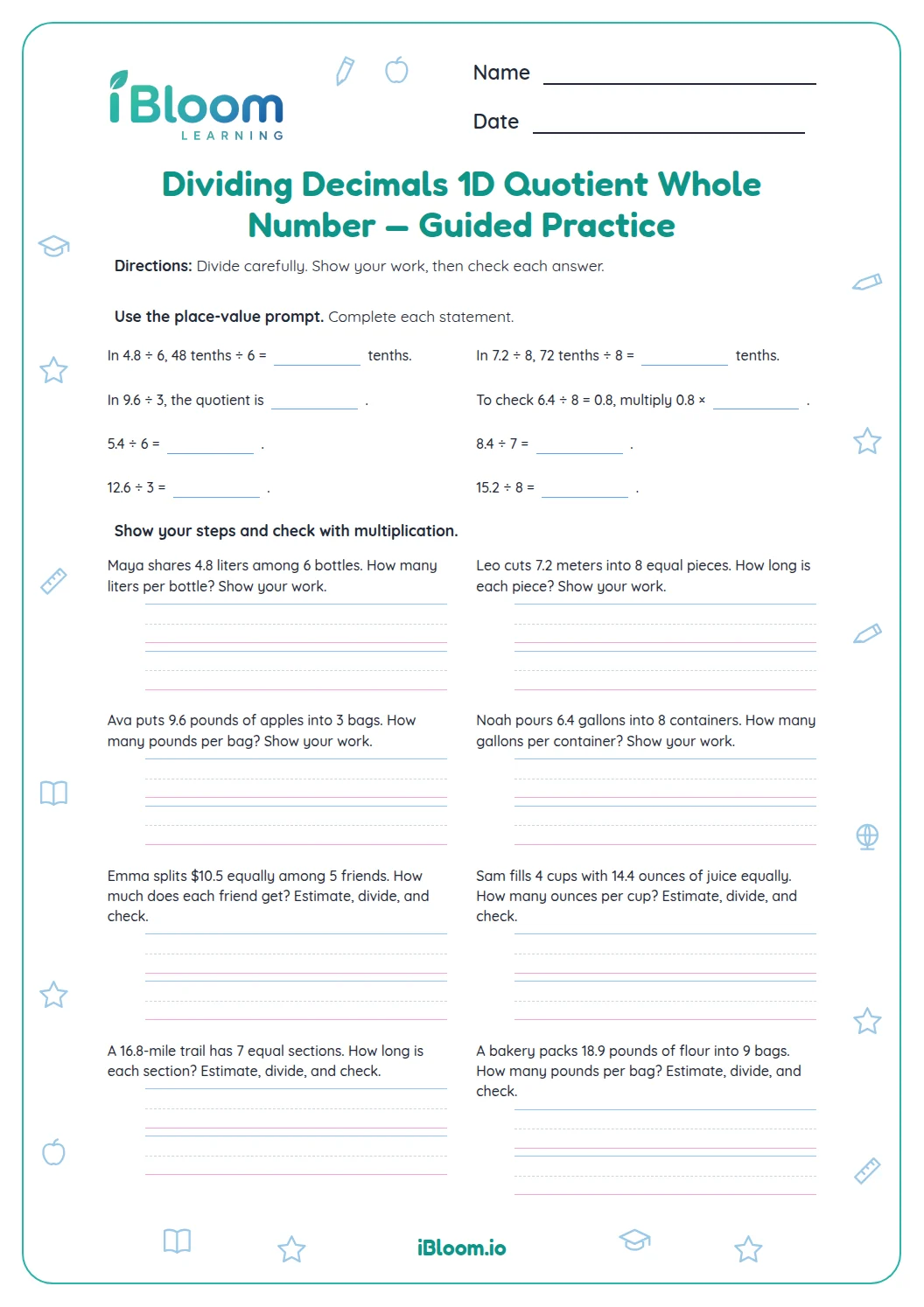
Questions 9–12 apply the same operation to equal shares. For example, 8.4 meters divided into 10 equal lengths gives 0.84 meter per length. Include the unit requested in each answer.
How can you check a quotient?
Multiply the quotient by its divisor to recover the starting value. When comparing 7.2 ÷ 10 with 7.2 ÷ 100, the first quotient is greater because dividing the same positive number by 10 leaves a larger result than dividing it by 100.
How to use this worksheet at home or in class
- 1Write the divisor and dividend clearly.
- 2Count how many places the divisor is larger than 1: one, two or three.
- 3Move the digits into the quotient’s place values and add leading zeros when needed.
- 4Check by multiplying the quotient by 10, 100 or 1,000.
- 5Include the unit in each story problem answer.
Common mistakes and quick fixes
The mistake
Moving the decimal point left when dividing.
The fix
Compare the quotient to the original positive number: division by 10 makes it smaller.
The mistake
Dropping a zero in a small quotient such as 0.0824.
The fix
Use a place-value chart or write the leading zero placeholders before the first nonzero digit.
The mistake
Forgetting that the divisor sets the number of place shifts.
The fix
Divide by 100 means two place shifts, while divide by 10 means one.
Common Core alignment
This worksheet gives Grade 5 learners focused practice with dividing decimals by powers of ten. The listed standard describes that work.
Use patterns in the number of zeros to divide decimals by powers of 10.
On this sheet: The worksheet questions directly practice the action named in this standard.
Show the official wordingHide the official wording
Explain patterns in the number of zeros of the product when multiplying a number by powers of 10, and explain patterns in the placement of the decimal point when a decimal is multiplied or divided by a power of 10.
What to practice next
Make more practice
Further reading
Questions parents and teachers ask
How many questions are on this worksheet?
There are 16 questions in four parts. Learners solve eight quotients and place-value choices, complete four equal-sharing situations, then answer four reasoning questions. The answer key includes the decimal values and units for the story problems. Each part builds on the same place-value idea.
Does the worksheet include word problems?
Yes. Questions 9–12 describe equal sharing with meters, liters, and kilograms. Divide each total amount by the number of equal shares, then include the unit asked for in the answer. For example, 8.4 meters shared into 10 equal lengths gives 0.84 meter per length.
How can I explain dividing by powers of ten?
Explain that division makes the number smaller by a factor of 10, 100, or 1,000. Each digit takes a place with one tenth, one hundredth, or one thousandth of its former value. Multiplication checks the quotient: 0.48 × 10 returns 4.8.
How can a learner check an answer?
Multiply the quotient by the divisor. If 4.8 ÷ 10 is 0.48, then 0.48 × 10 returns 4.8. This check works for all three divisors on the sheet. For a story problem, check that the unit still matches the question.
What does the answer key include?
The key gives the quotients, the equal-share answers with units, and the correct choices for the reasoning questions. It also makes it possible to check a quotient by multiplying it by the stated divisor and comparing the product with the original amount.