






About this worksheet
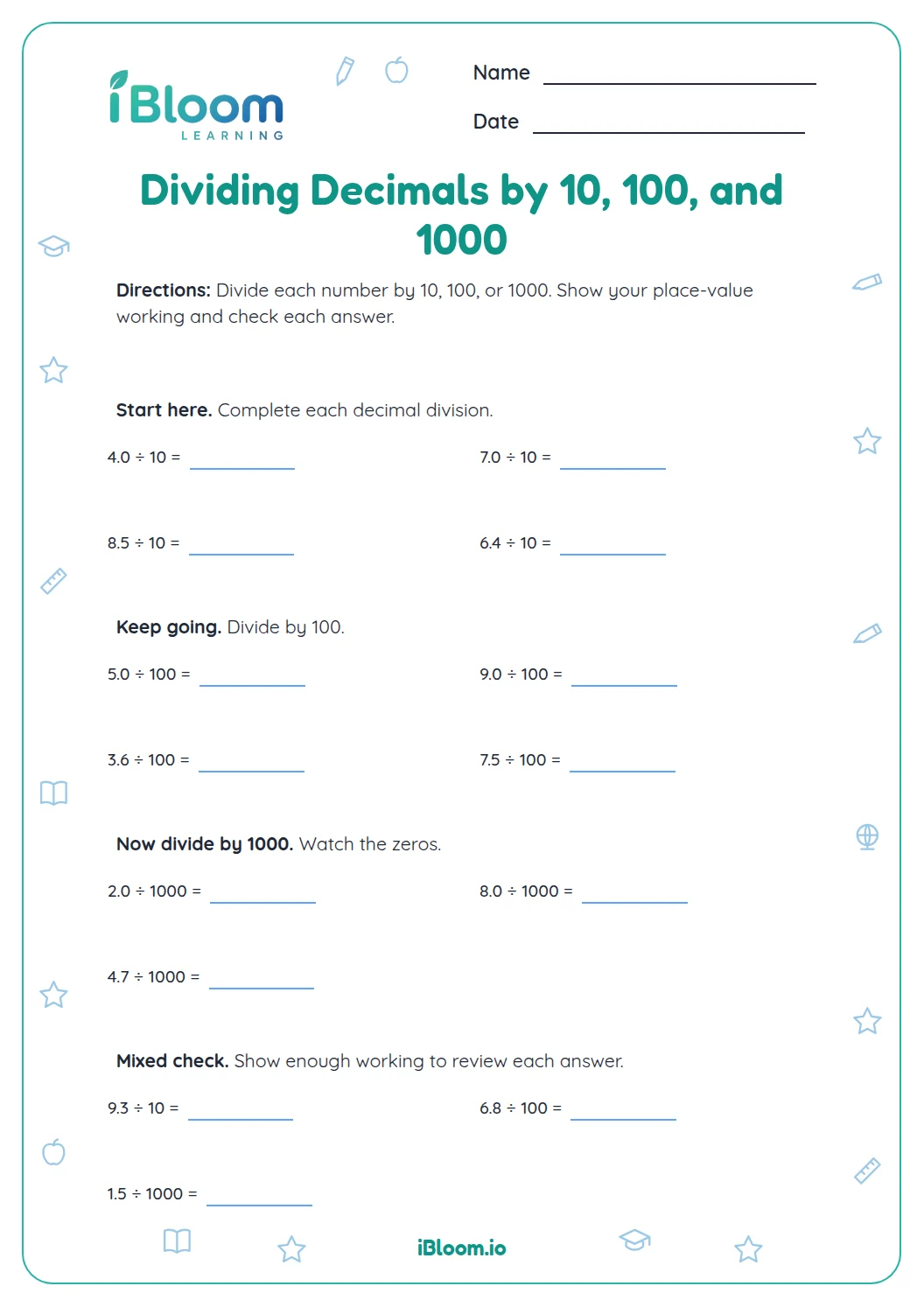
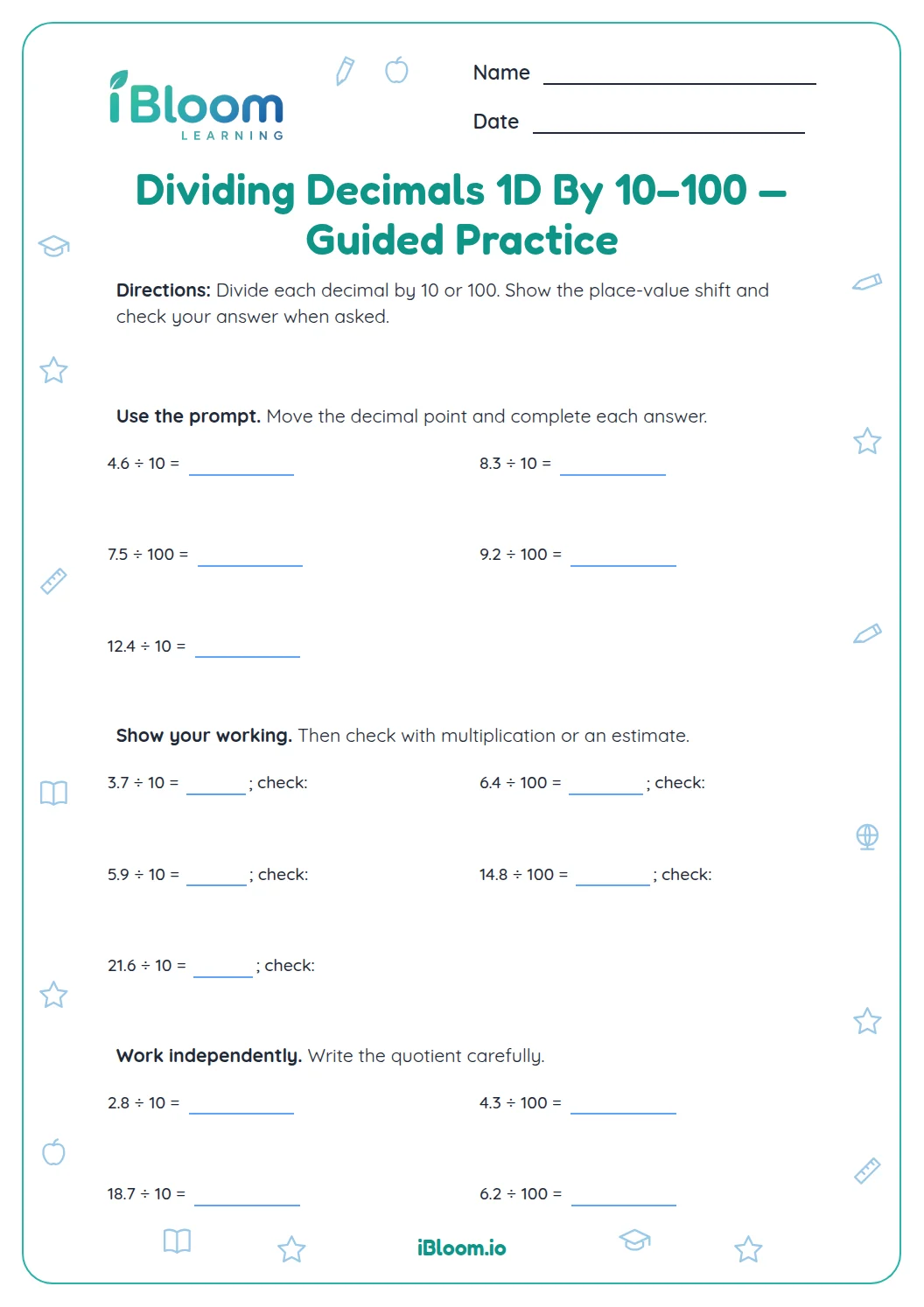
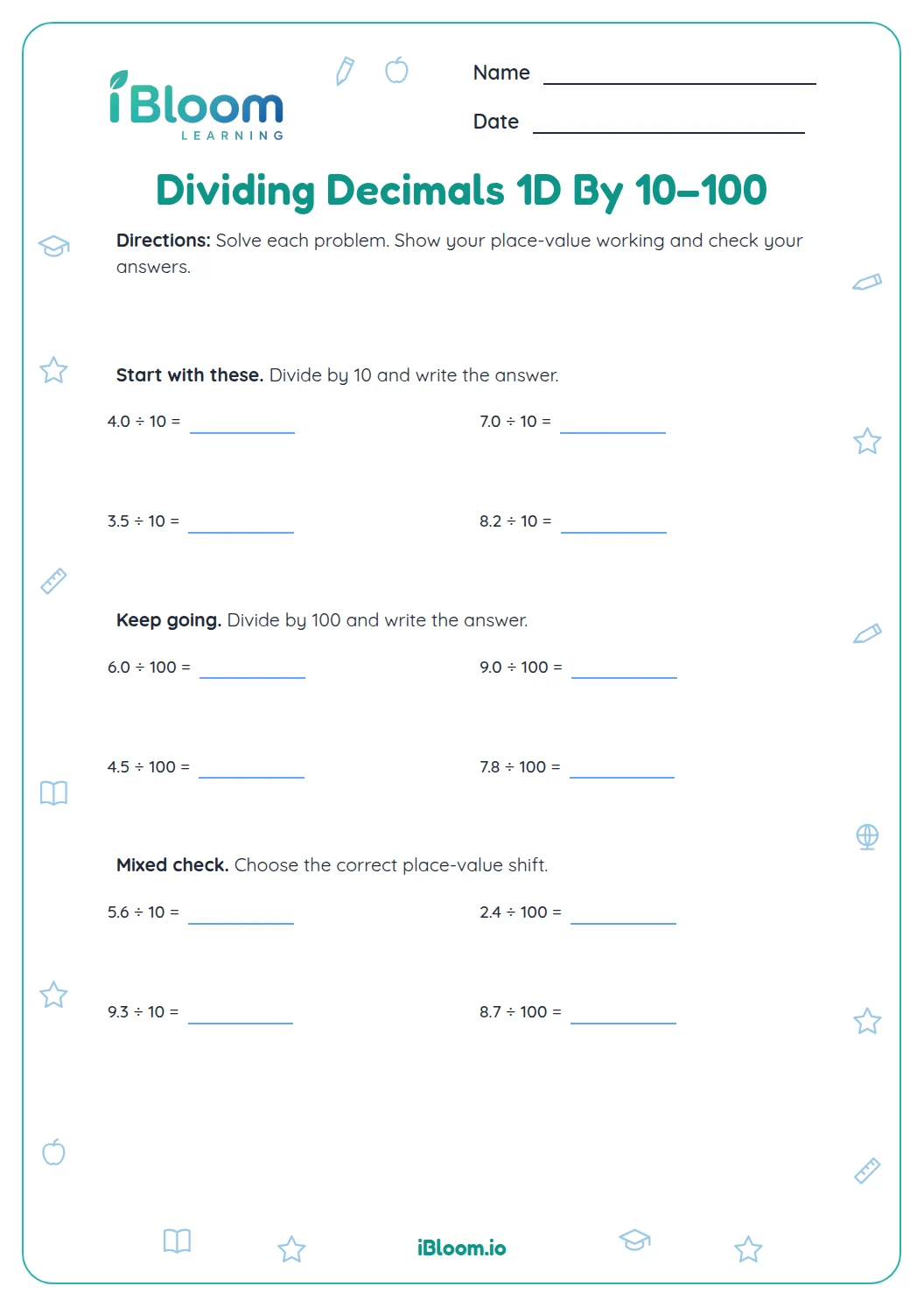
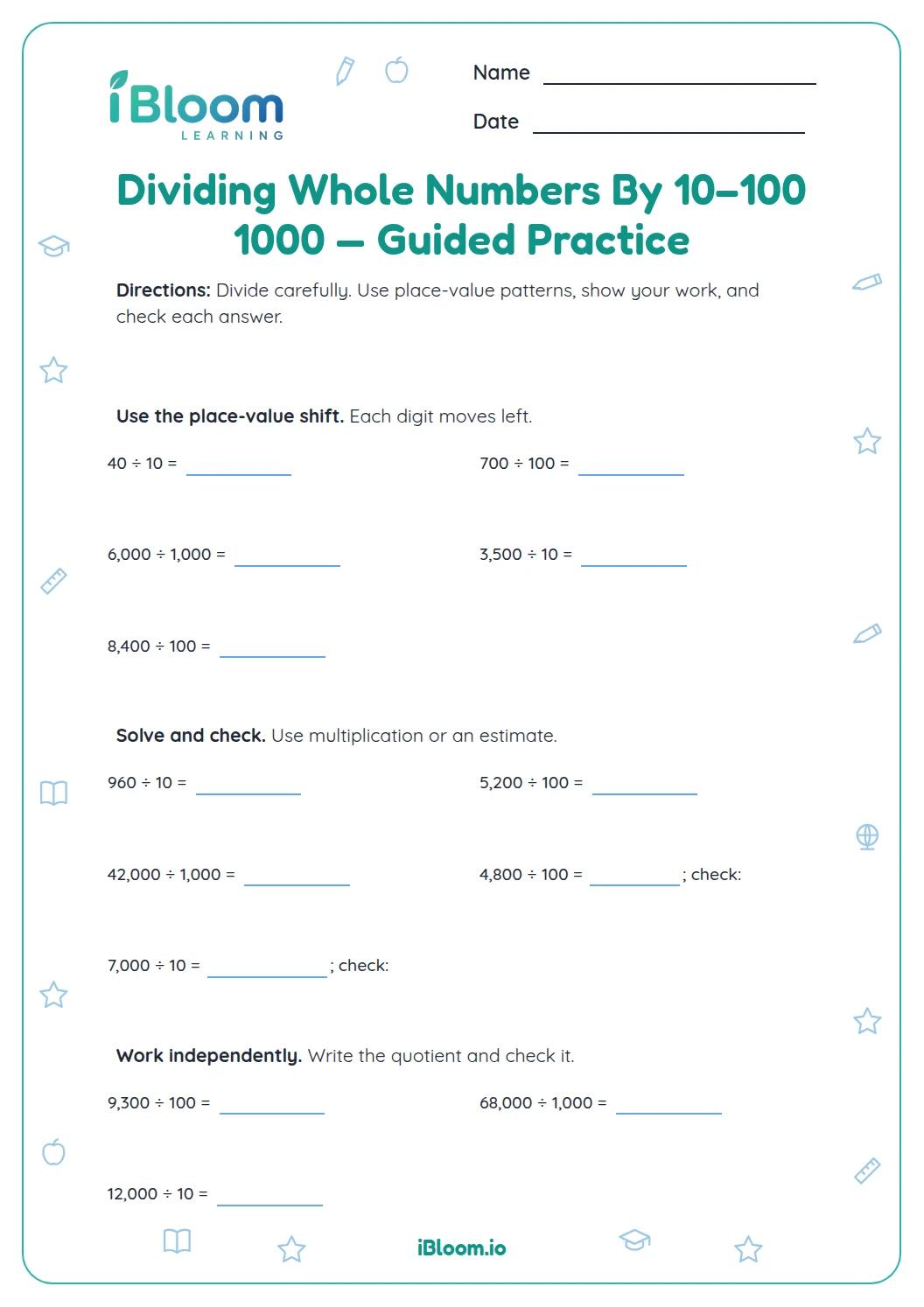
This Grade 5 reasoning challenge practices dividing a one-digit decimal by 10, 100, or 1,000. Children compute six quotients, inspect and correct place-value reasoning, solve two unit-labeled quotient questions, compare results, and explain a decimal shift. The questions emphasize digit value as the divisor is a power of ten. It aligns with Common Core 5.NBT.A.2, and a separate answer key includes sample explanations.
Aligned to 5.NBT.A.2
Why does the quotient get smaller?
Dividing by 10 makes each digit one place less valuable. In question 1, 8.4 becomes 0.84: the 8 tenths become 8 hundredths and the 4 ones become 4 tenths. Dividing by 100 or 1,000 changes place value by two or three places.
- 18.4 ÷ 10
- 2Each digit is worth one tenth as much.
- 38.4 ÷ 10 = 0.84
What if there are not enough decimal places?
Use zero placeholders to name the new place value. For 6.3 ÷ 100, the 6 moves from ones to hundredths and the 3 from tenths to thousandths, giving 0.063. The zero in the tenths place keeps the digits aligned.
How can you check a decimal quotient?
Dividing by a number greater than 1 makes a positive number smaller. Compare the quotient with the original and estimate its size. For example, 8.1 ÷ 1,000 is less than 0.01, which helps catch a decimal placed too far left.
How to use this worksheet
- 1Name the divisor as ten, one hundred, or one thousand.
- 2Track the value of each digit, not just the printed decimal point.
- 3Use zero placeholders when a place has no digit.
- 4Check that dividing made the positive number smaller.
- 5For word problems, divide the total equally by the number of groups.
- 6Explain an error by naming the number of places the digits should shift.
Common mistakes and quick fixes
The mistake
Moving the decimal only one place for division by 100.
The fix
Track each digit two place-value positions to the right.
The mistake
Dropping a zero placeholder, as in writing 0.63 for 6.3 ÷ 100.
The fix
Say the place names aloud and keep an empty tenths place with zero.
The mistake
Thinking division by 10 makes a number larger.
The fix
Estimate first: splitting into equal groups makes each share smaller.
Common Core alignment
This worksheet gives children focused practice with the standard below.
Explain how dividing a decimal by a power of ten shifts its digits.
On this sheet: Questions divide decimals by 10, 100, and 1,000 and explain the place-value pattern.
Show the official wordingHide the official wording
Explain patterns in the number of zeros of the product when multiplying a number by powers of 10, and explain patterns in the placement of the decimal point when a decimal is multiplied or divided by a power of 10. Use whole-number exponents to denote powers of 10.
What to practice next
Make more practice
Further reading
Questions parents and teachers ask
Why is 6.3 ÷ 100 equal to 0.063?
Each digit becomes one hundredth as valuable. The 6 ones become 6 hundredths, and the 3 tenths become 3 thousandths. A zero placeholder keeps the tenths place empty, giving 0.063. This place-value explanation is more reliable than moving a decimal without tracking the digits.
How can I check a decimal quotient?
First check that a positive number got smaller when divided by 10, 100, or 1,000. Then estimate its size by tracking each digit’s new place. For instance, 8.1 ÷ 1,000 is less than 0.01, a bound children choose in question 11.
Does the sheet include word problems?
Yes. Two questions include units: one divides 7.5 liters by 10 and another divides 6.2 meters by 100. Children write each quotient with the same unit. The key keeps the units beside the numerical answers so the amount is still clear.
Are explanations included in the answer key?
Yes. The key shows the quotients and gives sample reasoning for the decimal place-value questions. Where a question asks children to describe an error, look for an explanation that identifies how many places each digit should change in value.
Which divisors appear on the worksheet?
The questions use 10, 100, and 1,000. Children compare how many place-value positions each divisor changes, solve direct quotients, and check a student’s claim. The answer key lists each quotient and includes sample reasoning for the place-value questions.