






About this worksheet
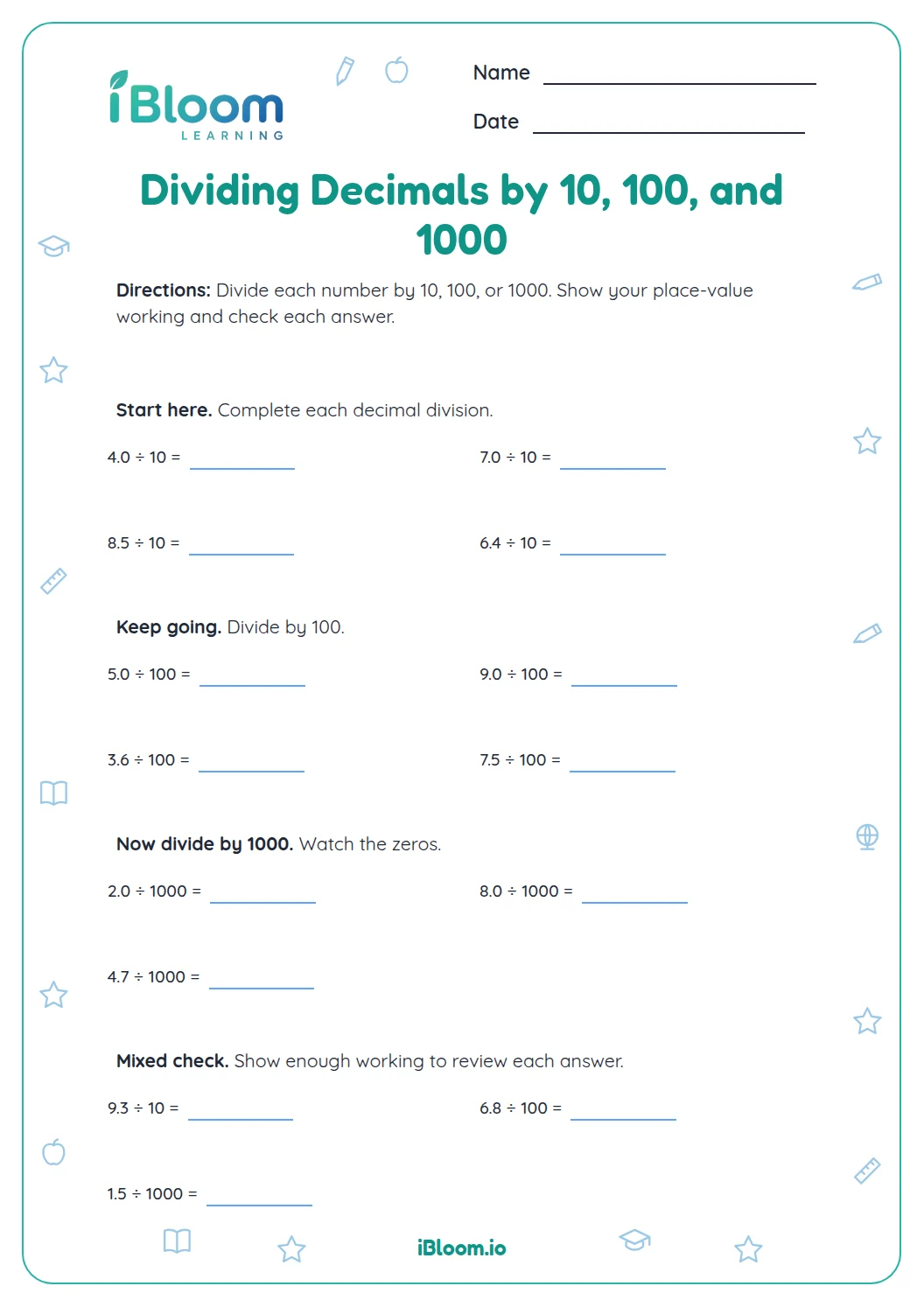
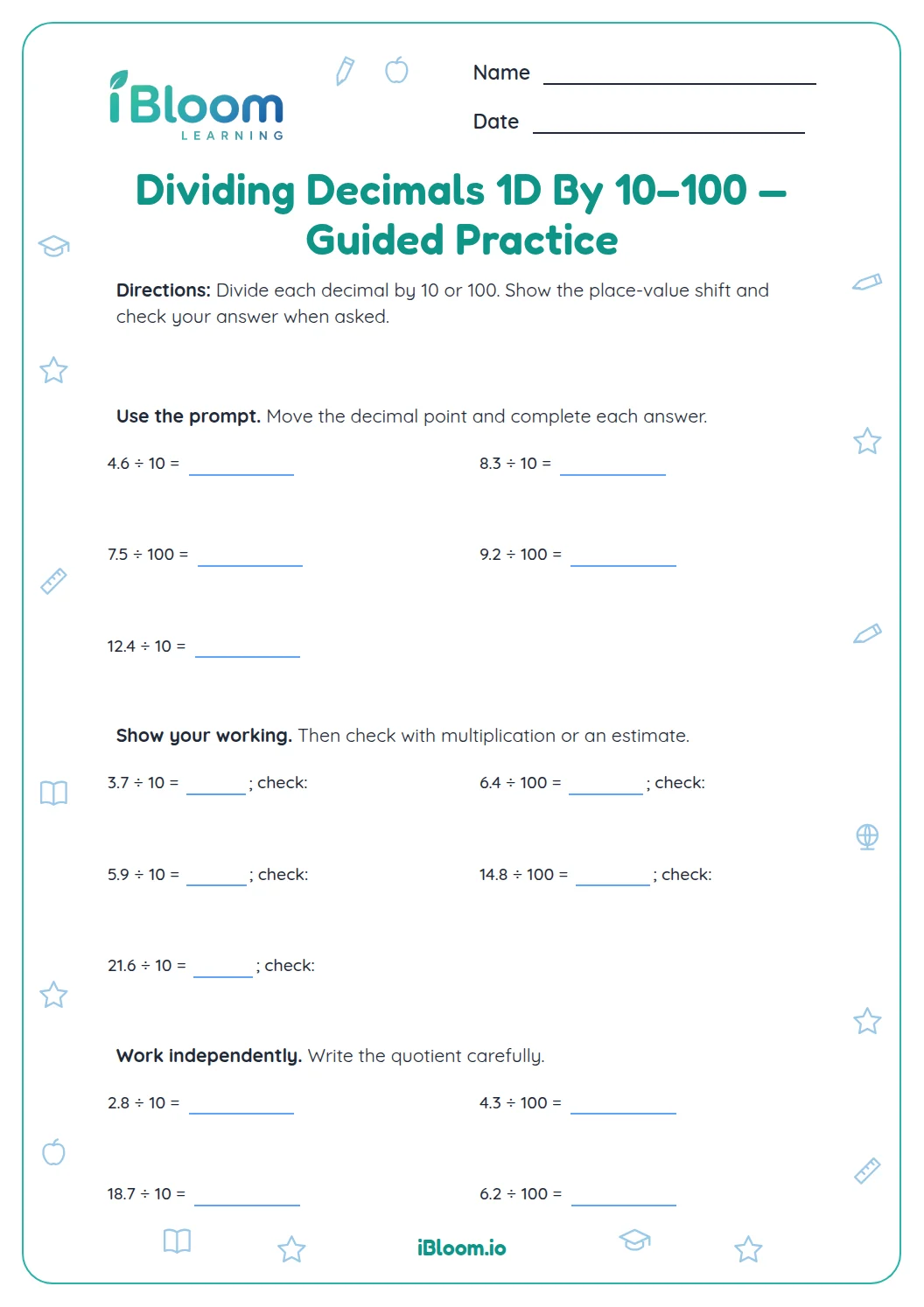
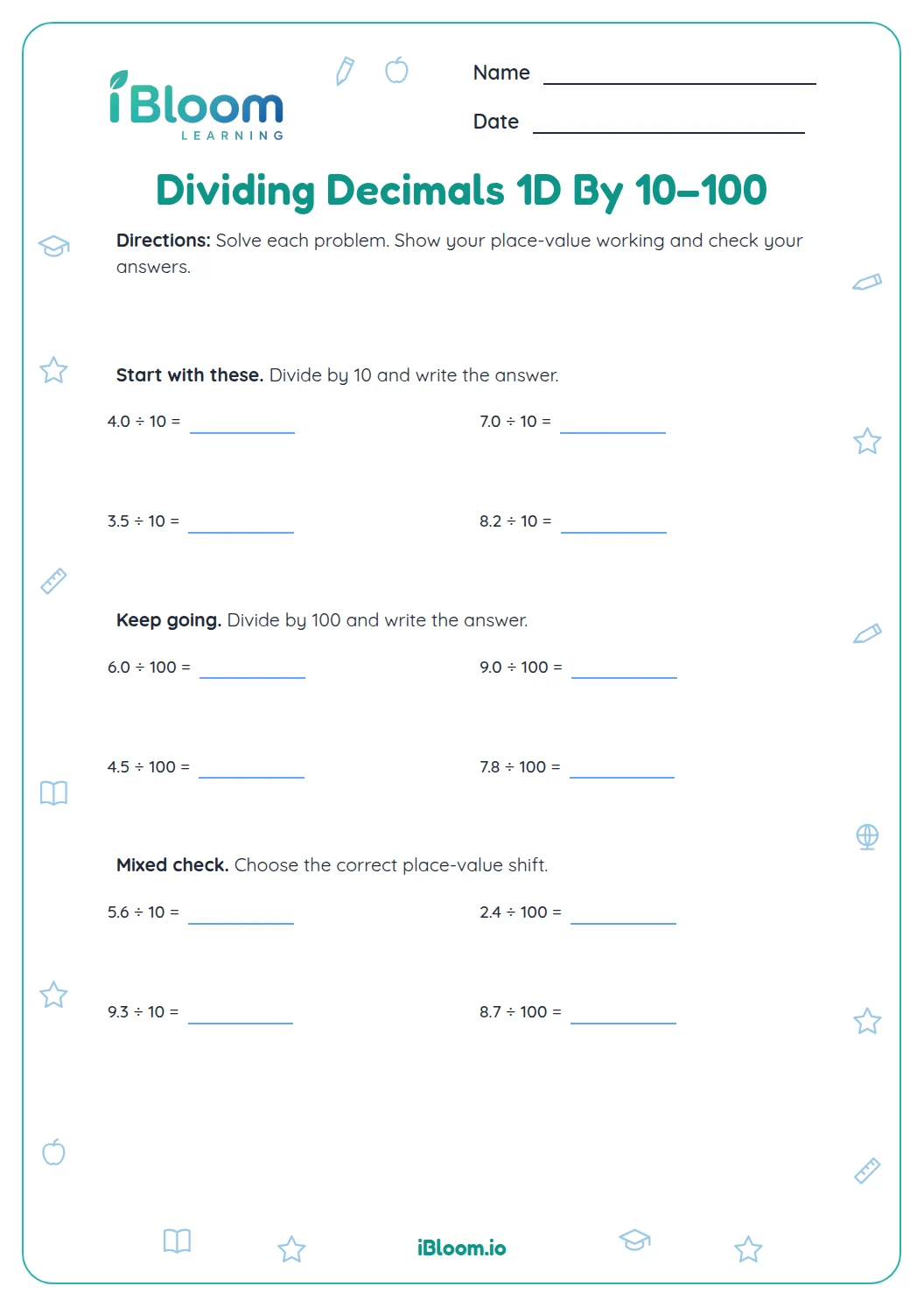
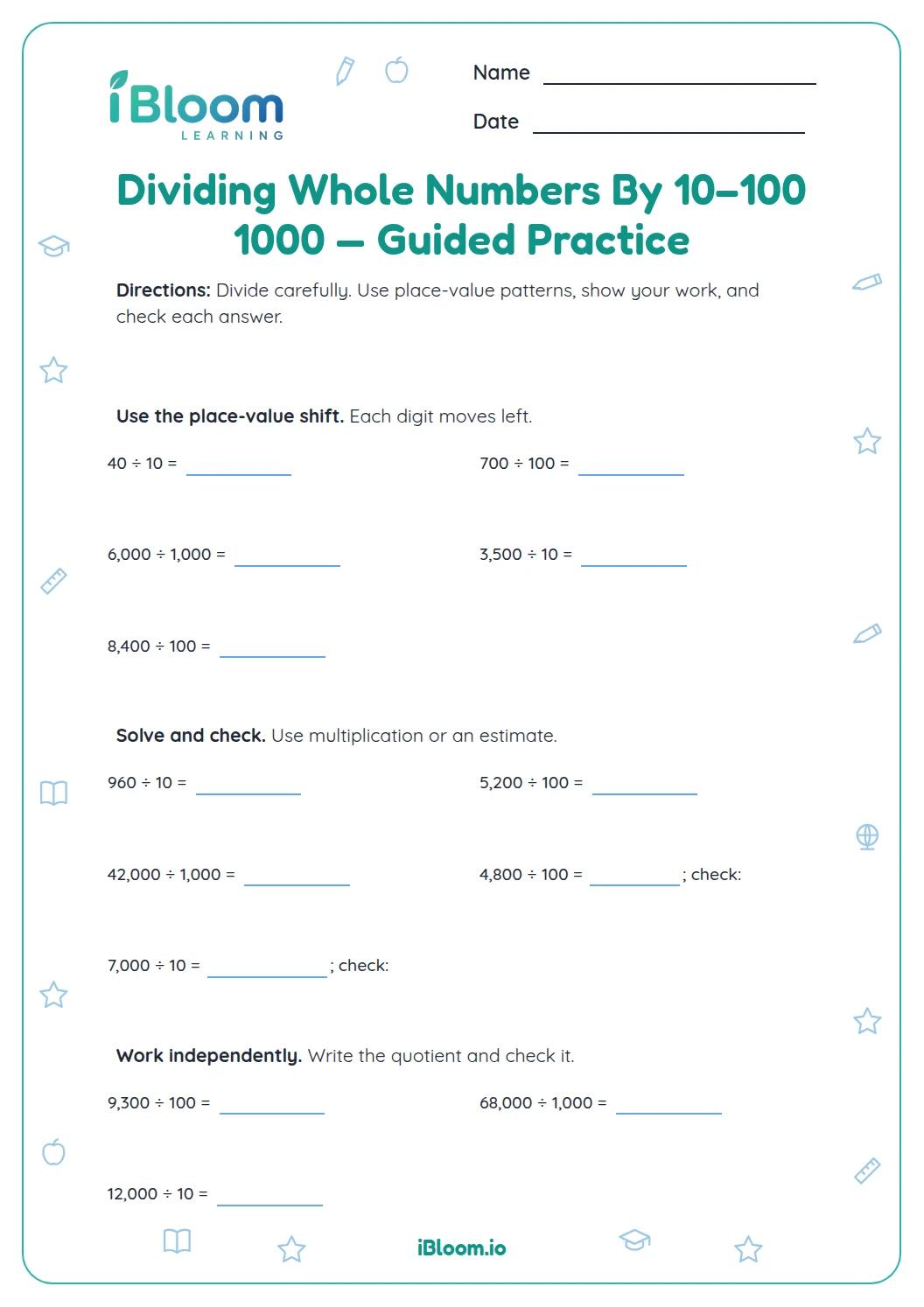
This Grade 5 decimal division worksheet turns division by powers of ten into practical equal-sharing situations. Learners solve 16 problems about lengths, liquids, weights, and small portions, then label every quotient with its unit. The parts practice division by 10, 100, and 1,000 before a mixed set. The page aligns with CCSS 5.NBT.A.2, which includes explaining decimal-place patterns when dividing by powers of ten.
Aligned to 5.NBT.A.2
How does dividing by ten change a decimal?
Dividing by 10 makes each amount one tenth as large. In question 1, 6.4 liters divided among 10 bottles gives 0.64 liter per bottle. Each digit moves one place to a smaller place value.
- 16.4 ÷ 10
- 26.4 becomes 0.64
- 3Each bottle gets 0.64 L
- 4Check: 0.64 × 10 = 6.4
What changes when the divisor is 100 or 1,000?
Dividing by 100 makes the amount one hundredth as large; dividing by 1,000 makes it one thousandth as large. Track the place values and use zero placeholders when needed, as in 5.08 ÷ 1,000 = 0.00508.
How do units help check a real-world answer?
Divide the starting amount by the number of equal groups. Keep the original unit, and check by multiplying the amount in one group by the group count. If the product returns the starting amount, the quotient is reasonable.
How to use this worksheet
- 1Read the situation and identify the starting amount and number of groups.
- 2Write a division expression before calculating.
- 3Track how many places the decimal shifts for the divisor.
- 4Include the unit in the answer.
- 5Multiply the quotient by the divisor to check.
Common mistakes and quick fixes
The mistake
Moving a decimal the same direction as multiplication
The fix
A quotient must be smaller than the starting amount when dividing by more than 1.
The mistake
Dropping zeros that hold place value
The fix
Write placeholder zeros before the first nonzero digit, as in 5.08 ÷ 1,000 = 0.00508.
The mistake
Leaving off the unit
The fix
Copy the original measurement unit into the per-group answer.
Common Core alignment
This worksheet practices the following Common Core skill.
Use powers of ten to explain how a decimal shifts when multiplied or divided.
On this sheet: Every problem divides a decimal amount by 10, 100, or 1,000 in a context.
Show the official wordingHide the official wording
Explain patterns in the number of zeros of the product when multiplying a number by powers of 10, and explain patterns in the placement of the decimal point when a decimal is multiplied or divided by a power of 10. Use whole-number exponents to denote powers of 10.
What to practice next
Make more practice
Further reading
Questions parents and teachers ask
How do I divide 6.4 by 10?
Dividing by 10 shifts each digit one place to the right in value. In question 1, 6.4 liters shared among 10 bottles gives 0.64 liter per bottle; multiplying 0.64 by 10 returns 6.4. The unit stays liters because each answer describes a portion of the original amount.
Why can a quotient have zeros before its first digit?
The zeros hold the decimal places needed to show the size of the quotient. In question 8, 5.08 kilograms divided among 1,000 packs gives 0.00508 kilogram per pack. Multiplying the quotient by 1,000 checks that the packs total 5.08 kilograms.
Should children write units in every answer?
Yes. The situations begin with liters, meters, grams, or kilograms, so the answer should use the same unit for one equal group. For example, 6.4 liters divided among 10 bottles gives 0.64 L in each bottle. Have the learner point to the relevant detail before using the answer key to check.
How can a child check a quotient?
Multiply the per-group amount by the number of groups. For question 6, 0.365 liter multiplied by 100 gives 36.5 liters, the original tank amount. This inverse operation checks both the decimal and the grouping. Have the learner point to the relevant detail before using the answer key to check.
What powers of ten appear on the worksheet?
The 16 questions use divisors of 10, 100, and 1,000 in measurement contexts. Each asks for the amount in one equal group, so children must connect the divisor to the number of groups and keep the original measurement unit in the answer.
How many practice problems and key pages are included?
Yes. The printable has 16 real-world division questions, and the separate key lists each quotient with its unit. To check a result, multiply the amount in one group by the number of groups and confirm it returns to the starting amount.