





About this worksheet
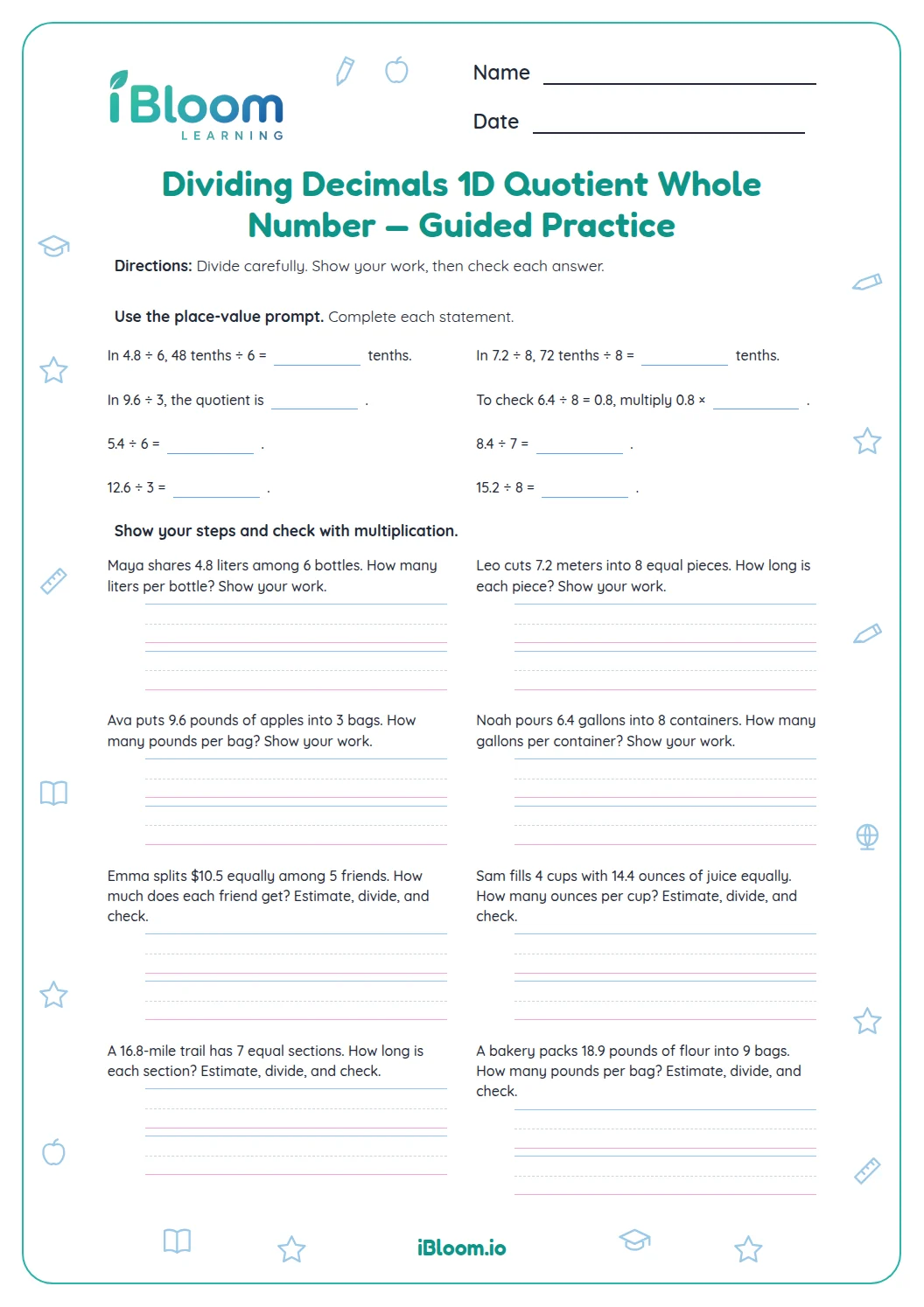
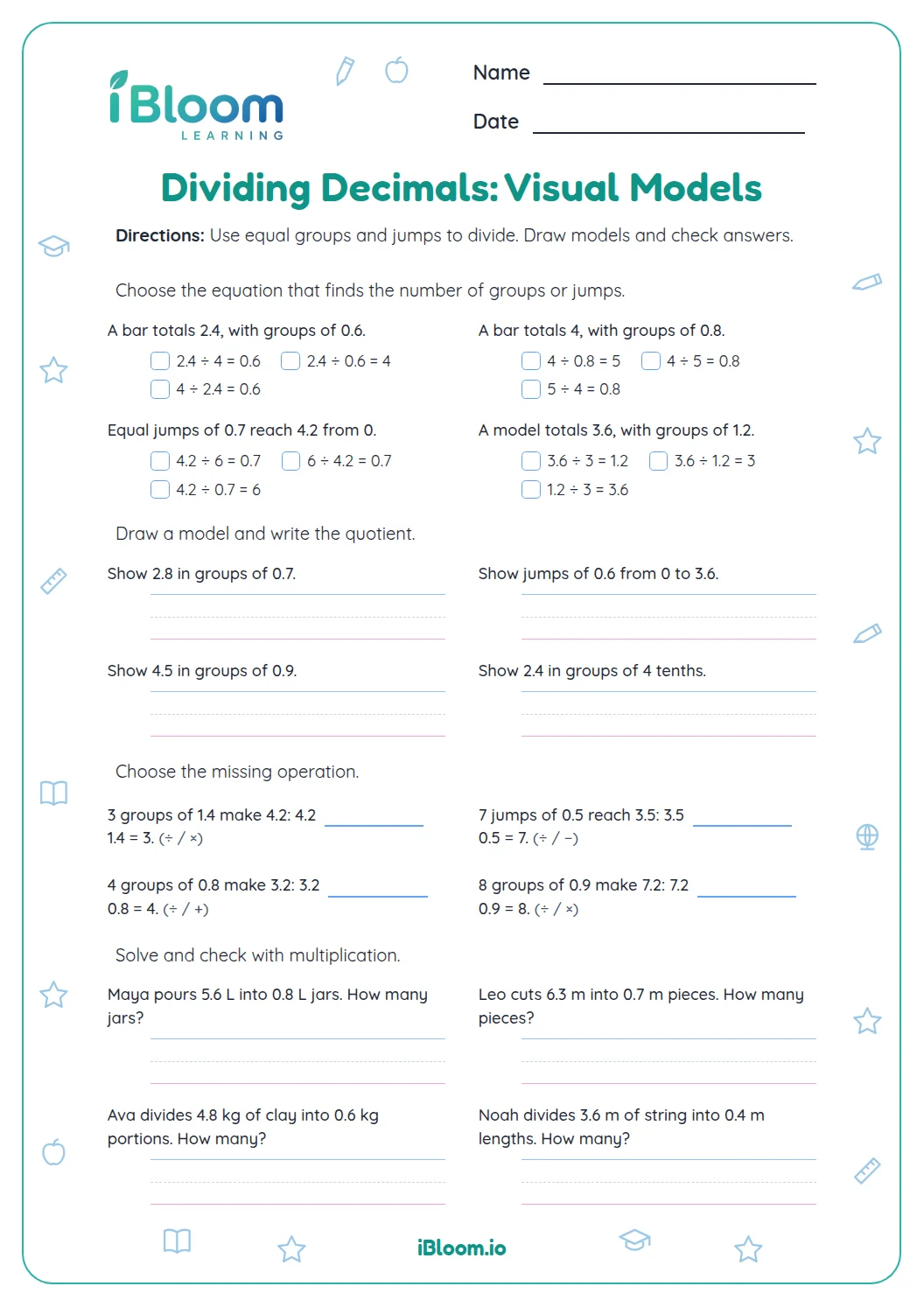
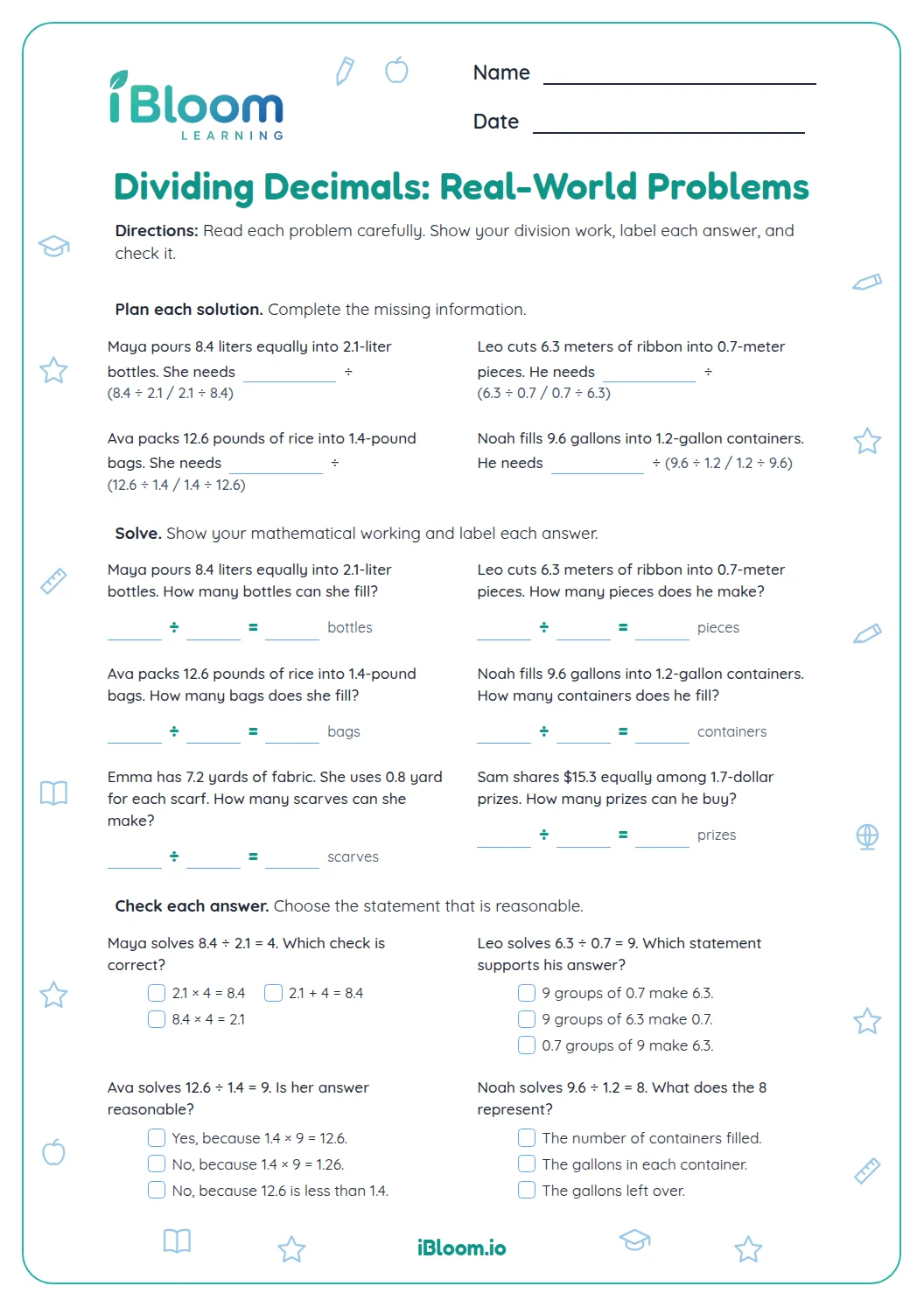
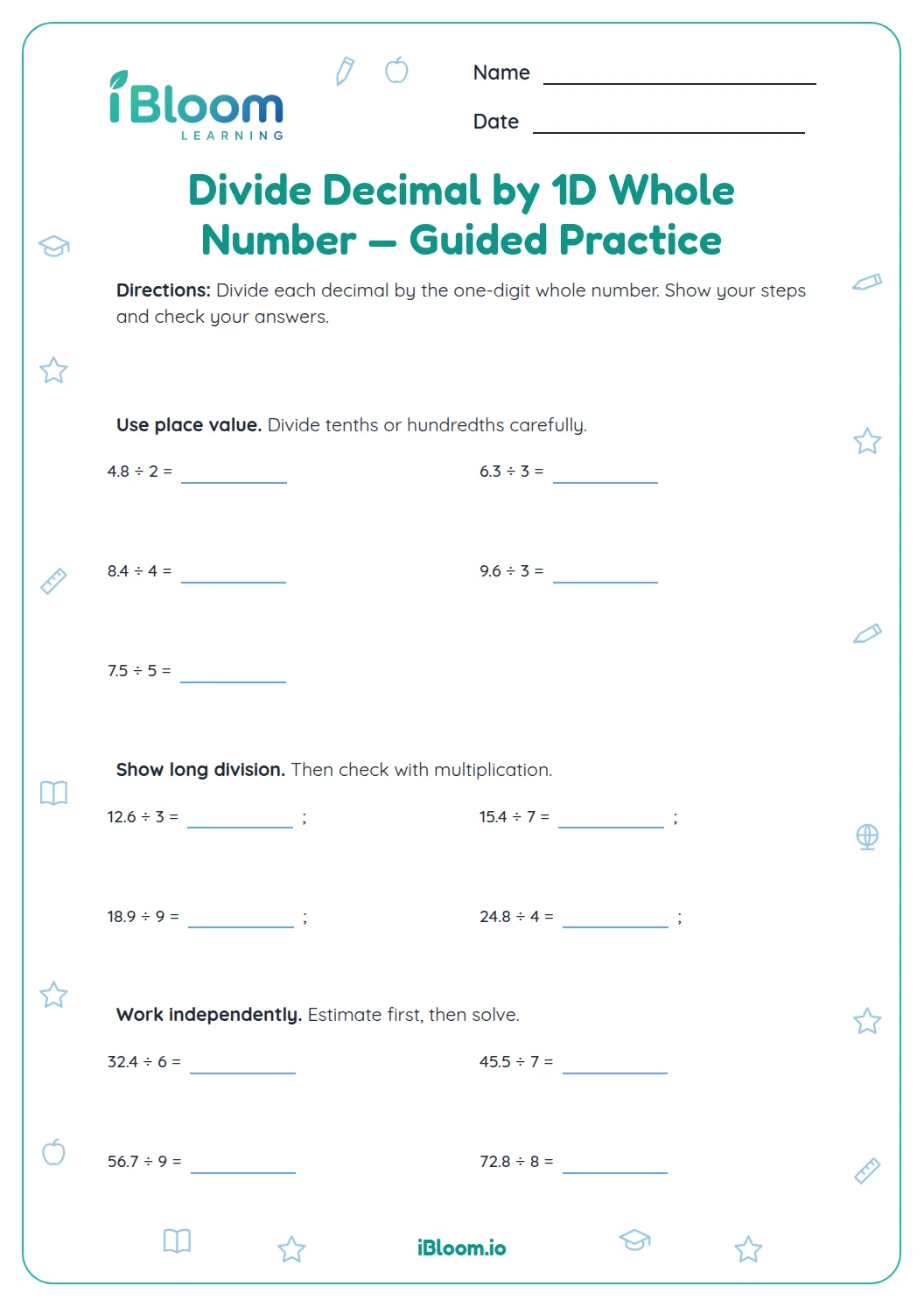
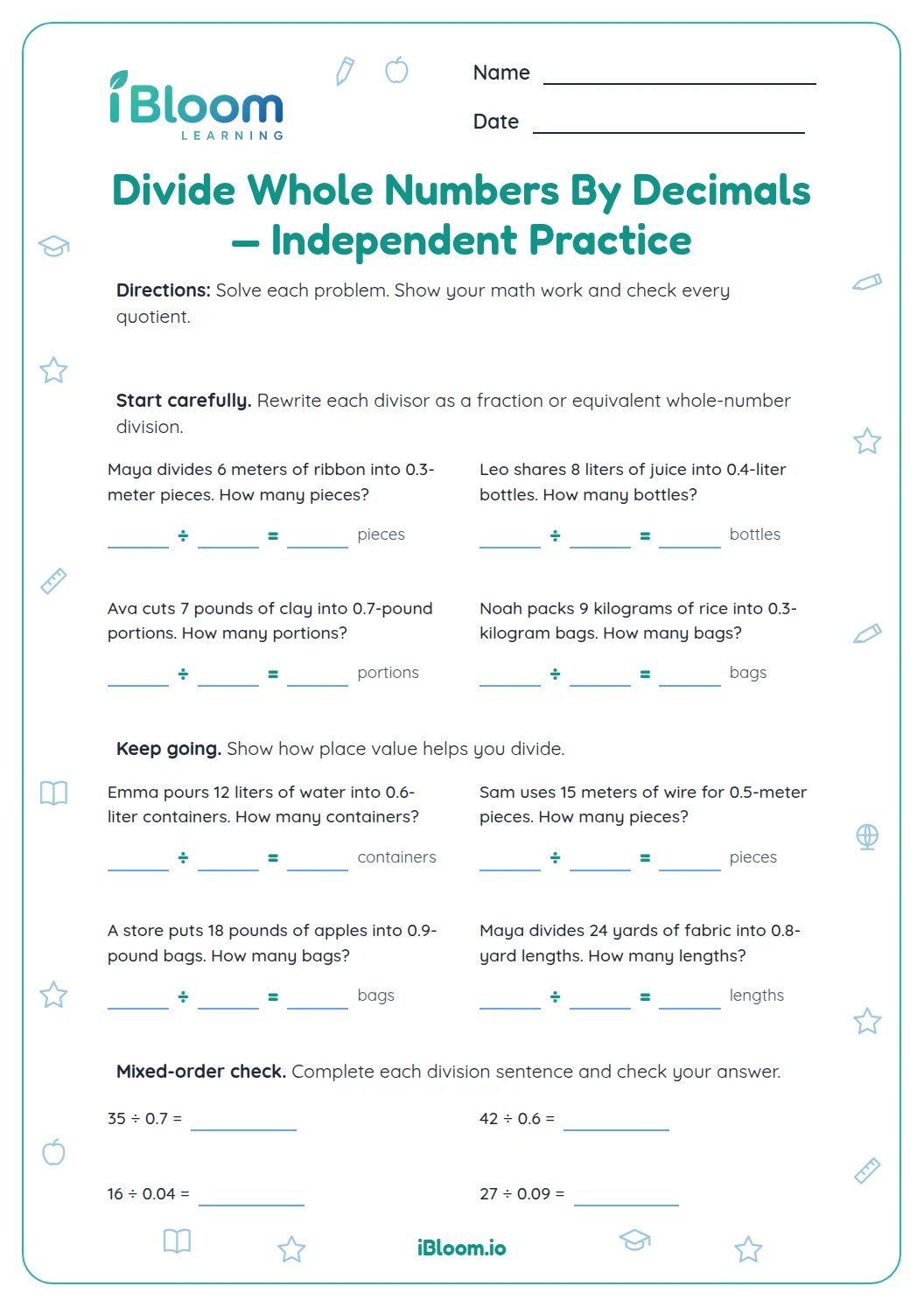
This two-page Grade 5 printable gives students 16 decimal division equations whose quotients are whole numbers. Early problems use tenths; later problems include hundredths, so students can practice making the divisor a whole number by scaling both numbers equally. The final part includes a multiplication check for each answer. A separate two-page key lists the quotients. The set practices decimal division to hundredths, a skill in CCSS 5.NBT.B.7.
Aligned to 5.NBT.B.7
What decimal division is on the sheet?
Part A starts with divisors in tenths. Part B moves to hundredths, and Part C mixes both forms. Every quotient is a whole number, so students can focus on place value rather than rounding.
How can you turn a decimal divisor into a whole number?
Move the decimal in both numbers the same number of places. The value of the quotient stays the same because the dividend and divisor are scaled equally.
- 12.52 ÷ 0.36
- 2Multiply both numbers by 100: 252 ÷ 36 = 7
- 3Check: 7 × 0.36 = 2.52
How can students check a quotient?
Multiply the quotient by the original divisor, not the scaled divisor. The product should return to the original dividend; for question 9, 7 × 0.36 returns 2.52.
How can an adult support this practice?
Ask the student to name the scale factor before calculating. For a hundredths divisor such as 0.36, both numbers are multiplied by 100; writing the equivalent equation makes that choice visible.
How to use this worksheet
- 1Read the divisor and count its decimal places.
- 2Choose a power of 10 that makes the divisor whole.
- 3Multiply the dividend by that same power of 10.
- 4Divide the equivalent whole-number equation.
- 5Multiply the quotient by the original divisor to check.
Mistakes to watch for
The mistake
Scaling the divisor but not the dividend.
The fix
Multiply both numbers by the same power of 10.
The mistake
Using a different scale factor for each number.
The fix
Move both decimal points the same number of places.
The mistake
Checking with the scaled divisor.
The fix
Multiply by the original decimal divisor and compare with the dividend.
Common Core alignment
This worksheet practices the following Common Core skill.
Solve decimal division problems to hundredths and check each quotient by multiplication.
On this sheet:
Show the official wordingHide the official wording
Add, subtract, multiply, and divide decimals to hundredths, using concrete models or drawings and strategies based on place value, properties of operations, and/or the relationship between addition and subtraction; relate the strategy to a written method and explain the reasoning used.
What to practice next
Make more practice
Further reading
Questions parents and teachers ask
What does this decimal division worksheet practice?
It gives Grade 5 students 16 division equations with whole-number quotients. The problems begin with tenths and include hundredths, then mix both kinds for review. Students can show how they scale both numbers and use multiplication to check. Ask the student to point to the exact clue in the question before checking the key.
How do students divide by a decimal?
Scale the divisor until it is a whole number, and multiply the dividend by the same amount. For example, 2.52 ÷ 0.36 becomes 252 ÷ 36 when both numbers are multiplied by 100. The quotient remains 7. Ask the student to point to the exact clue in the question before checking the key.
Does the printable include an answer key?
Yes. A separate two-page answer key follows the two student pages and lists a quotient for each equation. Students can finish a part before checking it, then revisit any equation where their quotient does not match. Ask the student to point to the exact clue in the question before checking the key.
Are the quotients whole numbers?
Yes. All 16 equations are designed to have whole-number quotients, including the problems with hundredths. This lets students focus on decimal place value and equivalent division equations without rounding. Ask the student to point to the exact clue in the question before checking the key.
How can I check a decimal division answer?
Multiply the quotient by the original divisor. For question 9, 7 × 0.36 = 2.52, which matches the dividend. This check helps reveal a misplaced decimal or a quotient that does not fit the original equation. Ask the student to point to the exact clue in the question before checking the key.