





About this worksheet
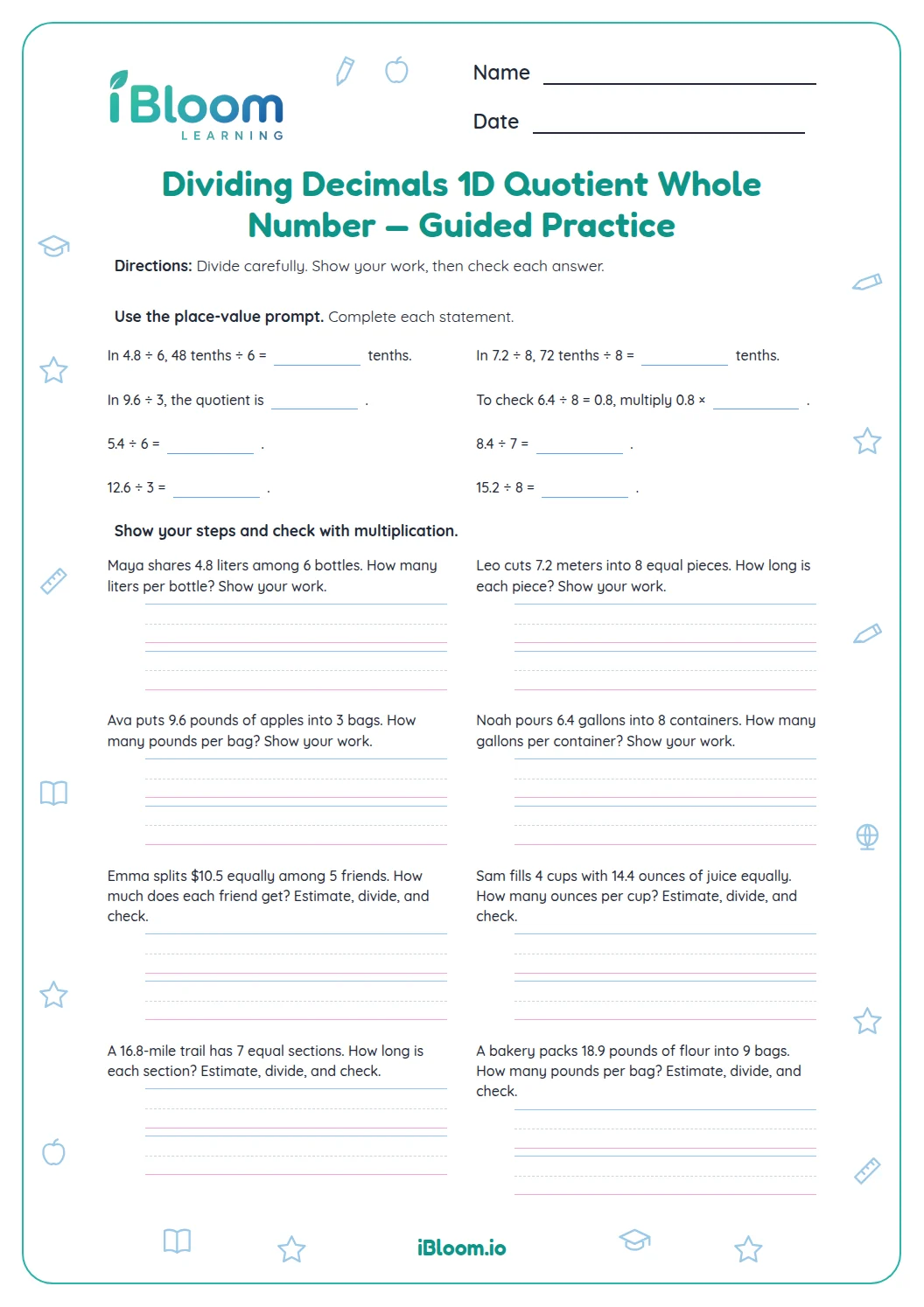
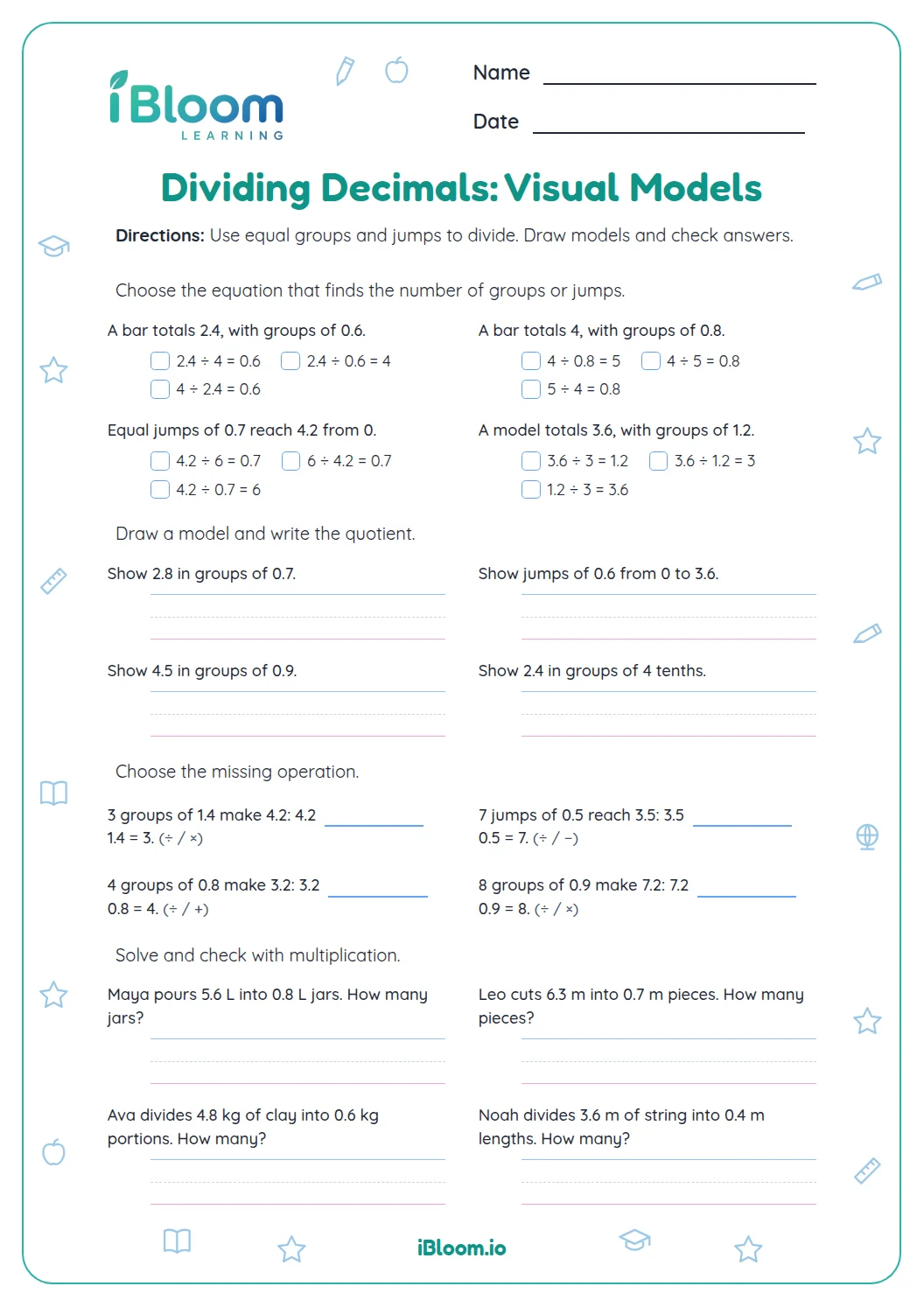
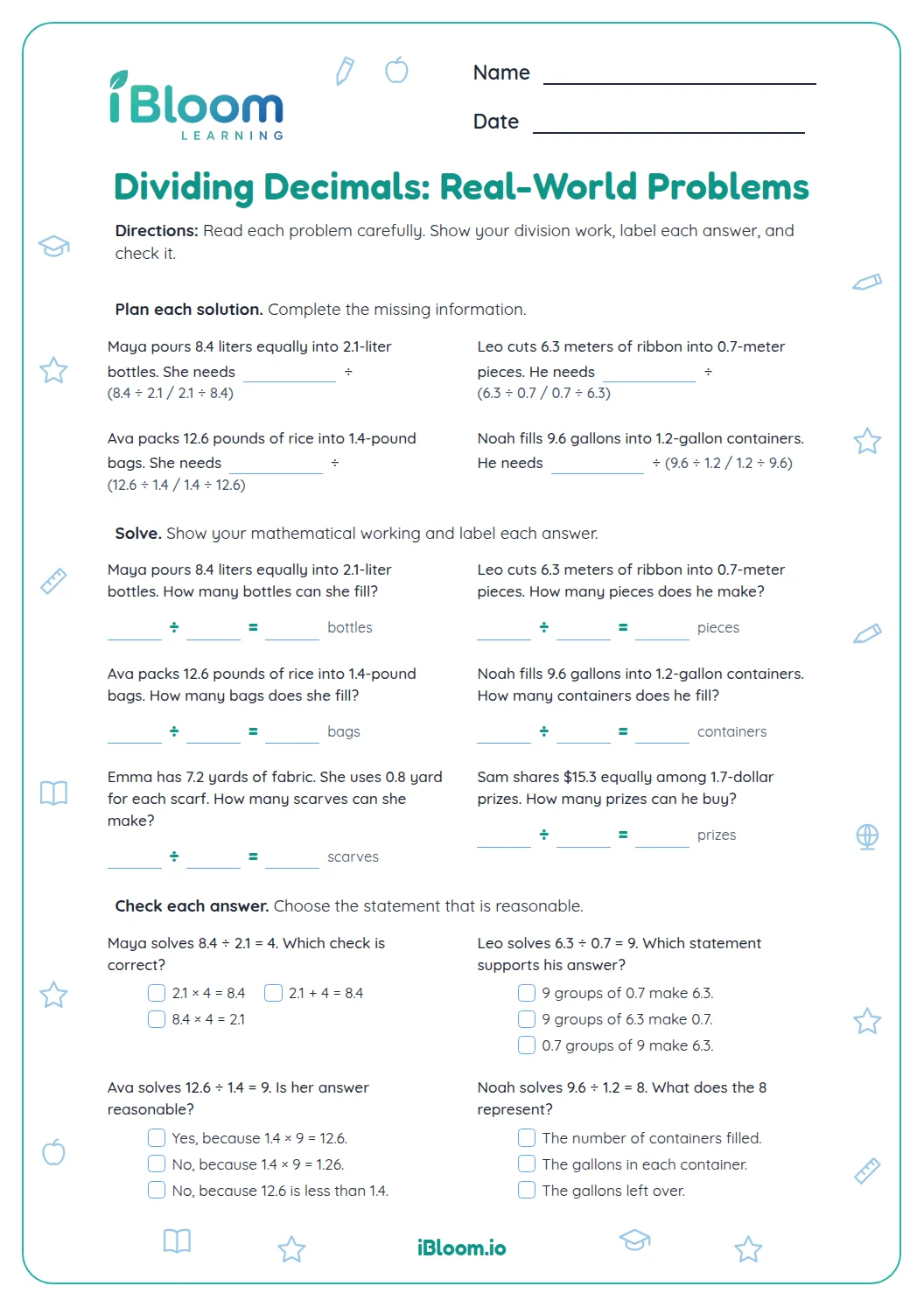
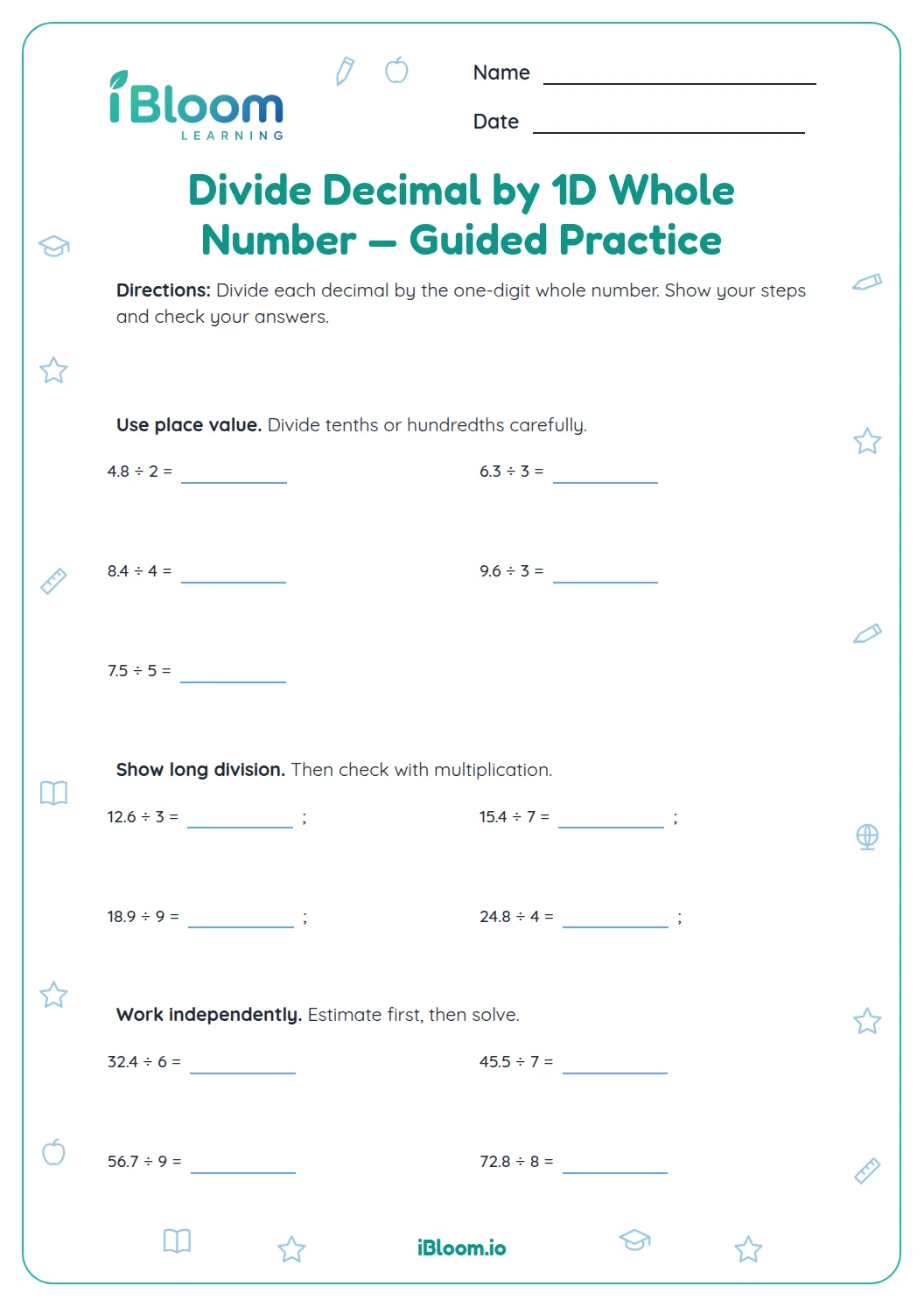
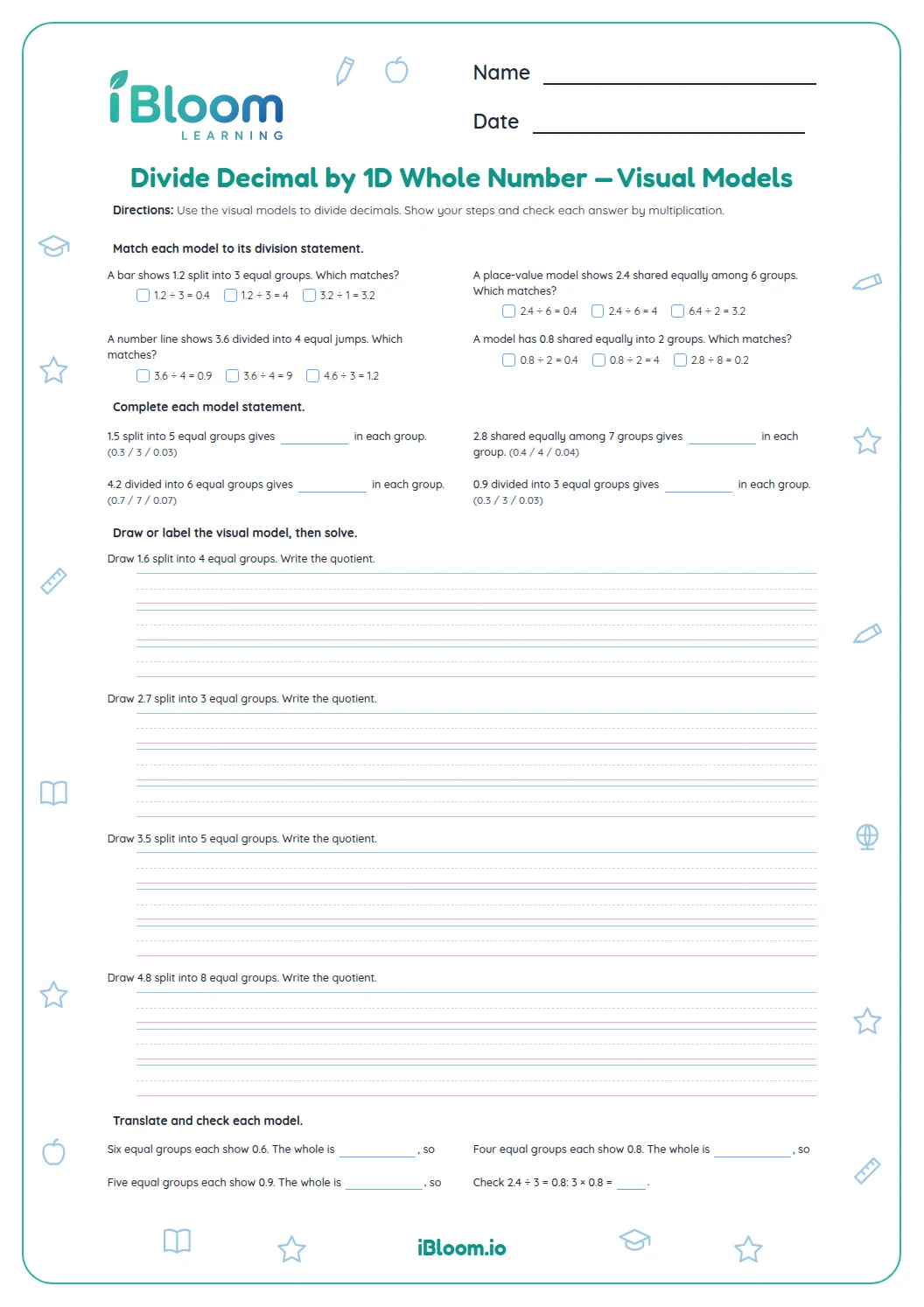
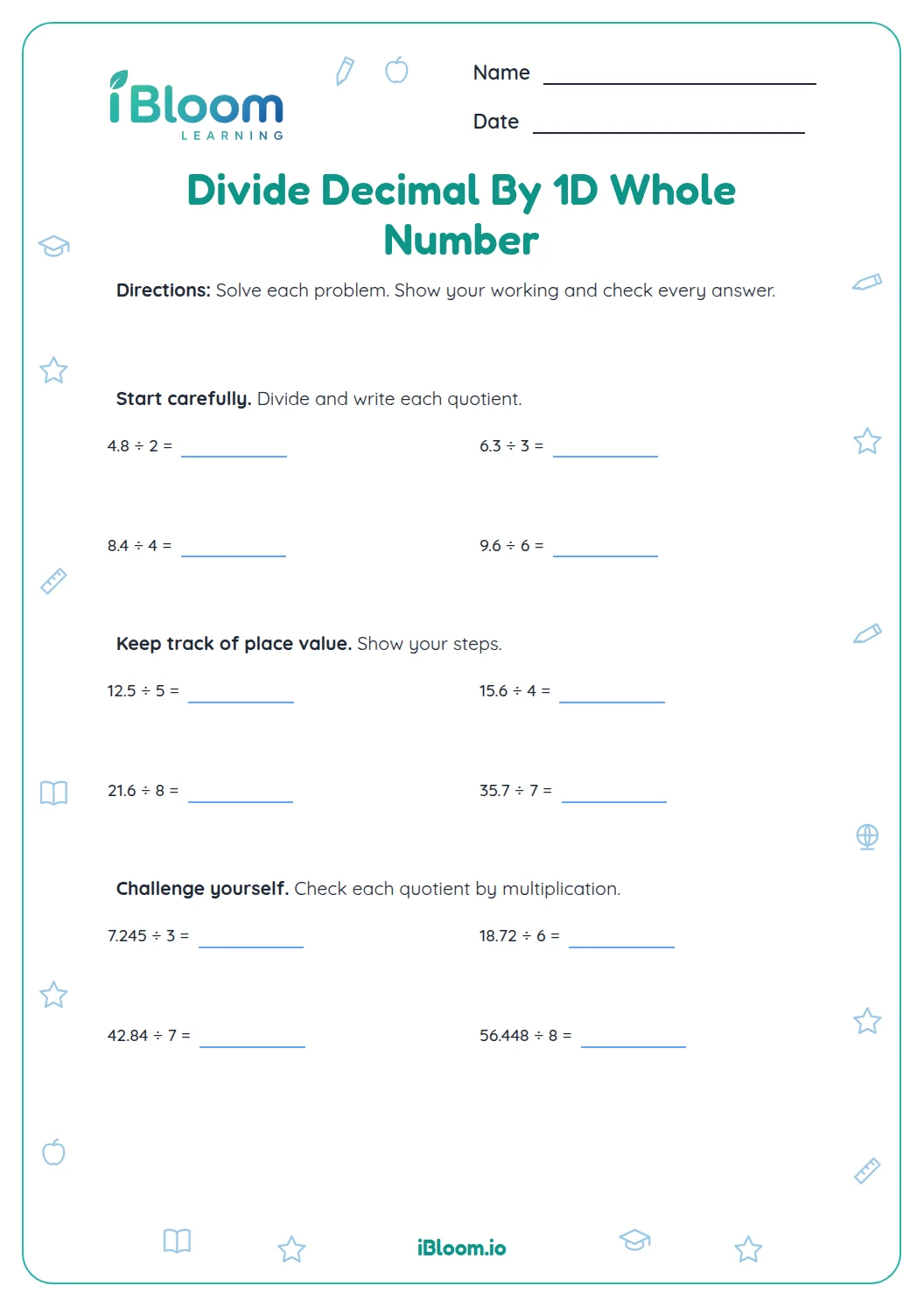
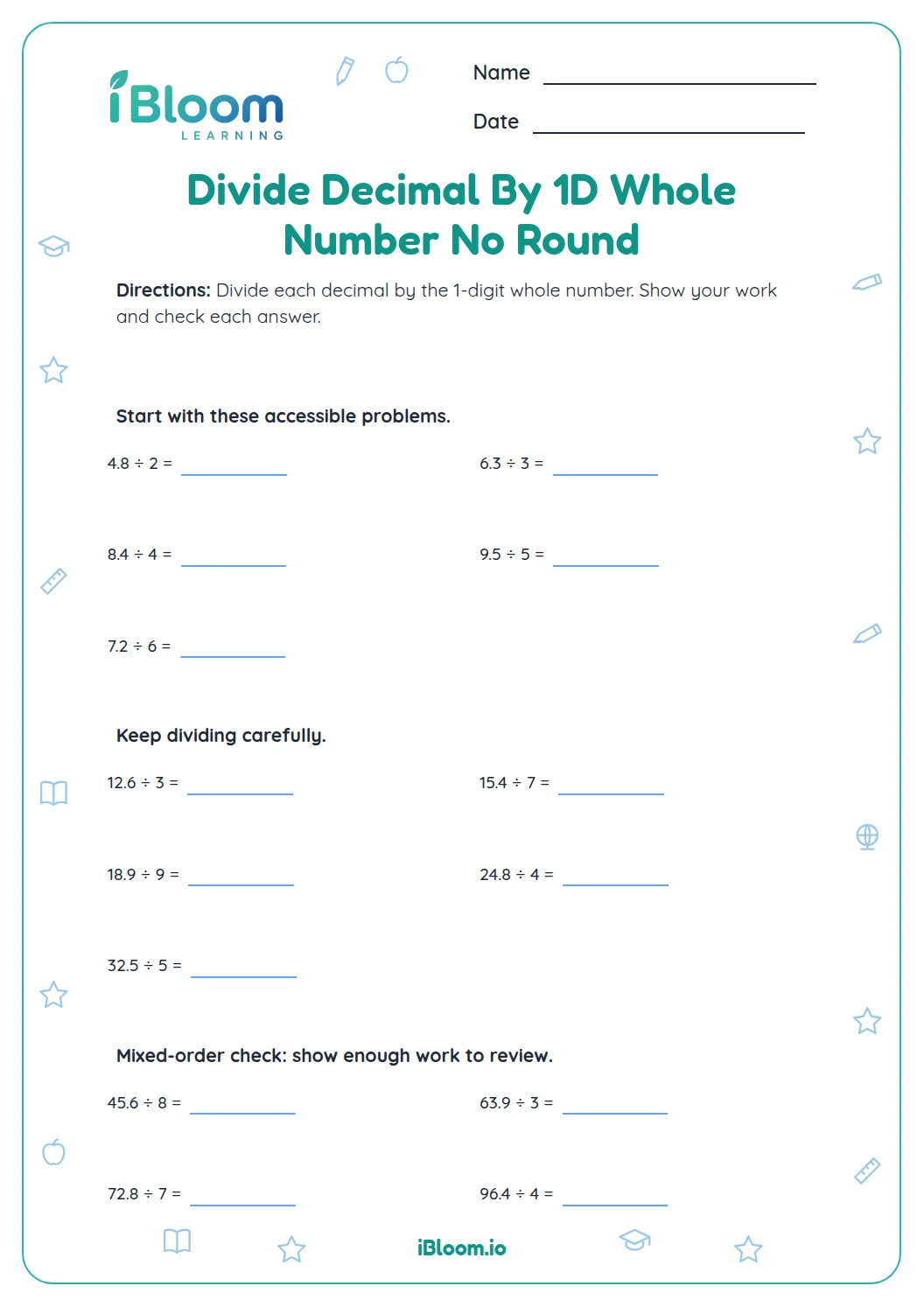
This Grade 5 worksheet practices dividing decimals by one-digit whole numbers when the quotient is a whole number or terminating decimal. Students compute, solve for a missing dividend or divisor, and apply division to equal-sharing situations. The story problems use familiar metric measures and provide space for equations. A separate answer key lists each quotient with its unit where needed.
Aligned to 5.NBT.B.7
How can you compute a decimal quotient?
Use place value to divide the decimal amount into equal groups. Check by multiplying the quotient by the divisor.
- 14.8 ÷ 2 = 2.4; check: 2.4 × 2 = 4.8.
How do missing values change the equation?
Use the inverse relationship. If the quotient and divisor are known, multiply them to find the dividend.
- 1___ ÷ 4 = 1.8, so 1.8 × 4 = 7.2.
How does division describe equal shares?
A decimal amount divided into equal groups gives the amount in one group. Attach the unit from the situation to the quotient.
How to use this worksheet
- 1Estimate whether the quotient should be greater or less than one.
- 2Divide the digits and place the decimal in the quotient.
- 3For a missing dividend, multiply divisor by quotient.
- 4For stories, identify the total and number of equal groups.
- 5Multiply your quotient by the divisor to check.
Common mistakes and fixes
The mistake
Dropping the decimal point
The fix
Use place-value units such as tenths and check the product.
The mistake
Multiplying when the story asks for equal shares
The fix
Look for the total and how many equal groups; divide the total by the group count.
The mistake
Leaving off the unit
The fix
Write meters, liters or kilograms in the answer when the question asks for a measure.
Common Core alignment
The worksheet practices decimal computation and explaining it with place value.
Add, subtract, multiply and divide decimals to hundredths using place-value strategies.
On this sheet: The worksheet gives direct practice with this skill.
Show the official wordingHide the official wording
Add, subtract, multiply, and divide decimals to hundredths, using concrete models or drawings and strategies based on place value, properties of operations, and/or the relationship between addition and subtraction; relate the strategy to a written method and explain the reasoning used.
What to practice next
Make more practice
Further reading
Questions parents and teachers ask
What does 1D mean in this skill title?
The divisor is the number you divide by. Every divisor here has one digit; in 4.8 ÷ 2, the divisor is 2. The decimal number being split into equal groups is the dividend. For example, in 8.4 ÷ 4, 8.4 is the dividend and 4 is the one-digit divisor.
Why do some quotients have two decimal places?
A quotient can have a decimal part when an amount does not split into whole-number shares. Keep the place value in mind, then multiply back to verify the answer. An estimate also helps; dividing about eight by four should give an answer near two.
How can a student check a division answer?
Multiply the quotient by its divisor to check the dividend. In a measurement story, also check that the answer uses the same unit as the original amount. A quotient of 2.1 liters means each bottle receives that amount, not the total pitcher amount.
Why are there missing-number equations?
For a missing dividend, multiply divisor by quotient. For a missing divisor, divide the dividend by the quotient and check that the result makes the equation true. For example, 8.4 ÷ ___ = 2.1 has a divisor of 4 because 2.1 times 4 is 8.4.
What is the answer to the ribbon problem?
The four equal pieces are 7.2 ÷ 4 = 1.8 meters each. Multiplying 1.8 meters by four pieces gives the original 7.2 meters, so the answer checks. Use the equation on the page to confirm both the numerical answer and its measurement unit.