

About this worksheet
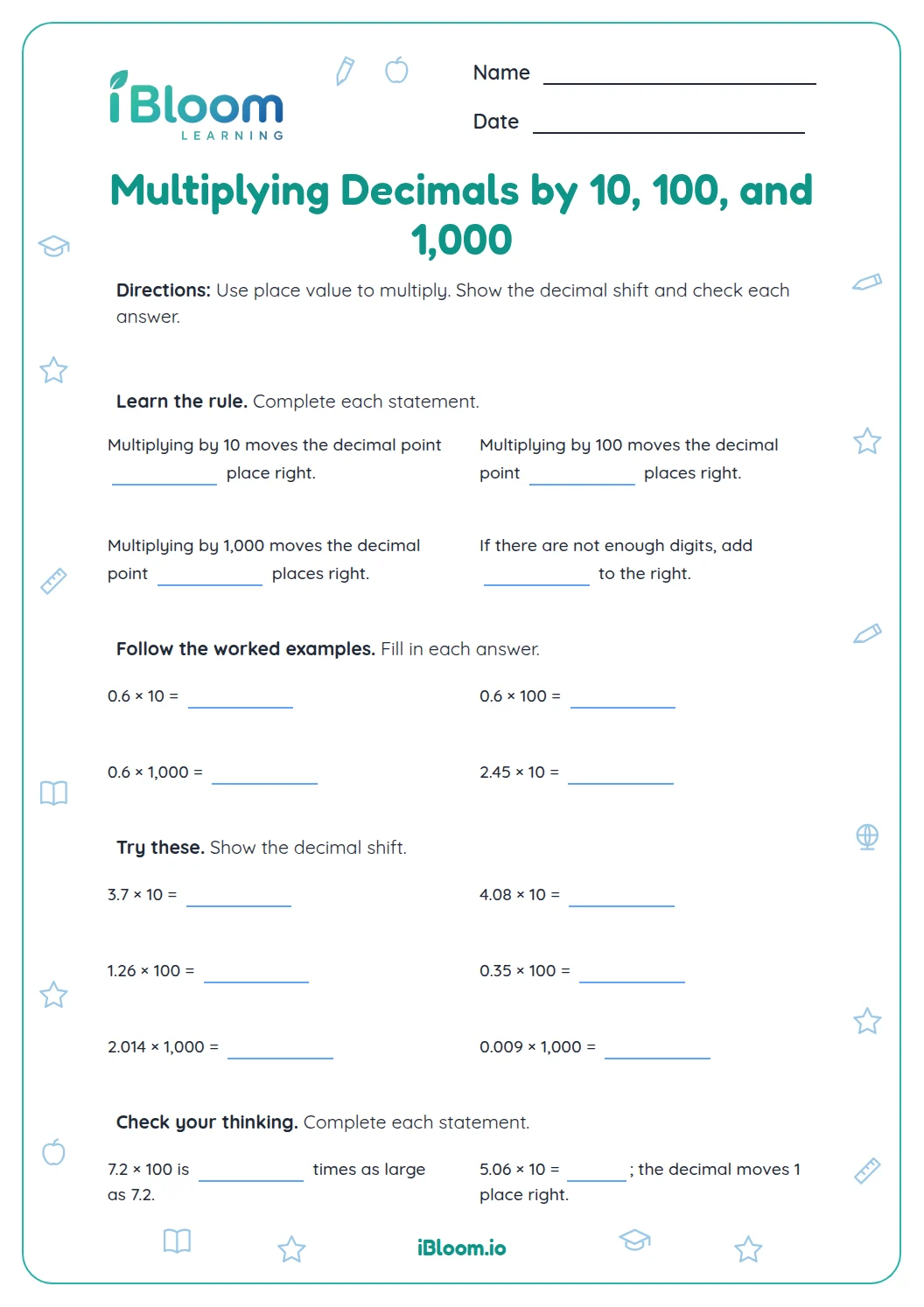
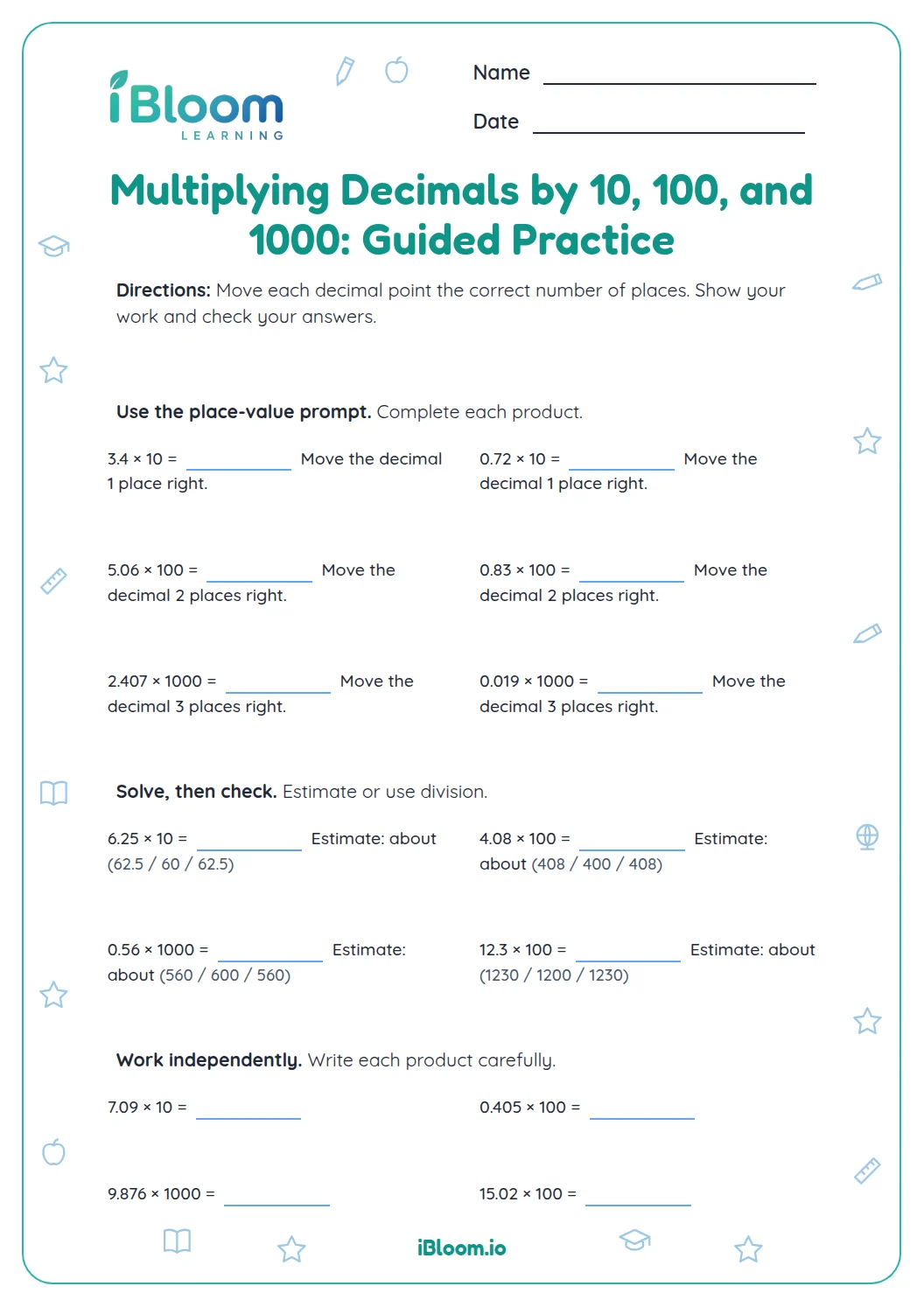
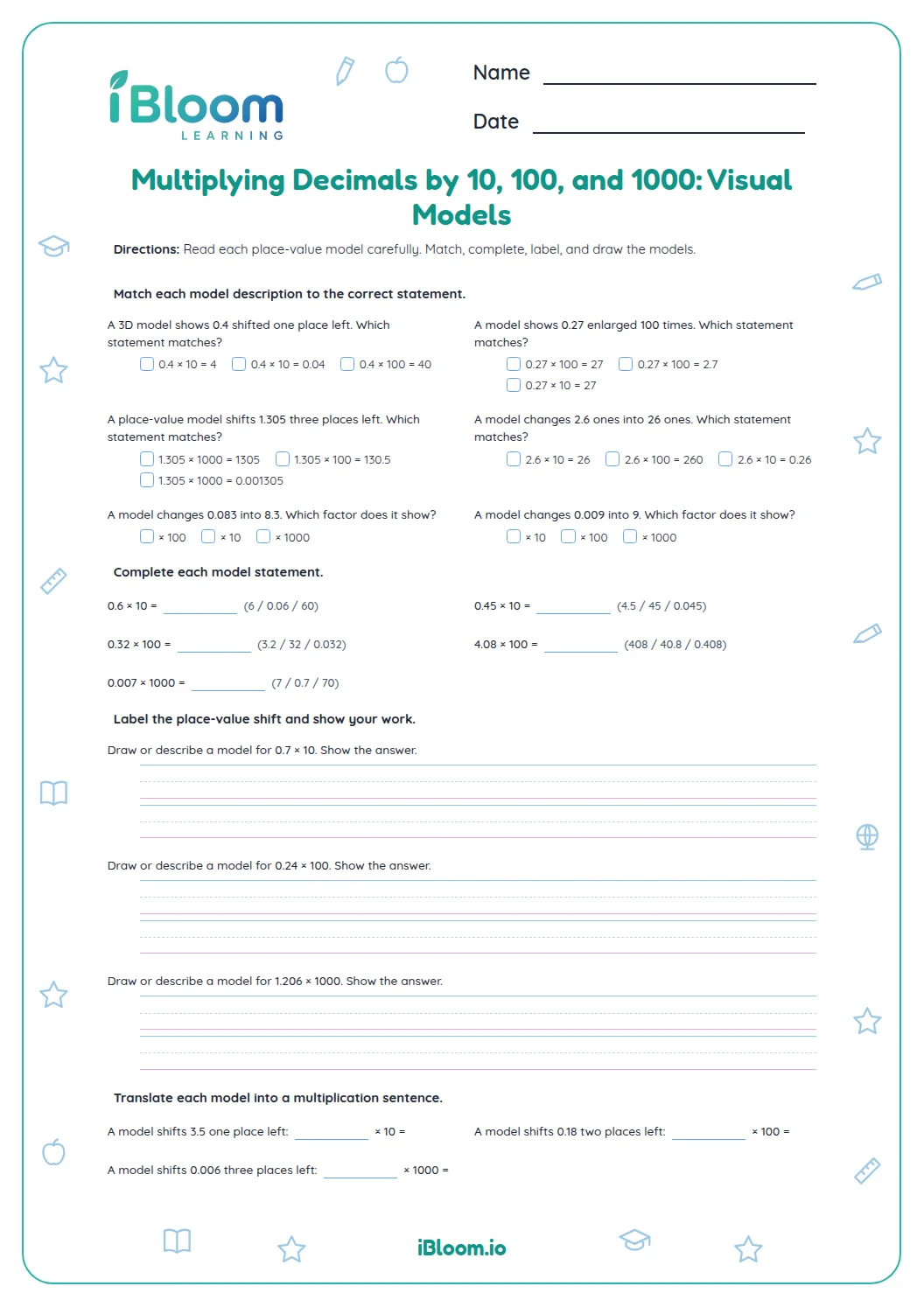
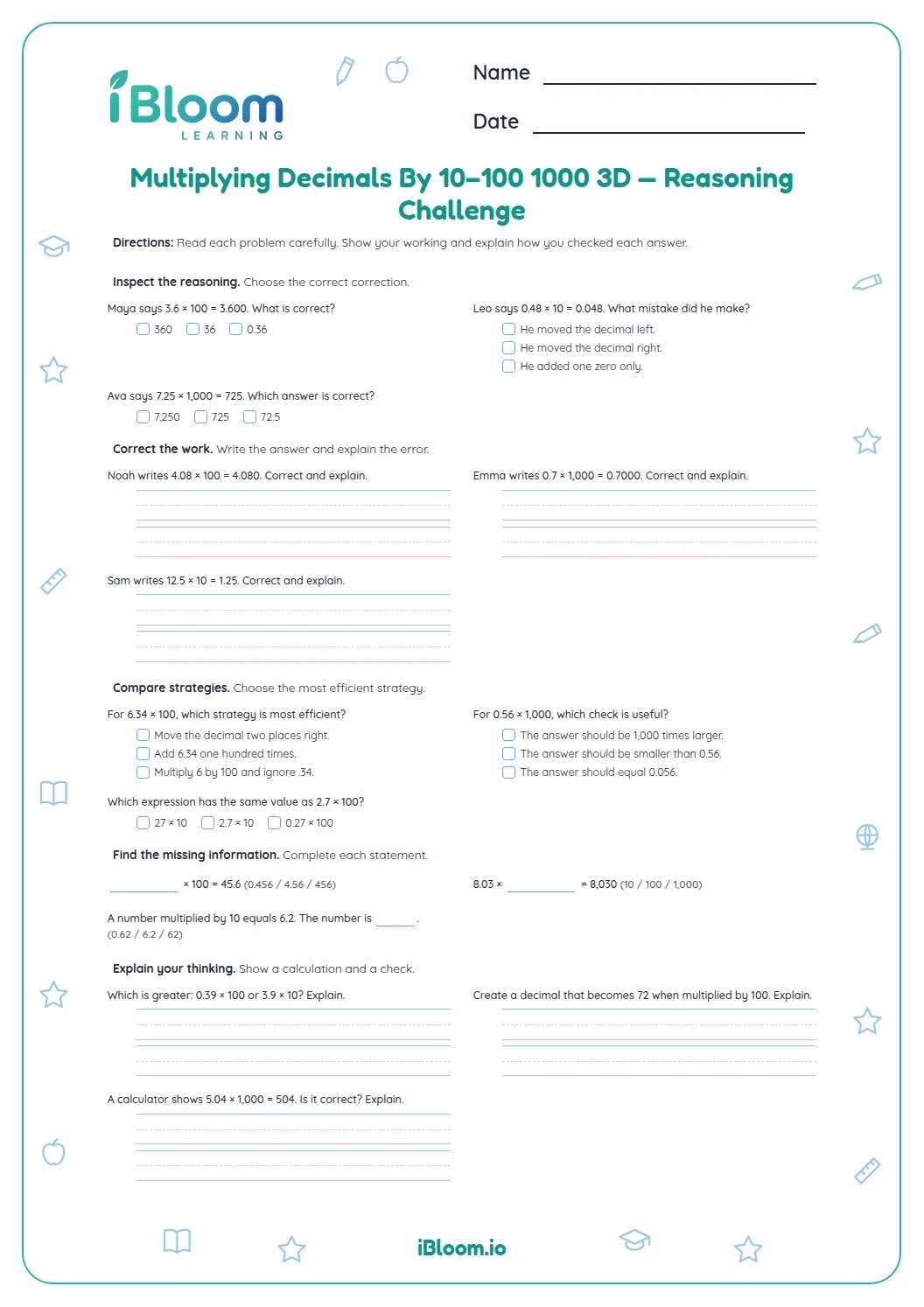
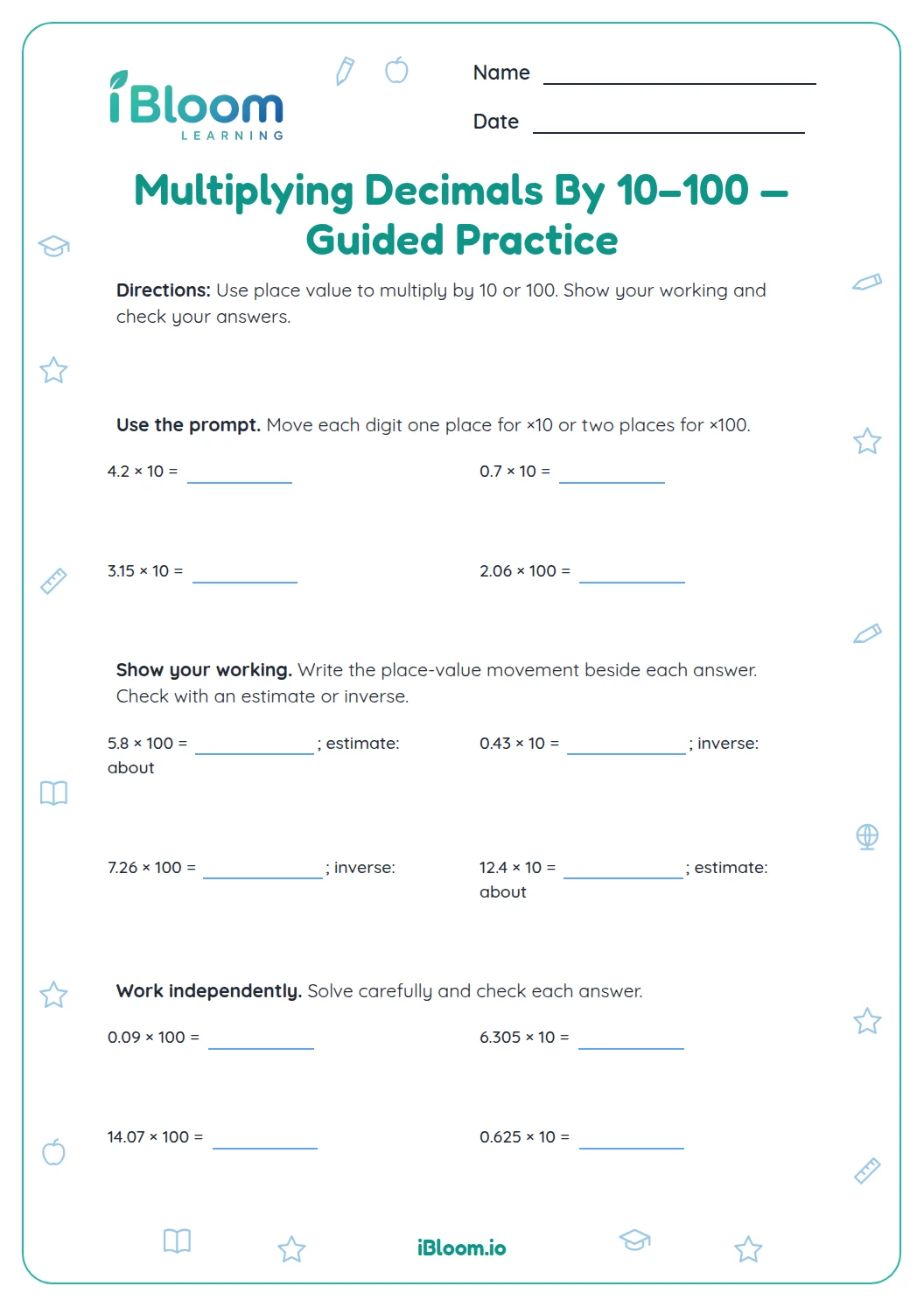
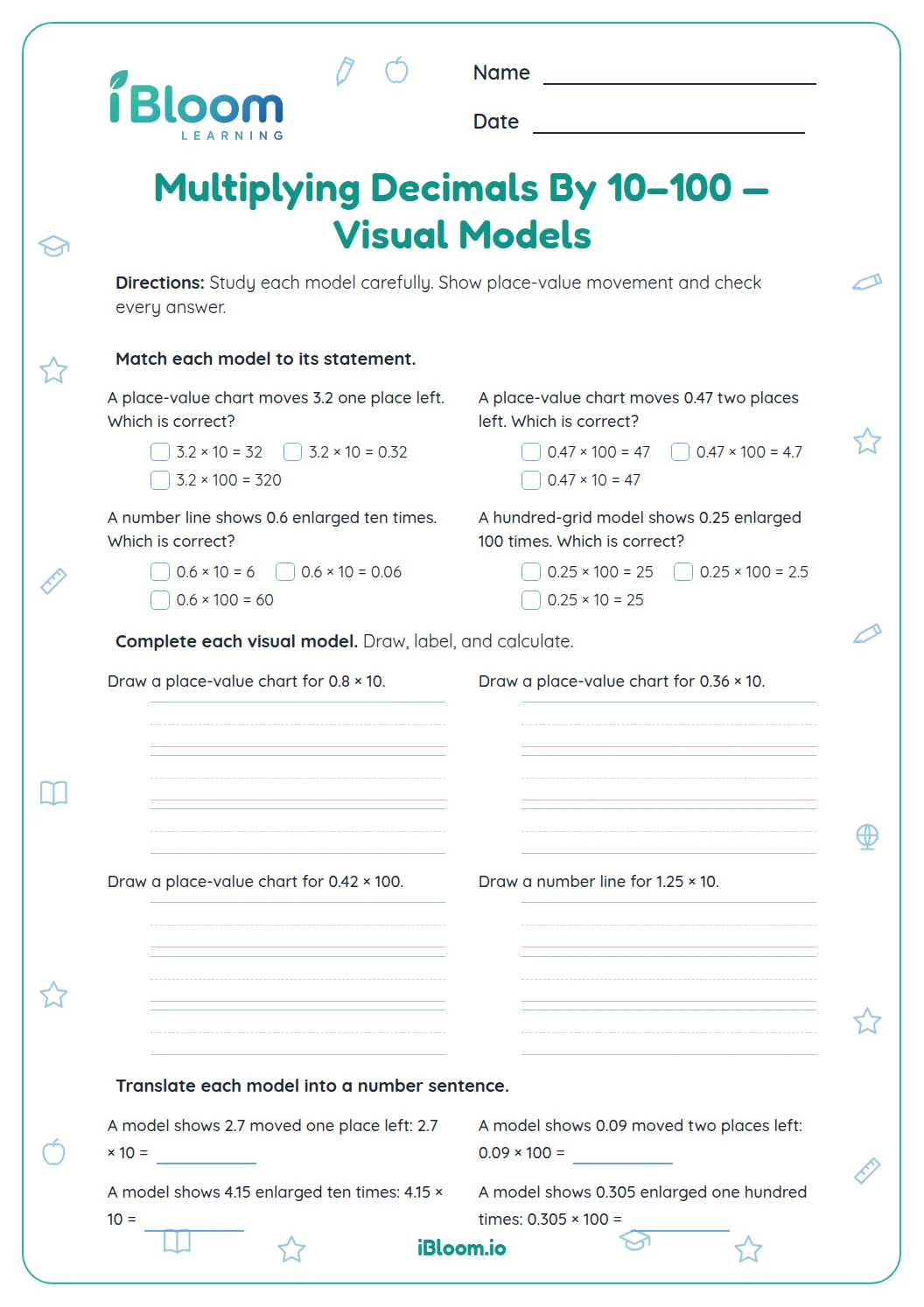
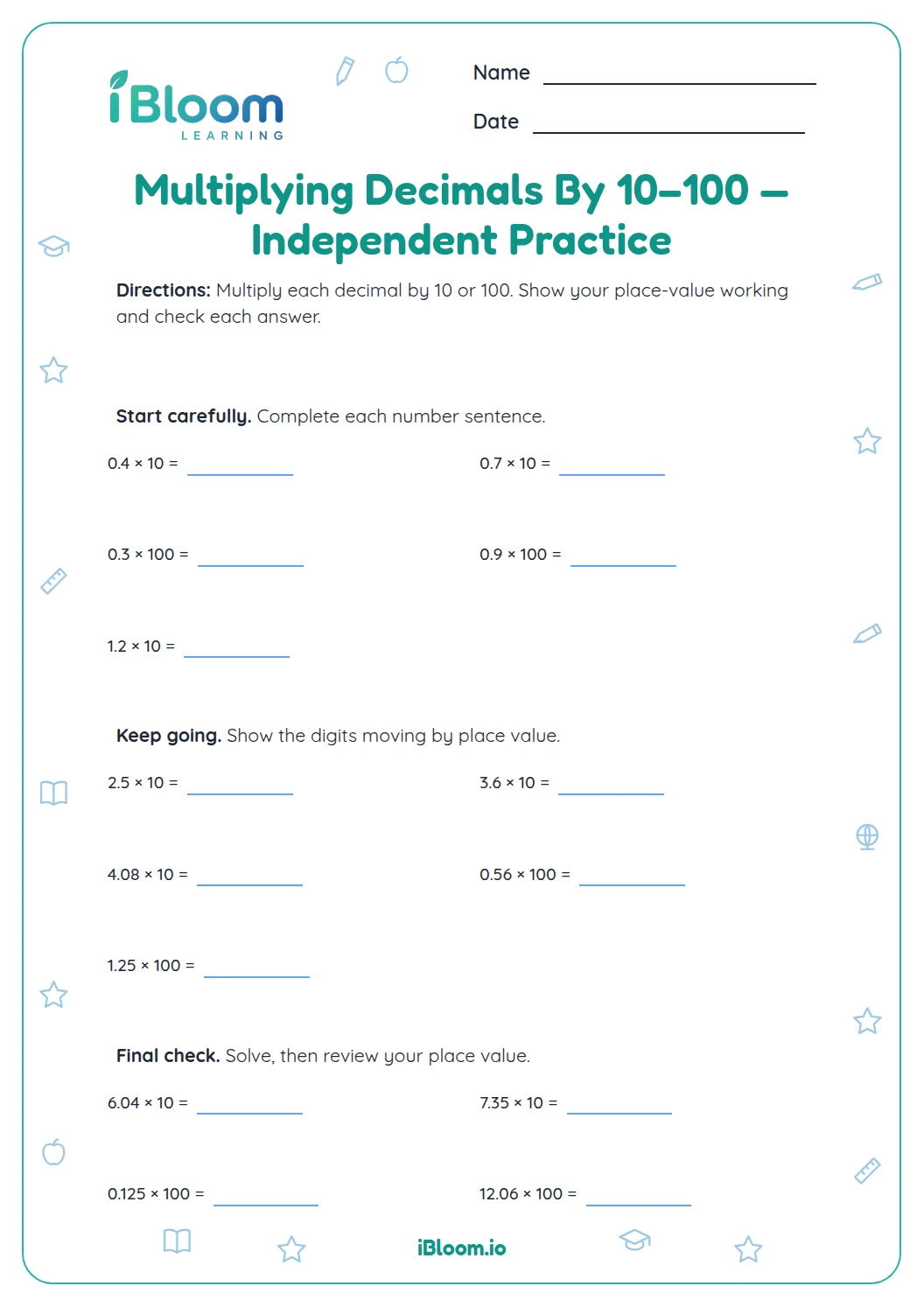
This Grade 5 printable practices multiplying decimals by 10, 100, and 1,000. Students track how each digit changes place value, then write the product with the decimal point in its new position. The 20 problems include tenths, hundredths, and thousandths, with a separate answer key for checking the calculations. The practice aligns with CCSS 5.NBT.A.2.
Aligned to 5.NBT.A.2
How do decimal place-value shifts work?
When a number is multiplied by 10, 100, or 1,000, each digit has a value 10, 100, or 1,000 times as large. Track the digits as they move into new place values, then write the decimal point to show the product.
For example, in 0.56 × 10, 5 tenths become 5 ones and 6 hundredths become 6 tenths. The product is 5.6.
What is in the practice set?
The 20 questions begin with one power-of-ten factor at a time, then mix the factors in Part D. Decimal factors range through thousandths.
- Part A: multiply by 10
- Part B: multiply by 100
- Part C: multiply by 1,000
- Part D: solve a mixed set and check with the key
A reliable way to solve
- 1Name the factor: 10, 100, or 1,000.
- 2Use the number of zeros in the factor to count the place shifts.
- 3Track the digits in a place-value chart; do not simply add zeros to the end.
- 4Place the decimal point so each digit has its new value.
- 5Estimate the size of the product before checking with the key.
Common decimal mistakes
The mistake
Adding zeros to the end instead of tracking each digit’s new place.
The fix
Move each digit the correct number of place-value columns, then place the decimal point.
The mistake
Moving digits to the right and making a positive product smaller.
The fix
Multiplication by 10, 100, or 1,000 makes a positive number larger.
The mistake
Dropping a placeholder zero when a digit moves past the ones place.
The fix
Use a place-value chart to hold empty places before writing the product.
Common Core alignment
Explain how multiplying decimals by powers of 10 changes digit values and decimal placement.
On this sheet: All 20 questions multiply decimals by 10, 100, or 1,000 and require correct place-value reasoning.
Show the official wordingHide the official wording
Explain patterns in the number of zeros of the product when multiplying a number by powers of 10, and explain patterns in the placement of the decimal point when a decimal is multiplied or divided by a power of 10.
What to practice next
Make more practice
Further reading
Questions parents and teachers ask
What happens to a decimal multiplied by 100?
Each digit takes a place with 100 times its previous value, which is a shift of two place-value places to the left. For example, 0.35 × 100 = 35. The decimal notation records the new values of the digits.
Should students add zeros to every answer?
No. Write a zero only when it holds a needed place. Track each digit instead of appending zeros automatically. For example, 0.56 × 10 = 5.6, while 6.08 × 100 = 608 because the zero helps show the tens place.
How can a student check a product?
Estimate the product first: multiplying a positive decimal by 10, 100, or 1,000 makes it larger by that factor. Then compare the digits and decimal placement with the starting number. A place-value chart can help locate any missing placeholder zero.
Does the worksheet include thousandths?
Yes. Several factors have digits through the thousandths place, including 7.306 and 0.047. Students multiply by one of the three powers of ten and write the resulting decimal or whole number. The answer key gives all 20 products.
Which standard does this page practice?
CCSS 5.NBT.A.2 asks students to explain patterns in products and decimal placement when multiplying by powers of 10. Every worksheet item multiplies a decimal by 10, 100, or 1,000, so students can connect the product to the digits’ place-value changes.