



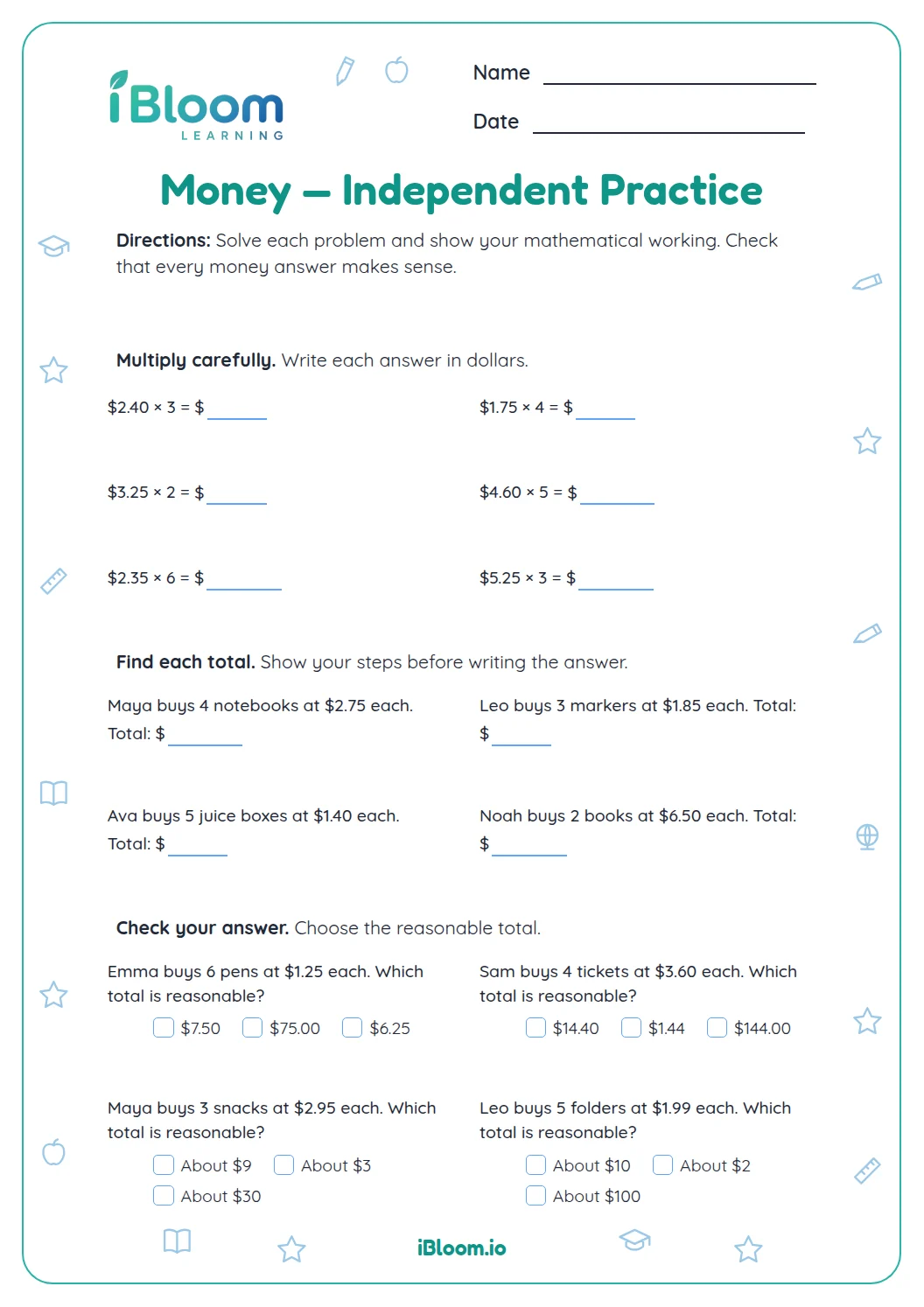
About this worksheet
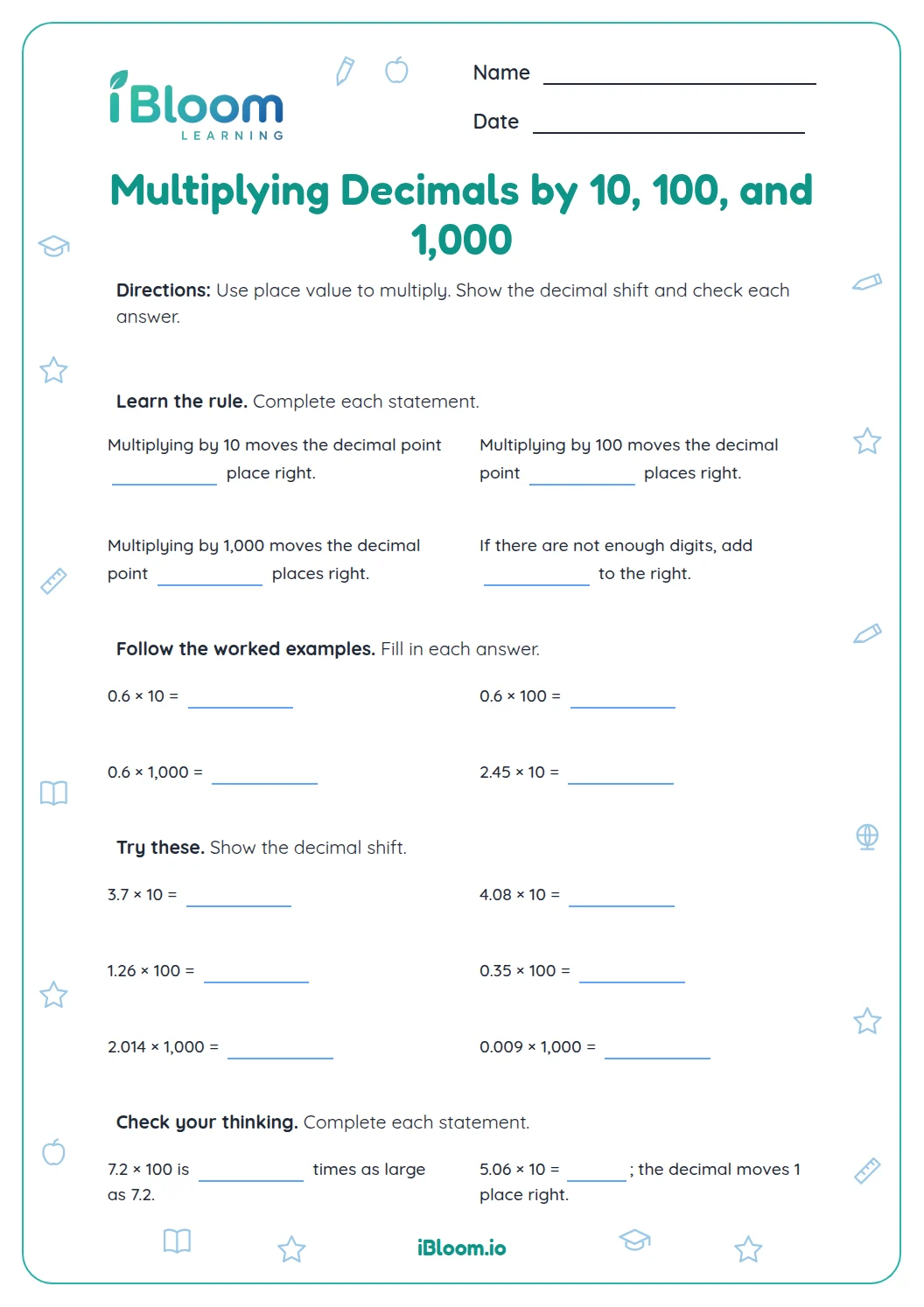
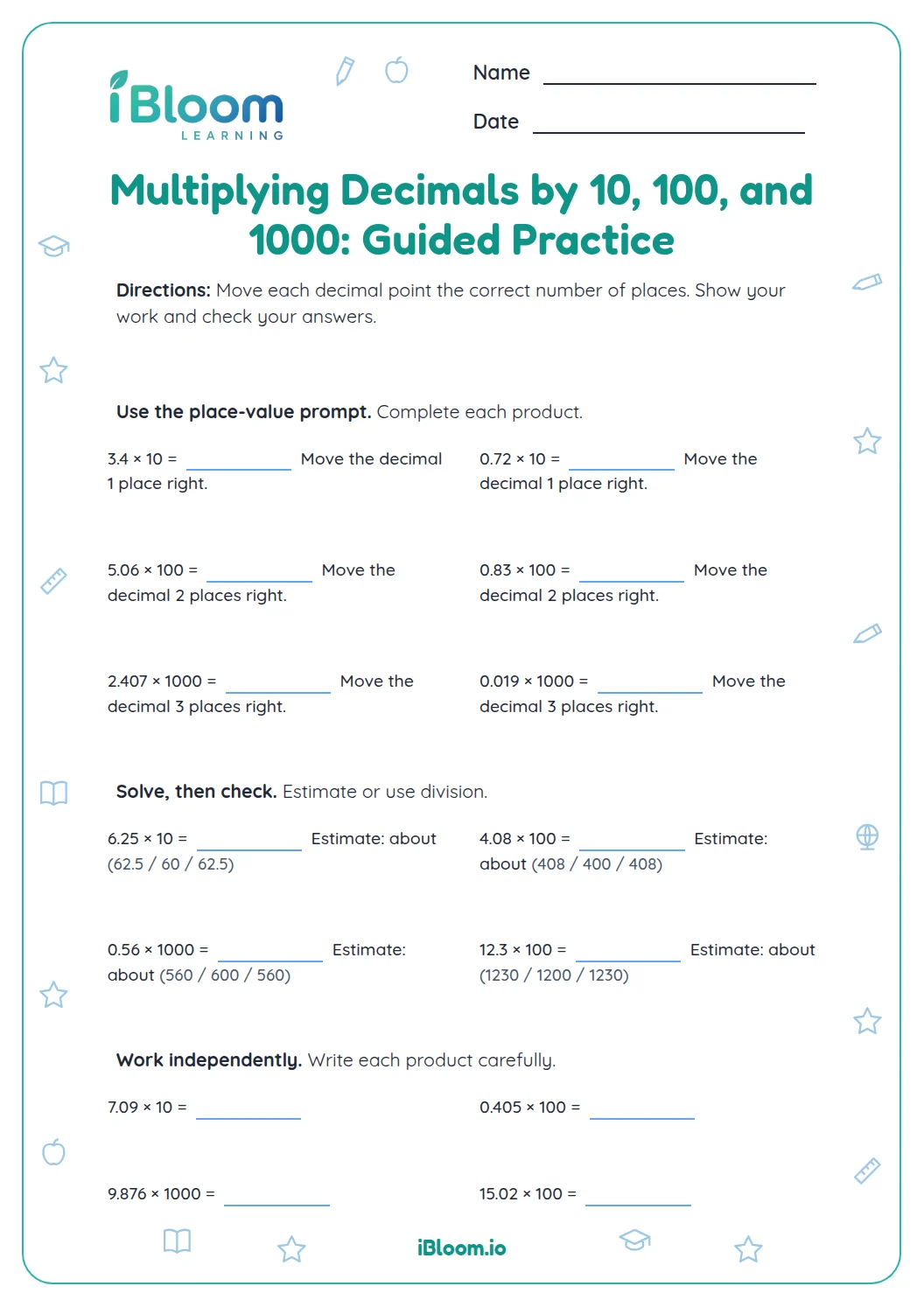
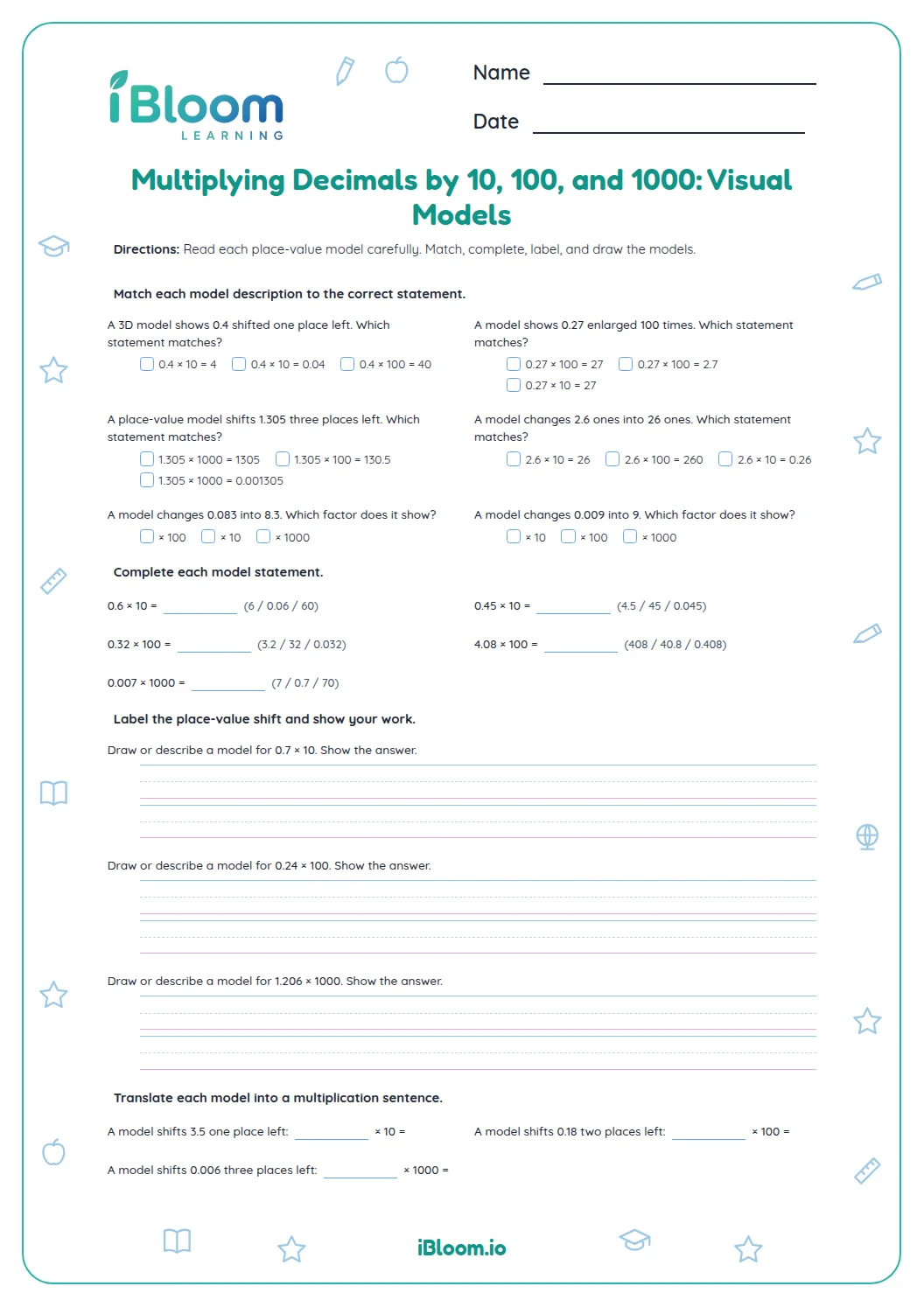
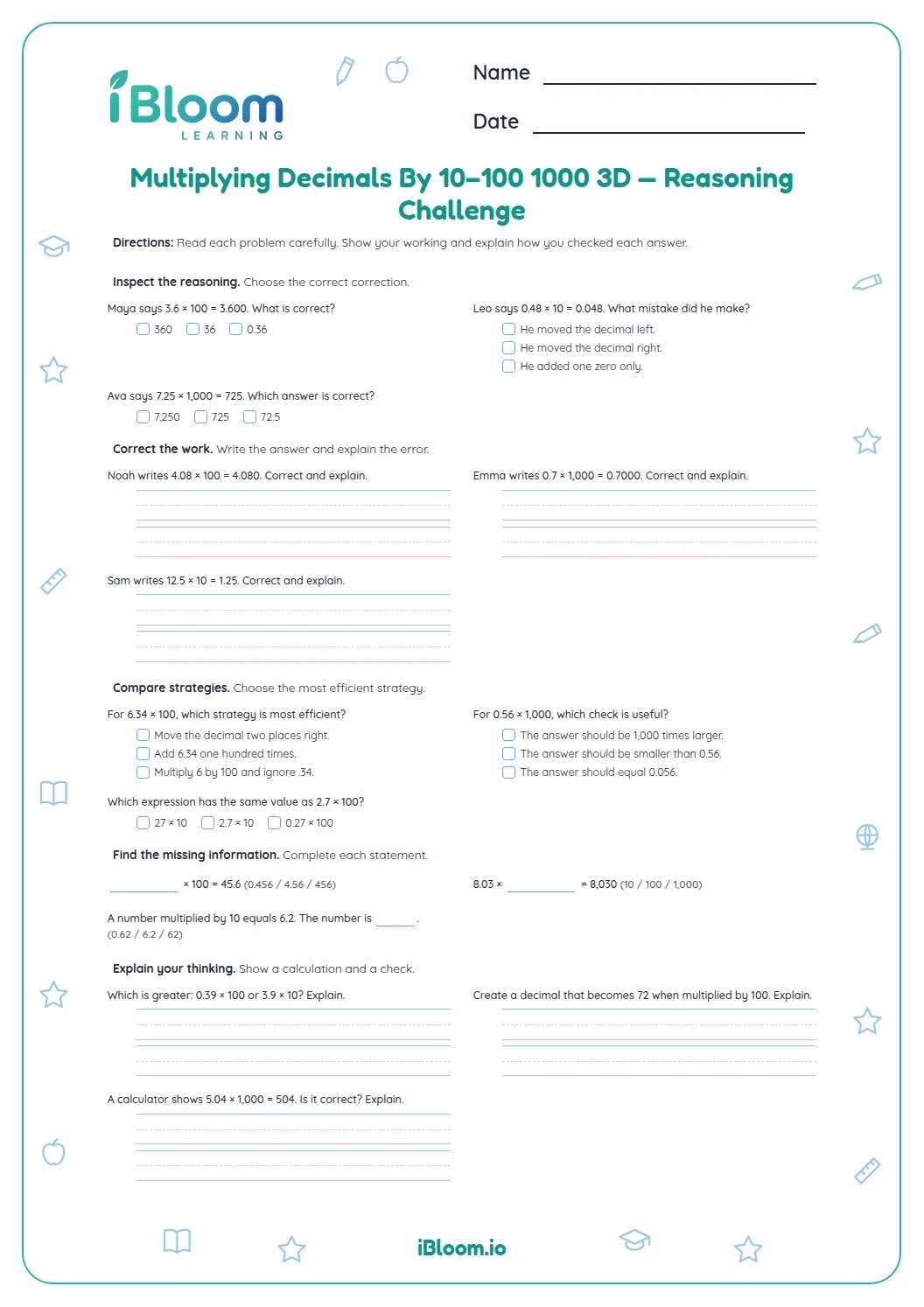
This free Grade 5 worksheet gives 16 real-world problems about multiplying decimals by 10, 100, and 1,000. Learners work with small measurements and repeated quantities, then write answers with units that fit the context. The lab theme matches the measurement settings. The practice aligns with CCSS 5.NBT.A.2, which includes explaining patterns when multiplying decimals by powers of 10.
Aligned to 5.NBT.A.2
What skill does this sheet practice?
The lab contexts use grams, meters, milliliters, liters, and counts so learners can judge whether each product is reasonable.
Work one item at a time, then check the result with a second method when possible.
What is on the worksheet?
Sixteen real-world problems practice multiplying decimals by 10, 100, or 1,000, with answers expressed in matching units.
- Part A: multiply measurements by 10.
- Part B: multiply by 100 and 1,000.
- Part C: apply the place-value pattern in measurement contexts.
- The answer key is separate from the student pages.
How can an adult support practice?
The value becomes 10, 100, or 1,000 times as large. Track the place-value shift, then check that the size of the answer makes sense in its context.
Ask the learner to point to the fraction, place-value shift, or letter clue that supports each response.
How to use this worksheet
- 1Read the one-line directions and check the first item together.
- 2Complete Part A, pausing to check the strategy rather than only the answer.
- 3Use the next part to try a different representation or question type.
- 4Finish Part C, then use the answer key to review and revisit any missed item.
Common mistakes and quick fixes
The mistake
Moving the decimal without considering the multiplier.
The fix
For ×10, ×100, and ×1,000, track one, two, and three place-value shifts.
The mistake
Writing a product that is smaller than the starting amount.
The fix
Multiplication by these powers of 10 makes a positive number larger.
The mistake
Dropping the unit from a measurement answer.
The fix
Copy the unit from the question and check that it still matches the quantity.
Common Core alignment
The questions connect powers of 10 with patterns in decimal place value.
Explain decimal place-value shifts when multiplying by powers of 10.
On this sheet: The worksheet directly practices the skill named in this standard through its questions and models.
Show the official wordingHide the official wording
Explain patterns in the number of zeros of the product when multiplying a number by powers of 10, and explain patterns in the placement of the decimal point when a decimal is multiplied or divided by a power of 10. Use whole-number exponents to denote powers of 10.
What to practice next
Make more practice
Further reading
Questions parents and teachers ask
How many questions are on this printable?
The worksheet has 16 questions across three parts. The problems include all three multipliers and measurements such as grams, meters, and liters. The separate answer key makes it possible to check each response after the learner finishes. Use the key to check the numerical product and its unit after the work is complete.
What does this Grade 5 worksheet practice?
It practices multiplying decimals by powers of 10 in measurement contexts. The first part starts with direct examples, while later items ask learners to apply the same idea in another format or setting. Read the directions aloud if useful, then let the learner work through the page at a comfortable pace.
Is an answer key included?
Yes. A separate answer key follows the worksheet pages. Keep it aside while the learner works, then use it to check responses and discuss a particular step when an answer differs. The examples keep the multiplier visible so learners can connect it to place value.
How can I help if a learner gets stuck?
Ask the learner to explain the first step aloud and point to the information they used. Keep track of place value and write the multiplier as 10, 100, or 1,000 before estimating the product. Let them try again with that clue before showing a complete solution.
Can this be used for independent practice?
Yes. The worksheet is labeled for independent practice, and its directions are printed on the page. An adult may demonstrate the first example if needed; the answer key can be used afterward to review the work. The contexts use several measures, including mass, length, and capacity.