




About this worksheet
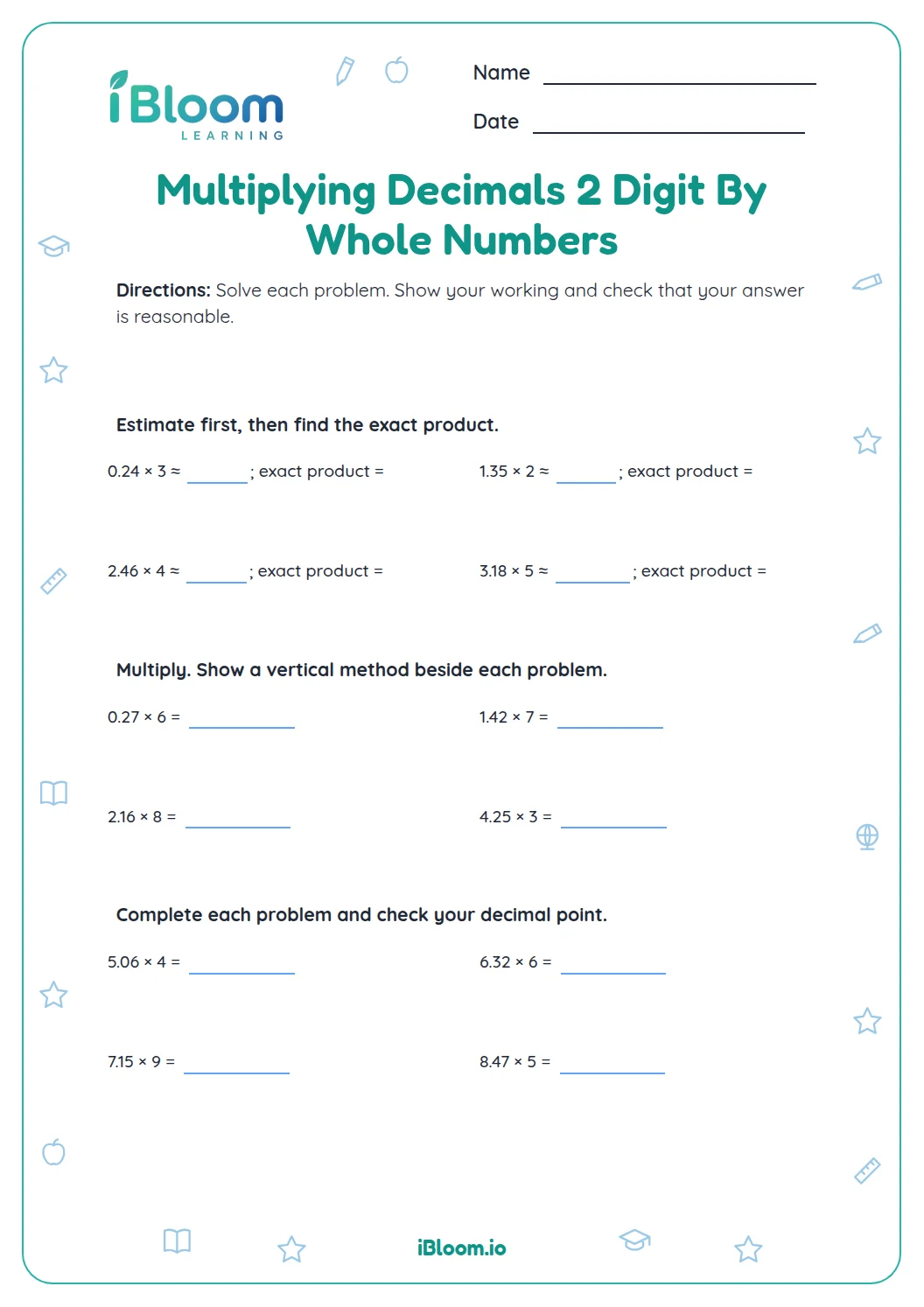
This Grade 5 worksheet provides independent practice multiplying decimals by whole numbers, including products with tenths, hundredths, and thousandths. Students work through 14 vertical-style number sentences and use estimation to check whether each product has a sensible value. The printable includes a separate answer key and aligns with CCSS 5.NBT.B.7.
Aligned to 5.NBT.B.7
What is the first step?
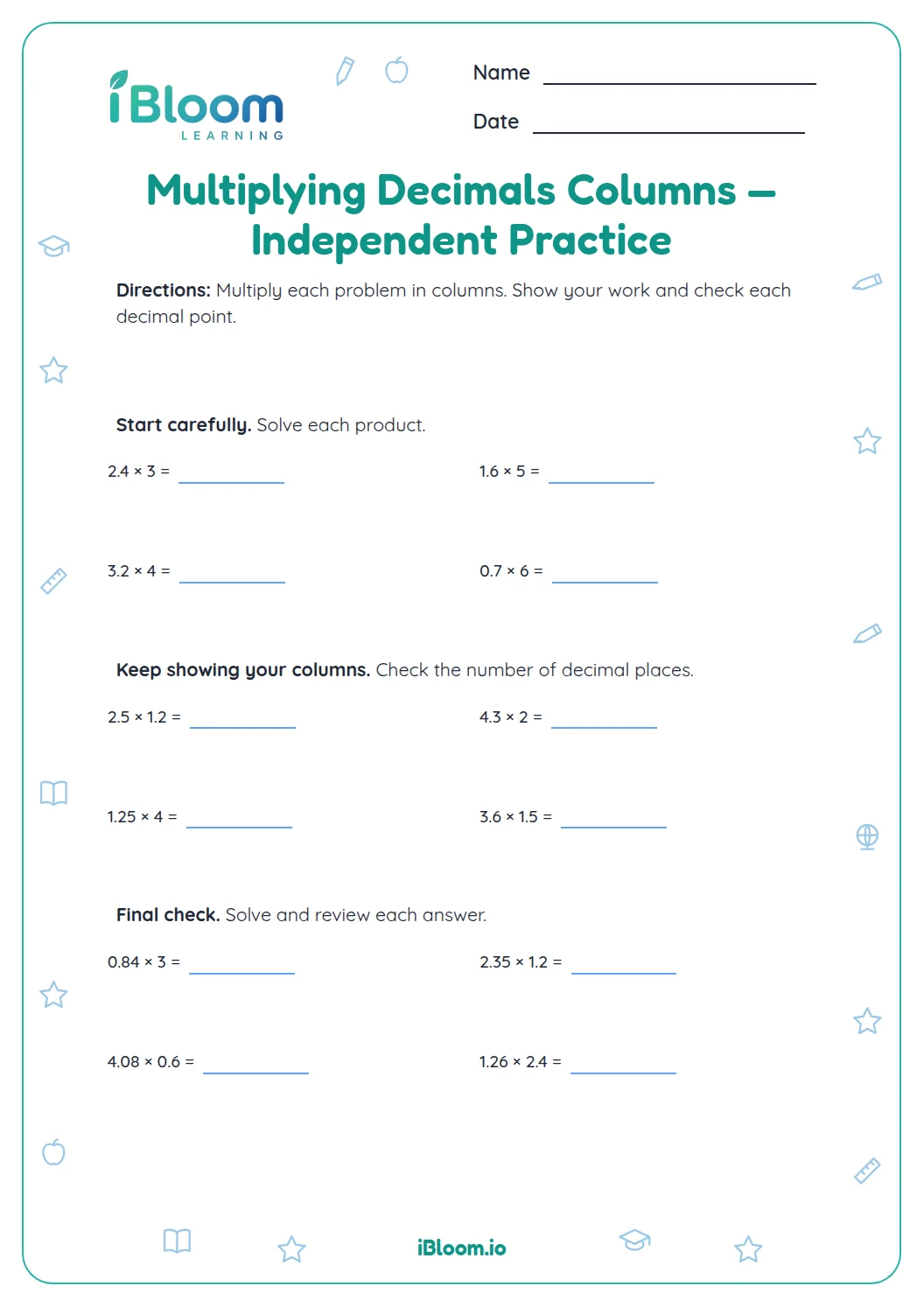
Multiply as if the decimal were a whole number, then place the decimal point based on the factor. For question 1, 24 × 3 = 72; since 2.4 has one decimal place, the product is 7.2.
- 12.4 × 3
- 224 × 3 = 72
- 3Place one decimal digit: 7.2
How can estimation check the answer?
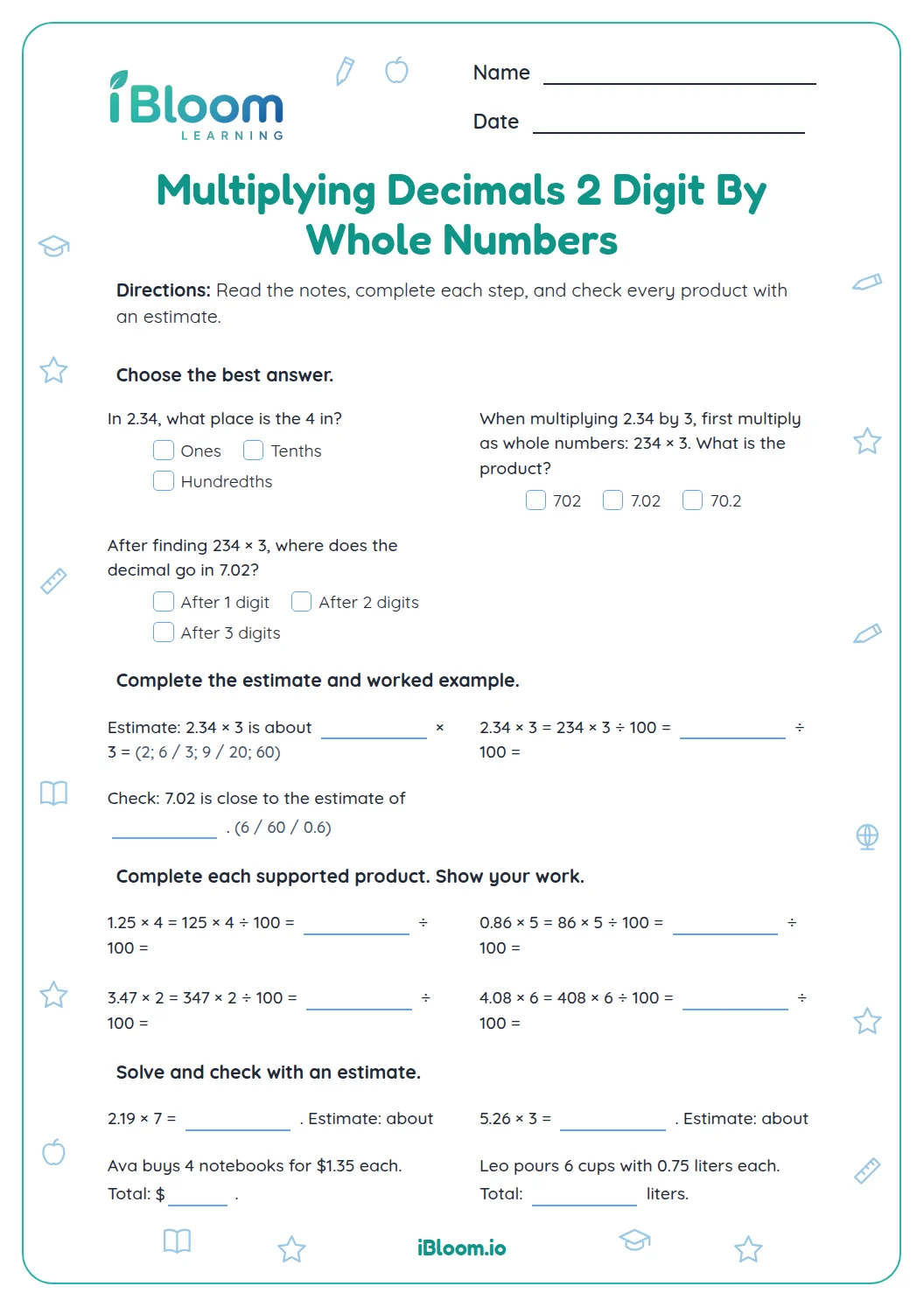
An estimate helps you check where the decimal belongs. In question 8, 2.06 is close to 2, and 2 × 8 is 16, so 16.48 is a reasonable product.
- 1Estimate: 2 × 8 = 16
- 2Exact product: 2.06 × 8 = 16.48
What if the product needs a zero?
A zero can hold a place in a decimal product. Keep it when needed to show tenths or hundredths accurately, then check the value against an estimate.
How to use this worksheet
- 1Estimate the product before multiplying.
- 2Multiply the digits without the decimal point.
- 3Count the decimal places in the decimal factor.
- 4Place the decimal and compare with your estimate.
Common mistakes and quick fixes
The mistake
Placing the decimal by guessing.
The fix
Count the decimal places in the original decimal factor.
The mistake
Making the product smaller when multiplying.
The fix
Check that multiplying by a number greater than 1 increases the amount.
The mistake
Dropping a needed zero.
The fix
Use a zero as a place holder, then read the product aloud.
Common Core alignment
Multiply decimals to hundredths using strategies based on place value.
On this sheet: Students multiply decimal numbers by whole numbers and check their reasoning with estimates.
Show the official wordingHide the official wording
Add, subtract, multiply, and divide decimals to hundredths, using concrete models or drawings and strategies based on place value, properties of operations, and/or the relationship between addition and subtraction; relate the strategy to a written method and explain the reasoning used.
What to practice next
Make more practice
Further reading
Questions parents and teachers ask
Should students line up the decimal points?
Multiply the nonzero digits as whole numbers, then place the decimal point so the product has the same number of decimal places as the decimal factor. For example, 2.4 × 3 gives 24 × 3 = 72, then 7.2. An estimate can help check the result.
Why estimate before multiplying?
Estimate the product before calculating. For 2.06 × 8, use 2 × 8 = 16 as a nearby estimate. The exact product, 16.48, is close to 16, which is a useful check that the decimal point is in a sensible place.
Can students use a calculator?
The worksheet includes 14 products across two pages, followed by a two-page answer key. The factors include decimals with one, two, and three decimal places, multiplied by whole numbers. Several products are greater than 10, so students also practice placing the decimal in larger answers.
How many problems are included?
The answers are exact products. Equivalent trailing-zero forms have the same value, so 27 and 27.0 are equivalent. The key lists compact forms, while students can use the estimate and multiplication work to check their own placement and calculation.
What is a common decimal placement error?
Yes. The last section includes products with two-digit whole-number factors, such as 2.45 × 12. Students can multiply by each digit and combine the partial products, then place the decimal point and check the result with an estimate.