







About this worksheet
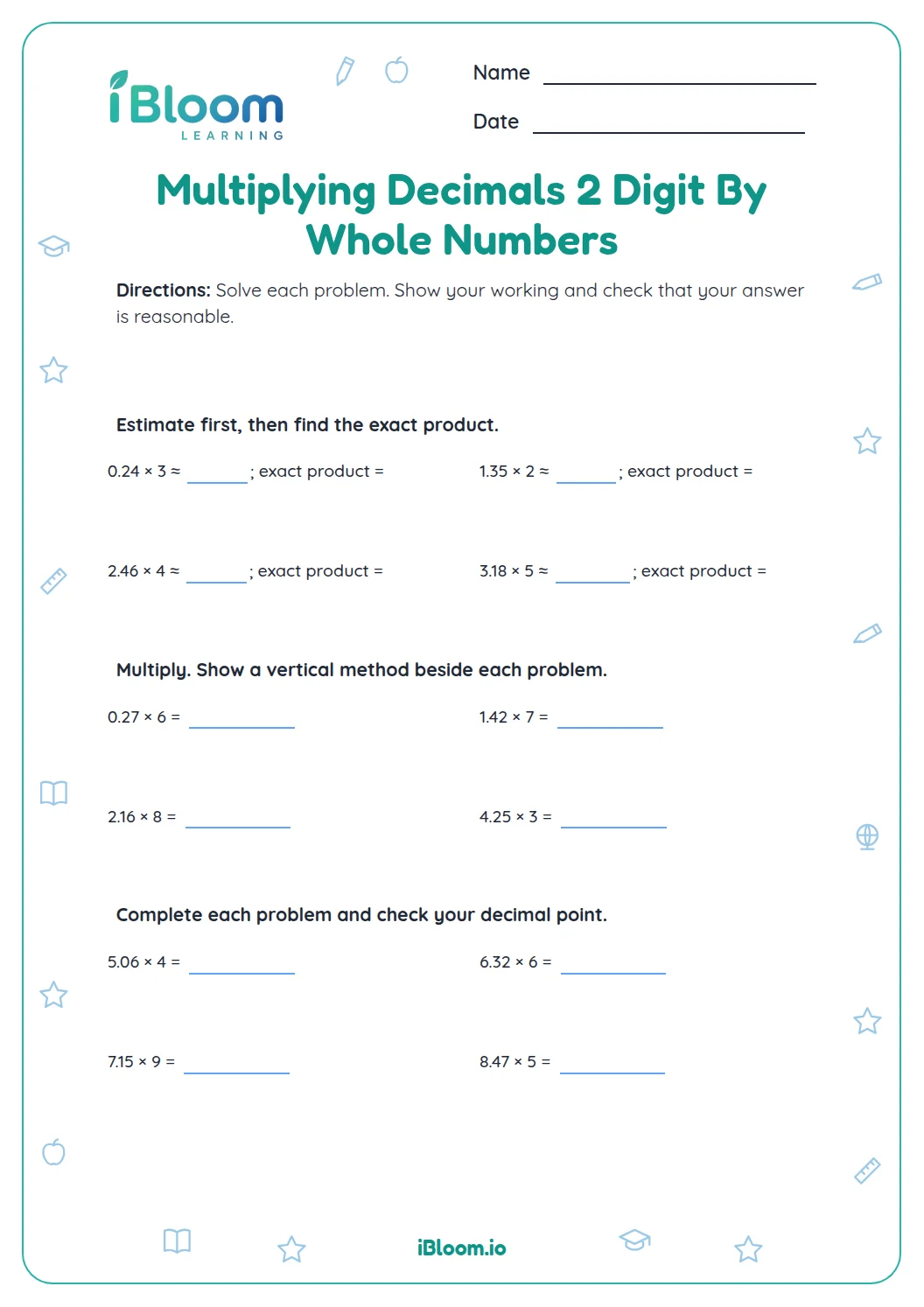
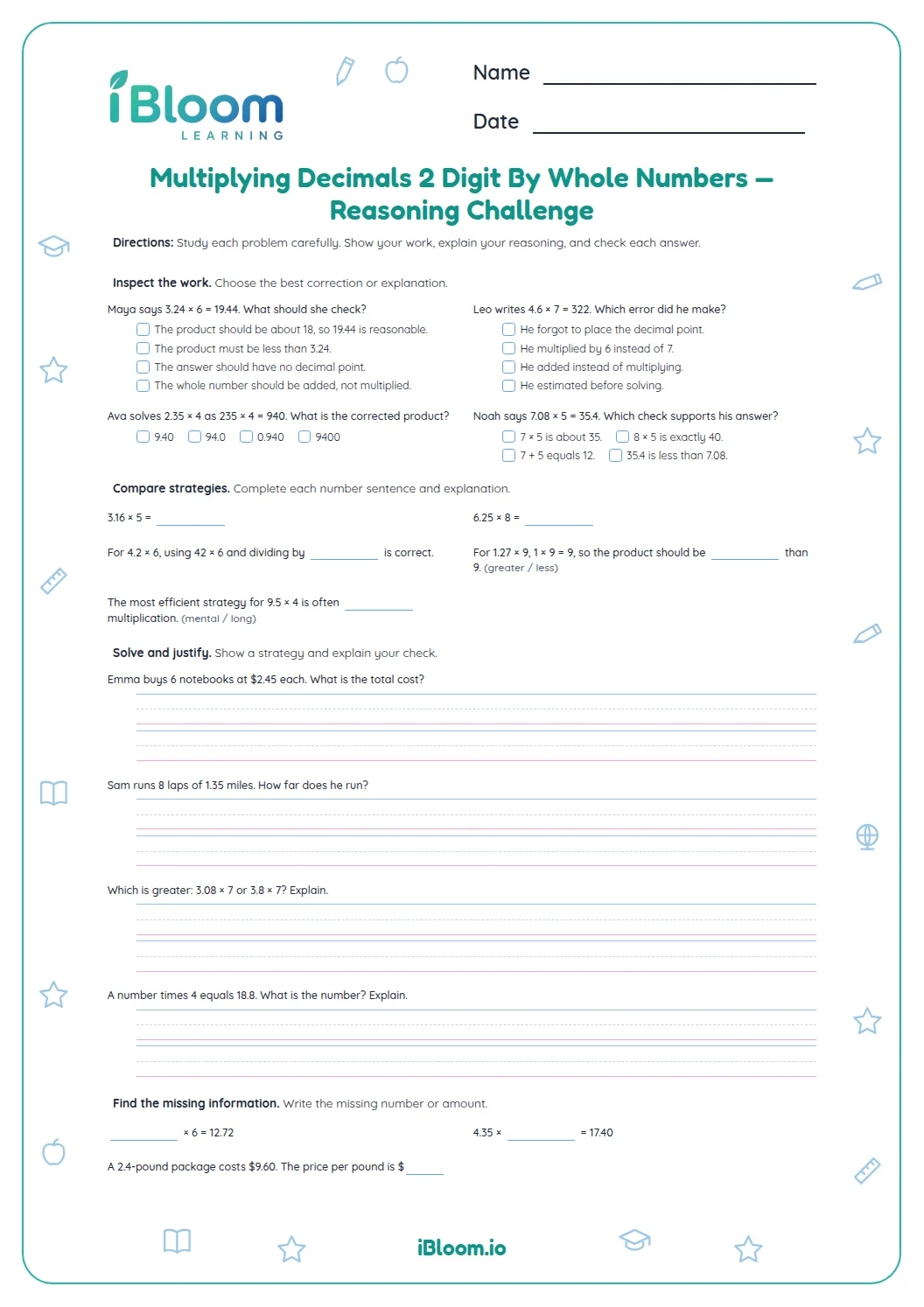
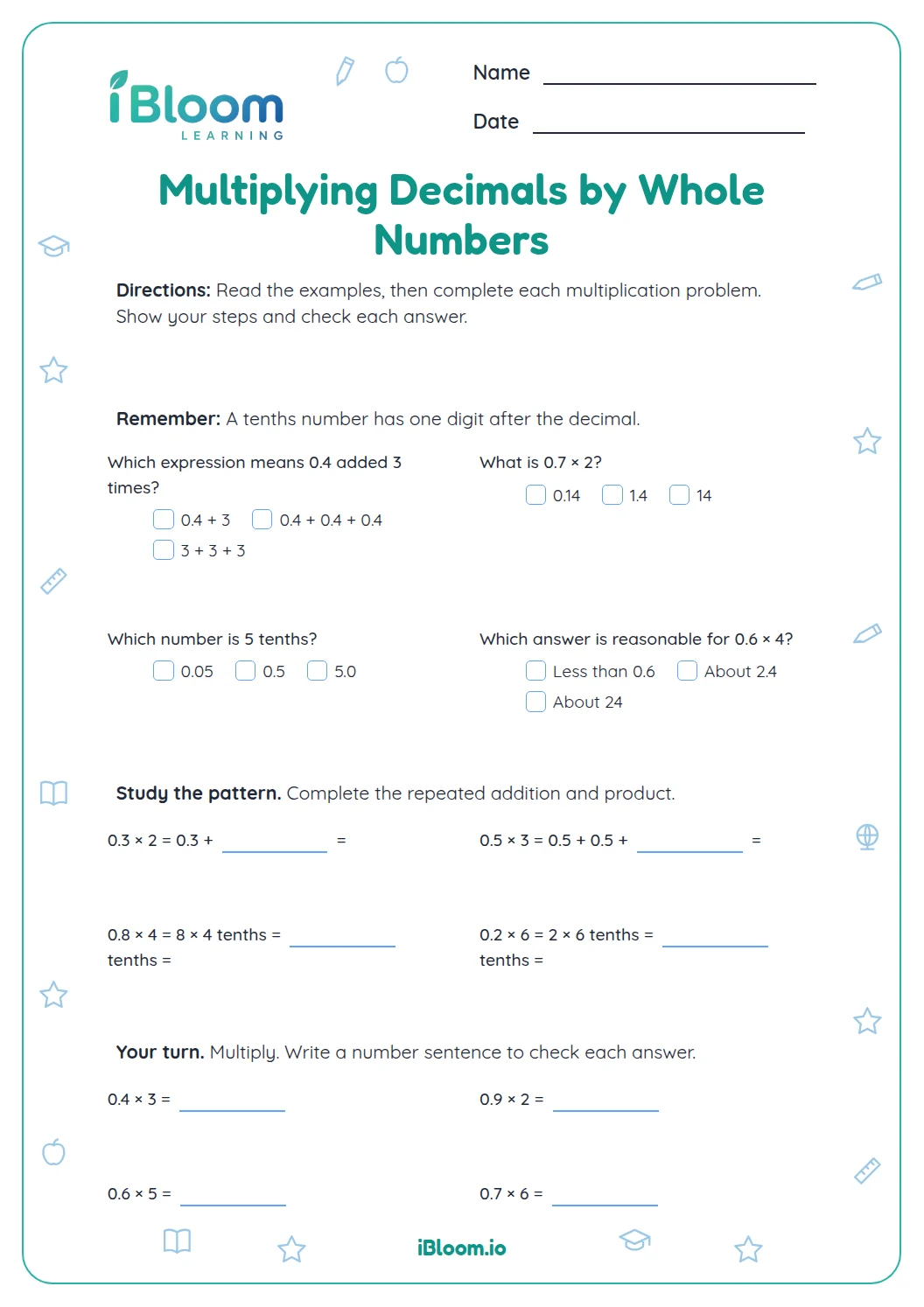
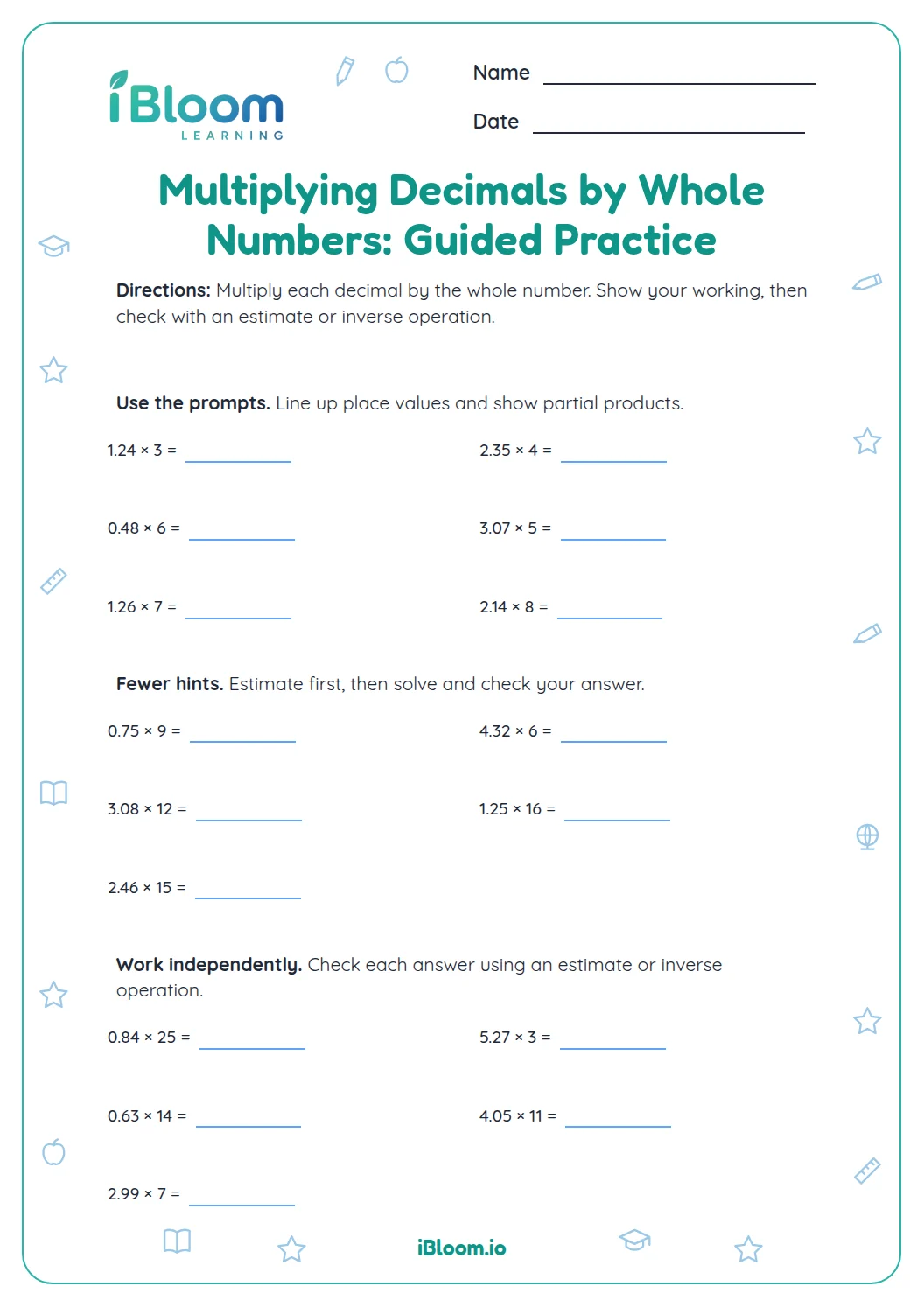
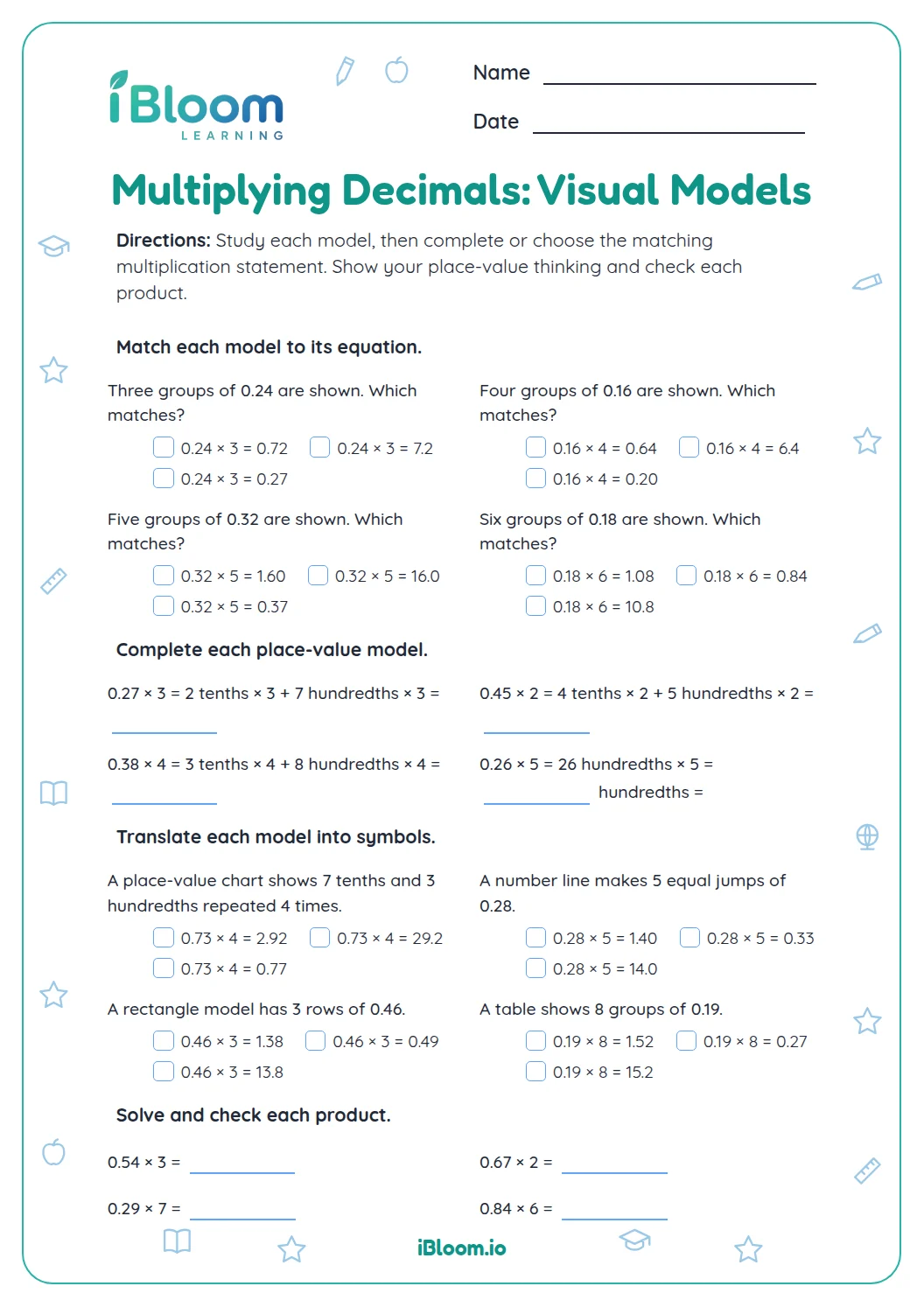
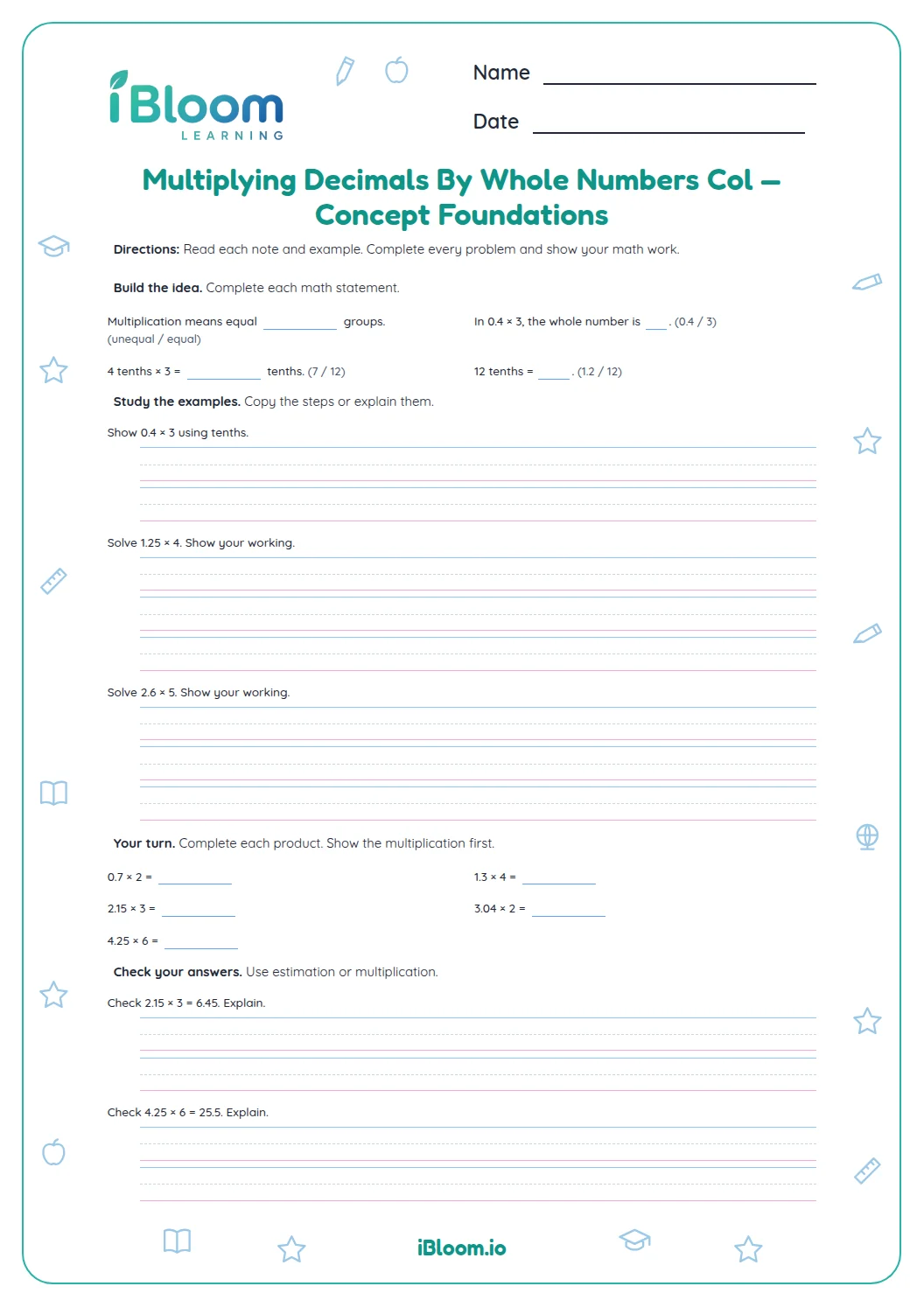
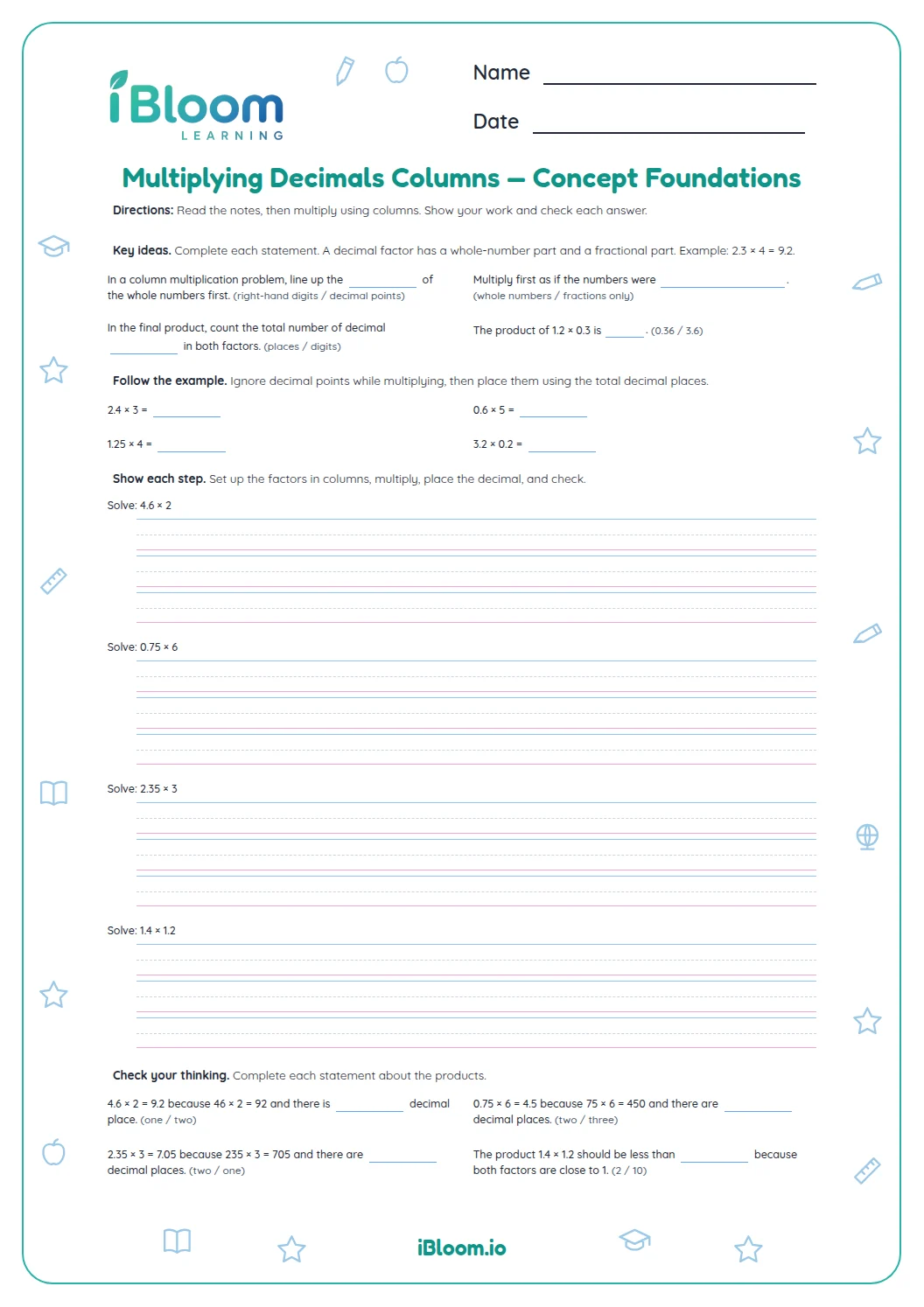
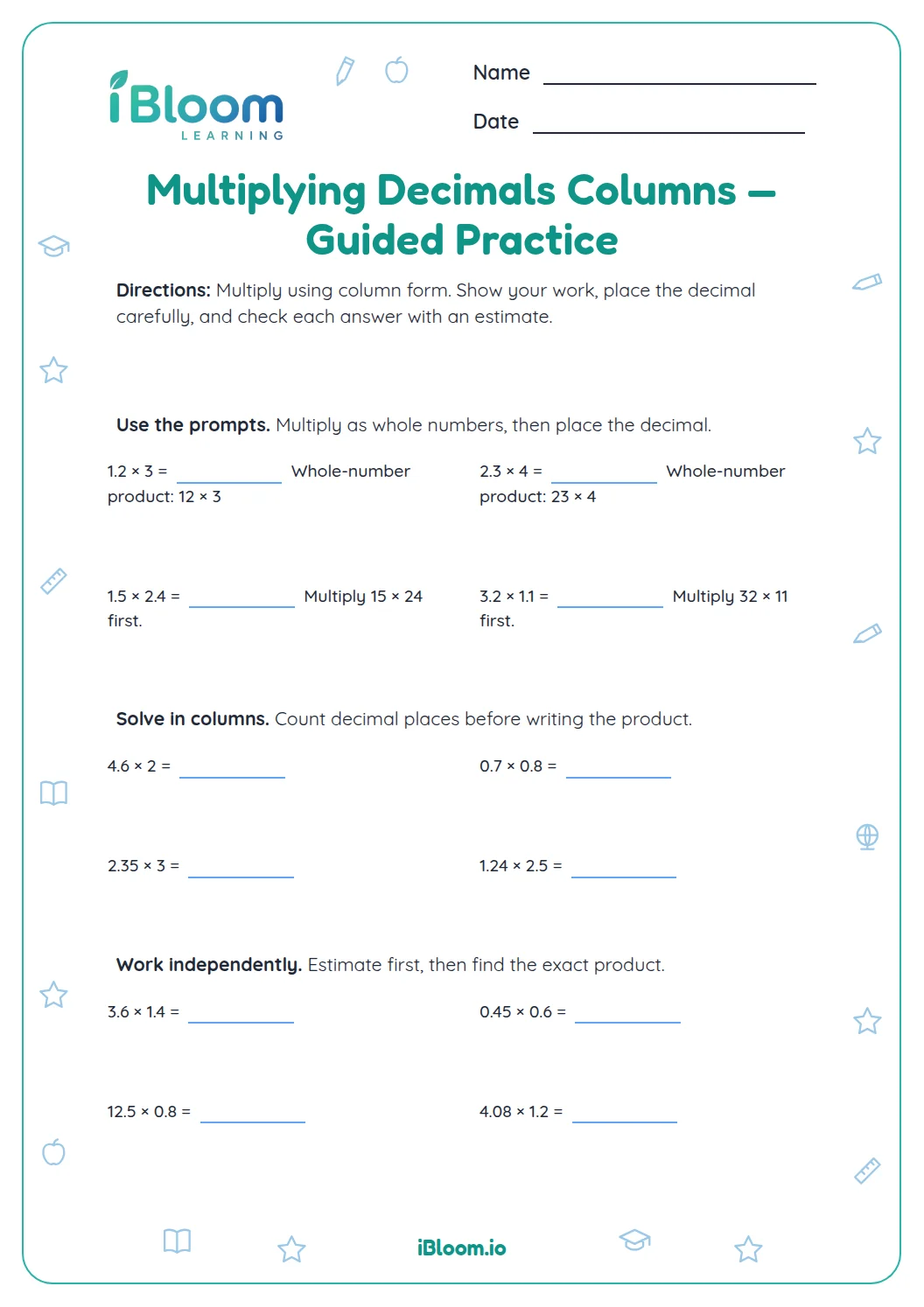
This Grade 5 guided practice sheet focuses on multiplying decimals by two-digit whole numbers. Children estimate each product, multiply digits as with whole numbers, and use place value to place the decimal point in the product. The 16 examples include tenths, hundredths, and thousandths, with products that keep a sensible decimal scale. The answer key makes it easy to check both computation and decimal placement.
Aligned to 5.NBT.B.7
How do you place the decimal in a product?
First multiply without the decimal point. Then use the decimal factor’s place value: tenths gives one decimal place, hundredths gives two, and thousandths gives three. Trailing zeros may be removed when the value stays the same.
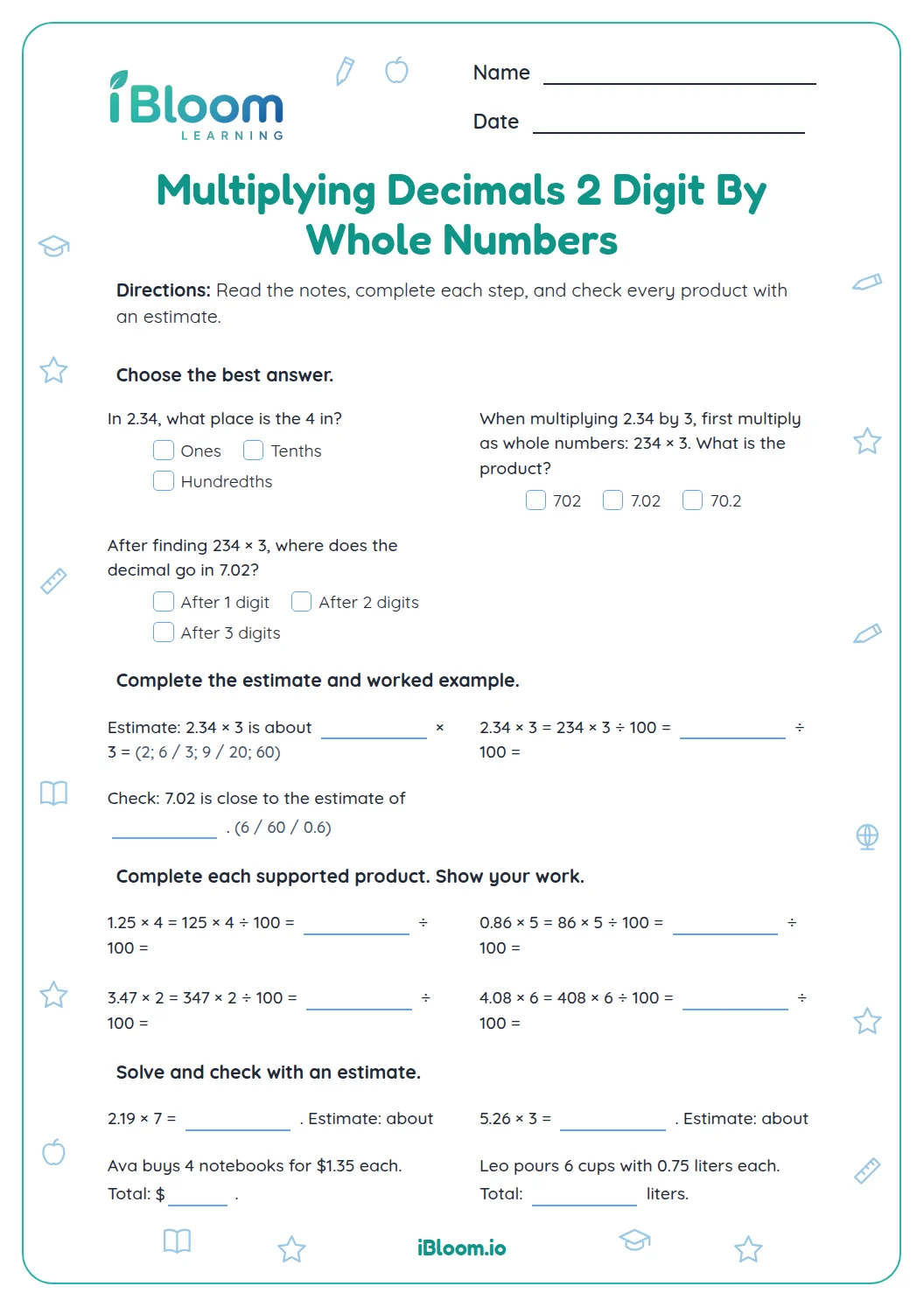
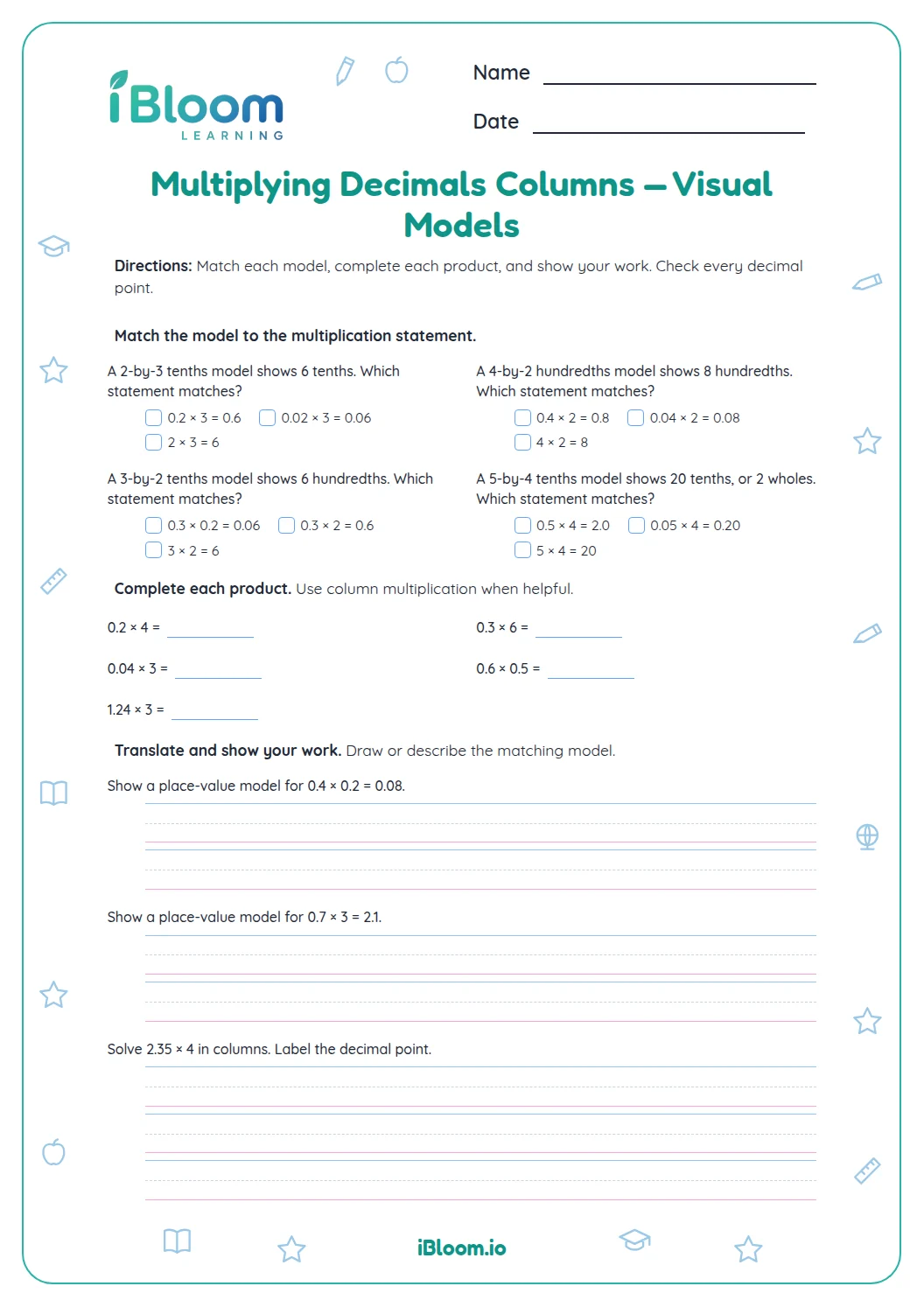
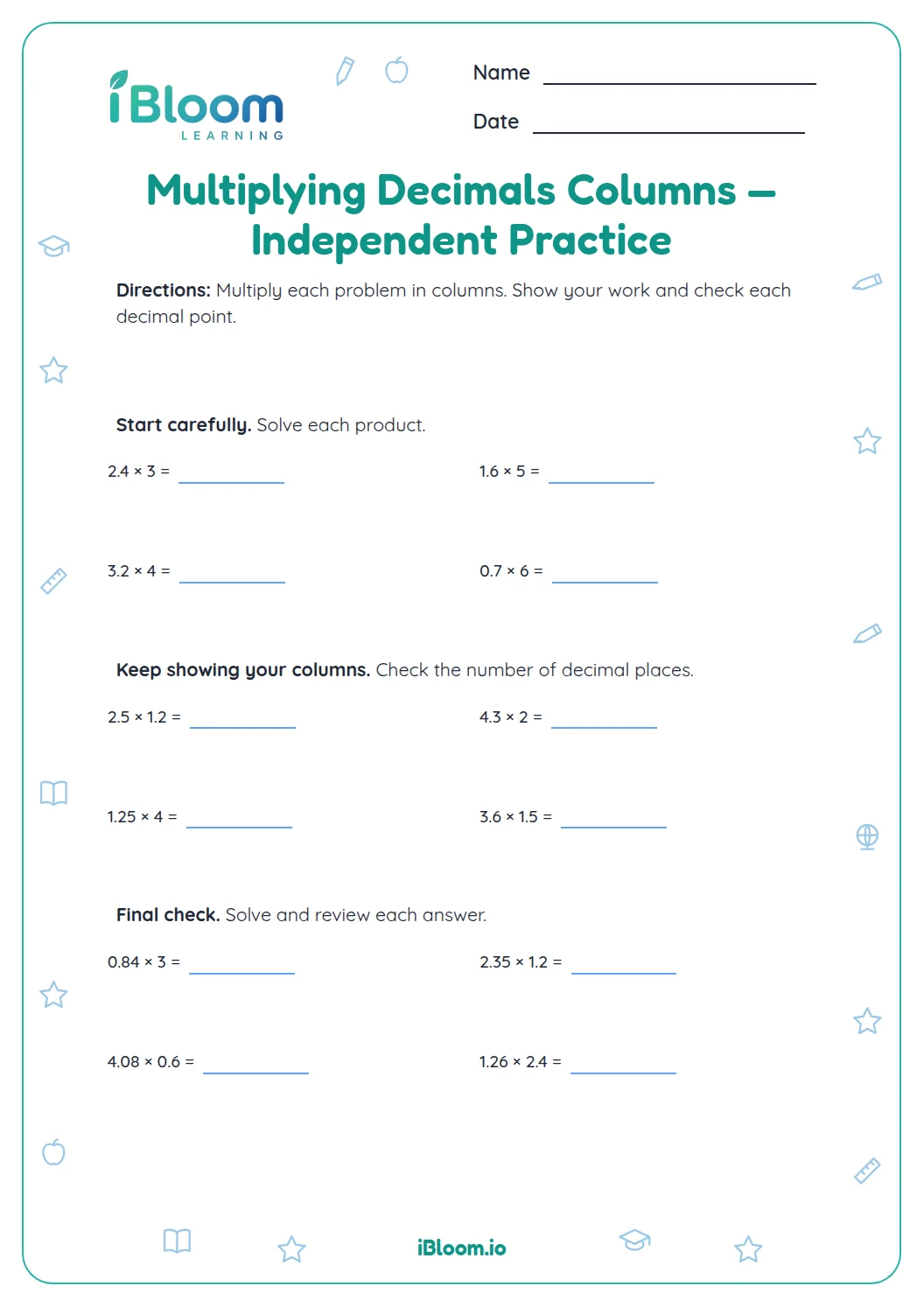
For question 2, 2.35 × 12 can be viewed as 235 × 12 = 2,820 hundredths, or 28.20. The product is 28.2.
- 12.35 × 12
- 2235 × 12 = 2,820
- 32.35 has 2 decimal places
- 42,820 hundredths = 28.20 = 28.2
Why estimate before multiplying?
An estimate helps catch a decimal point placed too far left or right. Since 2.35 is a little more than 2, twelve groups should be a little more than 24. A result such as 2.82 would be too small.
How can place value check the answer?
Count the decimal places in the original decimal factor, then compare the product with your estimate. Keep zeros as placeholders while placing the decimal; remove only zeros at the end of a decimal.
How can I use this sheet?
- 1Round the decimal factor to estimate the product.
- 2Multiply as though both factors were whole numbers.
- 3Count the decimal places in the decimal factor.
- 4Place the decimal that many places from the right.
- 5Compare the product with your estimate and simplify trailing zeros.
What errors should I watch for?
The mistake
Placing the decimal by looking at the whole-number factor.
The fix
Count decimal places in the decimal factor only.
The mistake
Making the product smaller than the decimal factor.
The fix
A whole-number factor greater than 1 makes a positive decimal product larger.
The mistake
Dropping a zero needed as a placeholder.
The fix
Write the full product first, then place the decimal point.
Curriculum alignment
Use place value and operations to multiply decimals to hundredths.
On this sheet: Use place value and operations to multiply decimals to hundredths.
Show the official wordingHide the official wording
Add, subtract, multiply, and divide decimals to hundredths, using concrete models or drawings and strategies based on place value, properties of operations, and/or the relationship between addition and subtraction; relate the strategy to a written method and explain the reasoning used.
What to practice next
Make more practice
Questions parents and teachers ask
Do I count decimal places in both factors?
For these problems, only one factor has a decimal. Count the decimal places in that factor and place the decimal that many digits from the right in the product. Then compare with an estimate to check whether the answer is a sensible size.
Can a product end in zero?
Yes. For example, 4.25 × 16 = 68.00, which has the same value as 68. Remove zeros only at the end after placing the decimal correctly. A zero between nonzero digits changes the value and must stay in the product.
Why estimate first?
An estimate helps catch a misplaced decimal point. Since 2.35 is close to 2 and 12 × 2 is 24, the product should be near 24, not near 3. Estimating before multiplying gives a useful size check and can reveal an answer that is too large or too small.
What if I need a zero before placing the decimal?
Keep a zero as a placeholder when needed. Multiply the digits first, then count the decimal places in the decimal factor and place the point from the right. For example, the zero preserves the hundredths place in some products.
How many problems are included?
There are 16 decimal products, with decimal factors from tenths through thousandths. The separate key lists each product. Students also estimate and use place value to check decimal placement as they work through the calculations, from familiar tenths to thousandths.