




About this worksheet
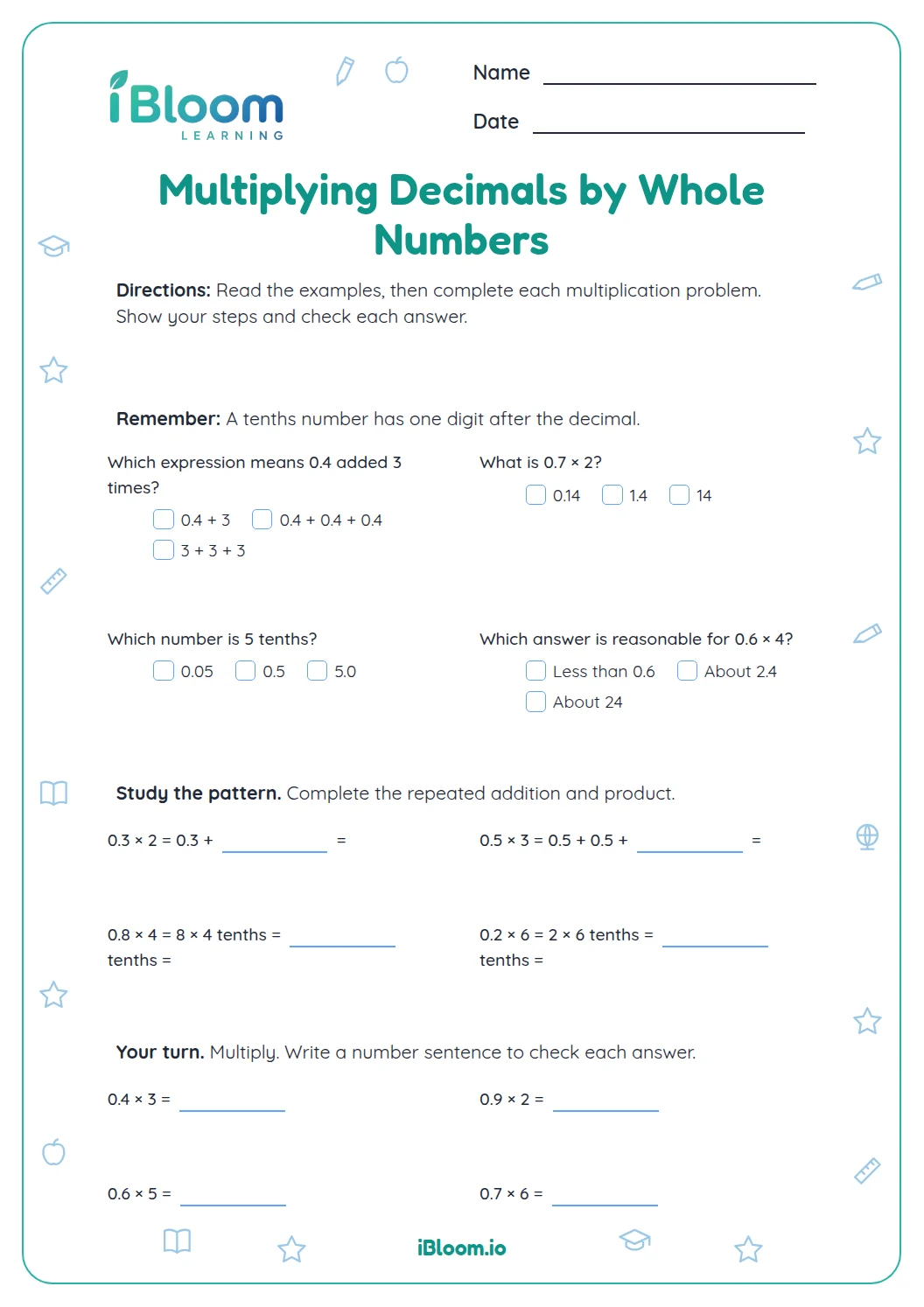
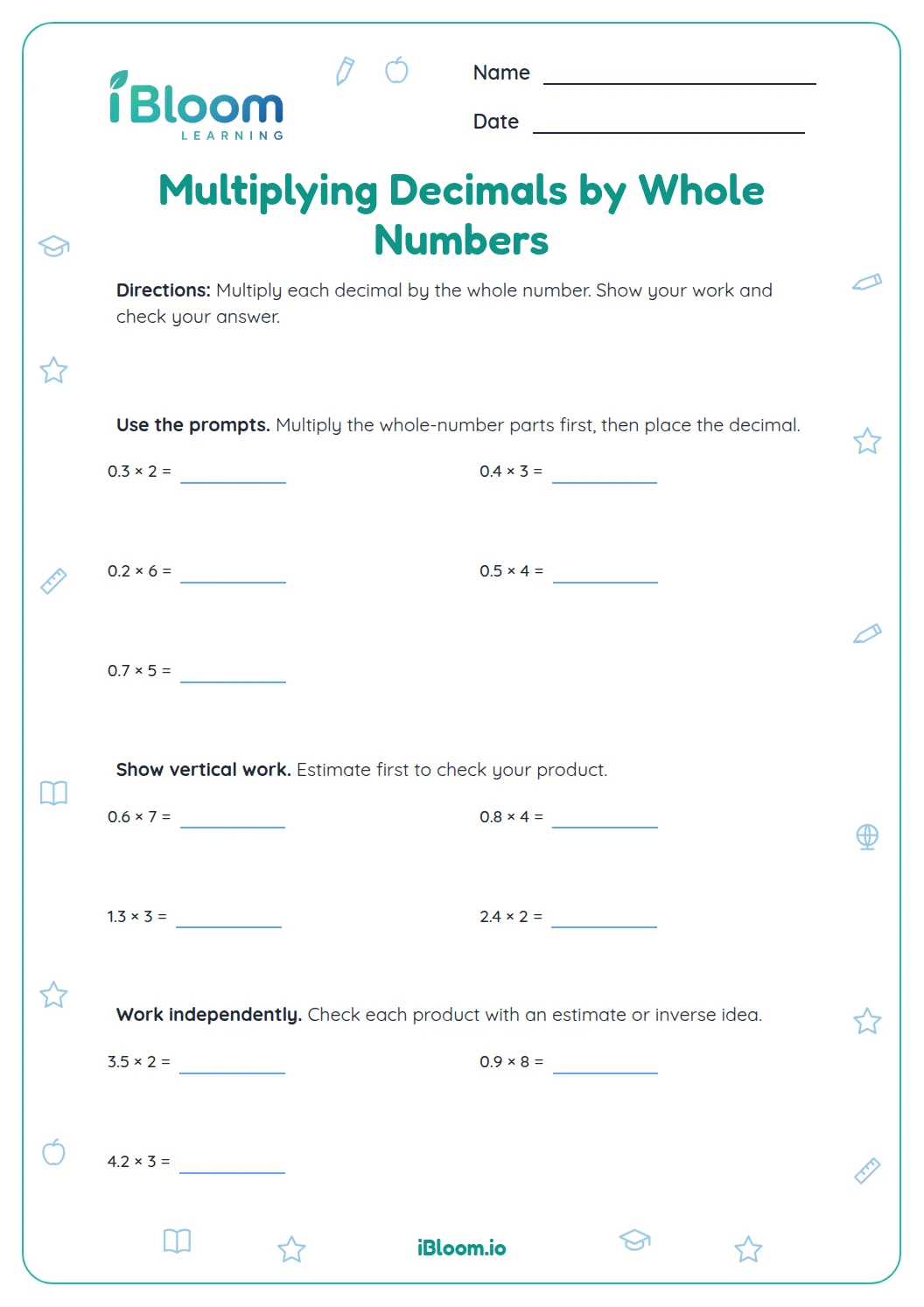
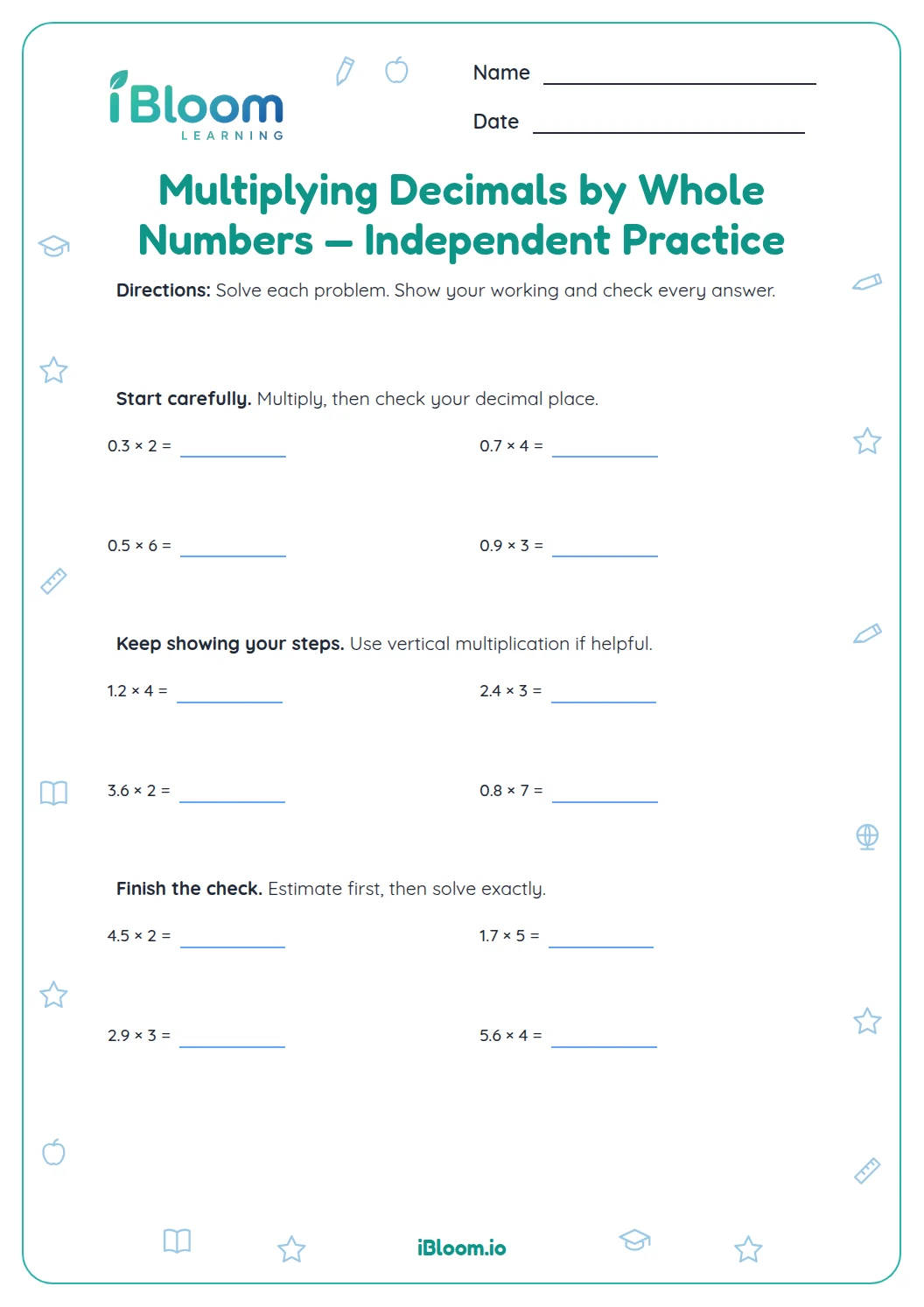
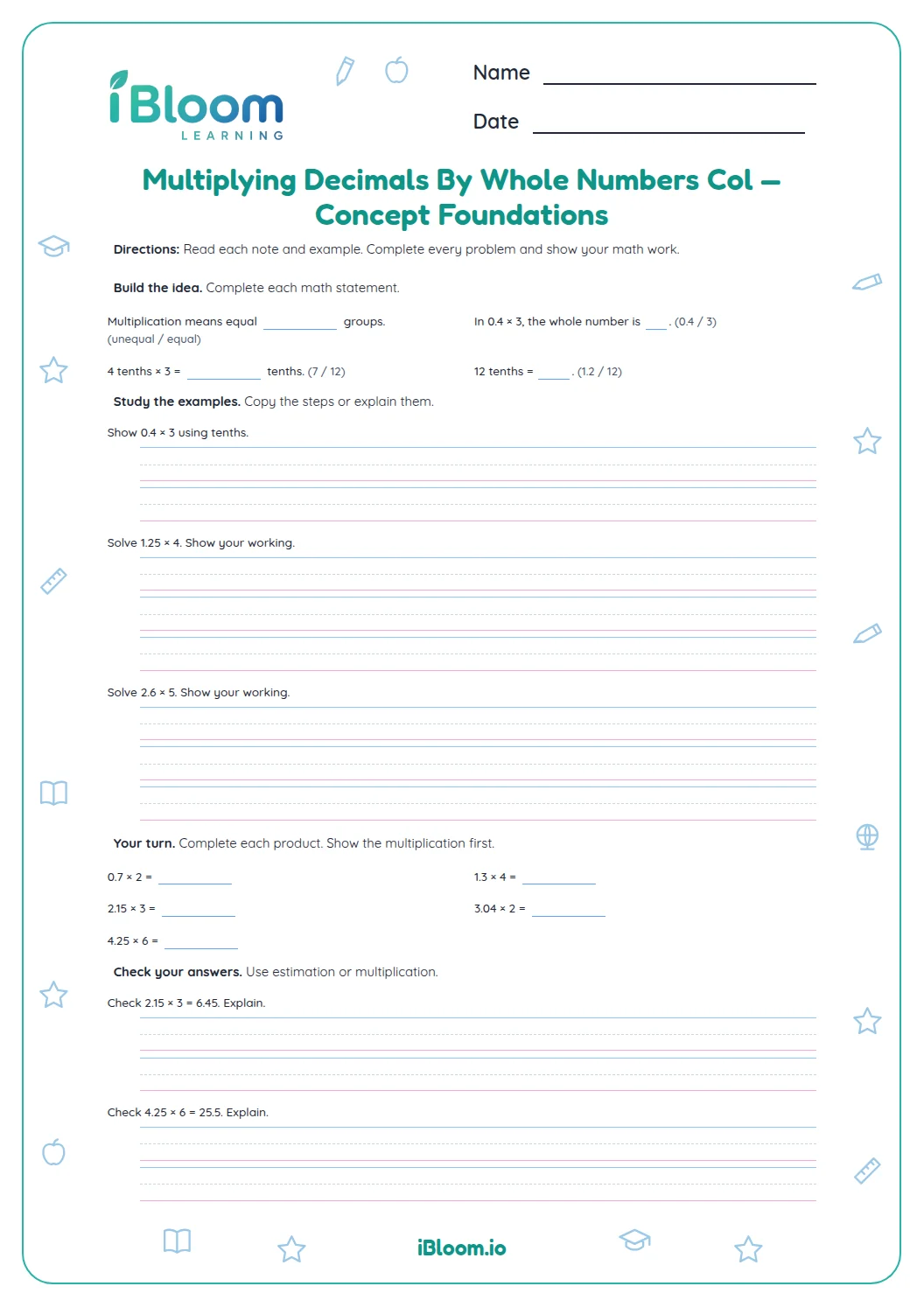
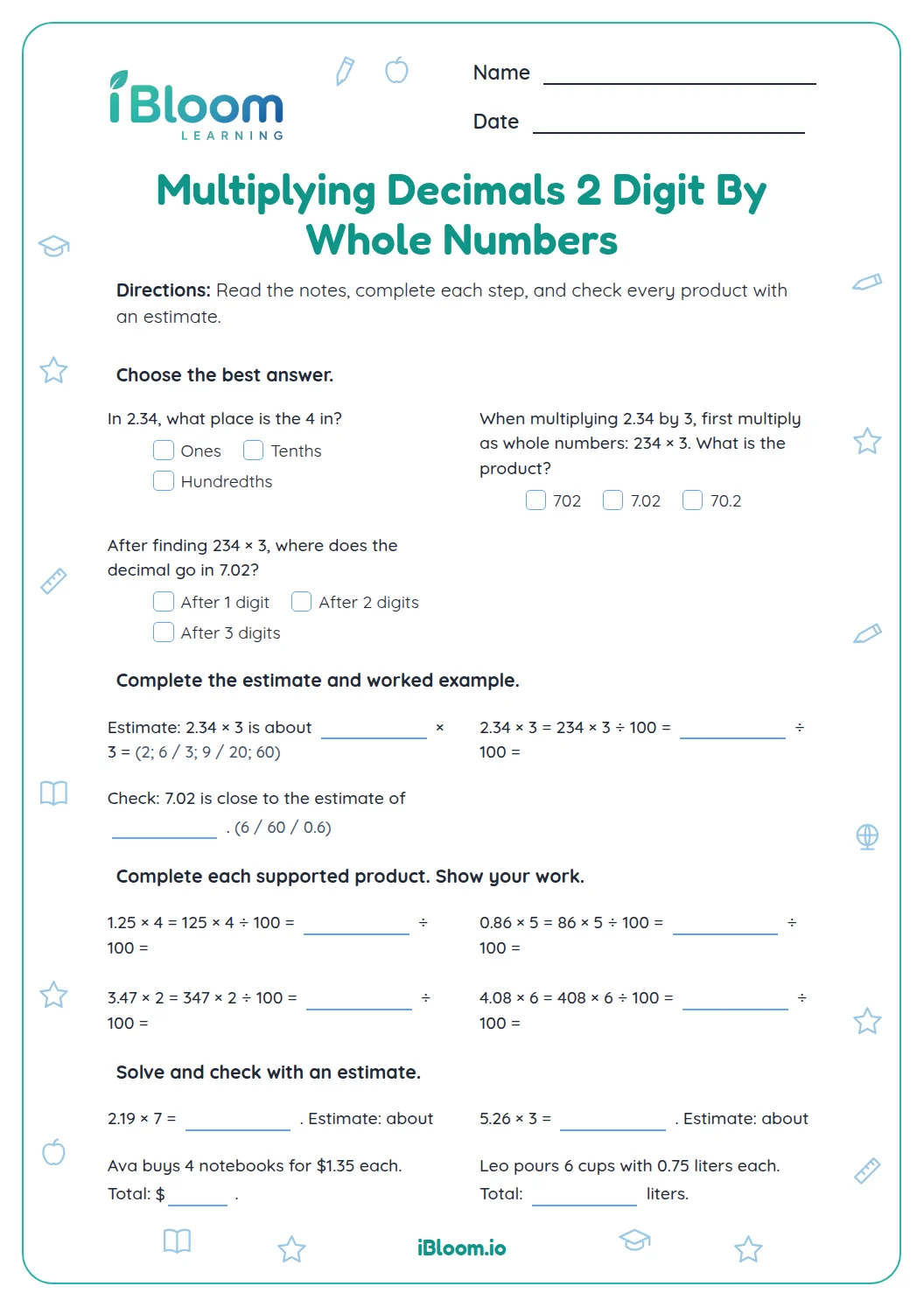
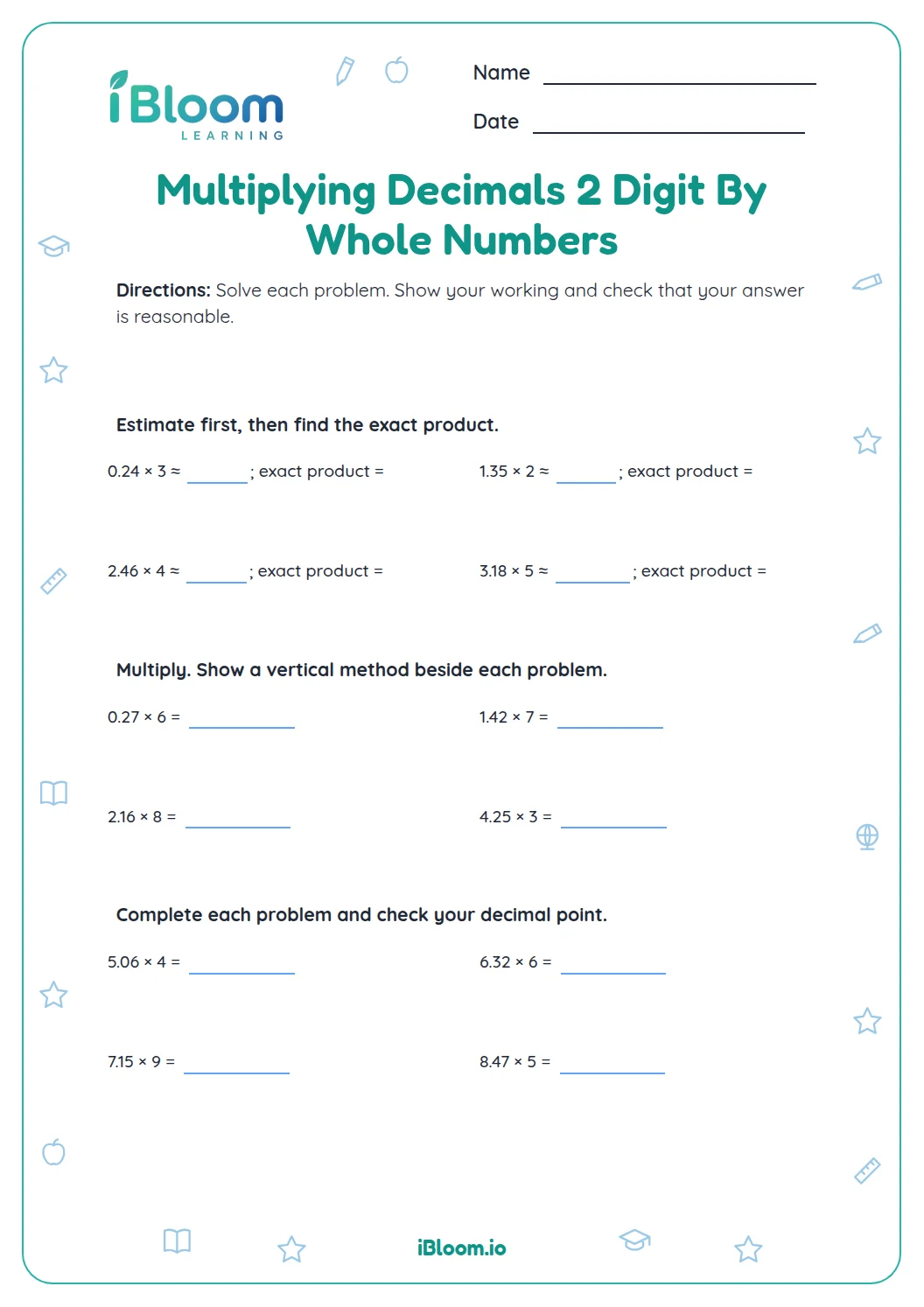
This Grade 5 worksheet helps students multiply decimals by one-digit whole numbers using tenths and hundredths models, equations, and short applications. Students begin by reading a model of the product amount, then reason about repeated groups and decimal placement. The 14 questions include products through hundredths and a separate answer key. The work supports CCSS 5.NBT.B.7.
Aligned to 5.NBT.B.7
How does a tenths model show multiplication?
Read the shaded amount as the product. For example, 0.3 × 4 is 12 tenths, or 1.2; the model shows one whole and two tenths.
How can a hundredths grid support a product?
A hundredths grid divides one whole into 100 equal squares. Question 5 models 25 hundredths; four groups make 100 hundredths, which is 1.00. The model connects the digits in 0.25 to the size of the product.
How should the decimal point be placed?
Think about the units in the factors. In 0.08 × 6, six groups of eight hundredths make 48 hundredths, or 0.48. The product has two decimal places because it represents hundredths.
How do equal groups help with word problems?
Identify the amount in one group and how many groups there are. For four ribbons of 0.6 meter each, multiply 0.6 × 4 to get 2.4 meters.
How to use this worksheet
- 1Read the model as one decimal group.
- 2Multiply the decimal amount by the number of equal groups.
- 3Regroup tenths or hundredths when the total passes a whole.
- 4Use place value to write the product as a decimal.
- 5Check whether the product is a reasonable size.
Common mistakes and quick fixes
The mistake
Dropping the decimal point and writing 48 for 0.08 × 6.
The fix
Recognize that 8 hundredths times 6 is 48 hundredths, written 0.48.
The mistake
Adding a zero to the product without place-value meaning.
The fix
Name the units first: 100 hundredths is 1.00.
The mistake
Multiplying only one digit in a two-place decimal.
The fix
Decompose the number by place value or use the grid to count all tenths and hundredths.
The models and calculations connect decimal products to place value.
Multiply decimals to hundredths by whole numbers and connect models to products.
On this sheet:
Show the official wordingHide the official wording
Add, subtract, multiply, and divide decimals to hundredths, using concrete models or drawings and strategies based on place value, properties of operations, and/or the relationship between addition and subtraction; relate the strategy to a written method and explain the reasoning used.
What to practice next
Make more practice
Further reading
Questions parents and teachers ask
How many decimal multiplication problems are included?
There are 14 questions in two parts. The first four pair a decimal multiplication expression with a tenths strip or hundredths grid; the next ten ask students to find or select a product, including two short real-world situations.
What is 0.3 × 4?
The product is 1.2. Four groups of 3 tenths make 12 tenths; regroup 10 tenths as one whole, leaving 1 whole and 2 tenths. Question 1 uses a tenths model to connect those groups to the decimal product.
Why is 0.08 × 6 equal to 0.48?
Eight hundredths repeated six times is 48 hundredths. Since 48 hundredths is less than one whole, the product is 0.48. Writing 48 would leave off the unit value represented by the two decimal places. A hundredths grid can show 48 shaded squares out of 100.
Can a product be greater than one when the decimal factor is less than one?
Yes. Repeated groups can add to more than a whole. For example, four groups of 0.6 make 2.4. The model helps students count the tenths across all four groups and regroup ten tenths as one whole. The product is larger than one because the groups combine.
Why does the worksheet show a hundredths grid?
The hundredths grid divides one whole into 100 equal squares. In question 4, 48 squares are shaded to show 0.48, the product of 0.08 × 6. Each small square represents one hundredth, so 48 shaded squares represent 48 hundredths. Students can use the model to connect the written decimal product to its place value.
Which standard does the worksheet practice?
The sheet supports CCSS 5.NBT.B.7, which includes multiplying decimals to hundredths with models or drawings and place-value reasoning. Students use tenths strips, hundredths grids, equations, and word problems to connect a model with a written product. The questions connect each representation to a decimal product.