




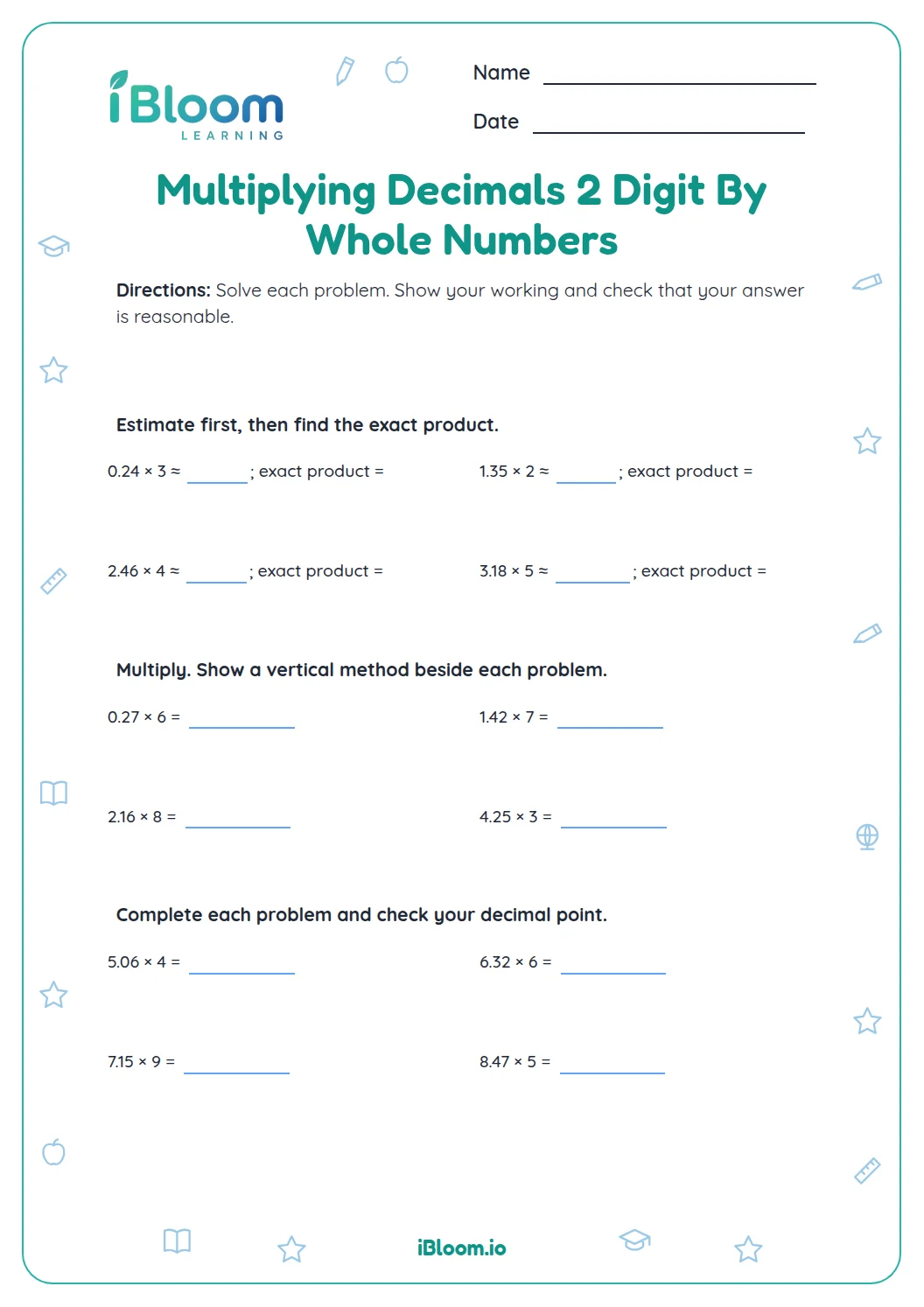
About this worksheet
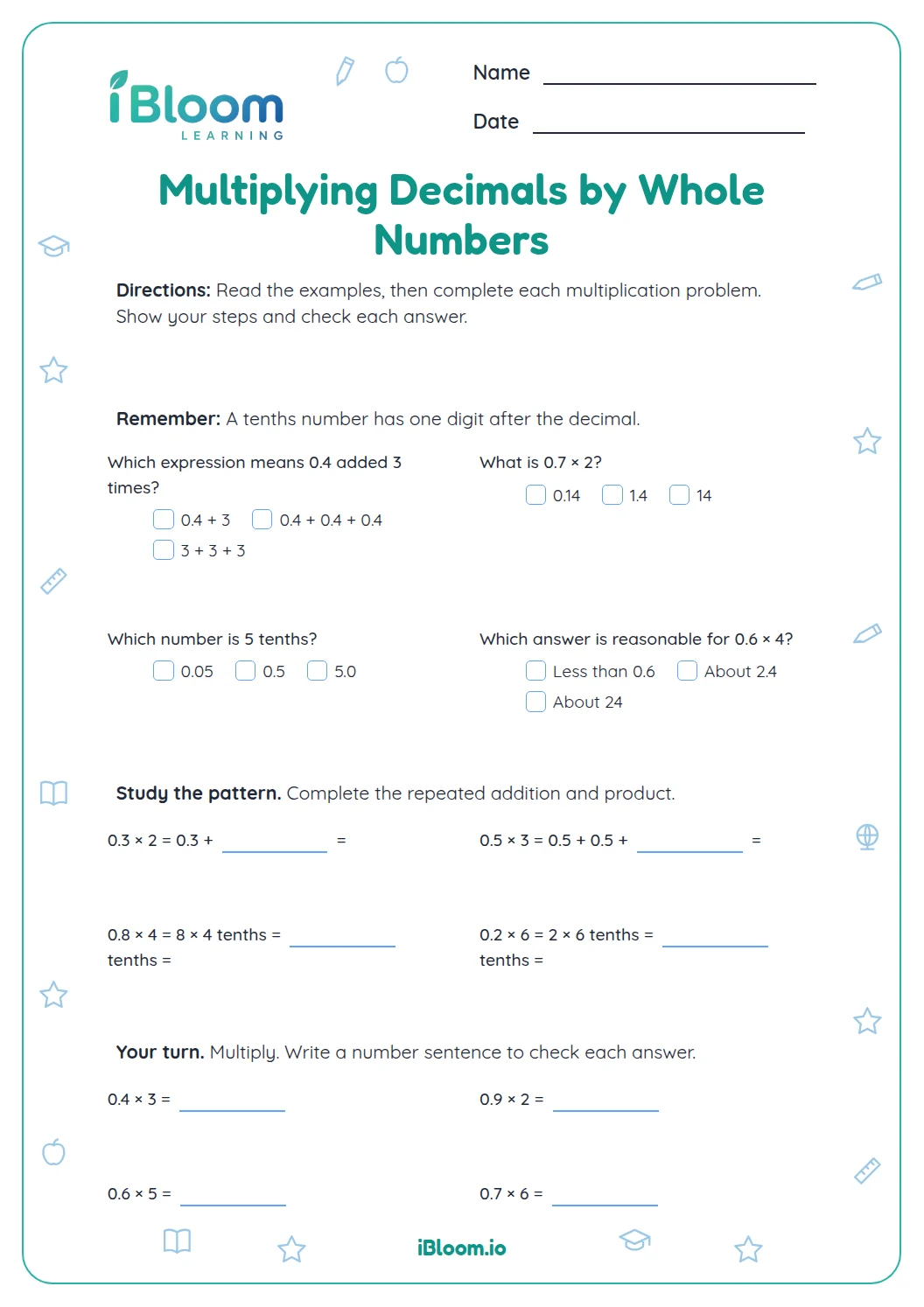
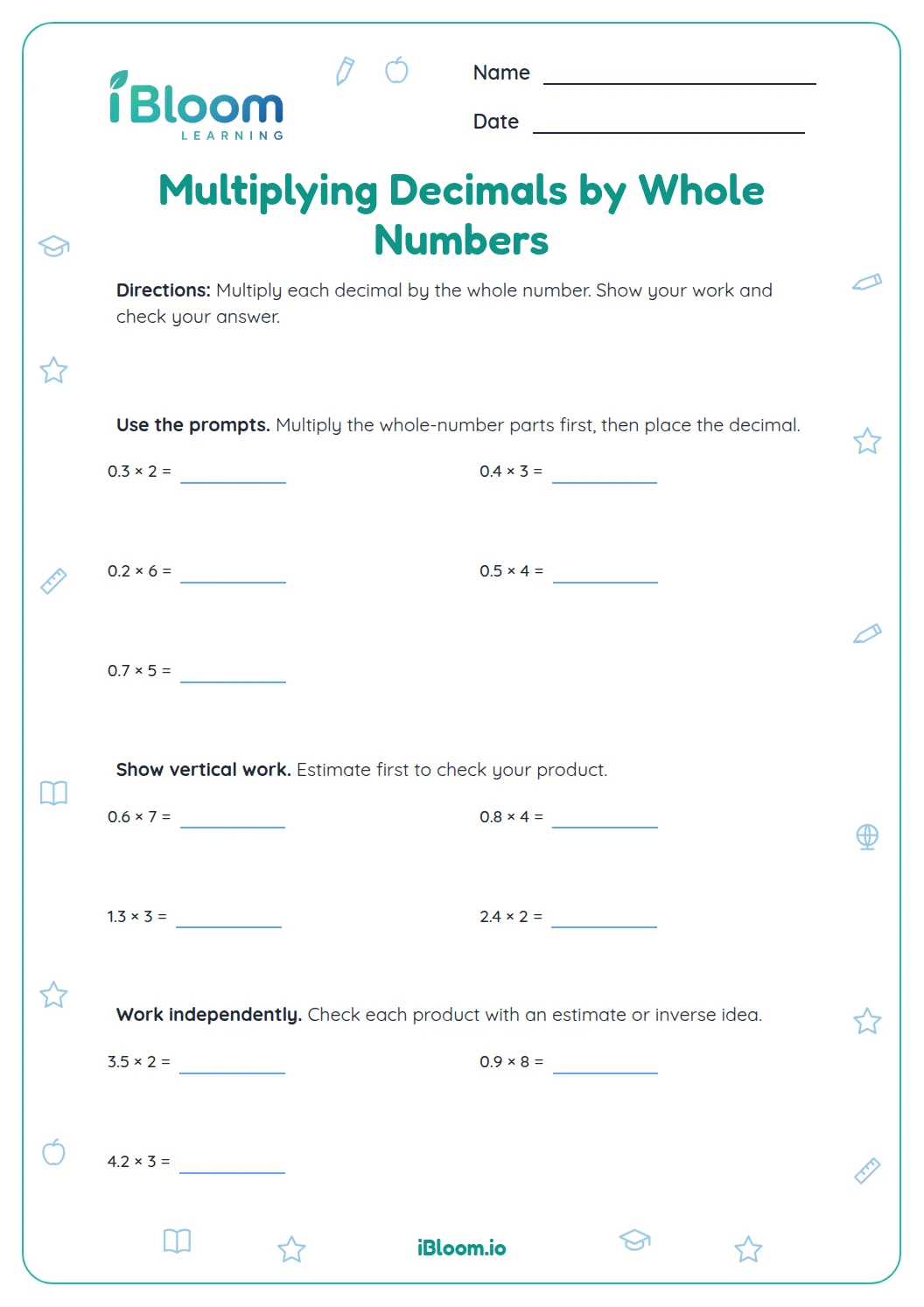
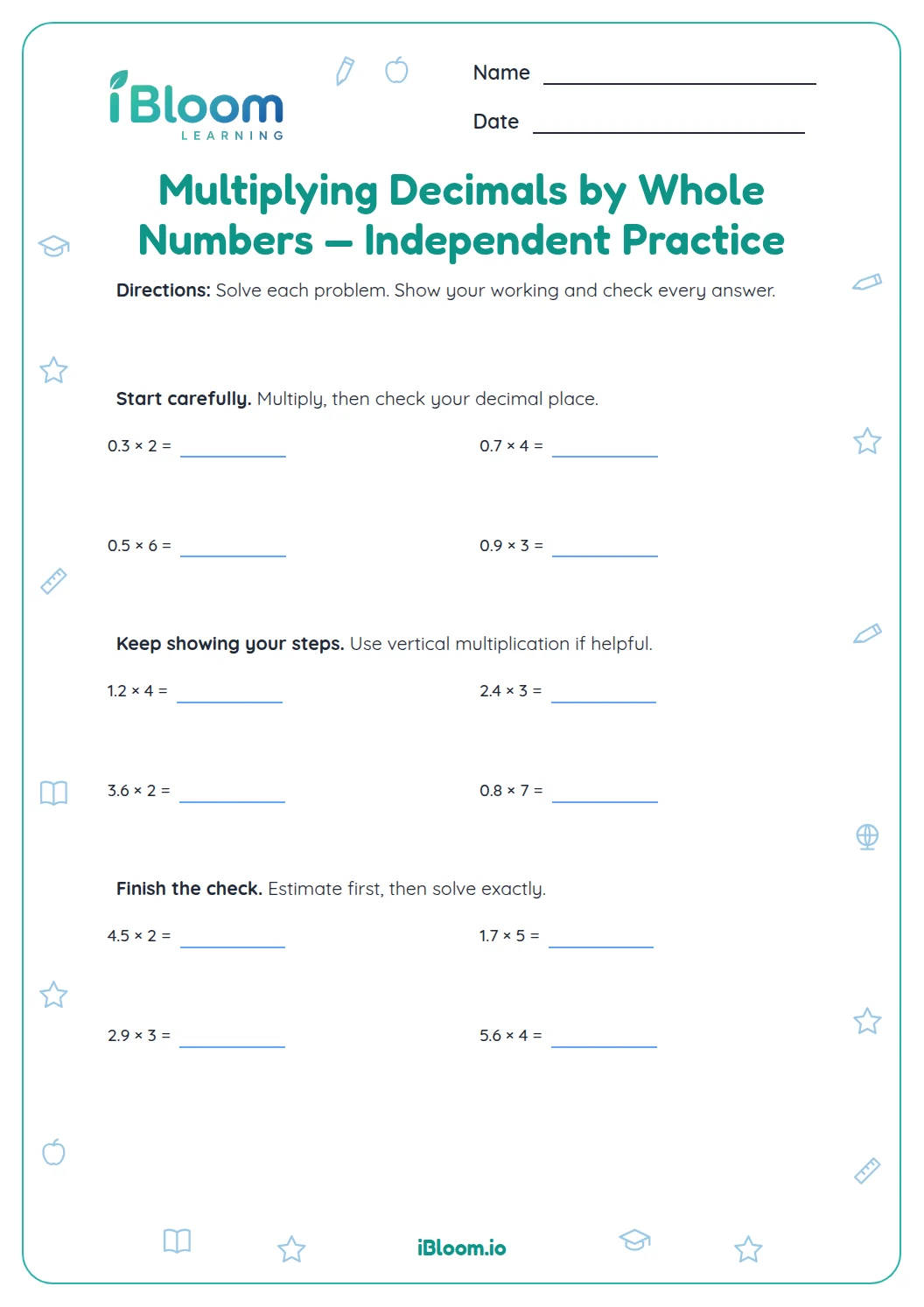
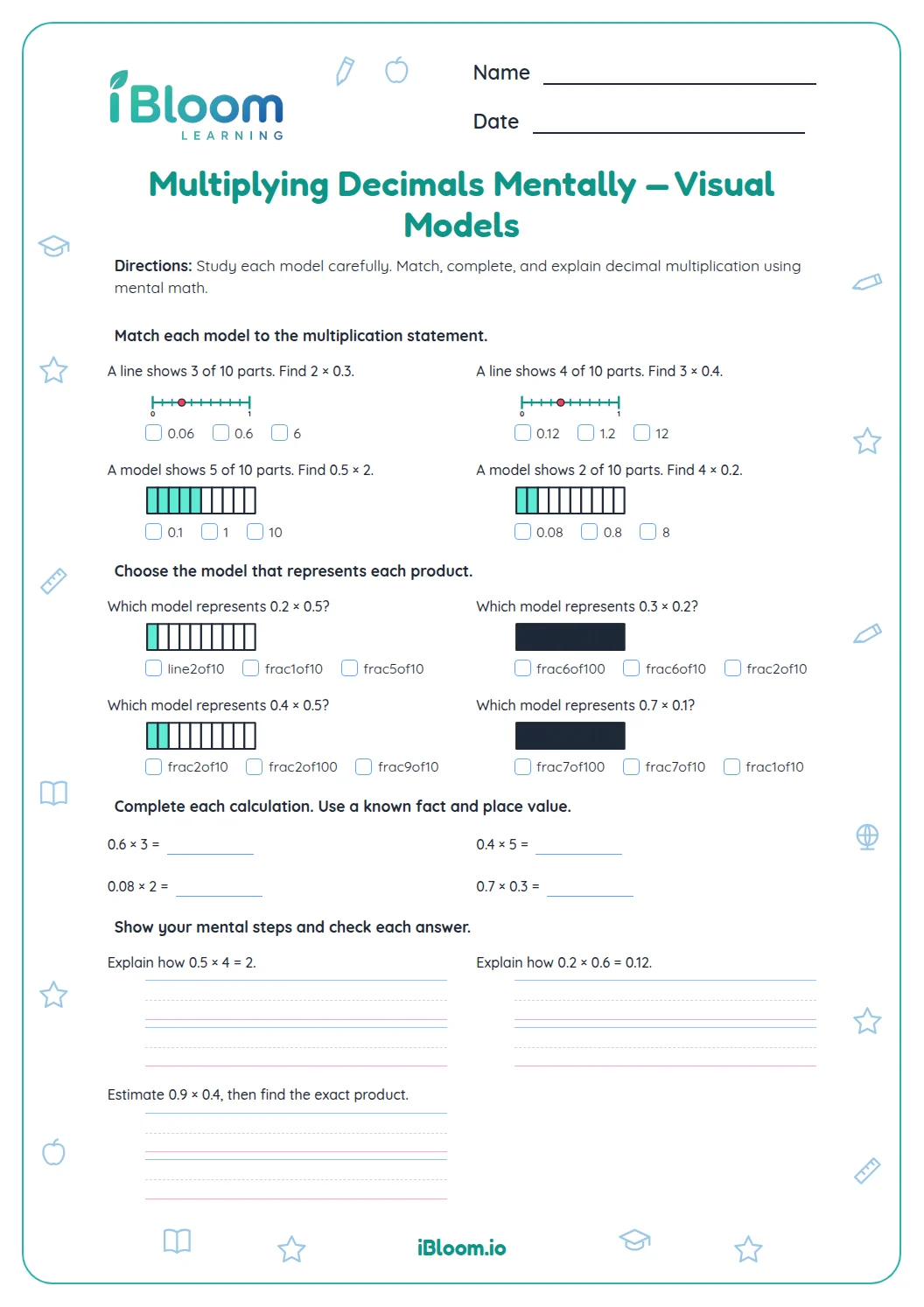
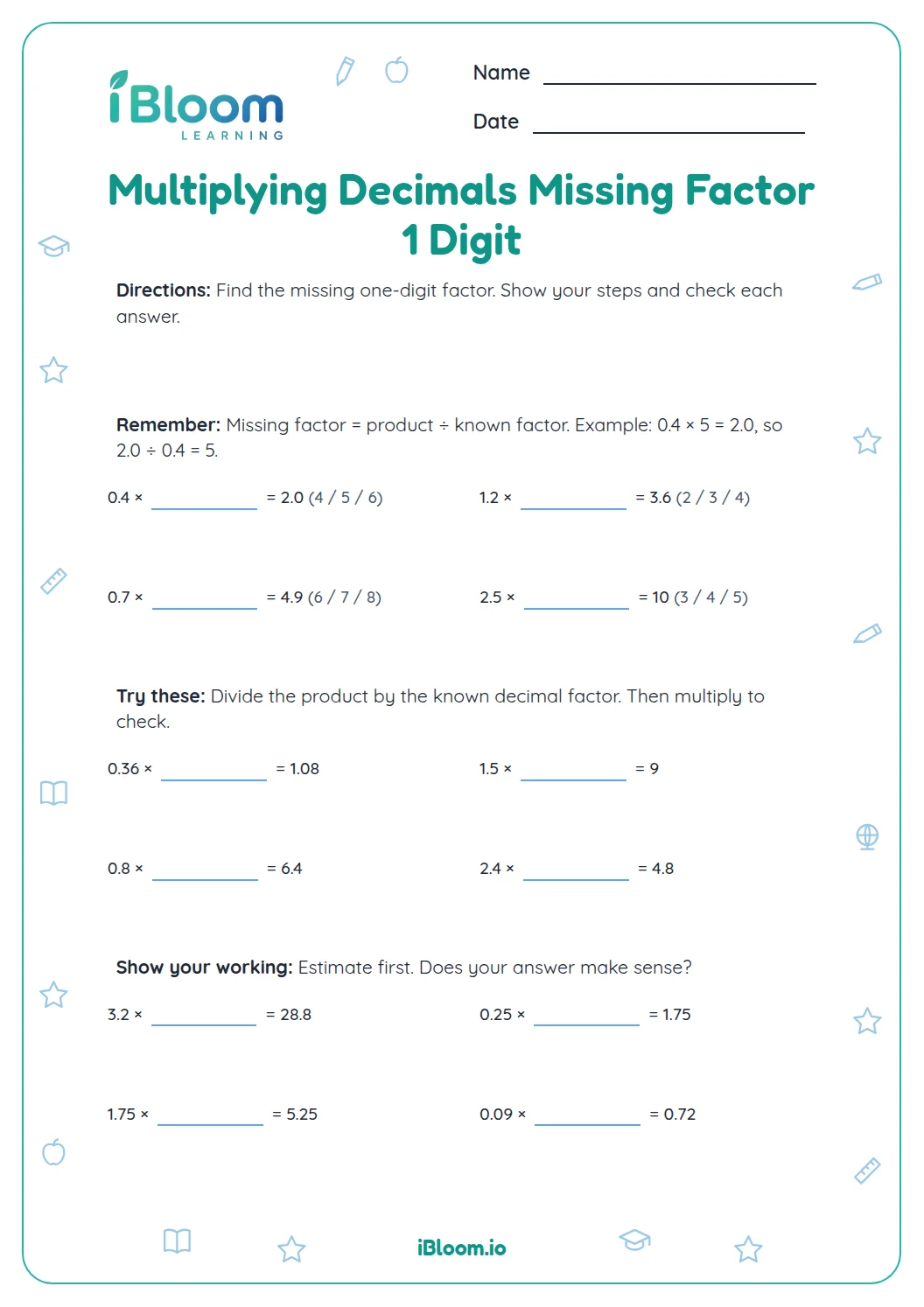
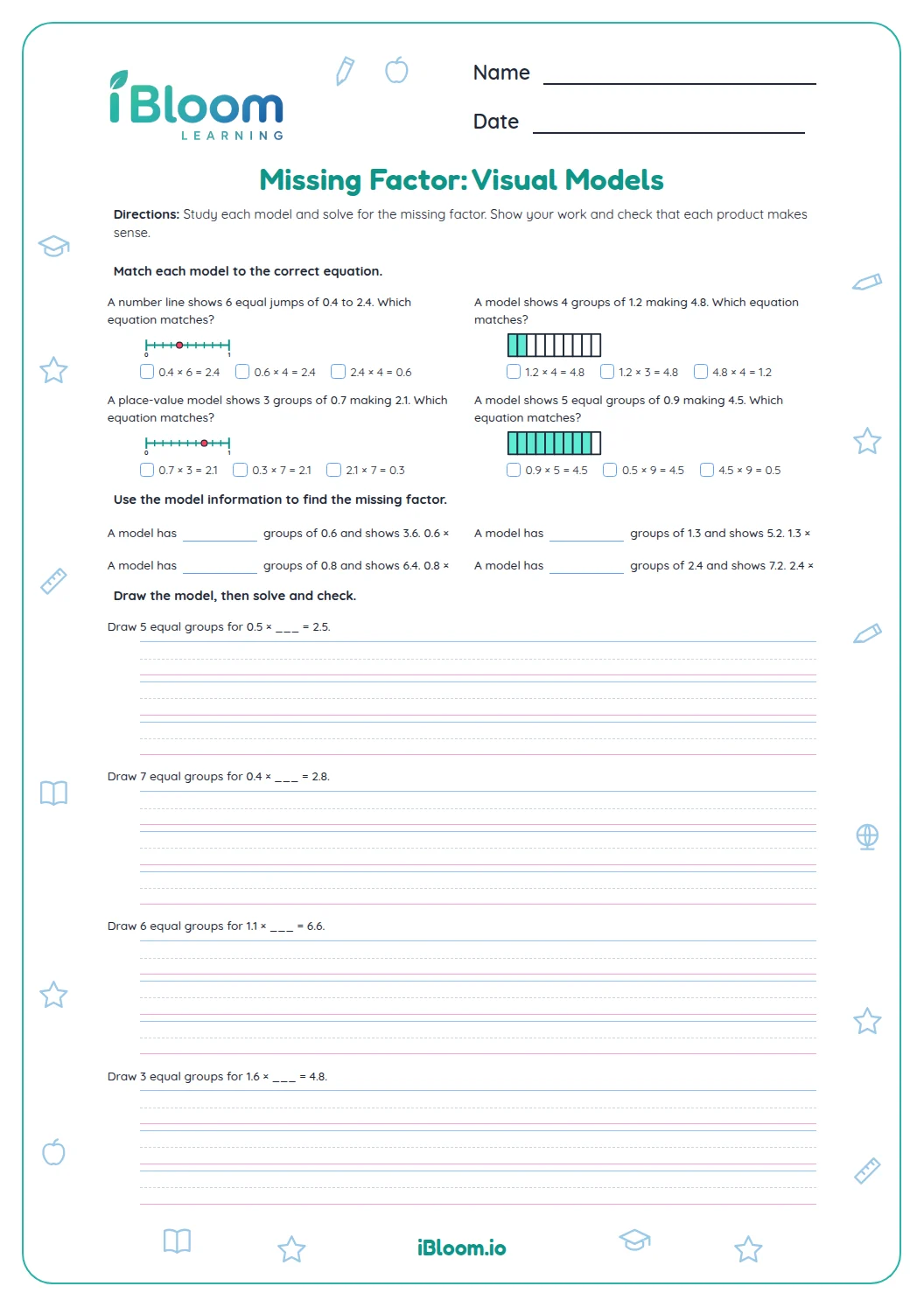
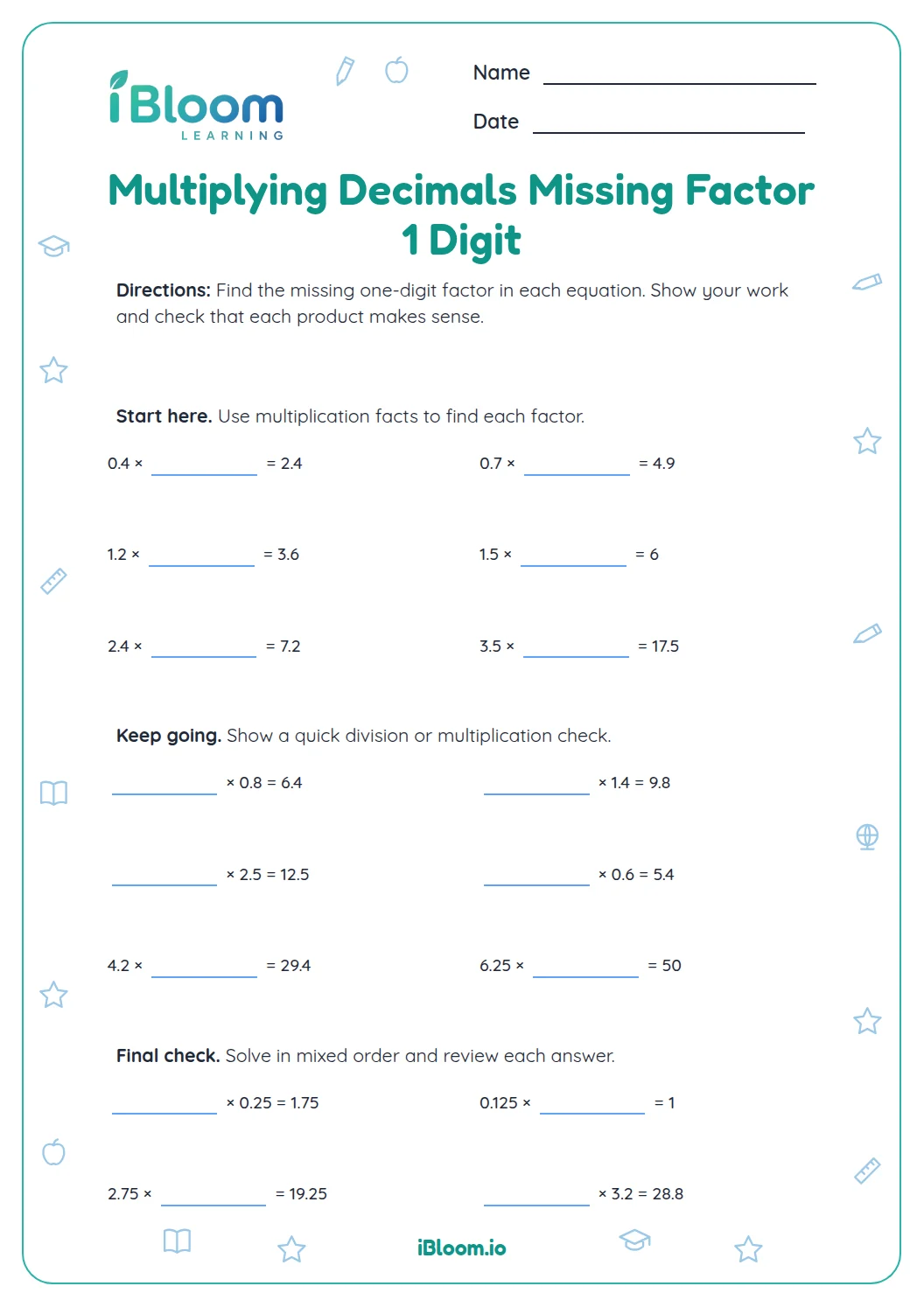
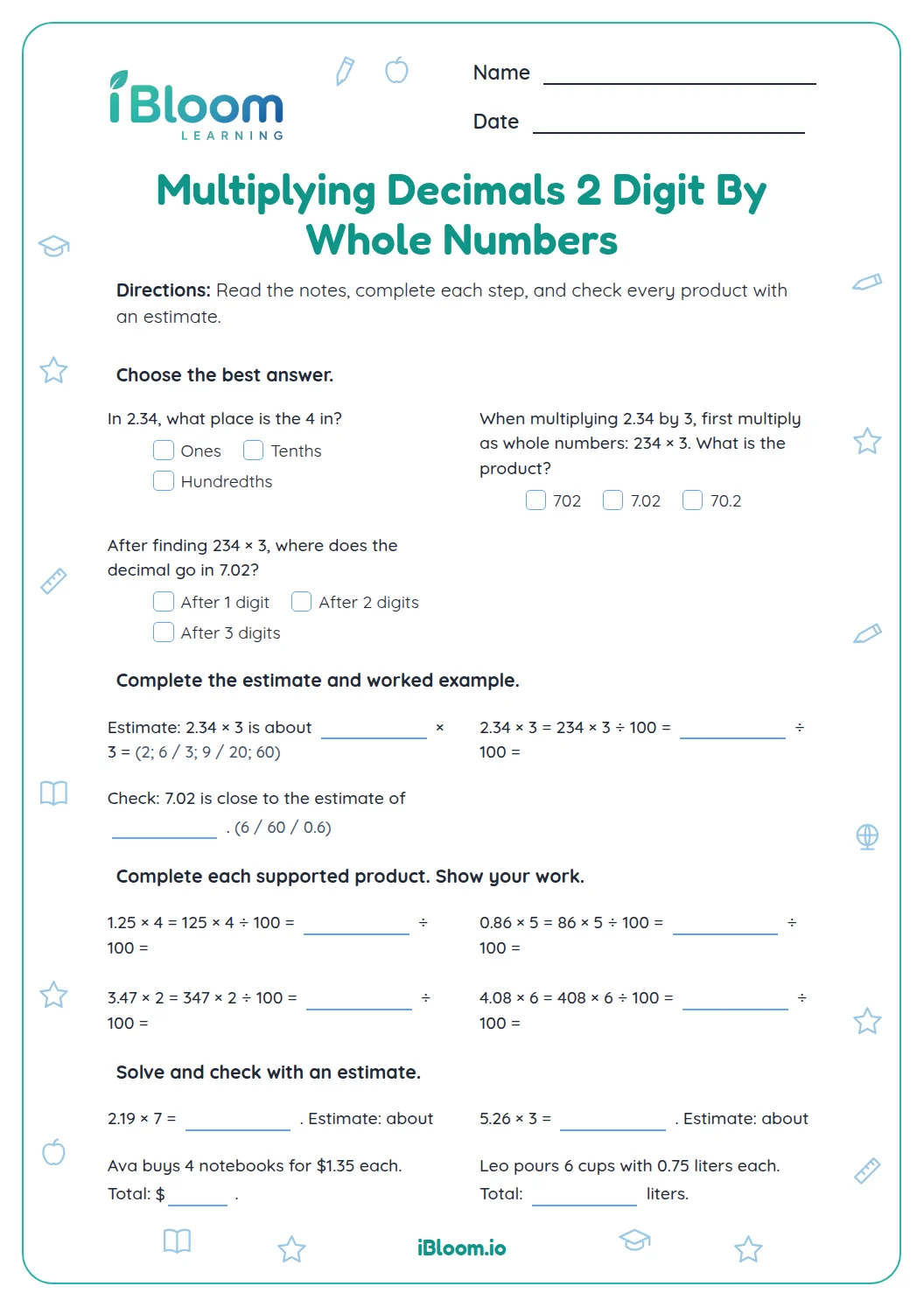
This free Grade 5 worksheet asks children to reason about multiplying a number with one decimal place by a whole number. Twelve questions move from missing products and factors to choices about tenths, two word problems, and two errors to explain. The numbers include 0.7, 1.2, and 2.4, so children must track place value as well as recall multiplication facts. Common Core 5.NBT.B.7 guides the work: use place-value strategies and explain how they connect to a written calculation. A separate key includes sample explanations.
Aligned to 5.NBT.B.7
Why is 0.7 × 6 equal to 4.2?
Seven tenths multiplied by six gives 42 tenths. Ten tenths make one whole, so 42 tenths can be regrouped as four wholes and two tenths. Naming the units explains the decimal point.
- 10.7 = 7 tenths
- 27 × 6 = 42
- 342 tenths = 4.2
- 40.7 × 6 = 4.2
What makes these questions a reasoning challenge?
Part A includes both products and missing factors. Part B asks children to interpret tenths, compare a product with its whole-number factor, and choose expressions equal to a product.
Part C applies multiplication to ribbon length and repeated laps. Part D asks children to correct two decimal-point errors and explain the correction. The key provides one model explanation for each.
How can children check the size of an answer?
Before calculating 0.6 × 5, notice that each of the five groups is less than one. The total must be less than five. For 1.4 × 3, the total must be more than three because each group contains more than one.
After finding the product, compare it with that prediction. A result of 42 for 1.4 × 3 fails the size check; three groups of about one and a half should be around four and a half.
How to use this worksheet
- 1Ask the child to say 0.7 as seven tenths before solving question 1.
- 2Complete the missing products and factors in Part A.
- 3For each Part B choice, ask which place-value fact supports it.
- 4Write a multiplication sentence for each Part C story and include meters.
- 5Read the wrong answers in Part D and write both a correction and a reason.
- 6Use the key to check the calculations and the meaning of each explanation.
Mistakes to check and how to help
The mistake
Writing 0.7 × 6 = 42.
The fix
Keep the unit: 42 tenths equals 4.2.
The mistake
Writing 1.4 × 3 = 0.42.
The fix
Fourteen tenths times three makes 42 tenths; the product must be greater than 3.
The mistake
Changing the product to 0.24 because a factor is a decimal.
The fix
For 0.8 × 3, calculate 24 tenths and rename them as 2.4.
Common Core alignment
Use tenths and whole-number facts to multiply decimals and explain the product.
On this sheet: Children connect products to tenths, solve decimal problems, and explain two place-value errors.
Show the official wordingHide the official wording
Add, subtract, multiply, and divide decimals to hundredths, using concrete models or drawings and strategies based on place value, properties of operations, and/or the relationship between addition and subtraction; relate the strategy to a written method and explain the reasoning used.
What to practice next
Make more practice
Further reading
Questions parents and teachers ask
What does one decimal place mean on this worksheet?
It means the decimal factor has one digit to the right of the decimal point, as in 0.7, 1.2, or 2.4. That digit names tenths. The other factor is a whole number, so children can use whole-number facts while keeping track of tenths.
How do children find the missing factor in question 3?
The missing factor is 0.9 because 0.9 × 4 = 3.6. Think of 3.6 as 36 tenths. Sharing 36 tenths among four equal groups gives nine tenths in each group. Children can check their answer by multiplying nine tenths by four again.
Why is 0.6 × 5 less than 5?
Each of the five equal groups contains less than one, so their total is less than five wholes. Question 6 asks children to choose that relationship. They can also calculate 0.6 × 5 = 3 and compare 3 with 5 to confirm their reasoning.
How much explanation is needed in Part D?
One short explanation that names the correct product and uses place value is enough. For question 11, a child might write that 14 tenths times 3 equals 42 tenths, or 4.2. The key offers sample answers; accept different wording that gives the same mathematical reason.
Are the word problem answers measured in meters?
Yes, both stories ask for a total length in meters. Four ribbon pieces of 1.8 meters total 7.2 meters, and seven laps of a 0.6-meter toy track total 4.2 meters. Children write a multiplication sentence in the work area and include the unit with each answer.