


About this worksheet
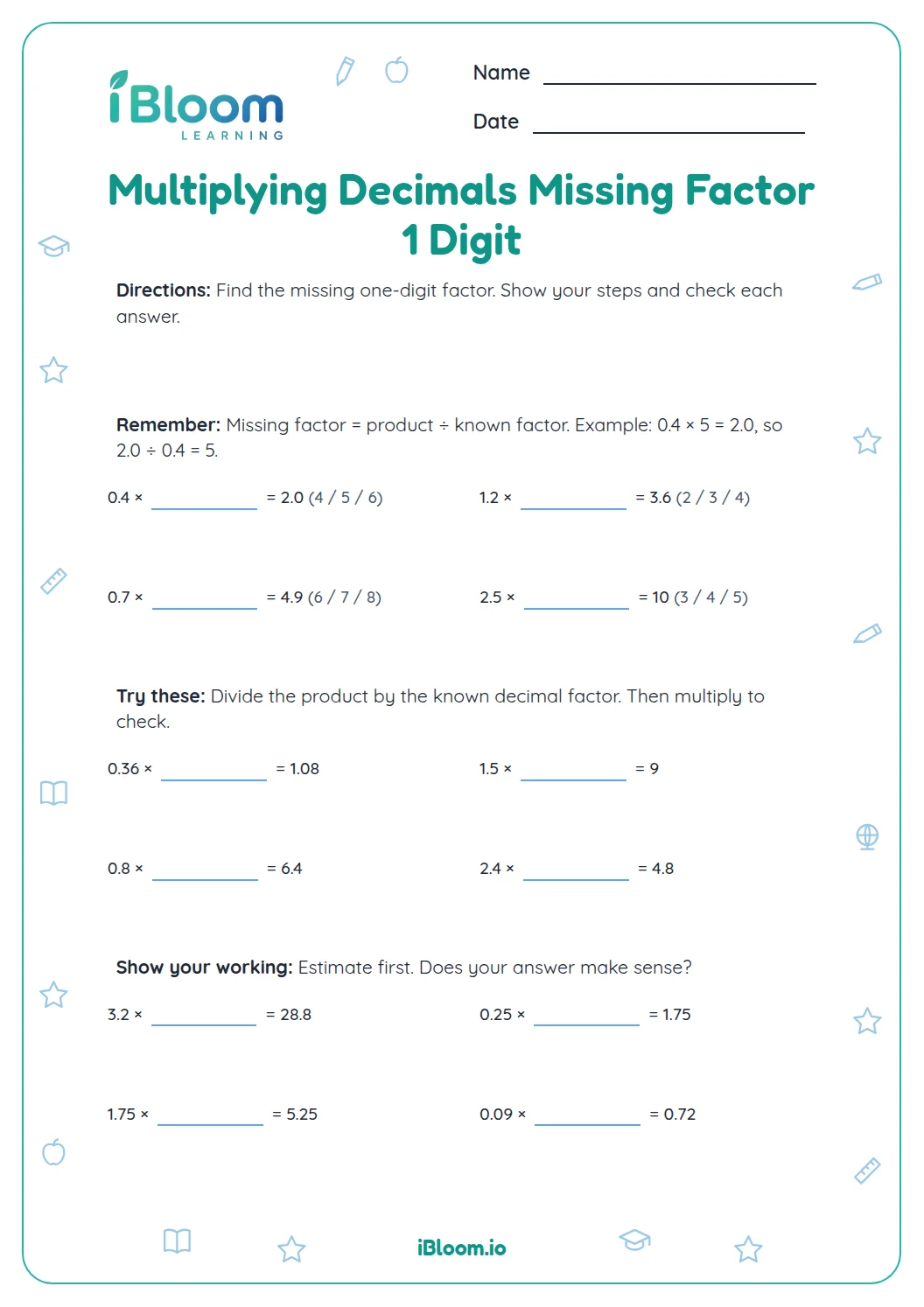
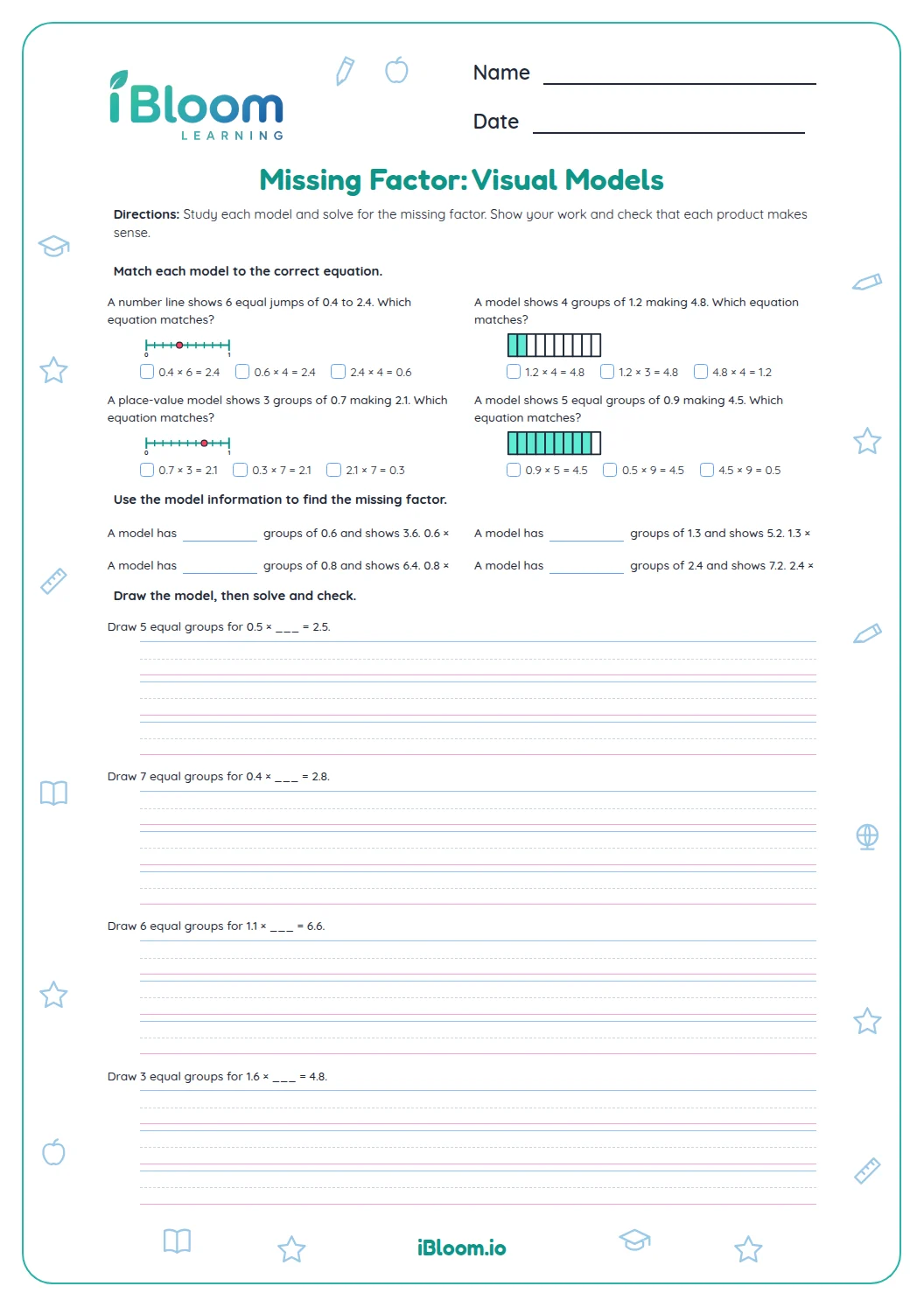
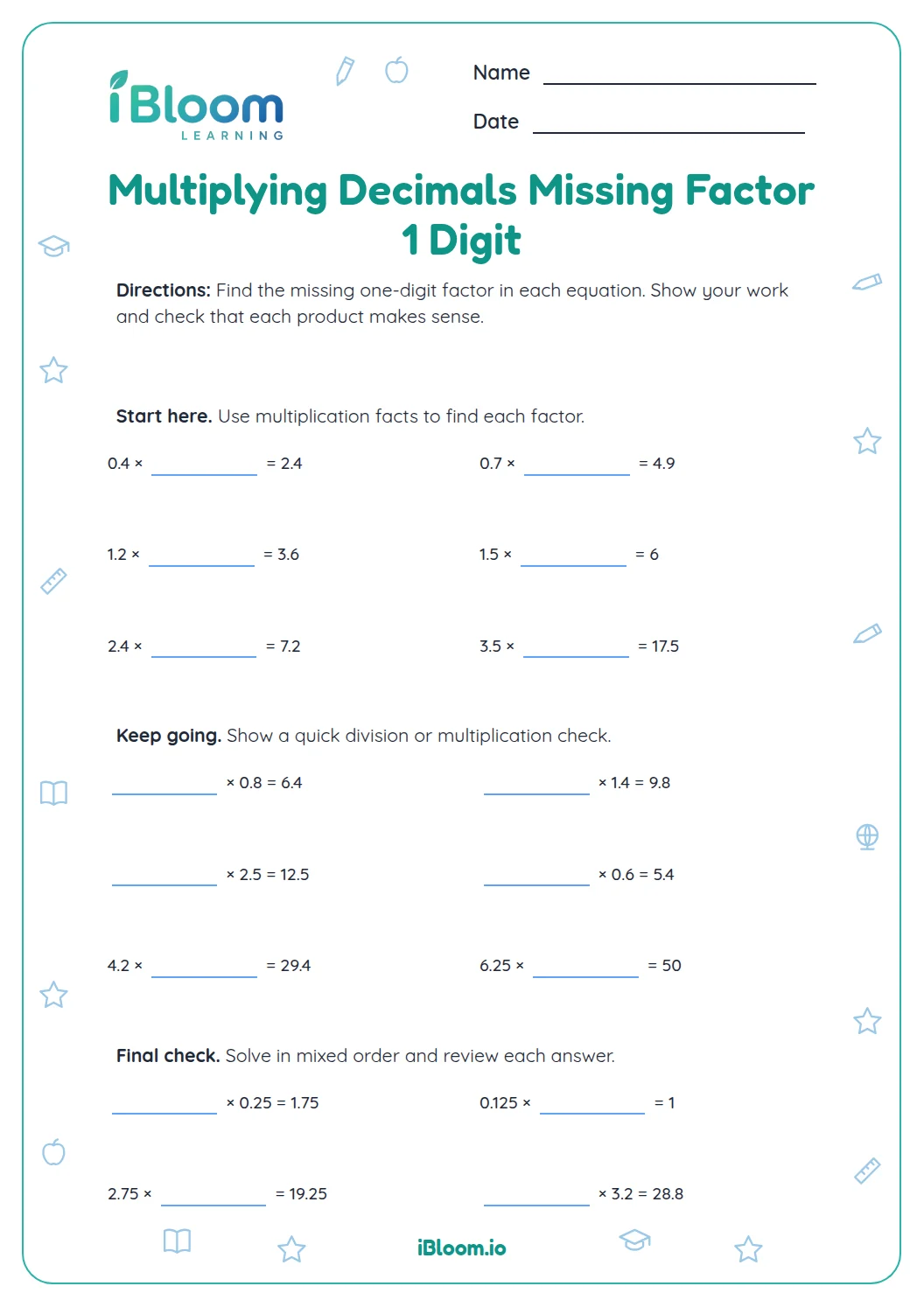
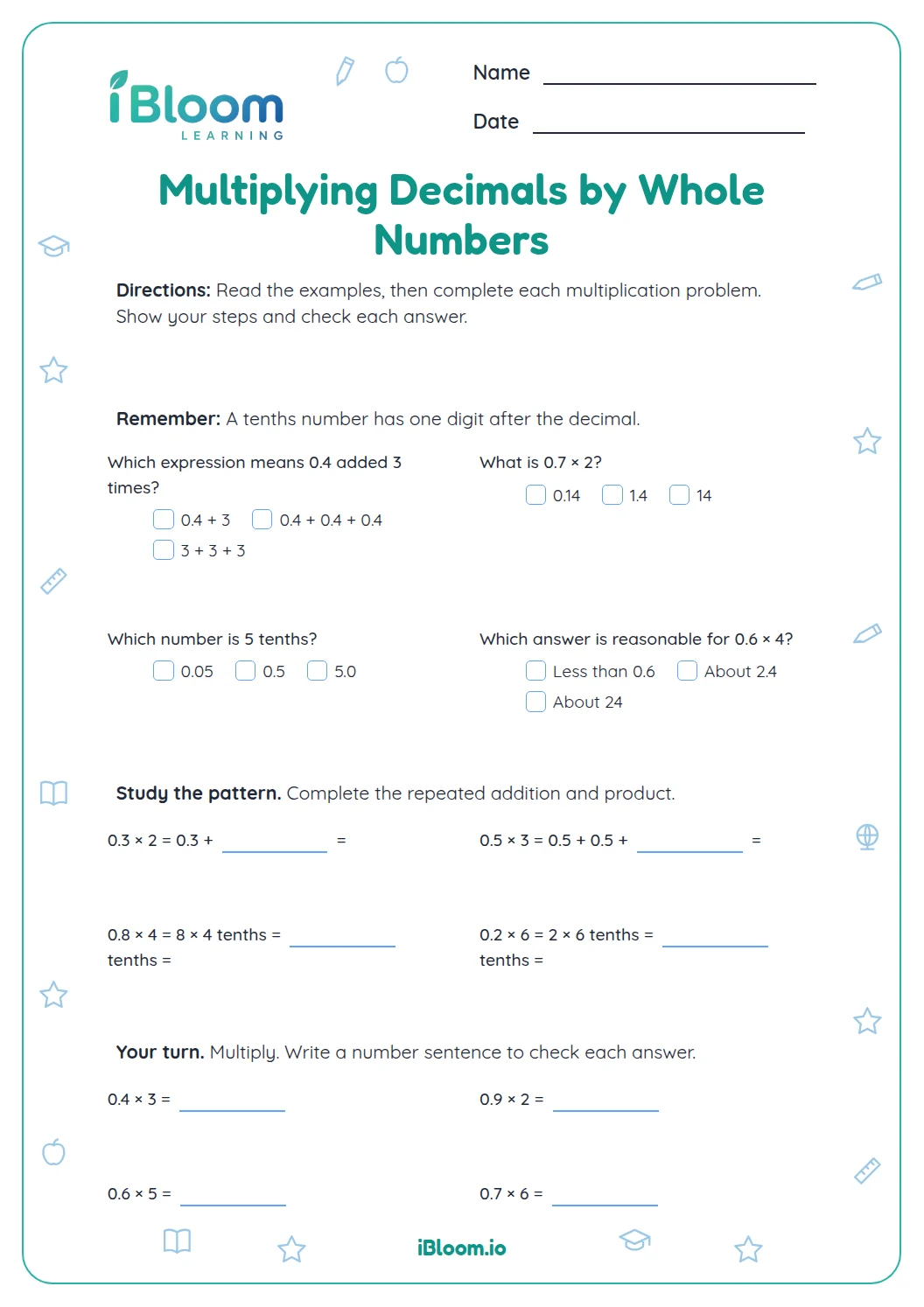
This Grade 5 printable focuses on equations such as 0.4 × ___ = 2.8, where the missing factor is a one-digit whole number. Students find factors by using division, then check with multiplication. The 14 questions move from short equations to error checking and two measurement situations, with a separate answer key. It practices CCSS 5.NBT.B.7.
Aligned to 5.NBT.B.7
How do you find a missing factor?
When a multiplication equation has one unknown factor, divide the product by the factor you know. In question 1, 2.8 ÷ 0.4 = 7, so 7 fills the blank. Multiplying 0.4 × 7 returns 2.8.
- 10.4 × ___ = 2.8
- 22.8 ÷ 0.4 = 7
- 3Check: 0.4 × 7 = 2.8
How can multiplication check a division answer?
A missing factor is the number that makes the product. After dividing, put the factor back into the original equation. Question 12 asks students to check 8 in ___ × 0.6 = 4.8: 8 × 0.6 equals 4.8.
How does the same idea work in a story?
Question 13 gives the length of one ribbon piece and the total length. Dividing 4.5 meters by 0.75 meter per piece gives 6 pieces. The units help show why the answer counts pieces.
How to use this worksheet
- 1Read the known factor and product in the equation.
- 2Divide the product by the known factor.
- 3Write the quotient in the blank.
- 4Multiply to check that the product matches.
- 5For a story, include the unit that answers the question.
Common mistakes and quick fixes
The mistake
Dividing the known factor by the product.
The fix
Use product ÷ known factor to find the missing factor.
The mistake
Treating a decimal factor as a whole number by dropping its decimal point.
The fix
Estimate first, then check by multiplying with the original decimal.
The mistake
Giving only a number for a measurement story.
The fix
Label the answer in pieces or bottles, as the question asks.
Common Core alignment
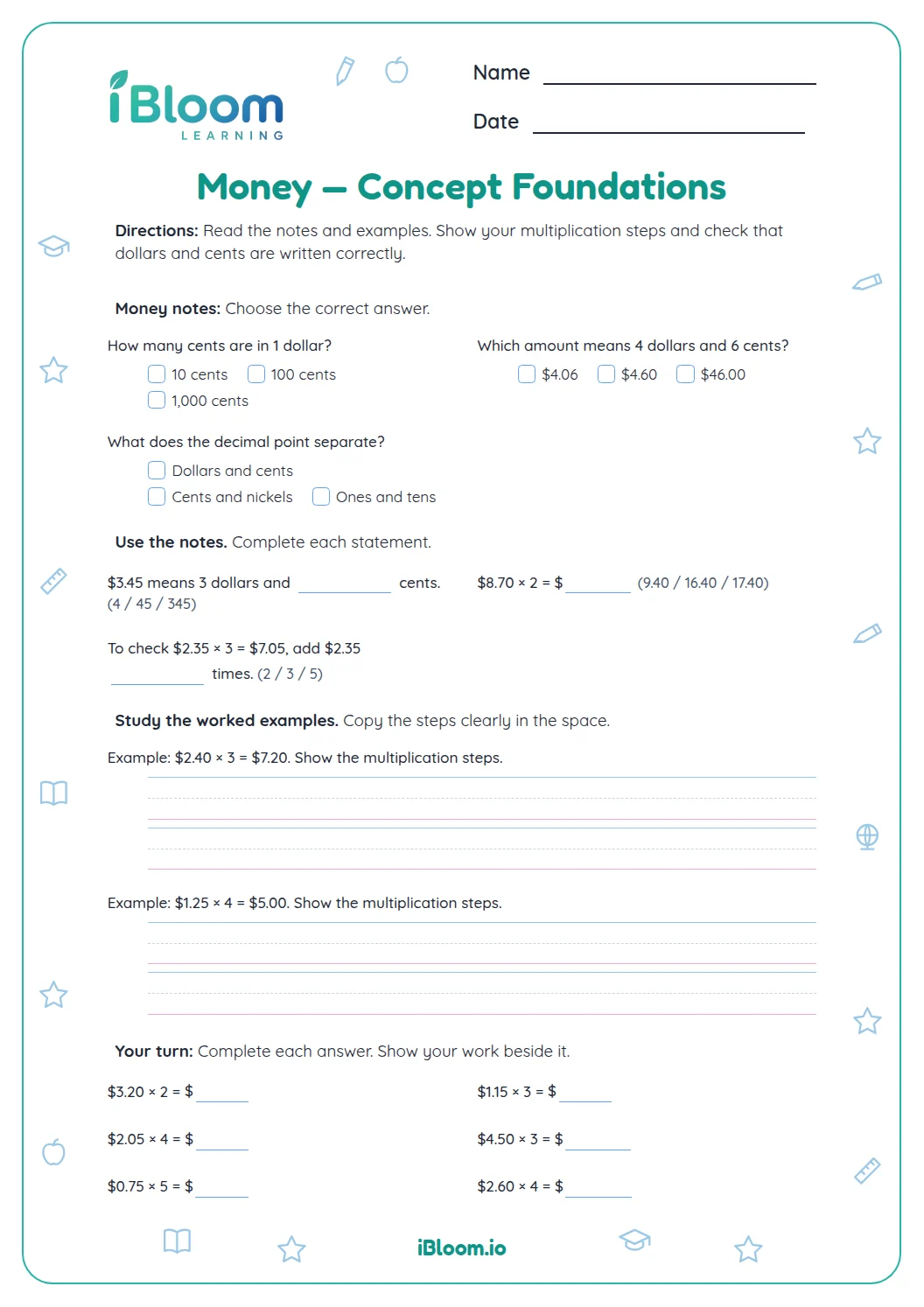
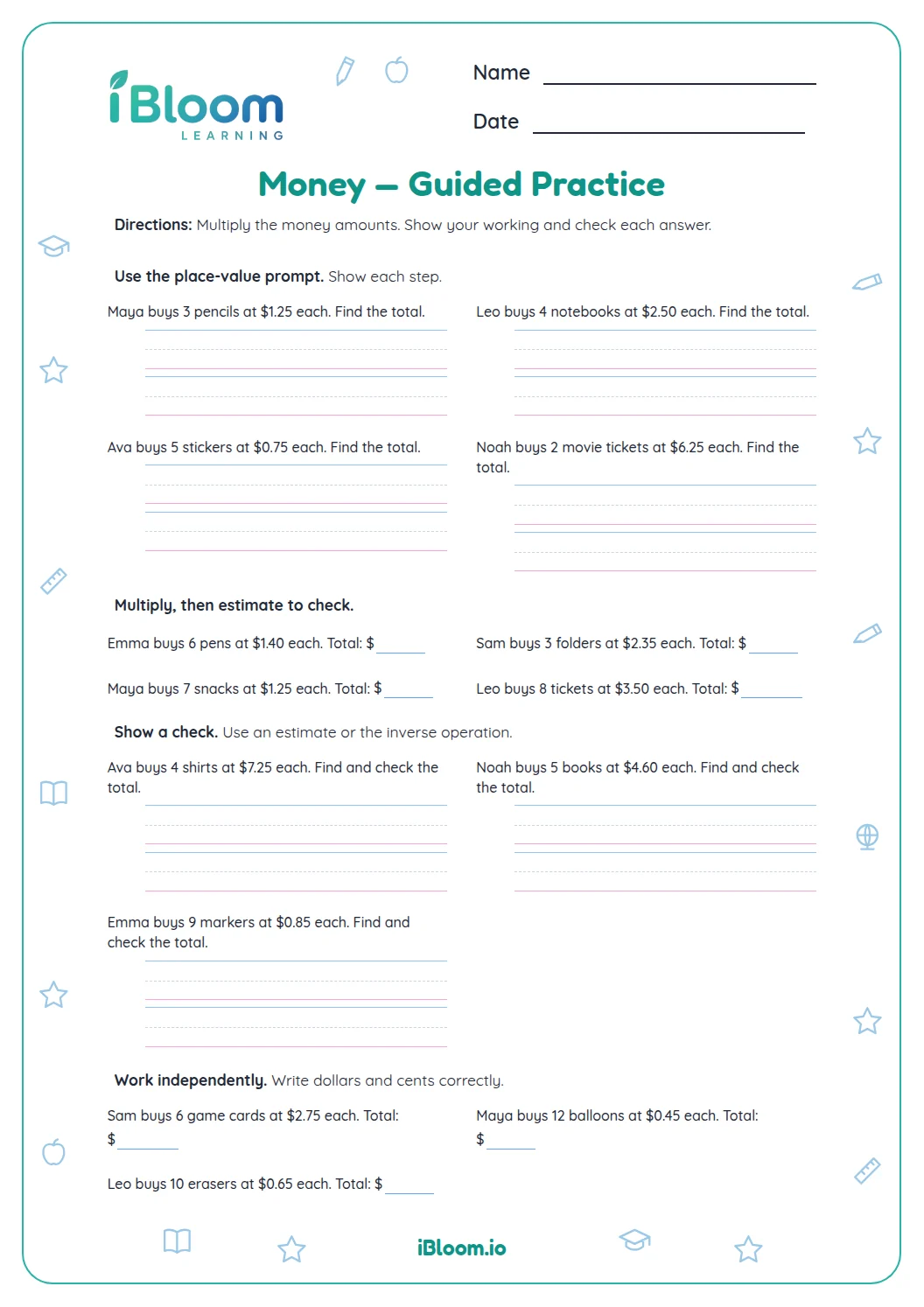
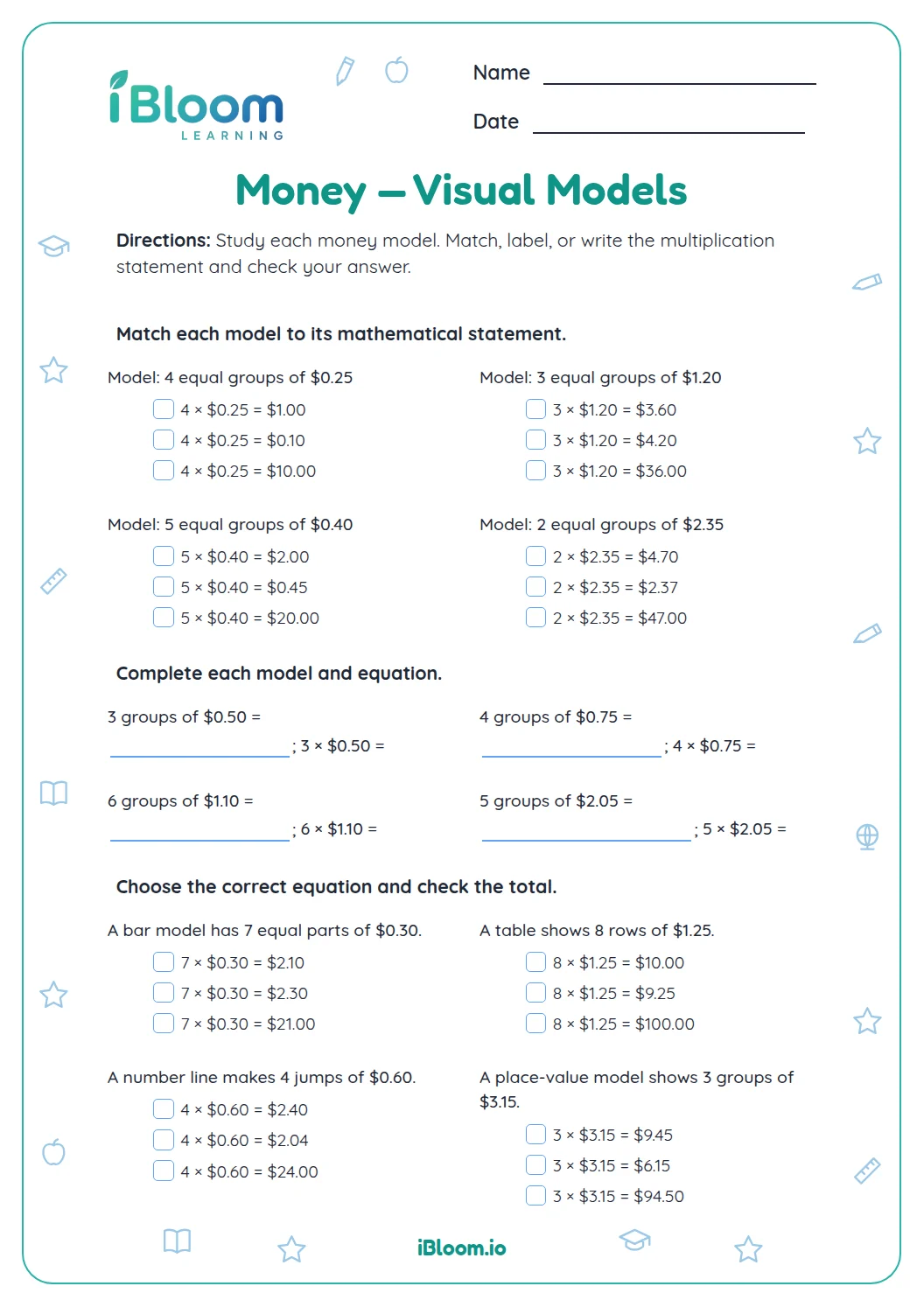
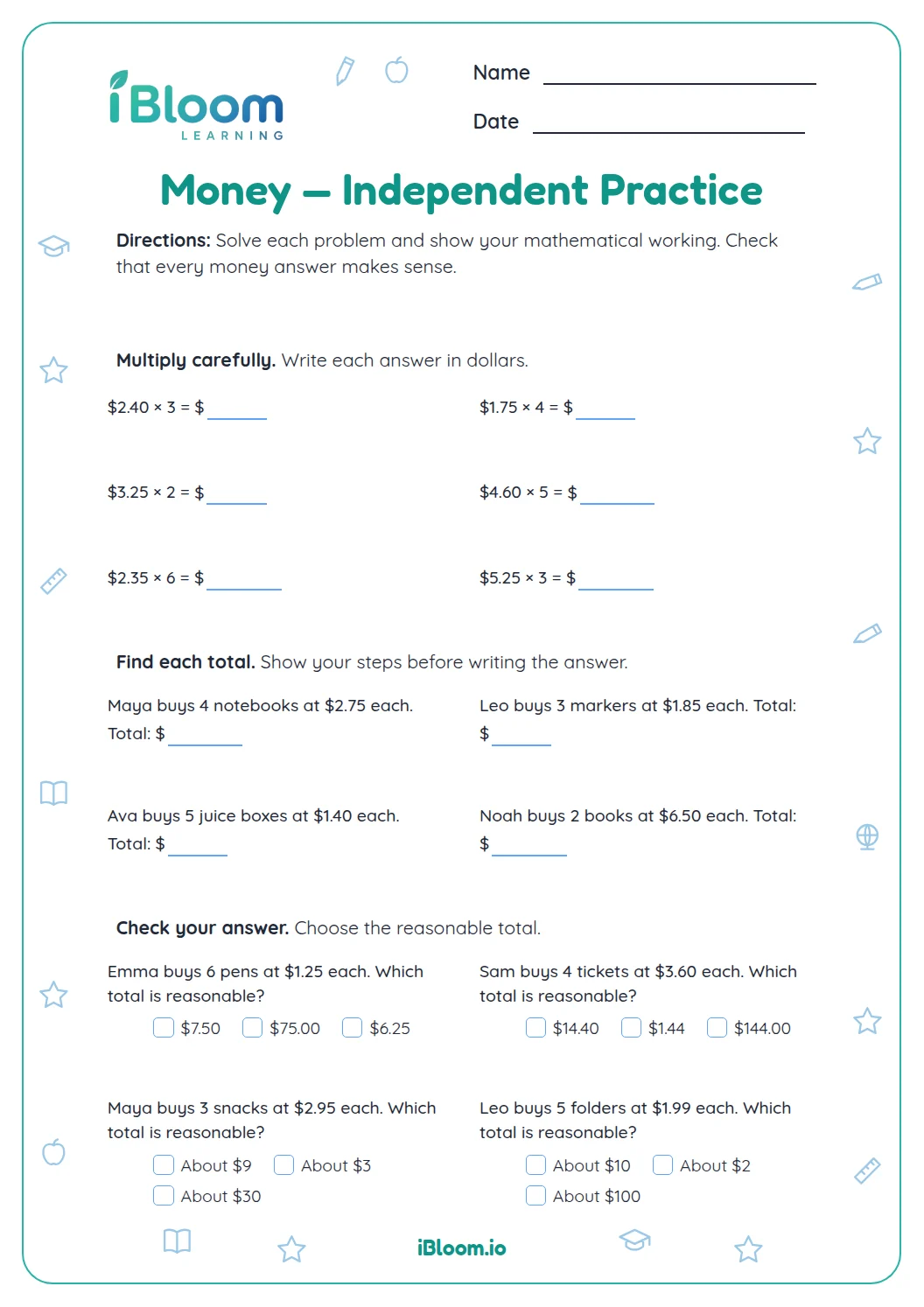
This worksheet practices decimal multiplication and uses division to find an unknown factor.
Use multiplication and division strategies with decimals to hundredths.
On this sheet: Students multiply decimal factors to check products and divide to find missing factors.
Show the official wordingHide the official wording
Add, subtract, multiply, and divide decimals to hundredths, using concrete models or drawings and strategies based on place value, properties of operations, and/or the relationship between addition and subtraction; relate the strategy to a written method and explain the reasoning used.
What to practice next
Make more practice
Further reading
Questions parents and teachers ask
What kind of missing factor does the sheet use?
Each equation has one missing one-digit whole-number factor and one known decimal factor. Products are chosen so the quotient is a whole number. Students use division to find the blank and multiplication to check it. The final multiplication sentence confirms that the quotient is the missing factor.
Should students use long division for every equation?
They can choose a method that makes sense, including place-value reasoning, equivalent fractions, or written division. The important check is to multiply the known decimal factor by the missing whole number and compare it with the product. Students can write the check beside the original equation.
What do the story problems ask students to find?
One asks how many 0.75-meter ribbon pieces make 4.5 meters. The other asks how many 1.25-liter bottles hold 10 liters. Both use division and ask for a count of equal groups. The key keeps both measurement units in the answer.
How can I help if a child gets stuck?
Ask which number is the product and which factor is already known. Then have the student think of the related division sentence. For example, if 0.4 times a number is 2.8, ask what 2.8 divided by 0.4 equals. This check connects multiplication and division in the equation.
Does the answer key show a check?
The key gives the missing factors and model responses for the explanation and story items. For each equation, students can confirm the answer themselves by putting the factor back into the multiplication sentence. Have the student test one equation at a time.