

About this worksheet
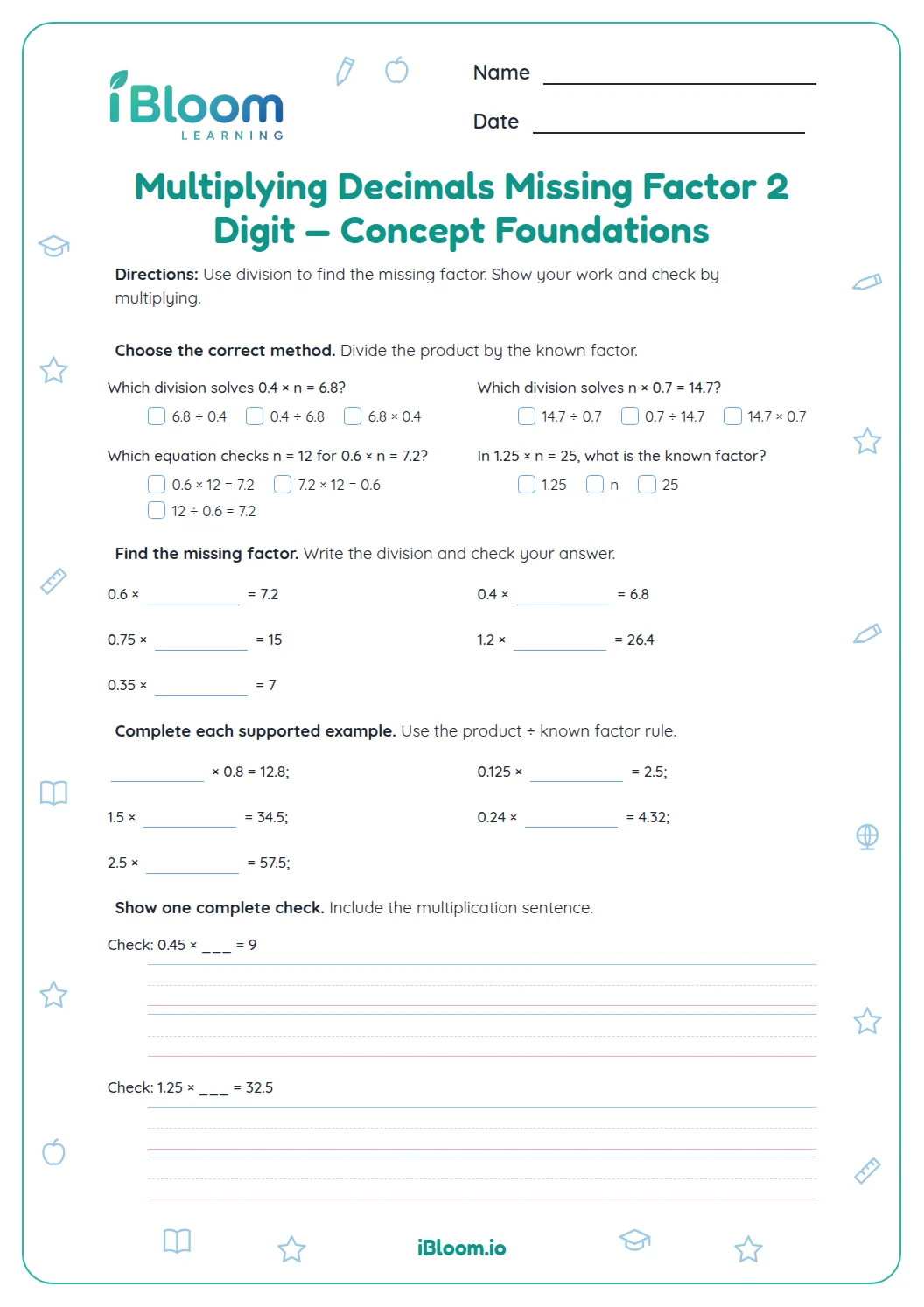
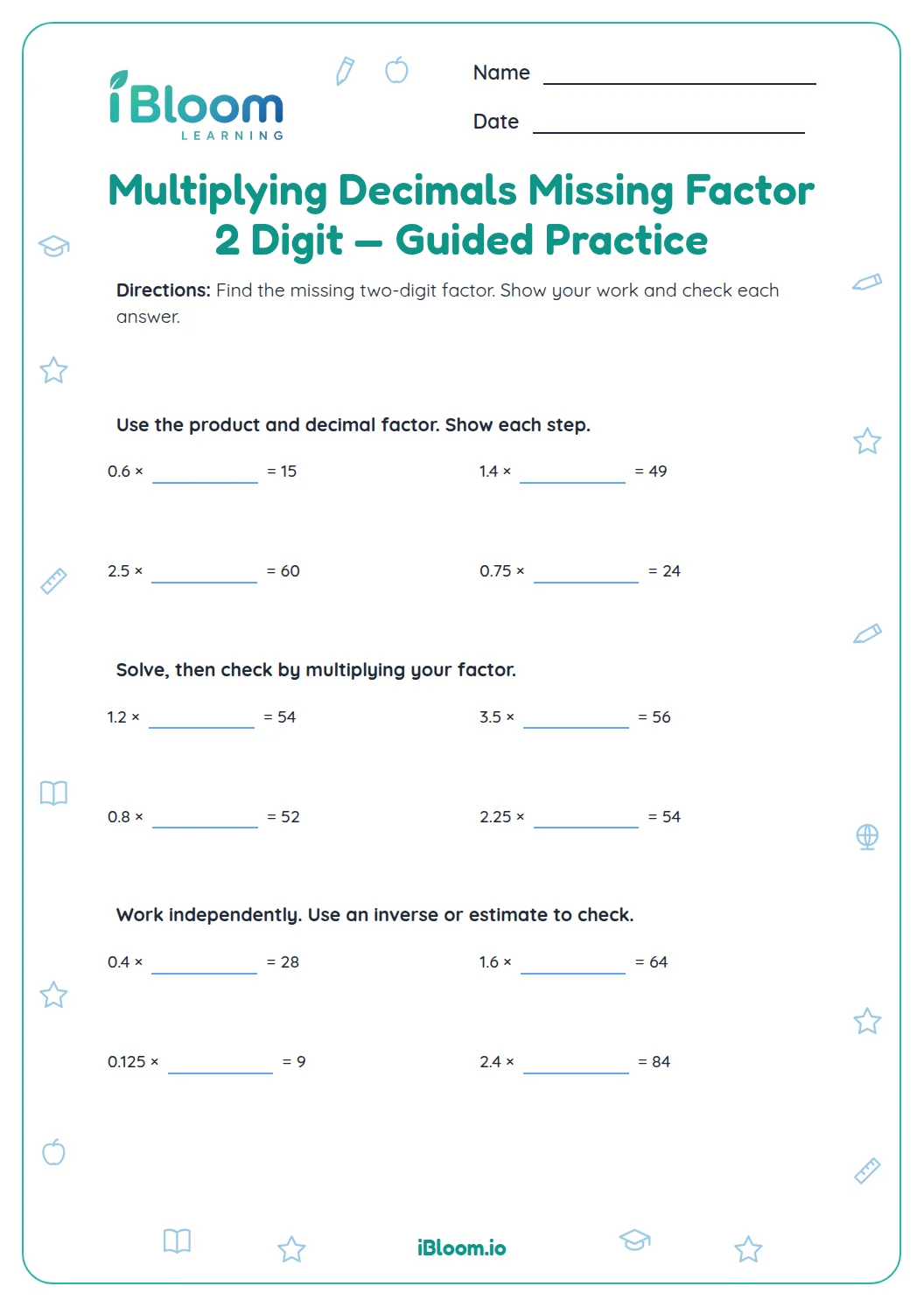
This two-page Grade 5 worksheet practices finding a one-digit whole-number factor in decimal multiplication. It begins with tenths, then uses hundredths and factors greater than one. Learners also check a proposed answer, estimate a factor before solving, and use division or a related fact to solve four short stories. The separate answer key shows the expected factors and reasoning. It practices multiplying decimals to hundredths under Common Core 5.NBT.B.7.
Aligned to 5.NBT.B.7
How do you find a one-digit factor?
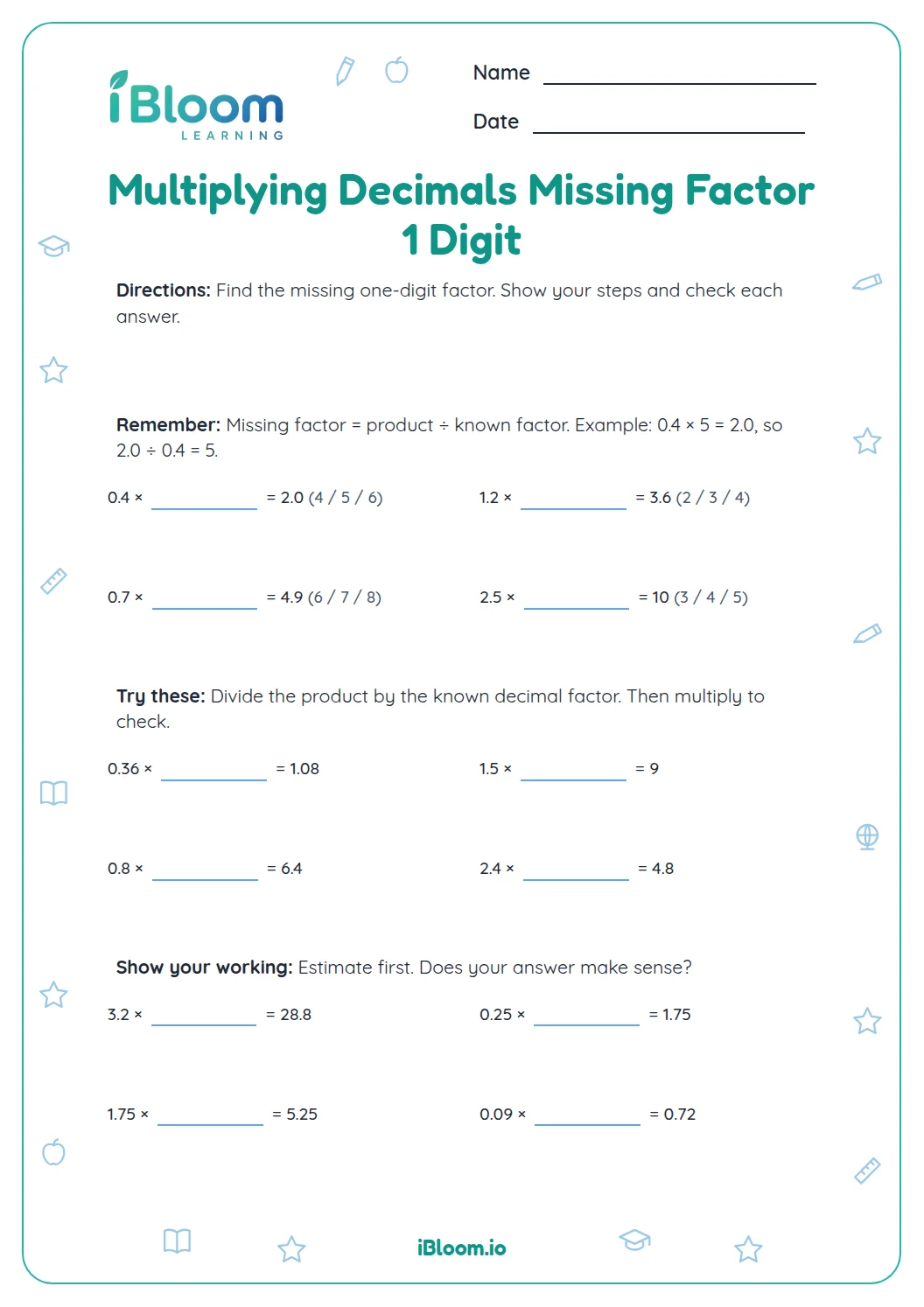
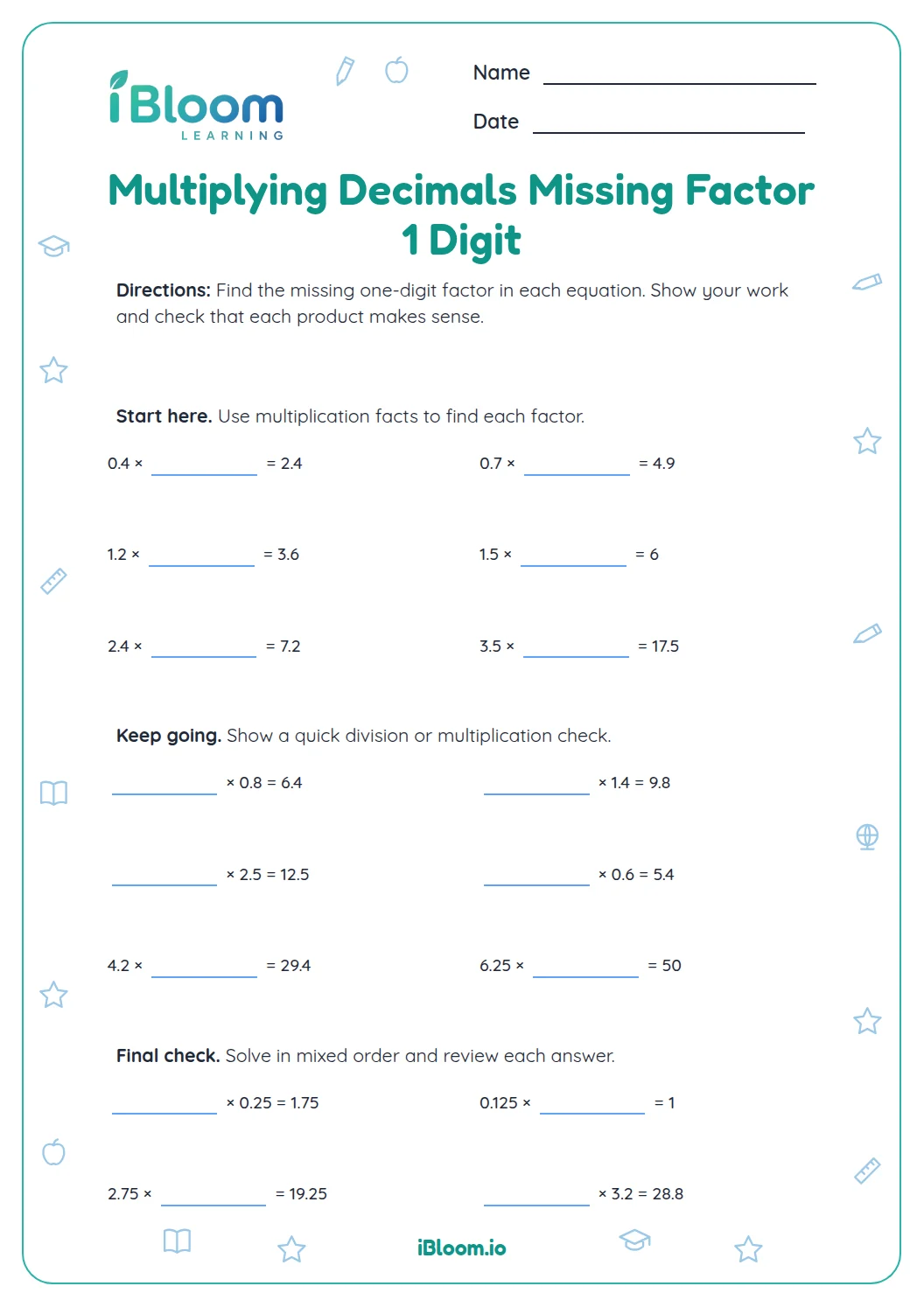
Part A starts with tenths such as 0.4 × ___ = 2.8. Divide 2.8 by 0.4 to find 7, then multiply to confirm the product.
- 10.4 × ___ = 2.8
- 22.8 ÷ 0.4 = 7
- 3Check: 0.4 × 7 = 2.8
How can you check a claim or estimate?
Part B asks students to judge a proposed factor and estimate another from the size of the product. For 27.3 = ___ × 3.9, a factor near 7 is reasonable; multiplying confirms 3.9 × 7 = 27.3.
How do different decimal places change the work?
Part C uses hundredths and factors above one. Divide the product by the known factor, keeping its decimal value in mind, then multiply to verify.
How does the same idea work in stories?
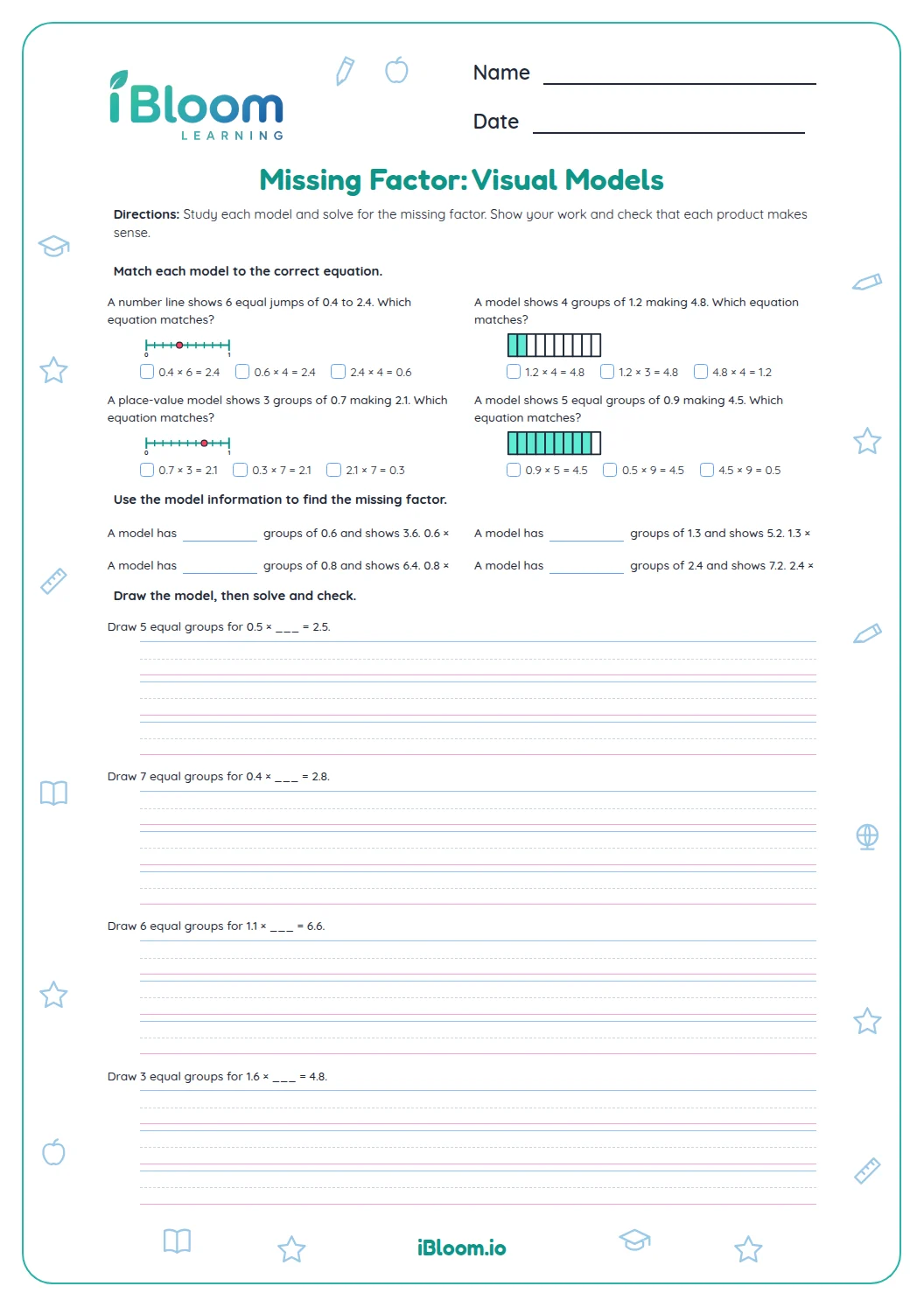
Part D gives a decimal amount for each group and a total amount. Divide the total by the amount per group, then state how many ribbons, bottles, turns, or batches fit.
How to work through the challenge
- 1Read the known factor and product before choosing an operation.
- 2Estimate the missing factor from the product’s size.
- 3Divide the product by the known factor.
- 4Multiply the known factor by your answer to check.
- 5For a story, include the unit or group named in the question.
Decimal factor checks to remember
The mistake
Dividing by the product
The fix
Divide the product by the known factor; the quotient is the missing factor.
The mistake
Treating 0.45 as 45
The fix
Keep the decimal value in the divisor and check with 0.45 × your factor.
The mistake
Accepting a factor that does not reproduce the product
The fix
Multiply the known factor by your answer and compare with the given product.
Common Core alignment
This sheet practices the following Common Core standard.
Use place value and equations to multiply decimals to hundredths.
On this sheet: Each missing-factor equation is checked by multiplying decimals.
Show the official wordingHide the official wording
Add, subtract, multiply, and divide decimals to hundredths, using concrete models or drawings and strategies based on place value, properties of operations, and/or the relationship between addition and subtraction; relate the strategy to a written method and explain the reasoning used.
What to practice next
Further reading
Questions parents and teachers ask
What is the missing factor in 0.4 × ___ = 2.8?
The missing factor is 7. Divide 2.8 by 0.4 to find it, then multiply 0.4 by 7 to check. Part A uses equations like this to connect decimal multiplication with a related division fact. Estimate whether the missing number should be near one, five, or ten before dividing.
Does the worksheet include hundredths?
Yes. Part B includes known factors such as 0.25, 0.35, 0.45, and 0.75. Students find the whole-number factor and check that multiplying by the decimal gives the printed product. The listed examples include hundredths as well as tenths, so keep place value in mind.
How does this worksheet practice reasoning?
Students use the size of a product to estimate, verify a proposed factor, and explain how division and multiplication are related. The final four items put the same missing-factor idea into measurement and recipe situations. For example, the product 27.3 is close to 28, and 3.9 times 7 is 27.3.
How many problems and pages are included?
There are 16 questions across three parts: missing-factor equations, reasoning checks, and four story problems. The worksheet uses two pages, and the separate answer key uses two pages for checking the work. Part A has six tenths equations; Part B adds different decimal places and the reasoning checks.
What should a child do after finding a factor?
Multiply the known decimal factor by the answer. For example, if the factor is 7 and the known amount is 0.6, check that 0.6 × 7 matches the product in the equation or story. This check catches a decimal-place slip before the answer is carried into a story.
Can I print the answer key separately?
Yes. The key is separate from the two practice pages. It lists the expected factor for every equation and story, so an adult can keep it aside while the learner works. You can print both worksheet pages and set the separate key aside until review.