
About this worksheet
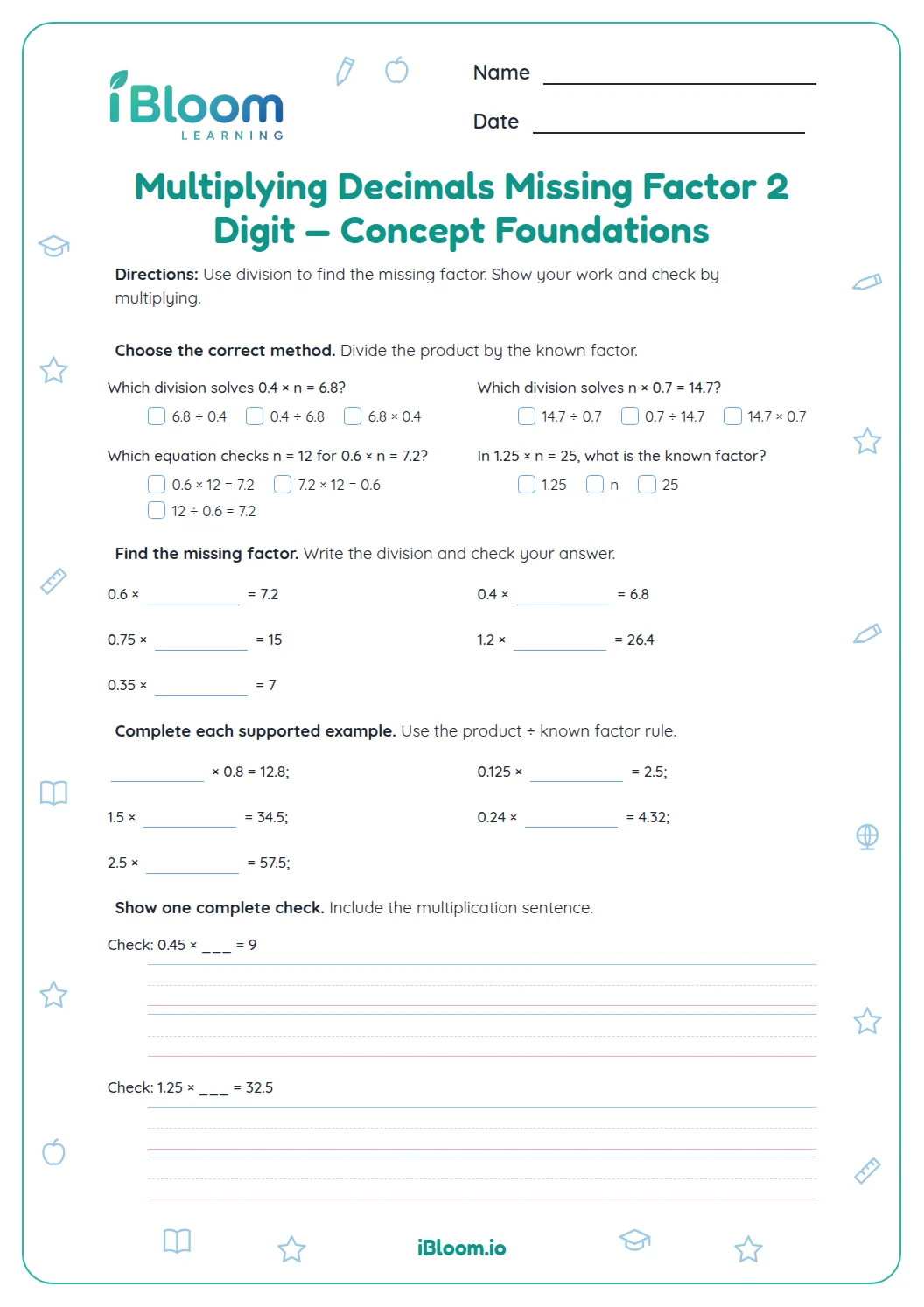
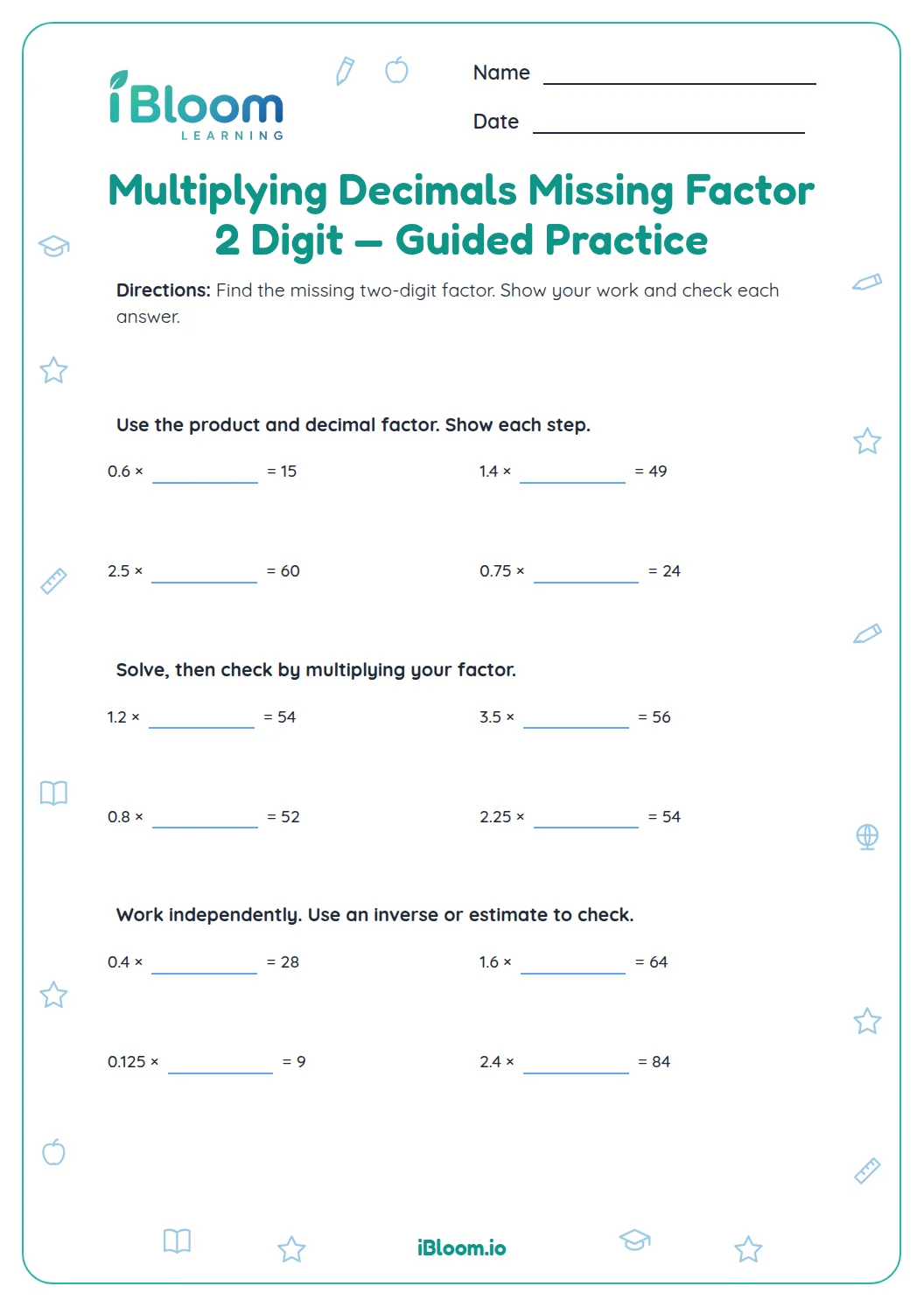
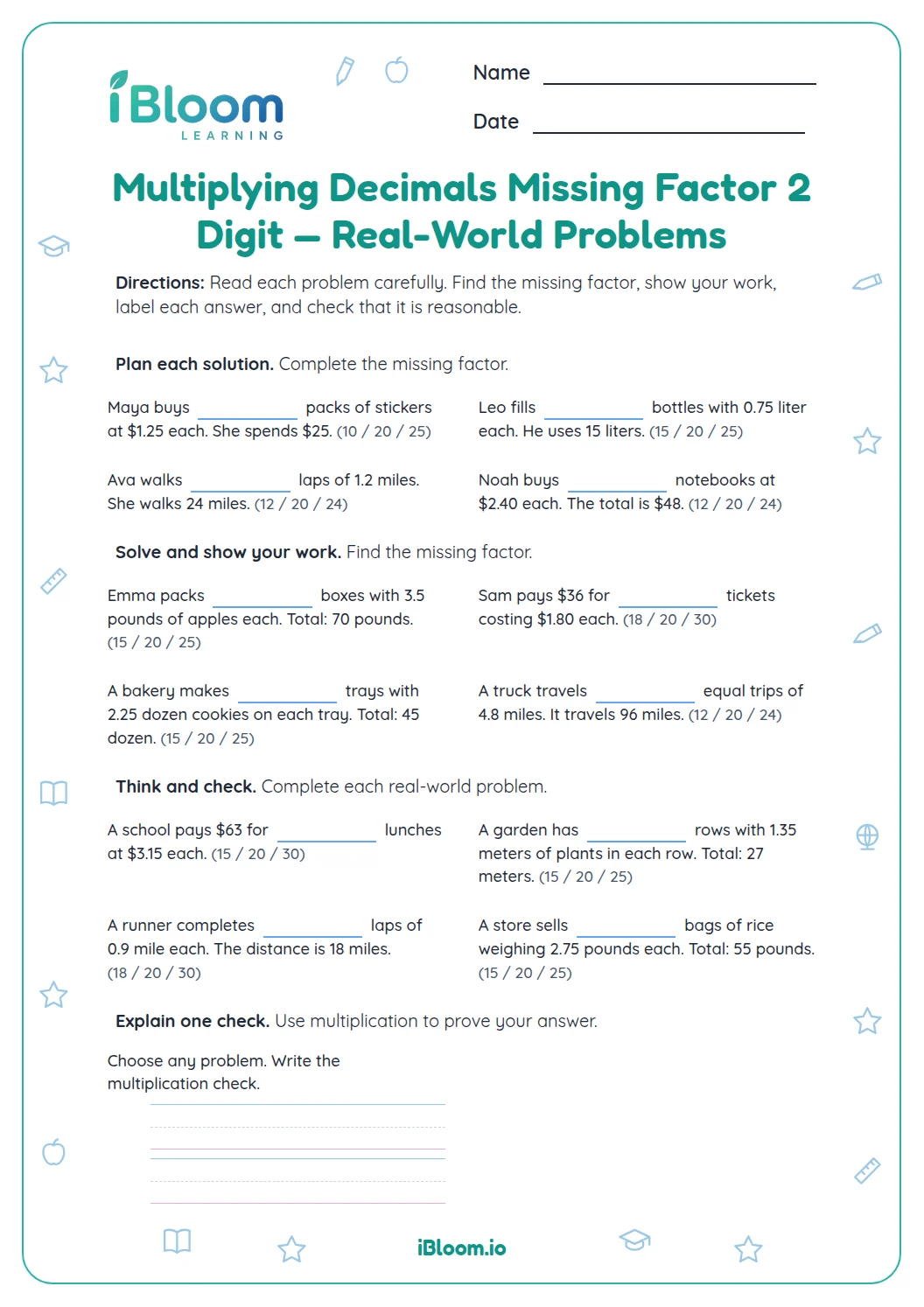
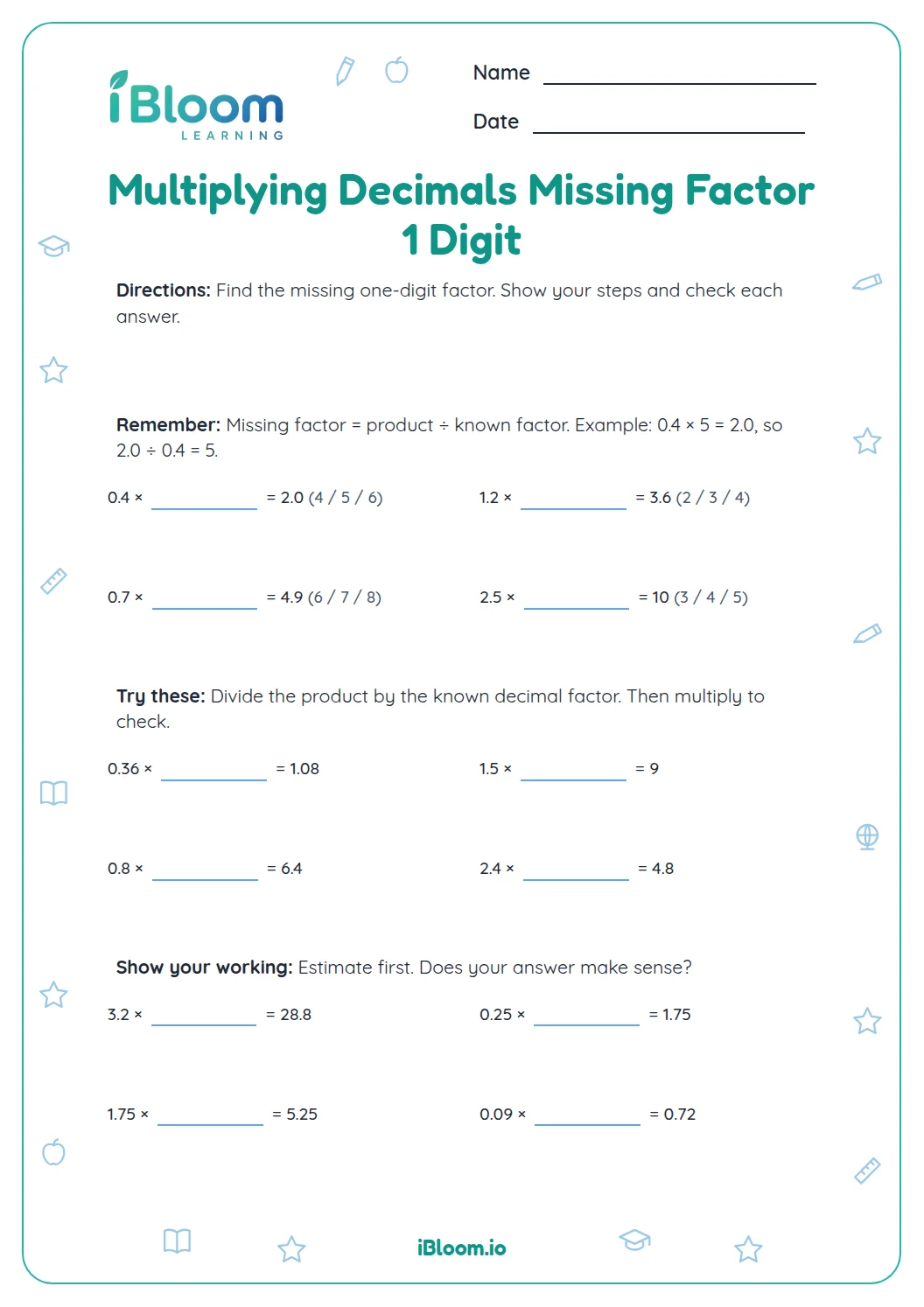
This Grade 5 printable focuses on multiplication with decimals to hundredths. Students first connect group size and number of groups to a product, then solve missing-factor equations, draw two models, and translate model descriptions into equations. For example, 9.6 ÷ 0.6 = 16, so 0.6 × 16 = 9.6. The separate key includes answers and sample model labels.
Aligned to 5.NBT.B.7
What is on the decimal models worksheet?
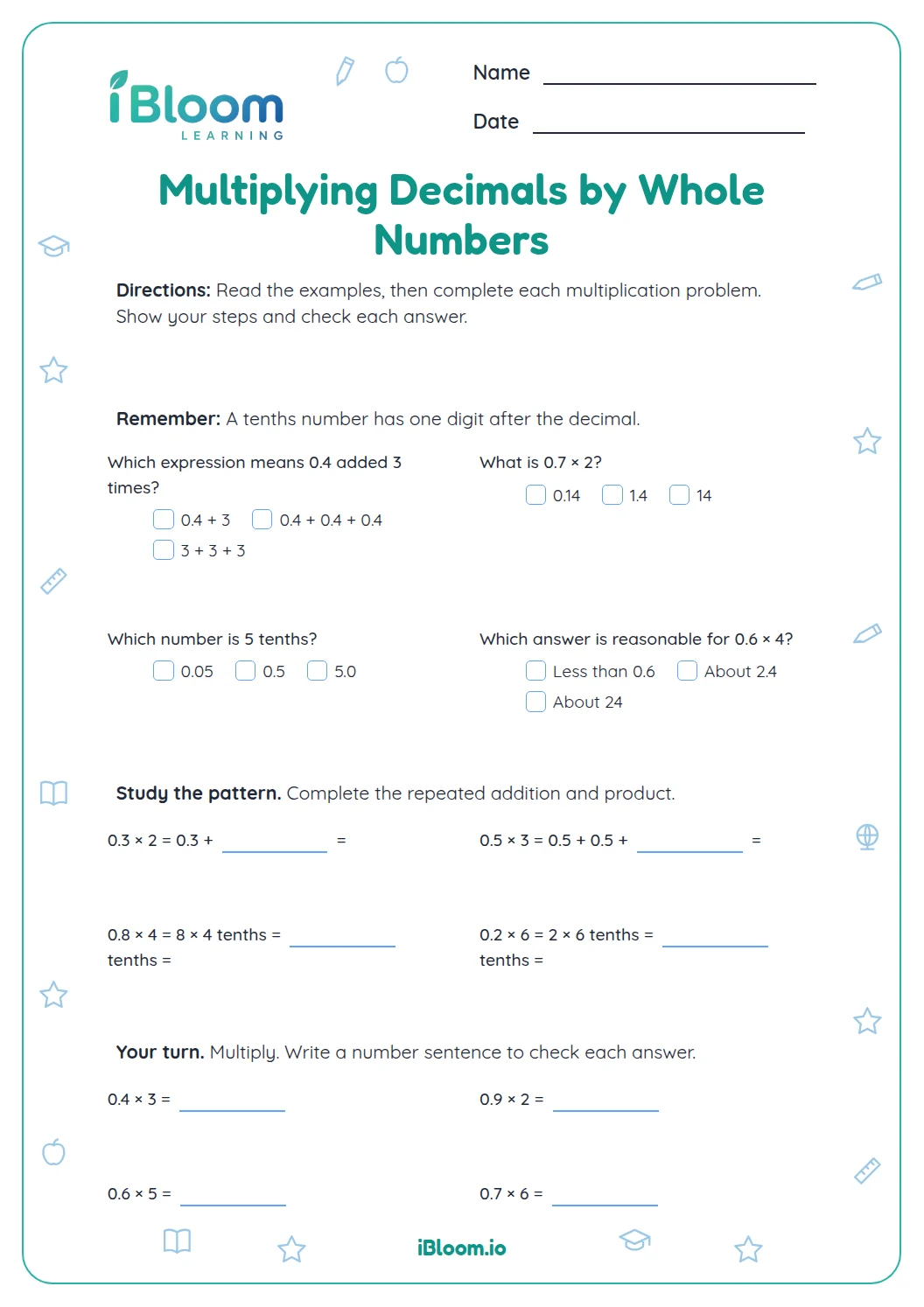
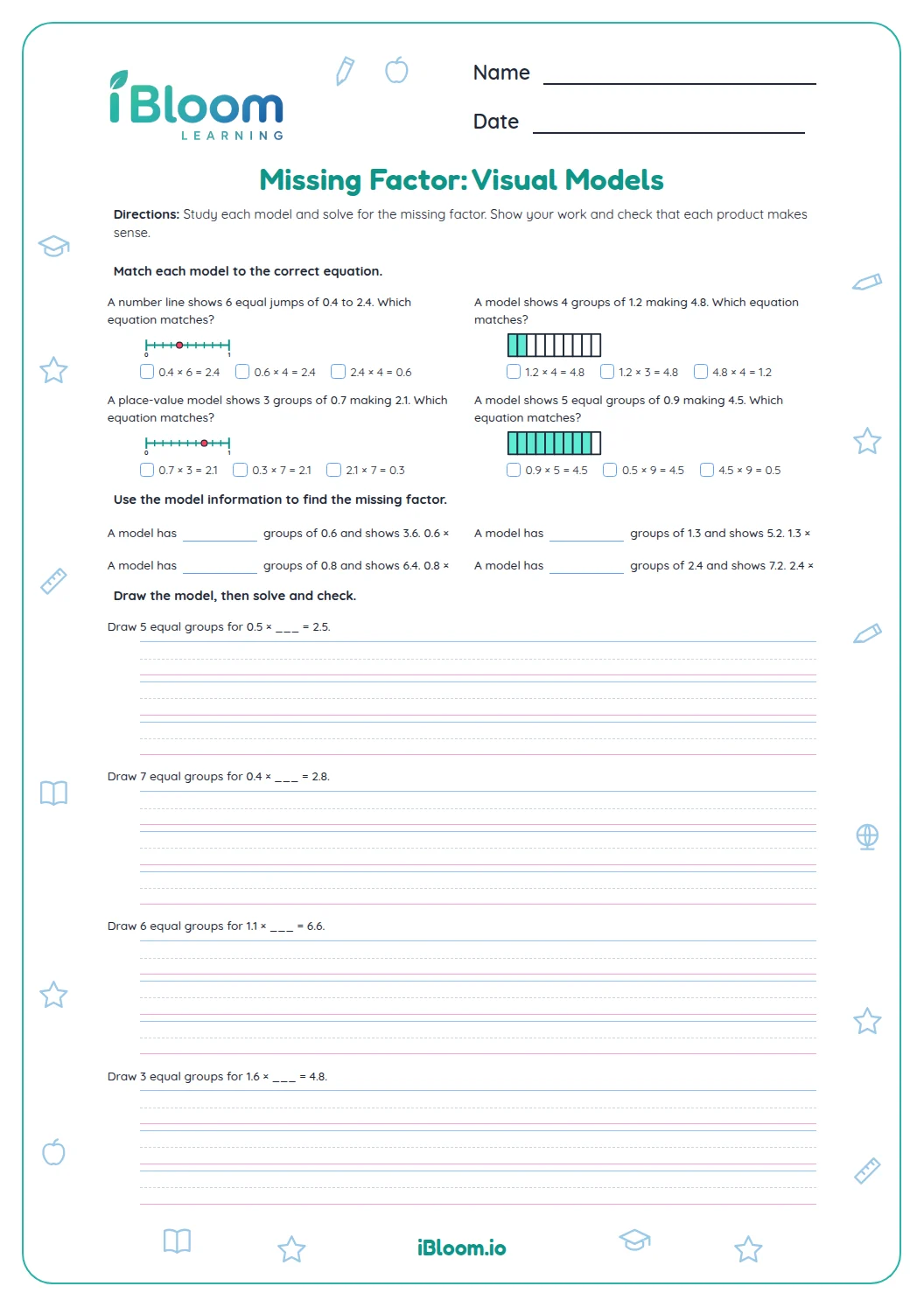
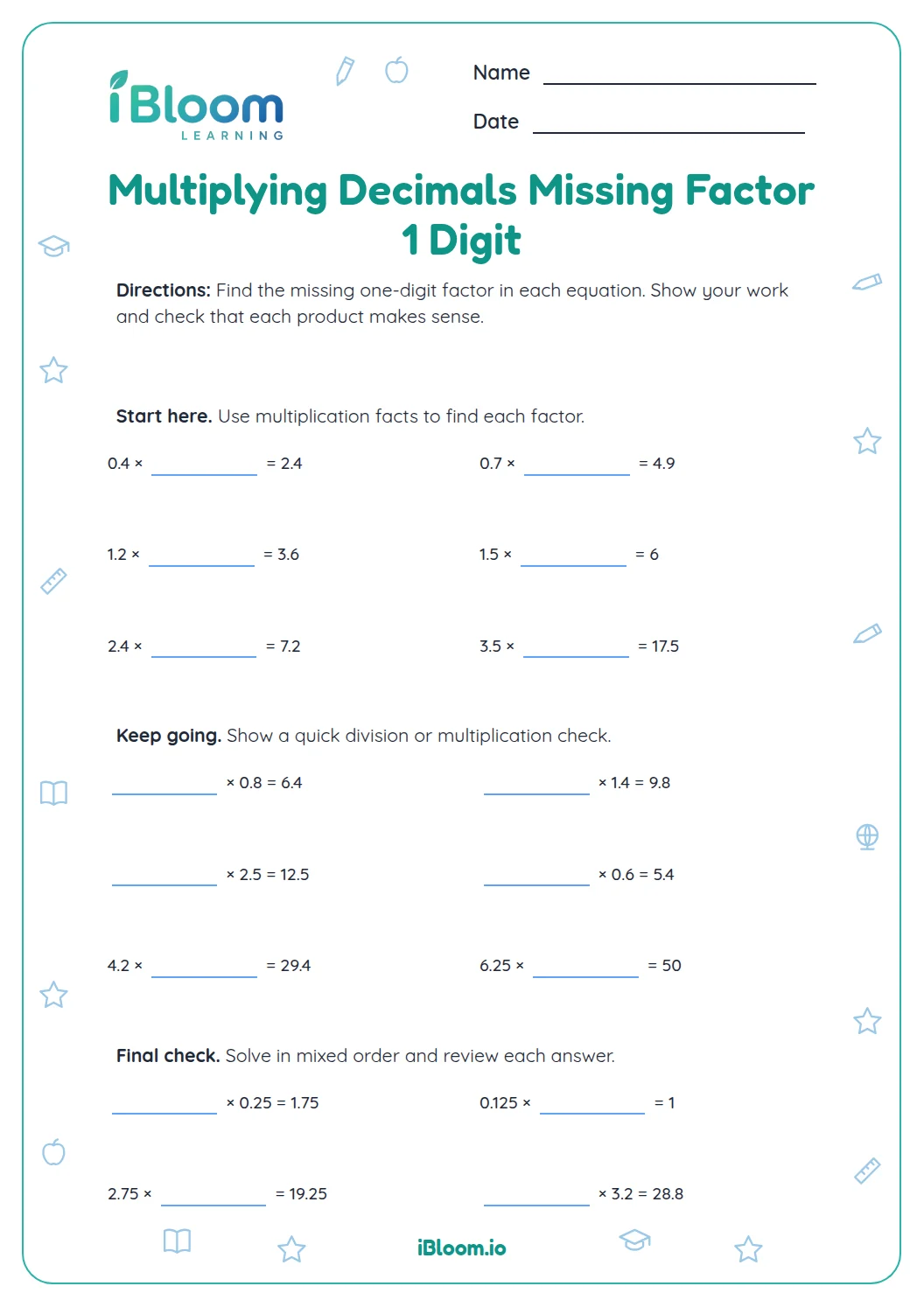
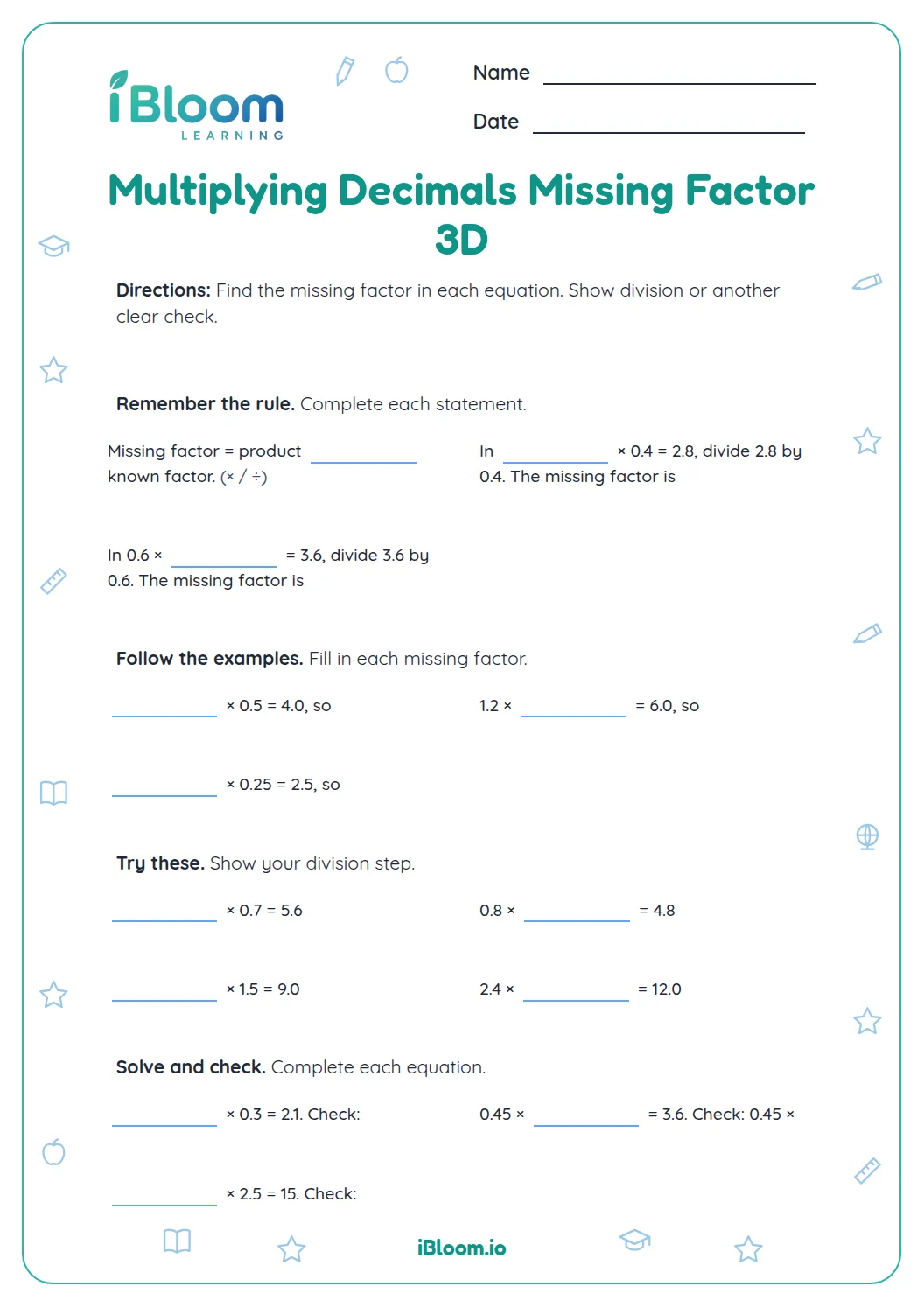
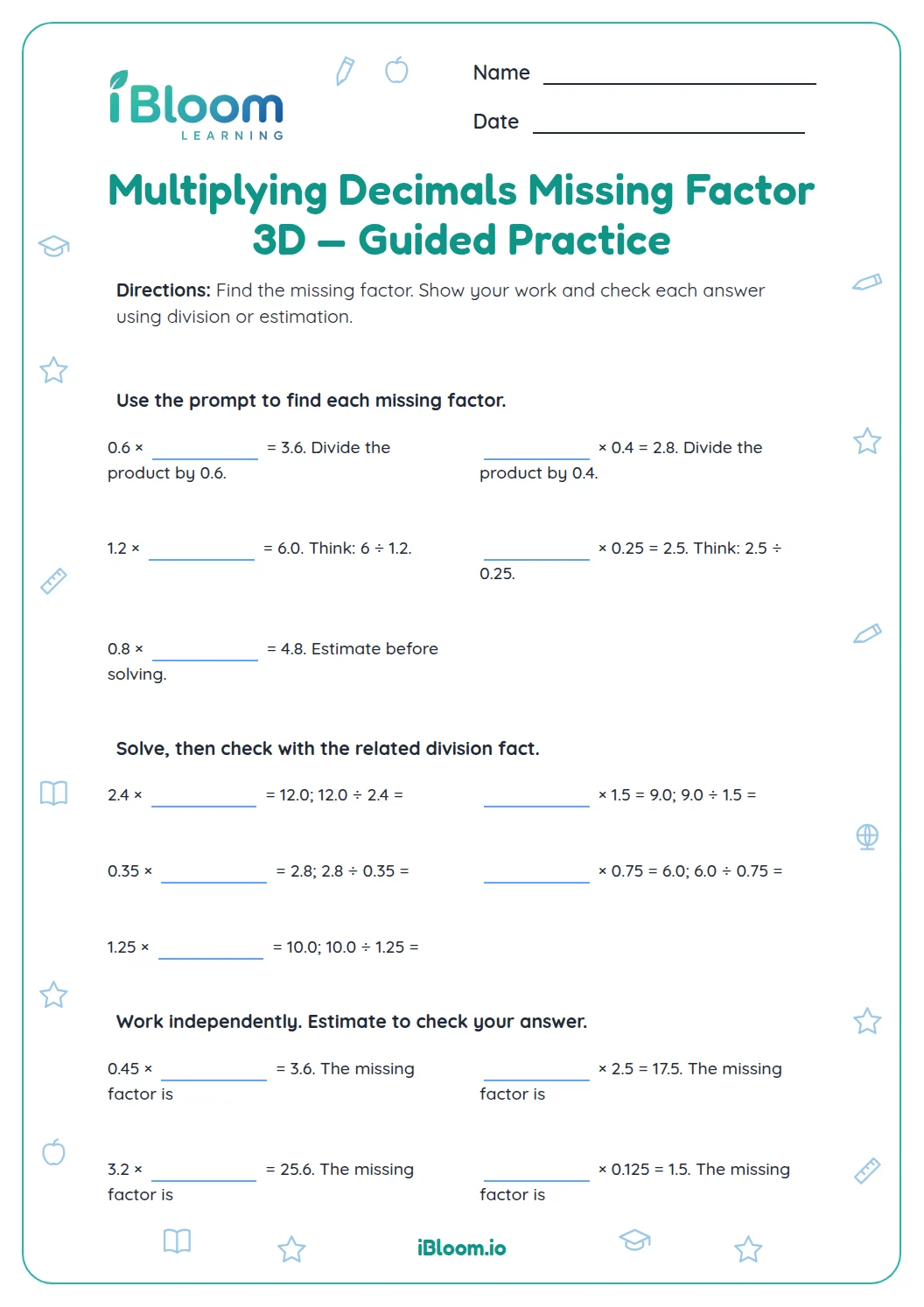
The 16 questions follow the approach of the visual-model sheet: identify the product represented by equal groups, use a product and one factor to recover the other factor, and translate group descriptions into equations. Two draw prompts let students represent the multiplication themselves.
Question 5, 0.6 × ___ = 9.6, asks how many groups of 0.6 make 9.6. Dividing 9.6 by 0.6 gives 16.
- Four model-reading choices
- Six missing-factor equations
- Two drawings and four model contexts
How can a product help find the missing factor?
Think of the product as the total and the known factor as the amount in each group. Divide total by group size to find the number of groups, then multiply to verify. Keep track of the decimal point by estimating the size of the answer.
What should a student label in a model?
A useful drawing identifies the amount in one group, how many equal groups there are, and the total. Those labels connect a picture to an equation such as 0.4 × 23 = 9.2.
How to use this worksheet
- 1Read each model description and identify the total or group size.
- 2Solve each missing-factor equation with division.
- 3Draw and label the two multiplication models.
- 4Use the model descriptions to find the number of groups.
- 5Multiply to check each missing factor.
Common mistakes and quick fixes
The mistake
Dividing the known factor by the product.
The fix
Use product ÷ known factor to find the missing factor.
The mistake
Moving the decimal point without checking place value.
The fix
Estimate the product first, then check by multiplication.
The mistake
Leaving out the number of groups in a drawn model.
The fix
Label the group size, number of groups, and total.
Common Core alignment
This worksheet practices the following mathematical ideas.
Use place value and models to reason about decimal products.
On this sheet: The models show decimal groups and products; students use division to recover a missing factor.
Show the official wordingHide the official wording
Add, subtract, multiply, and divide decimals to hundredths, using concrete models or drawings and strategies based on place value, properties of operations, and/or the relationship between addition and subtraction; relate the strategy to a written method and explain the reasoning used.
What to practice next
Make more practice
Further reading
Questions parents and teachers ask
What is a missing factor?
A missing factor is the unknown number in a multiplication equation. In 0.6 × ___ = 9.6, the blank asks how many groups of 0.6 make 9.6. Divide 9.6 by 0.6 to get 16, then check that 0.6 × 16 equals 9.6.
How do the models help with decimal multiplication?
A model shows equal groups or a rectangular area so students can connect the decimal amount in each group to the total. The first part asks students to read such descriptions, and two later questions ask them to draw and label models for decimal products.
How many questions are included?
There are 14 questions in four parts: four model-reading choices, four missing-factor equations, two model drawings, and four number sentences. Students can use division to connect the model total and equal group size, then multiply to confirm. The separate key includes sample model labels.
What is the answer to 0.6 × ___ = 9.6?
The missing factor is 16 because 9.6 divided by 0.6 equals 16. Check the result by multiplying: 0.6 × 16 = 9.6. Thinking of 9.6 as the total and 0.6 as the amount in each group makes the missing number of groups clear.
Should the decimal answer always be smaller than the product?
The size depends on the known factor. If the known factor is less than 1, dividing by it makes the quotient larger than the product, as in 9.6 ÷ 0.6 = 16. Estimating first and checking with multiplication helps students catch decimal-place errors.
What does a complete drawing include?
A complete model should show the decimal amount in each group, the number of equal groups, and the total product. For 0.4 × 23 = 9.2, a student can label 23 groups of 0.4 and a total of 9.2. The key accepts an equivalent clear representation.