

About this worksheet
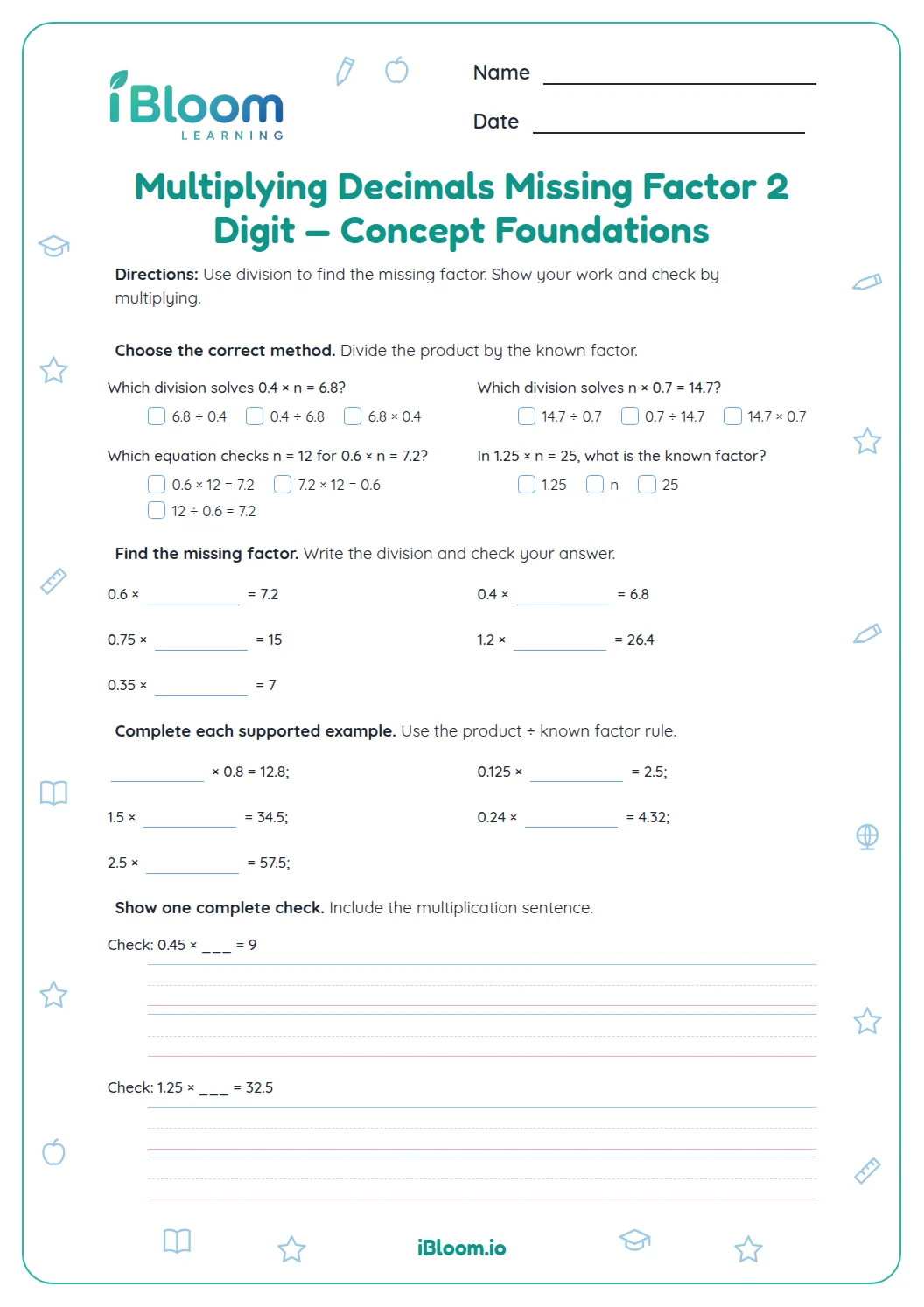
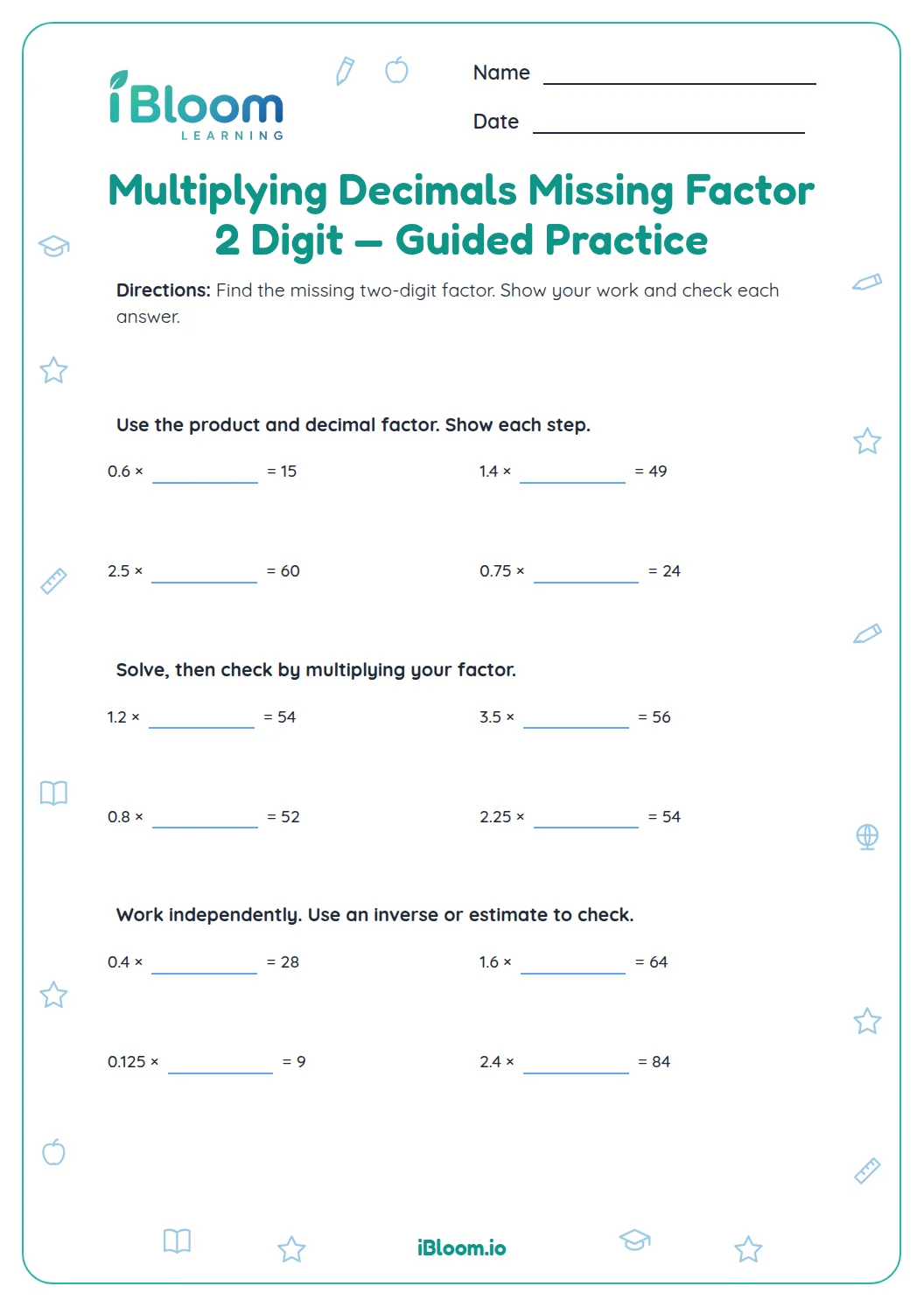
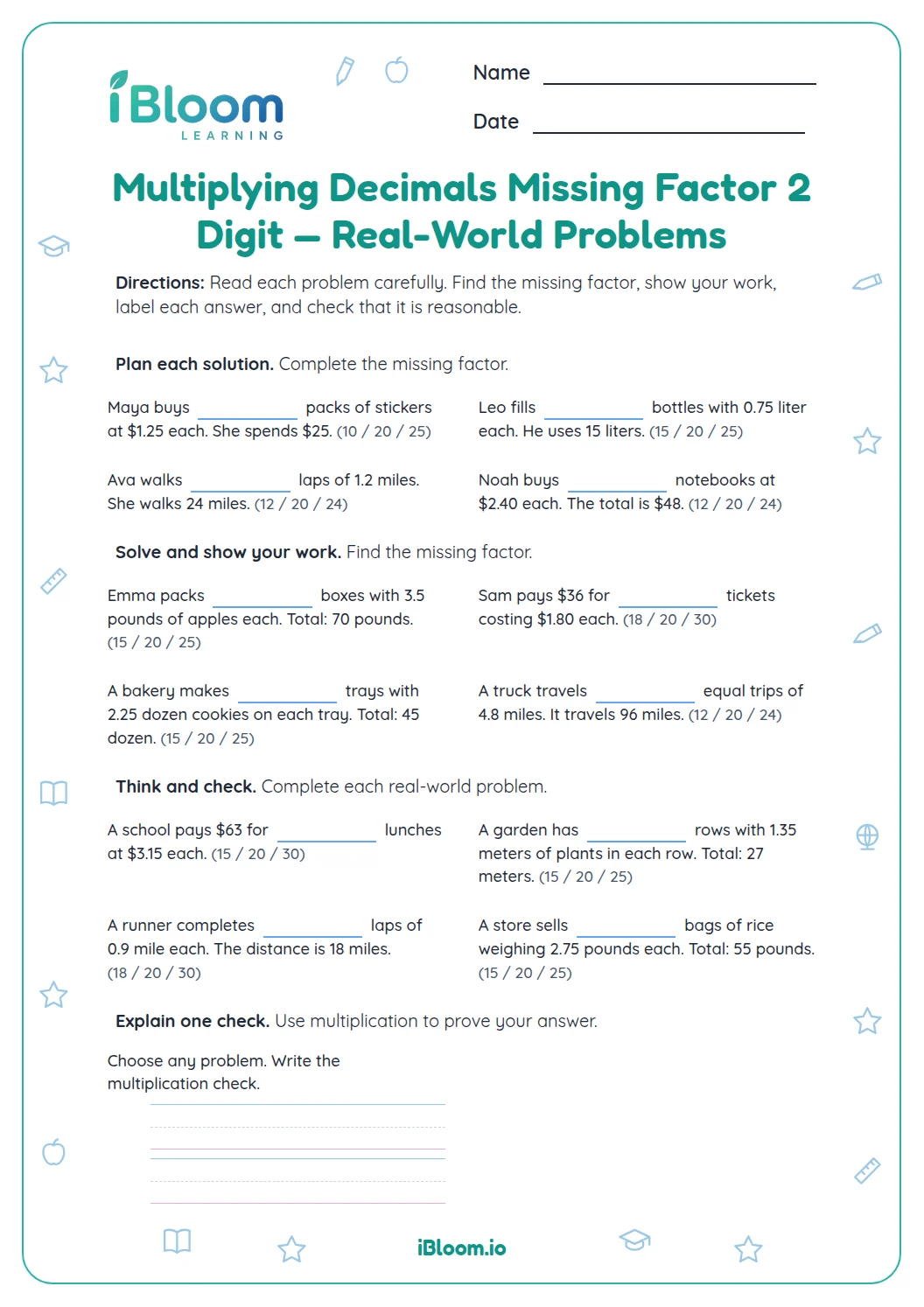
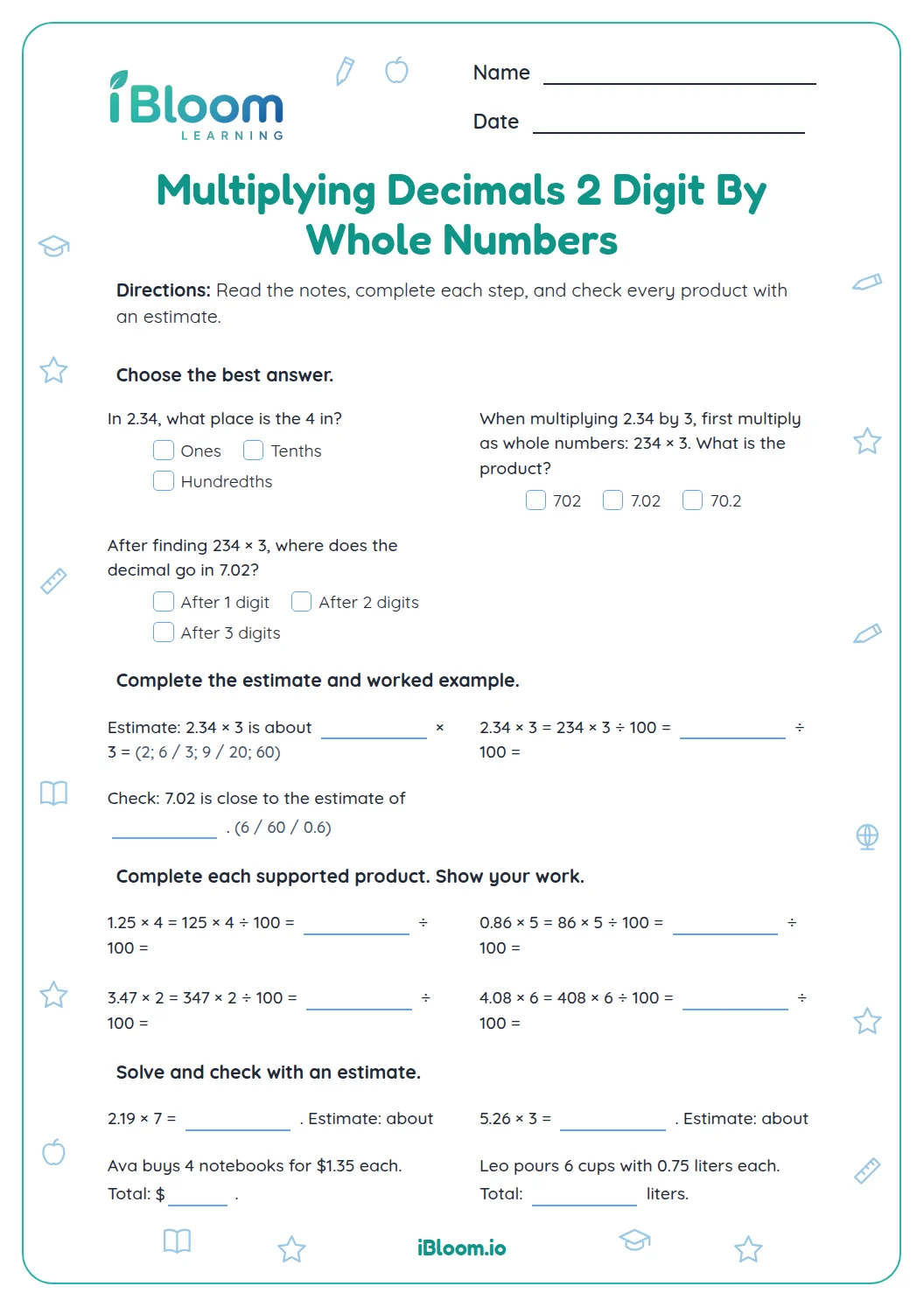
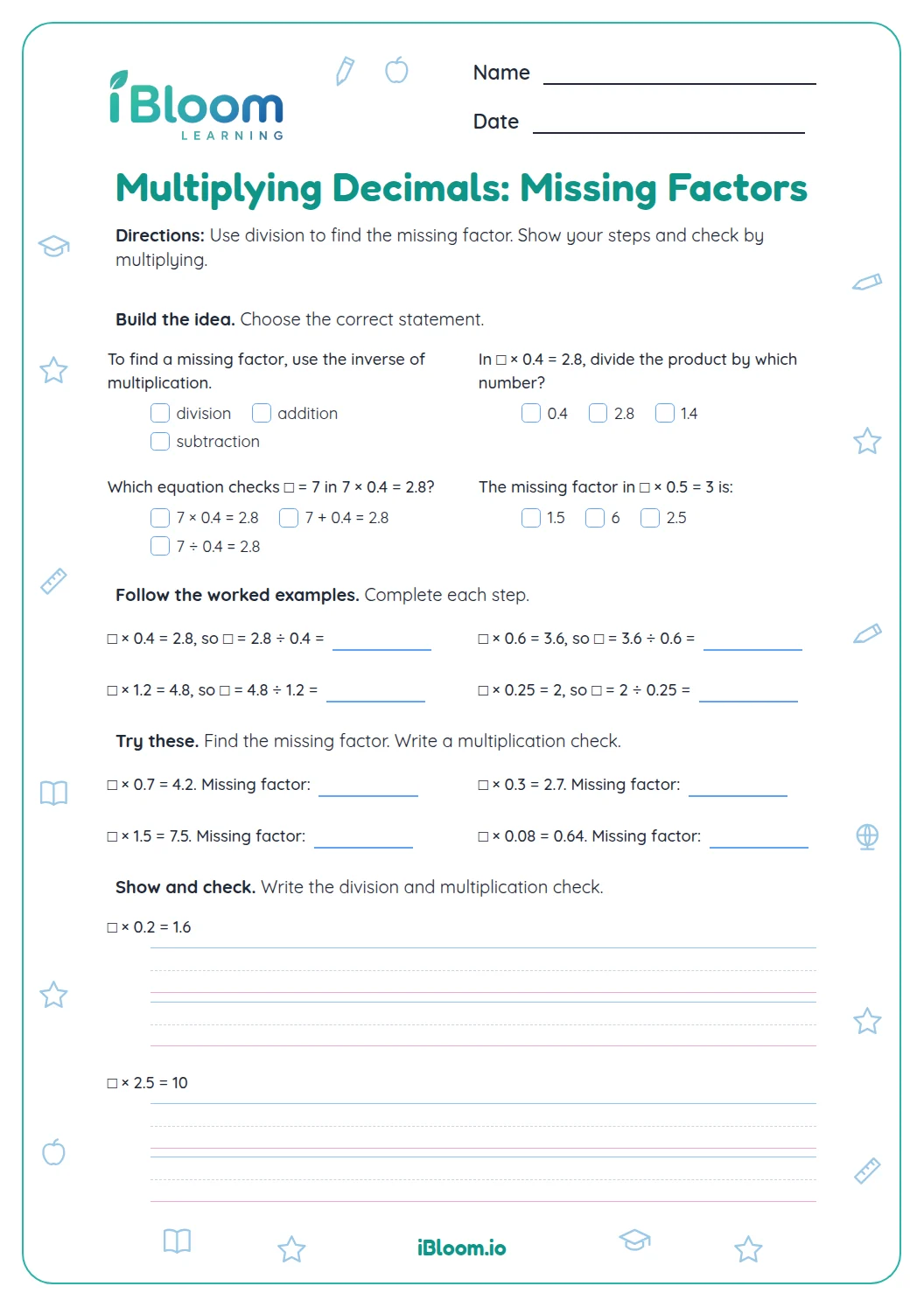
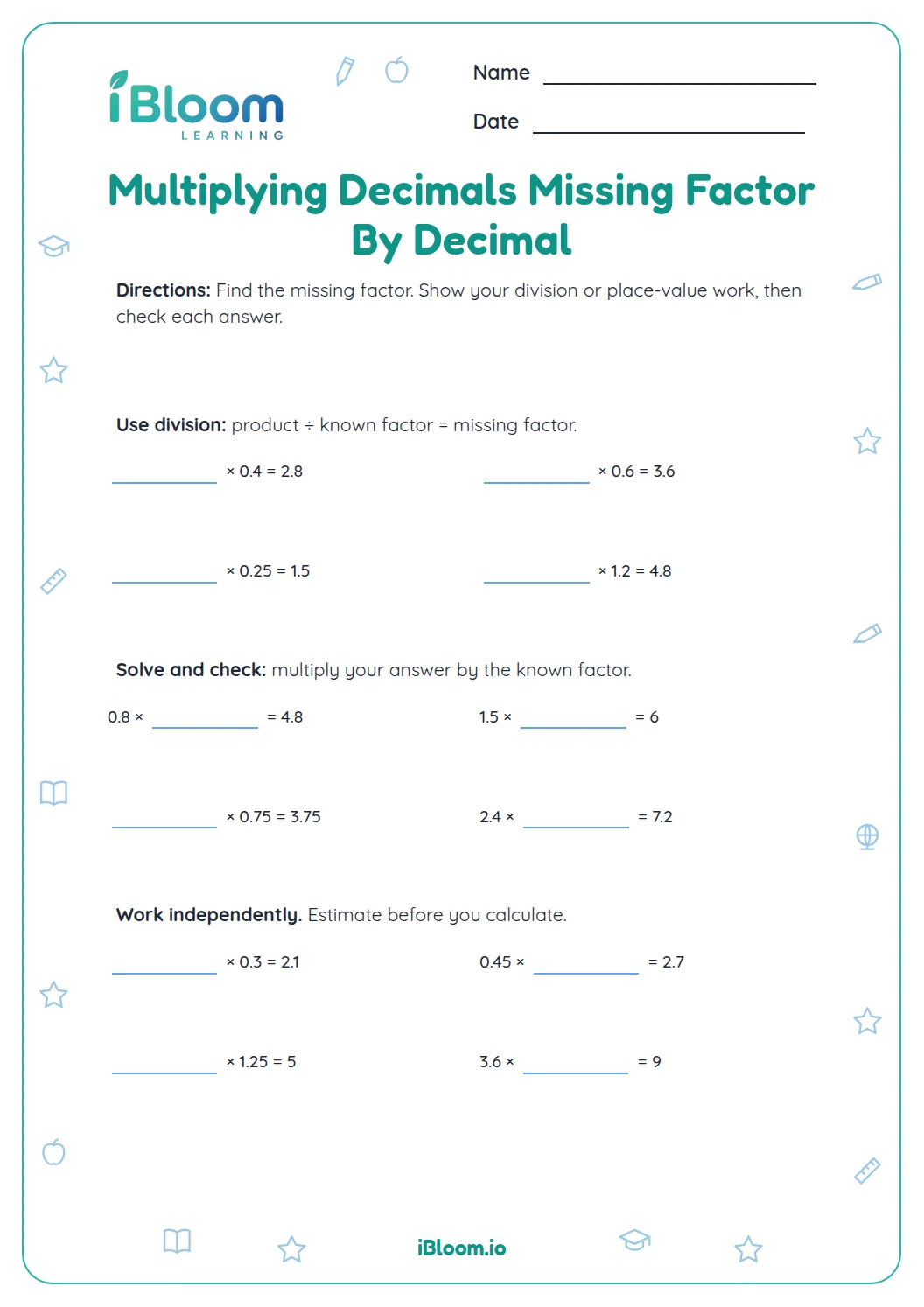
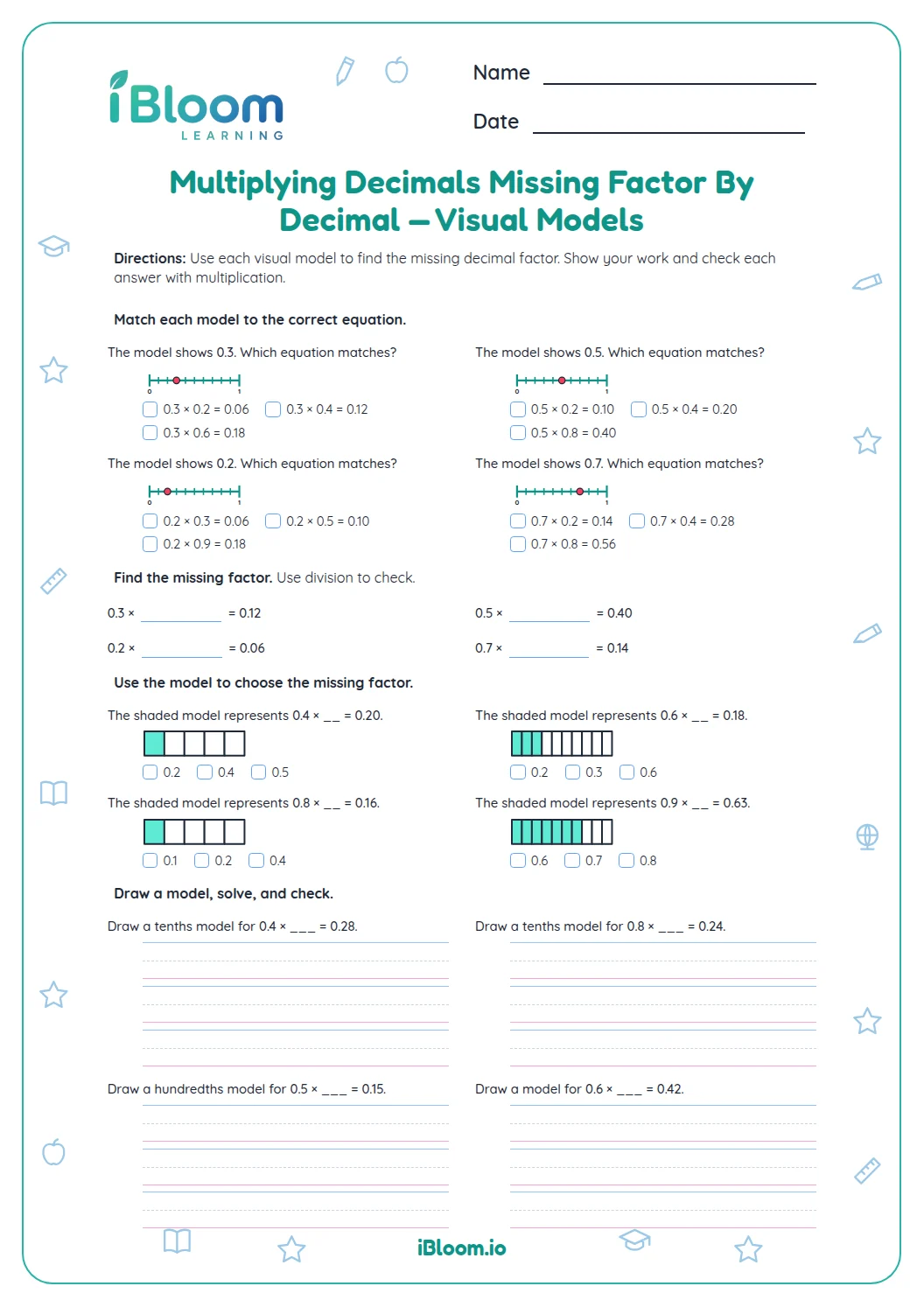
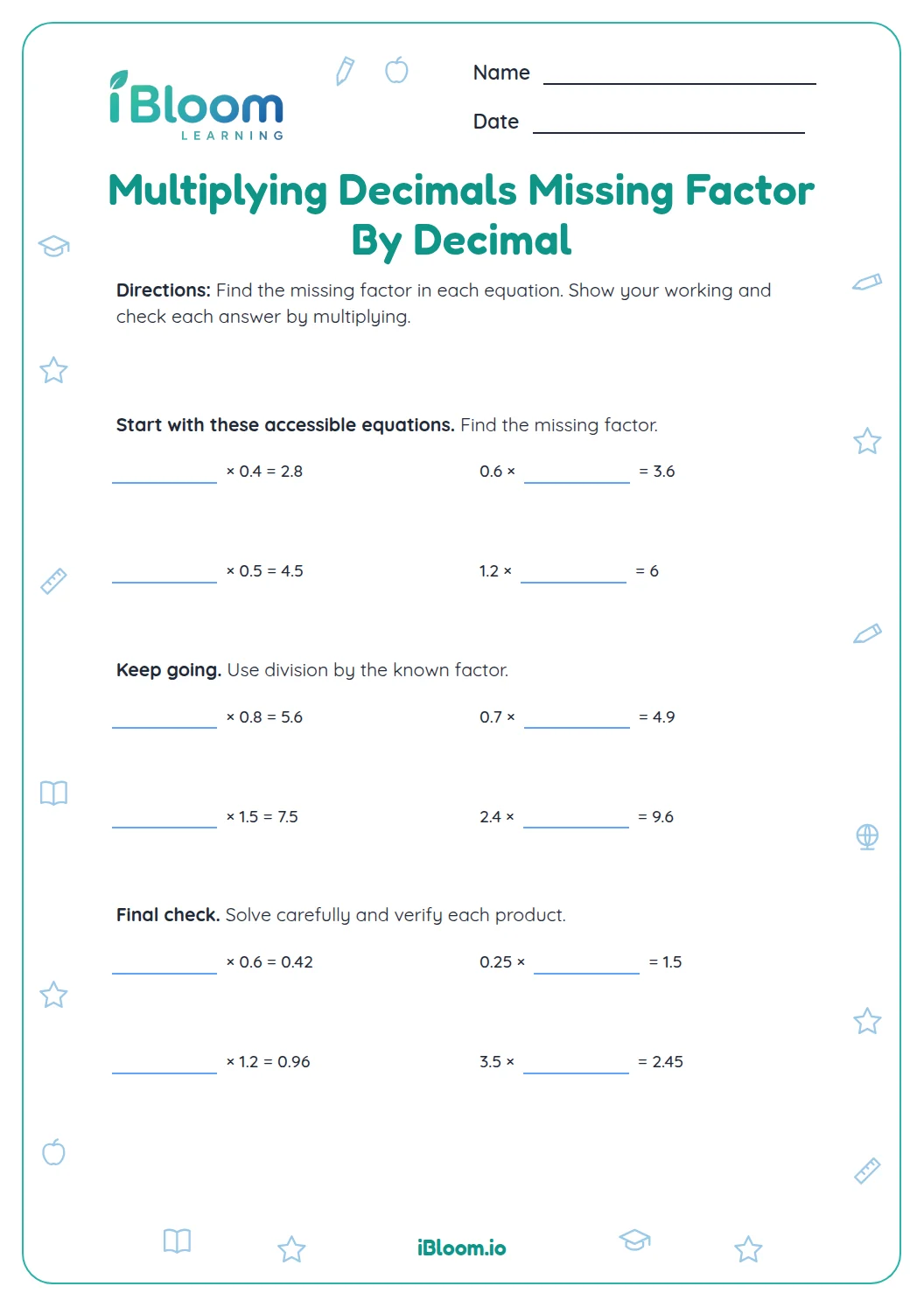
This free Grade 5 worksheet gives students independent practice finding missing factors in decimal multiplication. Part A has eight equations with a two-digit whole-number factor and a missing decimal factor. Part B reverses the task: a decimal factor is given and the missing factor is a two-digit whole number. Part C asks for two brief explanations using place value and multiplication checks. The eighteen questions practice decimal operations in Common Core 5.NBT.B.7. Decimal factors extend to hundredths, and every equation has an exact answer. The separate answer key includes all sixteen factors and sample explanations.
Aligned to 5.NBT.B.7
How do I find the missing decimal factor?
Treat a hundredths product as a whole number of hundredths. Divide that number by the whole factor, then write the result with the correct place value. Question 1 uses a product of 9.36 and a factor of 12.
- 112 × ___ = 9.36
- 29.36 is 936 hundredths.
- 3936 ÷ 12 = 78, so the missing factor is 78 hundredths.
- 412 × 0.78 = 9.36
What changes when the whole-number factor is missing?
Part B gives the decimal factor. Use the multiplication relationship to find how many copies make the product. In question 9, each copy is 24 hundredths and the product is 360 hundredths. Since 24 × 15 = 360, the missing factor is 15.
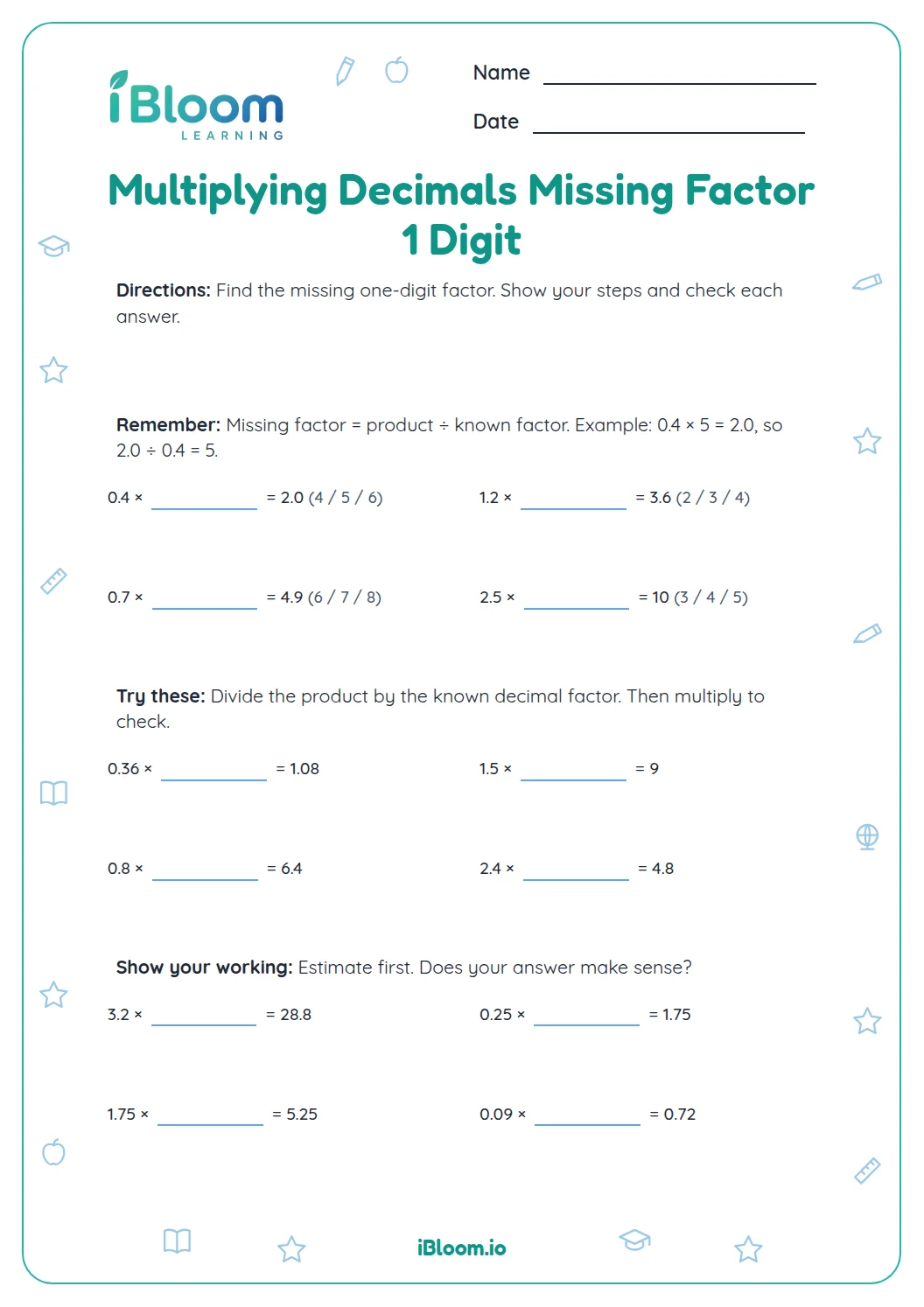
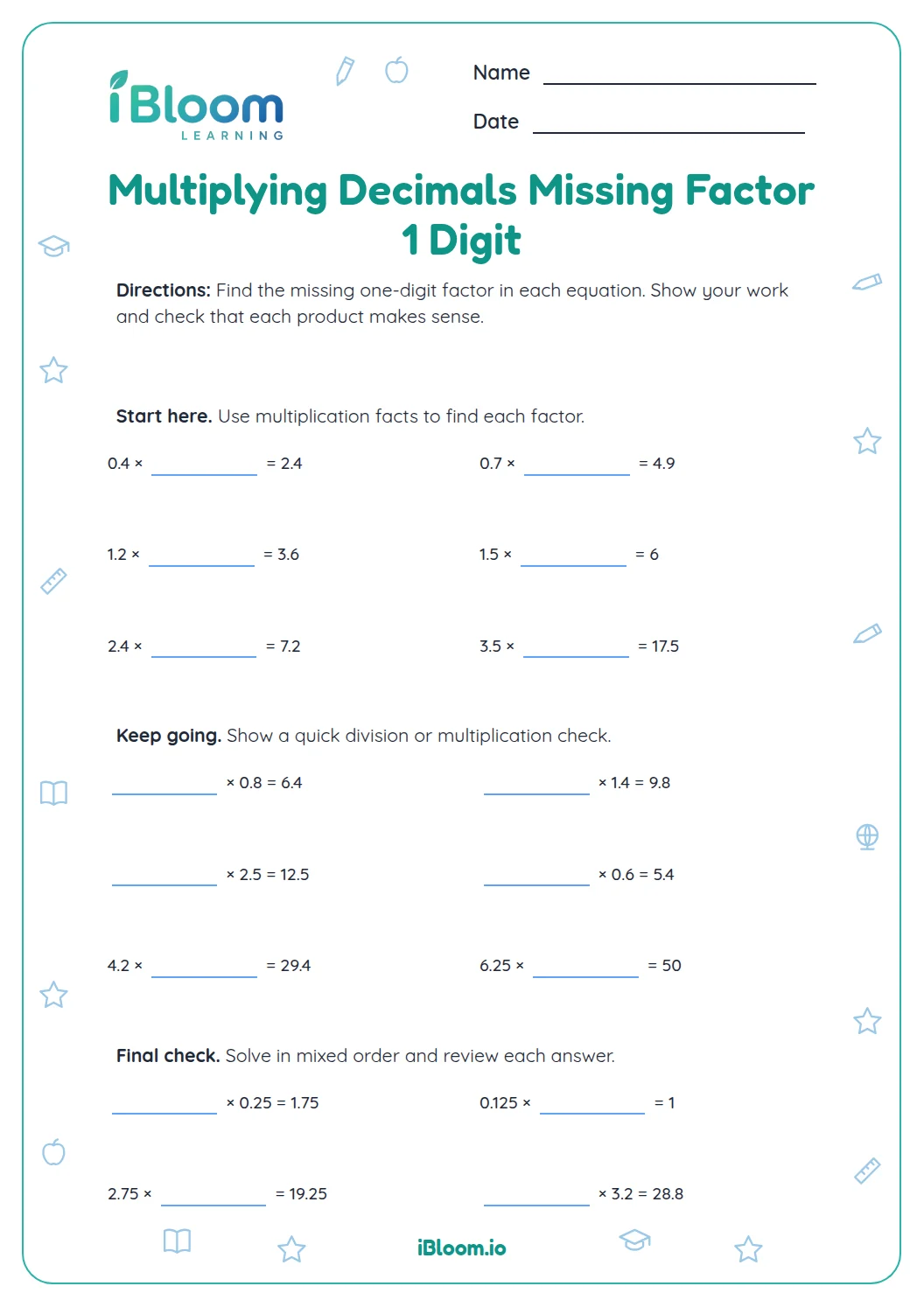
The blank appears on either side of the multiplication sign across the worksheet. Its position does not change the relationship: known factor times missing factor equals product.
How can a student catch a decimal-place error?
Substitute the proposed factor and multiply. In question 17, 15 × 3.2 produces 48, while 15 × 0.32 produces 4.80. Comparing the products shows exactly why the smaller factor belongs in the blank.
Part C asks students to explain this reasoning in words. A useful explanation names the place value or shows the checking multiplication; simply saying “move the decimal” leaves the reason unclear.
How to use this worksheet
- 1Identify the product and the known factor in each equation.
- 2Divide to find the missing factor, keeping tenths and hundredths labeled in your working.
- 3Multiply the two factors to verify each completed equation.
- 4In Part B, find a whole-number factor that gives the stated product.
- 5Answer Part C with a numerical check and a short place-value explanation.
Mistakes to check together
The mistake
Subtracting the known factor from the product.
The fix
Use division to undo multiplication, then verify with multiplication.
The mistake
Writing 7.8 instead of 0.78 in question 1.
The fix
Keep the units: 936 hundredths divided by 12 equals 78 hundredths, or 0.78.
The mistake
Scaling only one number when dividing by a decimal.
The fix
For question 9, compare 360 hundredths with 24 hundredths: 360 ÷ 24 = 15.
Common Core alignment
Find decimal missing factors and explain checks using hundredths and multiplication.
On this sheet: Students solve sixteen missing-factor equations and explain two checks using decimal place value.
Show the official wordingHide the official wording
Add, subtract, multiply, and divide decimals to hundredths, using concrete models or drawings and strategies based on place value, properties of operations, and/or the relationship between addition and subtraction; relate the strategy to a written method and explain the reasoning used.
What to practice next
Make more practice
Further reading
Questions parents and teachers ask
What does two-digit mean on this practice sheet?
The whole-number factors have two digits, such as 12, 15, 24, and 25. Decimal factors use tenths or hundredths. Part A hides the decimal factor, while Part B hides the whole-number factor, so students practice checking the same multiplication relationship with different information missing.
Should students divide or try multiplication facts?
Either method can work when the student verifies the result. Division directly finds the unknown factor, while a known multiplication fact may suggest it quickly. For question 9, 24 × 15 = 360 helps show that 0.24 × 15 = 3.60 because both decimal amounts are measured in hundredths.
Why is 0.6 acceptable when the key says 0.60?
Both names represent the same value: six tenths equals sixty hundredths. Accept either form when it makes the equation true. Keeping a trailing zero can make hundredths easier to track in written work, but a multiplication check should confirm the value rather than the number of written digits.
What should a correct Part C explanation include?
A correct explanation should connect the proposed factor to the product. For question 17, students can compare 15 × 3.2 = 48 with 15 × 0.32 = 4.80. For question 18, they can explain that dividing 864 hundredths by 12 gives 72 hundredths, then verify by multiplying.
How should I review a wrong factor?
Put the proposed factor back into the original equation and multiply. Compare that product with the printed product. If it is ten times too large or small, revisit the decimal place value. If the digits differ, check the division or the multiplication fact used to find the factor.