

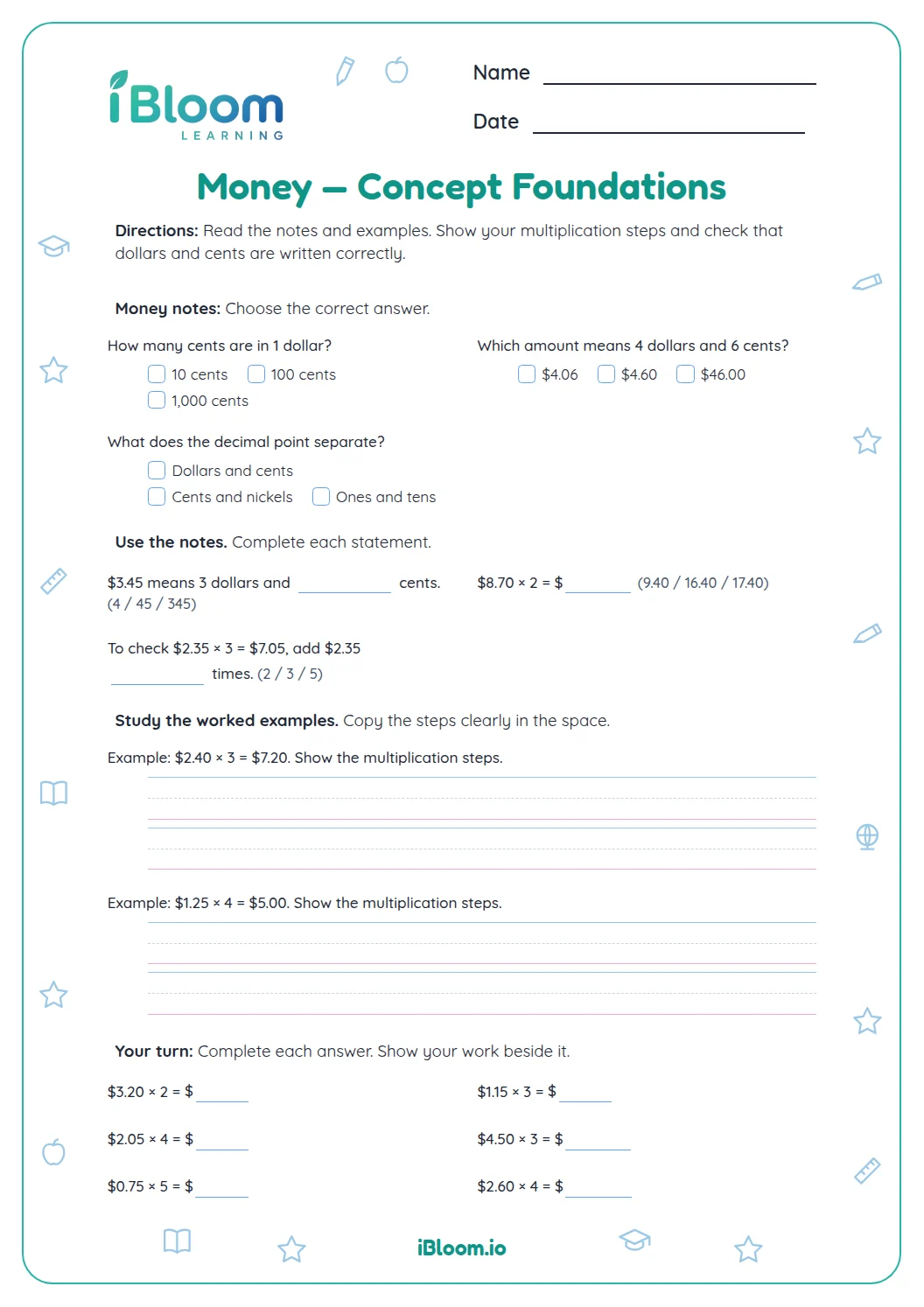
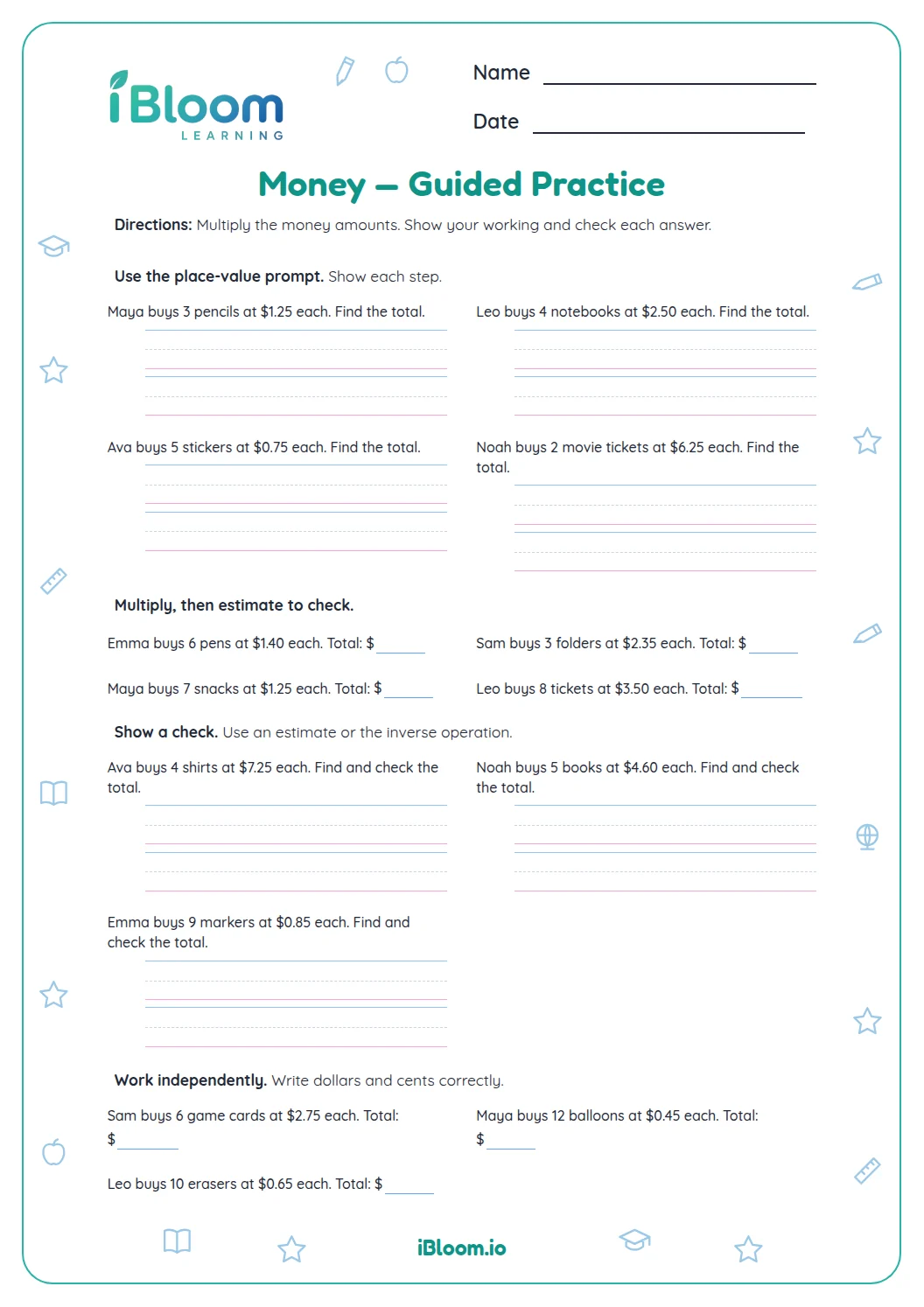
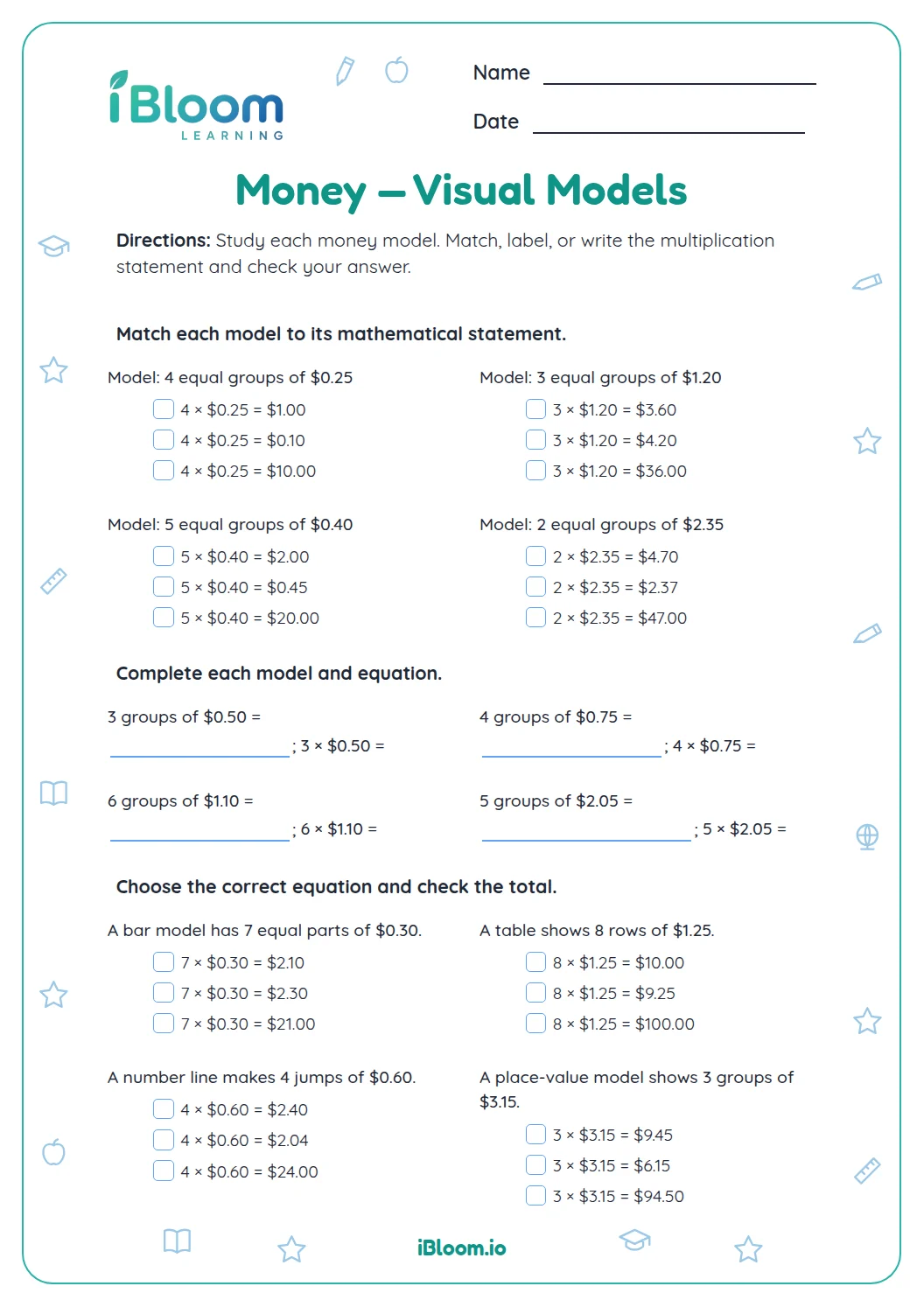
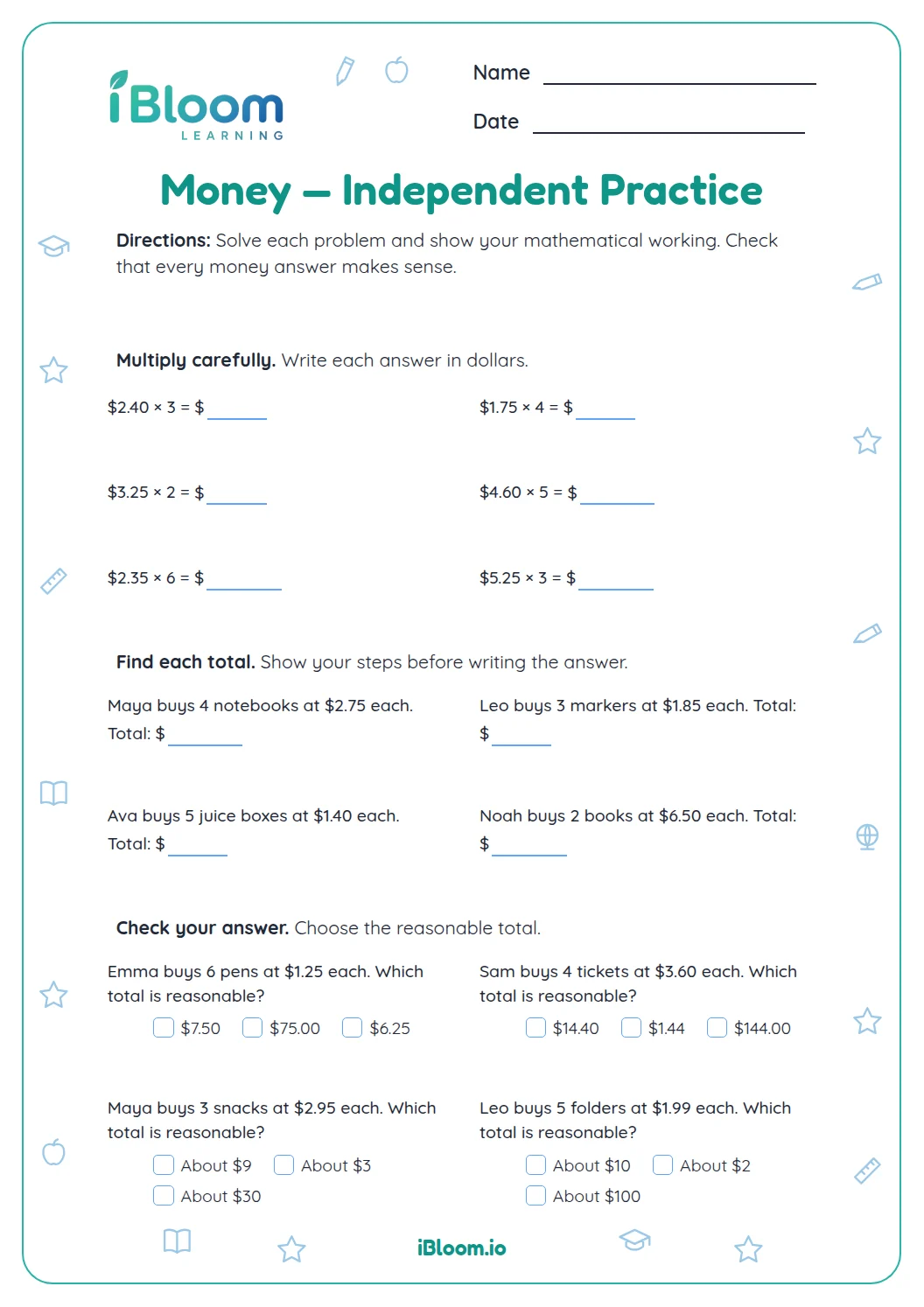
About this worksheet
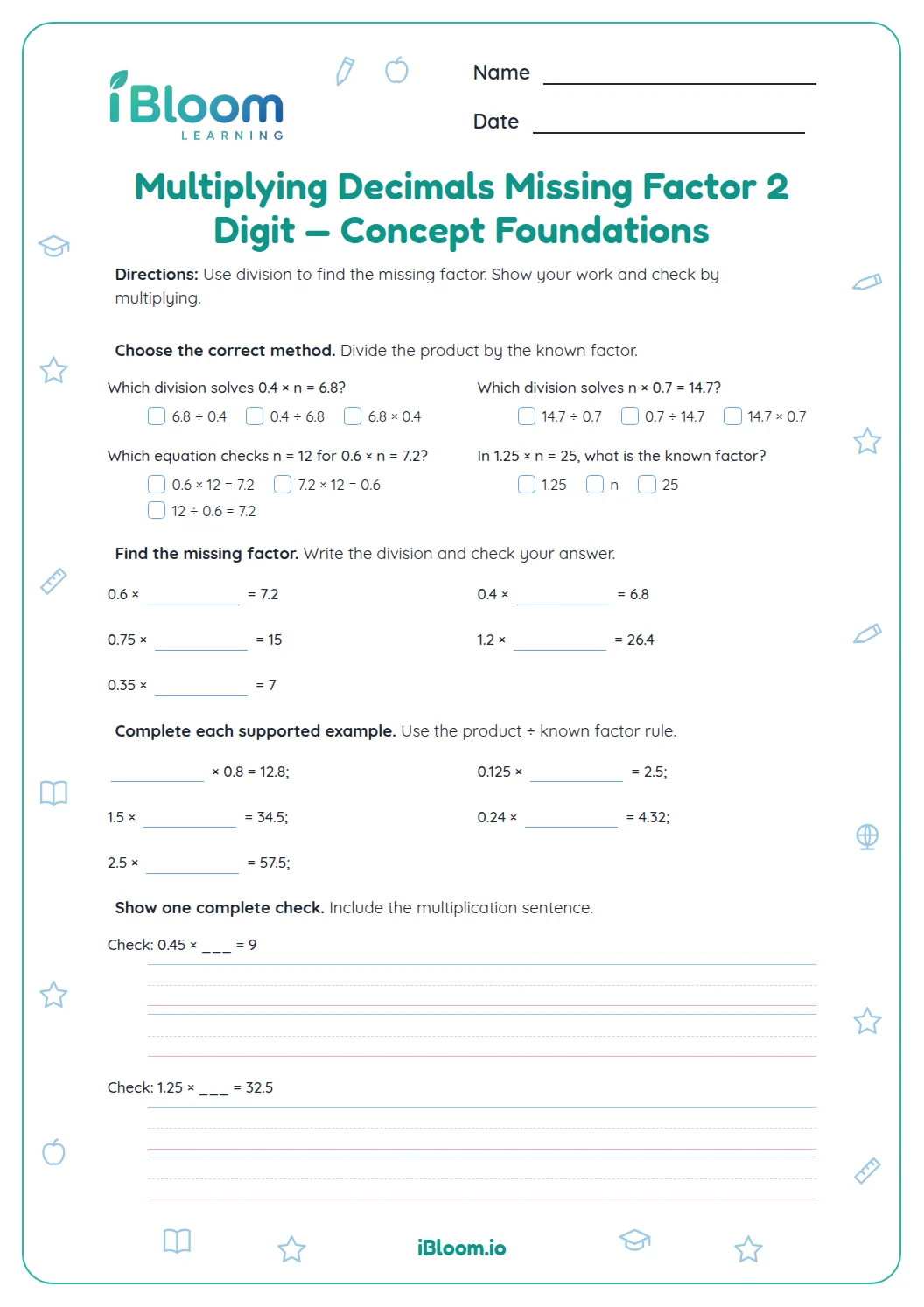
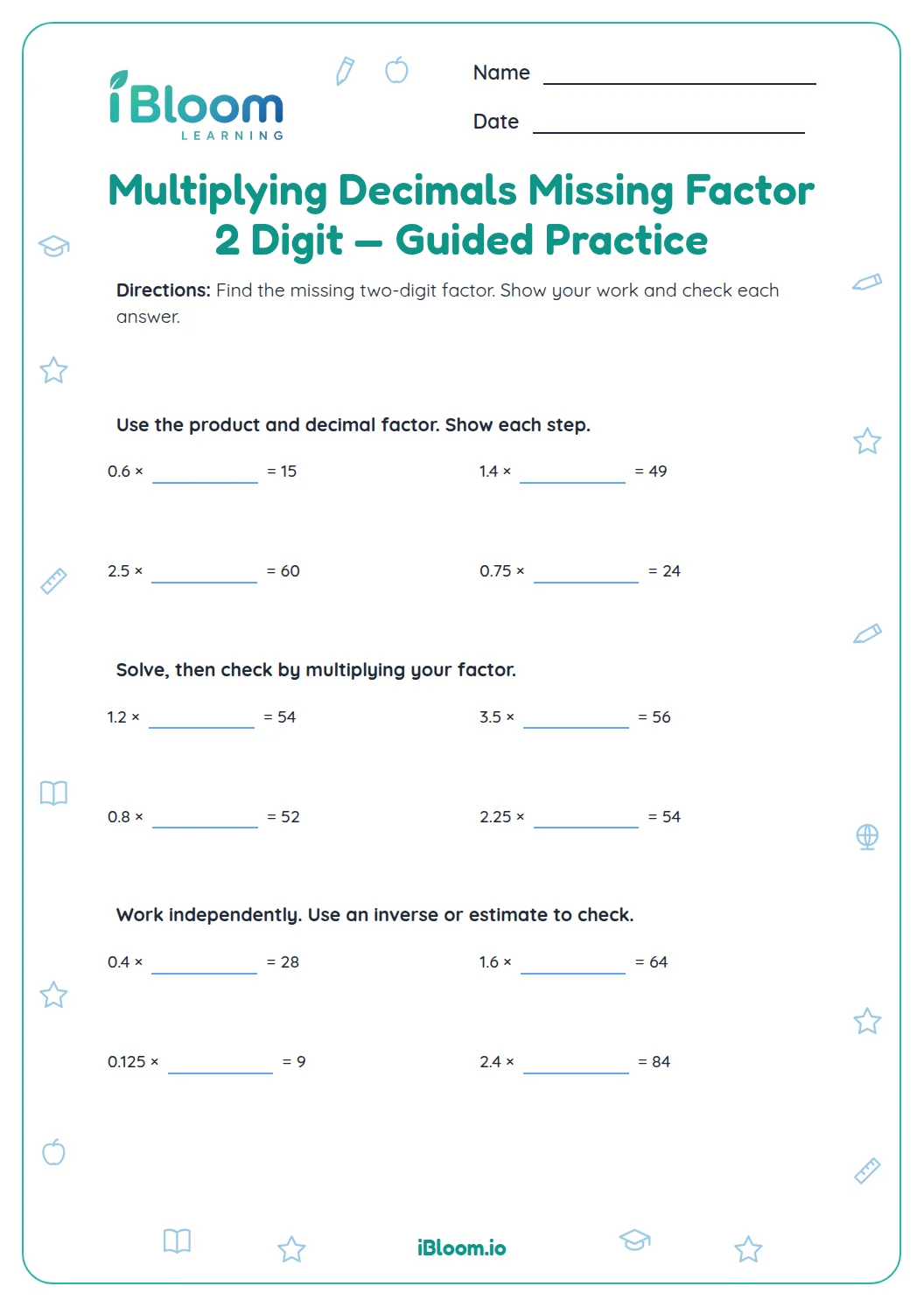
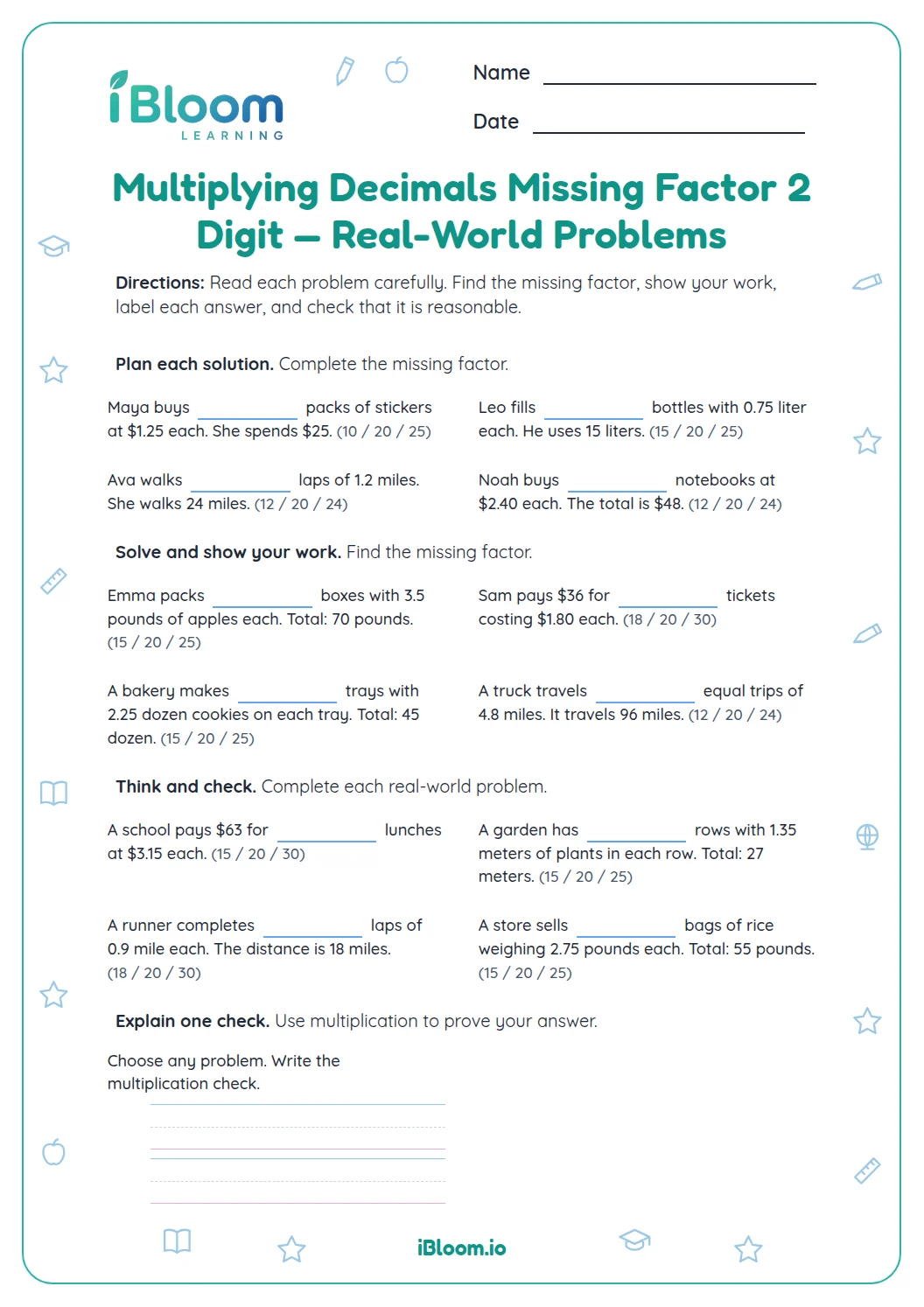
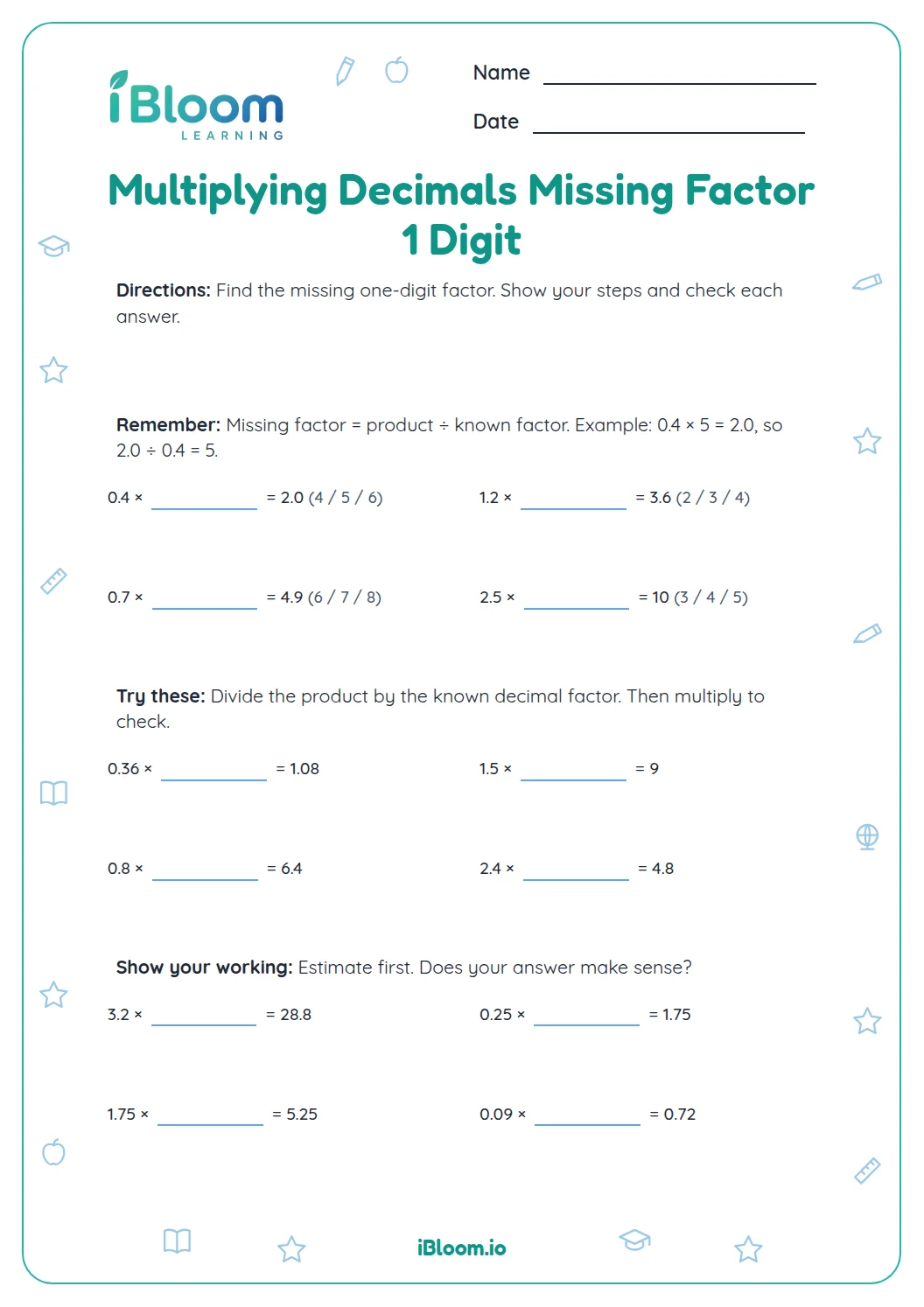
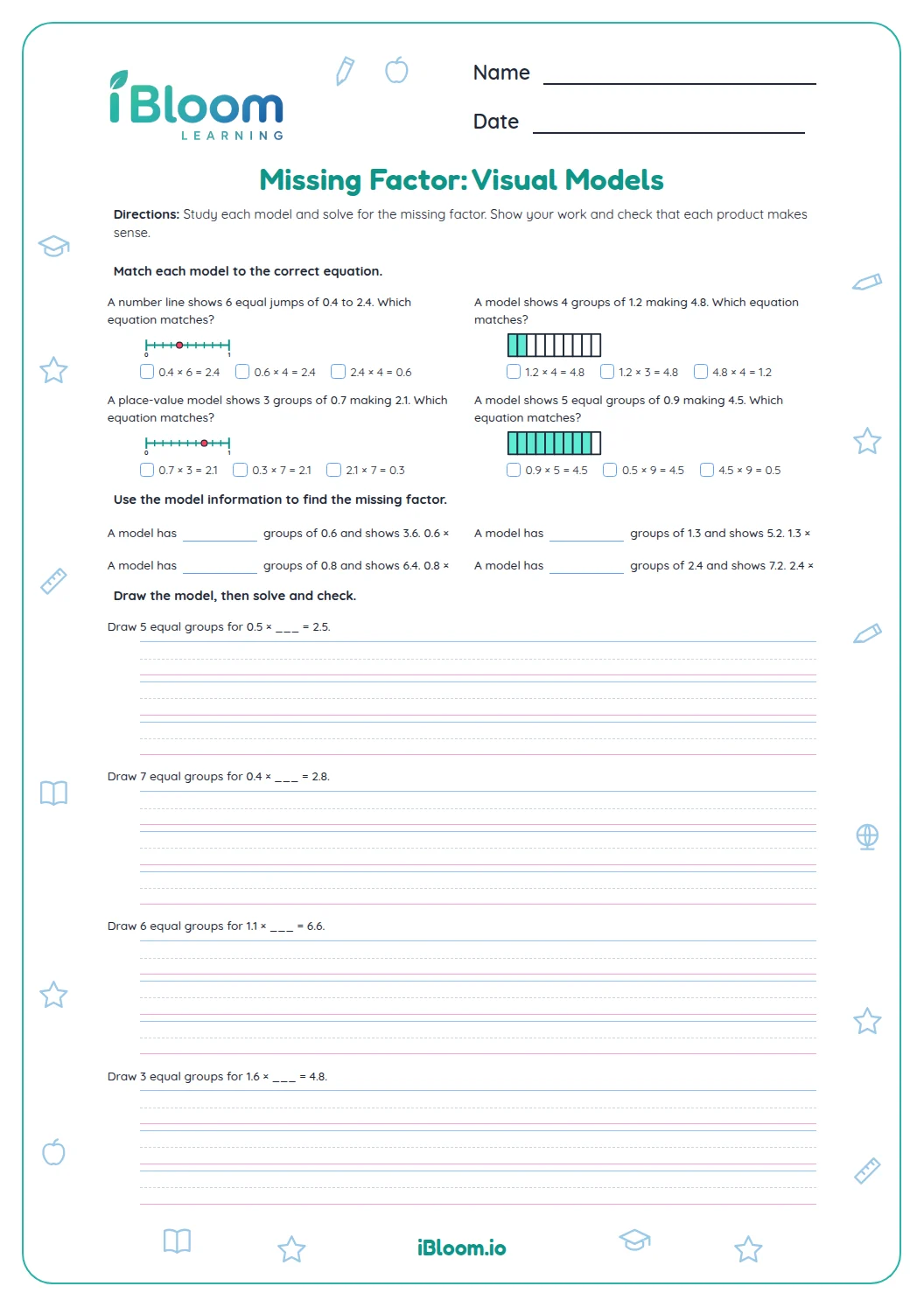
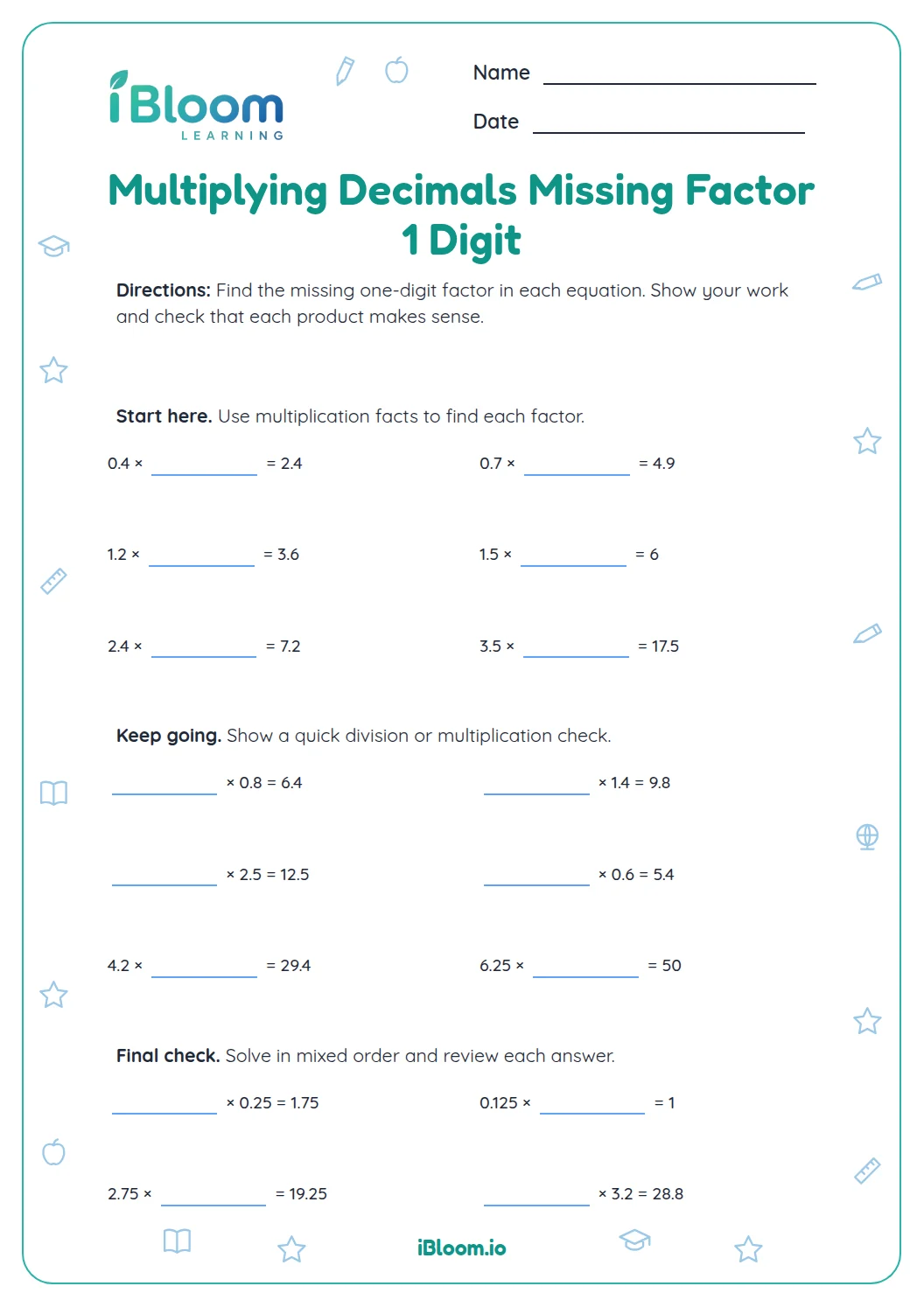
This Grade 5 printable practices finding a two-digit factor when a decimal factor and product are known. Each equation has a whole-number factor from 12 to 25, so students can divide to find the missing factor and multiply to check. The 12 questions progress through three short sections; the answer key is separate.
Aligned to 5.NBT.B.7
How can students find a missing factor in decimal multiplication?
Divide the product by the known decimal factor.
Check the quotient by multiplying it by the known factor.
- 10.4 × ___ = 4.8
- 24.8 ÷ 0.4 = 12
- 3Check: 0.4 × 12 = 4.8
What is on this worksheet?
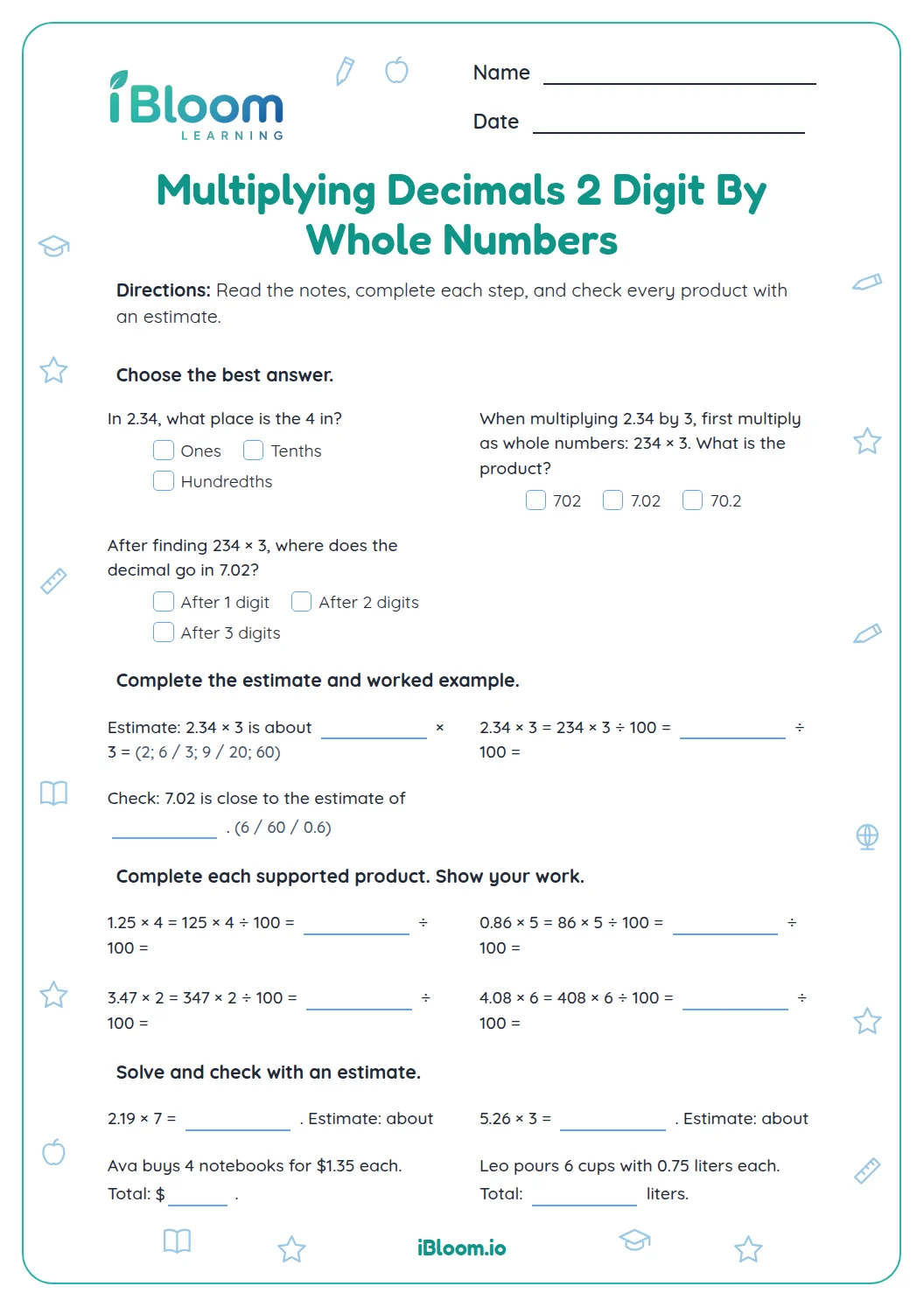
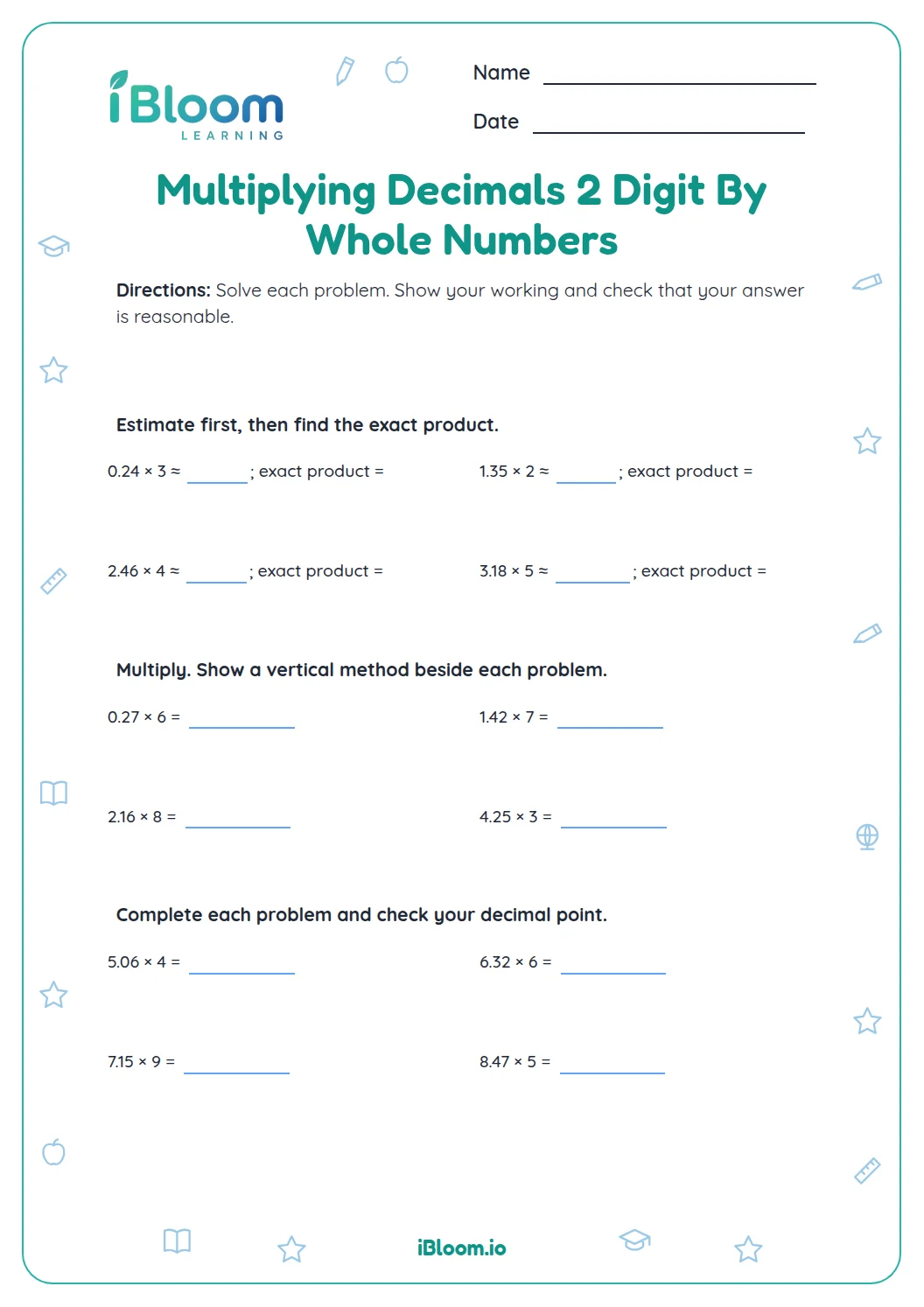
The one-page worksheet has 12 equations in three parts, followed by a separate answer key.
- Part A: find missing two-digit factors
- Part B: continue solving and checking products
- Part C: complete a final set of factor equations
How to use this worksheet
- 1Read the directions and try the first question carefully.
- 2Complete each part in order, showing a calculation or clue when it helps.
- 3Return to the prompt to check that the answer fits.
- 4Use the separate key to review any missed item.
Common mistakes and quick checks
The mistake
Treating 4.8 ÷ 0.4 as 4.8 ÷ 4.
The fix
Scale both numbers by 10: 48 ÷ 4 = 12.
The mistake
Giving a factor with the wrong number of digits.
The fix
Check the quotient and confirm it is a two-digit whole number.
The mistake
Accepting a quotient without checking.
The fix
Multiply the missing factor by the decimal factor to recover the product.
Common Core alignment
This worksheet practices the grade-level skill named below.
Multiply decimals to hundredths using place-value strategies and written methods.
On this sheet: Students use division to find a missing factor in decimal multiplication equations and verify by multiplying.
Show the official wordingHide the official wording
Add, subtract, multiply, and divide decimals to hundredths, using concrete models or drawings and strategies based on place value, properties of operations, and/or the relationship between addition and subtraction; relate the strategy to a written method and explain the reasoning used.
What to practice next
Make more practice
Questions parents and teachers ask
How do you find the missing factor in 0.4 × ___ = 4.8?
Divide the product by the known factor: 4.8 ÷ 0.4 = 12. The missing factor is 12, and 0.4 × 12 = 4.8 confirms it. Every equation on this page uses the same inverse relationship, so students can check each result by multiplying.
Are the missing factors two-digit numbers?
Yes. Every answer is a whole number from 12 to 25, so each missing factor has two digits. Students divide to find the factor, then multiply it by the given decimal to confirm the product and check that it matches the equation.
What should students do when dividing by a decimal?
Move the decimal point the same number of places in both numbers to make the divisor a whole number. For 4.8 ÷ 0.4, rewrite it as 48 ÷ 4. The quotient remains 12, which can be checked by multiplying 0.4 by 12.
How many questions are included?
There are 12 missing-factor equations arranged in three sections. Each equation gives a decimal factor and product; students solve for the two-digit whole-number factor, then check the result by multiplying the two factors together. This format connects division with multiplication.
Is an answer key included?
Yes. A separate answer-key page lists each missing factor. Students can multiply the factor by the decimal in the original equation to confirm the product before reviewing the key and correcting any calculation that does not match. The key is arranged by question number.