
About this worksheet
This Grade 5 worksheet practices missing factors in decimal multiplication with area models and equations. Two 10-by-10 grids show tenths-by-tenths rectangles, such as 2 tenths by 4 tenths, and children identify the product. The remaining items give one factor and a product, then ask for the other factor. Children can use place-value reasoning and inverse division to solve and check each equation. The work aligns with Common Core 5.NBT.B.7, which connects decimal calculations to models and place value.
Aligned to 5.NBT.B.7
What is a missing factor?
A factor is a number being multiplied. In 0.2 × ___ = 0.08, the product is 0.08 and one factor is 0.2; the blank asks for the other factor.
The grid shows 8 hundredths. Since 0.2 is two tenths, 0.2 × 0.4 = 0.08, so the missing factor is 0.4.
How does the hundredths model help?
Each 10-by-10 grid represents one whole divided into hundredths. For question 1, a 2-by-4 rectangle covers 8 small squares, so 2 tenths times 4 tenths is 8 hundredths, or 0.08.
A hundredths grid displays the product amount; the equation supplies the known factor. Check the answer by multiplying the two factors and confirming the product.
- 10.2 × 0.4
- 2The area model has 2 tenths by 4 tenths: 8 hundredths.
- 30.2 × 0.4 = 0.08
- 4Product: 0.08
How can a child check decimal placement?
Estimate first. A number less than 1 multiplied by a number less than 1 gives a product smaller than either factor. Then multiply to confirm the hundredths.
For 0.2 × 0.4, two tenths times four tenths is eight hundredths, or 0.08. The product has two decimal places because hundredths are being multiplied.
How to use this worksheet
- 1Read the known factor and product in the equation.
- 2Read the grid as a hundredths amount.
- 3Estimate whether the missing factor should be less than 1.
- 4Find the factor that makes the product true.
- 5Multiply the factors to check the product and decimal placement.
Common mistakes and quick fixes
The mistake
Reading 8 shaded squares as 0.8.
The fix
A hundredths grid has 100 squares, so 8 shaded squares are 8/100 or 0.08.
The mistake
Using addition instead of multiplication to check.
The fix
Multiply the known and missing factors and compare the product.
The mistake
Placing the decimal without estimating.
The fix
Check that a product of two numbers below 1 is smaller than each factor.
Common Core alignment
The models and equations connect decimal products to hundredths and place-value reasoning.
Use models and place value to calculate with decimals to hundredths.
On this sheet: The hundredths grids model each product and the equations ask children to reason about decimal multiplication.
Show the official wordingHide the official wording
Add, subtract, multiply, and divide decimals to hundredths, using concrete models or drawings and strategies based on place value, properties of operations, and/or the relationship between addition and subtraction; relate the strategy to a written method and explain the reasoning used.
What to practice next
Make more practice
Further reading
Questions parents and teachers ask
What does the hundredths grid show?
Each 10-by-10 grid represents one whole divided into 100 small squares. A 2-by-4 rectangle covers 8 squares, or 0.08. Multiply the known factor by your answer to check the equation. Count only the shaded small squares inside the rectangle, then read the decimal amount.
Why is the answer to 0.2 × ___ = 0.08 equal to 0.4?
Two tenths times four tenths equals eight hundredths: 0.2 × 0.4 = 0.08. The grid shows those 8 hundredths. Multiply the known factor by the proposed answer to check it. Four tenths is the factor that makes the equation match the model.
How many questions are on the sheet?
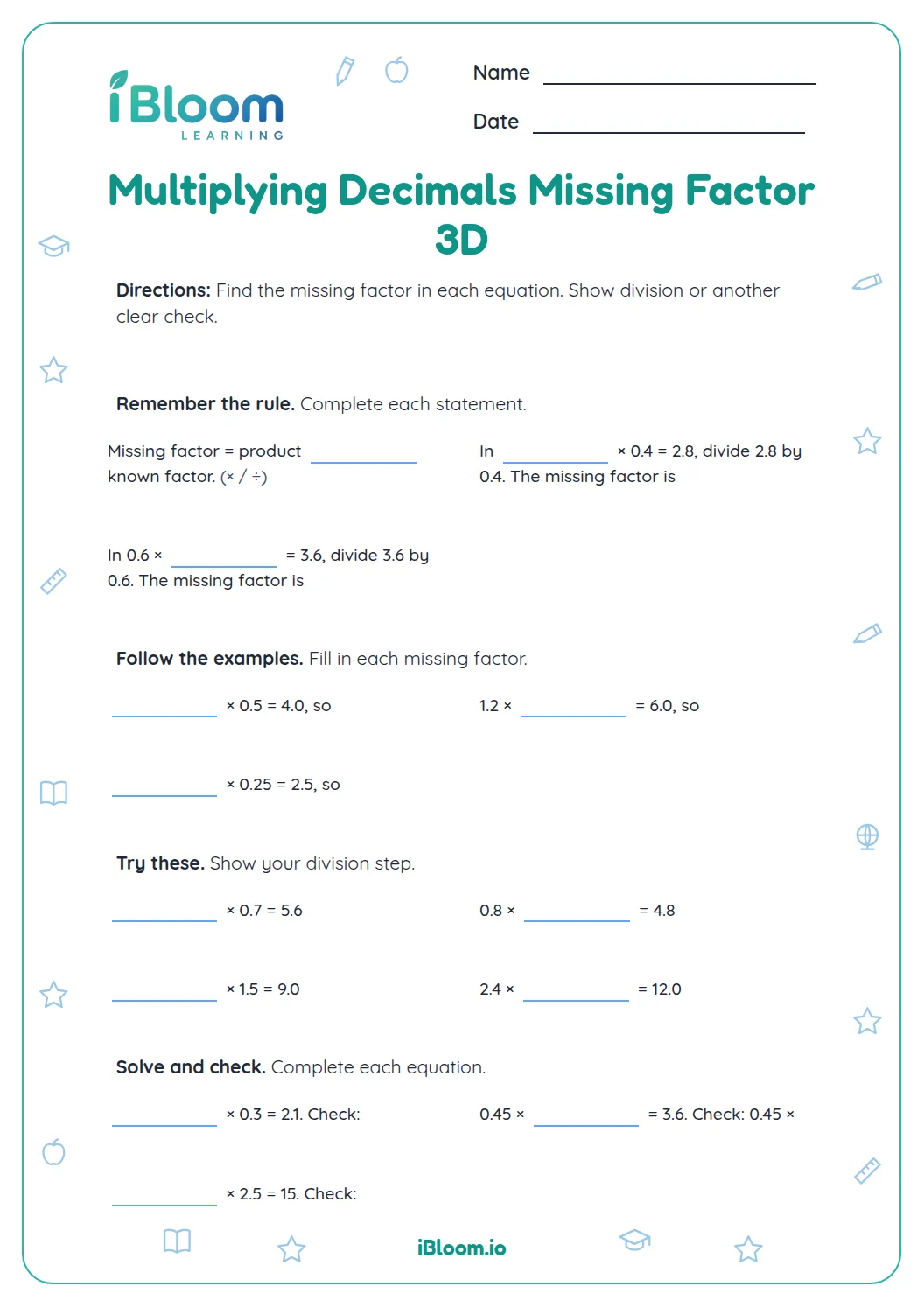
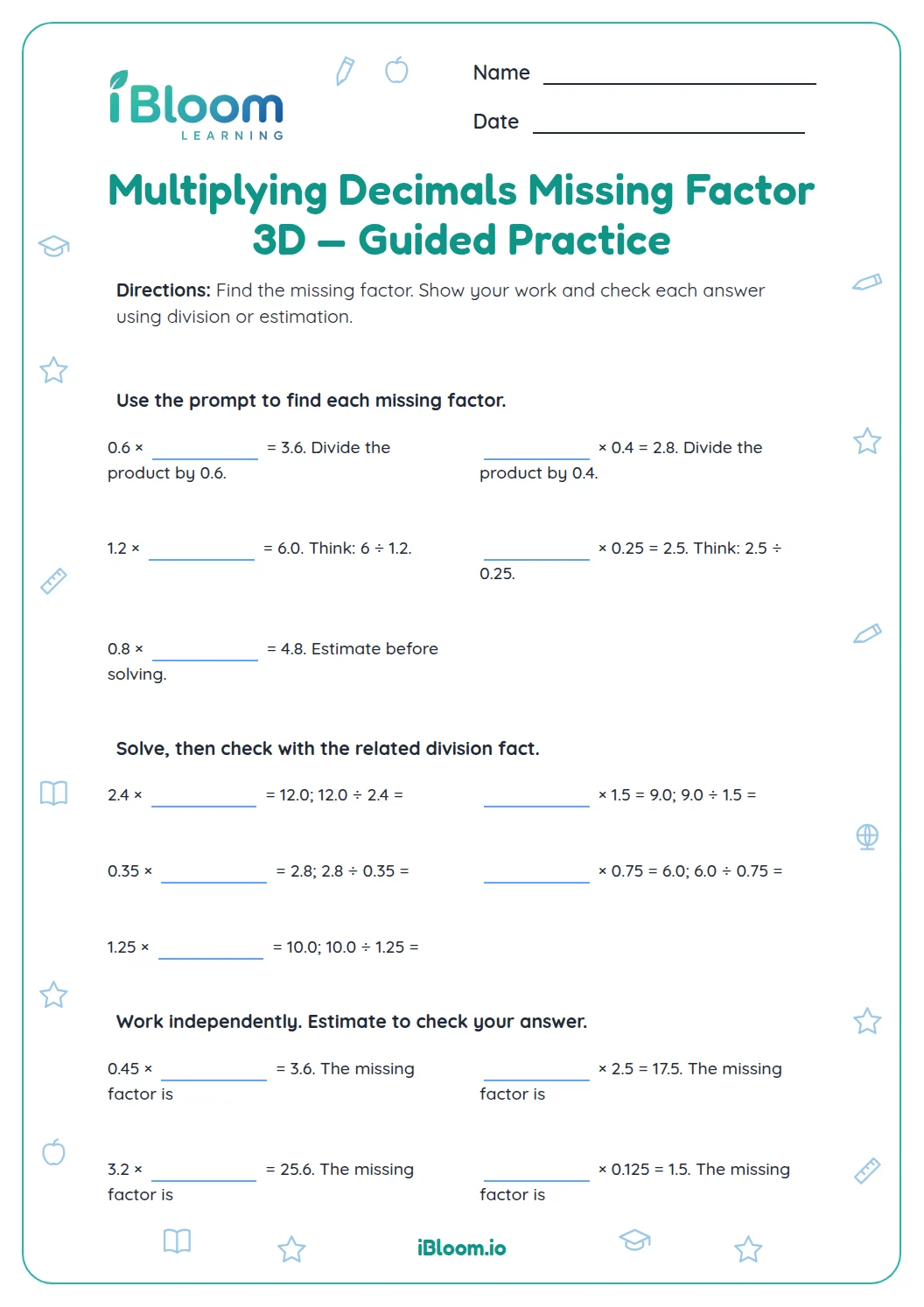
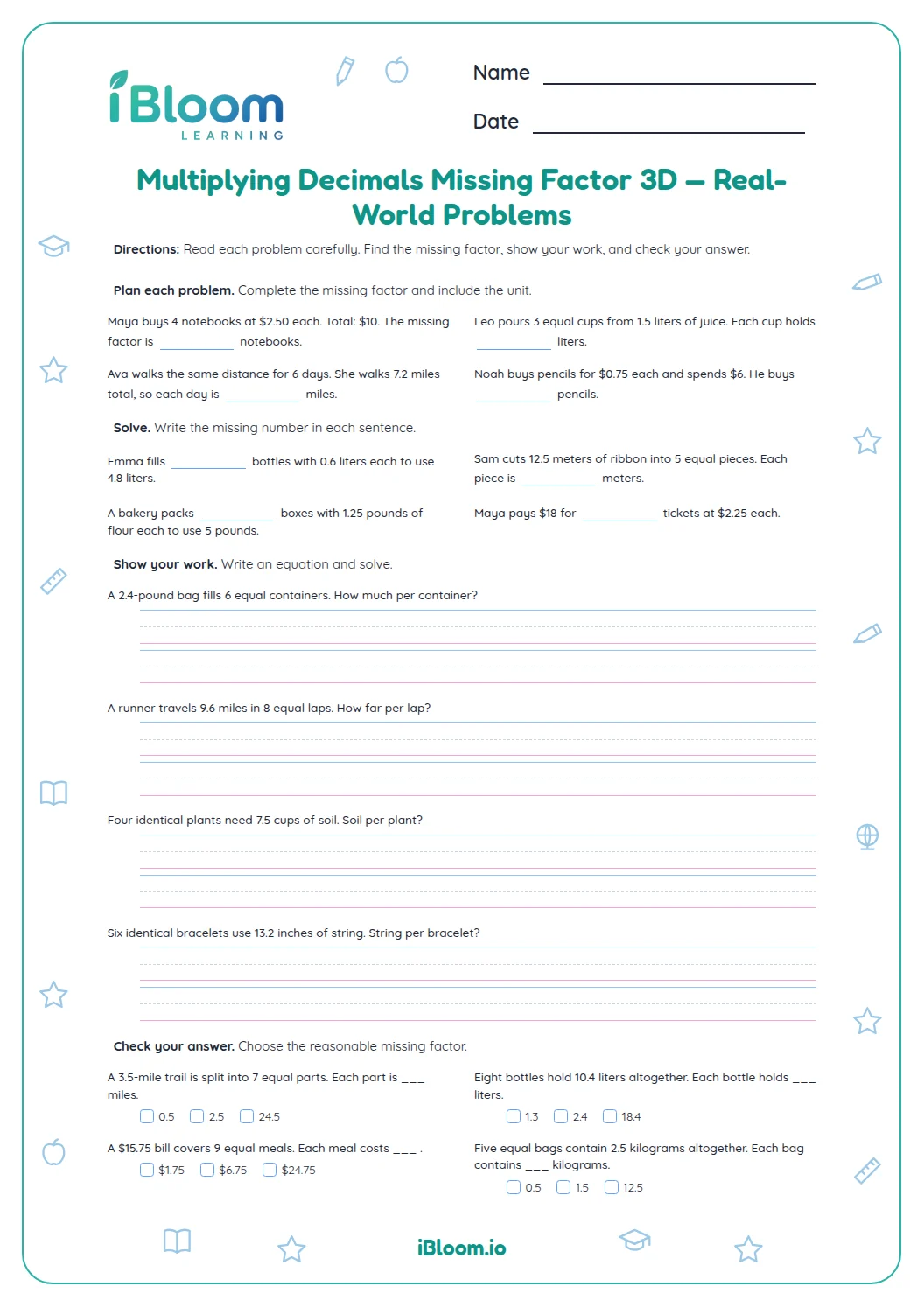
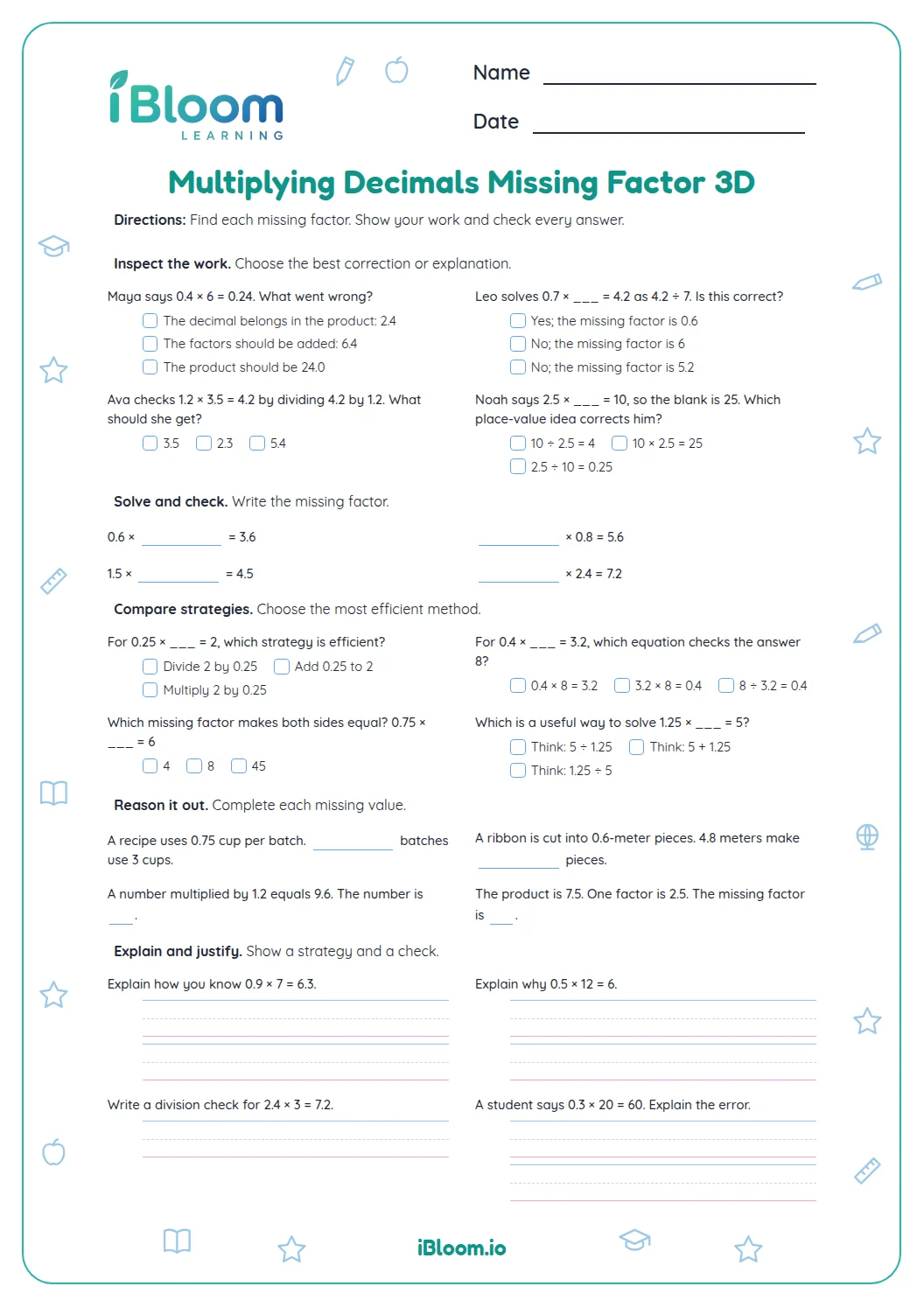
There are 15 items across two practice pages: two area-model product readings and 13 missing-factor equations. A separate answer key follows the worksheet. The first pair uses rectangles to connect two tenths factors with hundredths products. Read each instruction carefully.
How can a child check a missing factor?
Multiply the known decimal factor by the proposed answer, then compare the product with the number on the other side of the equation. The answer key provides a quick check for each item. This check works for each equation even when the grid is not beside it.
Why can the product be smaller than both factors?
When both factors are positive decimals less than 1, their product is smaller than either factor. For example, 0.2 × 0.4 = 0.08, which is less than both 0.2 and 0.4. This estimate helps catch a decimal point placed too far to the right.