
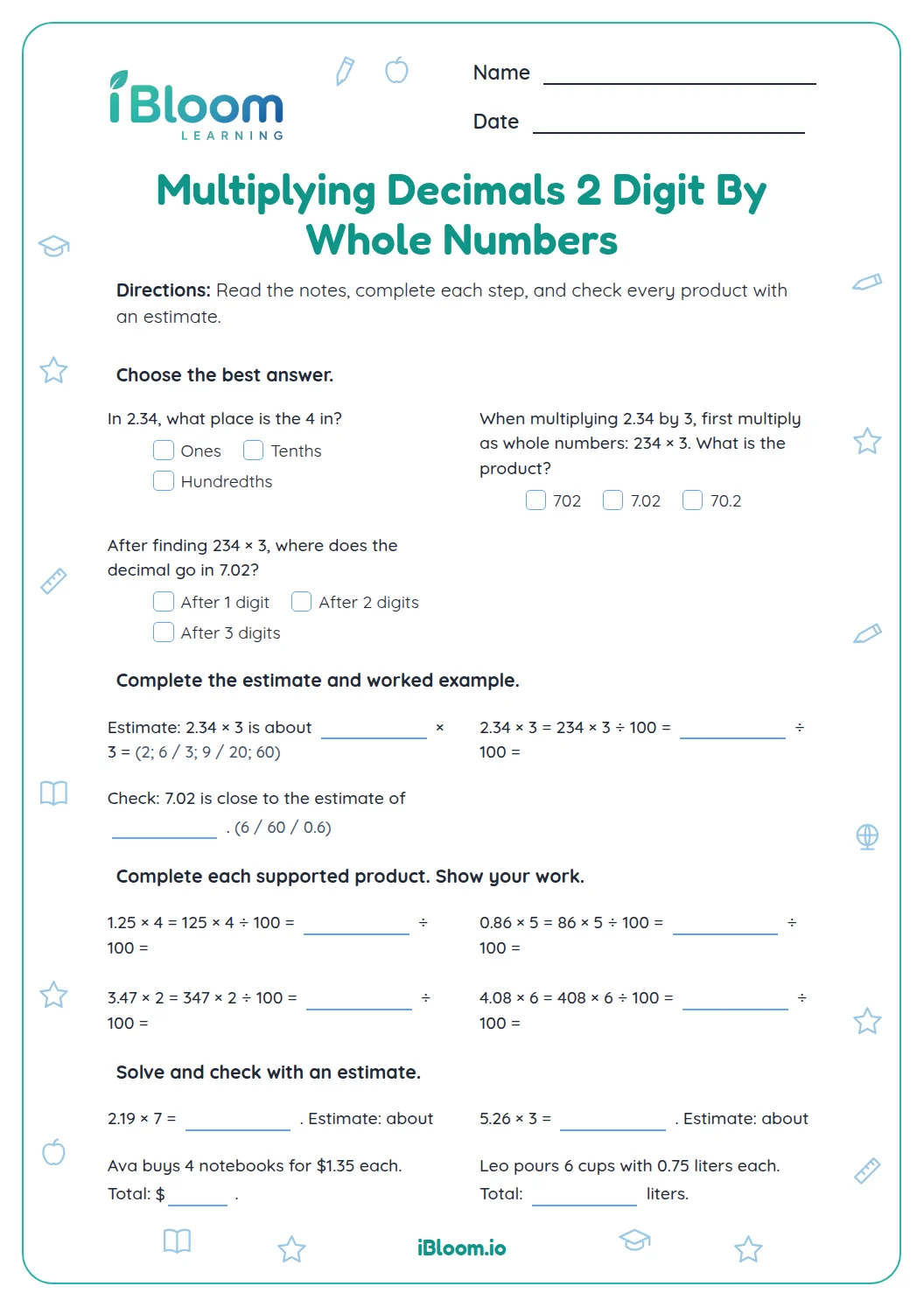

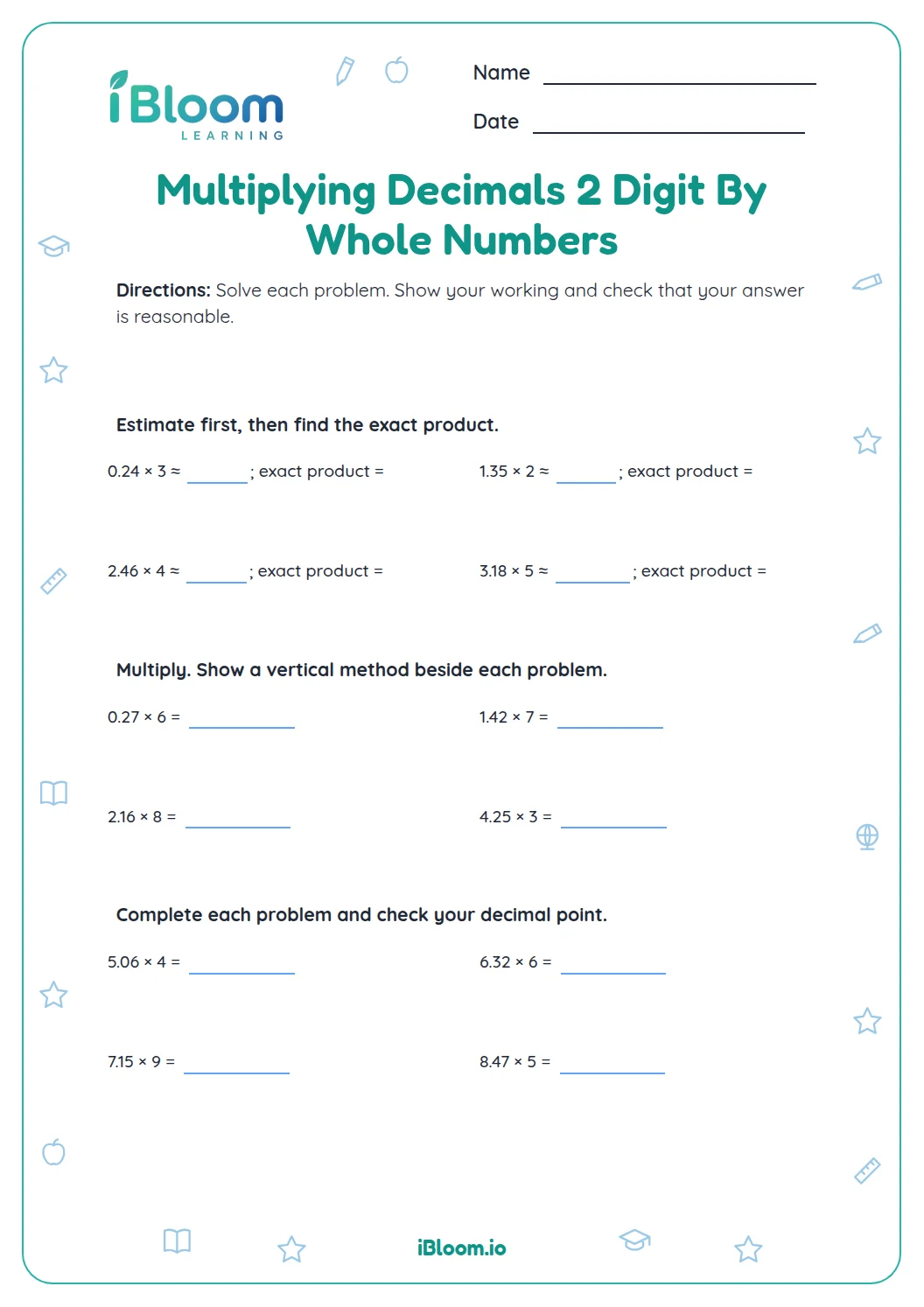
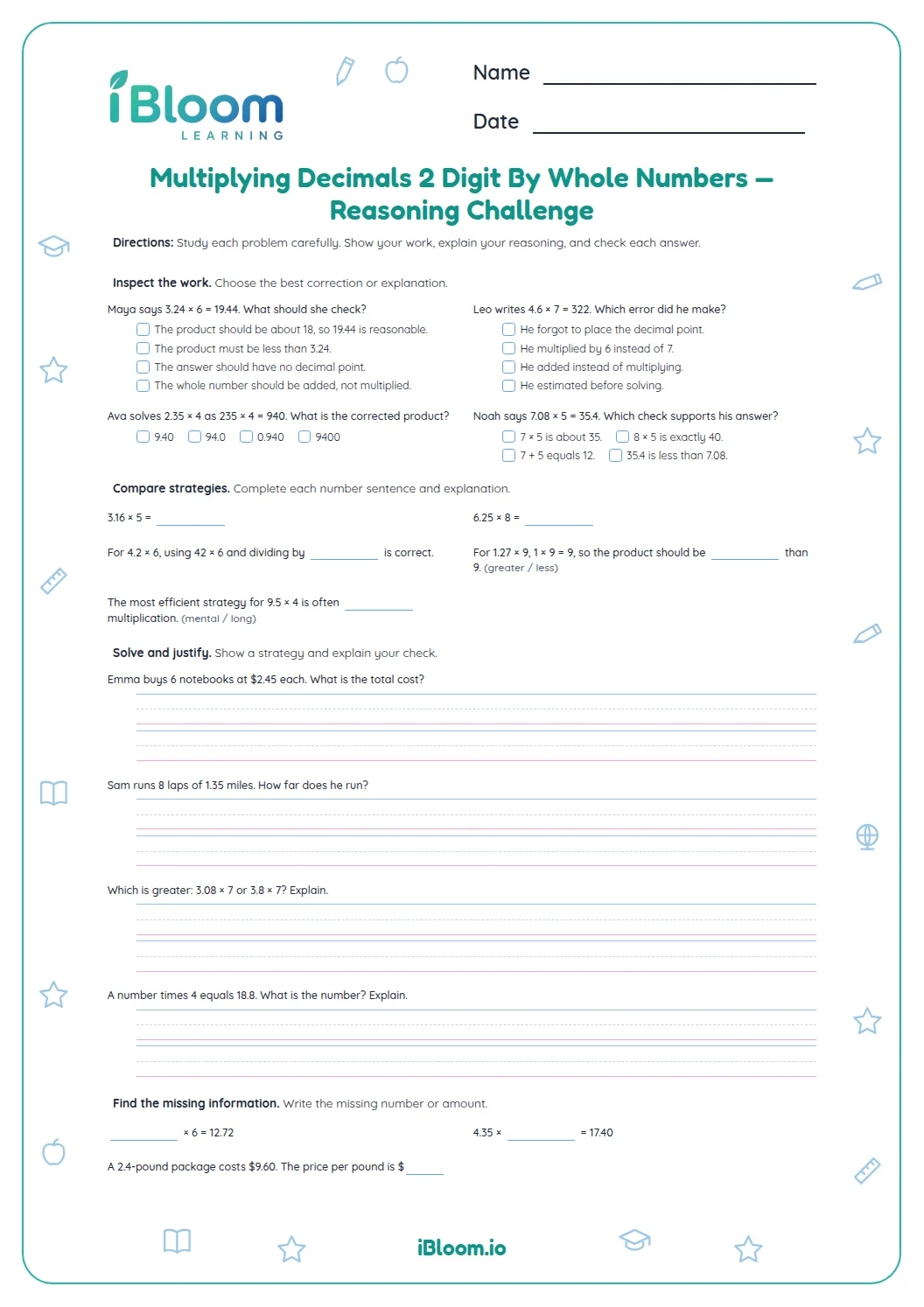
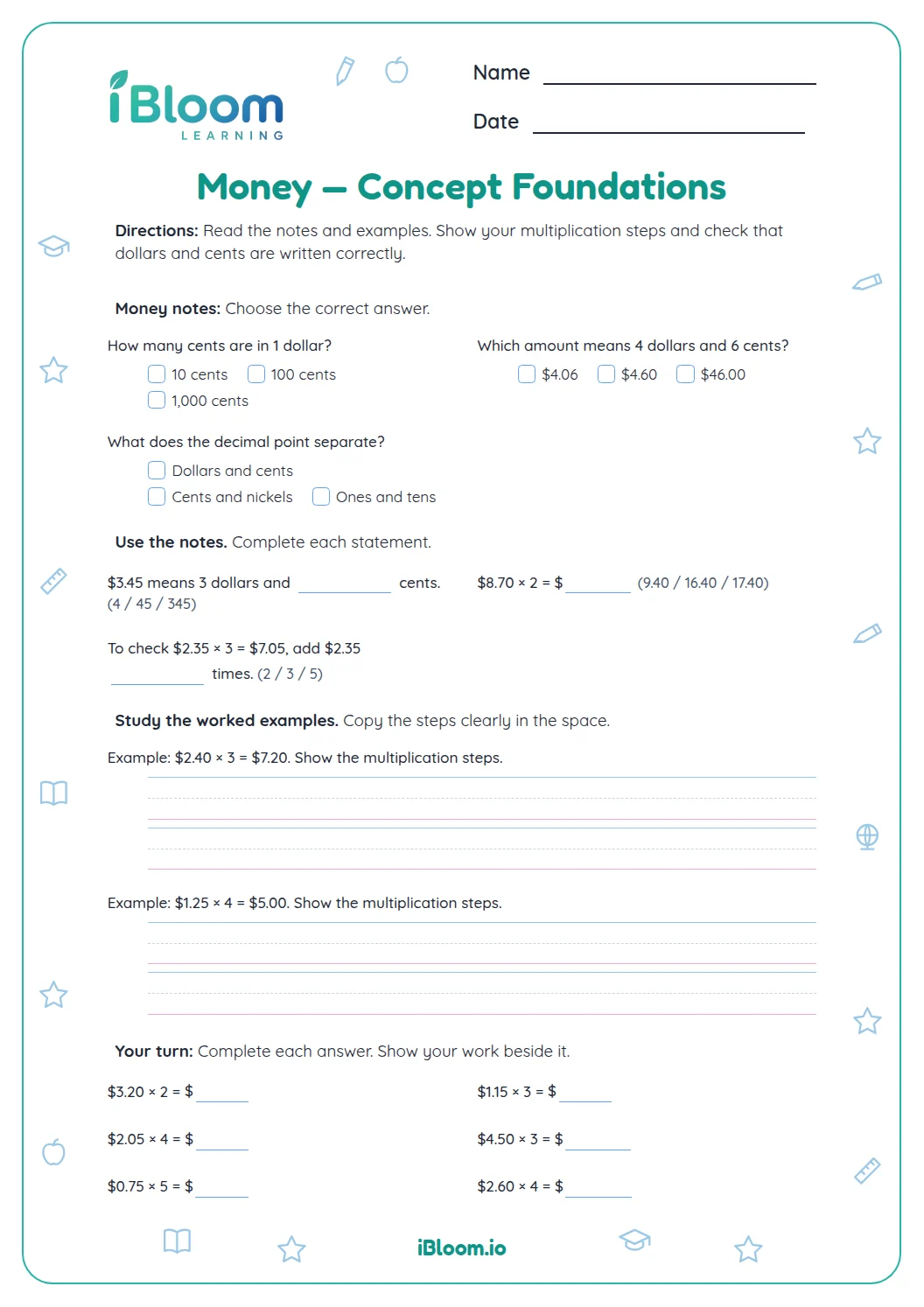


About this worksheet
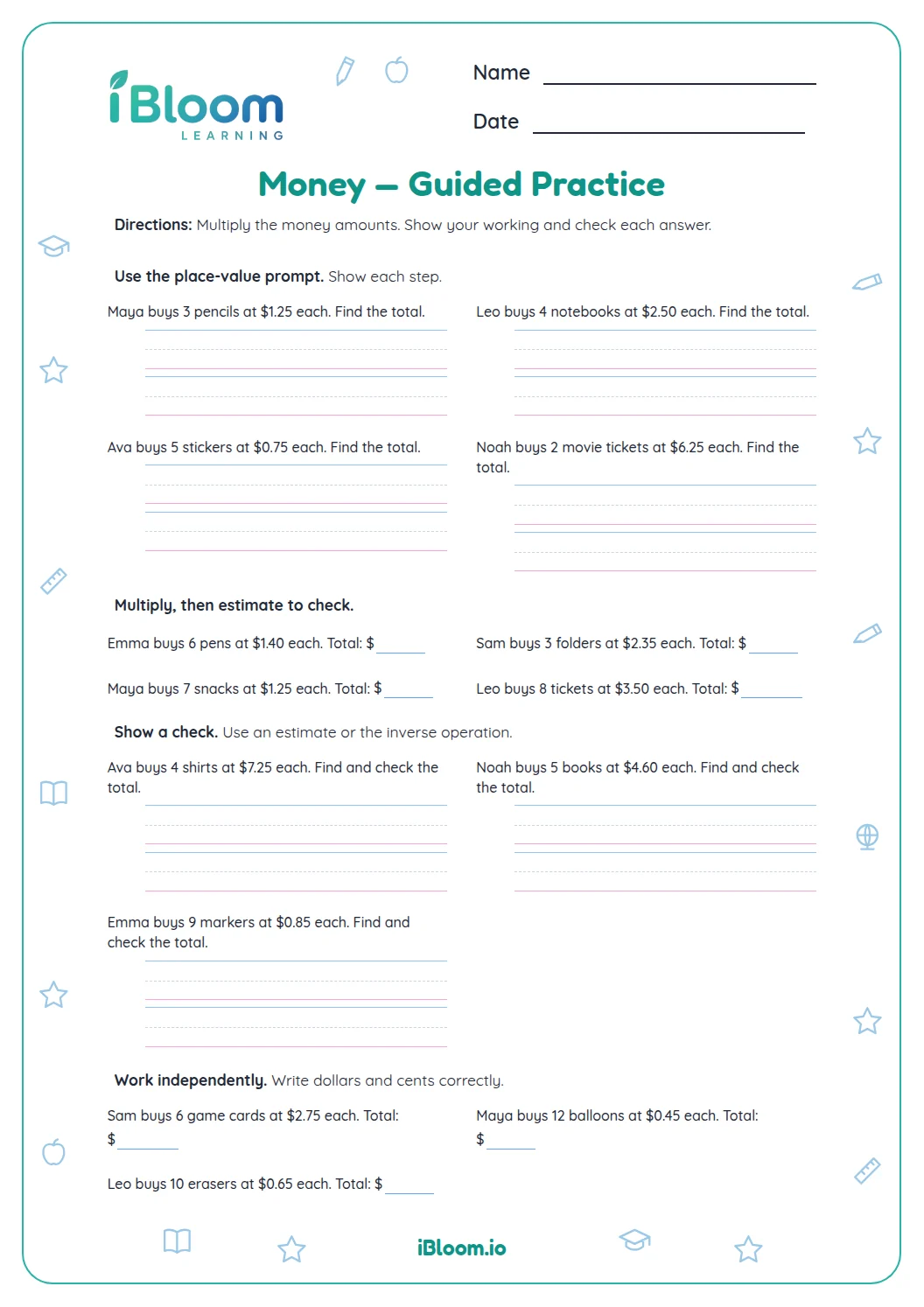
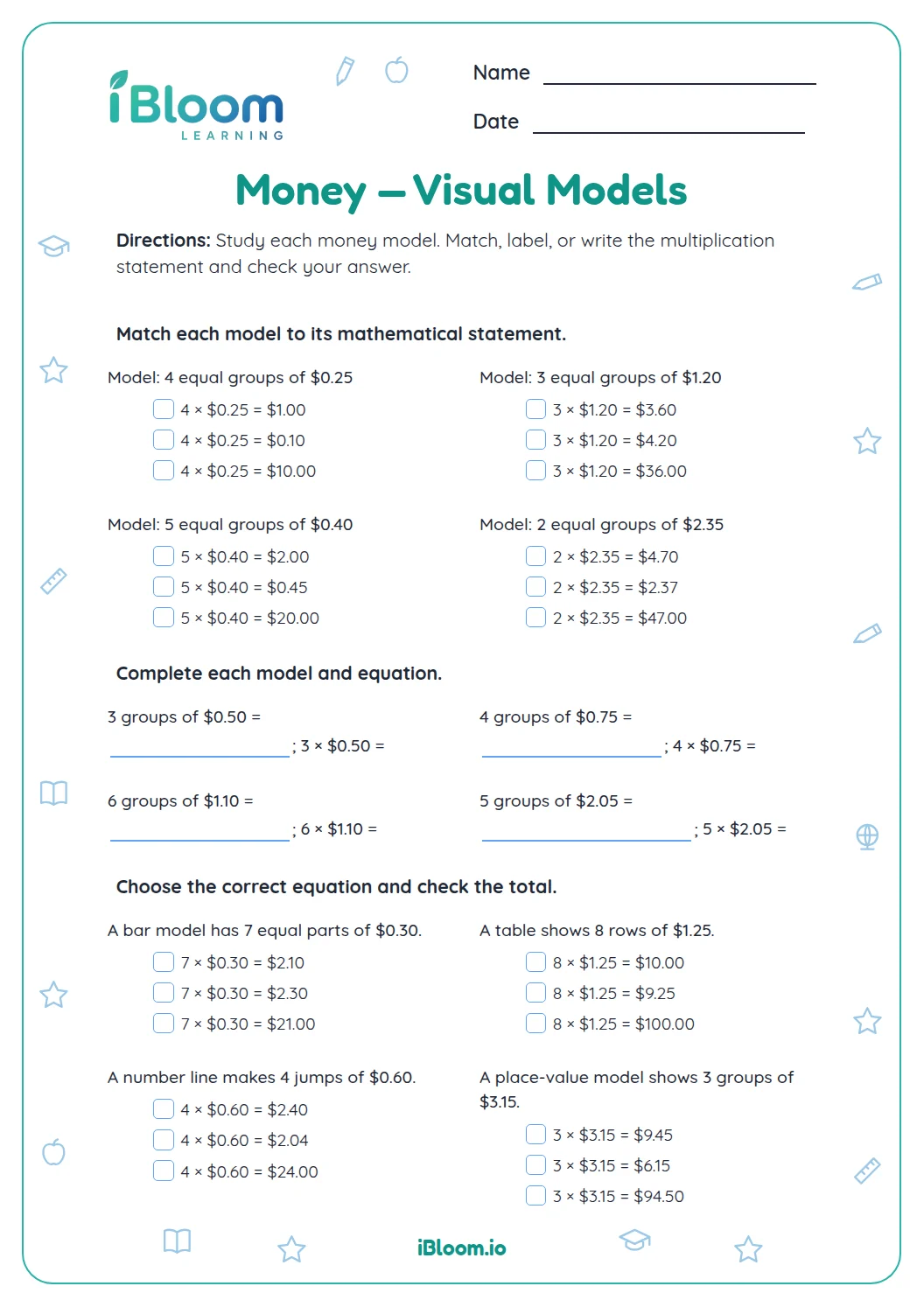
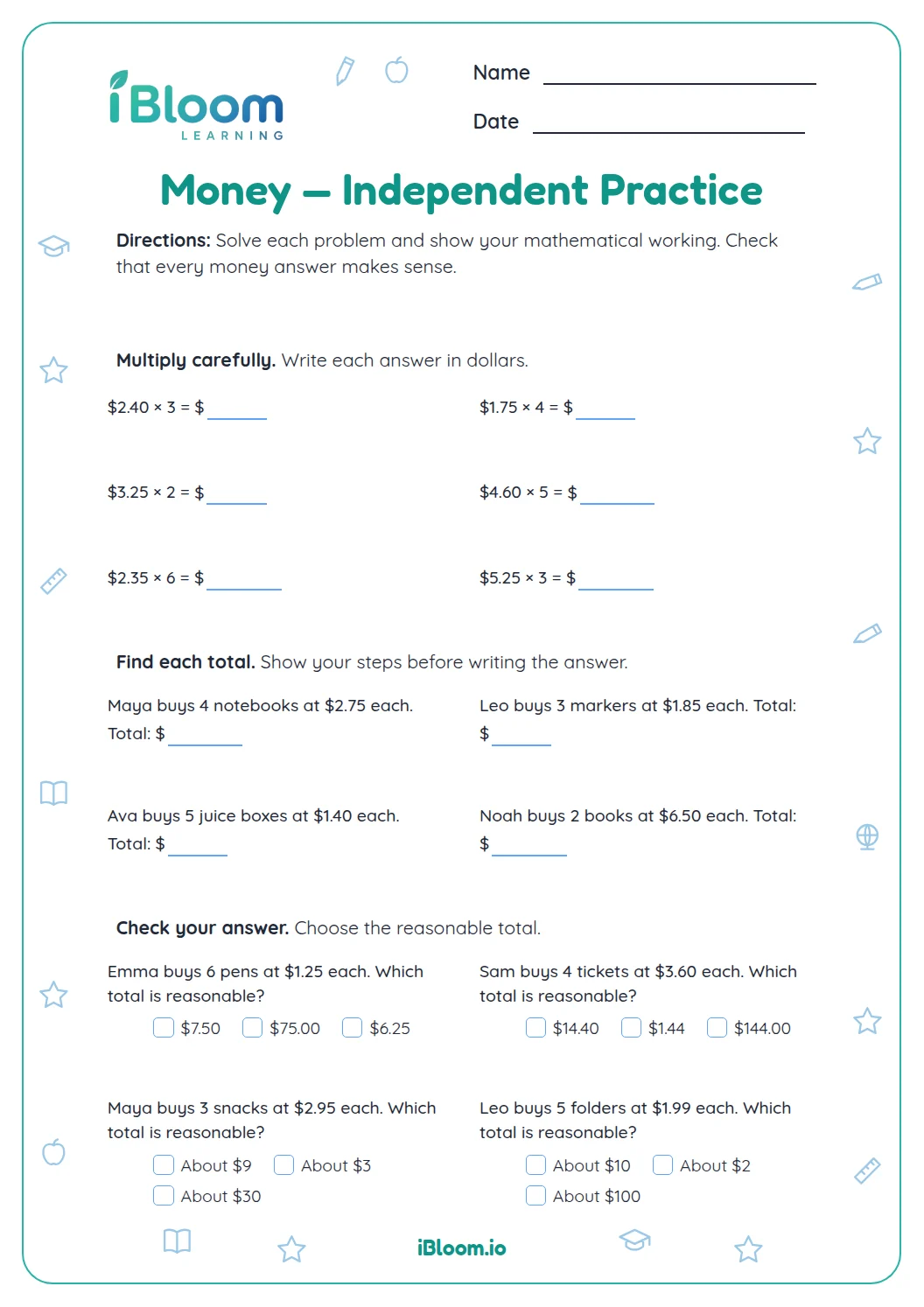
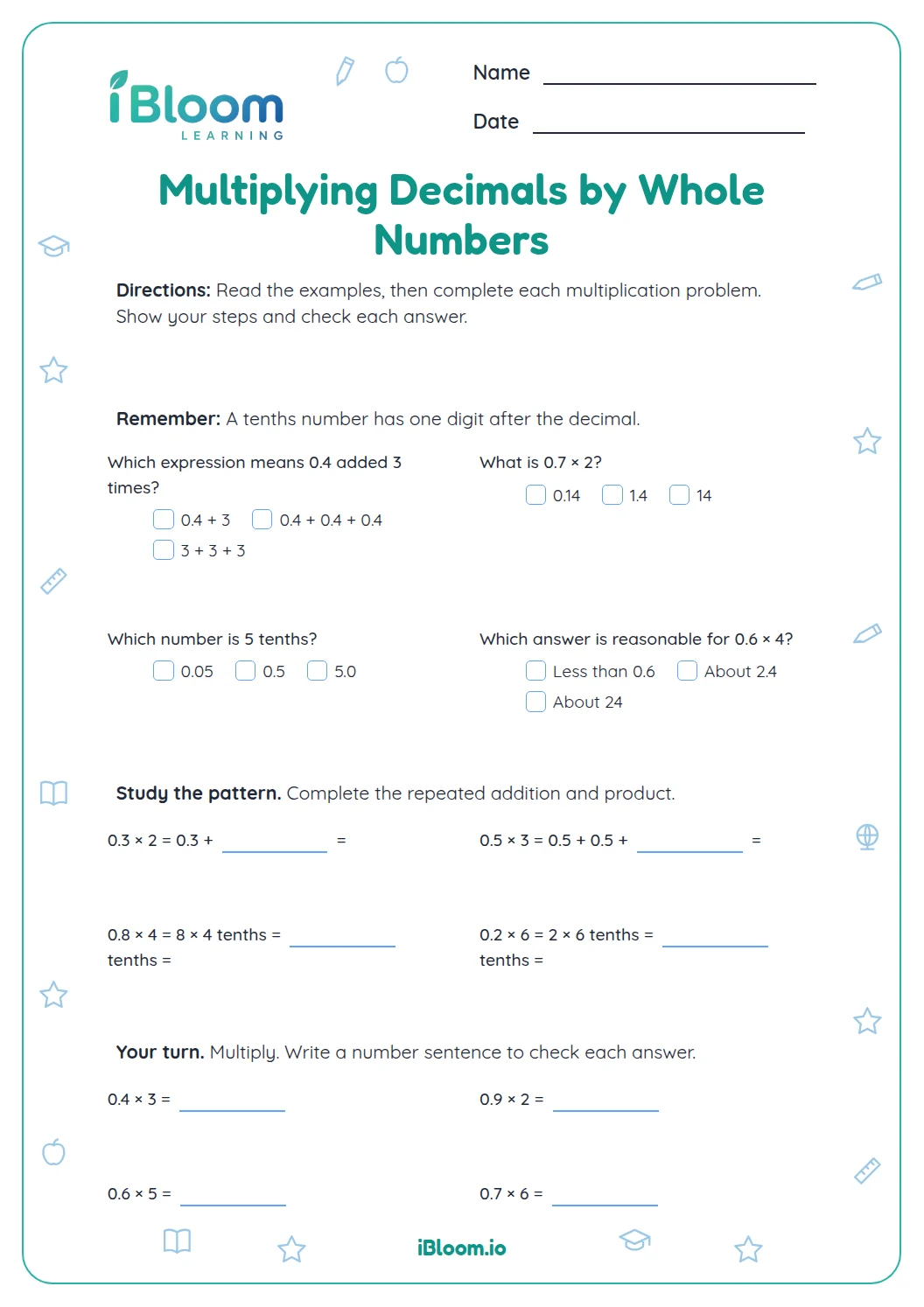
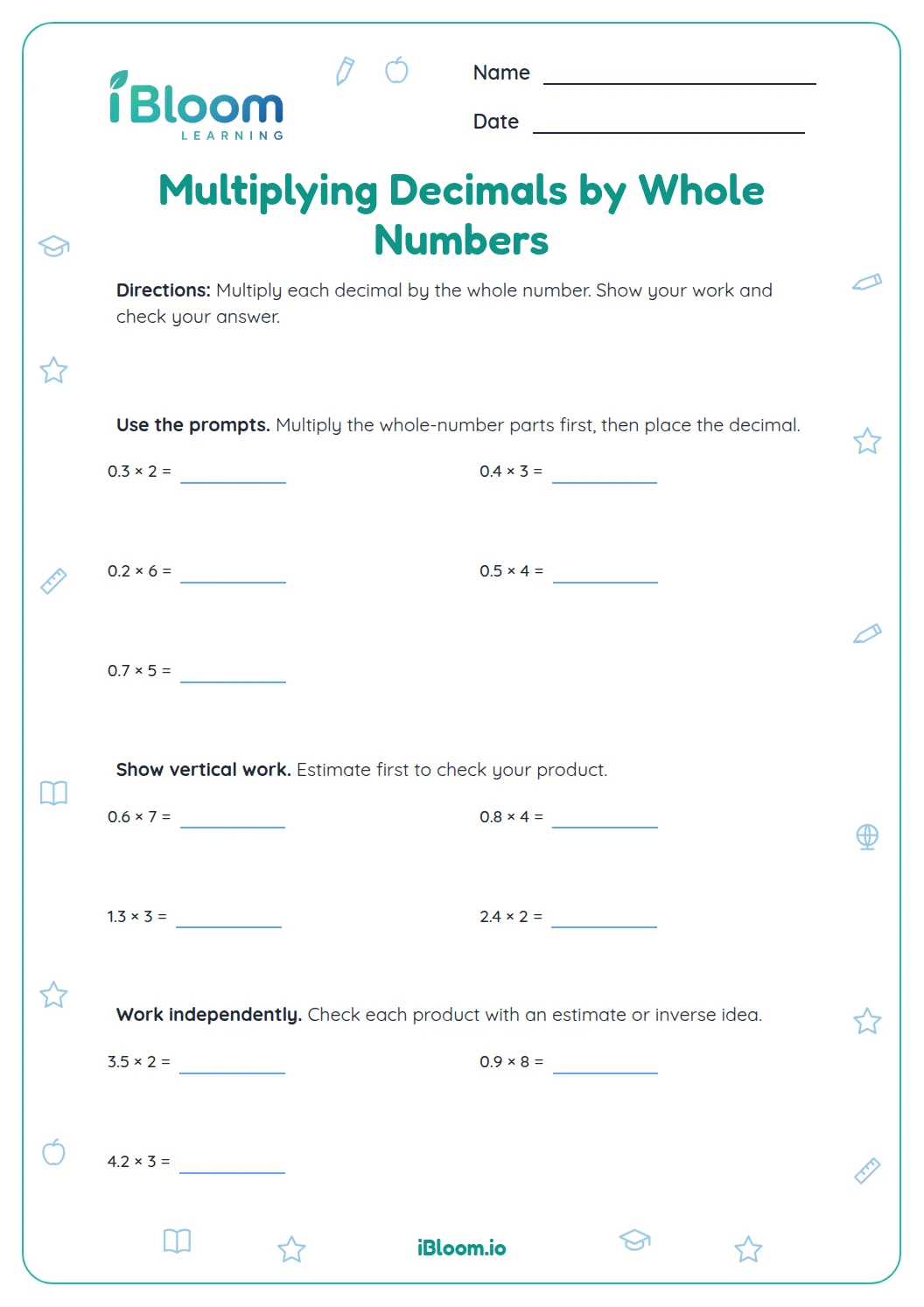
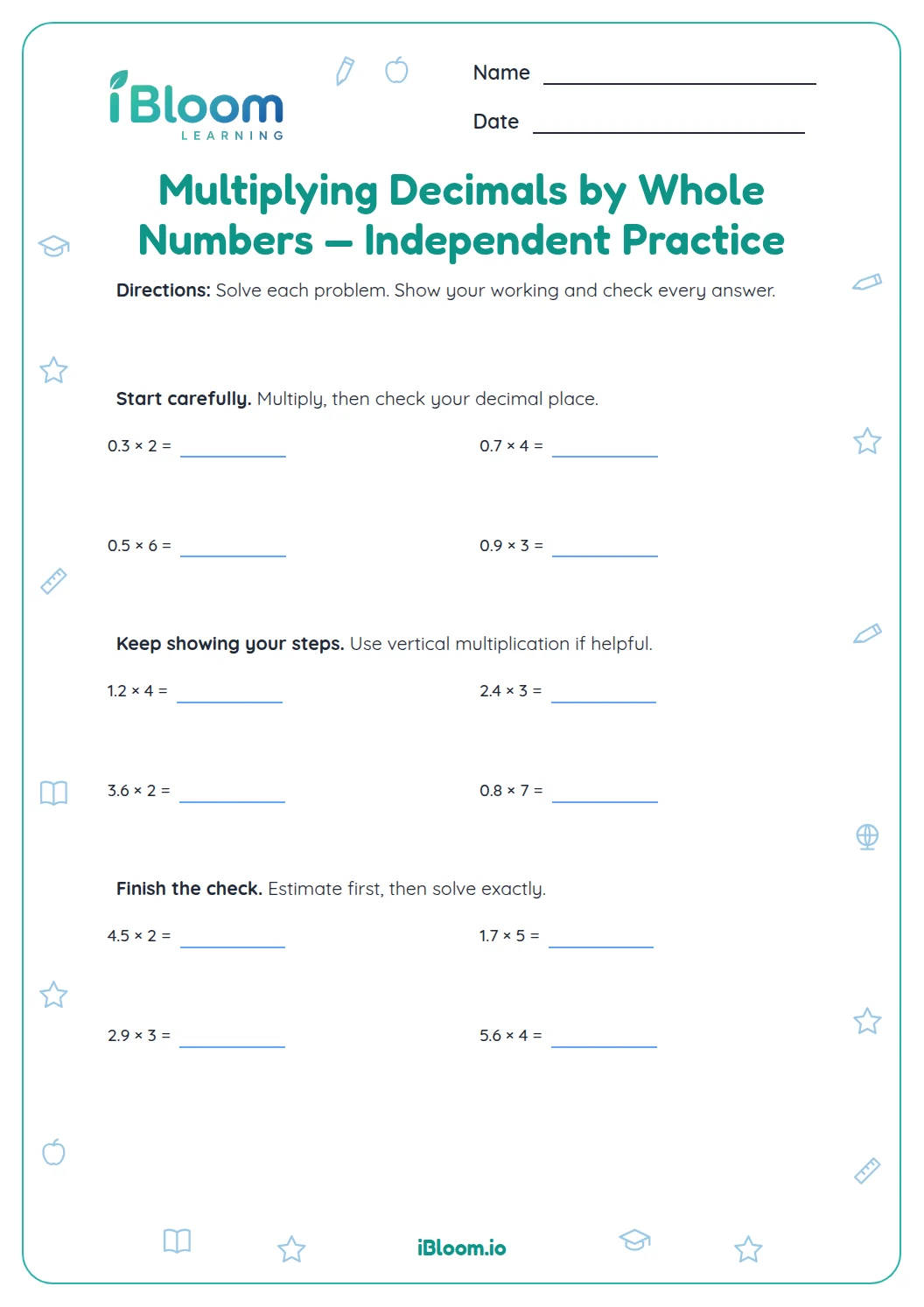
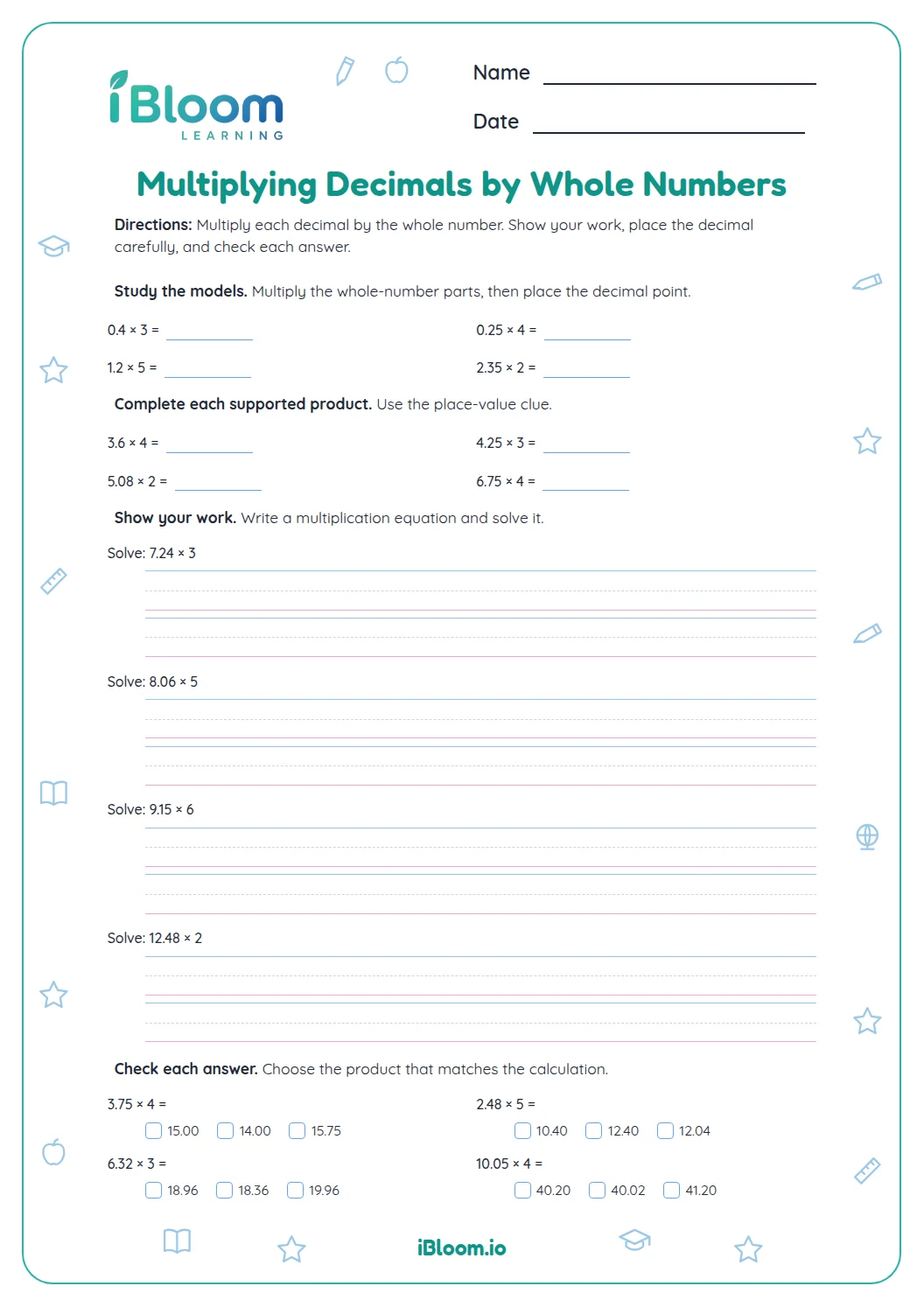
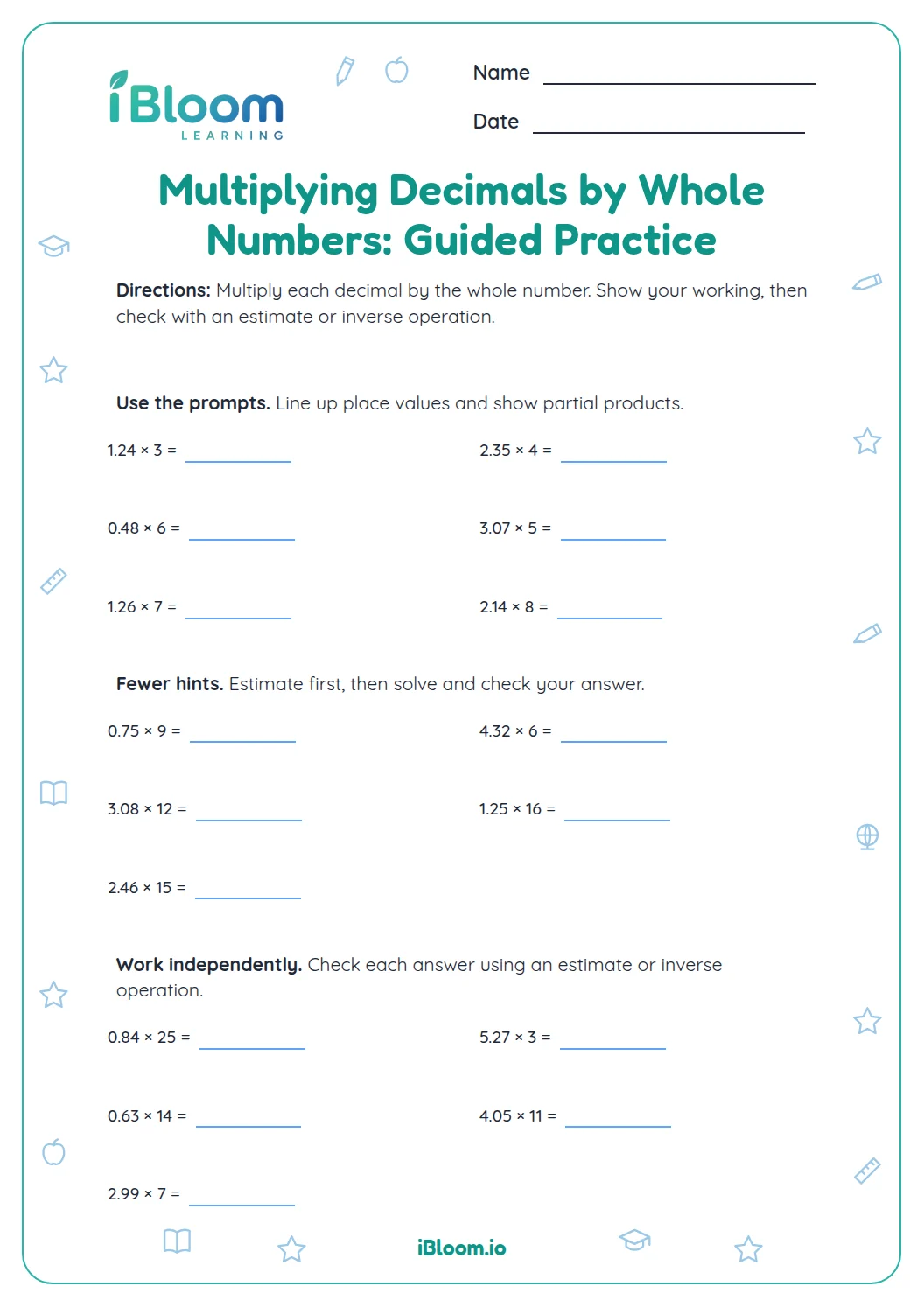
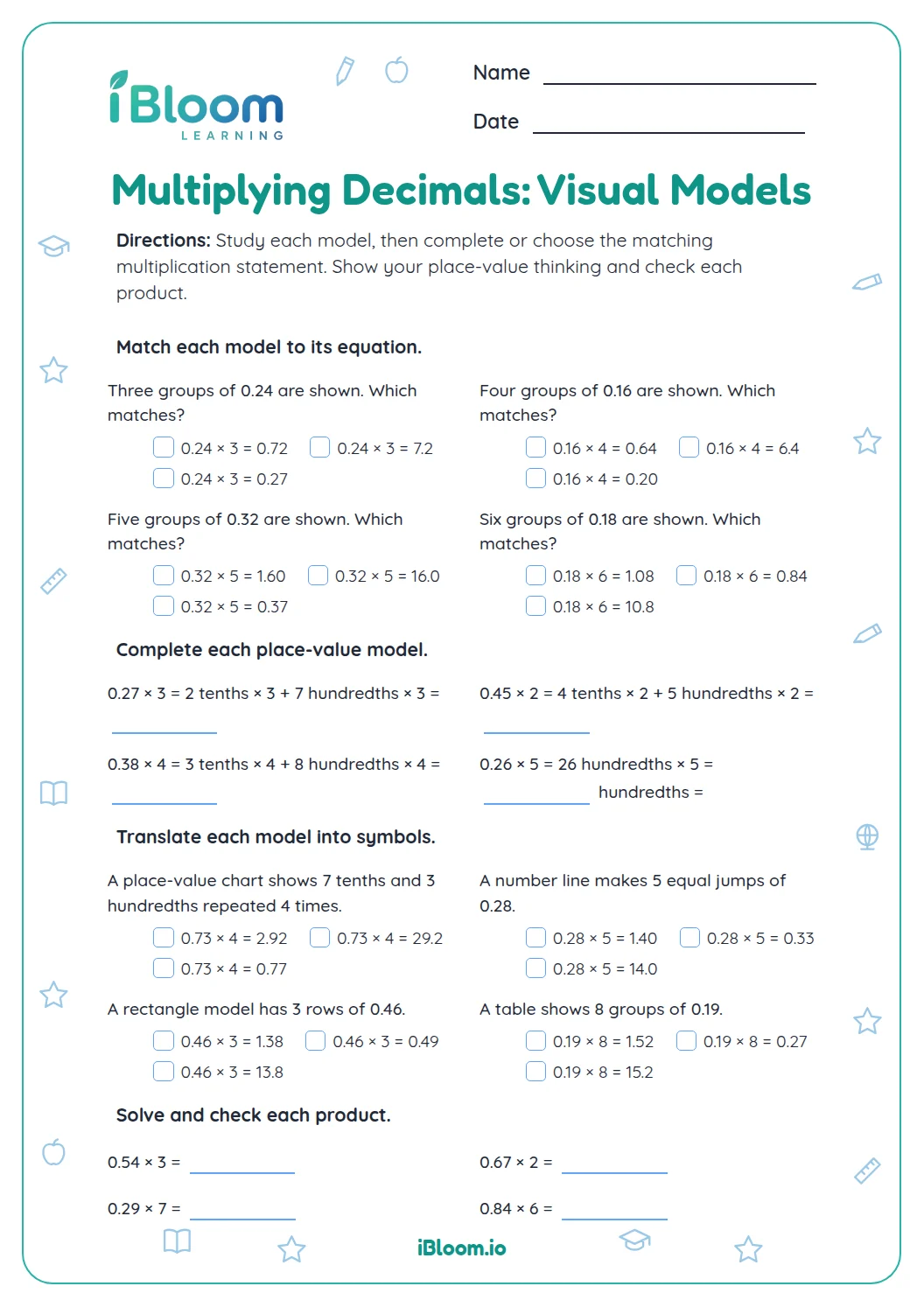
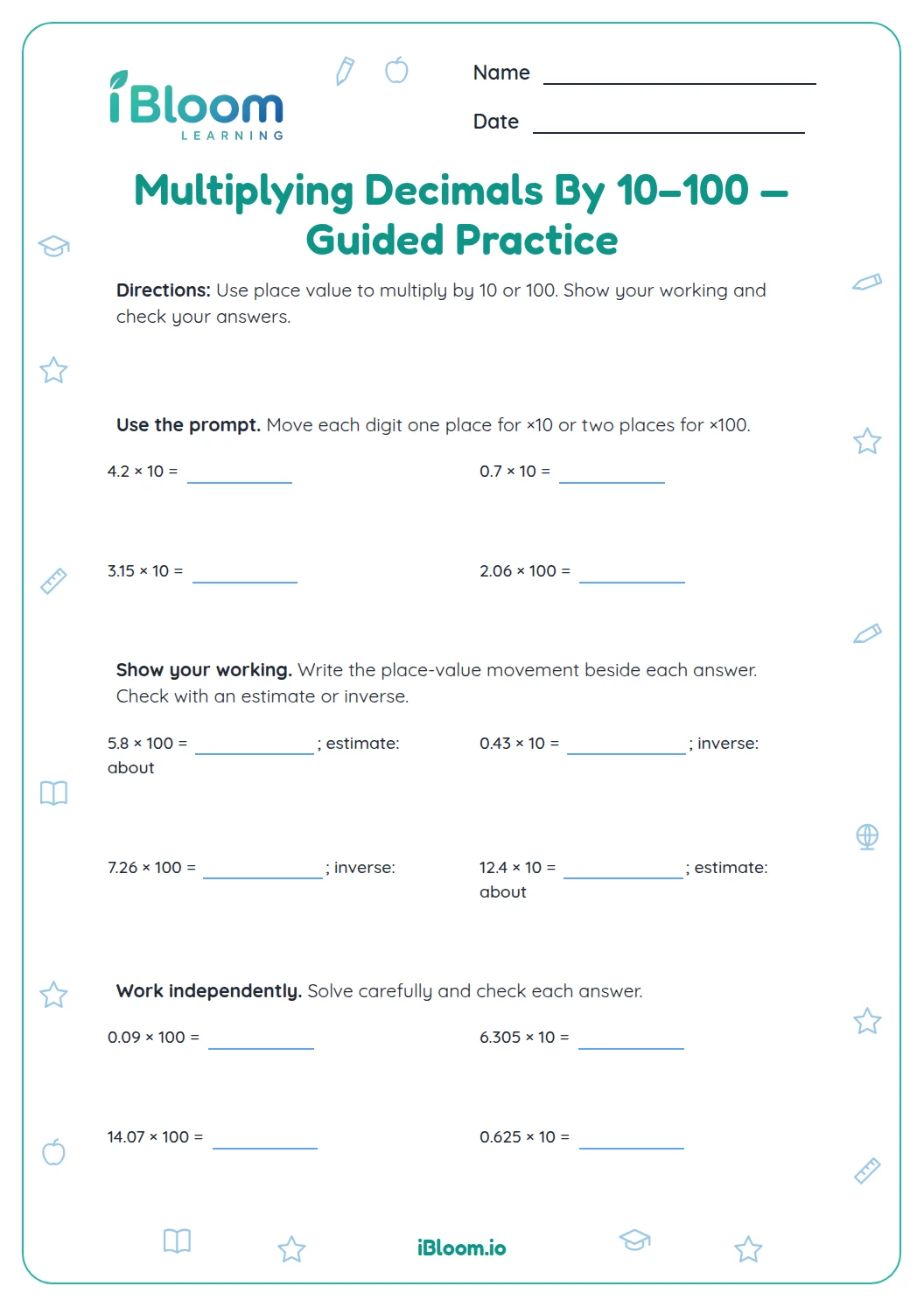
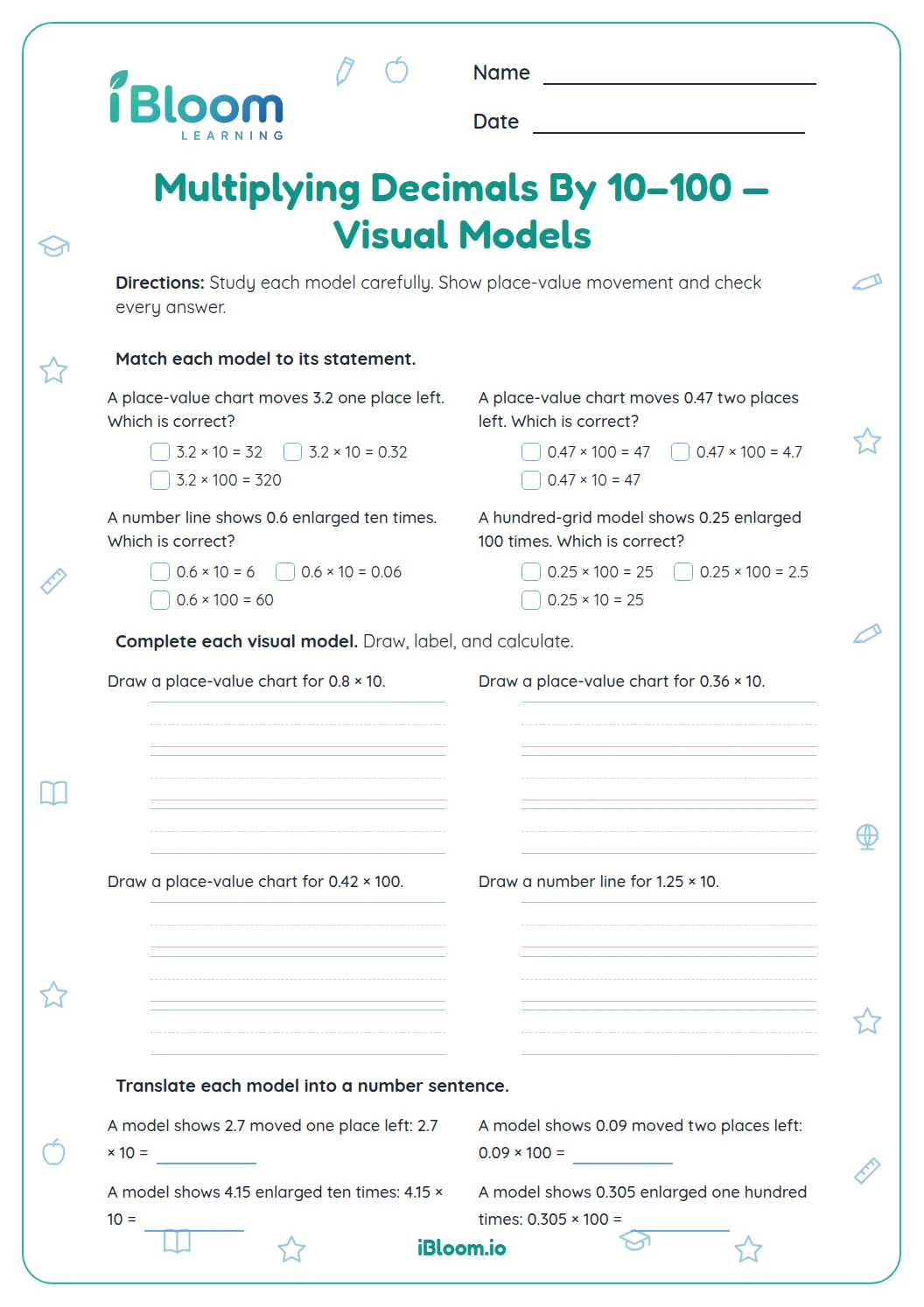
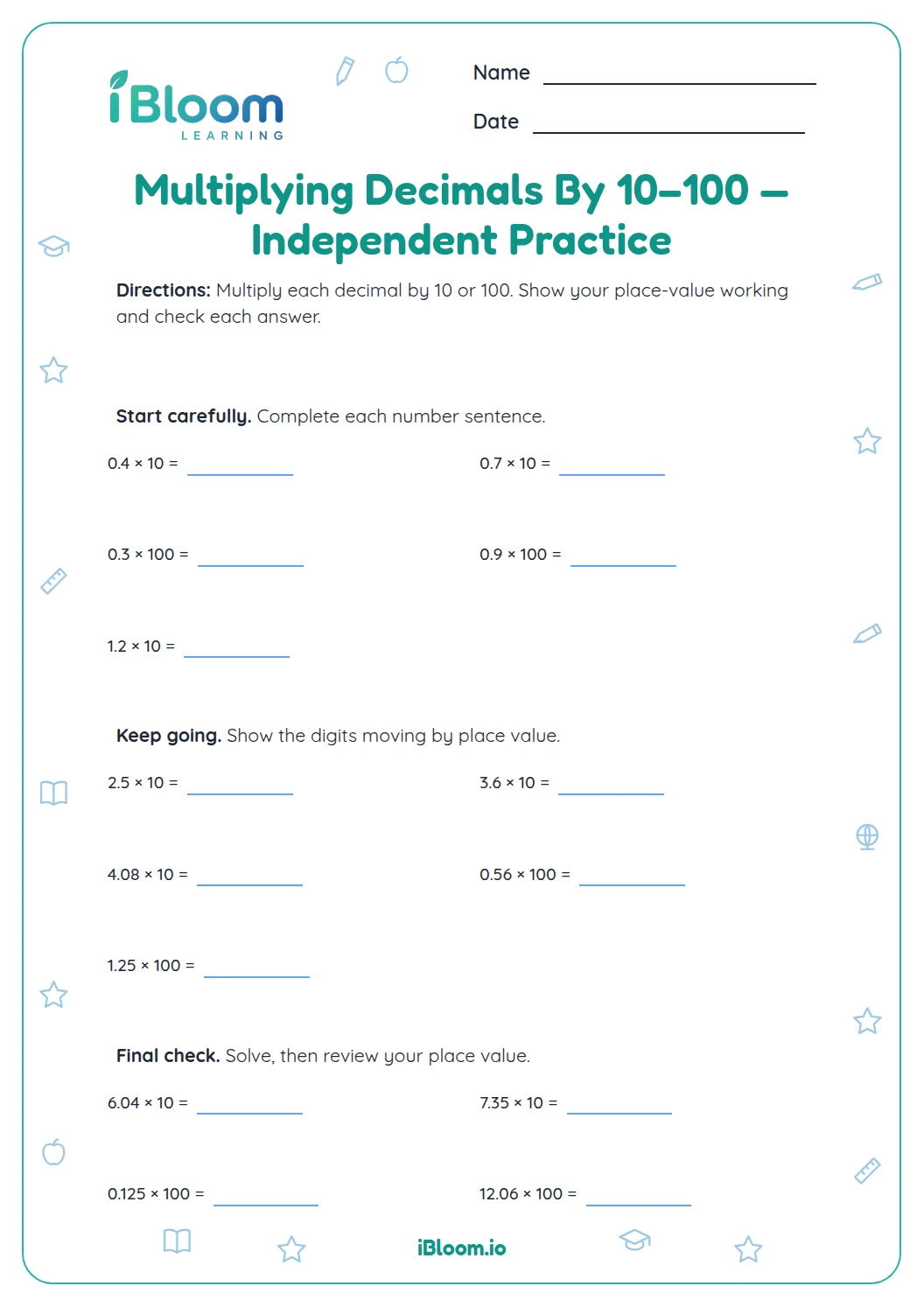
This Grade 5 printable uses prices, lengths, containers, and repeated quantities to practice multiplying decimals by whole numbers. Students first choose a multiplication expression, then solve real-world problems, and finish by selecting reasonable estimates. Decimal factors have two digits after the decimal point throughout. The work connects decimal computation to place-value strategies and written methods in CCSS 5.NBT.B.7.
Aligned to 5.NBT.B.7
How does the practice build?
Part A asks students to select an expression for four situations. Part B has eight decimal multiplication word problems. Part C asks students to choose reasonable estimates for two more products.
The factors have two decimal places and whole-number multipliers. The key includes units and money notation.
- Part A: match four stories to expressions
- Part B: solve eight real-world problems
- Part C: estimate two products
How do you multiply a decimal by a whole number?
Multiply as with whole numbers, then use the decimal factor’s place value to place the decimal in the product. Estimate to see whether the answer is reasonable.
- 14 × $2.35 = $9.40
- 2Estimate: 4 × $2 is about $8.
How can an estimate check the answer?
Round the decimal to a nearby whole number, multiply, and compare the estimate with the exact product. For 7 boxes at 2.18 pounds each, 7 × 2 is about 14 pounds.
How to solve each word problem
- 1Underline the decimal amount and the number of equal groups or items.
- 2Write a multiplication equation with the decimal as one factor.
- 3Multiply and use place value to place the decimal in the product.
- 4Estimate or compare with a nearby whole-number product.
- 5Write the unit named in the problem with the answer.
Decimal multiplication slips to check
The mistake
Placing the decimal without considering the decimal factor’s value.
The fix
Multiply the digits, then use the number of decimal places in the decimal factor.
The mistake
Adding the decimal amount to the whole-number count instead of multiplying.
The fix
Look for words such as “each,” “per,” or repeated equal groups.
The mistake
Leaving off the unit from a word-problem answer.
The fix
Read the question again and copy its unit, such as meters or dollars.
Common Core alignment
Students use decimal place value and multiplication to solve the situations.
Use place-value strategies and written methods to multiply decimals.
On this sheet: Students multiply decimals by whole numbers, connect products to contexts, and show written work.
Show the official wordingHide the official wording
Add, subtract, multiply, and divide decimals to hundredths, using concrete models or drawings and strategies based on place value, properties of operations, and/or the relationship between addition and subtraction; relate the strategy to a written method and explain the reasoning used.
What to practice next
Make more practice
Further reading
Questions parents and teachers ask
Do students write an equation?
Part A asks students to select the multiplication expression that matches each situation. In Part B, students calculate the total from the repeated amount and number of groups. Writing an equation makes the two factors clear and helps keep track of the units.
How should students place the decimal point?
Multiply the digits, then use the decimal factor’s place value to place the decimal in the product. Estimate to check the size. Four times $2.35 should be a little less than four times $2.50, or $10, so $9.40 is reasonable.
Are money answers written with dollar signs?
Yes. The answer key uses dollar signs for costs, such as $9.40 and $36.00. Measurement answers keep units, including miles, liters, yards, ounces, cups, and pounds, as stated in the situations on the worksheet. The units distinguish what each product measures.
What does Part C ask students to do?
Part C gives two situations and asks students to choose a reasonable estimate. Seven boxes at 2.18 pounds each is close to seven groups of 2 pounds, or about 14 pounds, which checks whether the exact product is sensible. The key includes the correct estimate alongside each exact product.
What kinds of situations are included?
The questions use repeated prices, trail distances, container amounts, ribbons, seeds, flour, shuttle travel, box weights, and servings. Each situation repeats a decimal amount a whole number of times, then asks for a product or estimate. The key keeps the relevant unit.