Free printable practice
Factoring Practice Activities
Grade 5 factoring worksheets for factors, divisibility rules, prime numbers, prime factor trees, GCF, and LCM practice.
Explore Factoring
Free printable worksheet PDFs
Preview every available page, then download the free worksheet PDF for home, homeschool, tutoring, or classroom practice.
Preview the exact activity before downloading it.
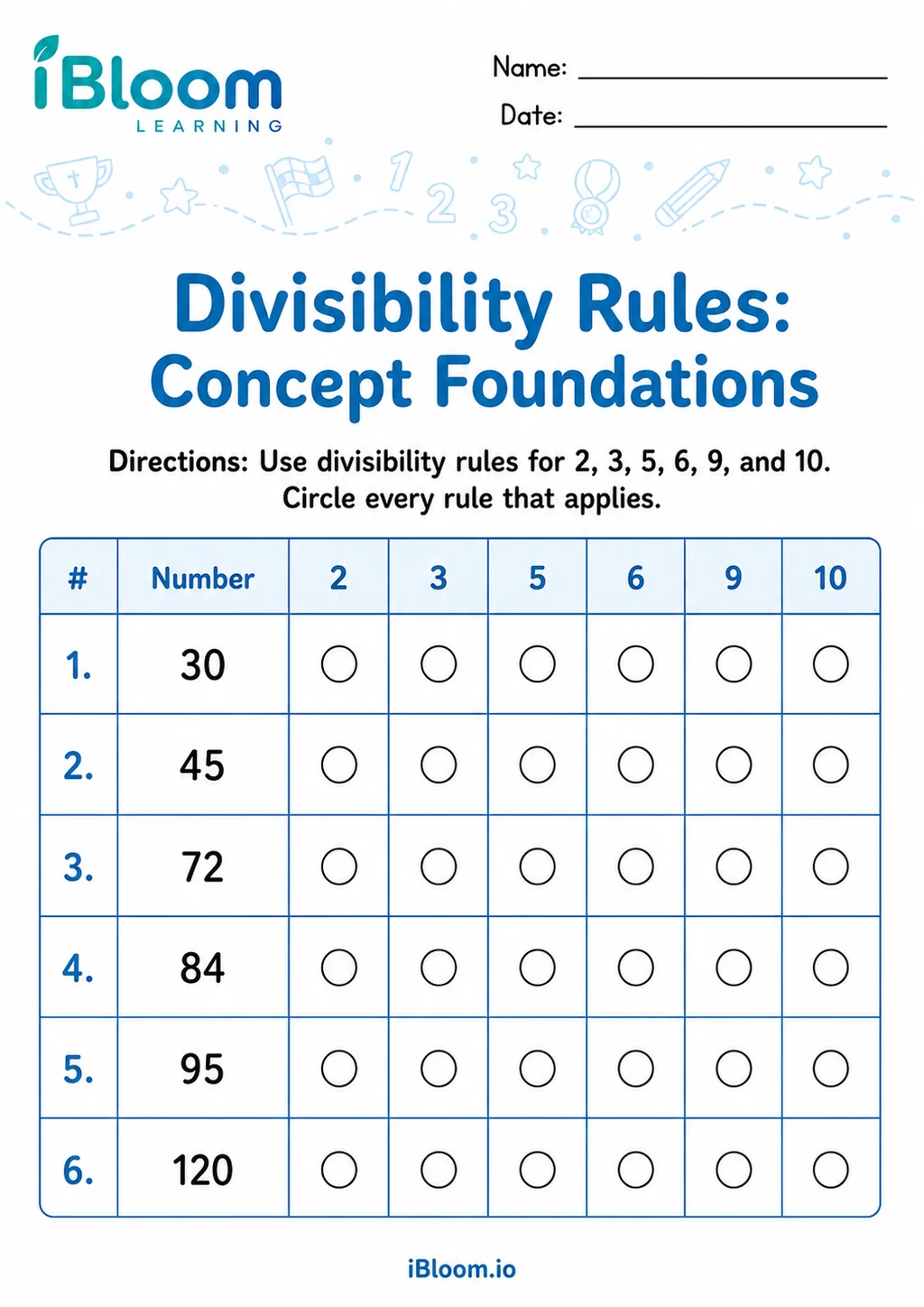 Divisibility Rules — Concept FoundationsGrade 5 students practise using divisibility rules to identify factors quickly and make smarter factoring decisions. This Grade 5 foundations worksheet adds concise teaching notes, worked examples, and supported first attempts.Grade 5Free PDF preview
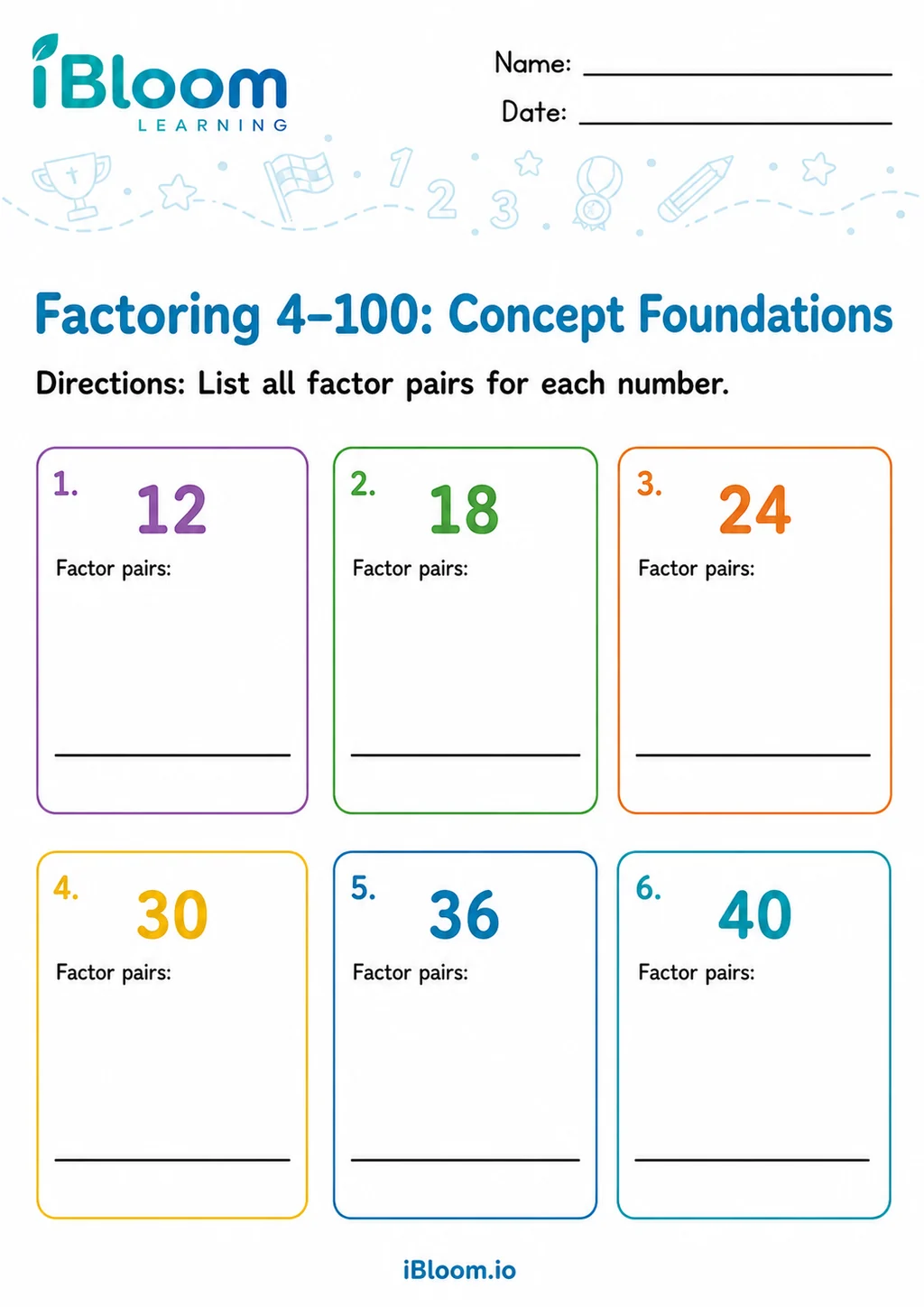 Factoring 4–100 — Concept FoundationsGrade 5 students practise finding factor pairs and listing all factors for whole numbers from 4 to 100. This Grade 5 foundations worksheet adds concise teaching notes, worked examples, and supported first attempts.Grade 5Free PDF preview
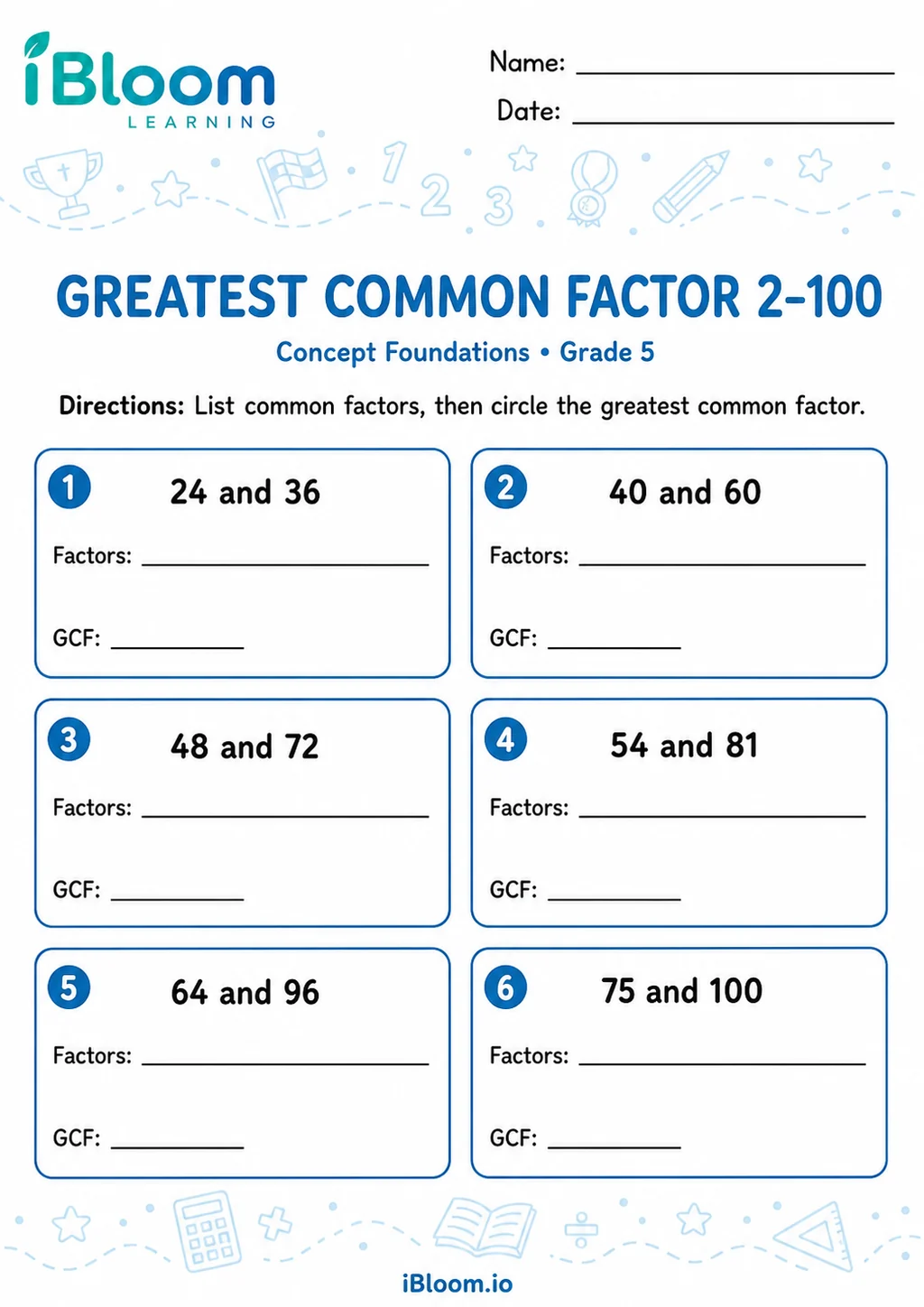 Greatest Common Factor 2–100 — Concept FoundationsGrade 5 students practice finding the greatest common factor of numbers from 2 to 100 using factor lists, divisibility, and comparison. This Grade 5 foundations worksheet adds concise teaching notes, worked examples, and supported first attempts.Grade 5Free PDF preview
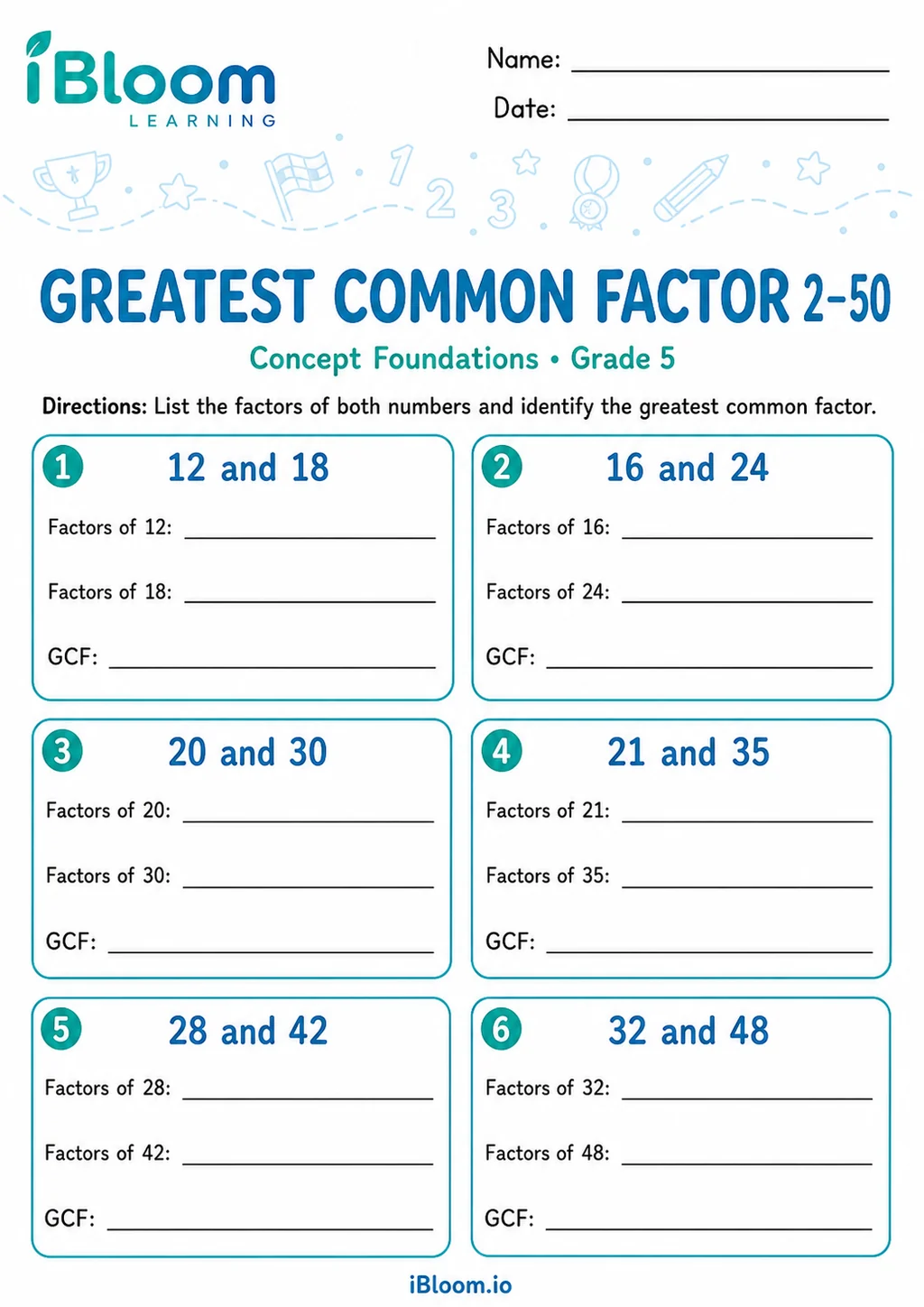 Greatest Common Factor 2–50 — Concept FoundationsPrintable Grade 5 worksheets for finding the greatest common factor of numbers from 2 to 50 through factor lists, comparisons, and reasoning practice. This Grade 5 foundations worksheet adds concise teaching notes, worked examples, and supported first attempts.Grade 5Free PDF preview
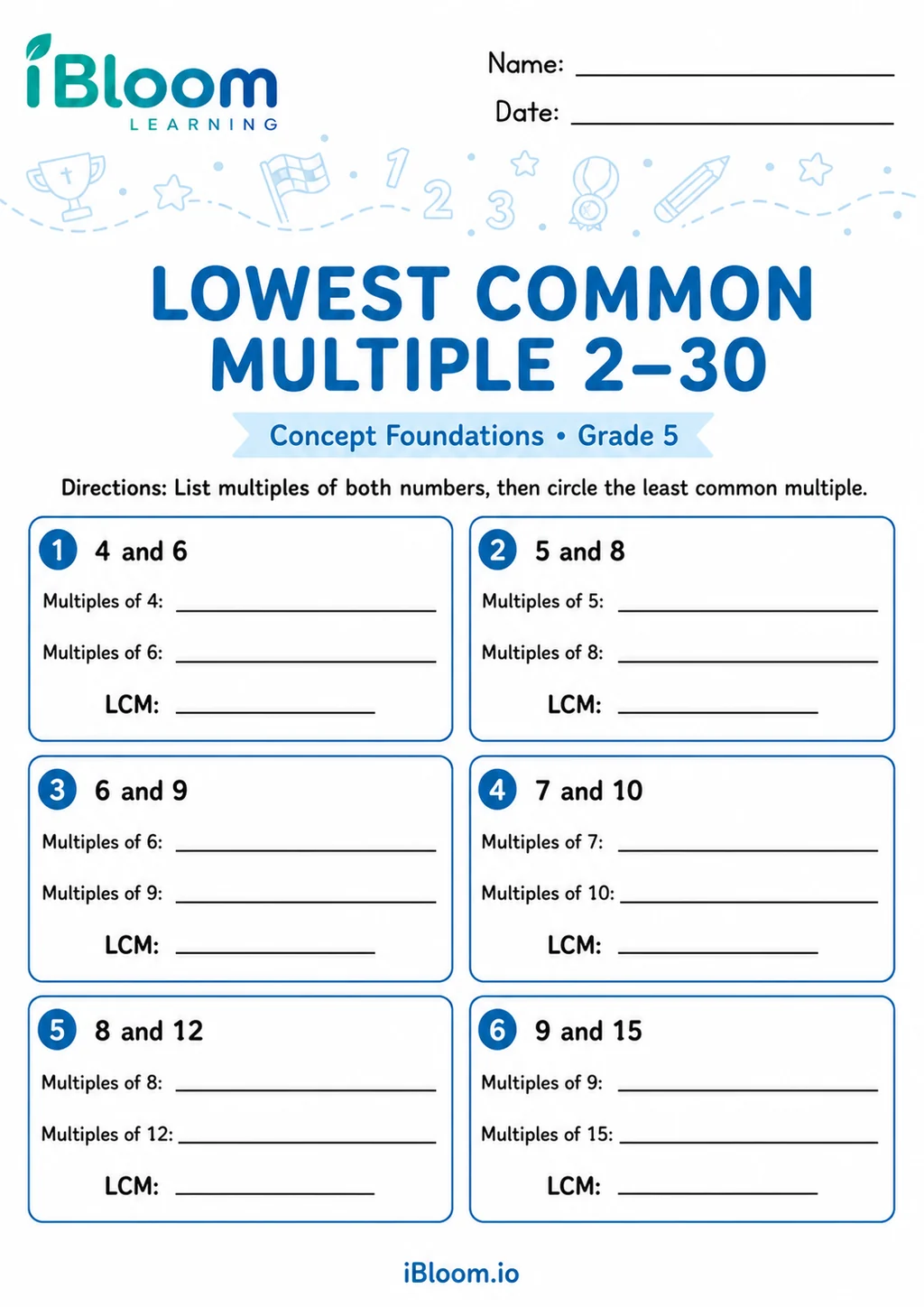 Lowest Common Multiple 2–30 — Concept FoundationsGrade 5 students practise finding the lowest common multiple of numbers from 2 to 30 using multiples, factor knowledge, and organized checking. This Grade 5 foundations worksheet adds concise teaching notes, worked examples, and supported first attempts.Grade 5Free PDF preview
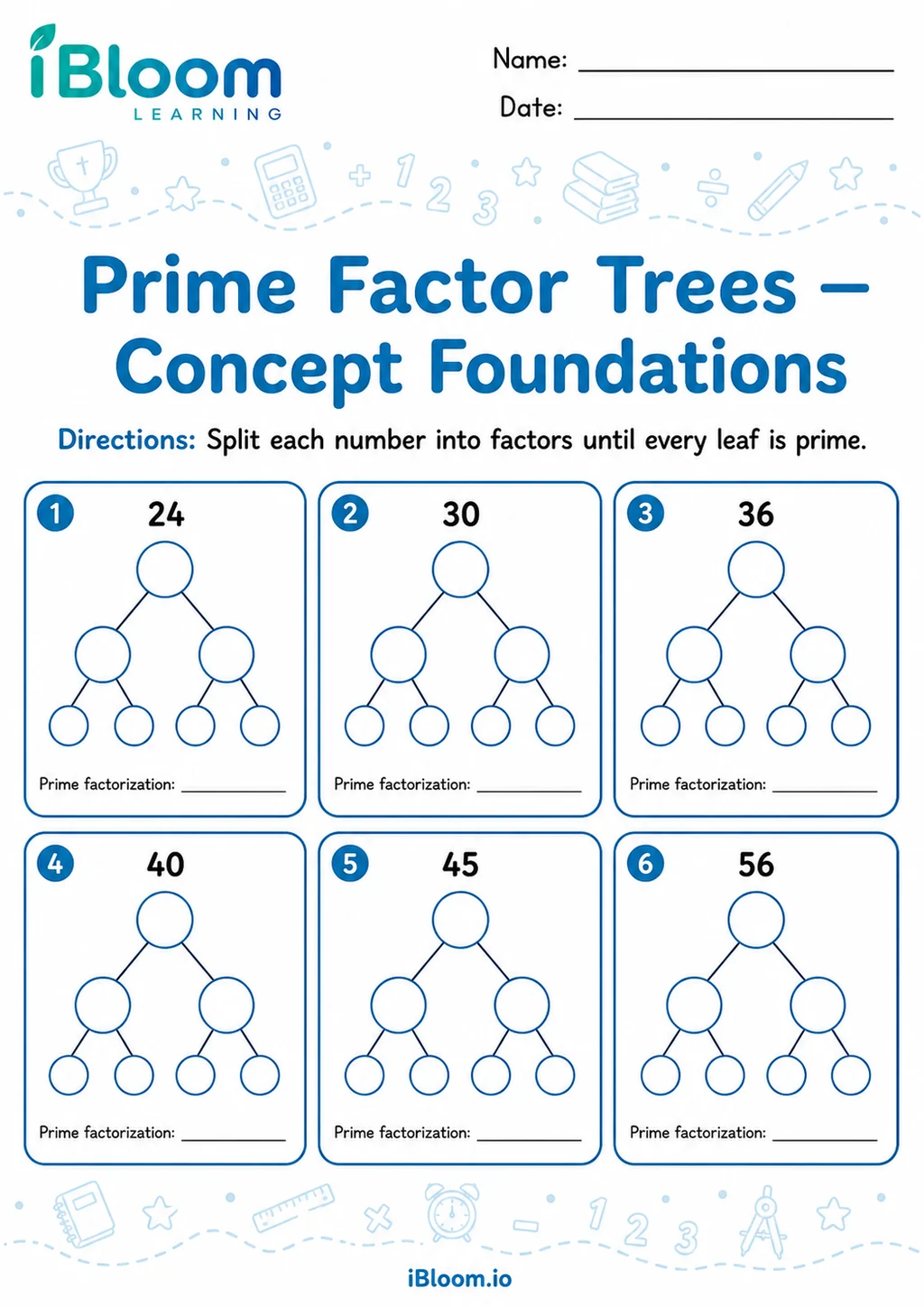 Prime Factor Trees — Concept FoundationsExplore prime factor trees practice activities within Factoring Practice Activities, organised so children, families, and elementary teachers can move from broad learning areas to focused printable practice. This Grade 5 foundations worksheet adds concise teaching notes, worked examples, and supported first attempts.Grade 5Free PDF preview
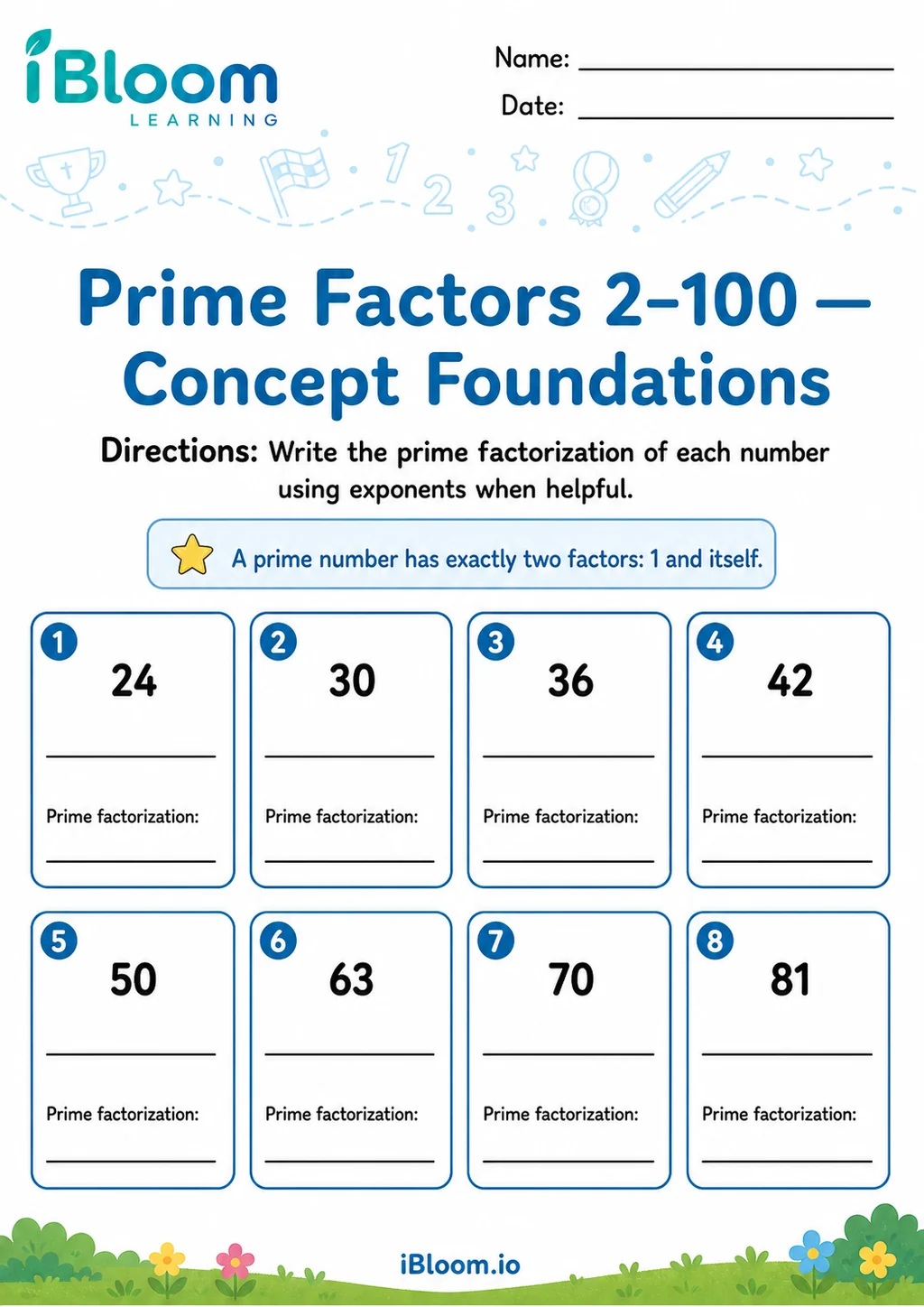 Prime Factors 2–100 — Concept FoundationsGrade 5 students practise finding prime factors of numbers from 2 to 100 using factor trees, division steps, and clear prime factor lists. This Grade 5 foundations worksheet adds concise teaching notes, worked examples, and supported first attempts.Grade 5Free PDF preview
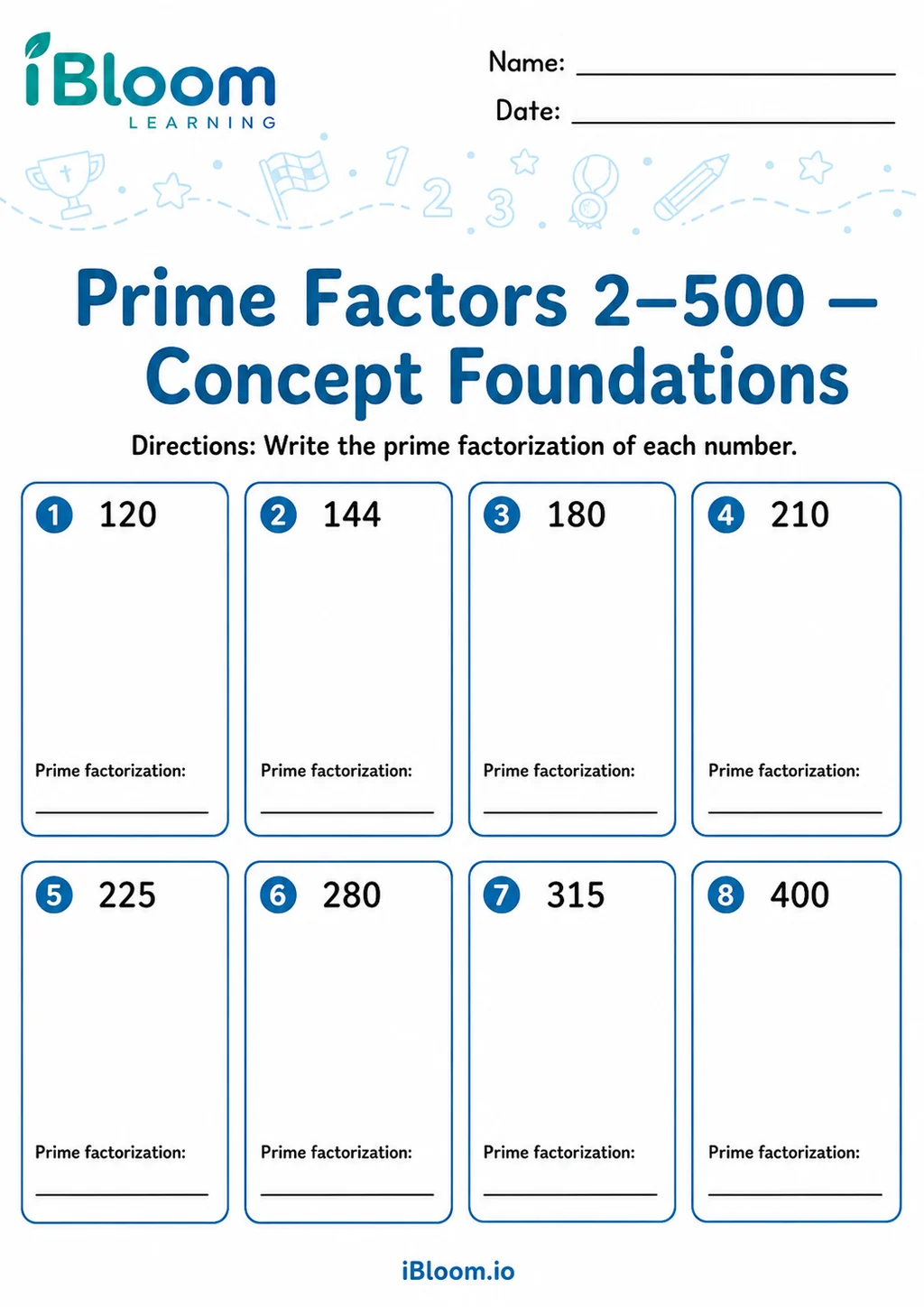 Prime Factors 2–500 — Concept FoundationsExplore prime factors 2 500 practice activities within Factoring Practice Activities, organised so children, families, and elementary teachers can move from broad learning areas to focused printable practice. This Grade 5 foundations worksheet adds concise teaching notes, worked examples, and supported first attempts.Grade 5Free PDF preview
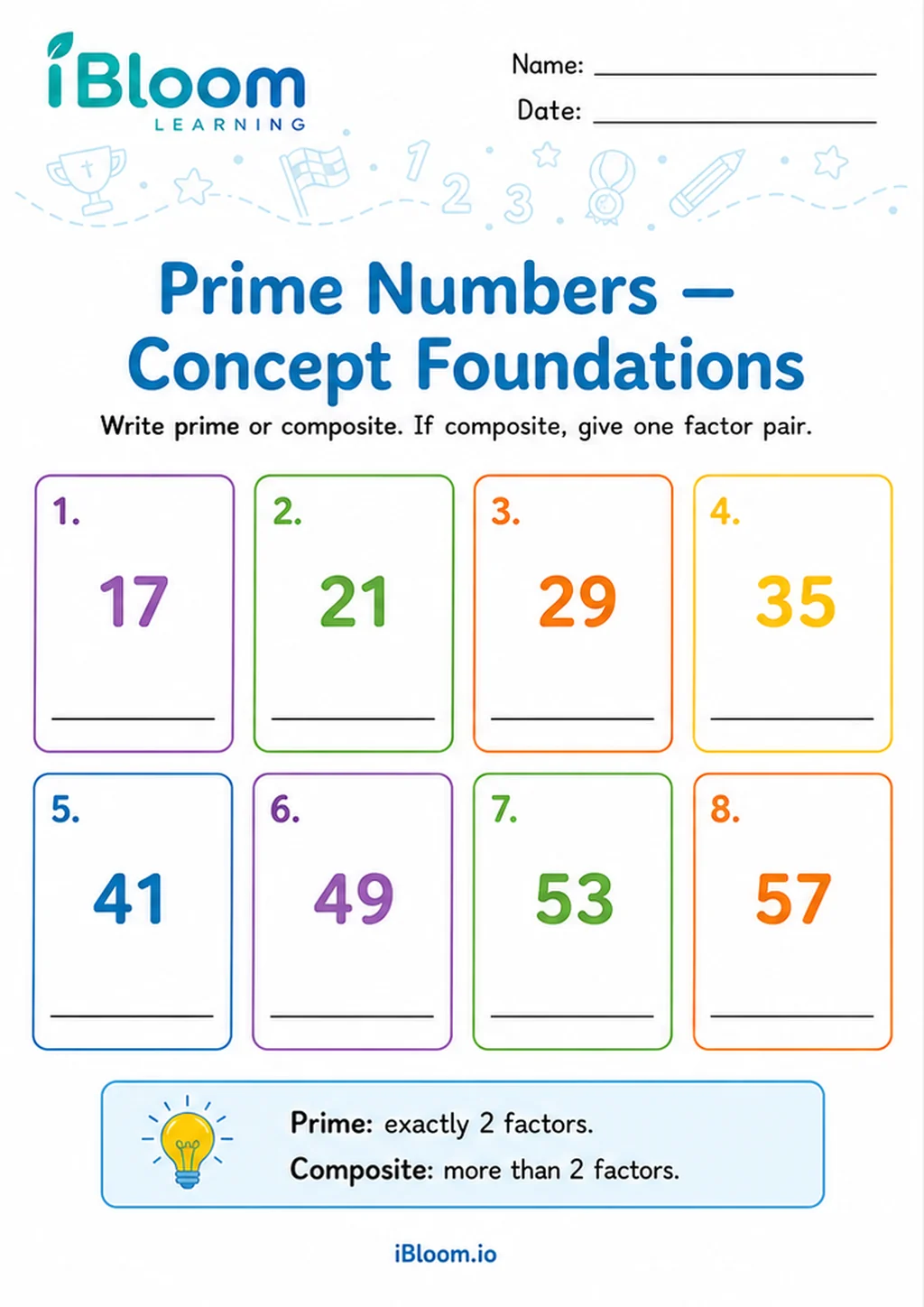 Prime Numbers — Concept FoundationsGrade 5 worksheets that help students identify prime numbers by testing factors, recognizing composites, and using divisibility clues. This Grade 5 foundations worksheet adds concise teaching notes, worked examples, and supported first attempts.Grade 5Free PDF preview
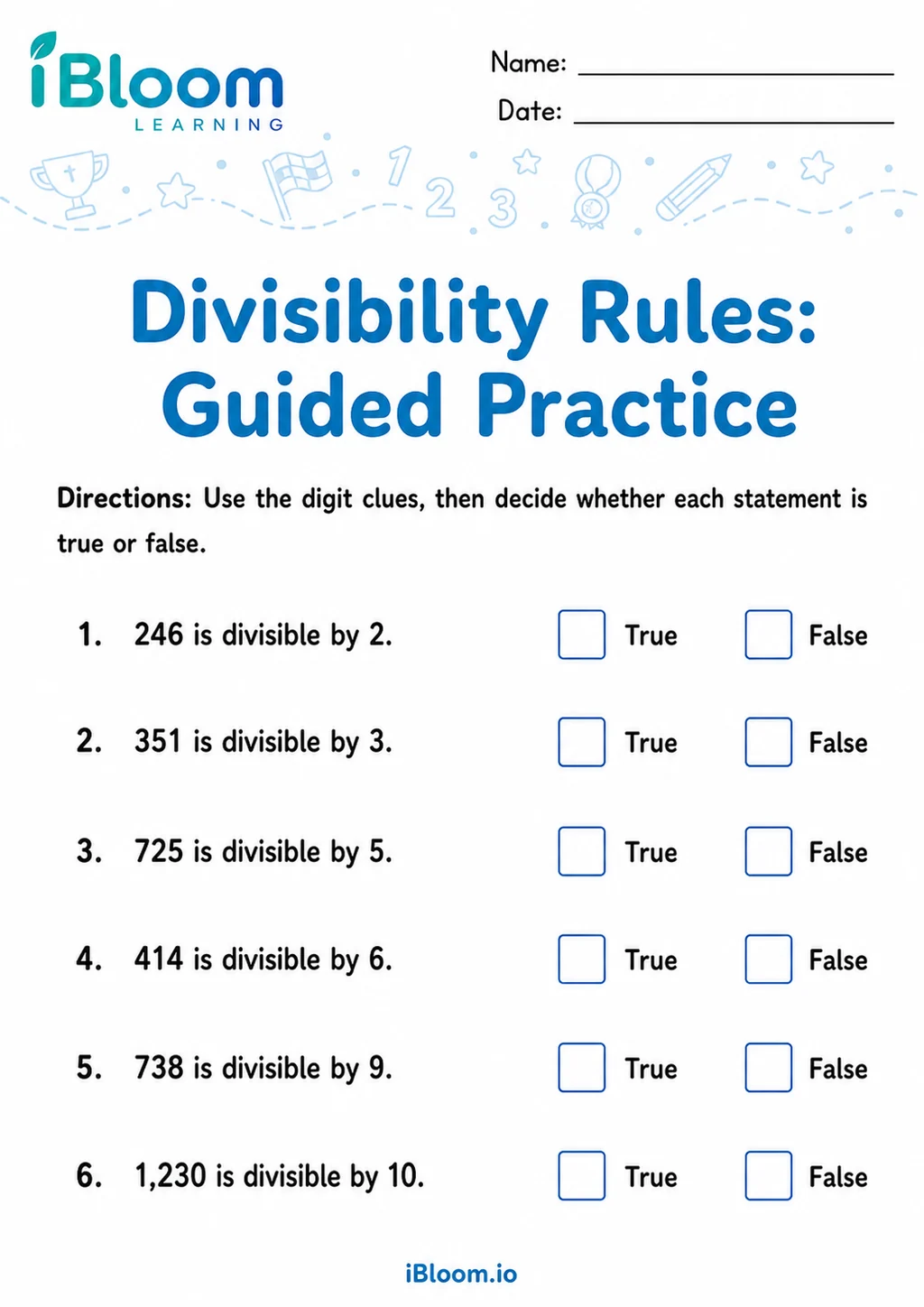 Divisibility Rules — Guided PracticeGrade 5 students practise using divisibility rules to identify factors quickly and make smarter factoring decisions. This Grade 5 guided-practice worksheet progresses from prompts and checkpoints to independent questions.Grade 5Free PDF preview
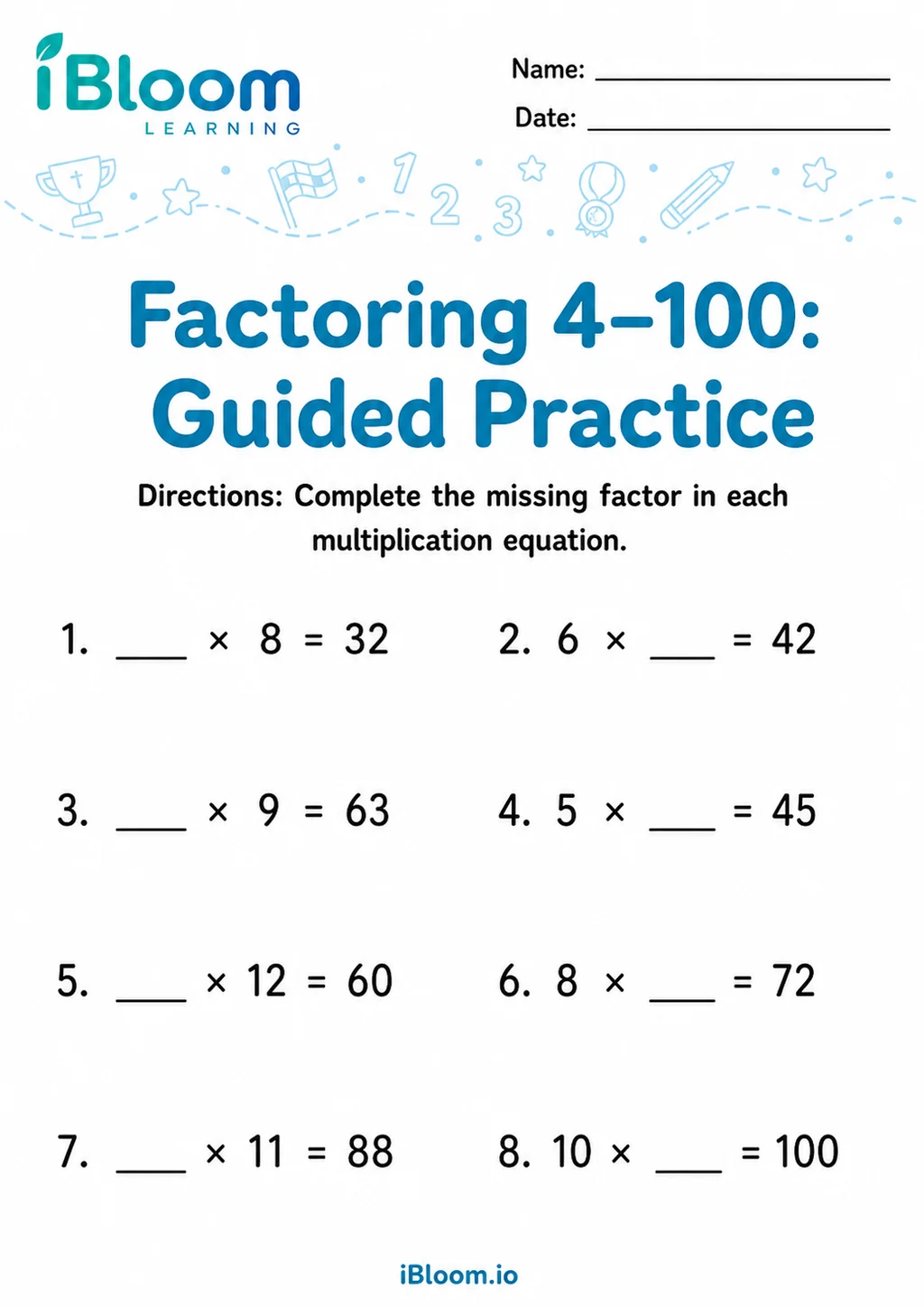 Factoring 4–100 — Guided PracticeGrade 5 students practise finding factor pairs and listing all factors for whole numbers from 4 to 100. This Grade 5 guided-practice worksheet progresses from prompts and checkpoints to independent questions.Grade 5Free PDF preview
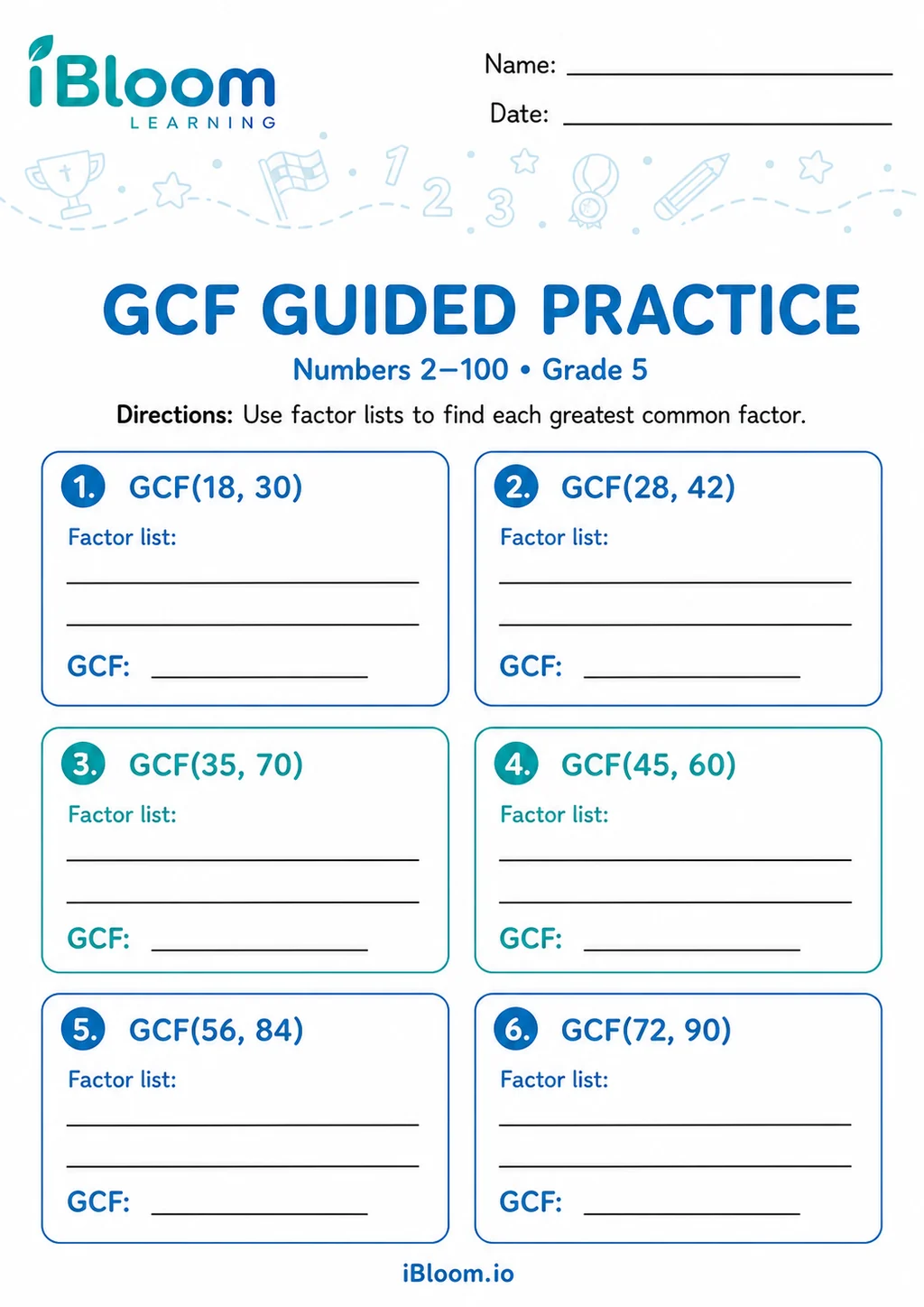 Greatest Common Factor 2–100 — Guided PracticeGrade 5 students practice finding the greatest common factor of numbers from 2 to 100 using factor lists, divisibility, and comparison. This Grade 5 guided-practice worksheet progresses from prompts and checkpoints to independent questions.Grade 5Free PDF preview
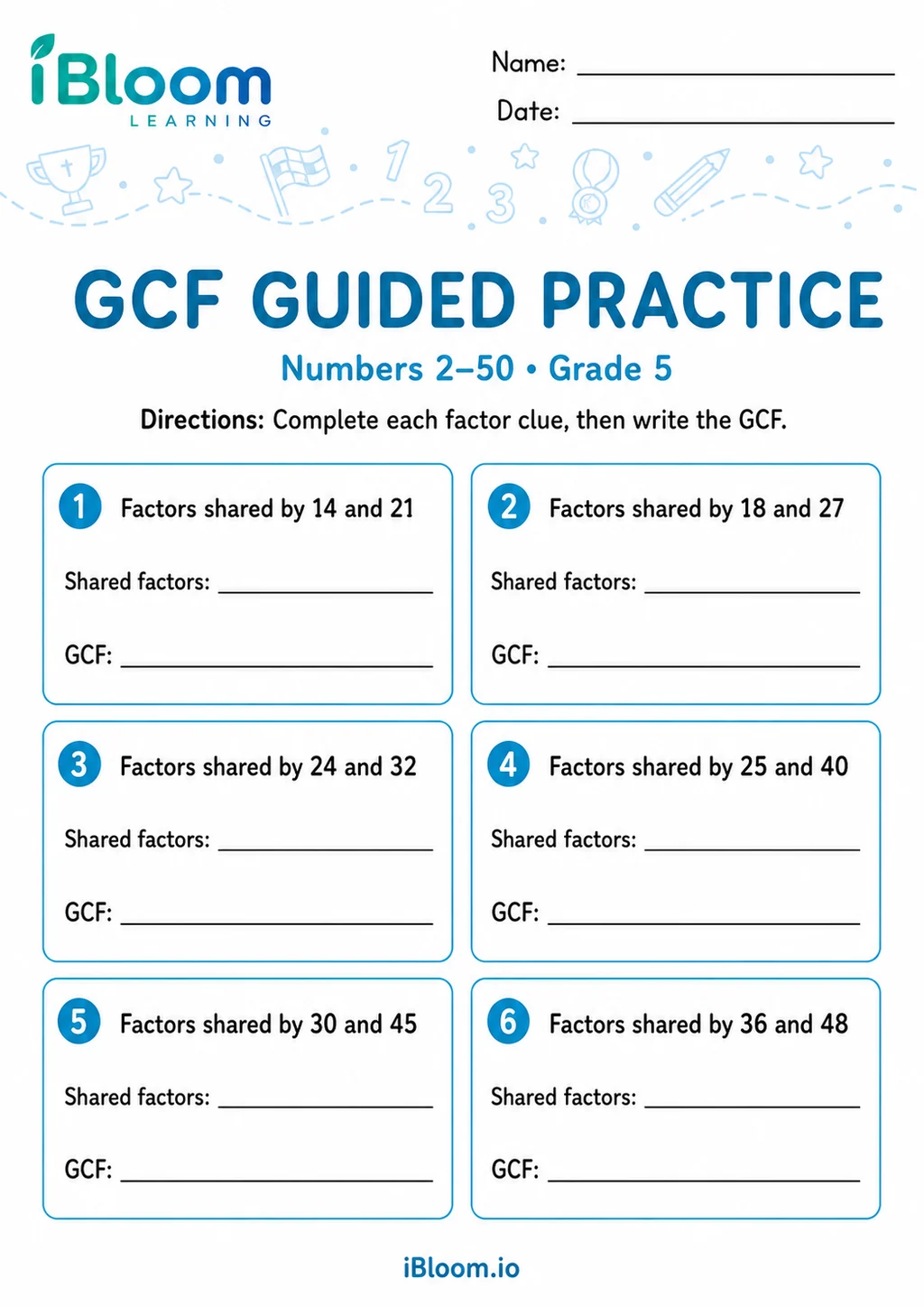 Greatest Common Factor 2–50 — Guided PracticePrintable Grade 5 worksheets for finding the greatest common factor of numbers from 2 to 50 through factor lists, comparisons, and reasoning practice. This Grade 5 guided-practice worksheet progresses from prompts and checkpoints to independent questions.Grade 5Free PDF preview
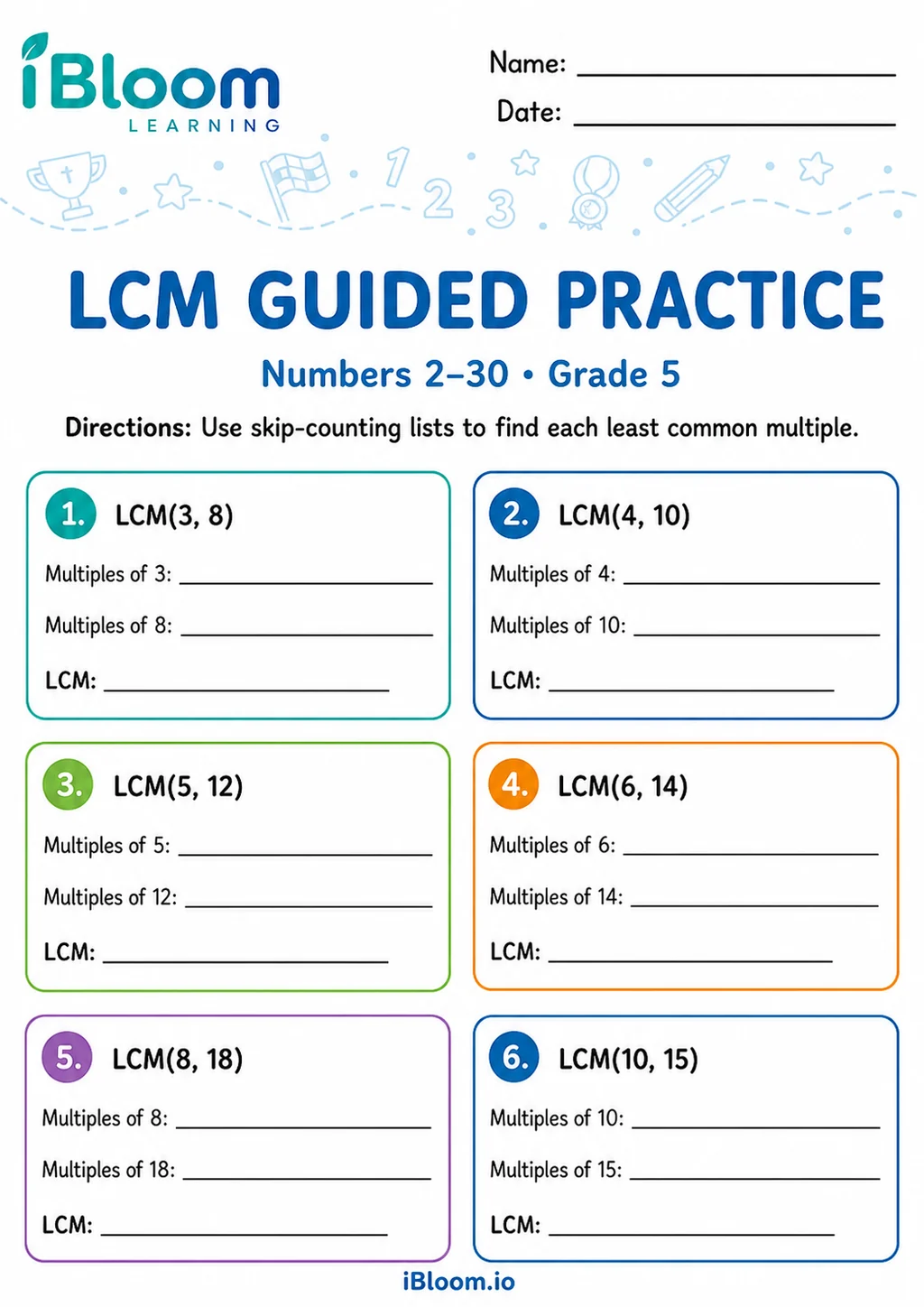 Lowest Common Multiple 2–30 — Guided PracticeGrade 5 students practise finding the lowest common multiple of numbers from 2 to 30 using multiples, factor knowledge, and organized checking. This Grade 5 guided-practice worksheet progresses from prompts and checkpoints to independent questions.Grade 5Free PDF preview
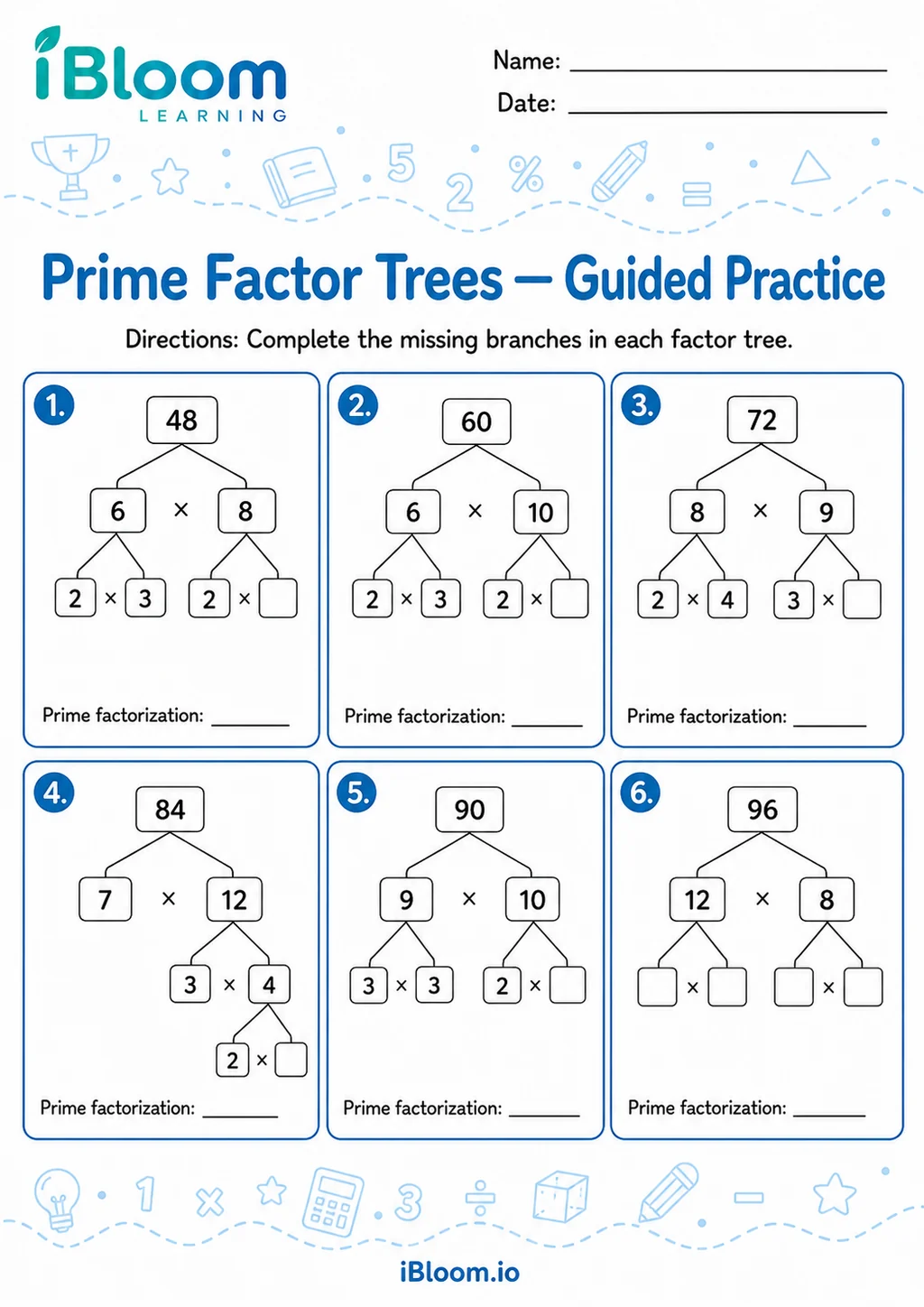 Prime Factor Trees — Guided PracticeExplore prime factor trees practice activities within Factoring Practice Activities, organised so children, families, and elementary teachers can move from broad learning areas to focused printable practice. This Grade 5 guided-practice worksheet progresses from prompts and checkpoints to independent questions.Grade 5Free PDF preview
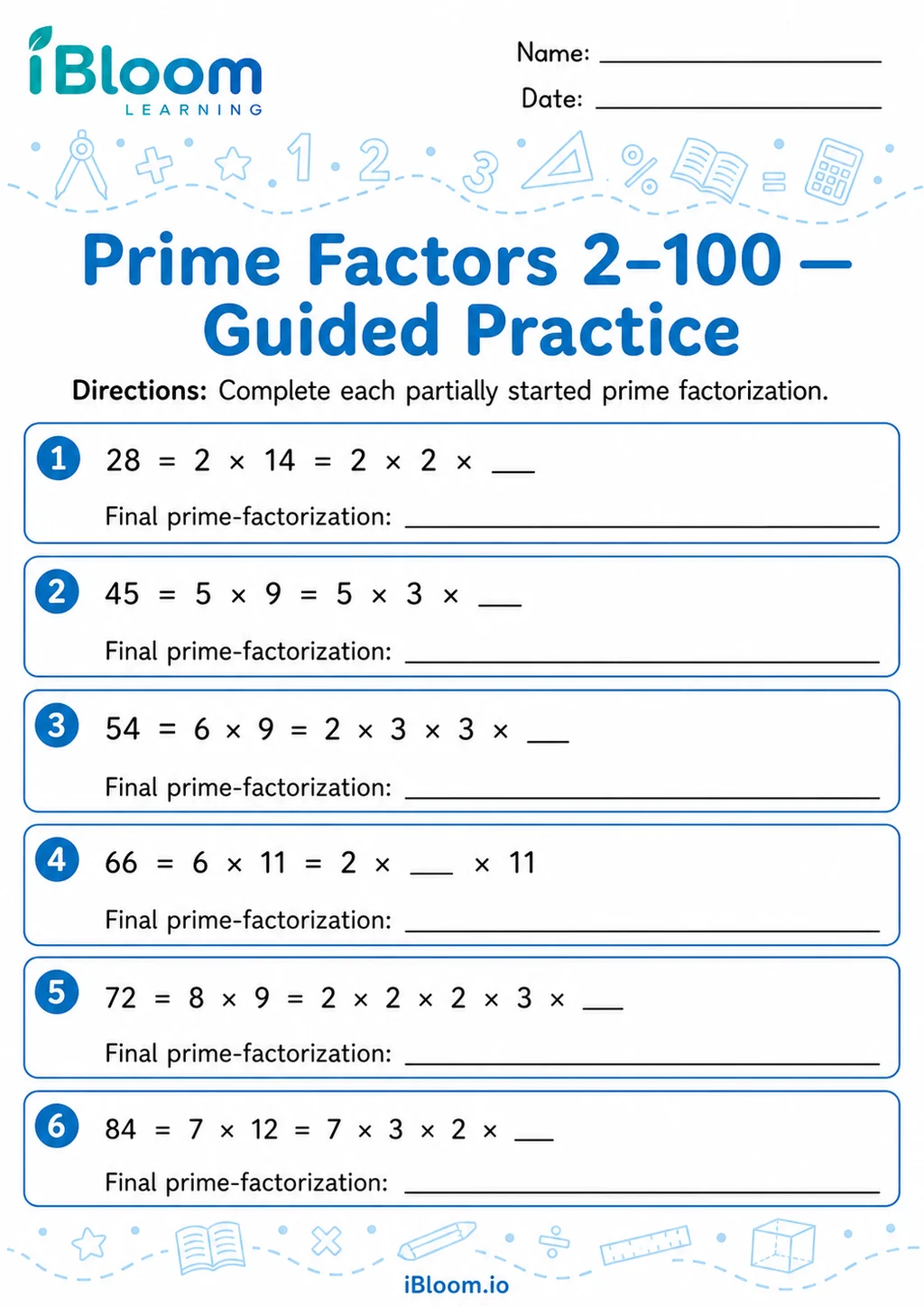 Prime Factors 2–100 — Guided PracticeGrade 5 students practise finding prime factors of numbers from 2 to 100 using factor trees, division steps, and clear prime factor lists. This Grade 5 guided-practice worksheet progresses from prompts and checkpoints to independent questions.Grade 5Free PDF preview
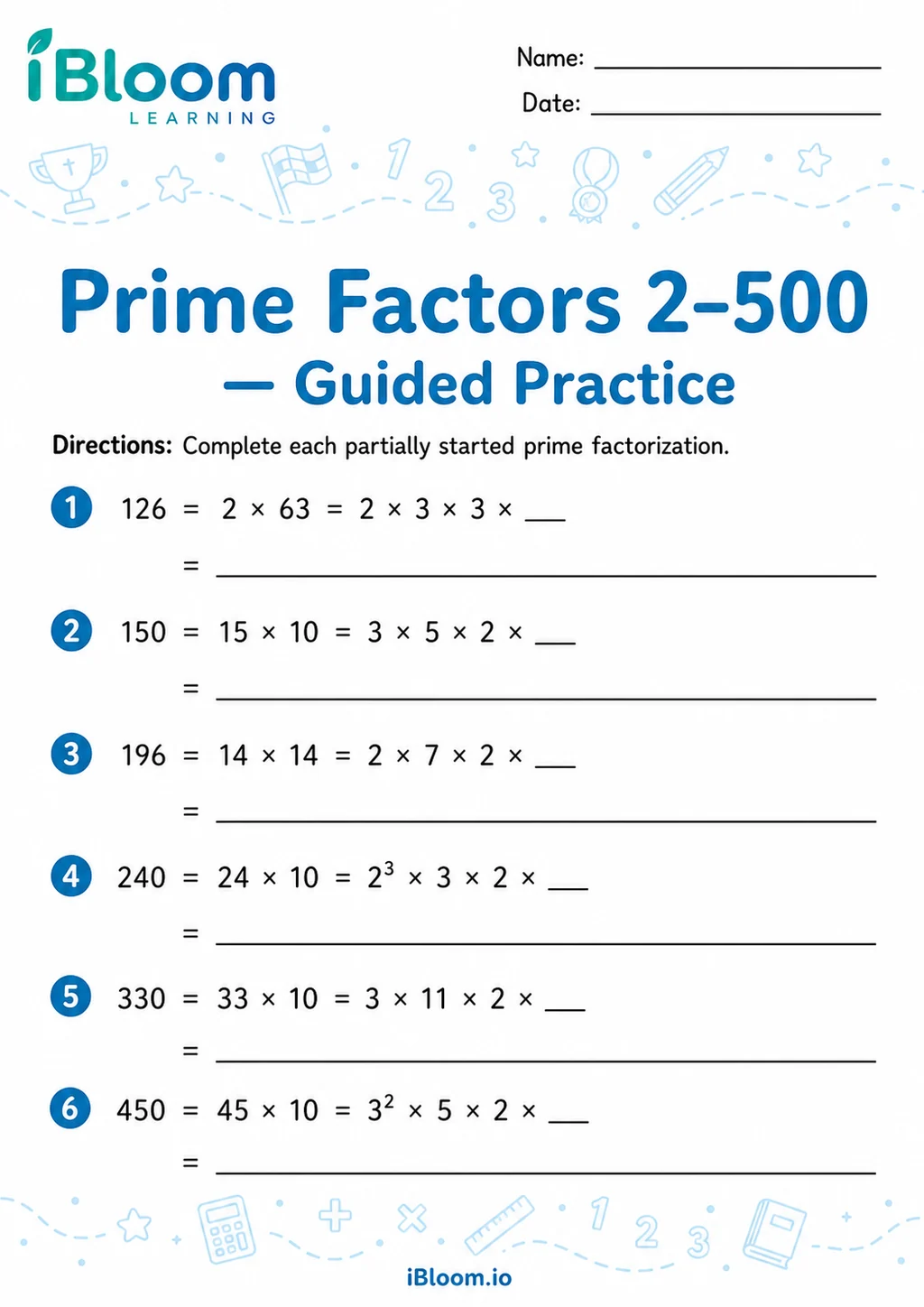 Prime Factors 2–500 — Guided PracticeExplore prime factors 2 500 practice activities within Factoring Practice Activities, organised so children, families, and elementary teachers can move from broad learning areas to focused printable practice. This Grade 5 guided-practice worksheet progresses from prompts and checkpoints to independent questions.Grade 5Free PDF preview
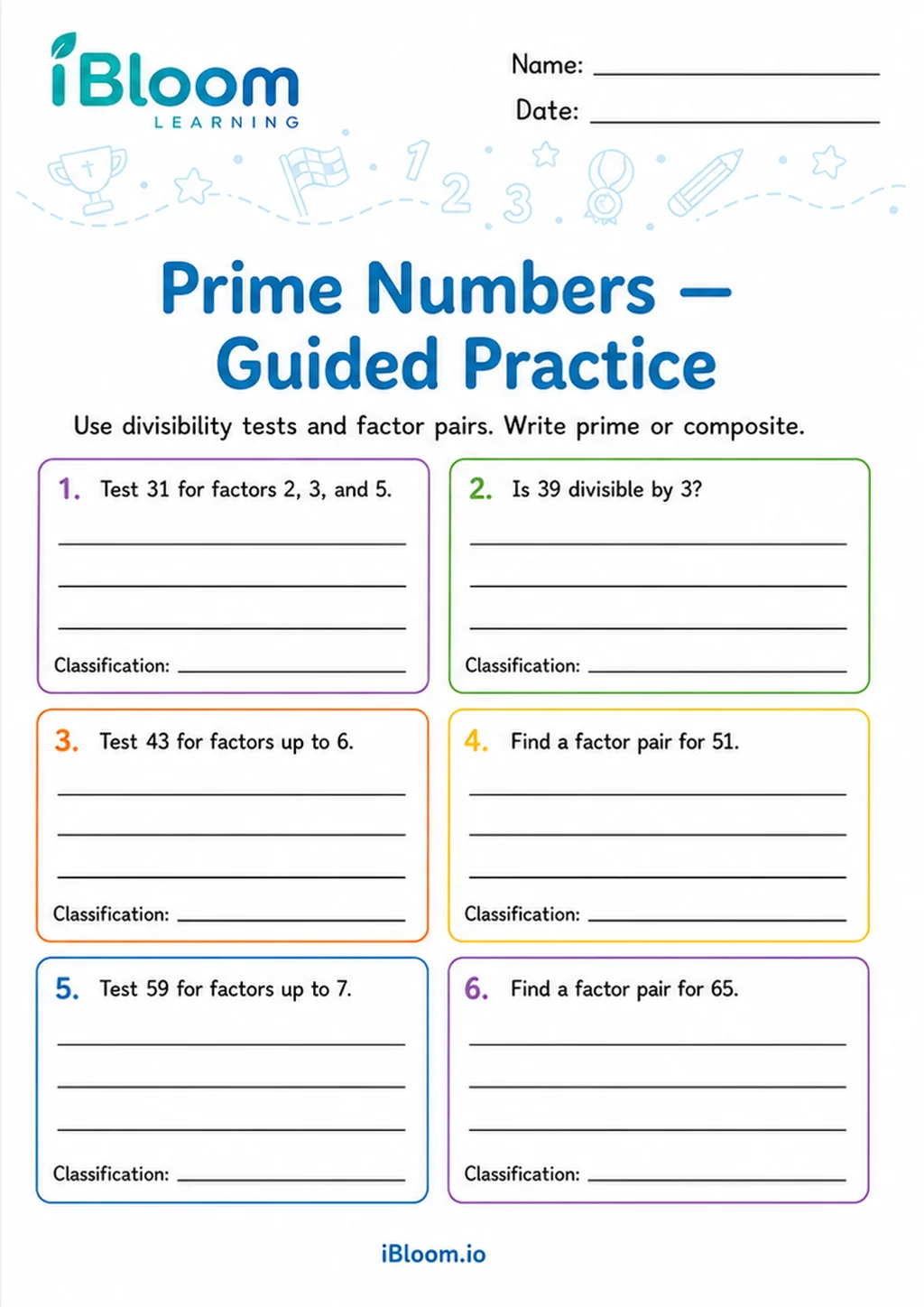 Prime Numbers — Guided PracticeGrade 5 worksheets that help students identify prime numbers by testing factors, recognizing composites, and using divisibility clues. This Grade 5 guided-practice worksheet progresses from prompts and checkpoints to independent questions.Grade 5Free PDF preview
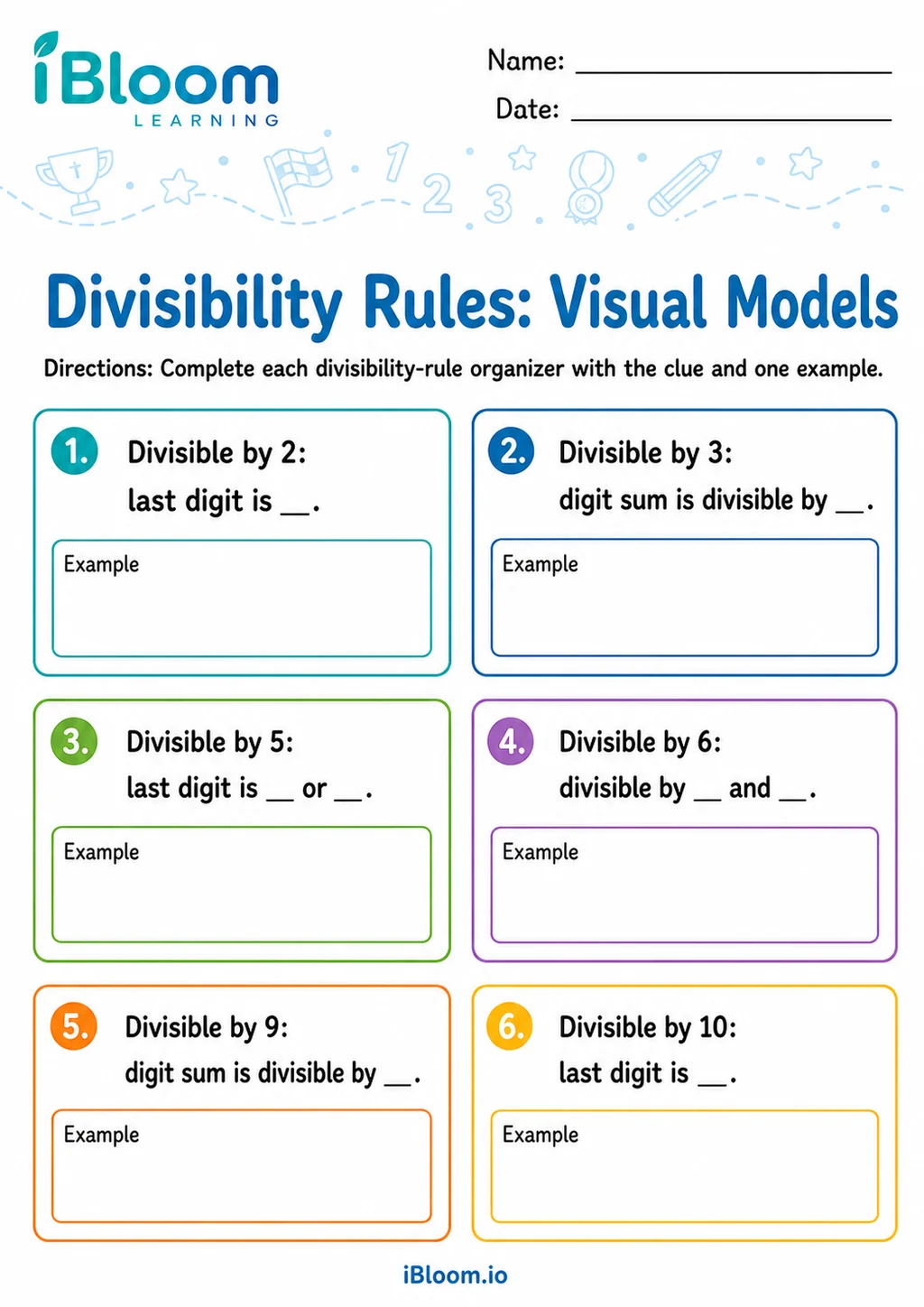 Divisibility Rules — Visual ModelsGrade 5 students practise using divisibility rules to identify factors quickly and make smarter factoring decisions. This Grade 5 visual-model worksheet connects suitable diagrams, tables, number lines, or place-value models to mathematical notation.Grade 5Free PDF preview
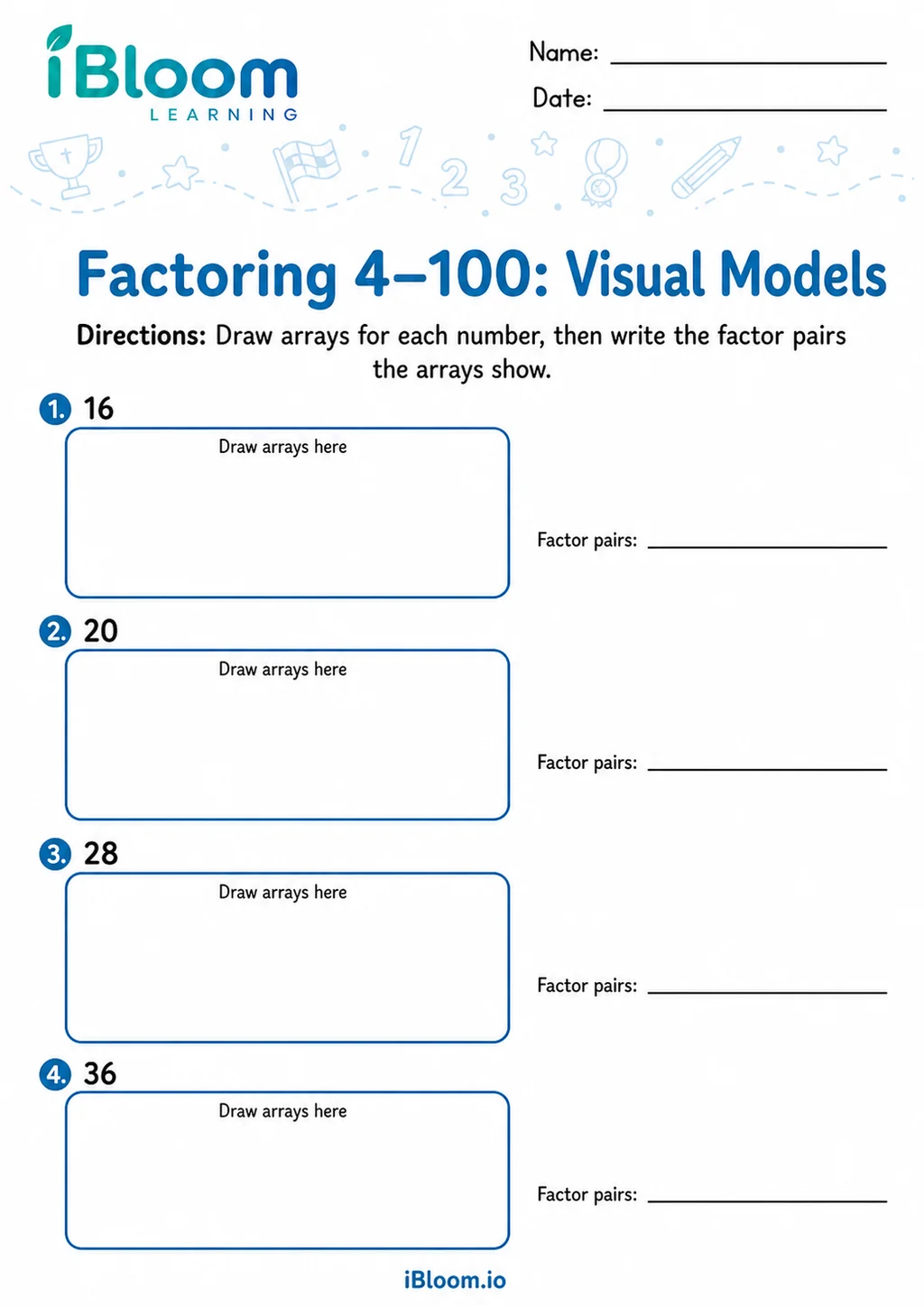 Factoring 4–100 — Visual ModelsGrade 5 students practise finding factor pairs and listing all factors for whole numbers from 4 to 100. This Grade 5 visual-model worksheet connects suitable diagrams, tables, number lines, or place-value models to mathematical notation.Grade 5Free PDF preview
Practice that builds confidence
From factor pairs to prime numbers
These Grade 5 math worksheets help children strengthen factoring skills by finding factor pairs, identifying prime and composite numbers, and using divisibility rules to reason about numbers efficiently.
The printable activities include factoring numbers from 4 to 100, finding greatest common factors, working with least common multiples, and breaking numbers into prime factors with factor trees, including practice up to 500.
Students begin by listing factor pairs and noticing how multiplication facts connect to division. A number such as 36 can be shown as 1 × 36, 2 × 18, 3 × 12, 4 × 9, and 6 × 6. This leads naturally to the difference between prime numbers, which have exactly two factors, and composite numbers, which have more than two.

Using divisibility rules with confidence
The worksheets give Grade 5 learners repeated practice applying rules for divisibility instead of guessing. Children check even numbers for divisibility by 2, use digit sums for 3 and 9, look at the last digit for 5 and 10, and combine reasoning when testing larger numbers. These habits make factoring numbers from 4 to 100 more accurate and less time-consuming.
GCF, LCM, and prime factor trees
Practice progresses from finding the greatest common factor of two numbers up to 50, then up to 100, to finding the lowest common multiple of two numbers up to 30. Prime factor pages include numbers up to 100 and up to 500, with factor trees that show how every branch ends in prime factors. Students learn to compare shared prime factors for GCF and build complete factor sets for LCM.
A simple parent routine
At home, choose one number and ask your child to list factor pairs in order, starting with 1 × the number. Next, ask whether the number is prime or composite and which divisibility rules helped. Finish with two numbers, such as 24 and 36, and have your child circle common factors before naming the GCF.

Classroom uses and errors to watch
Teachers can use these printables for small-group reteaching, math centers, exit tickets, or fluency review before fractions. Common errors include calling 1 a prime number, mixing up factors and multiples, stopping factor lists too early, or finding a common multiple when the question asks for a greatest common factor. Encourage students to show factor pairs or a tree so their reasoning is visible.

Free printable PDF download
Use this grade 5 factoring worksheet page to preview the activity, print it, or download it as a PDF for quick practice. It works well for homework, homeschool lessons, tutoring, morning work, revision, and classroom centers.
Answers and answer key support
After the child completes the worksheet independently, parents and teachers can use the answer support or answer key information to check the work, review mistakes, and choose the next practice step.
Why iBloom worksheets help
Each page focuses on one step in the factoring progression, so students are not asked to jump from basic factor pairs straight to prime factorization. A child-friendly strategy is: “test, pair, tree, compare.” Test with divisibility rules, pair factors neatly, build a factor tree when needed, and compare factors or multiples to solve GCF and LCM problems.
Helpful answers
Frequently asked questions
What factoring skills are included in these Grade 5 worksheets?
They cover finding factors of numbers from 4 to 100, identifying prime numbers, applying divisibility rules, finding GCF and LCM, and using prime factor trees for numbers up to 500.
How do factor trees help with prime factorization?
A factor tree breaks a composite number into smaller factor pairs until every branch ends in a prime number. This helps students see the complete prime factorization clearly.
What is the difference between GCF and LCM?
The greatest common factor is the largest factor shared by two numbers. The least common multiple is the smallest multiple shared by two numbers.
Should my child memorize divisibility rules before using these pages?
Memorization helps, but it is not required at first. The worksheets provide practice that helps children learn rules such as checking the last digit for 2, 5, and 10 or using digit sums for 3 and 9.
What common mistake should I watch for during factoring practice?
Many students confuse factors with multiples. A factor divides into a number evenly, while a multiple is the result of multiplying that number by another whole number.
Is this grade 5 factoring worksheet free?
Yes. You can preview it for free and use the printable worksheet for home or classroom practice.
Can I download this grade 5 factoring worksheet as a PDF?
Yes. Use the worksheet download option to save a printable PDF, or print the worksheet directly from the page.
Does this grade 5 factoring worksheet include answers or an answer key?
When the activity has fixed answers, iBloom includes answer support so parents and teachers can check the completed worksheet.