Free printable practice
Lowest Common Multiple 2 30 Practice Activities
Grade 5 students practise finding the lowest common multiple of numbers from 2 to 30 using multiples, factor knowledge, and organized checking.
Free printable worksheet PDFs
Preview every available page, then download the free worksheet PDF for home, homeschool, tutoring, or classroom practice.
Preview the exact activity before downloading it.
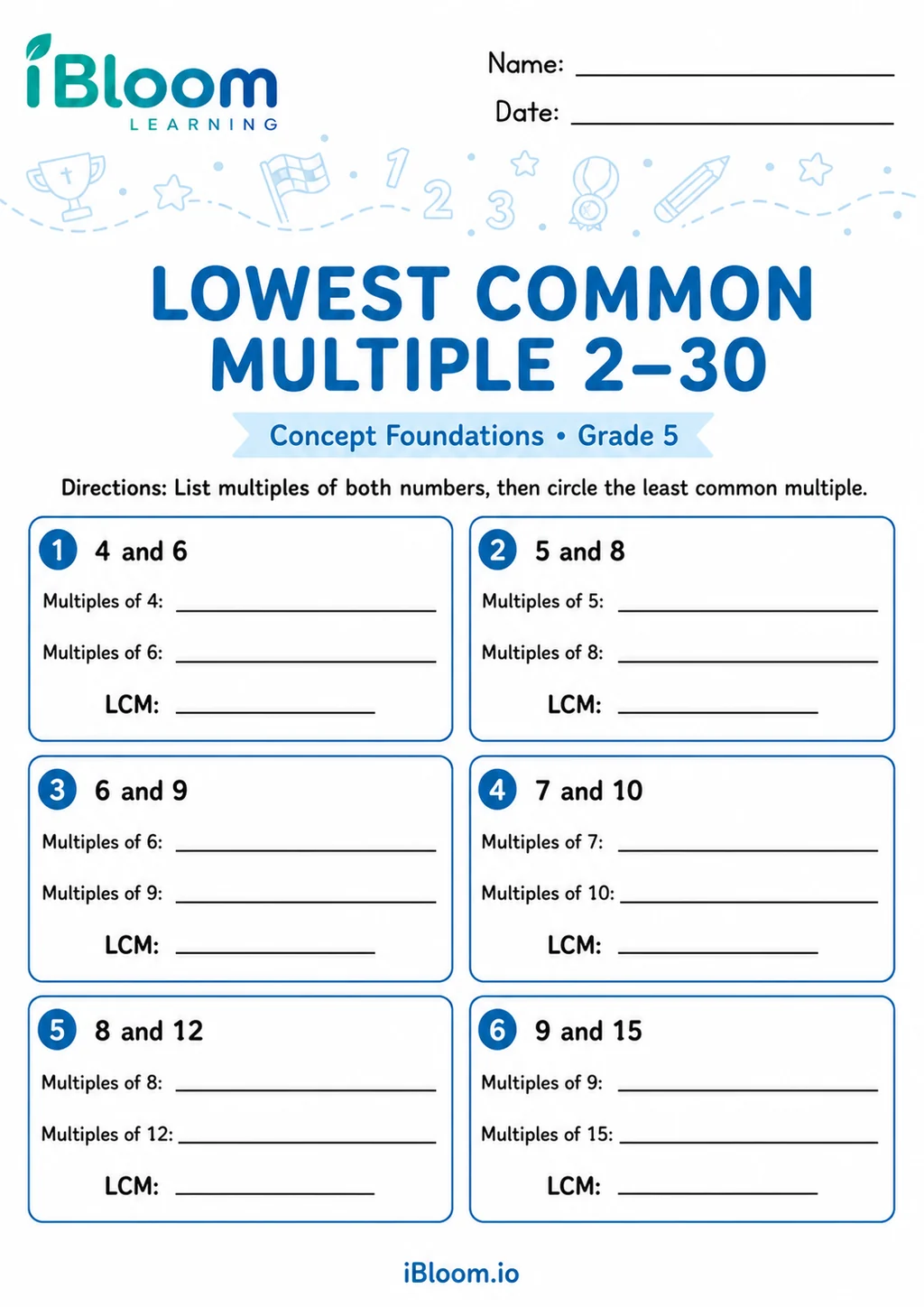 Lowest Common Multiple 2–30 — Concept FoundationsGrade 5 students practise finding the lowest common multiple of numbers from 2 to 30 using multiples, factor knowledge, and organized checking. This Grade 5 foundations worksheet adds concise teaching notes, worked examples, and supported first attempts.Grade 5Free PDF preview
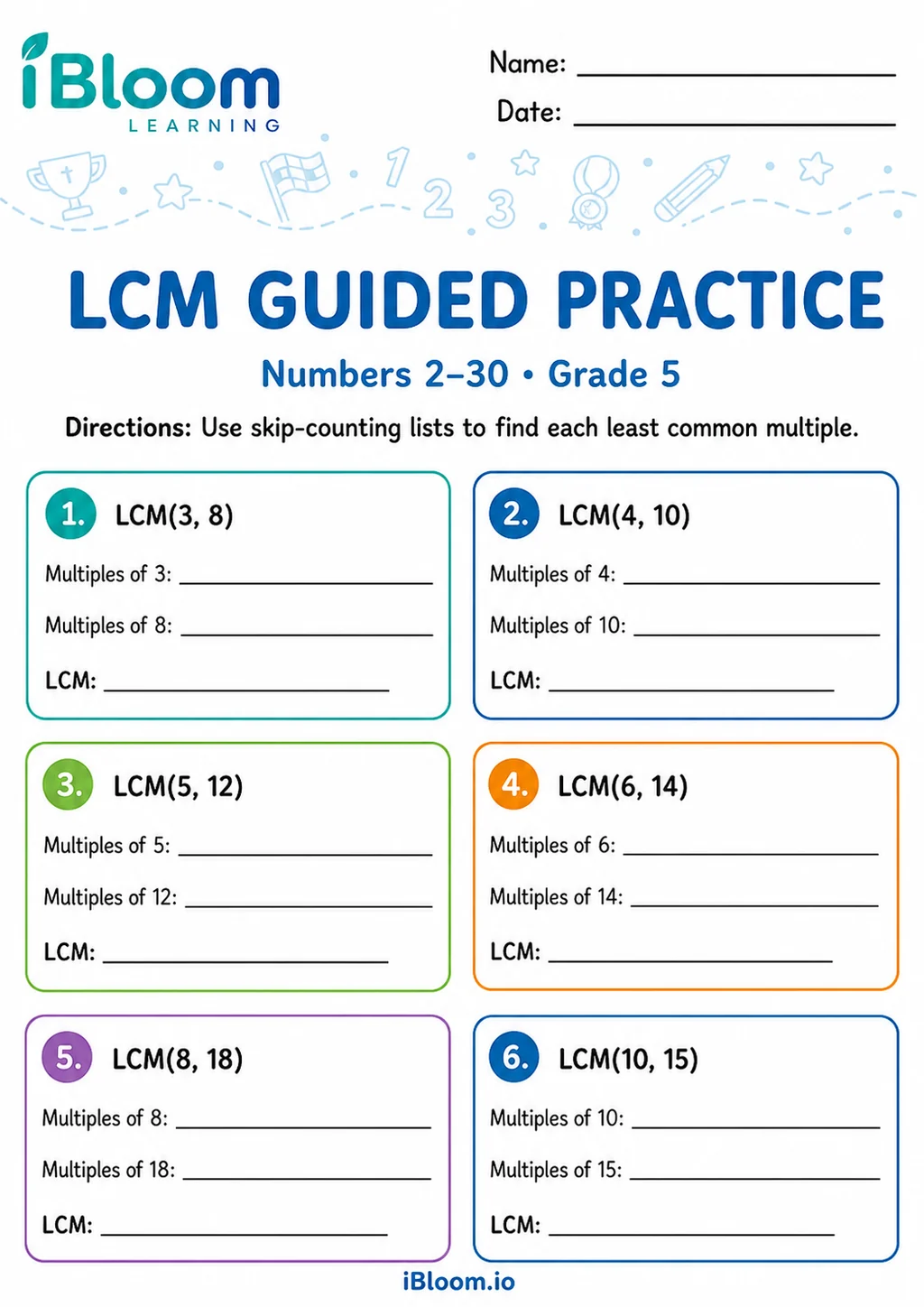 Lowest Common Multiple 2–30 — Guided PracticeGrade 5 students practise finding the lowest common multiple of numbers from 2 to 30 using multiples, factor knowledge, and organized checking. This Grade 5 guided-practice worksheet progresses from prompts and checkpoints to independent questions.Grade 5Free PDF preview
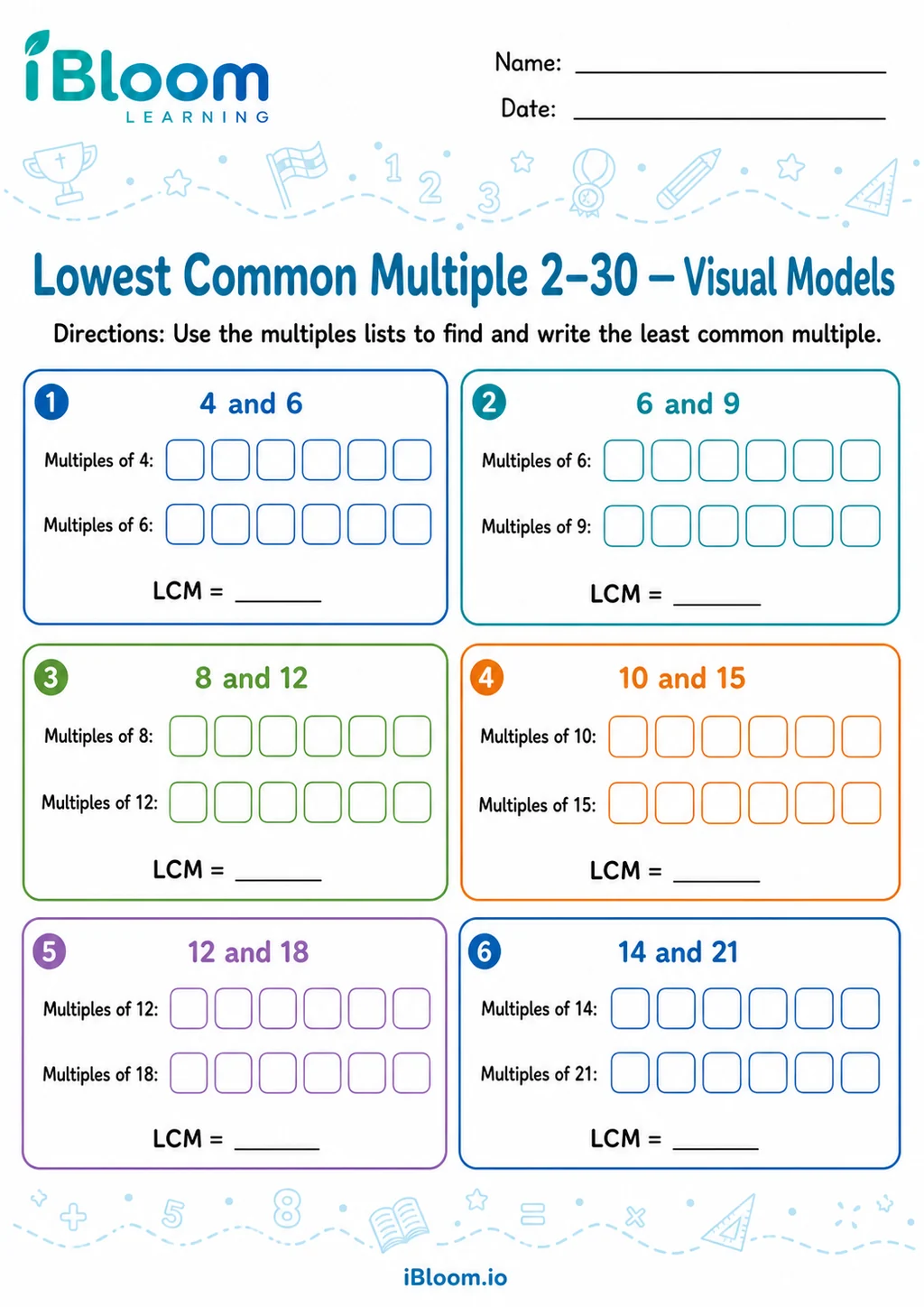 Lowest Common Multiple 2–30 — Visual ModelsGrade 5 students practise finding the lowest common multiple of numbers from 2 to 30 using multiples, factor knowledge, and organized checking. This Grade 5 visual-model worksheet connects suitable diagrams, tables, number lines, or place-value models to mathematical notation.Grade 5Free PDF preview
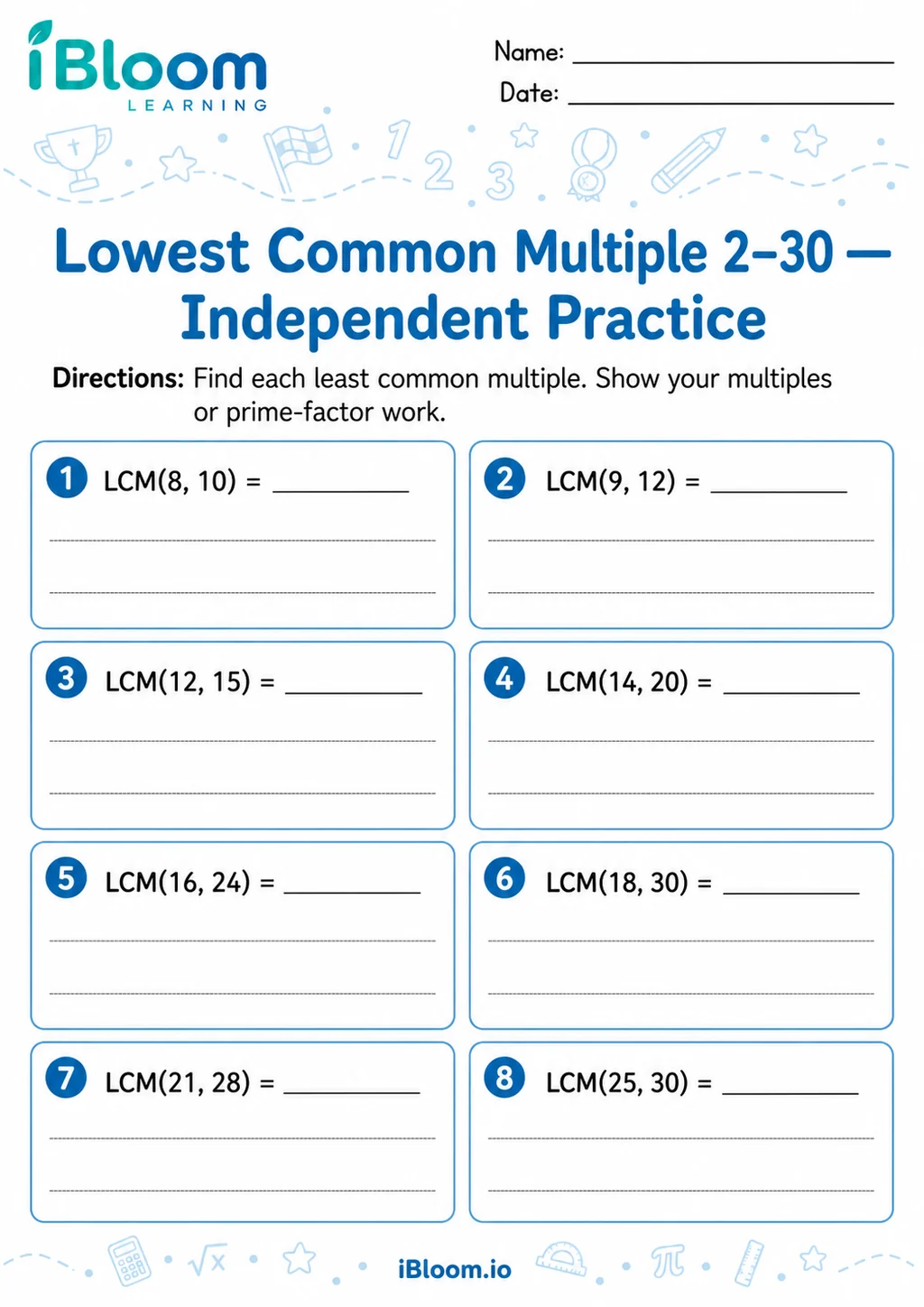 Lowest Common Multiple 2–30 — Independent PracticeGrade 5 students practise finding the lowest common multiple of numbers from 2 to 30 using multiples, factor knowledge, and organized checking. This Grade 5 independent-practice worksheet provides a balanced sequence of accurate, grade-level exercises.Grade 5Free PDF preview
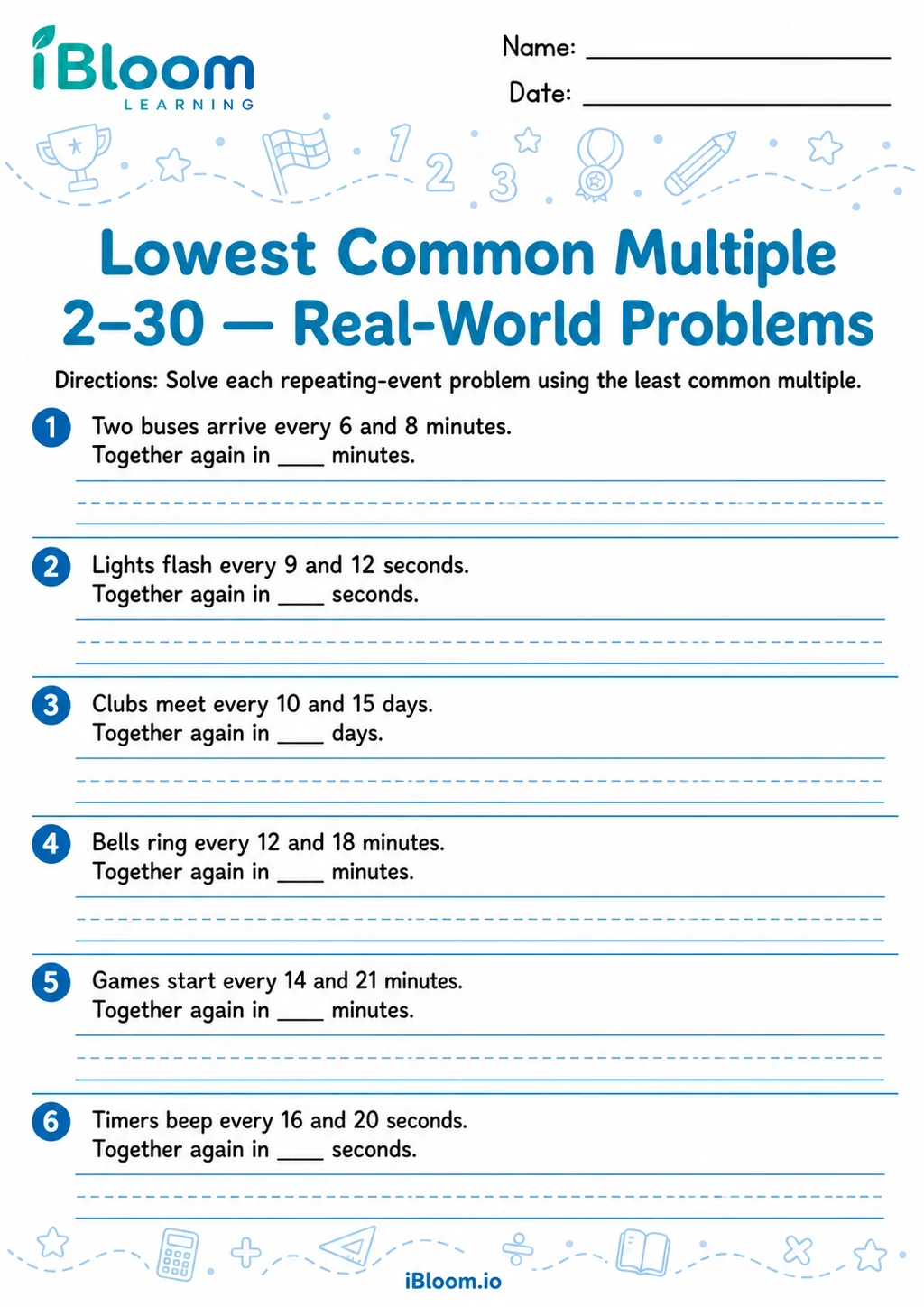 Lowest Common Multiple 2–30 — Real-World ProblemsGrade 5 students practise finding the lowest common multiple of numbers from 2 to 30 using multiples, factor knowledge, and organized checking. This Grade 5 application worksheet uses realistic one-step and multi-step situations with room to model and solve.Grade 5Free PDF preview
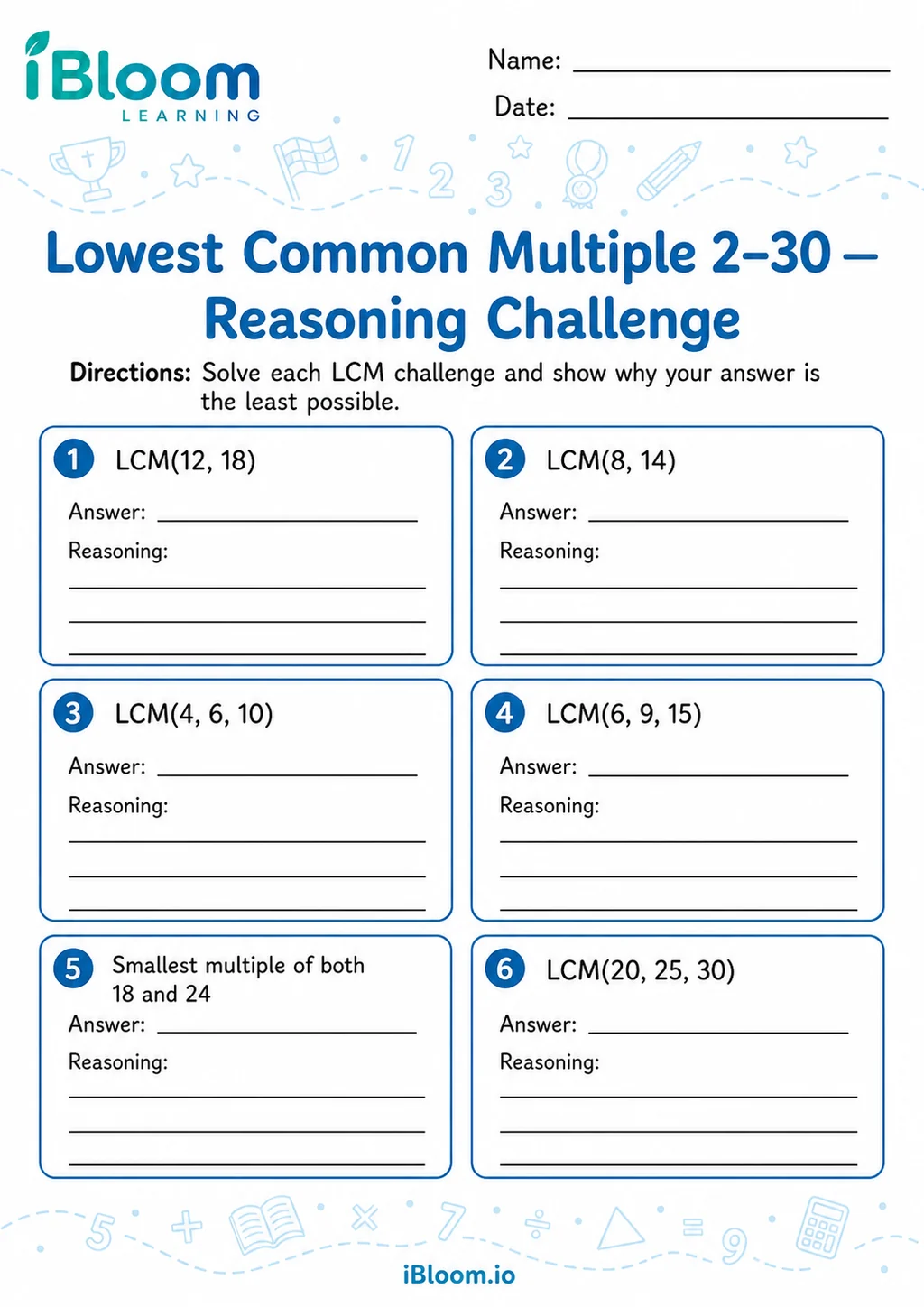 Lowest Common Multiple 2–30 — Reasoning ChallengeGrade 5 students practise finding the lowest common multiple of numbers from 2 to 30 using multiples, factor knowledge, and organized checking. This Grade 5 reasoning worksheet combines error analysis, strategy comparison, missing information, and a gentle extension.Grade 5Free PDF preview
Practice that builds confidence
What the skill means
These Grade 5 factoring worksheets help children find the lowest common multiple, often called the least common multiple, for numbers from 2 through 30. Students practise listing multiples, comparing shared multiples, and choosing the smallest common one.
The printable activities include focused LCM problems that build accuracy and number sense. Children use multiplication facts, factor pairs, and patterns such as even numbers, multiples of 5, and repeated multiples to solve without guessing.
The lowest common multiple is the smallest number that two or more whole numbers share as a multiple. For example, the multiples of 6 include 6, 12, 18, 24, and 30, while the multiples of 8 include 8, 16, 24, and 32; the LCM is 24. In this Grade 5 factoring set, numbers stay within 2 to 30 so children can connect the idea to multiplication facts they already know.

How the practice progresses
Students begin by listing multiples in order, then compare two lists to find the first match. As they gain confidence, they can use factor thinking: if one number is already a multiple of the other, such as 6 and 18, the LCM is 18. If the numbers share a factor, such as 12 and 18, students learn to avoid simply multiplying both numbers and instead look for the smaller shared multiple.
A simple parent routine
Choose three problems from the page. Ask your child to say the first five multiples of each number aloud, circle the common multiples, and explain why the smallest circled number is the answer. Keep a small multiplication chart nearby only as a checking tool. After each answer, ask, “Is there any smaller number that both numbers divide into evenly?”

Classroom uses
Teachers can use these sheets for factoring review, math centers, partner checks, or quick exit tickets before fraction lessons. LCM practice prepares students for adding and subtracting fractions with unlike denominators because it strengthens the habit of finding a shared multiple rather than choosing a denominator at random.

Common errors to watch for
Some students choose the greatest common factor instead of the lowest common multiple, especially when both skills are practised together. Others stop at the first multiple of one number without checking the second number. A third common mistake is multiplying the two numbers every time; that works for some pairs, but not when a smaller common multiple exists.
Free printable PDF download
Use this grade 5 lowest common multiple 2 to 30 worksheet page to preview the activity, print it, or download it as a PDF for quick practice. It works well for homework, homeschool lessons, tutoring, morning work, revision, and classroom centers.
Answers and answer key support
After the child completes the worksheet independently, parents and teachers can use the answer support or answer key information to check the work, review mistakes, and choose the next practice step.
Why iBloom worksheets help
Each worksheet keeps attention on one clear Grade 5 skill: finding the LCM for numbers from 2 to 30. The repeated, well-spaced practice helps children notice patterns, use vocabulary correctly, and develop a reliable strategy: list, compare, test, and choose the smallest shared multiple.
Helpful answers
Frequently asked questions
What does lowest common multiple mean in Grade 5 math?
It means the smallest whole number that is a multiple of each number in the problem. For example, the lowest common multiple of 4 and 6 is 12.
What number range do these worksheets use?
The practice focuses on finding the LCM of numbers from 2 through 30, which is appropriate for strengthening Grade 5 factoring and multiplication knowledge.
Should students list multiples or use prime factorization?
For this level, listing and comparing multiples is a clear starting strategy. Students who are ready can also use factor knowledge to find the LCM more efficiently.
How is LCM different from greatest common factor?
The LCM is a shared multiple and is usually equal to or larger than the numbers. The greatest common factor is a shared factor and is never larger than the numbers being compared.
Why is LCM important before working with fractions?
LCM helps students find common denominators when adding or subtracting fractions with unlike denominators, so this practice builds an important foundation.
Is this grade 5 lowest common multiple 2 to 30 worksheet free?
Yes. You can preview it for free and use the printable worksheet for home or classroom practice.
Can I download this grade 5 lowest common multiple 2 to 30 worksheet as a PDF?
Yes. Use the worksheet download option to save a printable PDF, or print the worksheet directly from the page.
Does this grade 5 lowest common multiple 2 to 30 worksheet include answers or an answer key?
When the activity has fixed answers, iBloom includes answer support so parents and teachers can check the completed worksheet.