


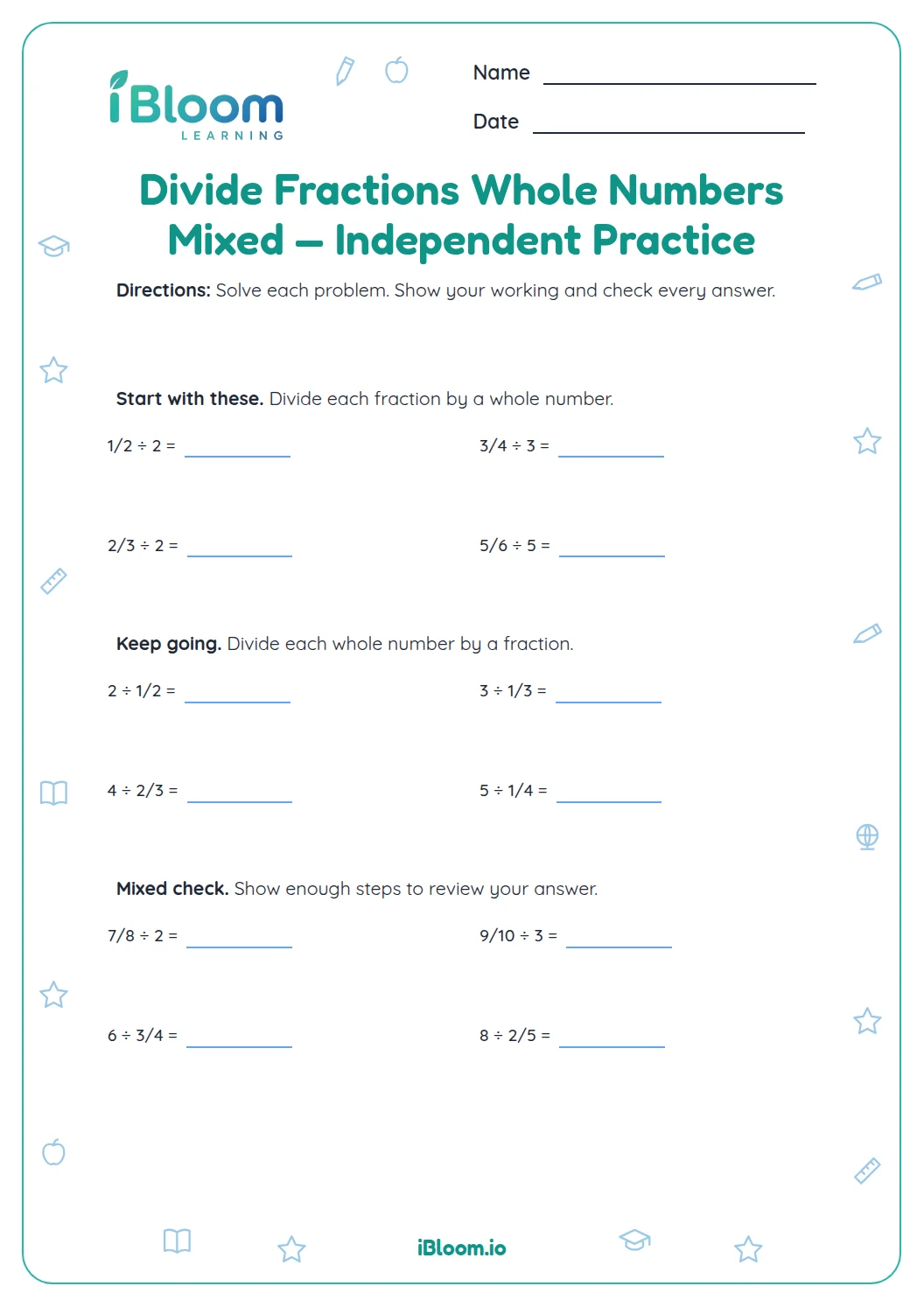


About this worksheet
This printable builds fraction division from its meaning: how many groups fit, or how much is in each equal group? Students start with fraction bars, then divide whole numbers by unit fractions, fractions by whole numbers, and mixed numbers by fractions. The final problems connect quotient reasoning to familiar measures. An answer key is included.
Aligned to 5.NF.B.7
What does fraction division mean?
Division can ask how many groups of a certain size fit in an amount. For 3 ÷ 1/2, count halves in three wholes: there are six. A model makes the unit size visible before students use a calculation rule.
Division can also split a fraction into equal groups. In 3/4 ÷ 3, three equal groups share three fourths, so each group is 1/4.
What does this worksheet practice?
Part A reads shaded fraction bars to connect quotients with equal groups. Part B moves into equations with unit fractions. Part C applies the same reasoning to mixed numbers and liquid or length measures.
How can a model show equal shares?
For question 6, split the shaded two thirds into two equal groups. Each group is one third, so 2/3 ÷ 2 = 1/3. Multiplying 1/3 by 2 returns 2/3, which checks the quotient.
How to work through it
- 1For Part A, identify the size of one group, then count how many fit.
- 2For Part B, ask whether the quotient counts groups or finds the size of each group.
- 3For Part C, write the total amount and the size of one piece before dividing.
- 4Check by multiplying the quotient by the divisor.
Common mistakes
The mistake
Answering 3 ÷ 1/2 with 1 1/2 by multiplying by the fraction.
The fix
Count half-size groups: each whole contains two halves, so three wholes contain six.
The mistake
Treating 2/3 ÷ 2 as 2/3 × 2.
The fix
Sharing two thirds between two groups gives one third per group.
The mistake
Multiplying the two fractions instead of asking how many divisor-size groups fit.
The fix
Use equal jumps or groups to identify what the quotient counts, then check by multiplication.
Common Core alignment
This sheet practices Grade 5 fraction division.
Interpret and solve division of unit fractions and whole numbers.
On this sheet: Questions model and solve whole-number and fraction division, including real-world contexts.
Show the official wordingHide the official wording
Apply and extend previous understandings of division to divide unit fractions by whole numbers and whole numbers by unit fractions.
What to practice next
Make more practice
Further reading
Questions parents and teachers ask
What does 3 divided by one half mean?
It asks how many groups of one half fit in three wholes. Each whole contains two halves, so three wholes contain six halves. Therefore 3 ÷ 1/2 = 6. A bar model or number line helps make those equal groups visible before a student writes the quotient.
Why can dividing by a fraction make the answer larger?
The quotient counts how many small groups fit inside the starting amount. When the group size is less than one whole, several groups can fit inside one whole. For example, six half-size groups fit inside three wholes, so 3 ÷ 1/2 equals 6.
How do I divide a fraction by a whole number?
Think of sharing the fraction into the stated number of equal groups. For 2/3 ÷ 2, split two thirds into two equal shares. Each share is one third, so the quotient is 1/3. The worksheet uses this meaning before asking students to solve more equations.
What does the answer key include?
The separate key gives the quotient for every model, equation, and word problem. For the final measurement questions, it shows the number of equal pieces or containers that fit. Students can check their work by multiplying the quotient by the divisor and seeing whether they recover the starting amount.
How can a fraction bar support division?
A shaded bar makes the starting fraction visible and divides it into equal parts. A student can compare the part size with the divisor, then find the quotient. For example, three shaded fourths contain three one-fourth pieces, so 3/4 ÷ 1/4 = 3.