


About this worksheet
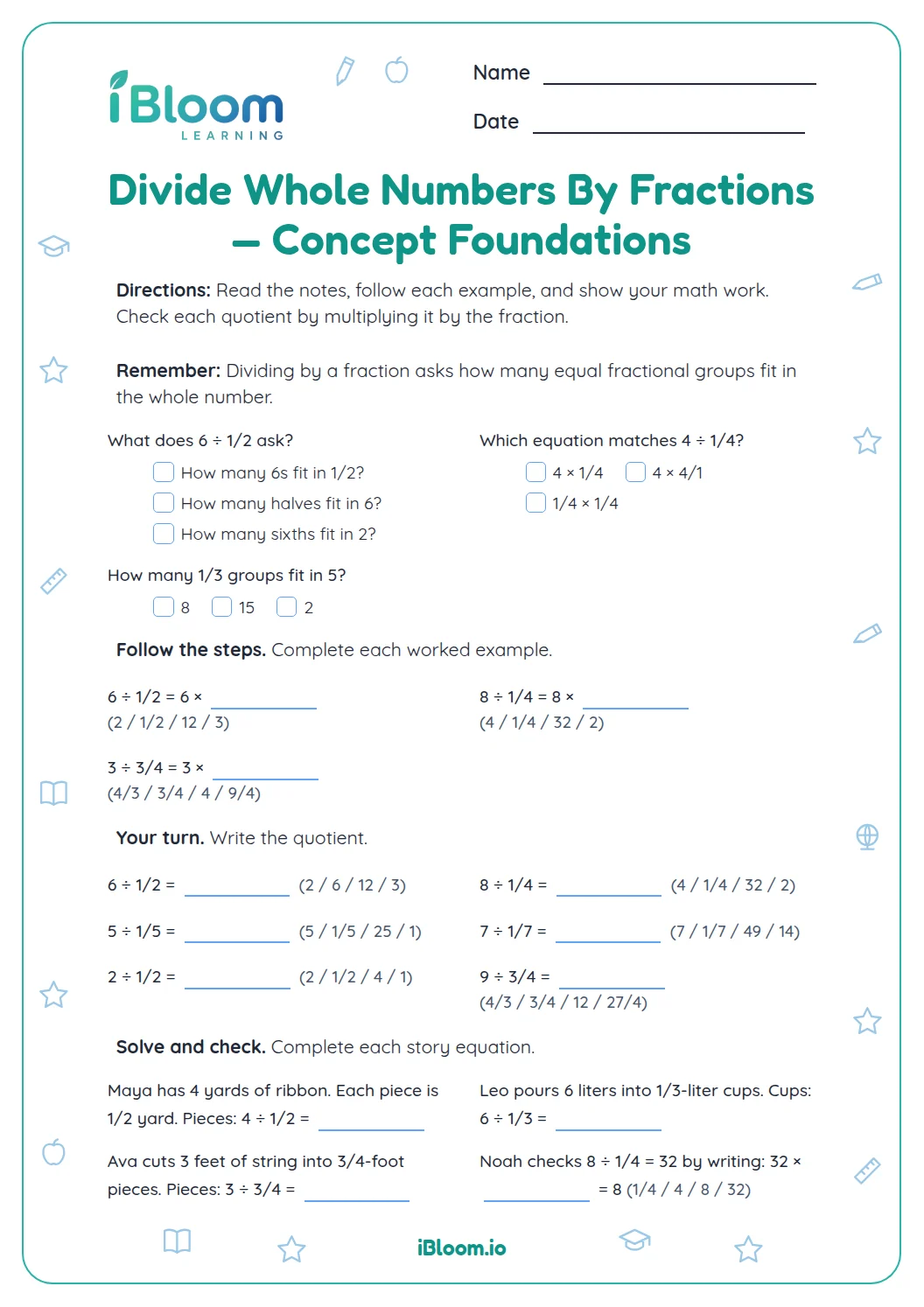
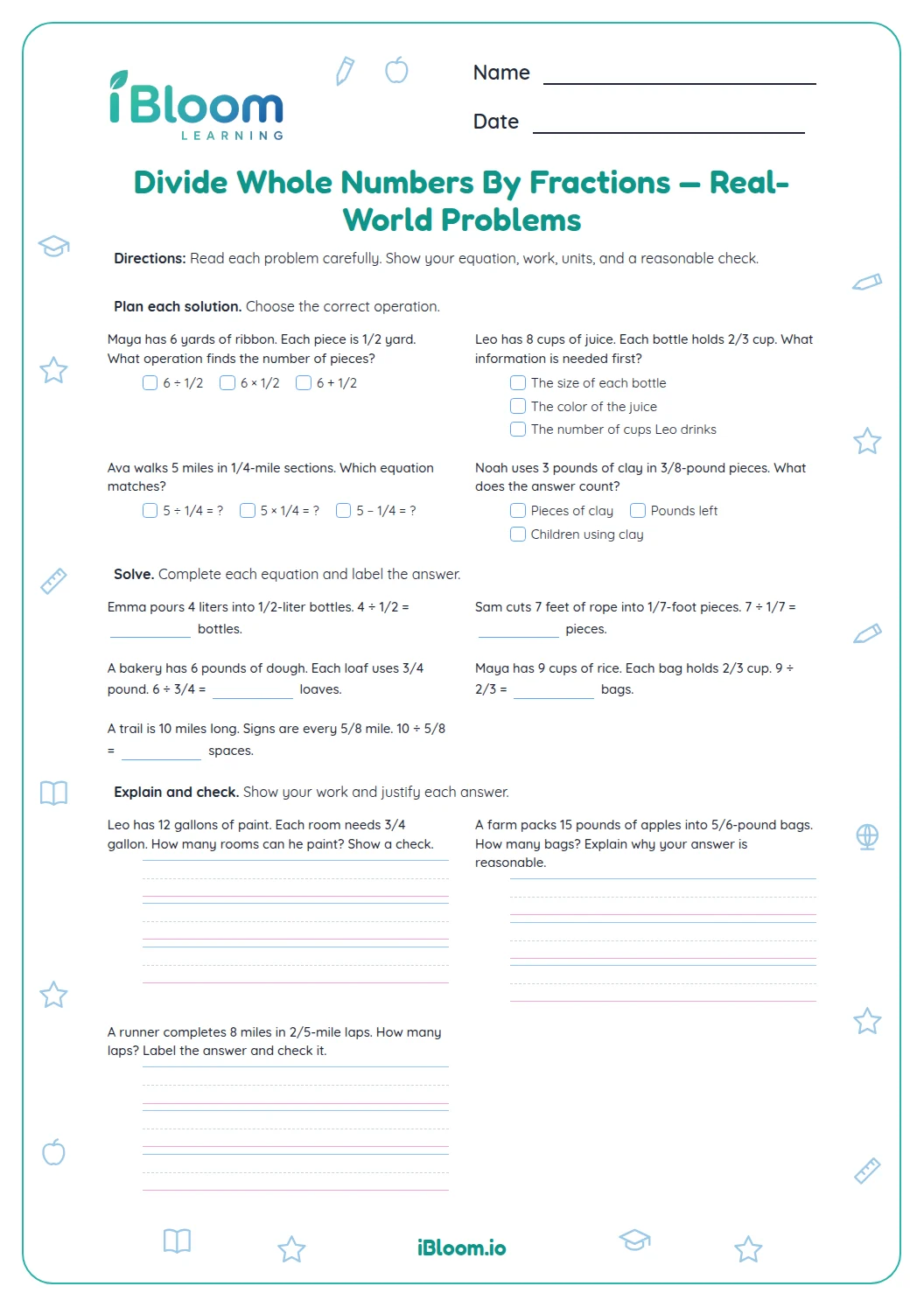
This Grade 5 printable practices dividing whole numbers by unit fractions. Children solve five group-size stories, evaluate five division expressions, and answer four reasoning prompts. Part A connects division to how many fractional groups fit in a total; Part B builds fluency with unit-fraction divisors; Part C asks children to explain, compare, and create examples. The separate key includes units and sample answers. The sheet practices CCSS 5.NF.B.7 by interpreting whole-number division by unit fractions.
Aligned to 5.NF.B.7
What does dividing by a fraction ask?
It asks how many groups of that size fit in the whole amount. Four cups divided into half-cup bags makes eight bags because each cup contains two halves.
Question 1 uses this equal-groups meaning before the number sentences.
- 14 ÷ 1/2
- 2There are 2 halves in each cup.
- 34 × 2 = 8 half-cup bags.
How can multiplication check the quotient?
Multiply the quotient by the divisor. For 6 ÷ 1/3 = 18, check 18 × 1/3 = 6.
Why can the quotient be larger than the dividend?
A small group size fits many times inside a whole number. Dividing by 1/6 asks how many sixths fit, so the answer can be much larger than the starting number.
How can I use this worksheet?
- 1Name the amount and the size of one group.
- 2Decide whether you are counting groups or sharing into groups.
- 3Use the reciprocal relationship or count equal fraction parts.
- 4Check by multiplying the quotient by the divisor.
- 5For a remainder, subtract the value of the full groups from the total.
Common mistakes and quick fixes
The mistake
Dividing by 1/2 as if dividing by 2.
The fix
Ask how many halves fit in each whole; there are two.
The mistake
Assuming division always makes a number smaller.
The fix
Compare the group size with one whole: small fractional groups can make a larger count.
The mistake
Ignoring a remainder in a cutting story.
The fix
Multiply the number of full pieces by their length, then subtract from the total.
Common Core alignment
This worksheet practices the following Common Core skill.
Interpret and solve whole-number division by unit fractions.
On this sheet: The computation and stories divide whole numbers by unit fractions.
Show the official wordingHide the official wording
Apply and extend previous understandings of division to divide unit fractions by whole numbers and whole numbers by unit fractions.
What to practice next
Make more practice
Questions parents and teachers ask
Why can dividing by a fraction make a larger answer?
The quotient counts how many fraction-size groups fit in the whole number. There are two halves in each whole, so four wholes contain eight halves. When the group is small, many groups fit; multiplication by the divisor checks the quotient.
How do the word problems connect to division?
Each story gives a total amount and the size of one group, then asks how many groups fit. For example, four cups divided into half-cup bags makes eight bags. Children should keep the units in their answers so the result answers the story.
How should children check a division answer?
Multiply the answer by the fraction divisor and see whether the product is the starting whole number. For 6 ÷ 1/3, the answer is 18; 18 groups of one third equal 6 wholes. This check can catch reciprocal and calculation errors.
What does the reasoning part ask children to explain?
Children correct a mistaken division idea, compare quotient sizes, reason about a rope cut into full pieces, and write a story of their own. The key gives sample responses. For the rope, 5 yards makes 15 full pieces that are each 1/3 yard long.
What does 4 ÷ 1/2 mean in the first problem?
It asks how many half-cup groups fit in four cups. Each cup contains two half-cups, so four cups contain eight half-cups. The same result can be checked by multiplying 8 × 1/2 cup to get 4 cups. This is the same equal-groups interpretation used in the first word problem, with cups kept as the unit throughout.
Does the answer key include units?
Yes. Story answers include units such as bags, cans, intervals, or portions when the context calls for them. The equation section gives numerical quotients, while open responses have model explanations. Equivalent reasoning is acceptable when it correctly answers the question.