




About this worksheet
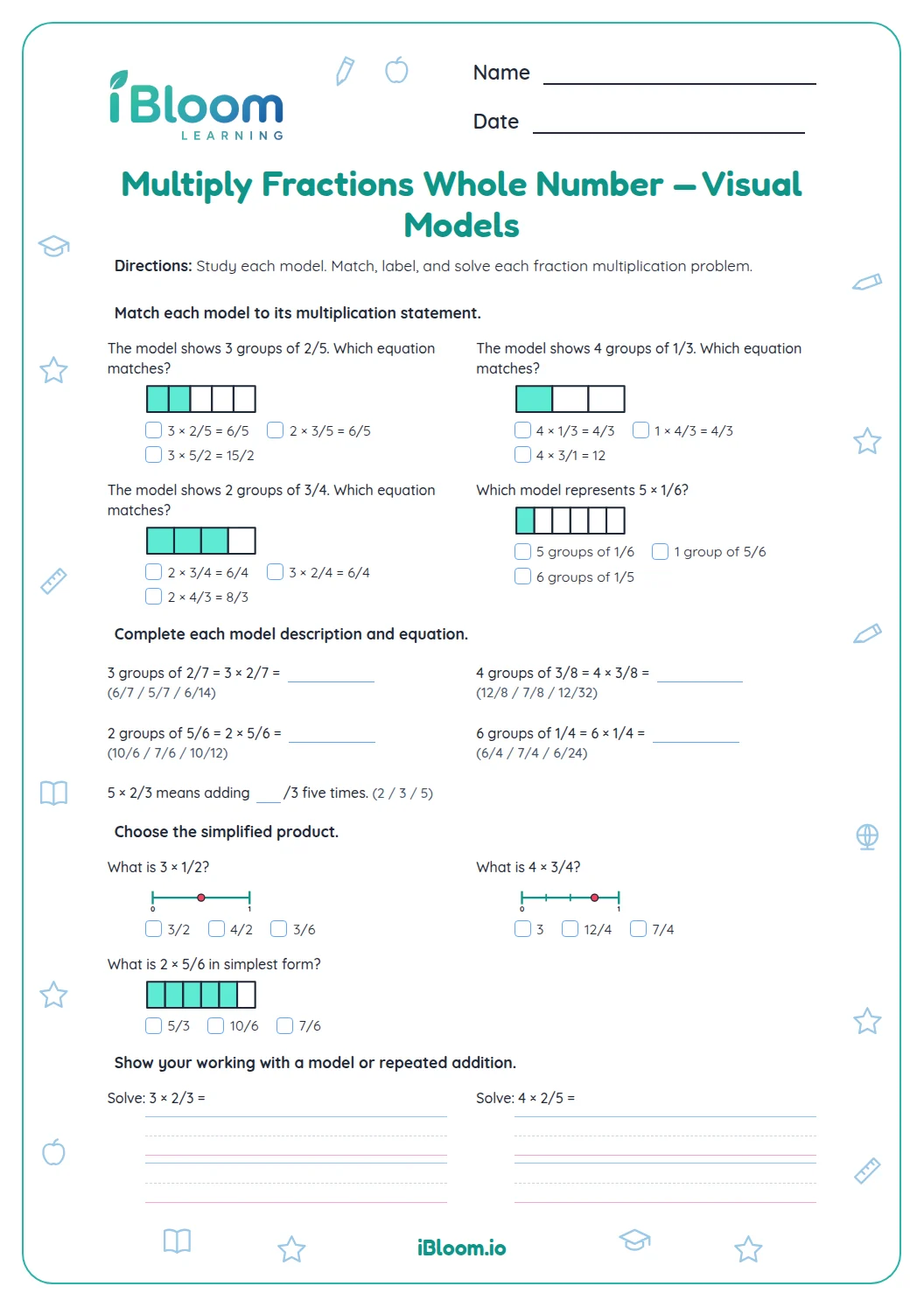
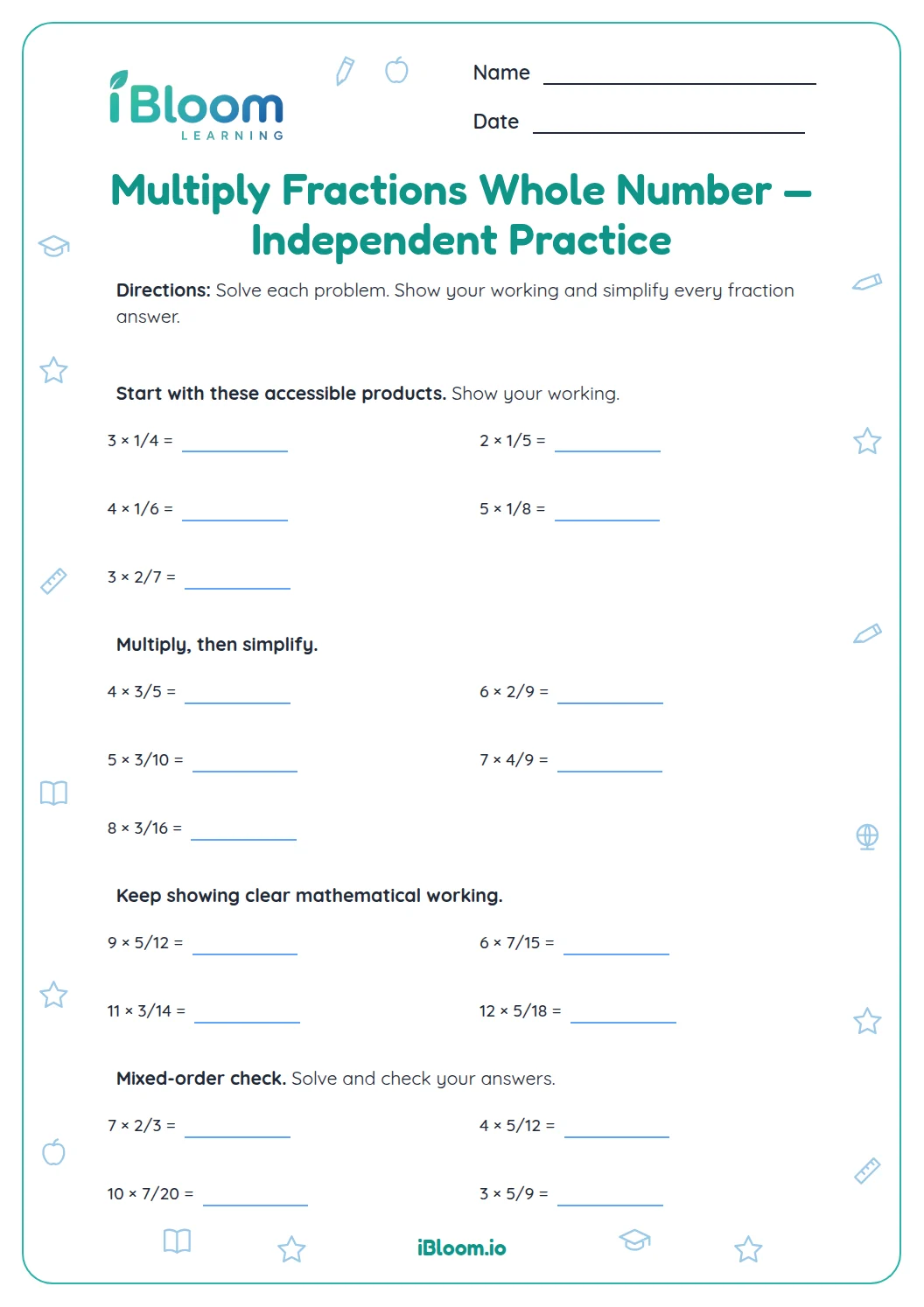
Sixteen questions practice whole-number division by fractions through quotients, grouping situations, and a brief explanation. The printable includes a separate answer key and focused practice that moves from direct work to reasoning.
Aligned to 5.NF.B.7
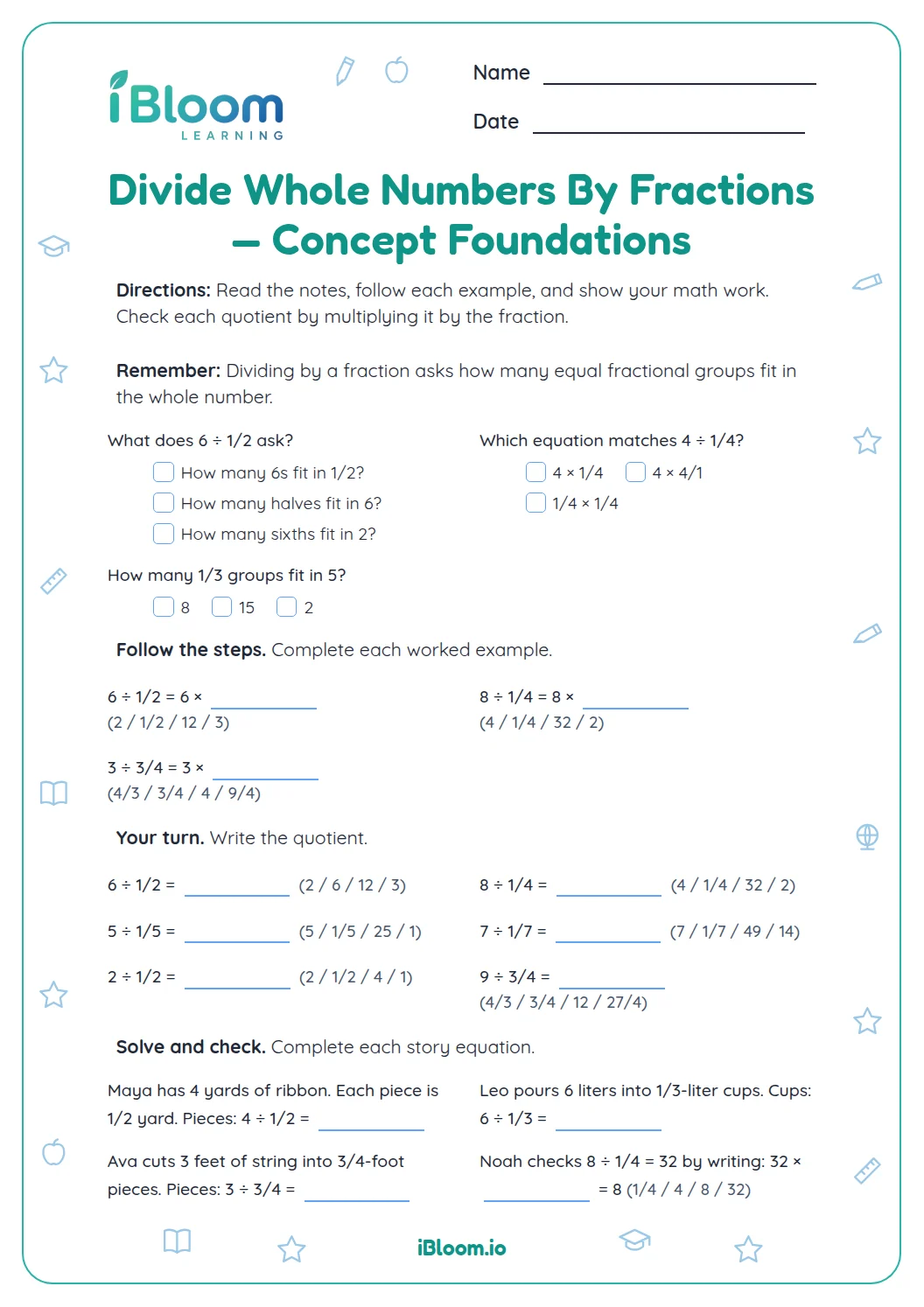
Division asks how many groups fit
For 4 ÷ 1/2, ask how many halves fit in 4 wholes. Each whole has two halves, so four wholes have eight halves.
- 14 ÷ 1/2 = 8
- 2Check: 8 × 1/2 = 4
Use multiplication to check
A quotient is reasonable when multiplying it by the divisor returns the starting whole number. This check helps catch errors when the divisor is a fraction.
Practice sequence
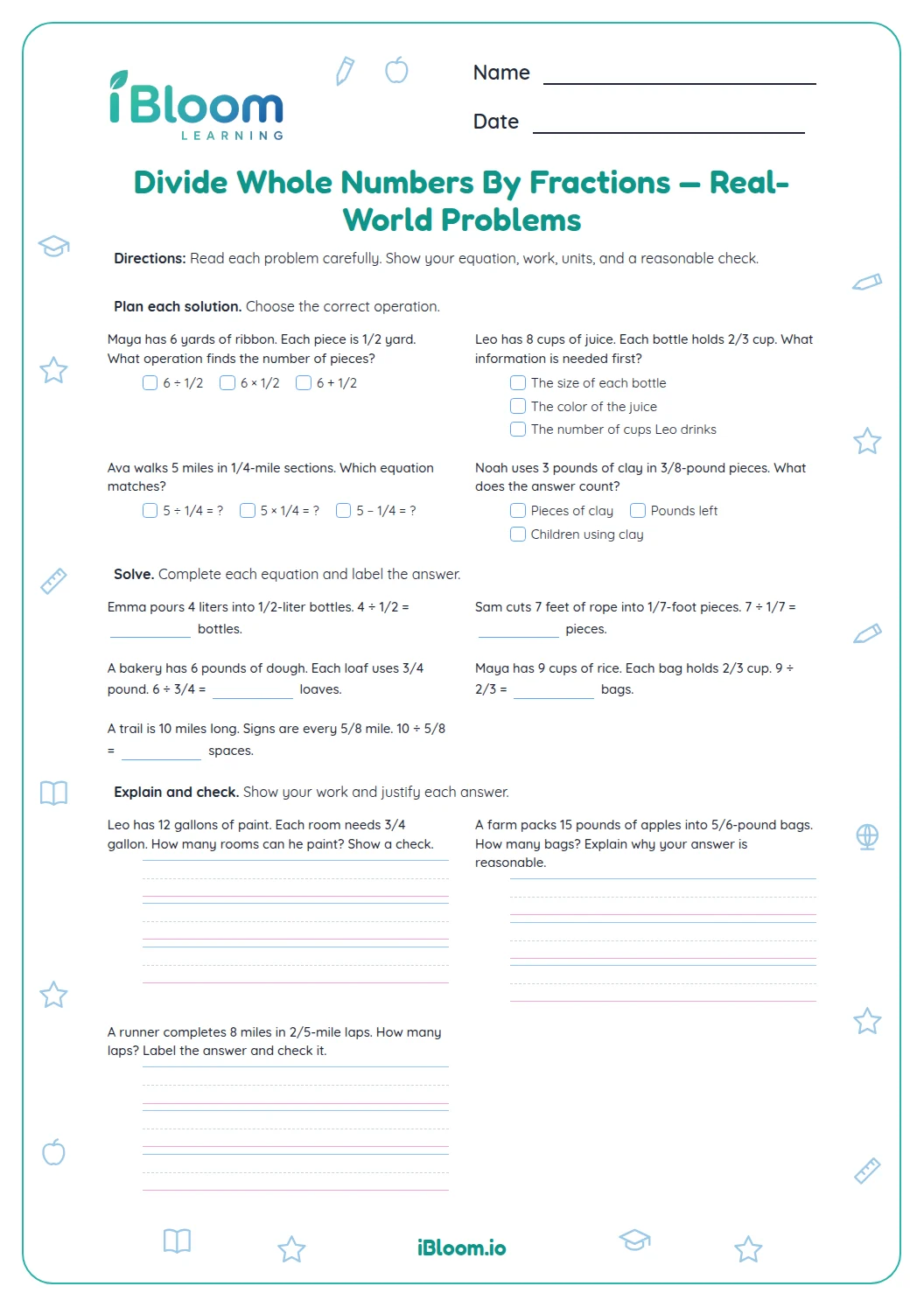
Part A builds quotient fluency. Part B connects division to measured groups. Part C applies the same idea and asks for a short explanation.
- Part A: six quotients
- Part B: fractional groups in lengths and amounts
- Part C: word problems, a quotient, and an explanation
How to use this worksheet
- 1Read the divisor as the size of one group.
- 2Ask how many groups of that size fit in the whole amount.
- 3For a measurement problem, include the requested unit in the answer.
- 4Multiply the quotient by the divisor to check that it returns the starting whole.
- 5Use the separate two-page key to check work and revisit missed items.
Common mistakes and quick fixes
The mistake
Multiplying by the fraction instead of dividing.
The fix
Use a group-size question: how many of these fractional groups fit?
The mistake
Forgetting that dividing by a number smaller than 1 can make a larger result.
The fix
Check the size: several small groups can fit inside each whole.
The mistake
Leaving off the context unit, such as jars or pieces.
The fix
Reread what is being counted and include that unit in the answer.
Curriculum alignment
This worksheet practices the following Common Core skills.
Divide whole numbers by unit fractions and solve fraction division problems.
On this sheet: Every quotient uses a whole number divided by a unit fraction; applied questions use unit-fraction group sizes.
Show the official wordingHide the official wording
Apply and extend previous understandings of division to divide unit fractions by whole numbers and whole numbers by unit fractions.
What to practice next
Make more practice
Further reading
Questions parents and teachers ask
What does a whole number divided by a fraction ask?
It asks how many groups of that fractional size fit inside the whole number. For 3 ÷ 1/3, each whole contains three one-third groups, so three wholes contain nine groups. This group-size meaning helps learners decide whether a quotient makes sense.
Why can the quotient be greater than the starting whole?
A unit fraction is smaller than one whole, so several groups of that size fit into each whole. For example, four wholes contain eight half-size groups. The answer counts groups, which can be more numerous than the wholes being measured.
How can a learner check a quotient?
Multiply the quotient by the divisor. The product should return the starting whole number. If 4 ÷ 1/2 = 8, then 8 × 1/2 = 4. In a story problem, also check that the answer names the right unit, such as jars or pieces.
What is in the three parts?
Part A has six whole-number quotients by unit fractions. Part B asks about fractional servings, lengths, and distances. Part C mixes direct and applied quotients with a short explanation. The printable has two practice pages and a separate two-page answer key.
Does this worksheet use unit fractions as divisors?
Yes. Each divisor is a unit fraction such as 1/2, 1/3, or 1/4. The contexts ask how many groups of that size fit into a whole amount, including servings, ribbon pieces, jars, and trail sections.
What does “independent practice” mean on these pages?
Learners work through the quotient questions and short situations without a worked example beside each one. They can use the group-size idea from the page explanation, then check their calculations with the answer key and multiplication.