




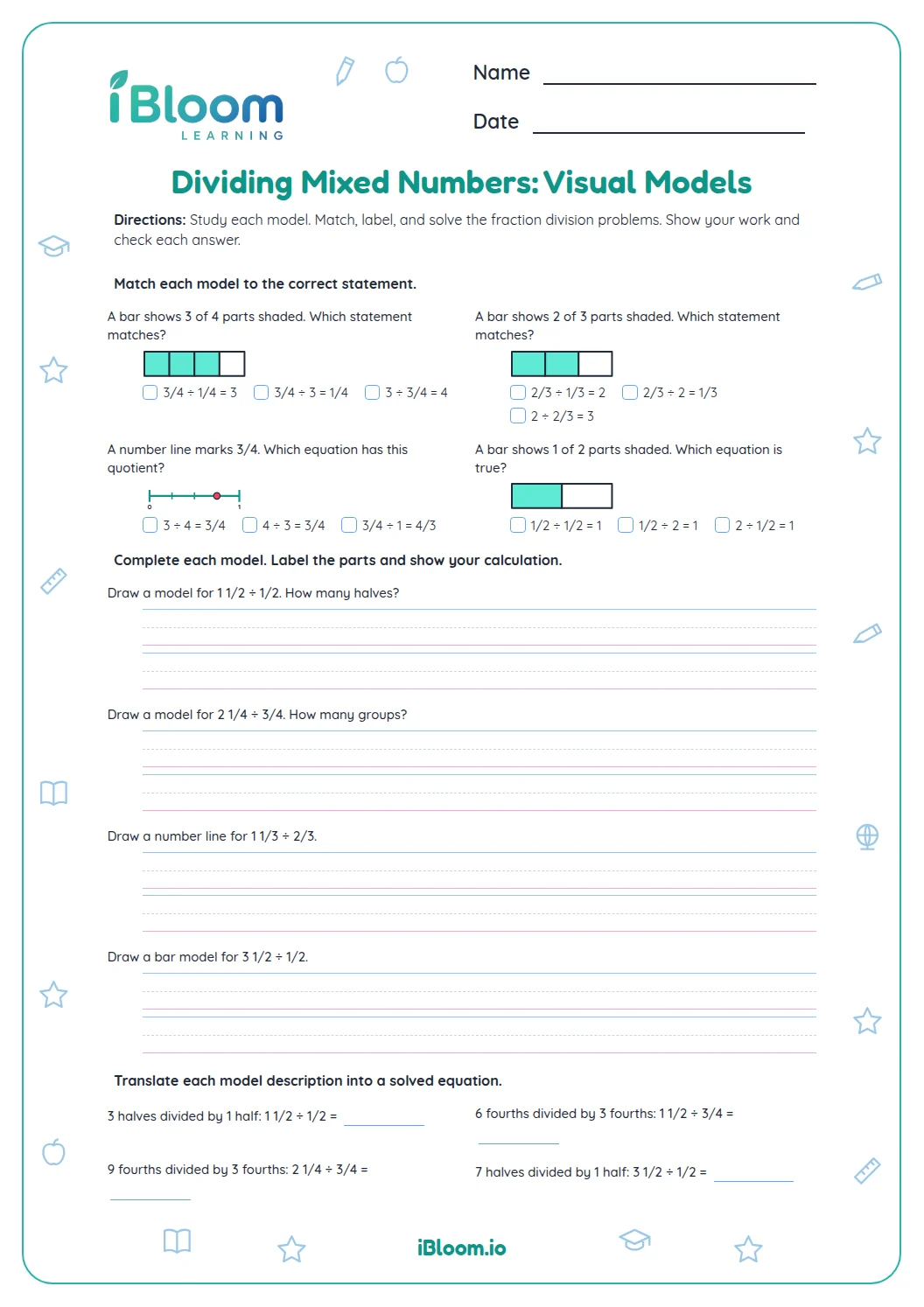
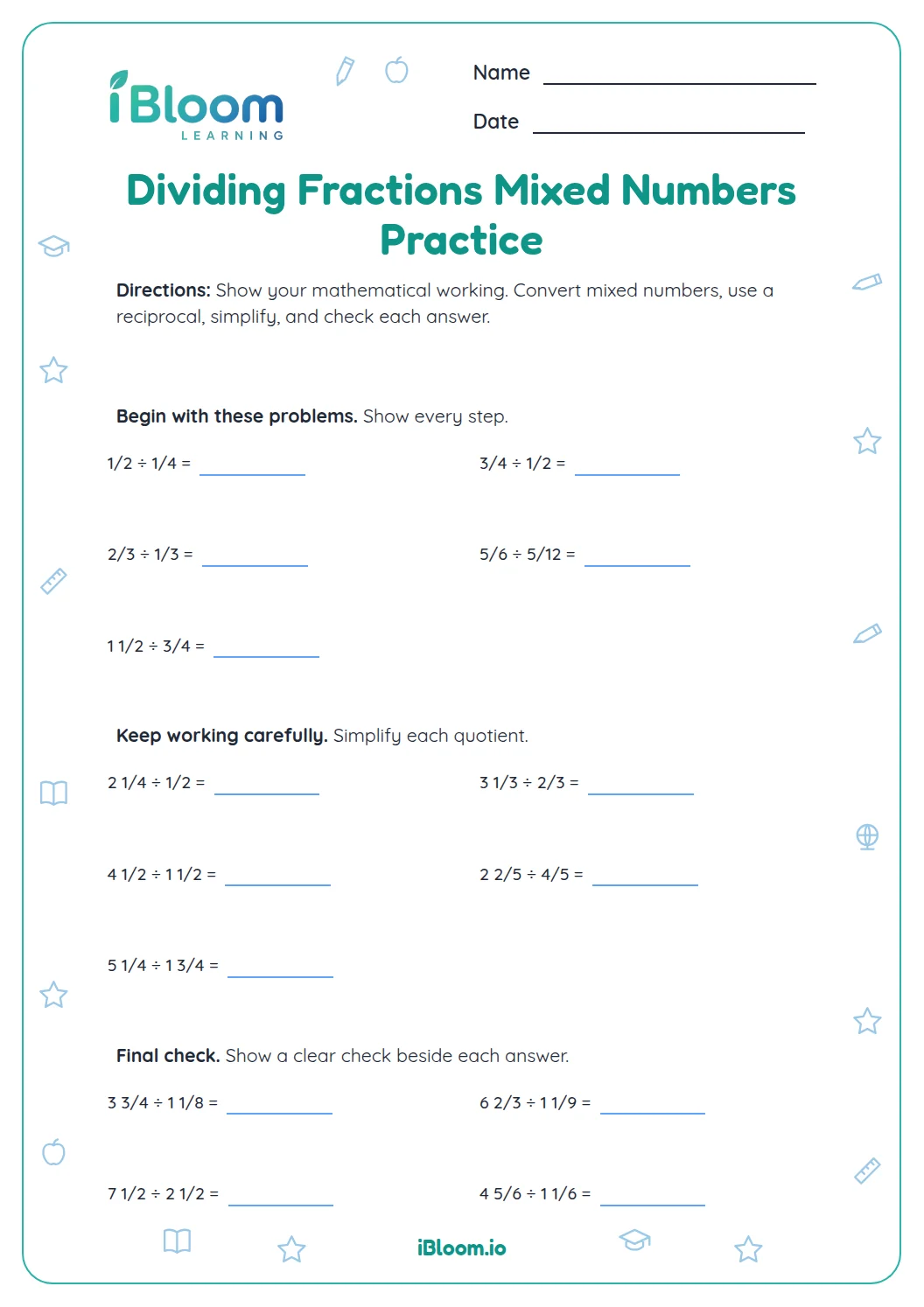
About this worksheet
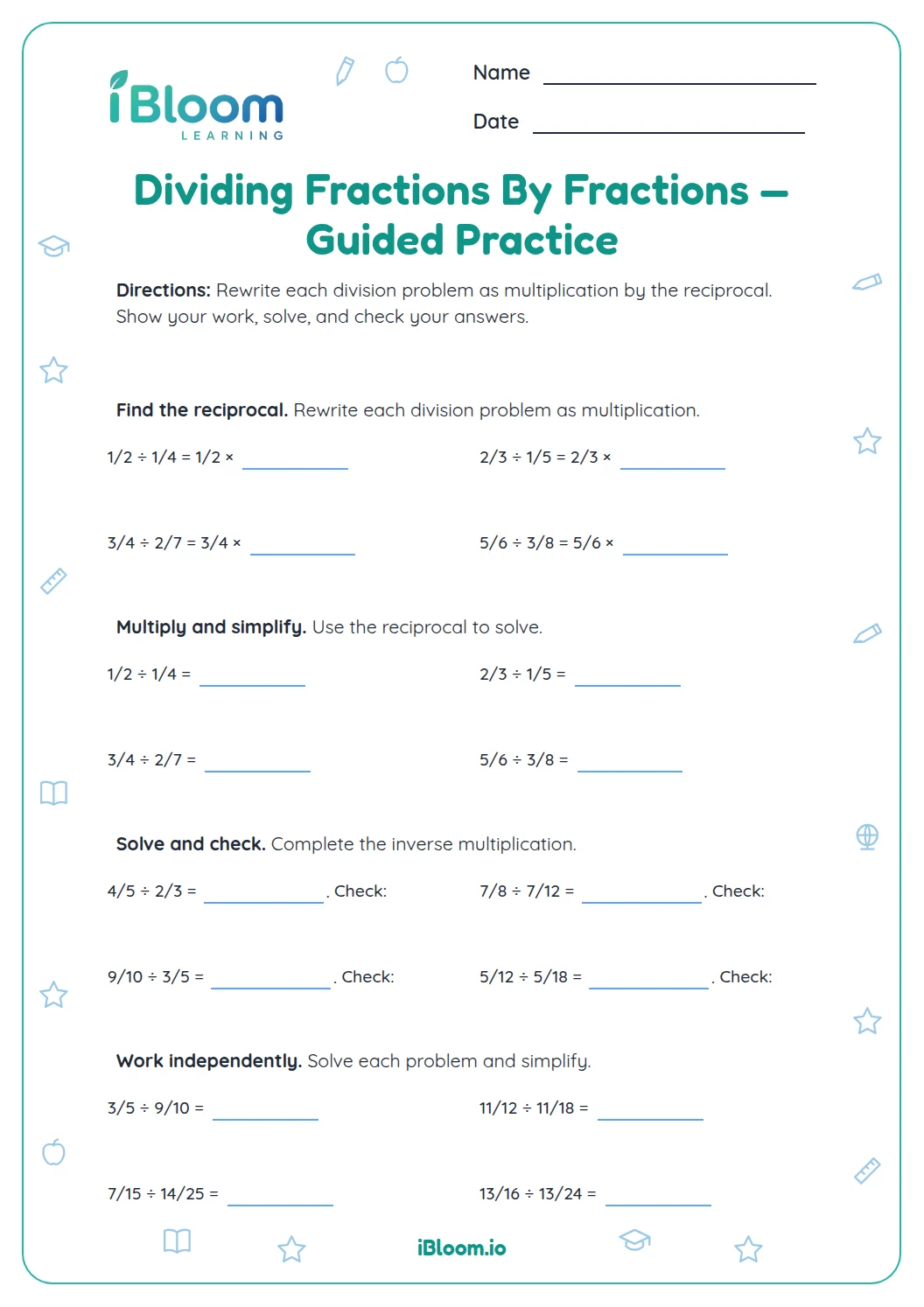
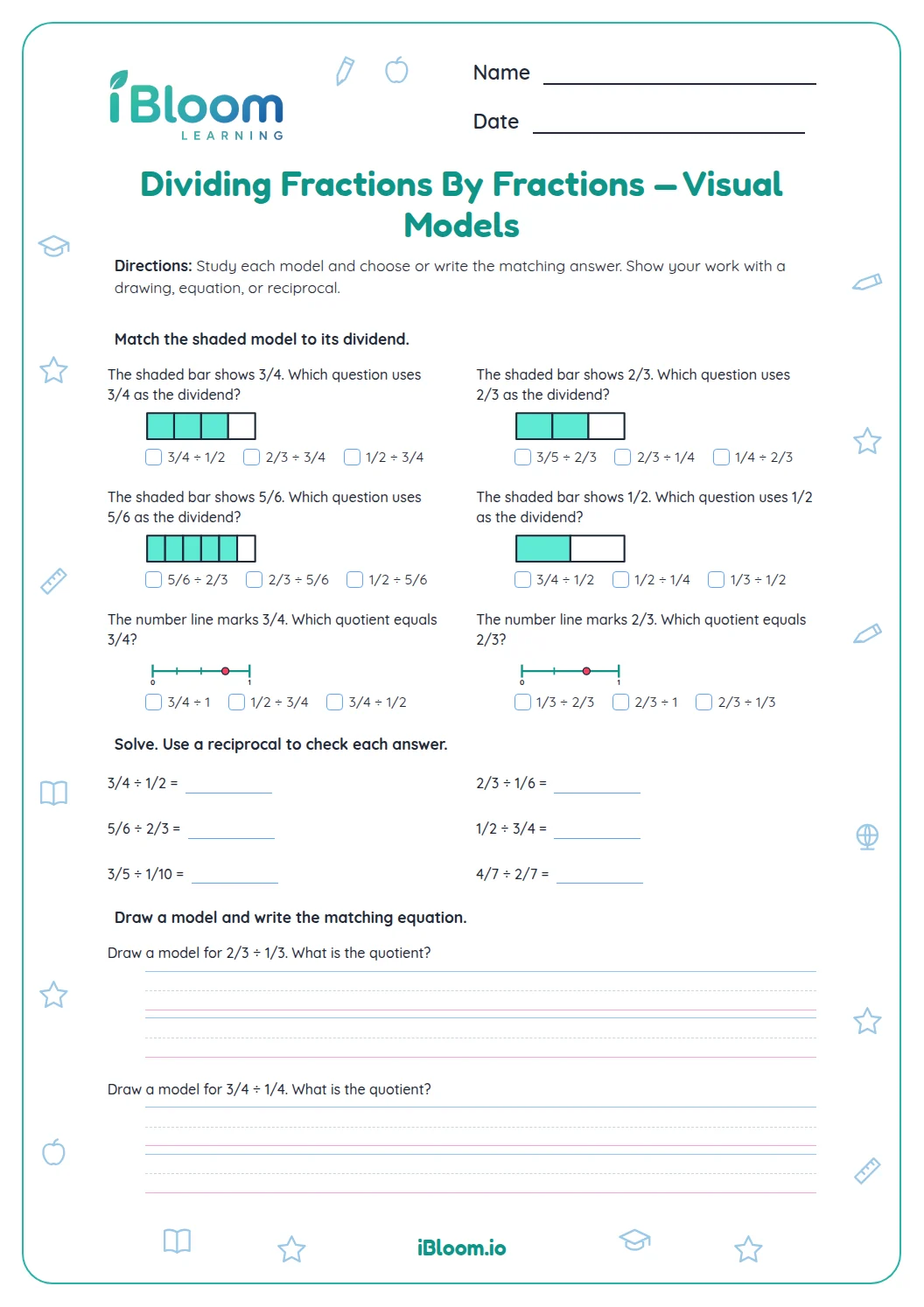
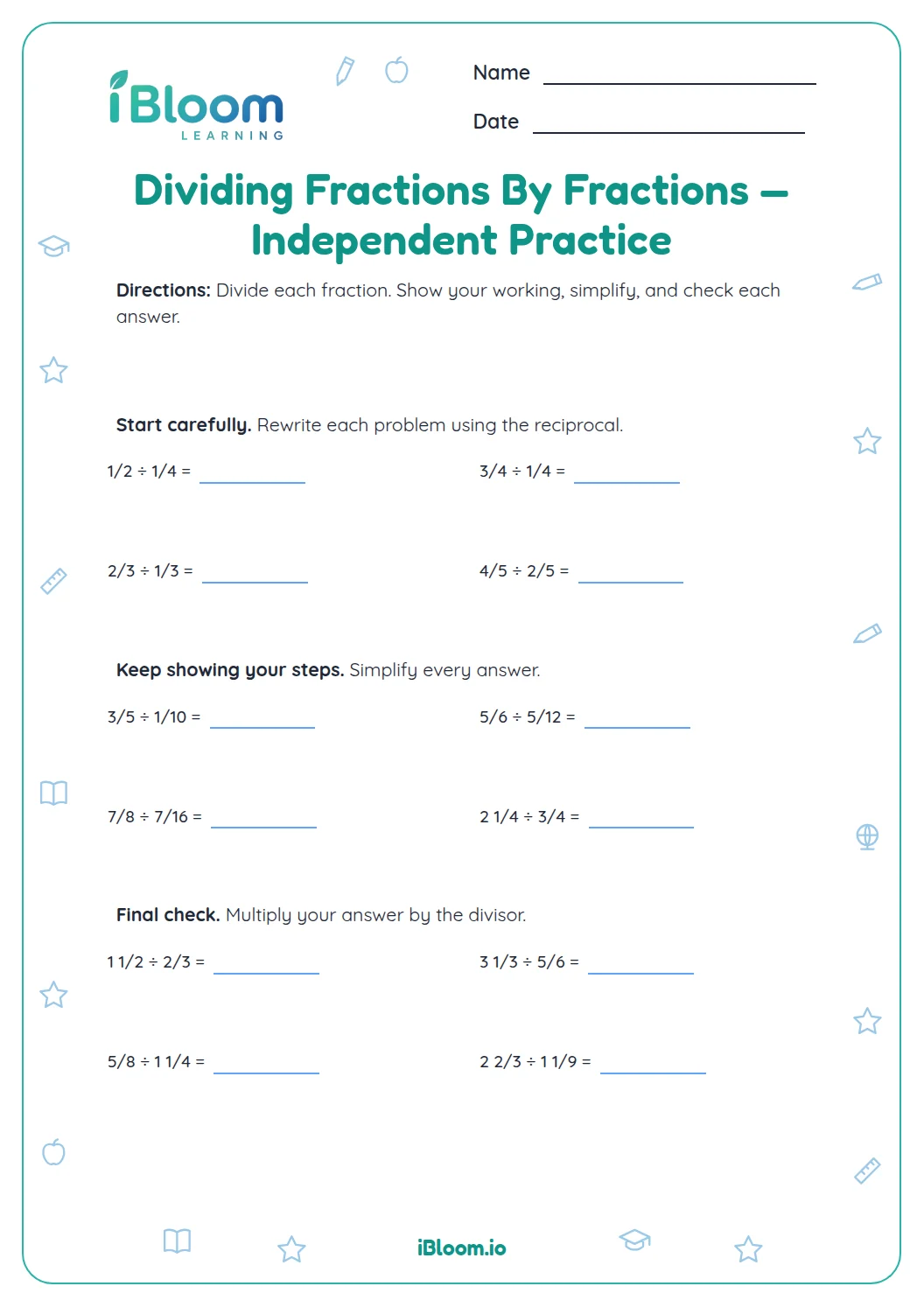
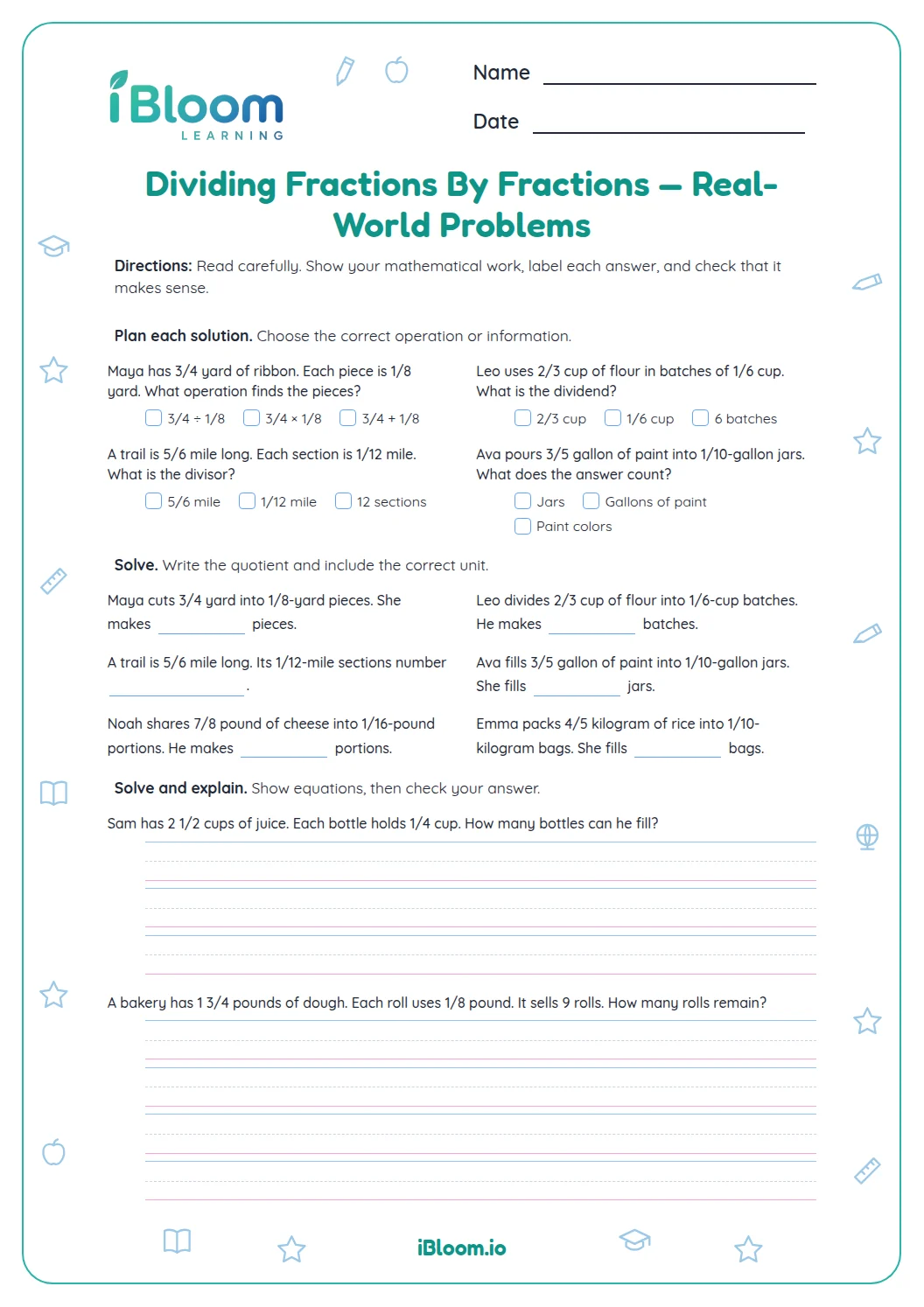
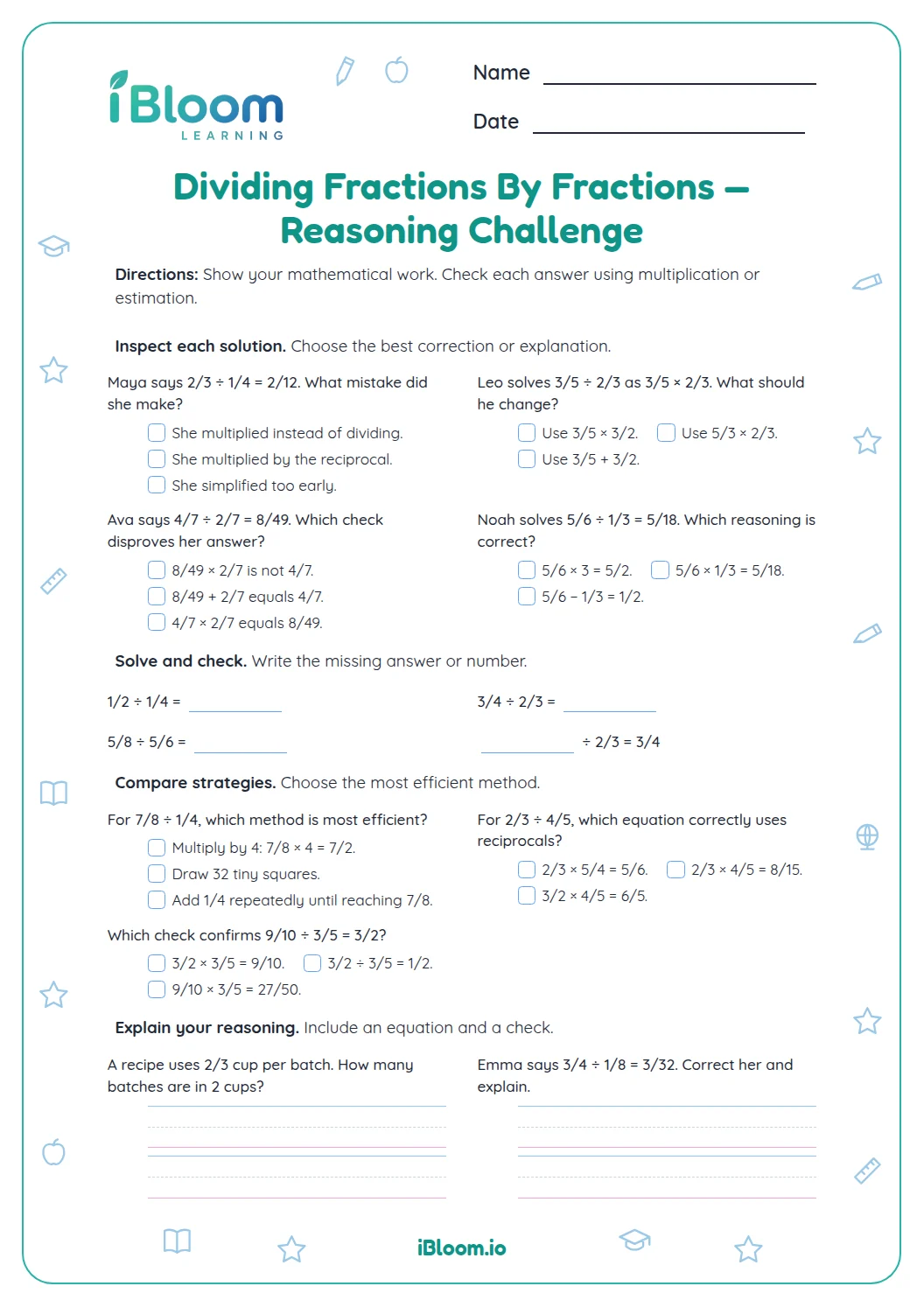
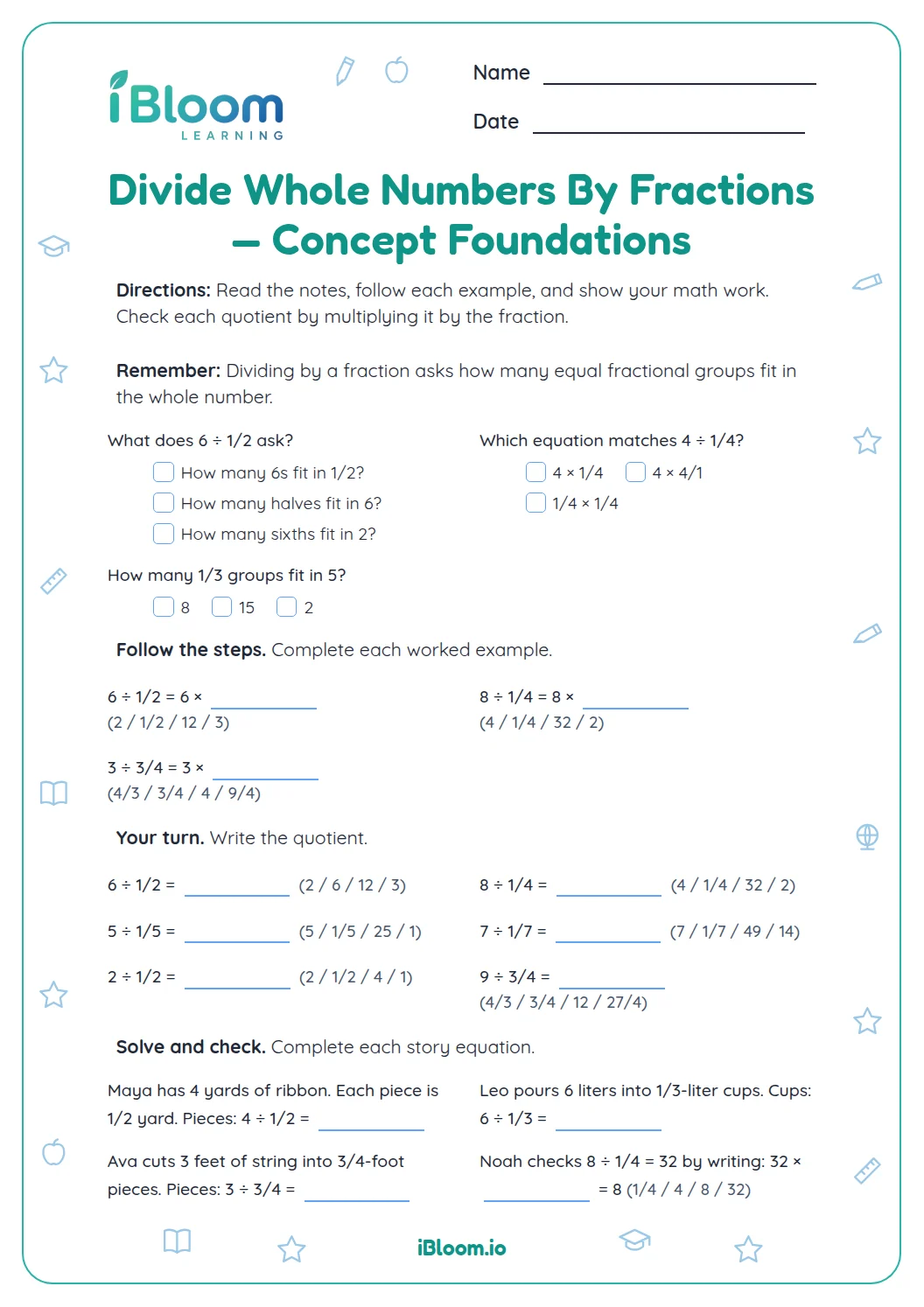
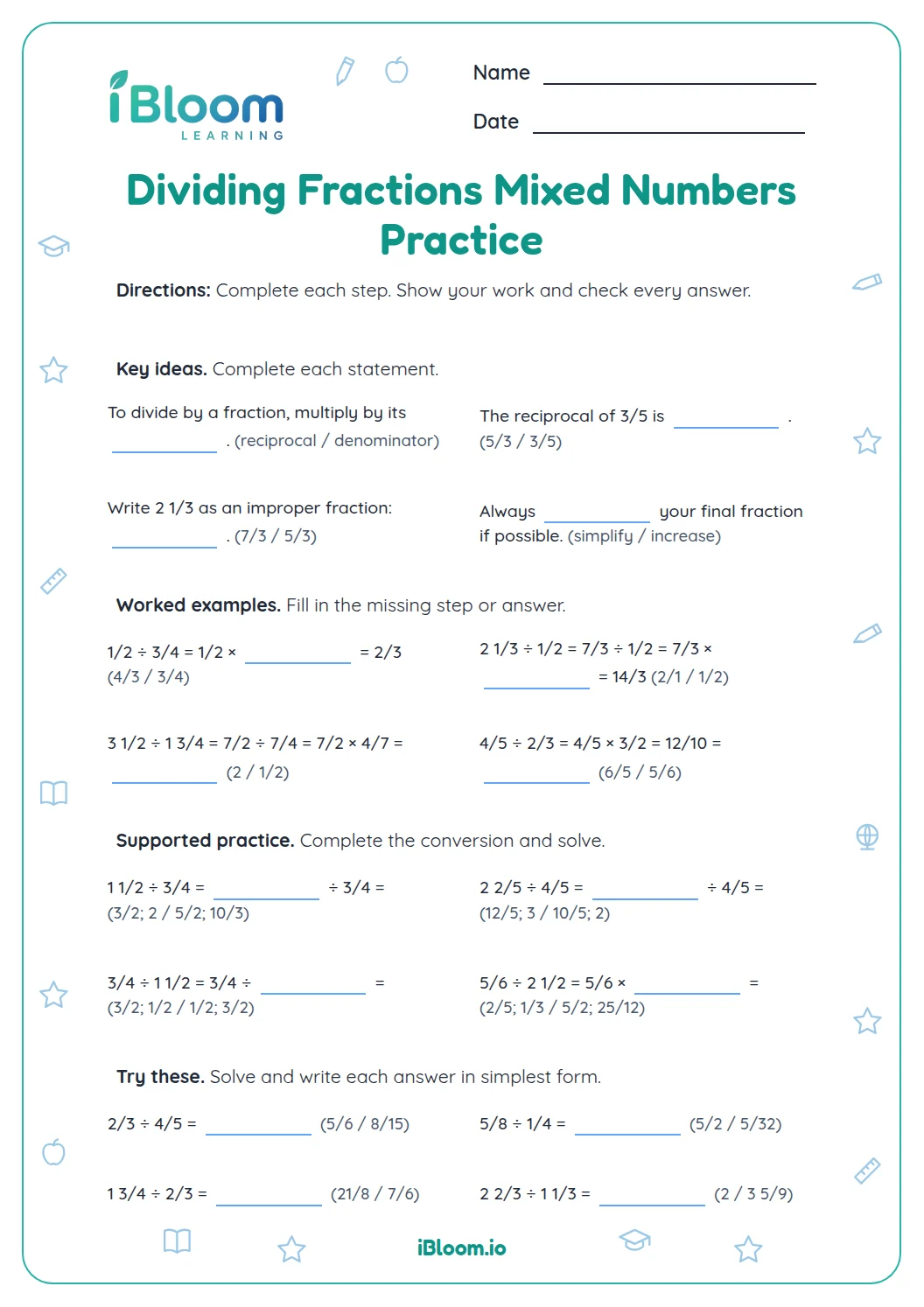
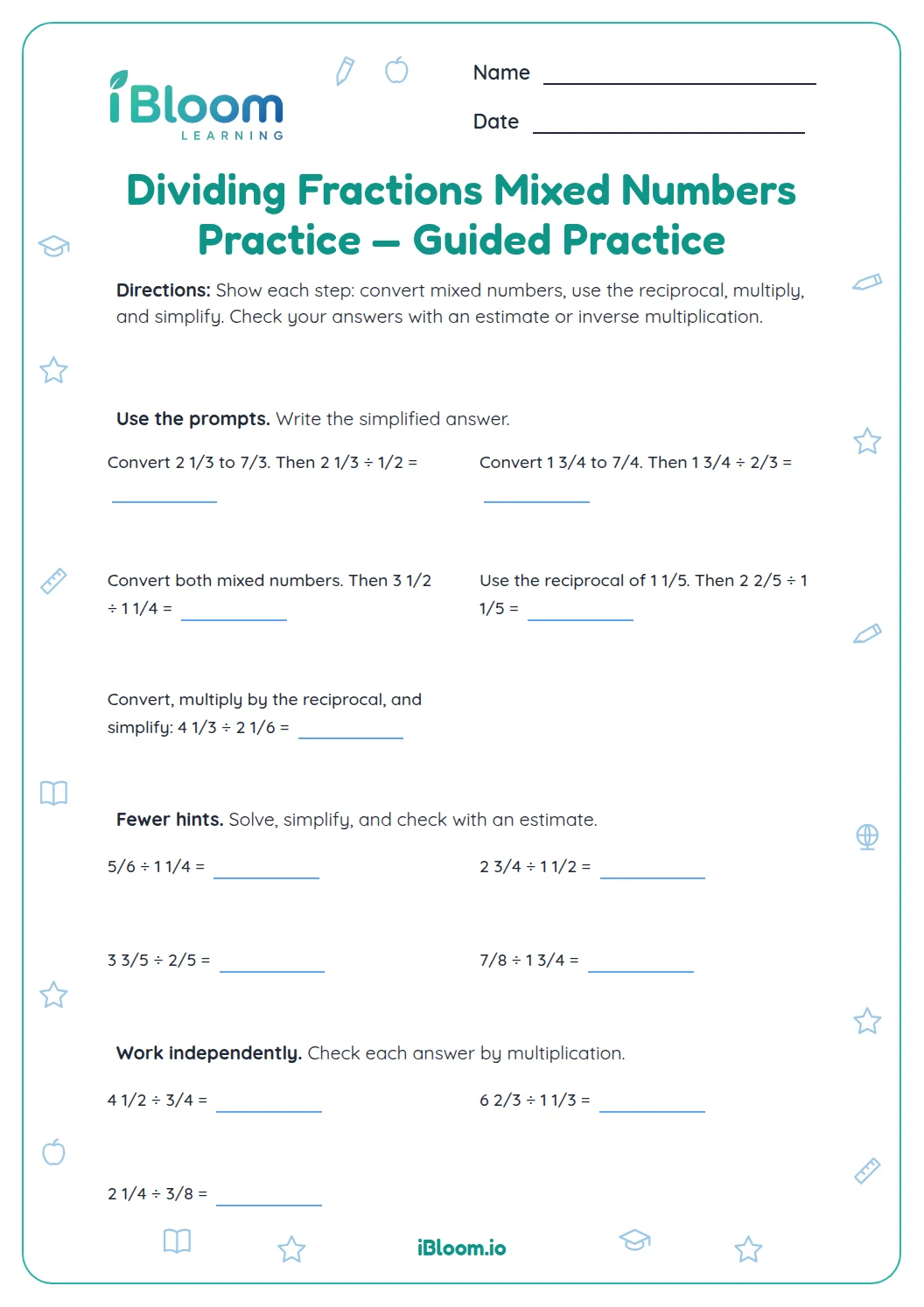
This Grade 5 worksheet builds the meaning of dividing a fraction by another fraction. Students begin with unit fractions, count equal-size parts, and solve quotients with like and unlike denominators. The 18 main questions move from whole-number quotients to fractional answers, followed by three equivalent-fraction bonus challenges. A separate answer key supports checking.
What does a unit-fraction quotient count?
A quotient tells how many groups of the divisor fit in the dividend. With unit fractions that share a whole, compare the number of equal pieces: 1/2 contains two pieces of size 1/4, so 1/2 ÷ 1/4 = 2.
- 11/3 ÷ 1/6 asks how many sixths fit in one third.
- 2Since 1/3 = 2/6, the quotient is 2.
How can equal denominators make division easier?
When the denominators match, each numerator counts pieces of the same size. In 5/6 ÷ 1/6, five sixth-size pieces contain five groups of one sixth.
- 15/6 ÷ 1/6 counts how many one-sixth groups fit in five sixths.
- 2There are 5 groups, so 5/6 ÷ 1/6 = 5.
What if the denominators are different?
Rename the fractions with a common denominator, or multiply by the reciprocal of the divisor. For 3/4 ÷ 1/2, multiply 3/4 by 2/1 to get 6/4, then simplify to 1 1/2.
- 1For 3/4 ÷ 1/2, multiply by the reciprocal: 3/4 × 2/1 = 6/4.
- 2Simplify 6/4 to 3/2, or 1 1/2.
How to use this worksheet
- 1Name the dividend and divisor in each expression.
- 2For unit fractions, count how many divisor-sized pieces fit.
- 3For unlike denominators, multiply by the reciprocal of the divisor.
- 4Simplify the quotient and convert an improper fraction to a mixed number.
Common mistakes and quick fixes
The mistake
Reversing the dividend and divisor
The fix
Keep the first fraction as the amount being grouped; invert only the second.
The mistake
Multiplying both fractions without inverting
The fix
Write the reciprocal of the divisor, then multiply.
The mistake
Leaving an improper fraction when a mixed number is expected
The fix
Divide numerator by denominator and record the remainder.
What to practice next
Make more practice
Questions parents and teachers ask
What does 1/2 ÷ 1/4 mean?
It asks how many groups of one fourth fit into one half. Two fourths equal one half, so the quotient is 2. Thinking about equal-size pieces helps explain the answer before using a multiplication rule. Students can sketch equal pieces or use a number line to picture those groups before writing a quotient.
Why do I multiply by the reciprocal?
Multiplying by the reciprocal of the divisor is a reliable way to calculate how many divisor-sized groups fit. For 3/4 ÷ 1/2, write 3/4 × 2/1 = 6/4, then simplify to 1 1/2. The worksheet asks students to find quotients; the page explanation models this calculation alongside the equal-size-parts meaning.
Do I always get a whole-number quotient?
No. If the dividend contains only part of one divisor-sized group, the quotient is a fraction. In 2/3 ÷ 3/4, the answer is 8/9 because two thirds is less than three fourths. A quotient less than one is reasonable when the dividend is smaller than the divisor. Compare their sizes before calculating to anticipate that result.
When should an answer be simplified?
Simplify whenever numerator and denominator share a factor. For example, 6/4 can be reduced to 3/2 and written as 1 1/2. Reduced fractions make it easier to compare answers and see the size of the quotient. The answer key accepts equivalent reduced values, including mixed-number forms when the quotient is greater than one. Compare the value, not just its format.
What does this worksheet practice first?
Part A starts with unit fractions so students can compare equal pieces. Part B counts groups when denominators match, and Part C mixes denominators. After those 18 division problems, the sheet includes three bonus questions on equivalent fractions. The key includes answers for the quotient practice and bonus items.