
About this worksheet
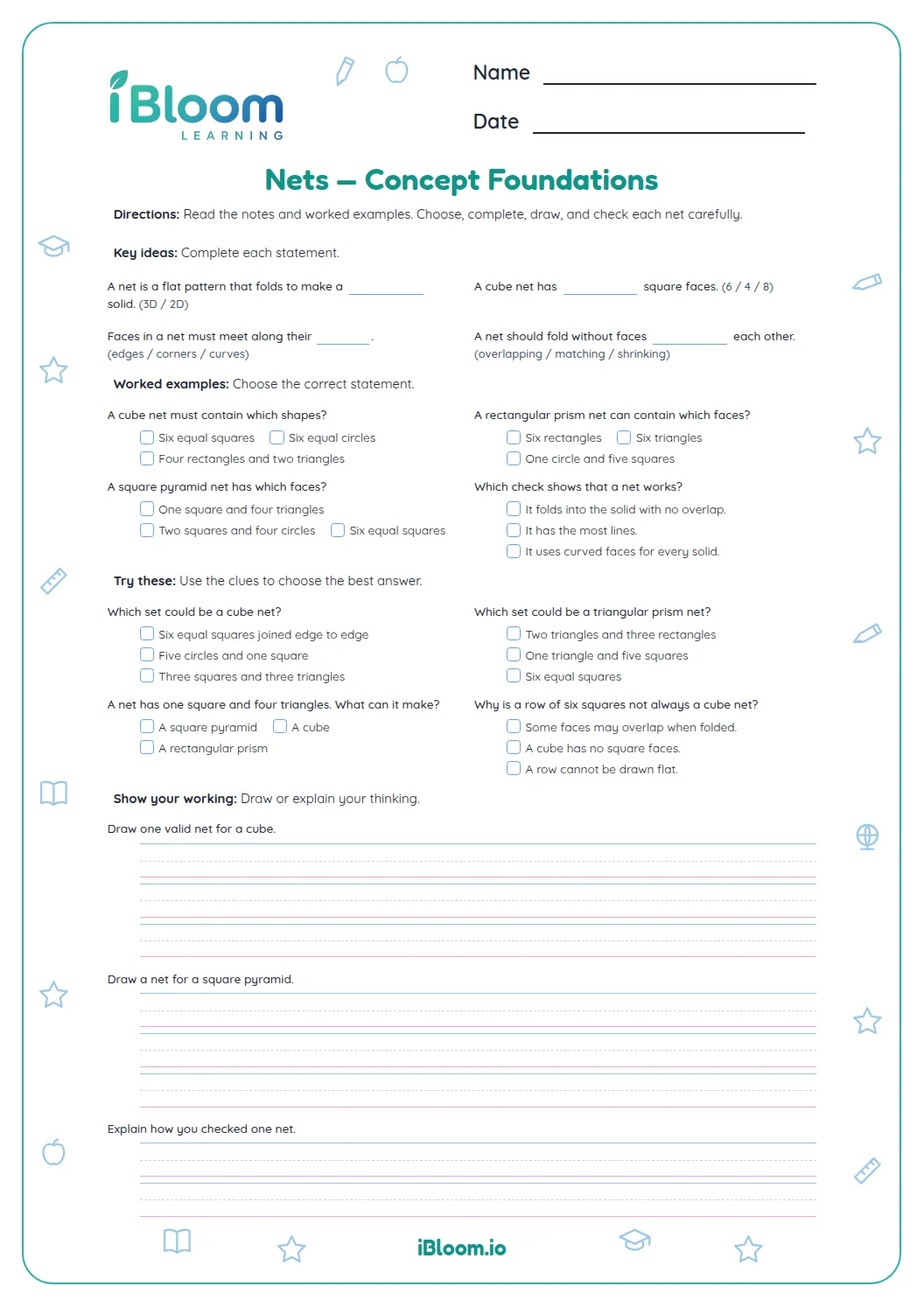
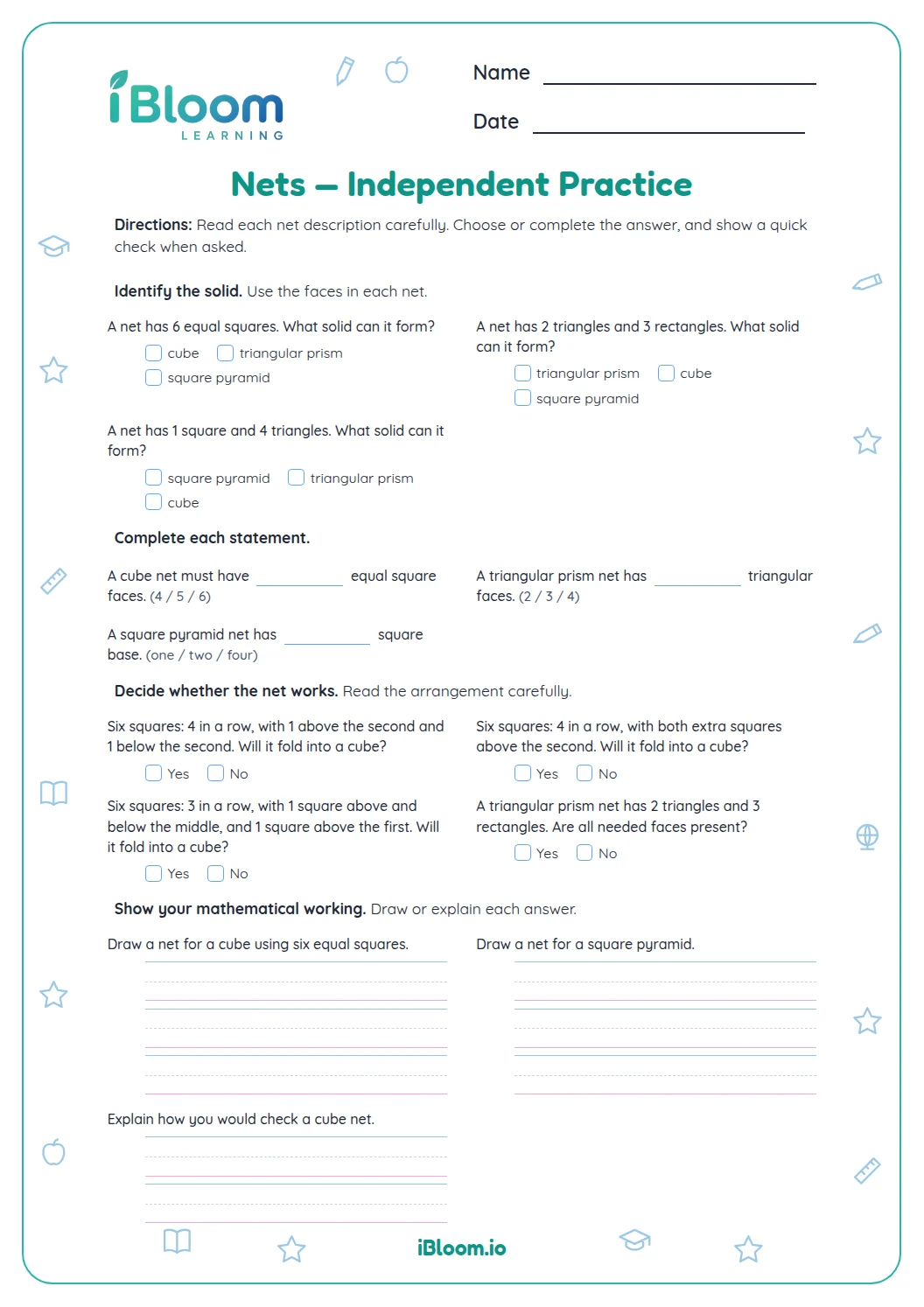
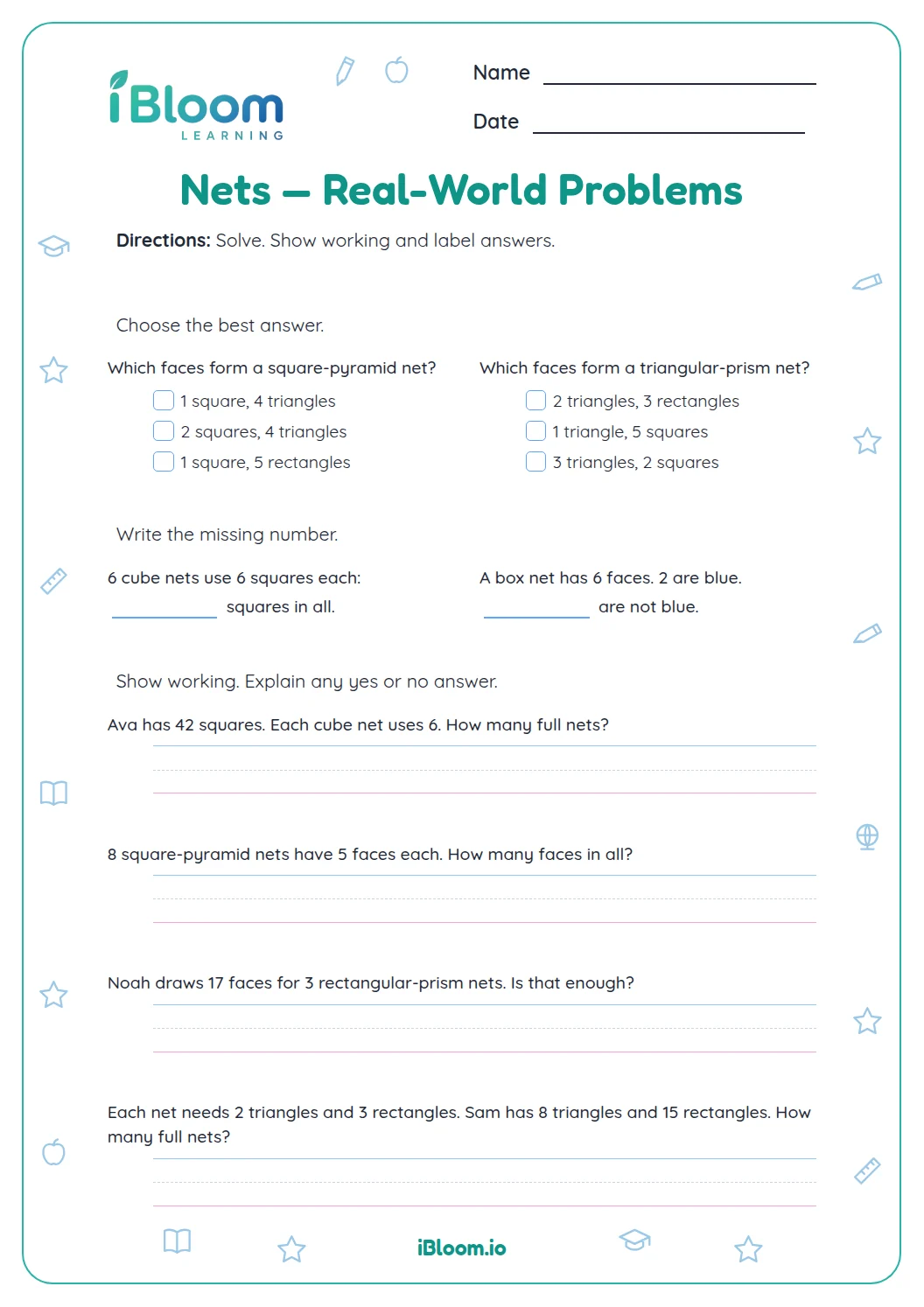
This Grade 5 geometry worksheet asks students to reason about nets of three-dimensional shapes. They inspect two pictured arrangements of connected squares, identify face sets for cubes and prisms, and consider whether faces fold without overlap. It contains 14 questions in three parts across three worksheet pages, with a matching answer key. The page focuses on visual reasoning about how flat faces form solids.
What does a net show?
A net is a flat arrangement of faces that can fold to make a three-dimensional solid. The number and shapes of faces matter, and their arrangement must allow the solid to close without overlap.
What reasoning appears in the questions?
The fourteen items use pictured square arrangements and questions about cubes, square pyramids, triangular prisms, and rectangular prisms. Students consider face counts and whether layouts can close without overlap.
How can face dimensions identify a solid?
Pair faces with matching dimensions and count each type.
- 1Net A contains six connected equal squares.
- 2A cube has six square faces.
- 3Check that folding closes the faces without overlap.
- 4Answer: cube, if the layout folds correctly.
How to use this worksheet
- 1List the faces a solid needs before judging a net.
- 2Check how many faces meet at each edge.
- 3Ask whether folding would close the solid without overlap.
- 4In written answers, name both the faces and the reason they fit.
Common mistakes and quick fixes
The mistake
Counting the right number of faces but ignoring their layout.
The fix
Check whether the arrangement folds closed without overlap.
The mistake
Assuming all nets for one solid must look alike.
The fix
Compare face shapes and folding connections, not the outline.
The mistake
Naming a solid from one face alone.
The fix
Use the full set of face shapes and their counts.
What to practice next
Make more practice
Questions parents and teachers ask
What makes a net valid?
A valid net is a connected flat arrangement of the solid’s faces that folds into the solid without gaps or overlapping faces. Both the face shapes and their arrangement matter. The questions ask students to examine counts and explain folding behavior.
How many faces does a cube net need?
A cube has six square faces. A candidate net must use six connected squares and fold so the faces close without overlap. Merely counting six squares is not enough; their arrangement also has to work. Ask the learner to explain the clue they used.
Can different nets make the same solid?
Yes. A solid can have different flat arrangements of the same faces. Each arrangement must still fold into the solid correctly. Students compare the faces and their connections rather than assuming every valid net has one outline. Ask the learner to explain the clue they used.
What faces belong in a rectangular prism net?
A rectangular prism has three pairs of matching rectangles, one pair for each pair of dimensions. With dimensions 4, 3, and 2, its face pairs measure 4 by 3, 4 by 2, and 3 by 2. The key lists those pairs.
What does the answer key show?
The answer key marks the correct choice for each item. It also lets students revisit the pictured square layouts and compare face counts or dimensions with the solid named in the question. Reviewing the reason for a choice can help clarify why a connected arrangement may or may not fold successfully.