
About this worksheet
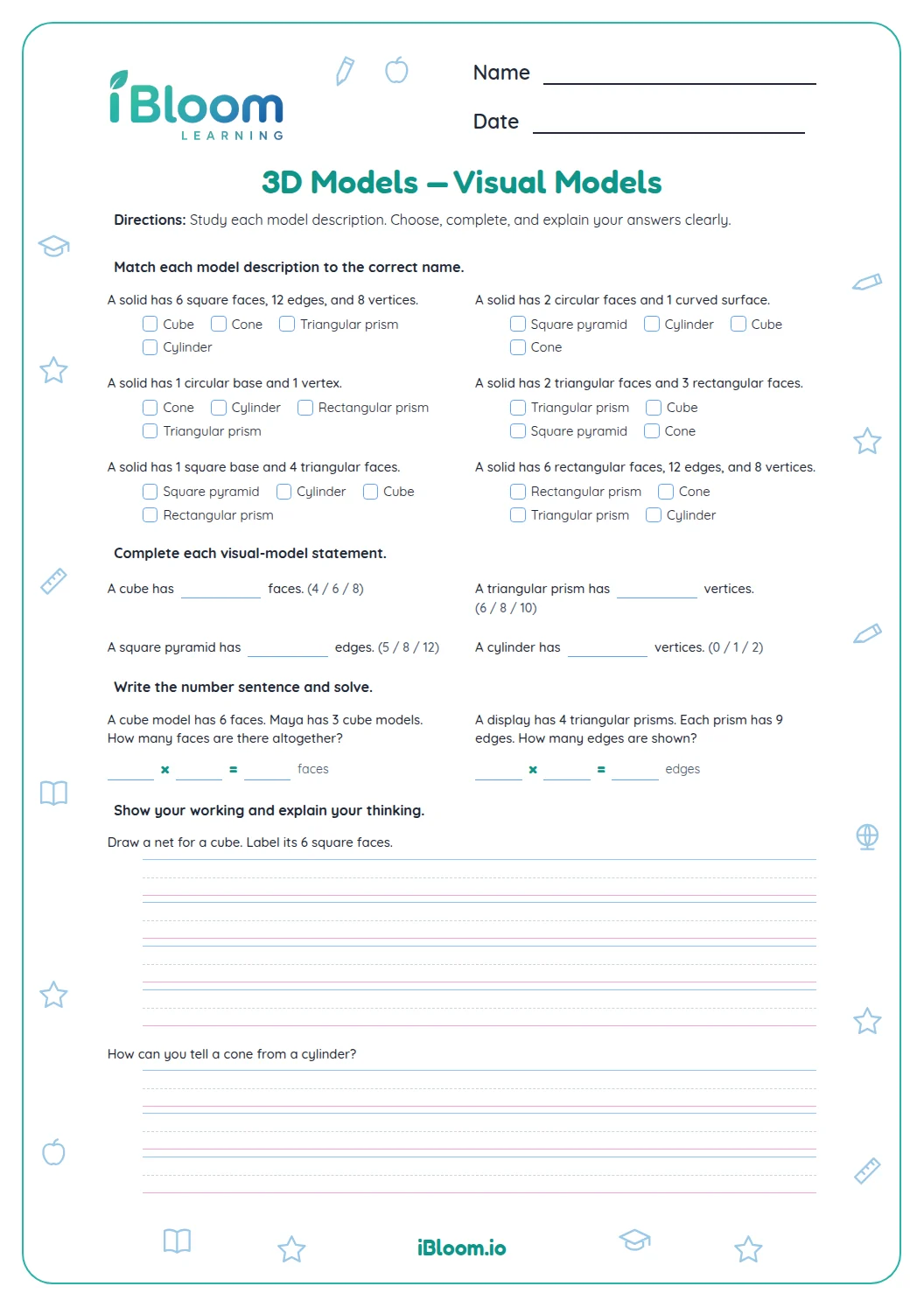
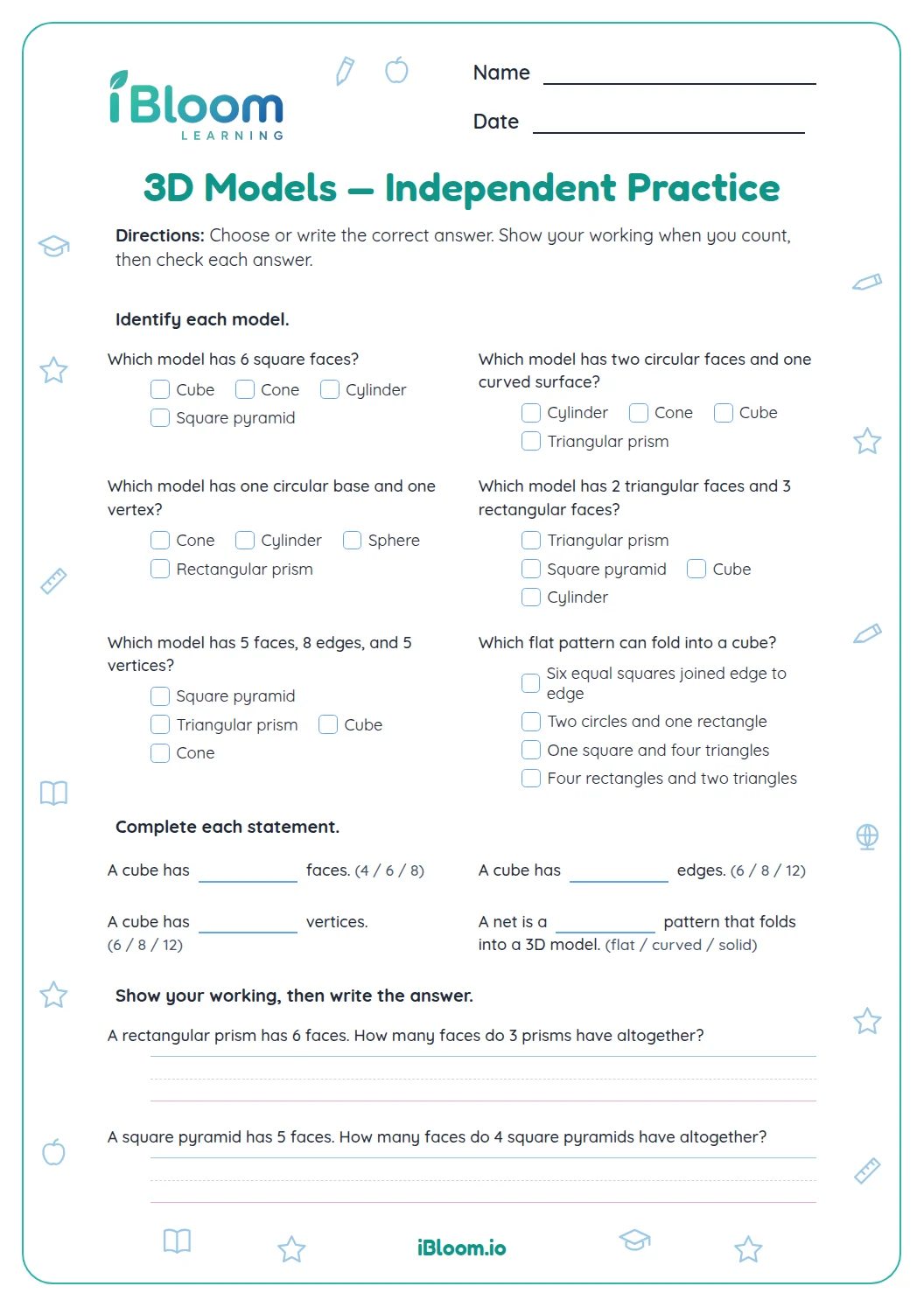
This Grade 5 geometry worksheet asks learners to read net models by the faces they contain, connect those faces to solid figures, and use face dimensions to calculate nets and solid figures. Visual clues and measurements support learners as they picture how each set of faces folds.
Aligned to 6.G.A.4
How does a net represent a solid?
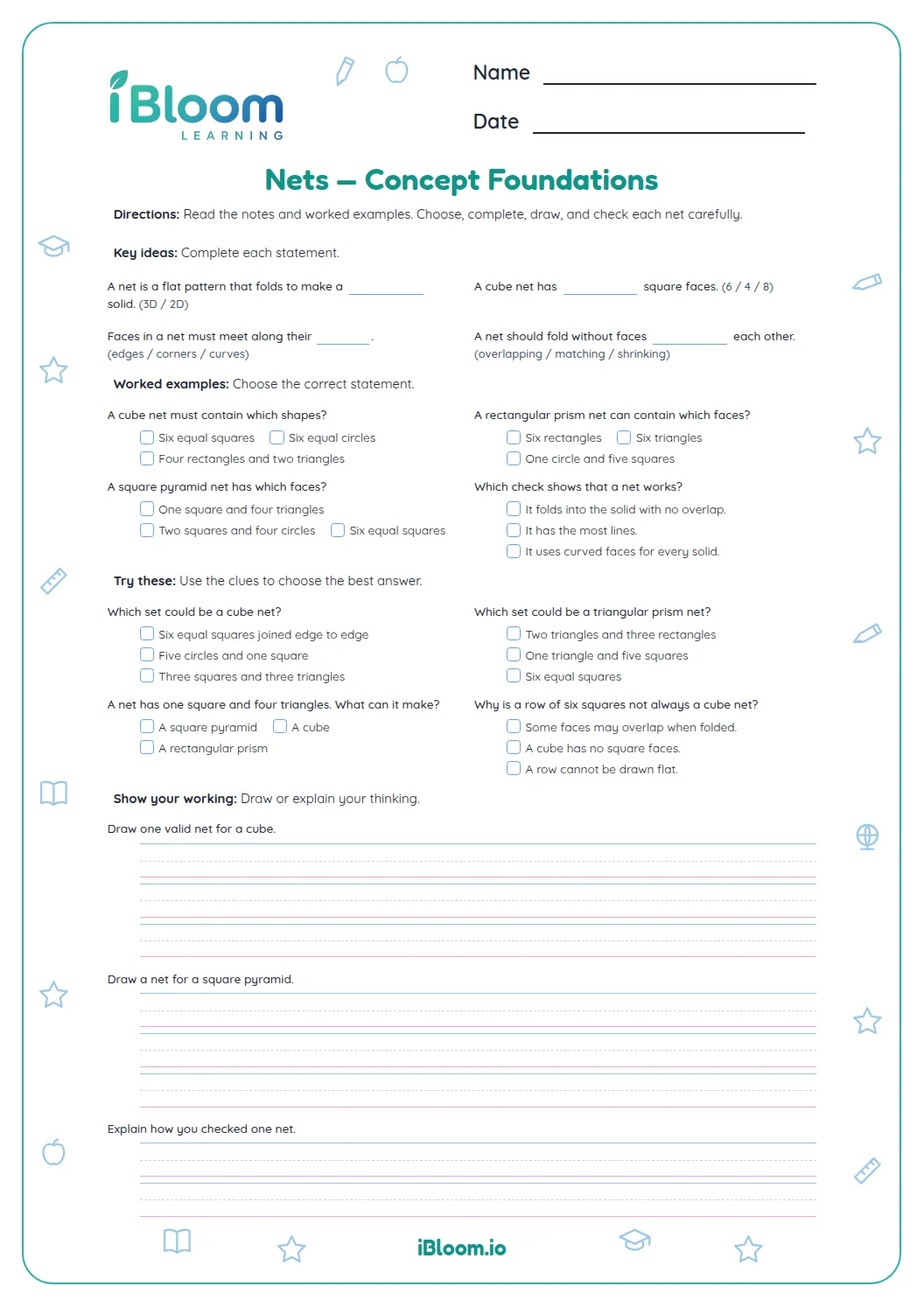
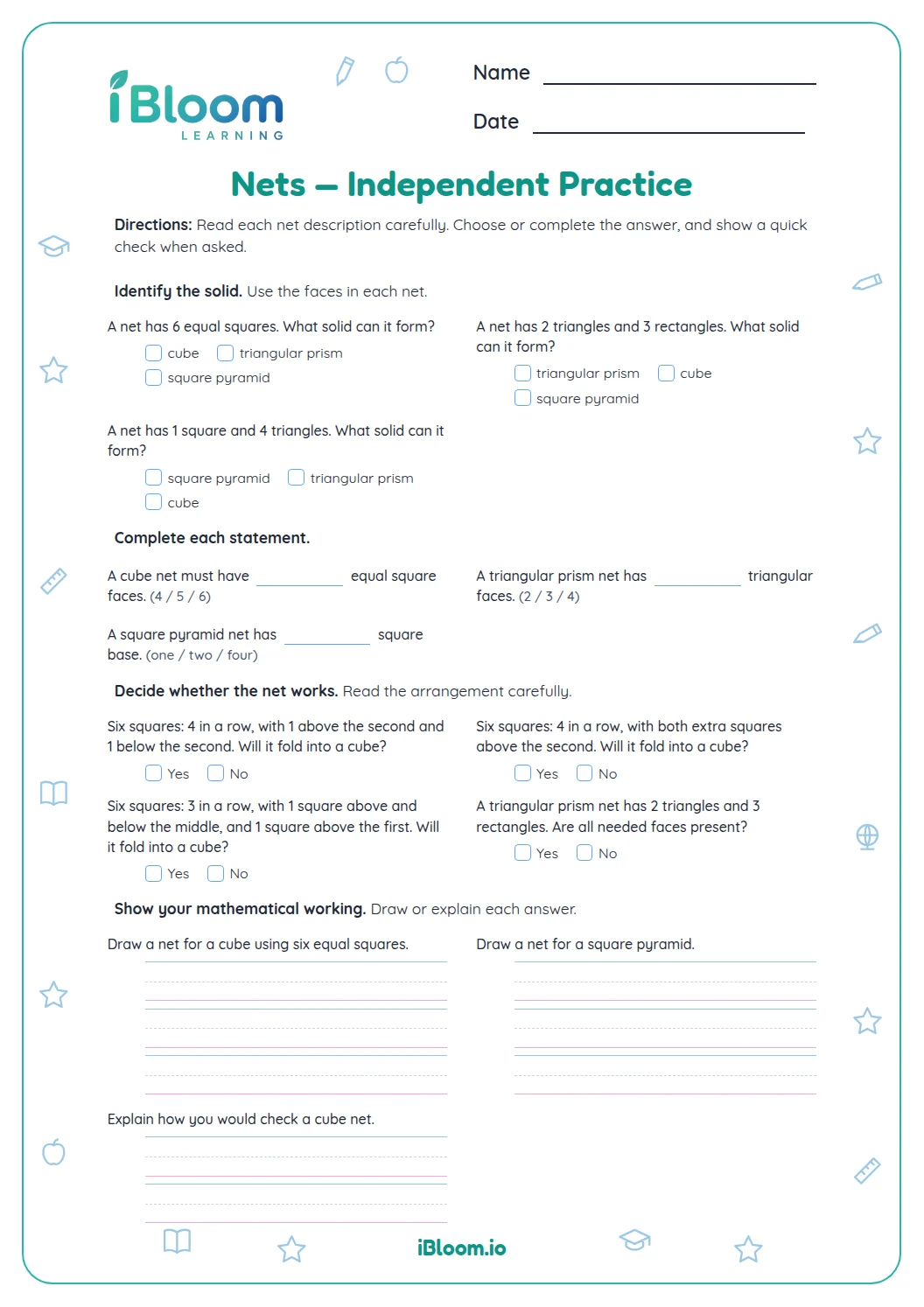
A net is a flat arrangement of faces that can fold to make a three-dimensional figure. The face shapes and their count give clues: a cube has six squares, while a triangular prism has two triangles and three rectangles.
Surface area is the total area of all the outside faces. For a rectangular prism, find the three different face areas and count each twice.
- 14 × 3 = 12
- 24 × 2 = 8
- 33 × 2 = 6
- 42 × (12 + 8 + 6) = 52 cm²
What does each part practice?
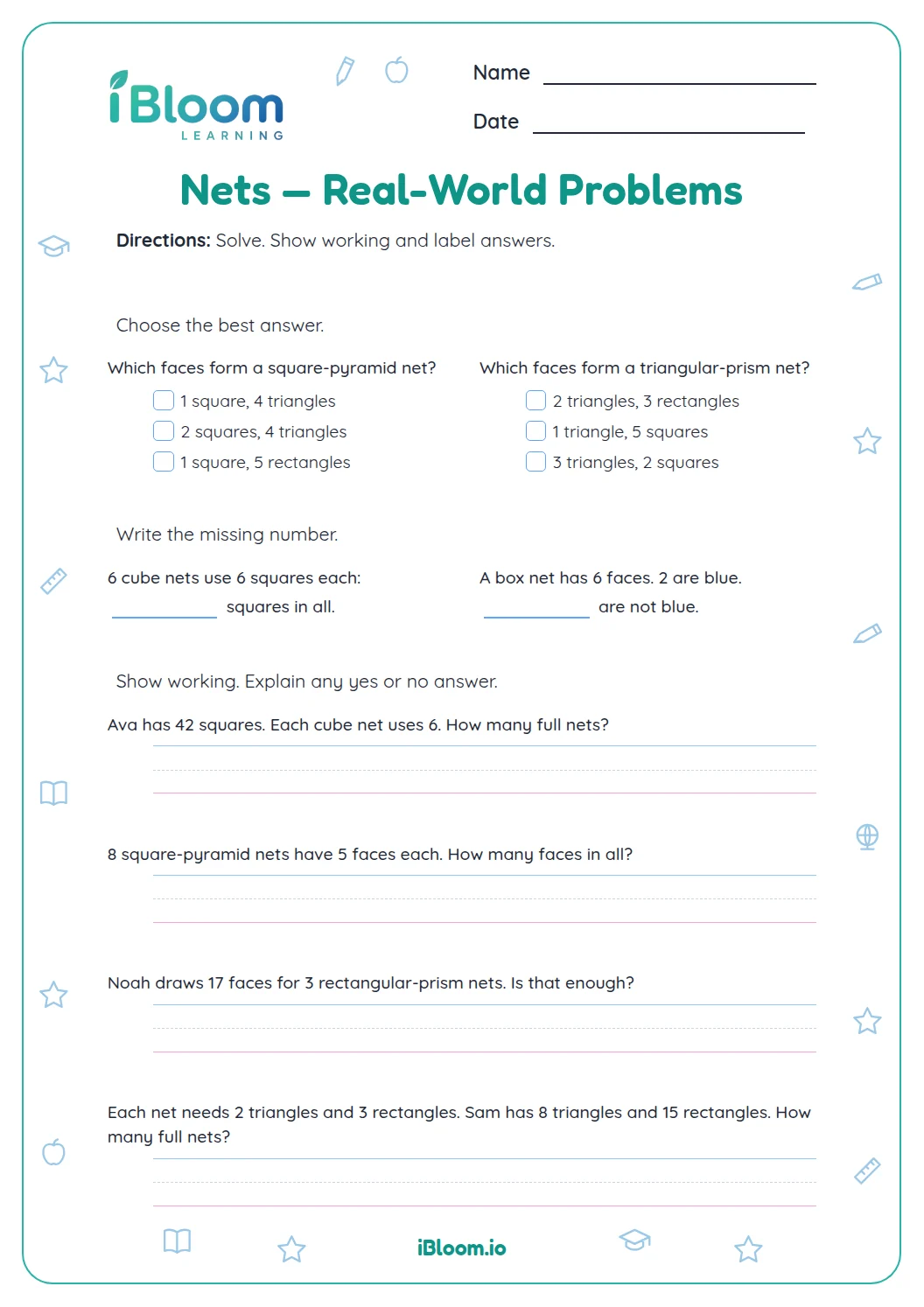
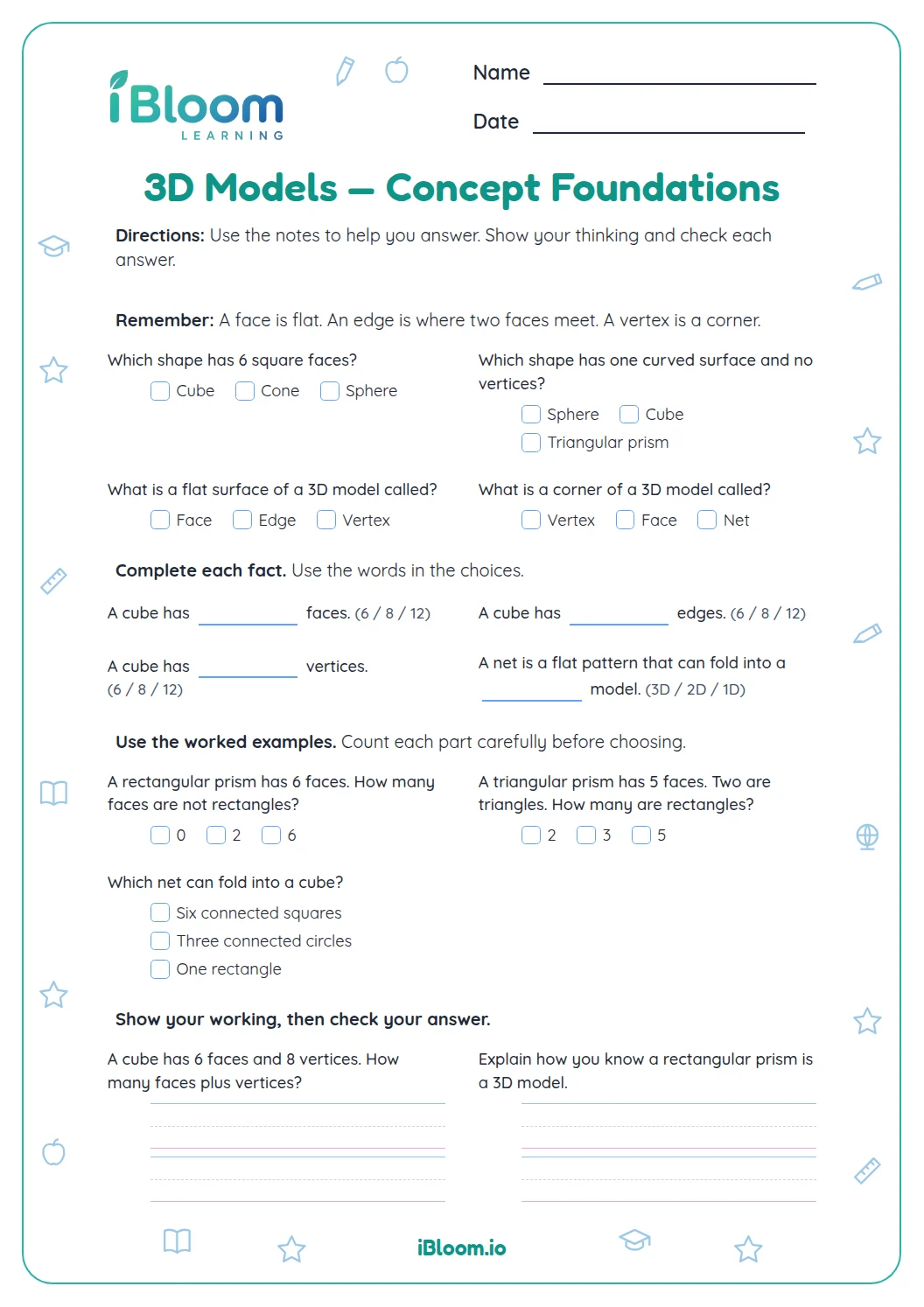
Part A matches face sets to solids and counts faces. Part B calculates surface area using side lengths. Part C explains what a net must show.
A described model still asks children to visualize how faces fit together. Encourage them to sketch the faces on scrap paper and imagine folding along shared edges.
How can learners check their work?
For a 4 by 3 by 2 prism, the face pairs have areas 12, 8, and 6 square centimeters. Twice their sum is 52 cm².
Curriculum alignment
Connect nets made of rectangles and triangles to three-dimensional figures.
On this sheet: Students identify solids from nets and count their faces.
Show the official wordingHide the official wording
Represent three-dimensional figures using nets made up of rectangles and triangles, and use the nets to find the surface area of these figures. Apply these techniques in the context of solving real-world and mathematical problems.
What to practice next
Make more practice
Further reading
Questions parents and teachers ask
What information can a net give about a solid?
A net is a flat arrangement of faces that can fold into a solid. The face shapes and how many there are help identify the solid: a cube net has six squares. Invite the learner to point to the part of the item that supports the answer, then explain the choice in their own words.
How do I find a rectangular prism’s surface area?
Find the area of each different face, then include every face in the total. A rectangular prism has three pairs of matching rectangles, so double each of the three face areas. Invite the learner to point to the part of the item that supports the answer, then explain the choice in their own words.
How many faces does a cube have?
A cube has six square faces. Its net must show six connected squares arranged so they can fold into the cube without overlapping. Invite the learner to point to the part of the item that supports the answer, then explain the choice in their own words.
Why does this page describe nets in words?
The sheet contains 14 questions about identifying solids from face sets, counting faces, and finding surface area. It includes visual net models and a separate answer key. Invite the learner to point to the part of the item that supports the answer, then explain the choice in their own words.
How many questions and pages are included?
There are 14 questions arranged across the worksheet pages, followed by a separate answer key. Review the directions at the start of each part so the learner knows what kind of response to give before beginning. Use the key to check.