

About this worksheet
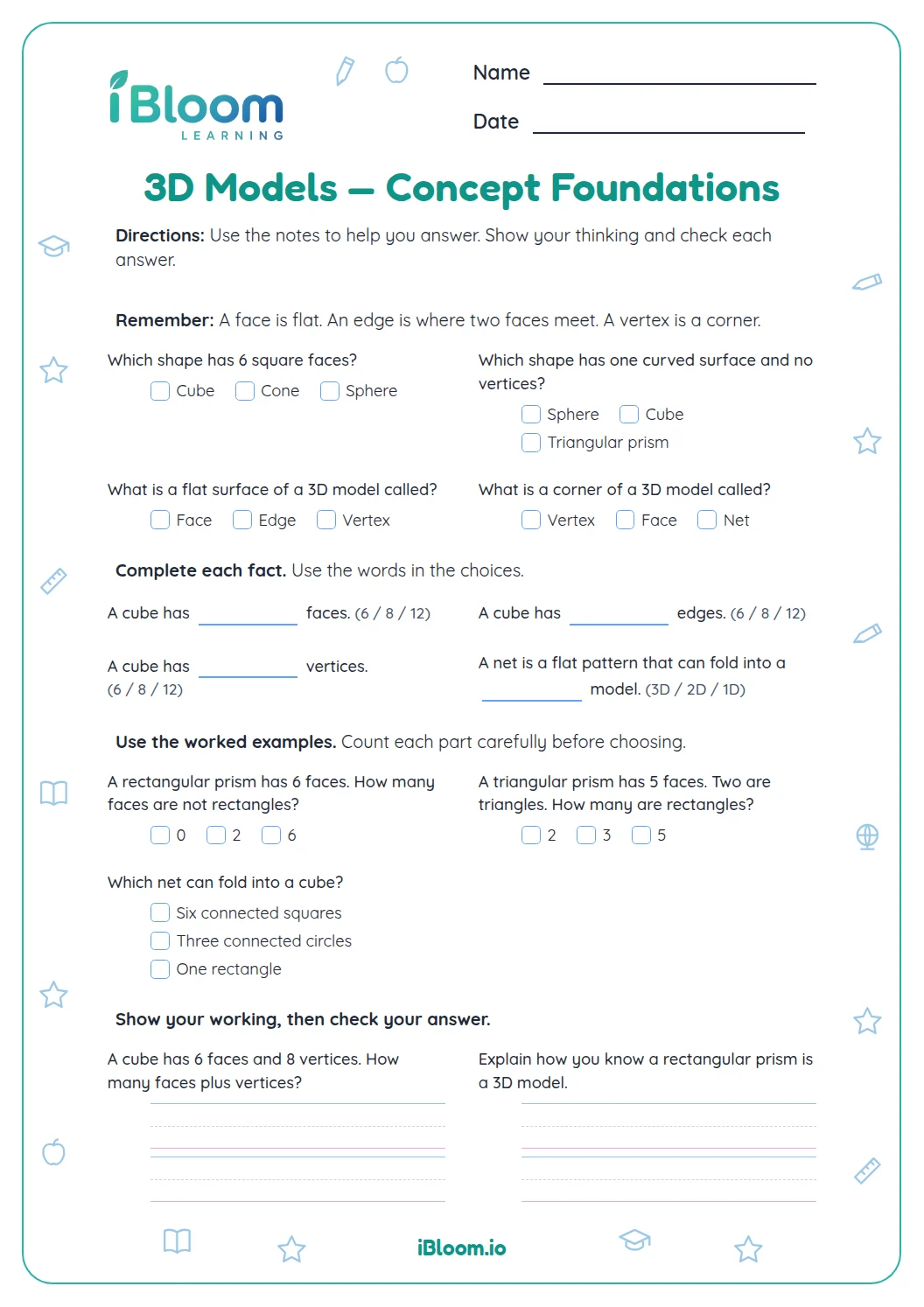
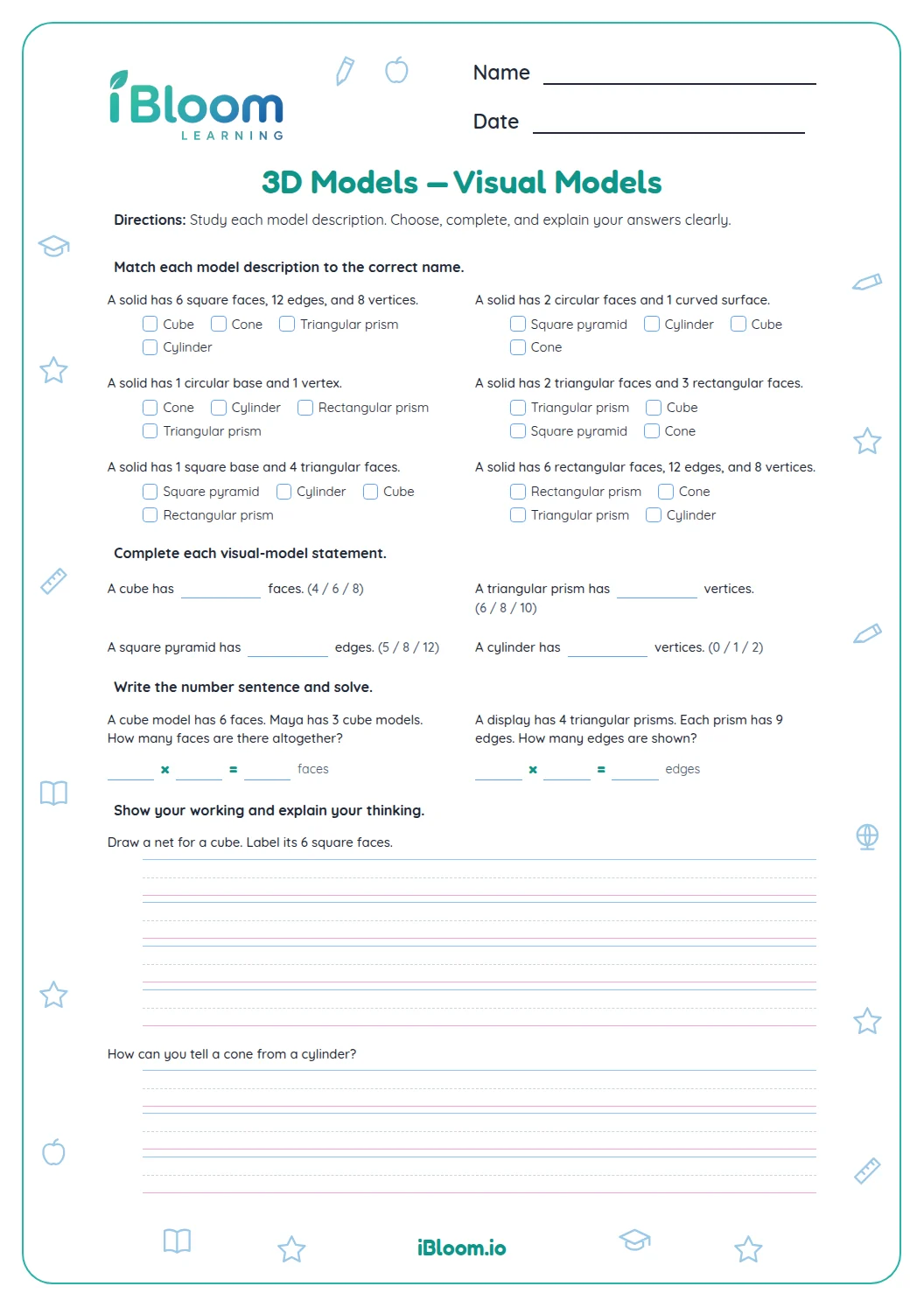
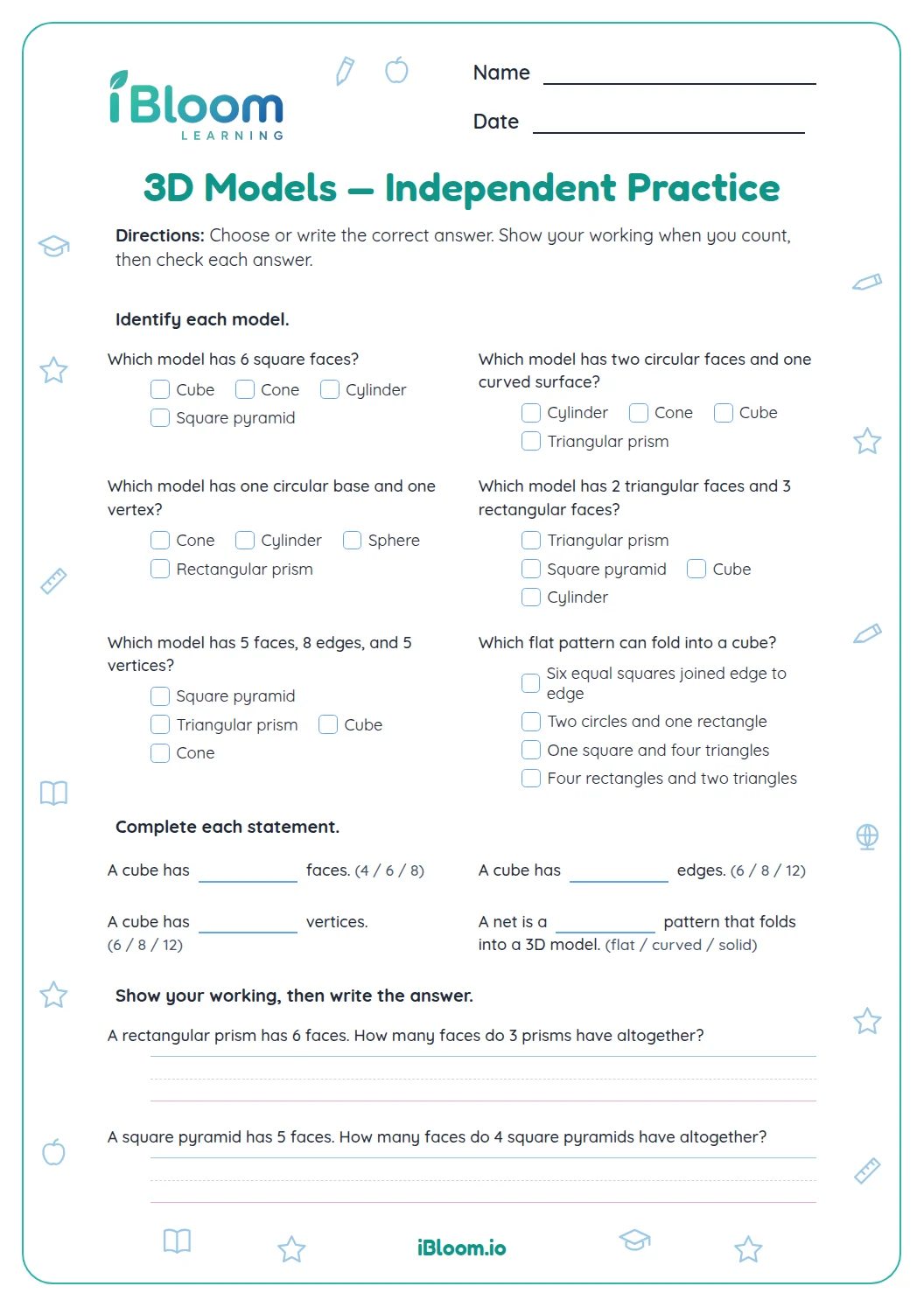
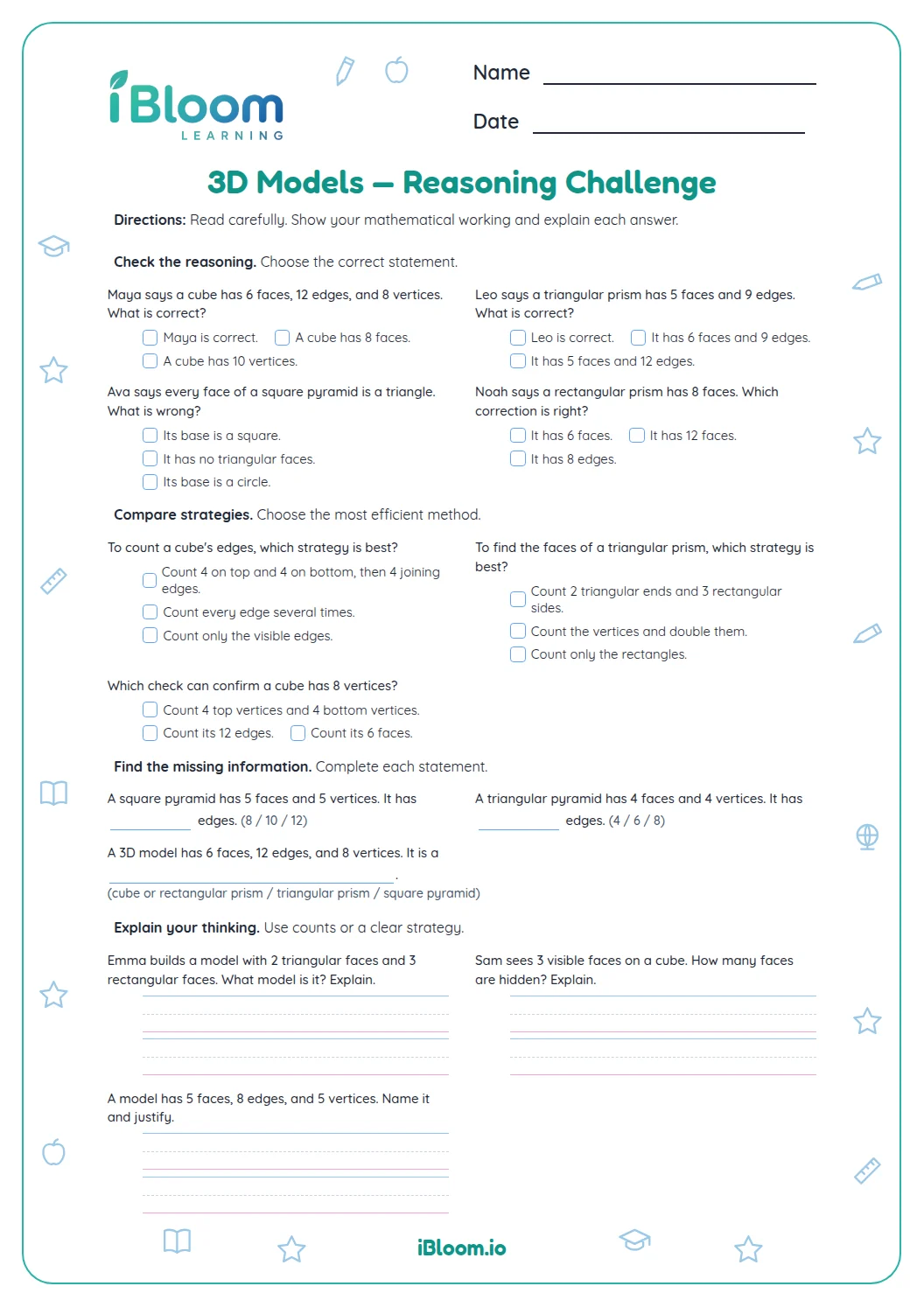
This Grade 5 geometry worksheet reviews solid figures through their faces, edges, and vertices. Students identify prisms, pyramids, cylinders, and cones, recall attribute counts, and reason about shared edges and cube nets. Sixteen questions move from recognition to short explanations and calculations.
What skill does this page practice?
This Grade 5 geometry worksheet reviews solid figures through their faces, edges, and vertices. Students identify prisms, pyramids, cylinders, and cones, recall attribute counts, and reason about shared edges and cube nets. Sixteen questions move from recognition to short explanations and calculations.
What solid attributes does this worksheet review?
Students identify solids and use their faces, edges, and vertices to answer 16 guided questions. A separate answer key includes counts and sample reasoning.
How can learners check their work?
Start with the known face, edge, and vertex counts for cubes and prisms. For the short answers, recall how many faces meet to form each solid.
What is one useful example?
Each cube edge borders two faces. The product counts every edge twice, so divide 24 by 2.
How to use this worksheet at home or in class
- 1Start with the known face, edge, and vertex counts for cubes and prisms.
- 2For the short answers, recall how many faces meet to form each solid.
- 3In the explanation questions, check whether a feature is shared by more than one face.
- 4Use the answer key to check each response after completing the page.
Common mistakes and quick fixes
The mistake
Multiplying 6 faces by 4 edges and concluding that a cube has 24 edges.
The fix
Each cube edge borders two faces. The product counts every edge twice, so divide 24 by 2.
The mistake
Giving a square pyramid 4 faces because it has four triangular sides.
The fix
Include the square base as a face too.
The mistake
Rushing past the clue in the prompt.
The fix
Read the full item again and point to the detail that supports the answer.
What to practice next
Questions parents and teachers ask
How many edges does a cube have?
A cube has 12 edges. Each of its 6 square faces has 4 edges, but every edge belongs to two faces. That is why 6 × 4 counts the cube’s 12 edges twice. The first four items ask about edges and faces of solids, including cylinders and cones
How is a prism different from a pyramid?
A prism has two congruent, parallel bases. A pyramid has one base and triangular side faces that meet at a vertex. Students use these properties and face, edge, and vertex counts to reason about solids. For example, a rectangular prism has 6 faces, 12 edges, and 8 vertices
How many faces does a triangular prism have?
A triangular prism has 5 faces: two triangular bases and three rectangular side faces. The worksheet asks students to recall this count and add the face groups to find the total. The two triangular bases match, and three rectangles connect their corresponding sides. Together those groups make five faces, which is the total expected in the fact questions.
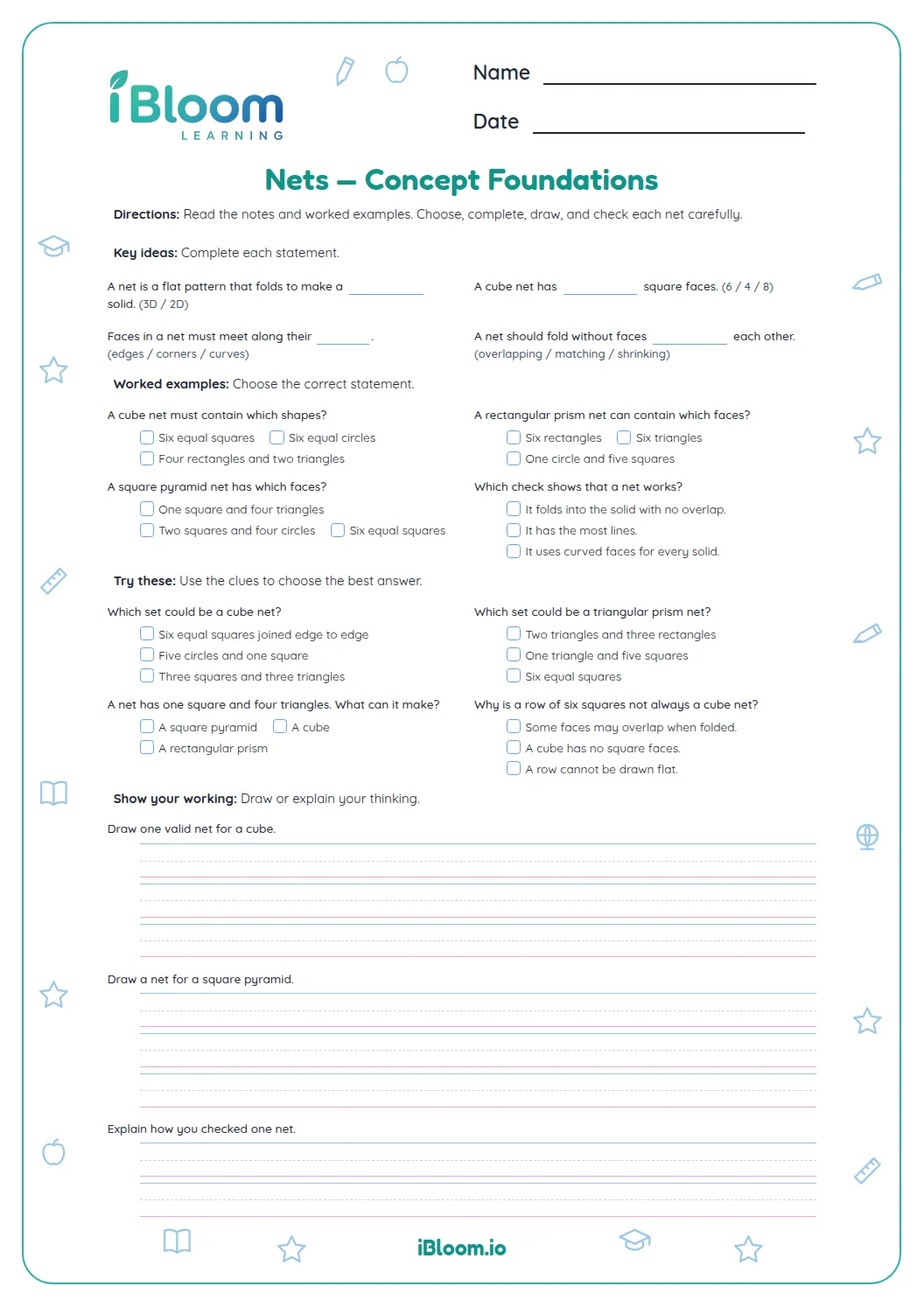
What is a cube net?
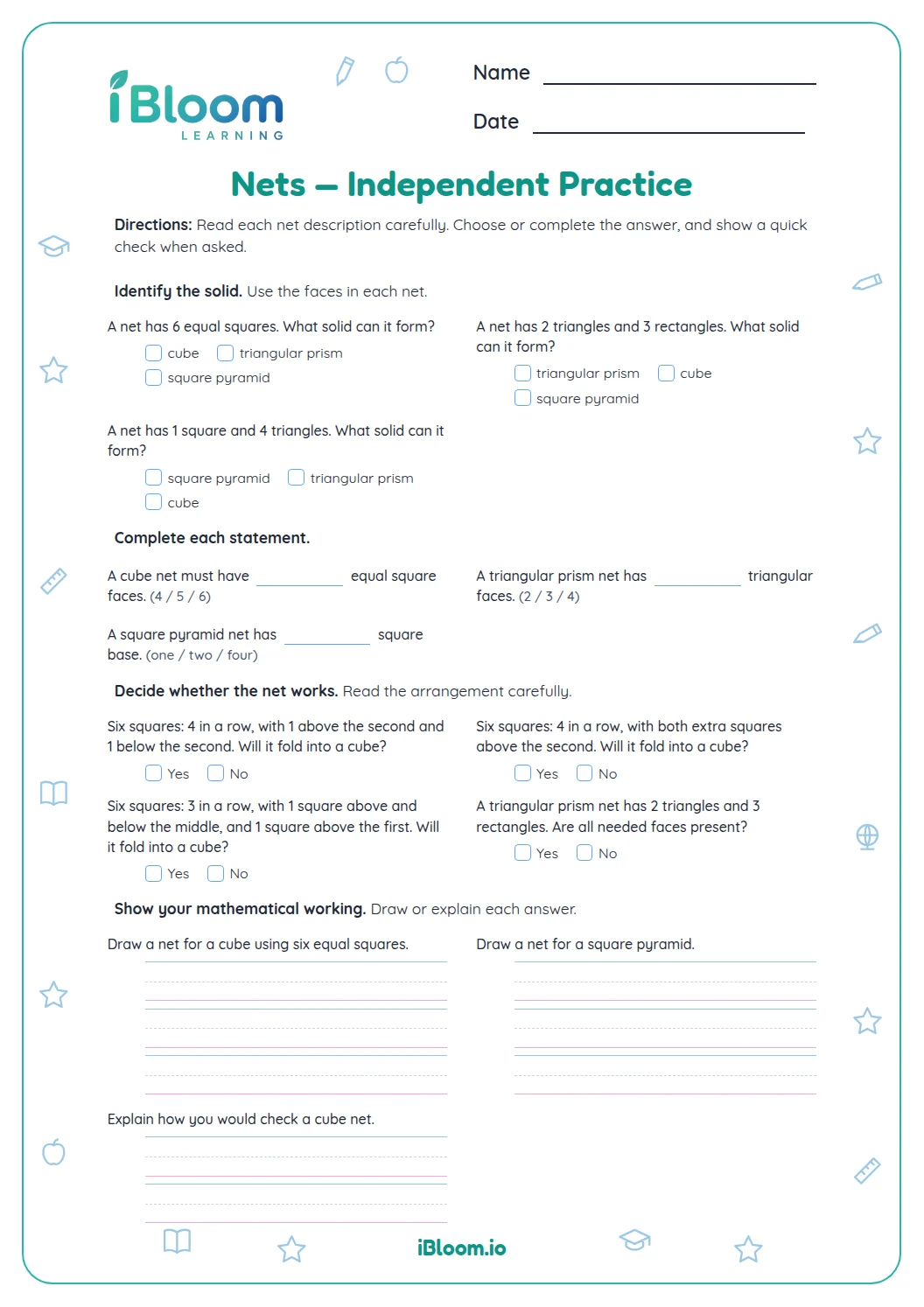
A cube net is a connected arrangement of six squares that folds into a cube. The worksheet asks students to recognize that the faces must be squares and that all six are needed for the solid. A cube has six square faces, so a possible net must contain six connected squares arranged so they can fold without overlap
Why do shared edges matter?
An edge is where two faces meet. Counting four edges on every cube face counts each physical edge twice, so 24 ÷ 2 gives the cube’s 12 distinct edges. If a child gets 24 edges, ask how many faces share one edge. Each edge is counted on two faces, so dividing 24 by 2 gives 12 different edges.
Is an answer key included?
Yes. The separate key gives solid names, attribute counts, calculations, and a sample explanation about shared edges. Use it to check the work after students have attempted each section. The key includes a model explanation for why each edge is counted twice The answer lines and selected options are visible on the matching page.