
About this worksheet
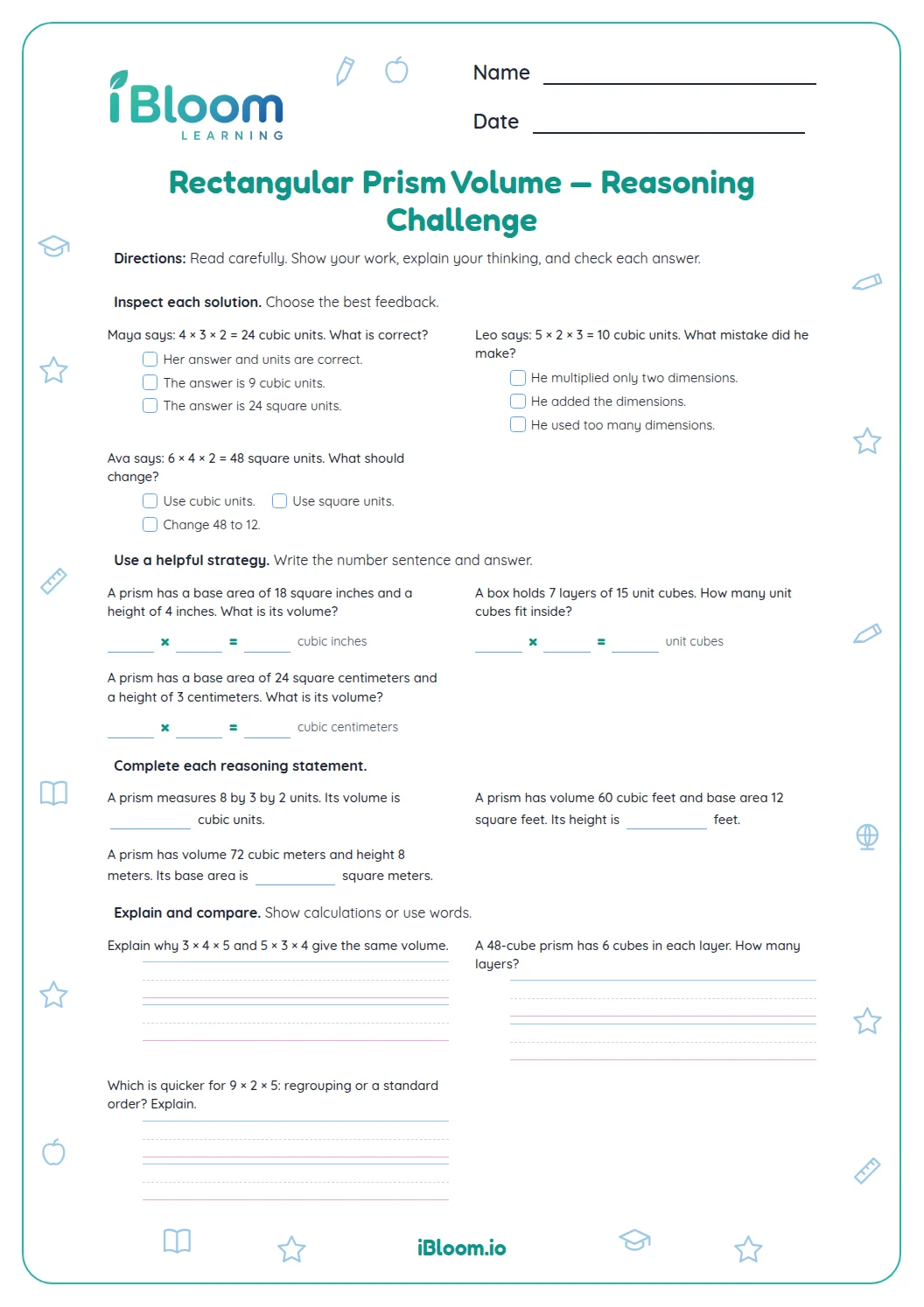
This Grade 5 worksheet connects a rectangular prism’s base layer to its total volume. Each of the 16 items shows a base array, gives the number of equal layers, and asks for volume in cubic units. Learners count rows and cubes in a row, find the base-layer total, and multiply by the layer count. A separate answer key shows each product and the unit.
Aligned to 5.MD.C.5
How does a base layer help find volume?
Each array shows the cubes in one layer. Count the rows and cubes in each row to find that layer’s total. A base with 2 rows of 3 cubes has 6 cubes in one layer.
How do equal layers make a prism?
Multiply the base-layer total by the number of equal layers. If the base layer has 6 cubes and the prism has 4 layers, the volume is 6 × 4 = 24 cubic units.
Why do answers use cubic units?
The model counts unit cubes filling a three-dimensional shape, so report the result in cubic units. Keep the array dimensions and layer count attached to the same prism as you calculate.
How to use this worksheet
- 1Count the array’s rows.
- 2Count the cubes in each row.
- 3Multiply rows by cubes in each row to find one layer.
- 4Multiply that layer total by the number of layers.
- 5Write the result in cubic units.
- 6Check the product against the answer key.
Common mistakes and quick fixes
The mistake
Reporting only the cubes in one base layer.
The fix
Multiply the base-layer total by the number of layers.
The mistake
Adding the row and column counts instead of finding the array total.
The fix
Multiply rows by cubes in each row to count one full layer.
The mistake
Leaving off the cubic unit.
The fix
Label the total in cubic units because the model fills a three-dimensional prism.
Common Core alignment
Learners use base-layer arrays and equal layers to calculate volume.
Relate volume to multiplication by finding the base-layer cubes and multiplying by layer count.
On this sheet: Each model represents equal layers of unit cubes and asks learners to calculate the prism’s volume.
Show the official wordingHide the official wording
Relate volume to the operations of multiplication and addition and solve real world and mathematical problems involving volume.
What to practice next
Make more practice
Further reading
Questions parents and teachers ask
What does the array show?
The array shows the unit cubes in one base layer of a rectangular prism. Count its rows and the cubes in each row to find the layer total. Have the learner explain the clue before checking the answer key together. A nearby calendar or model can make the sequence easier to see.
How many models are included?
There are 16 visual-model questions. Each includes a base array and a number of equal layers, and every answer is written in cubic units. Have the learner explain the clue before checking the answer key together. A nearby calendar or model can make the sequence easier to see.
Why multiply by the number of layers?
Each layer contains the same number of unit cubes. Multiplying the cubes in one layer by the number of layers counts all the cubes that fill the prism. Have the learner explain the clue before checking the answer key together. A nearby calendar or model can make the sequence easier to see.
What is the answer to a base with 2 rows of 3 cubes and 4 layers?
There are 6 cubes in each base layer, because 2 × 3 = 6. Four equal layers contain 6 × 4 = 24 cubic units. Have the learner explain the clue before checking the answer key together. A nearby calendar or model can make the sequence easier to see.
Which standard does this practice support?
The models support CCSS 5.MD.C.5, which connects volume to multiplication and addition and asks students to solve volume problems. Here learners multiply a base-layer count by the number of equal layers. Have the learner explain the clue before checking the answer key together. A nearby calendar or model can make the sequence easier to see.