

About this worksheet
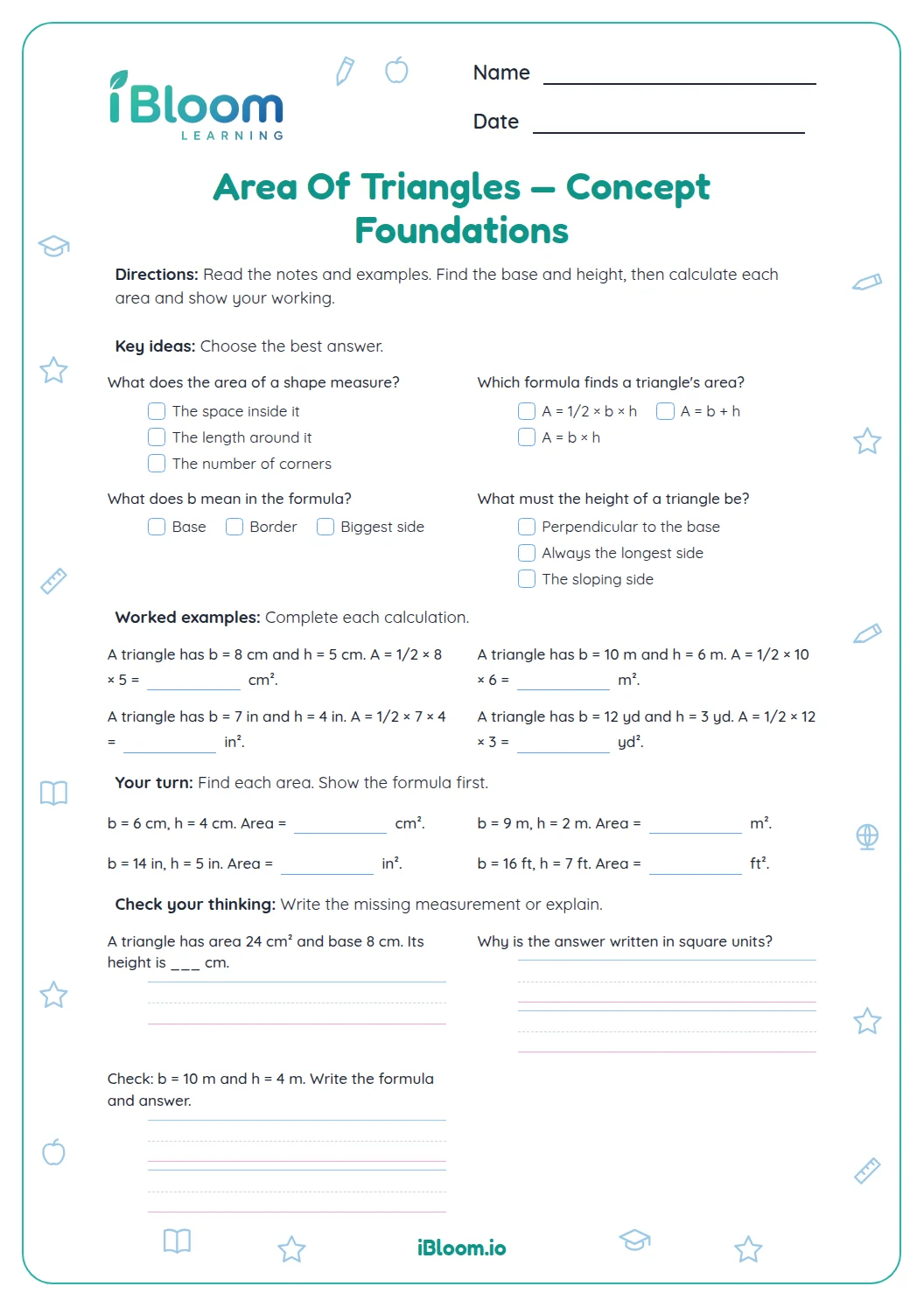
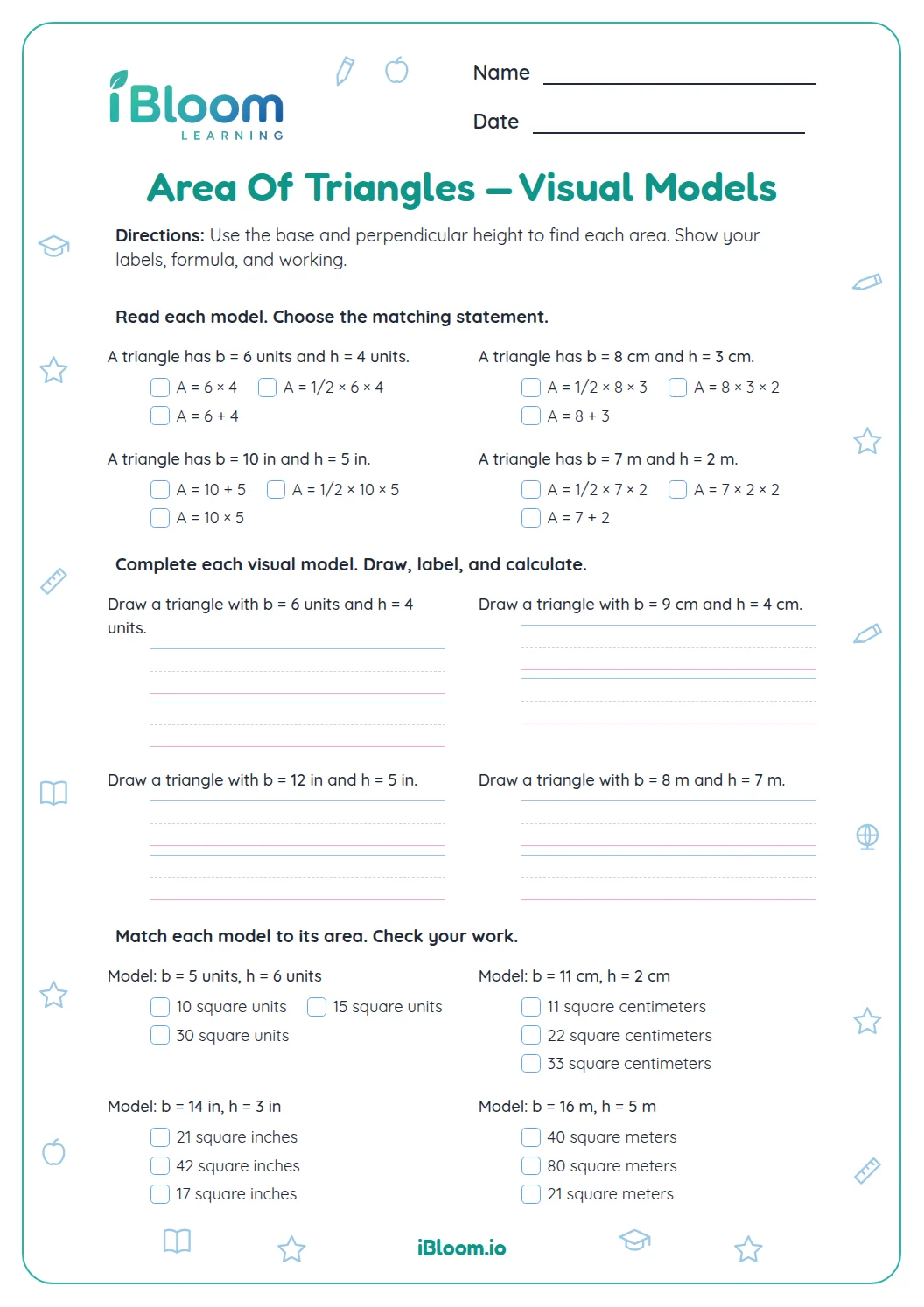
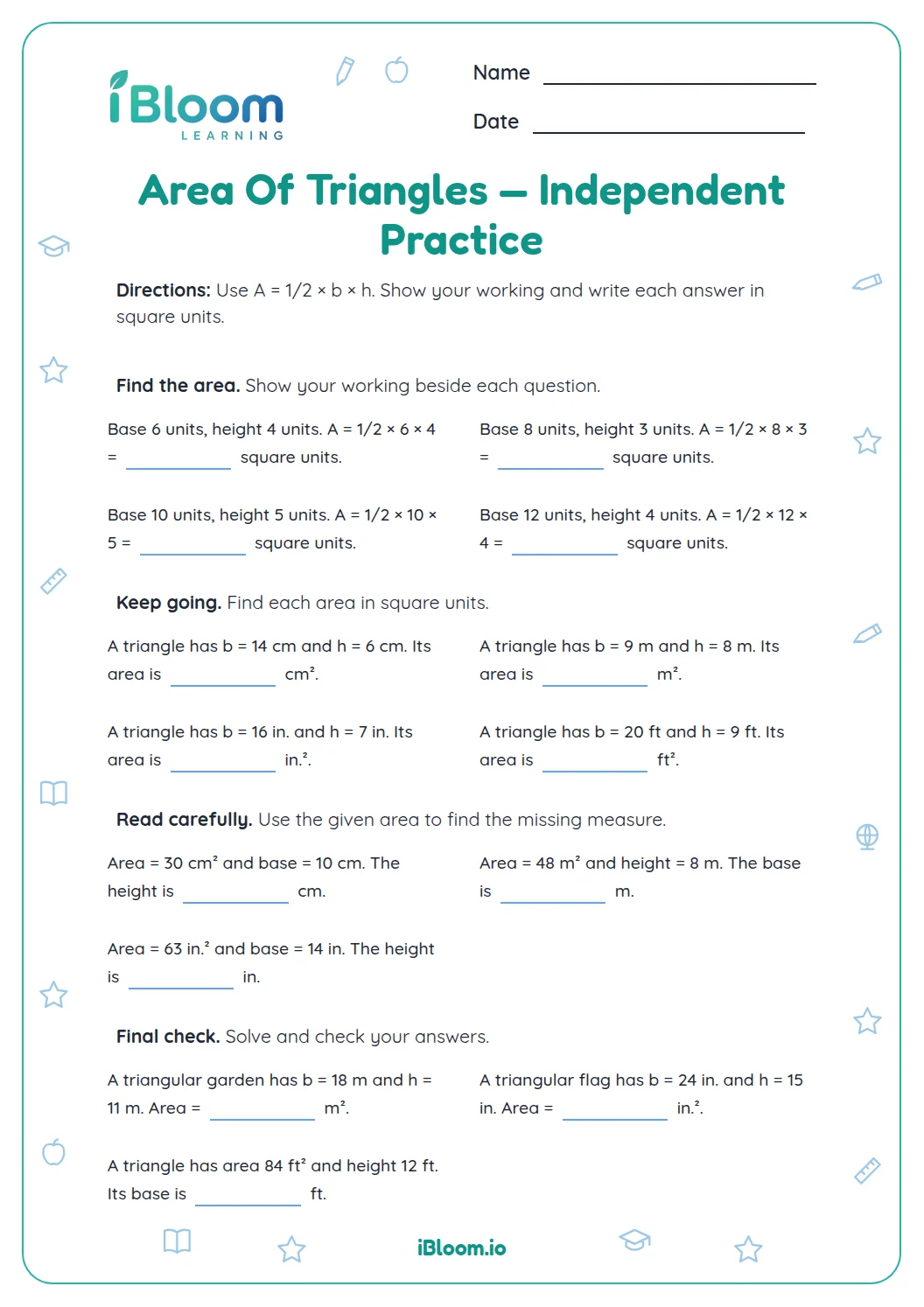
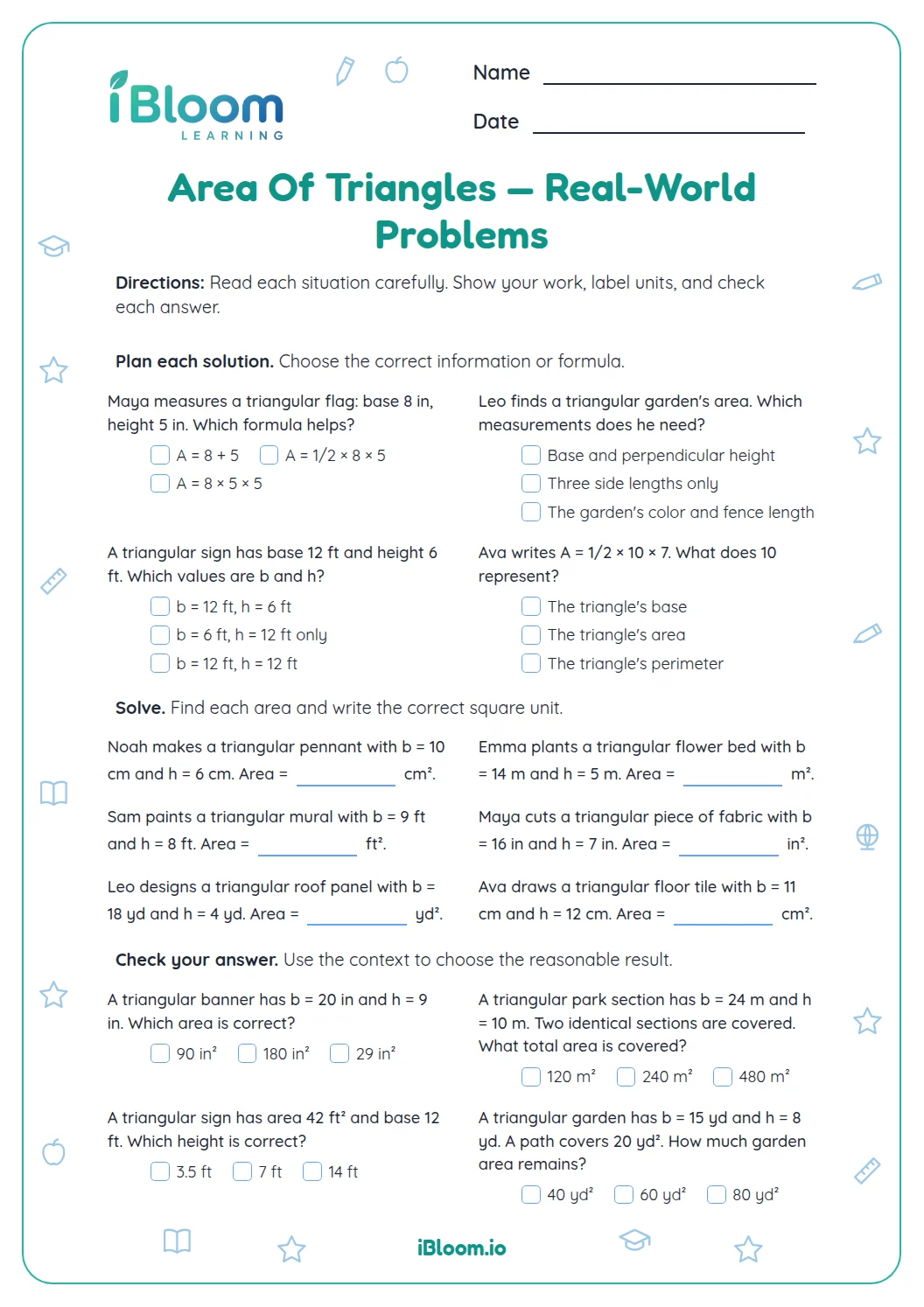
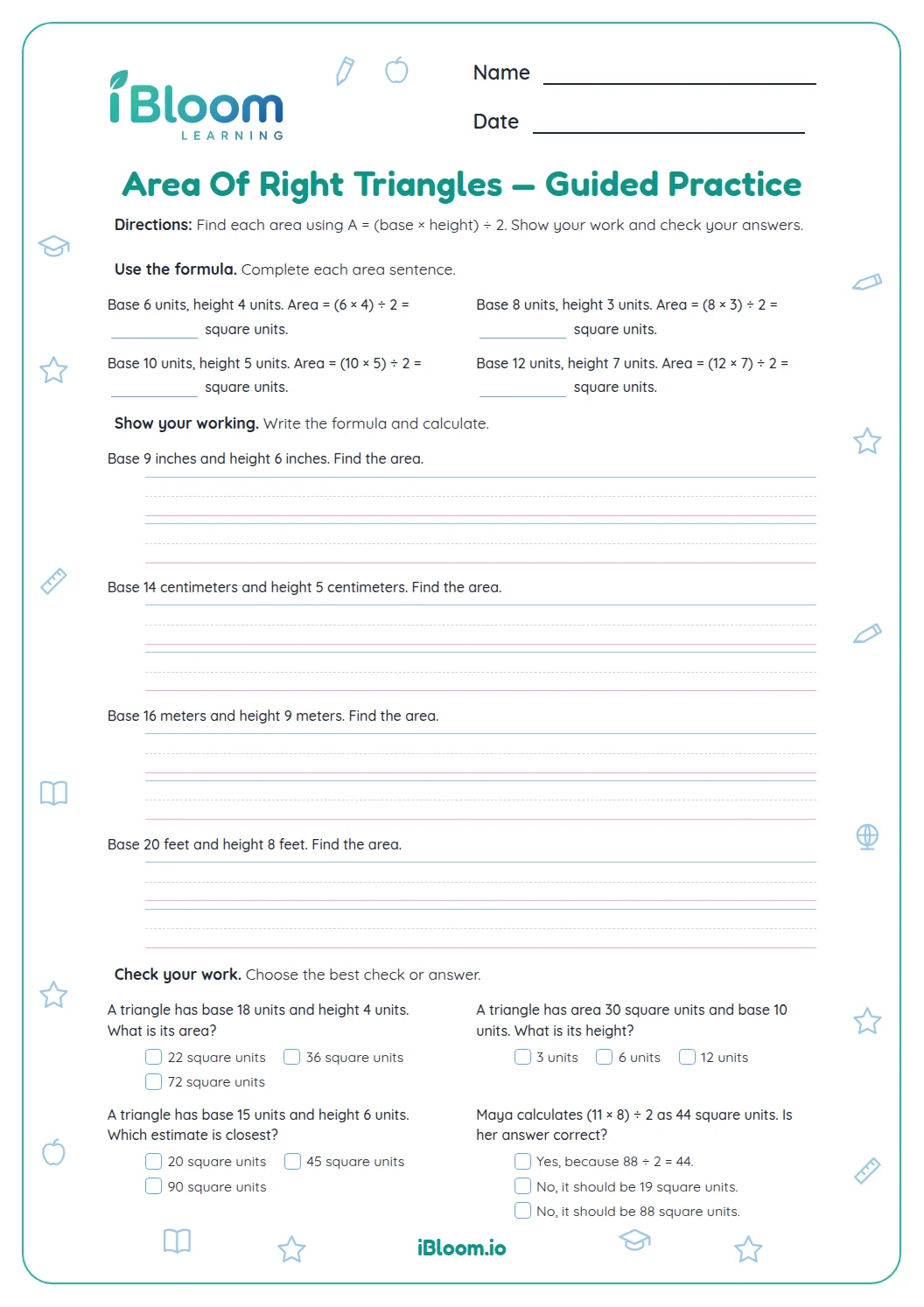
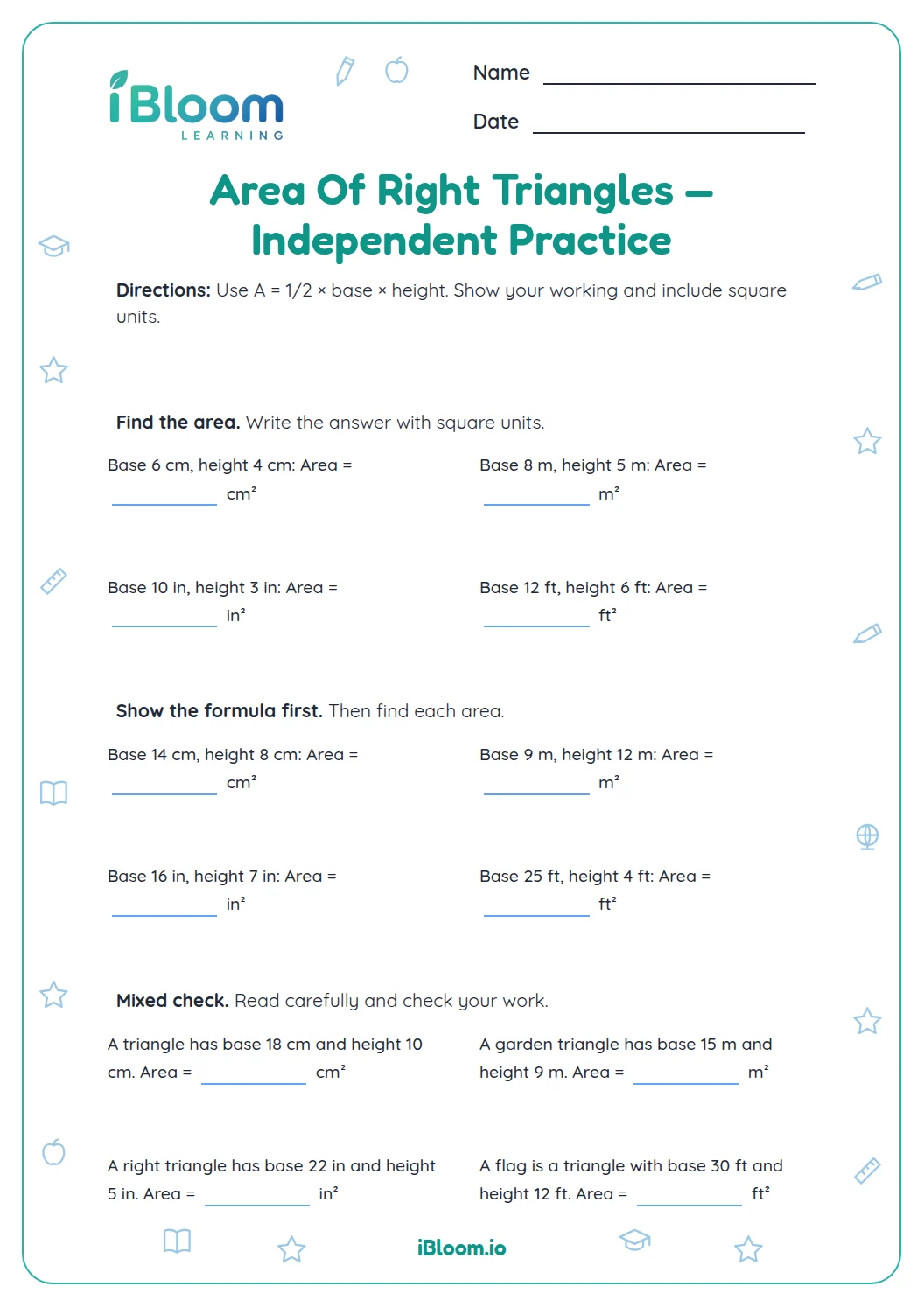
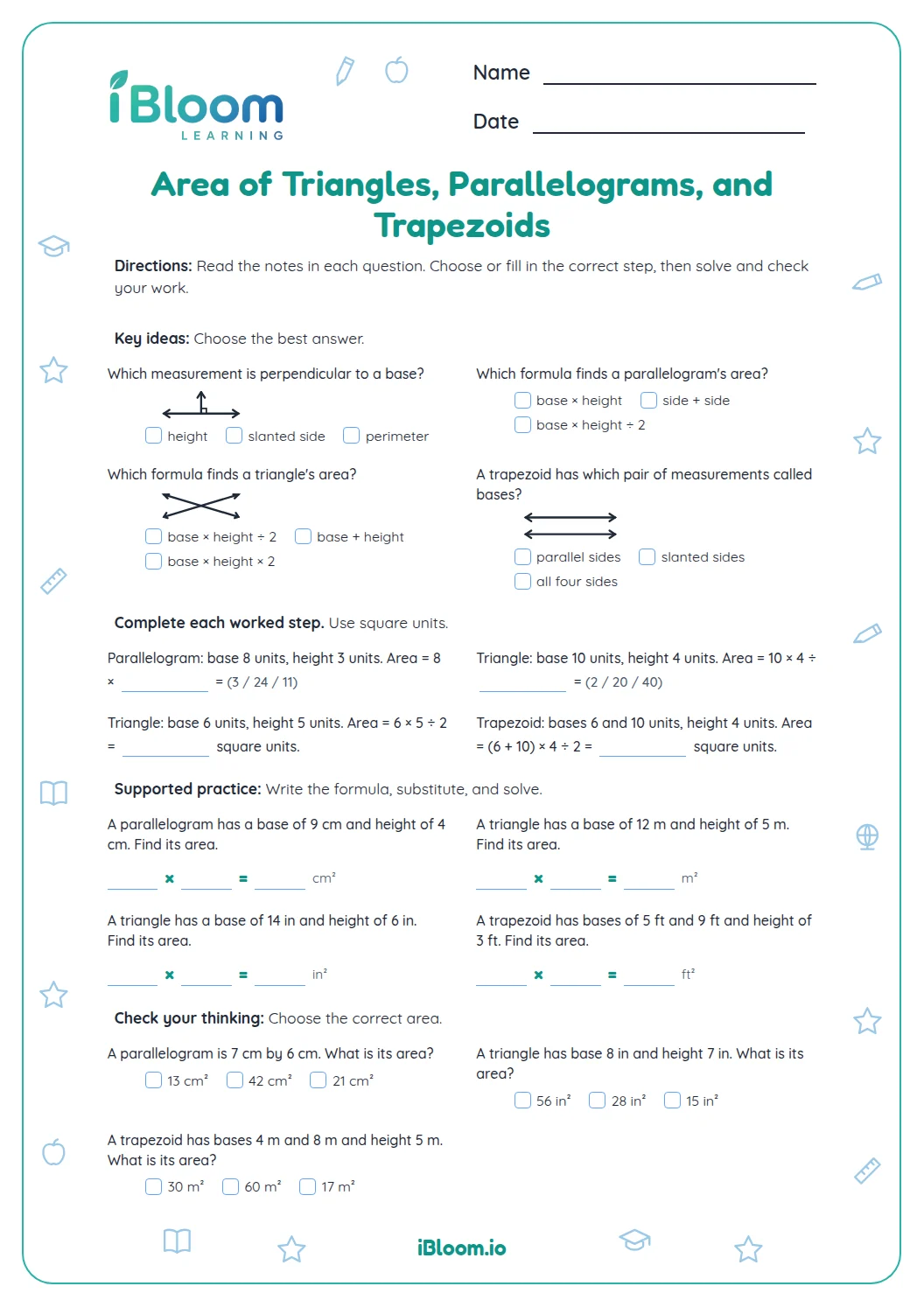
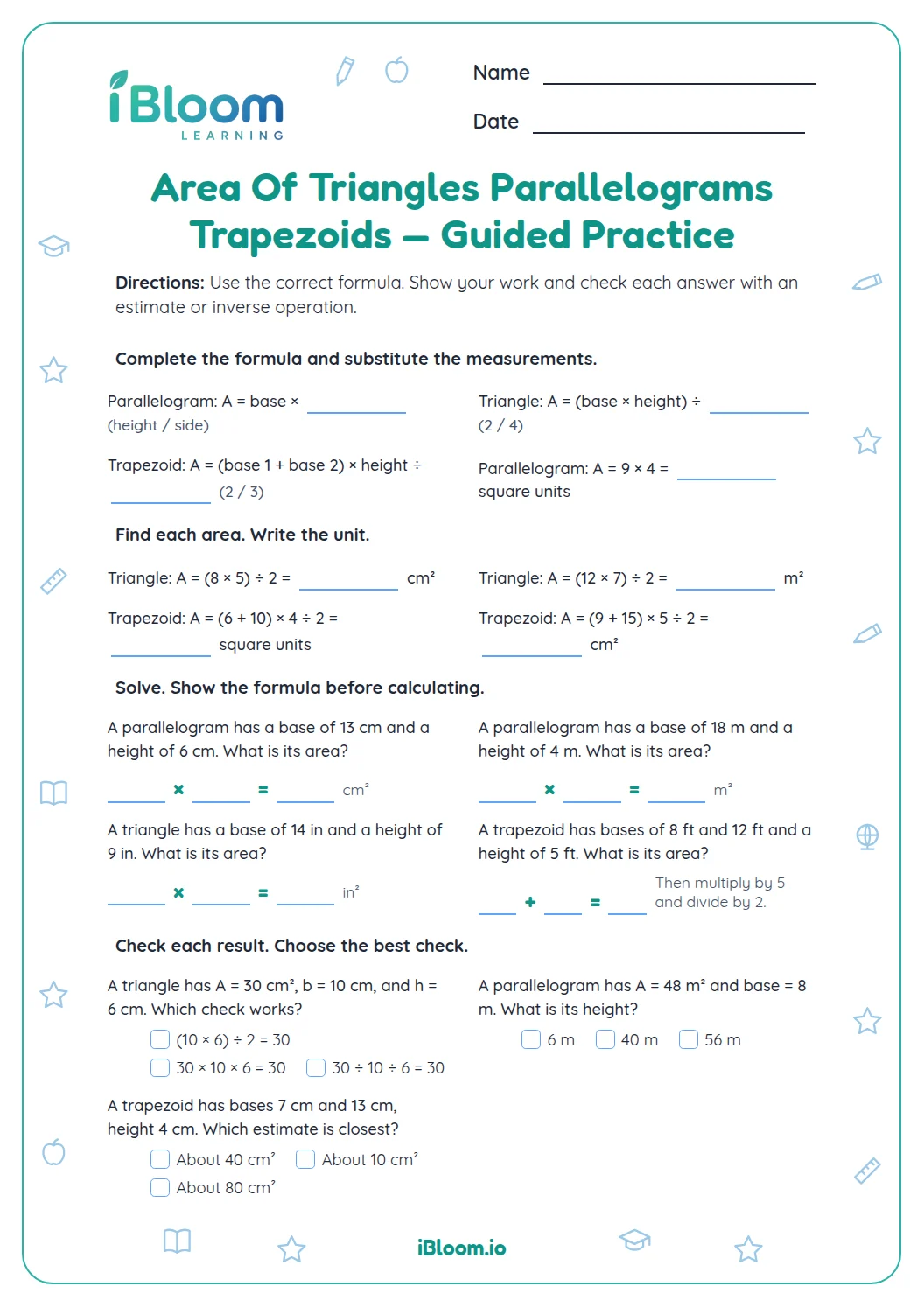
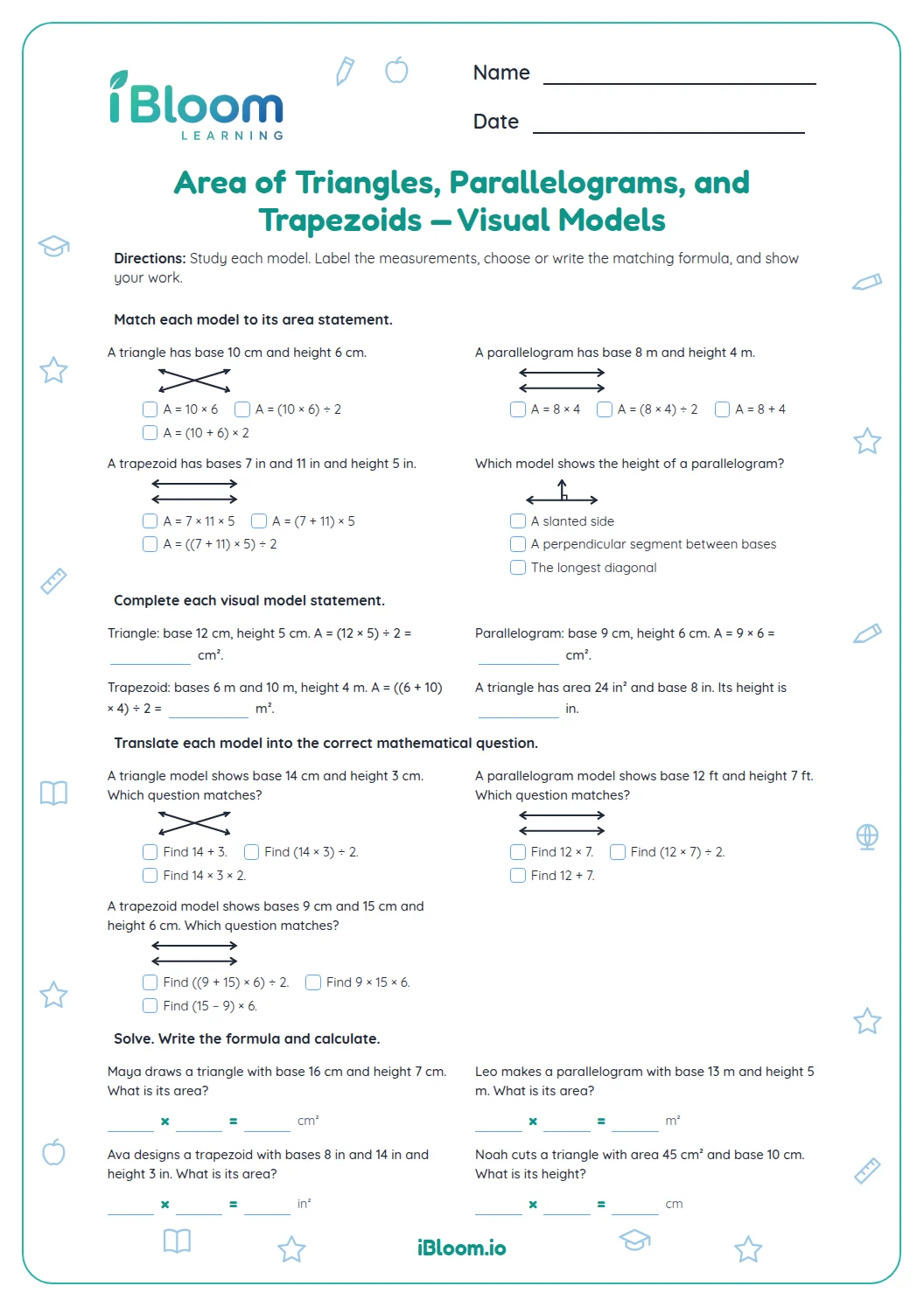
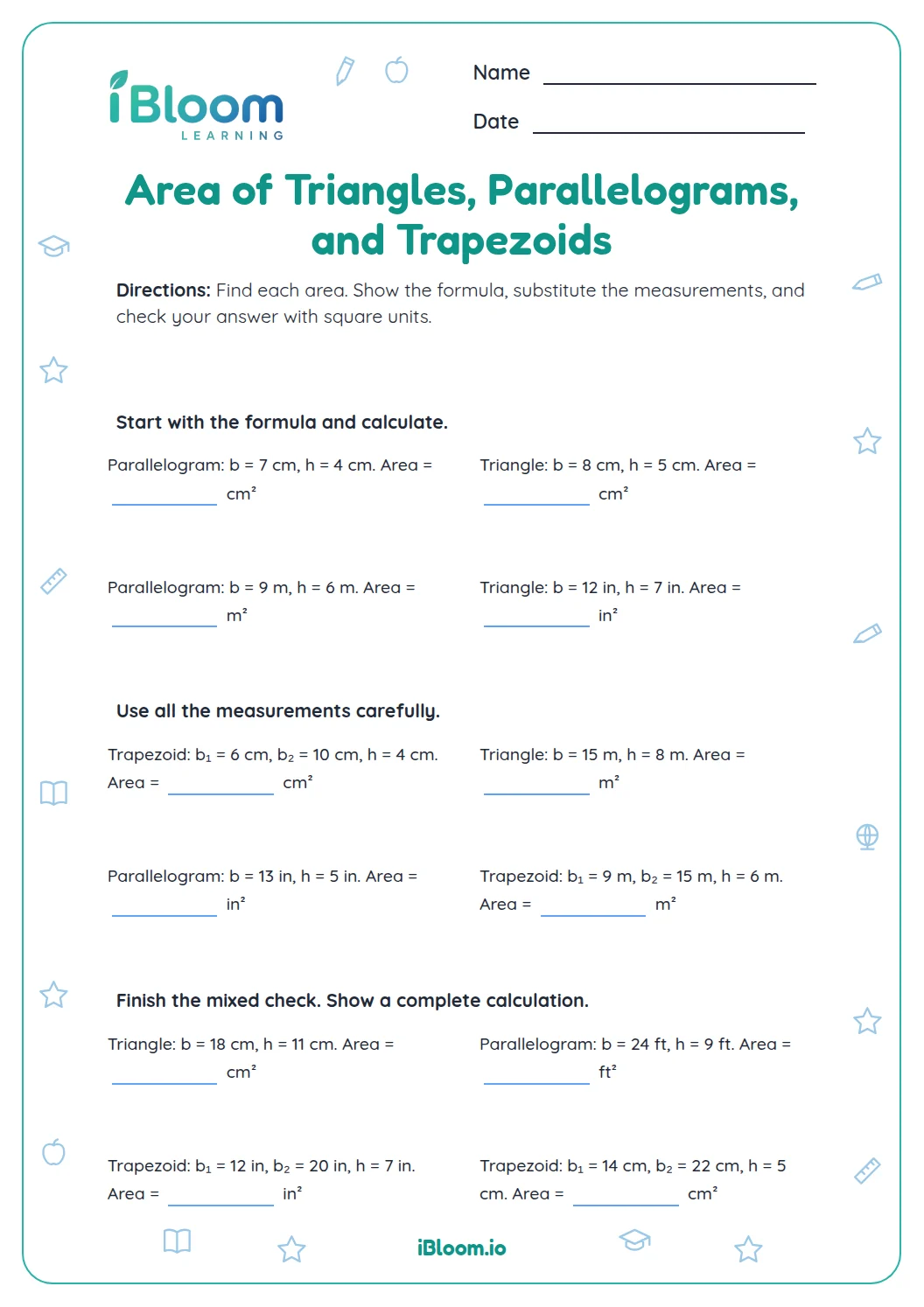
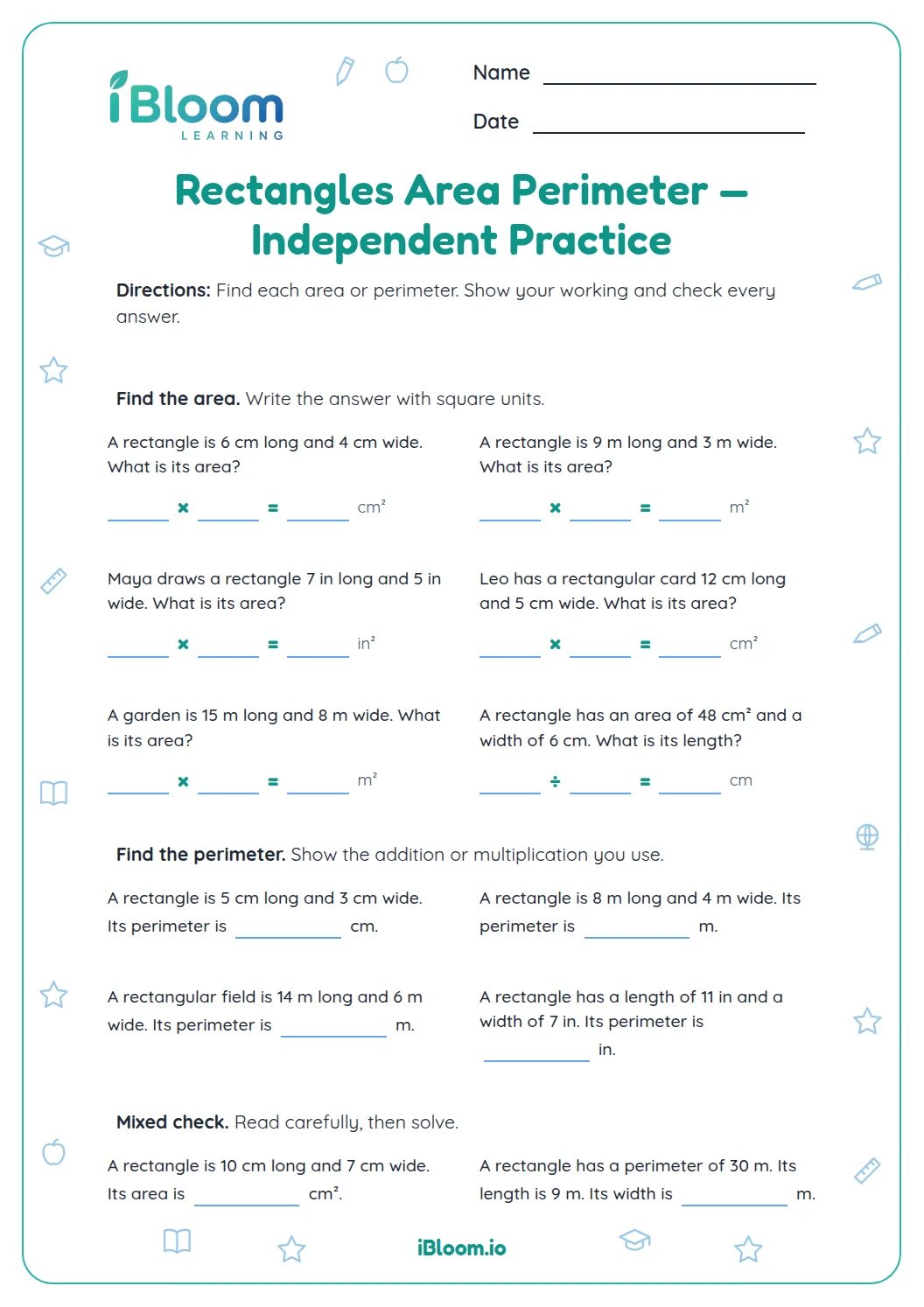
This guided practice worksheet helps Grade 5 learners find triangle area from a base and perpendicular height. Children choose the correct calculation, complete missing values, and solve short real-world problems with workspace for showing steps. Each question uses area = base × height ÷ 2 and asks for square units when finding area. The practice aligns with CCSS 6.G.A.1, which describes finding triangle areas through composition and decomposition. A separate answer key lists the results.
Aligned to 6.G.A.1
Why do we divide by two?
A triangle can be paired with a matching triangle to make a parallelogram or rectangle. Its area is half of base times perpendicular height. Use the height that meets the base at a right angle, then label area in square units.
How does the practice build step by step?
Part A uses fill-in calculations to find areas and missing dimensions. Part B applies the relationship to three short real-world problems.
- 1Base = 10 in; height = 4 in
- 2Area = 10 × 4 ÷ 2
- 310 × 4 = 40; 40 ÷ 2 = 20
- 4Answer: 20 square inches
Which units belong in each answer?
Base and height use linear units such as centimeters or feet. Area uses square units, such as sq cm or sq ft. When a problem gives area and one dimension, rearrange the formula: height = 2 × area ÷ base, or base = 2 × area ÷ height.
How to use this worksheet
- 1Identify the base and perpendicular height.
- 2Multiply the two lengths.
- 3Divide the product by two.
- 4Use square units when the answer is an area.
- 5For a missing dimension, double the area and divide by the known dimension.
- 6Estimate whether the result is half of the matching rectangle.
Common mistakes and quick fixes
The mistake
Multiplying base by height but stopping before halving.
The fix
Write the product first, then divide it by two.
The mistake
Using a slanted side as the height.
The fix
Use the perpendicular height, which meets the base at a right angle.
The mistake
Writing centimeters instead of square centimeters for area.
The fix
Label area in square units such as sq cm; keep a missing length in cm.
Common Core alignment
Find triangle areas by using base and perpendicular height, then apply the method to problems.
On this sheet: Find triangle areas by using base and perpendicular height, then apply the method to problems.
Show the official wordingHide the official wording
Find the area of right triangles, other triangles, special quadrilaterals, and polygons by composing into rectangles or decomposing into triangles and other shapes; apply these techniques in the context of solving real-world and mathematical problems.
What to practice next
Make more practice
Further reading
Questions parents and teachers ask
What formula does this sheet use?
Use area = base × perpendicular height ÷ 2. For a base of 10 inches and a height of 4 inches, multiply to get 40 and then divide by 2. The area is 20 square inches. Writing the multiplication before division helps keep the steps in order.
Why is a triangle’s area half of a rectangle’s?
Two matching copies of a triangle can make a parallelogram with the same base and height. One triangle therefore covers half of that full shape. On this sheet, children practice the relationship by calculating areas and missing measurements with the formula.
What is perpendicular height?
It is the distance from the base straight up to the opposite vertex, meeting the base at a right angle. The height can lie inside or outside a triangle, so it is not always one of the slanted sides. A small right-angle mark can help identify the perpendicular measure.
When should a child use square units?
Use square units when the answer measures area, such as 18 sq cm. Use linear units such as centimeters when answering for a missing base or height. The answer key includes unit labels for the word problems. The word problems give a chance to practice labeling each result.
How long does the guided practice take?
Allow about 25 minutes for 14 questions, especially if the learner writes each calculation. The first items establish the formula, and the later word problems ask learners to apply it and include units. Have the learner show each calculation before checking the answer.