
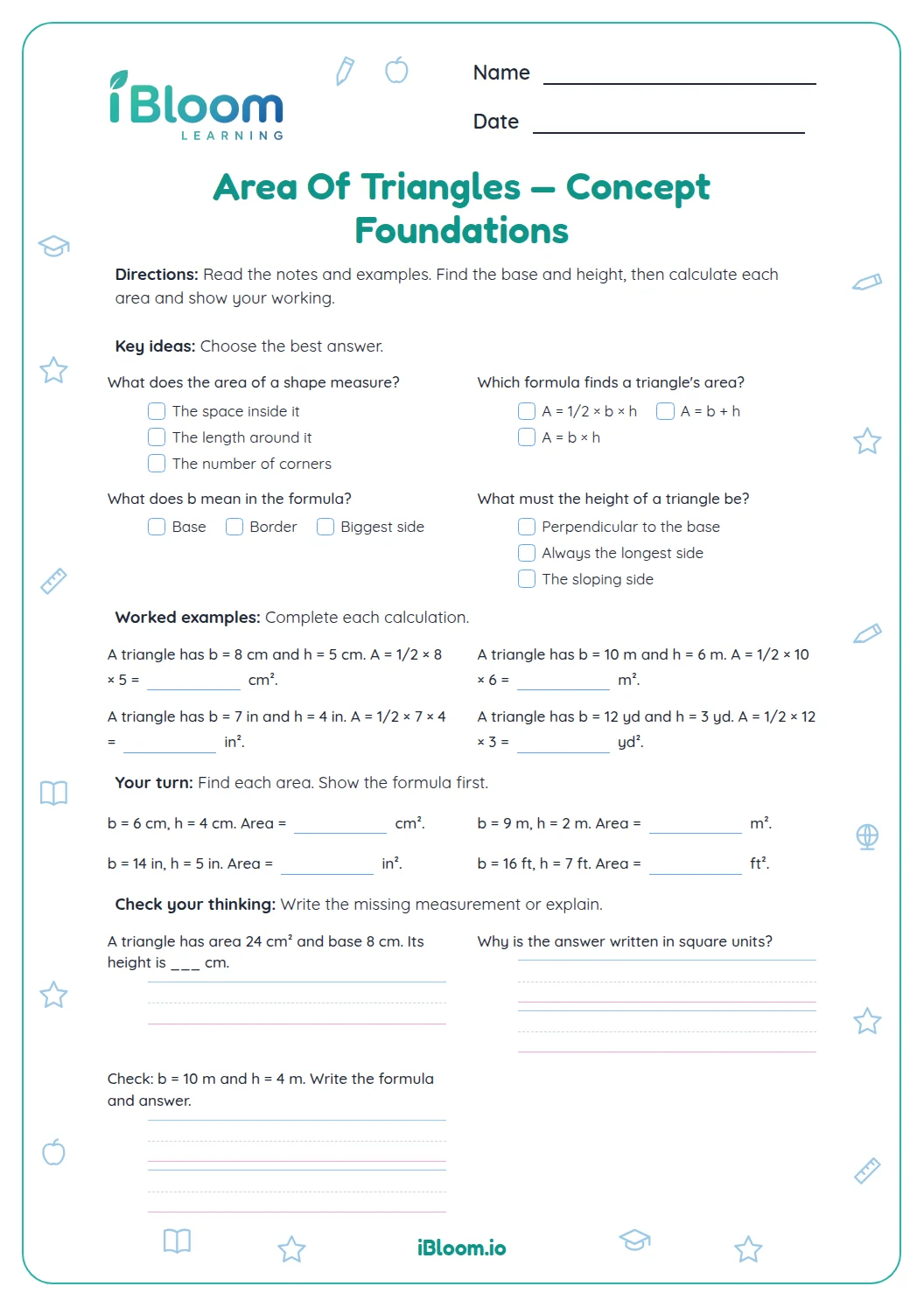
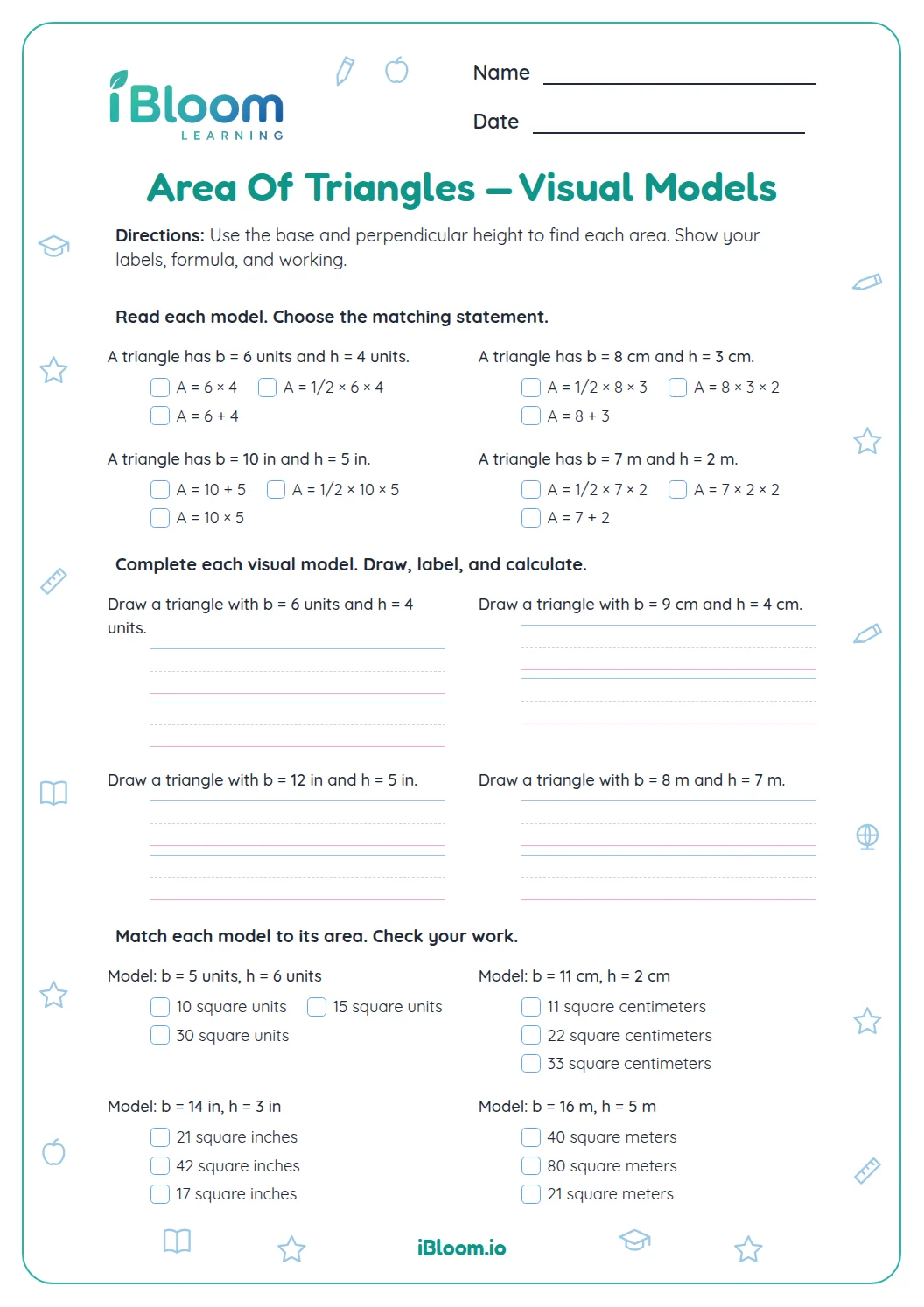
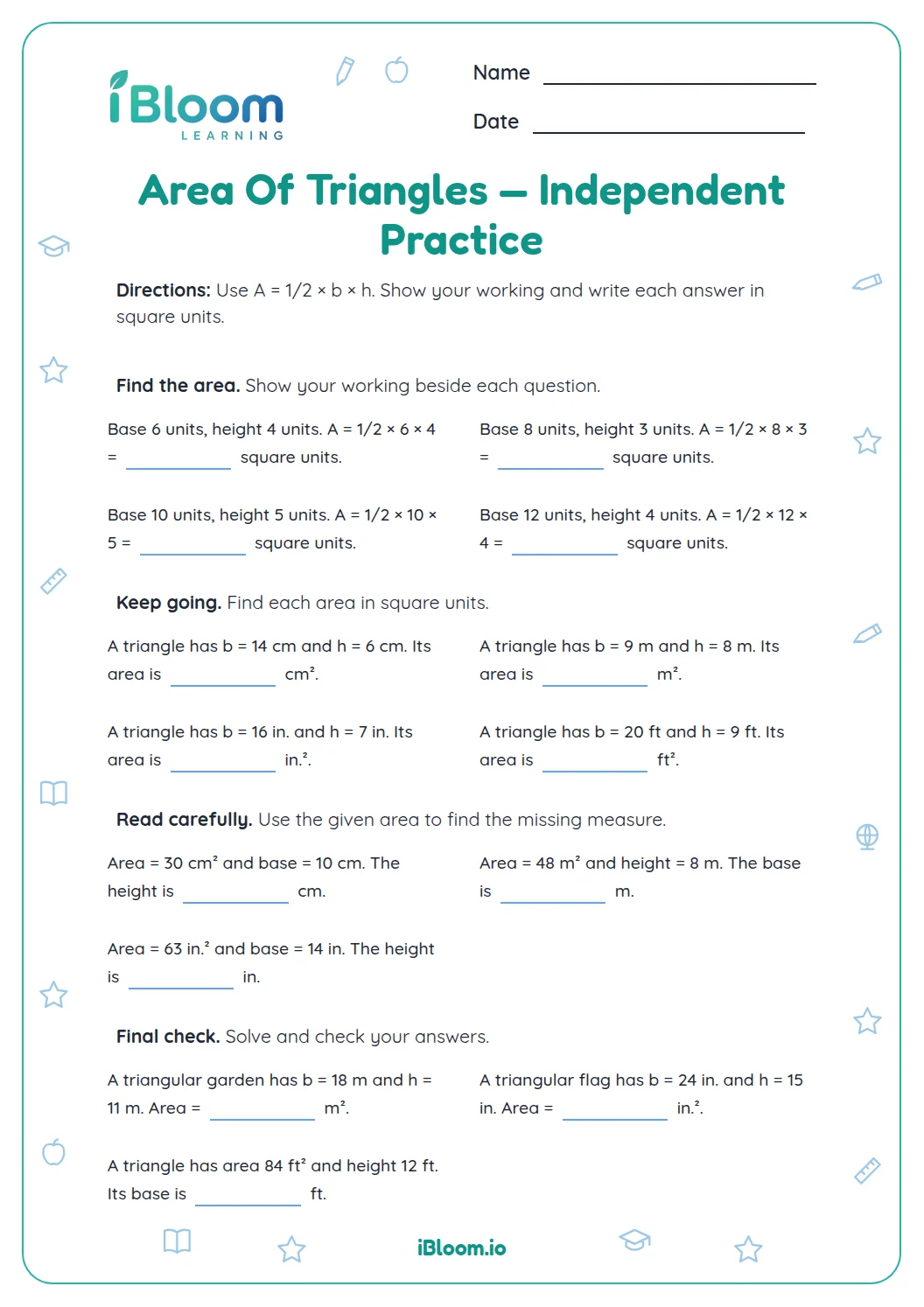
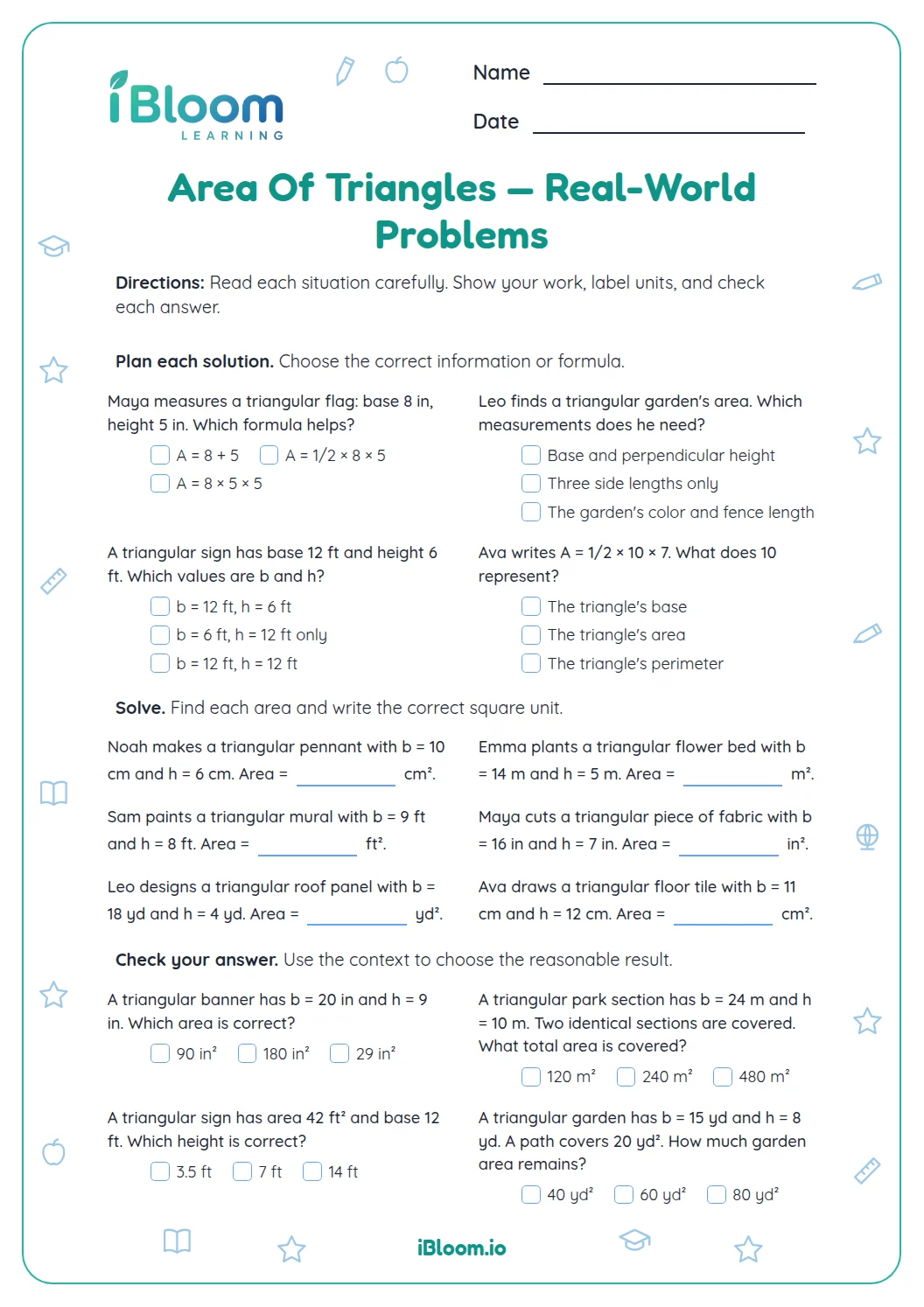
About this worksheet
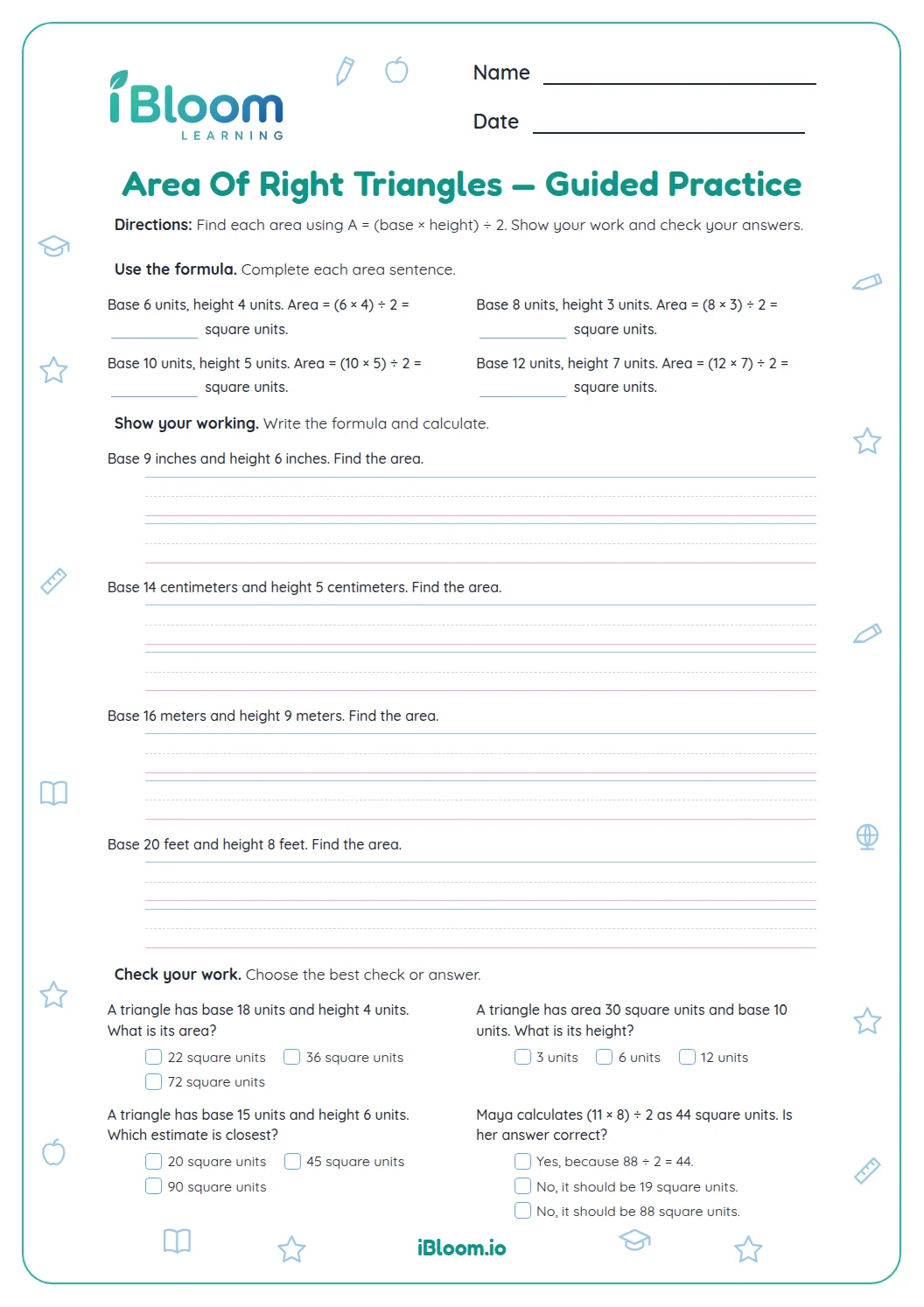
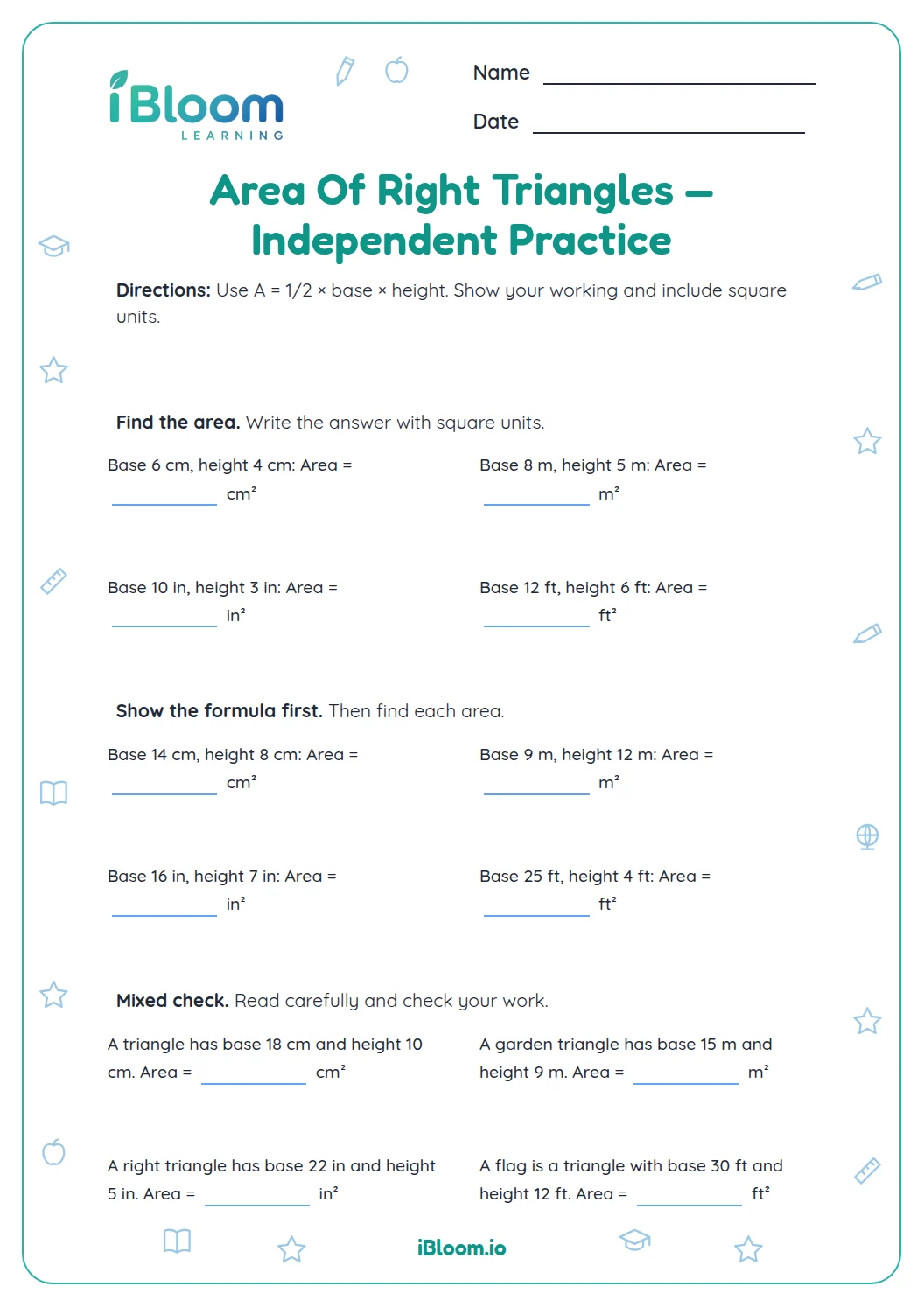
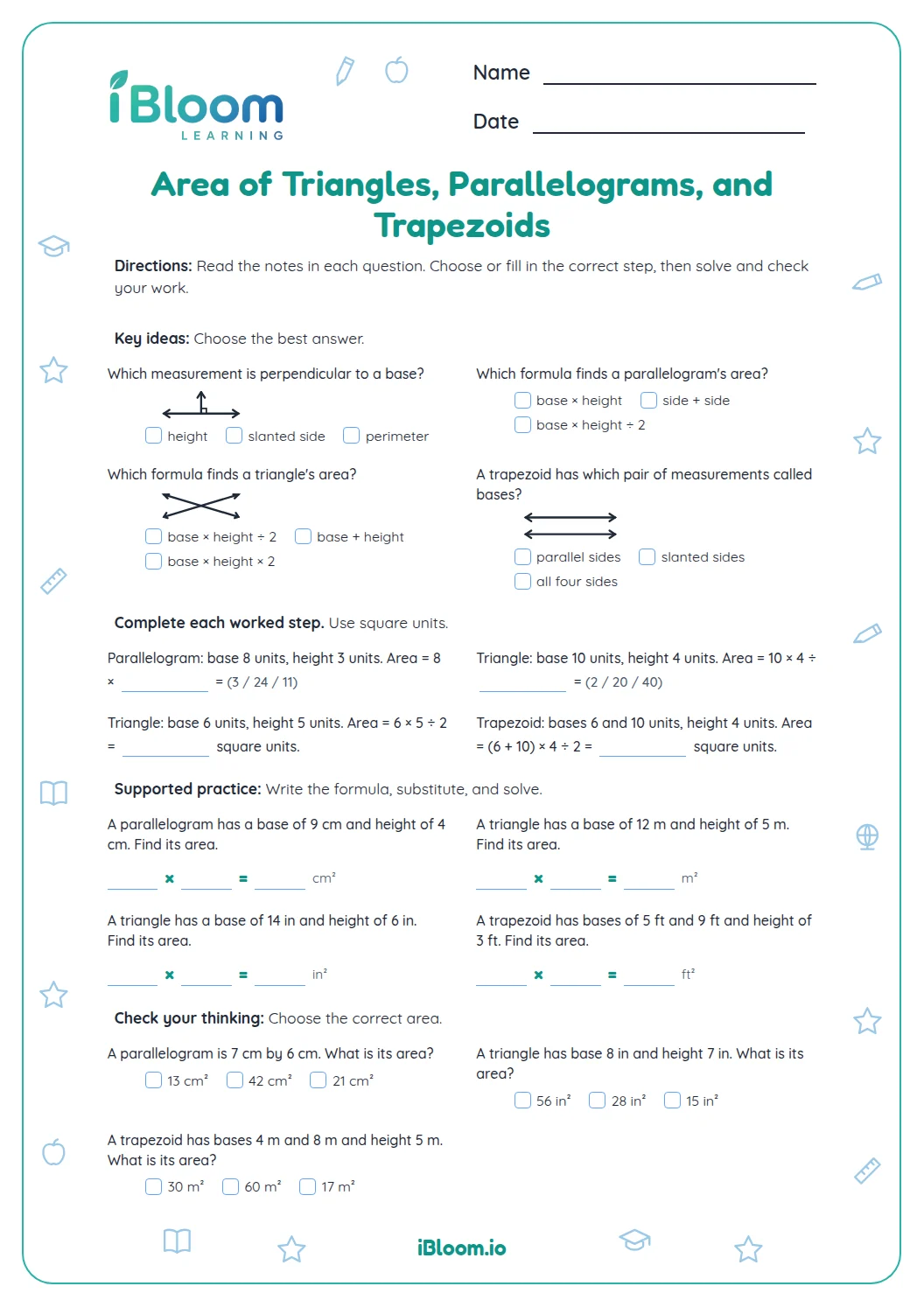
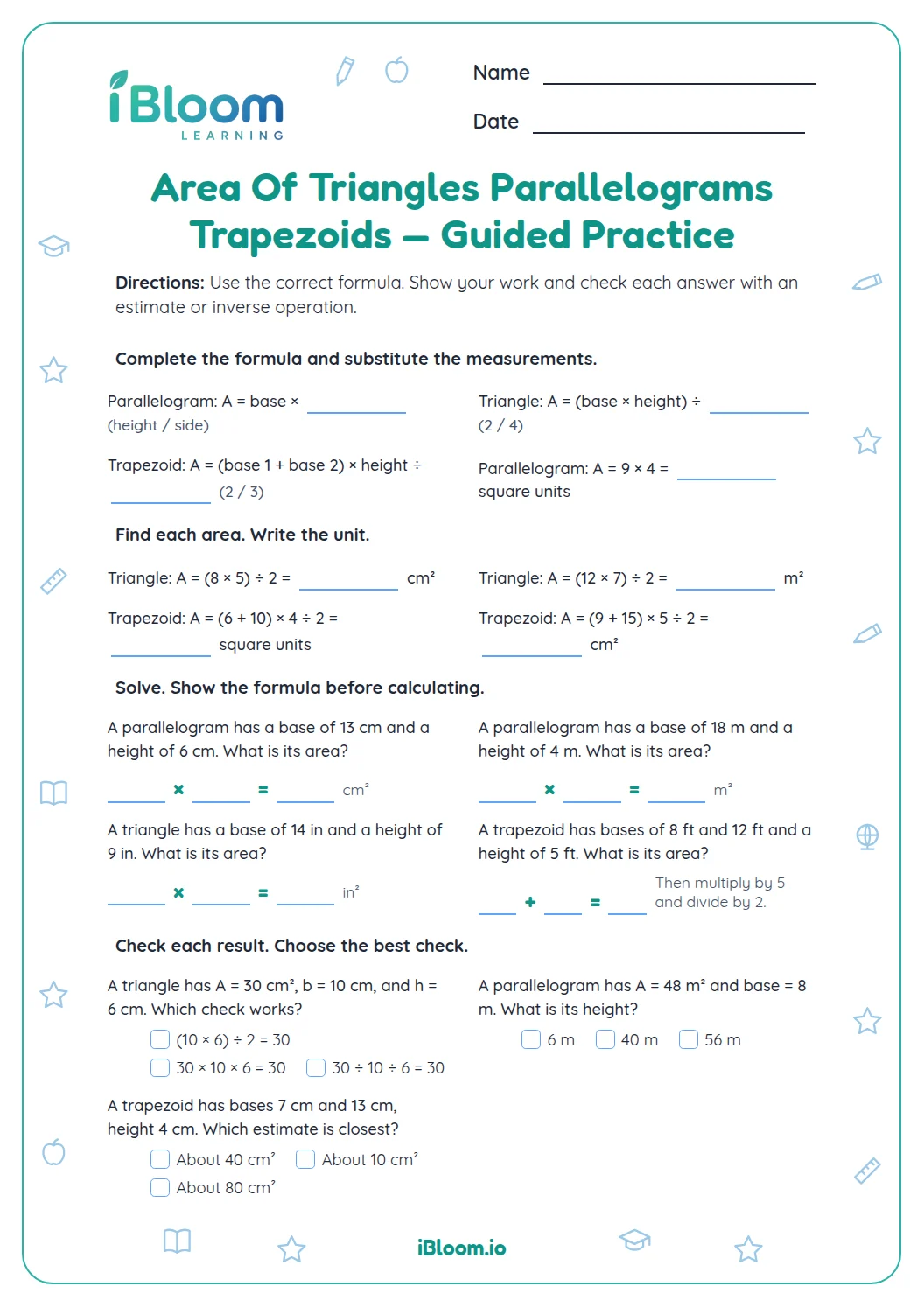
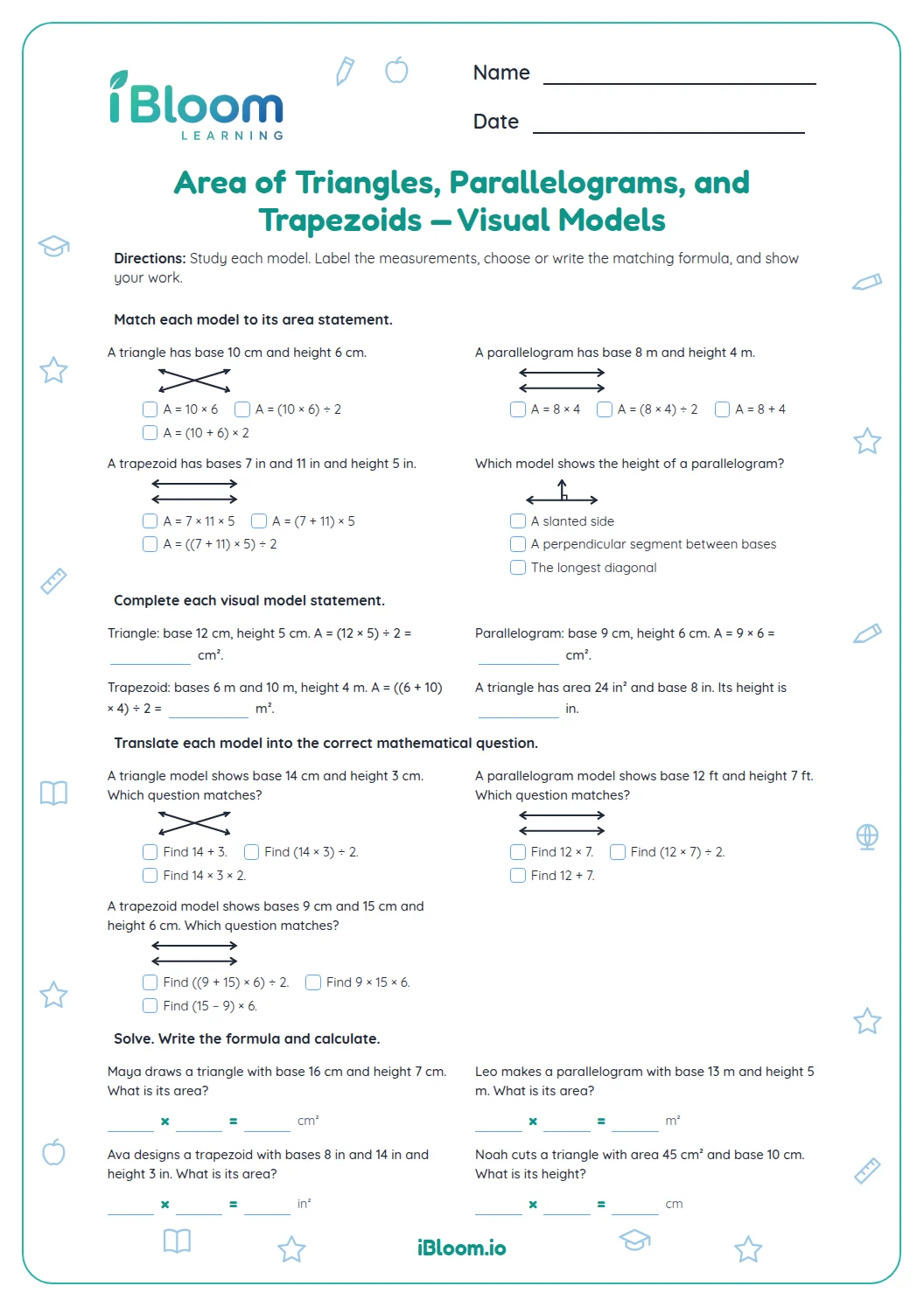
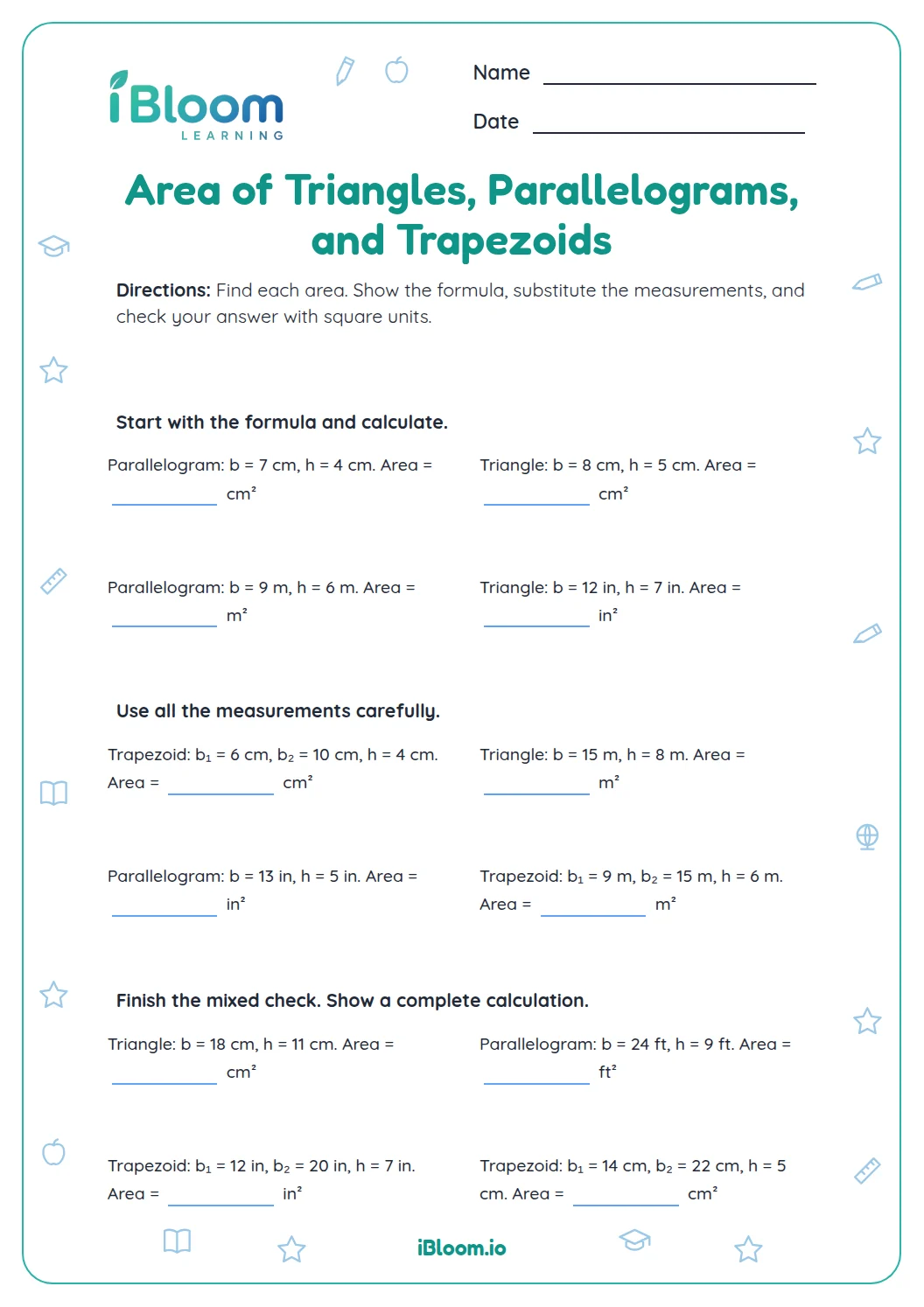
This free printable worksheet is for Grade 5 learners practicing find and reason about triangle area. It has 14 questions in 2 parts and a separate answer key. The questions use base and perpendicular height to calculate area, find a missing measure, correct a common error, and compare equal areas. A matching rectangle contains two equal triangles, so one triangle has half its area. The prompts follow the same skill focus as the original sheet, with clear steps for independent practice.
Aligned to 6.G.A.1
How does this worksheet practice find and reason about triangle area?
The questions use base and perpendicular height to calculate area, find a missing measure, correct a common error, and compare equal areas. A matching rectangle contains two equal triangles, so one triangle has half its area. The questions are arranged from reason with half the rectangle toward independent use of the skill.
- 1Base 8 cm, height 5 cm. Find area. (20 cm²; 40 cm²; 13 cm²)
- 2Answer: 20 cm²
- 3For example, base 8 cm and height 5 cm give (8 × 5) ÷ 2 = 20 cm².
What is in each part?
The 14 questions are grouped into 2 parts: Reason with half the rectangle: 7; Find the missing measure and explain: 7.
How can I use the answer key?
For example, base 8 cm and height 5 cm give (8 × 5) ÷ 2 = 20 cm². Check the answer after attempting the item. If it differs, return to the exact clue or operation and try again; for questions with more than one reasonable response, compare the child’s reasoning with the model answer.
How to use this worksheet
- 1Identify the base and its perpendicular height.
- 2Multiply base by height.
- 3Divide that product by 2 for triangle area.
- 4For a missing measure, reverse the same relationship.
- 5Include square units when the question gives units.
Common mistakes and quick fixes
The mistake
Using base × height without halving.
The fix
Divide the rectangle’s area by 2 because it contains two equal triangles.
The mistake
Using a slanted side as the height.
The fix
Use the perpendicular height, which meets the base at a right angle.
The mistake
Writing linear units for area.
The fix
Use square units such as cm² or square units.
Common Core alignment
This worksheet practices the following Common Core standard.
Find triangle areas by halving a matching rectangle and apply the method to problems.
On this sheet: The problems find triangle areas from base and perpendicular height and reason from a matching rectangle.
Show the official wordingHide the official wording
Find the area of right triangles, other triangles, special quadrilaterals, and polygons by composing into rectangles or decomposing into triangles and other shapes; apply these techniques in the context of solving real-world and mathematical problems.
What to practice next
Make more practice
Further reading
Questions parents and teachers ask
What does this worksheet practice?
It practices finding triangle area from a base and perpendicular height, then applying the same relationship to missing measures and comparisons. The multiple-choice items include calculations, a misconception to correct, and a question about why the product is halved.
What formula should learners use?
Use area = base × height ÷ 2. Multiply the base by its perpendicular height first, then divide by 2. For base 8 cm and height 5 cm, the rectangle area is 40 cm², so the triangle area is 20 cm².
What does perpendicular height mean?
The height meets the base at a right angle. It may be inside or outside a triangle depending on its shape, so it is not always one of the slanted sides. This sheet names base and height in each calculation.
Why is the rectangle comparison useful?
A rectangle with the same base and height can be split into two equal triangles. Each triangle therefore has half the rectangle’s area. This explains why multiplying base by height and dividing by two gives the triangle’s area.
Is this labeled for Grade 5?
Yes. The page is labeled Grade 5, while its listed Common Core alignment is 6.G.A.1, which describes area work with triangles. The worksheet itself practices the stated base-height method through calculations and reasoning. Invite the learner to show one calculation with the formula.