

About this worksheet
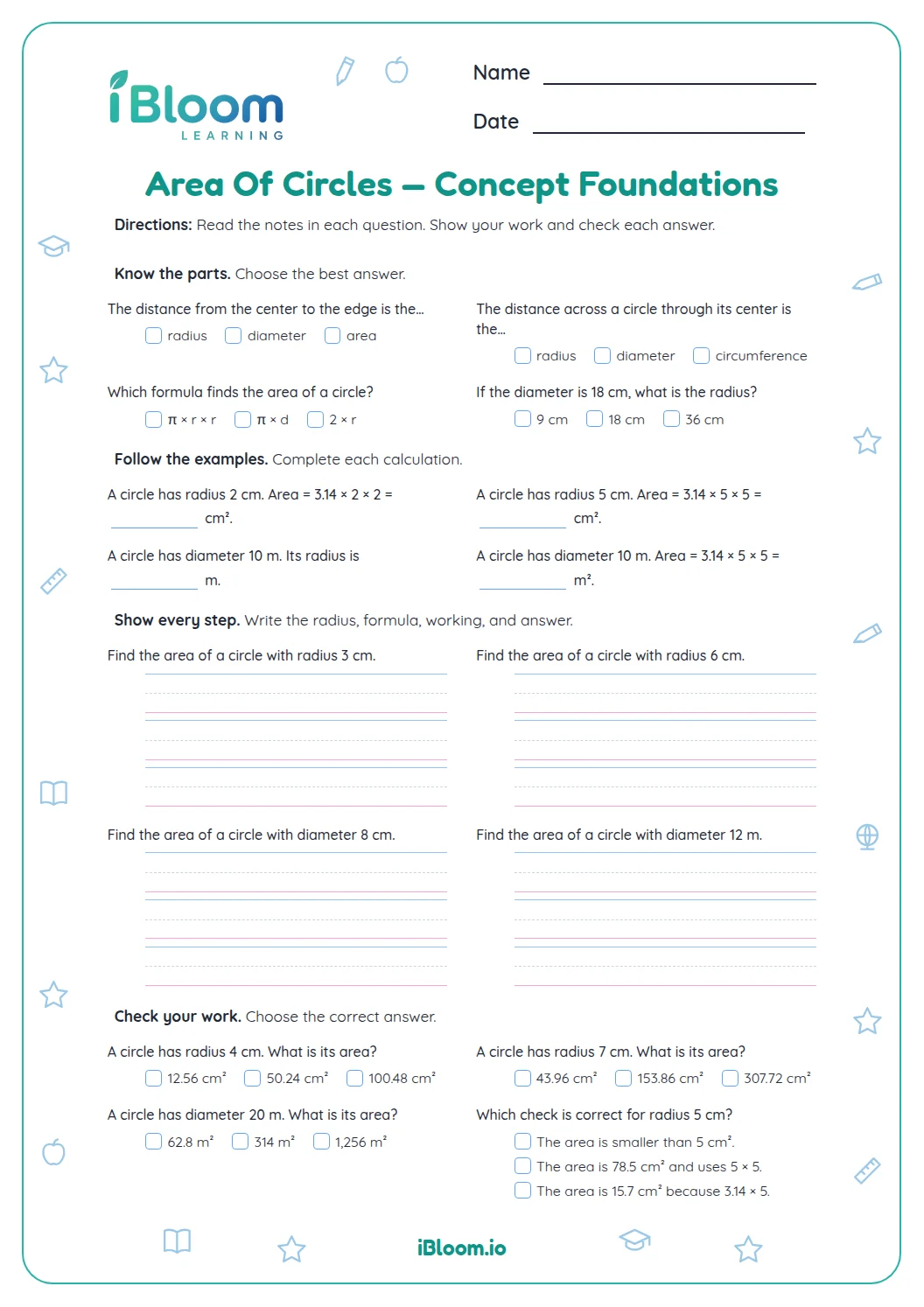
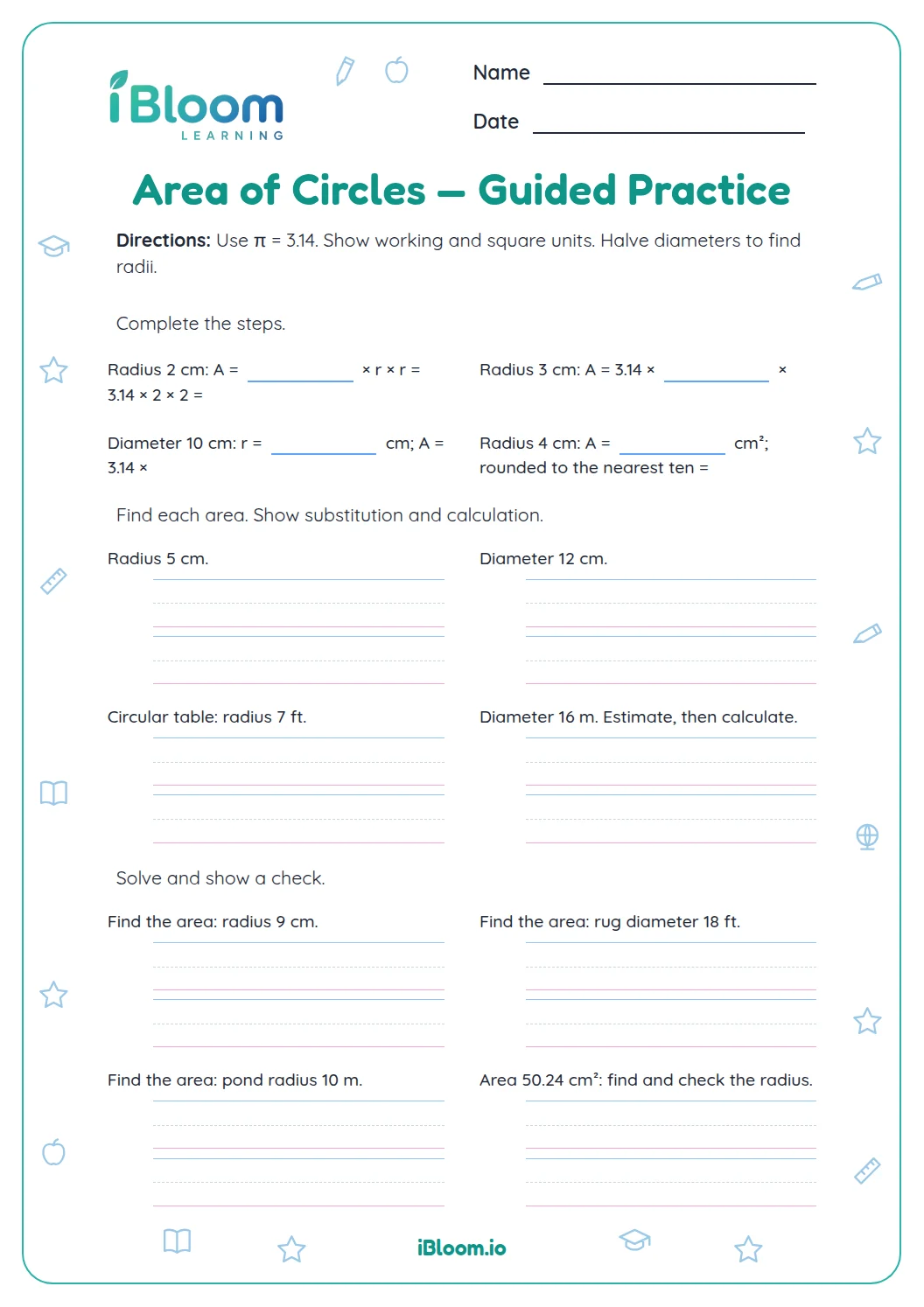
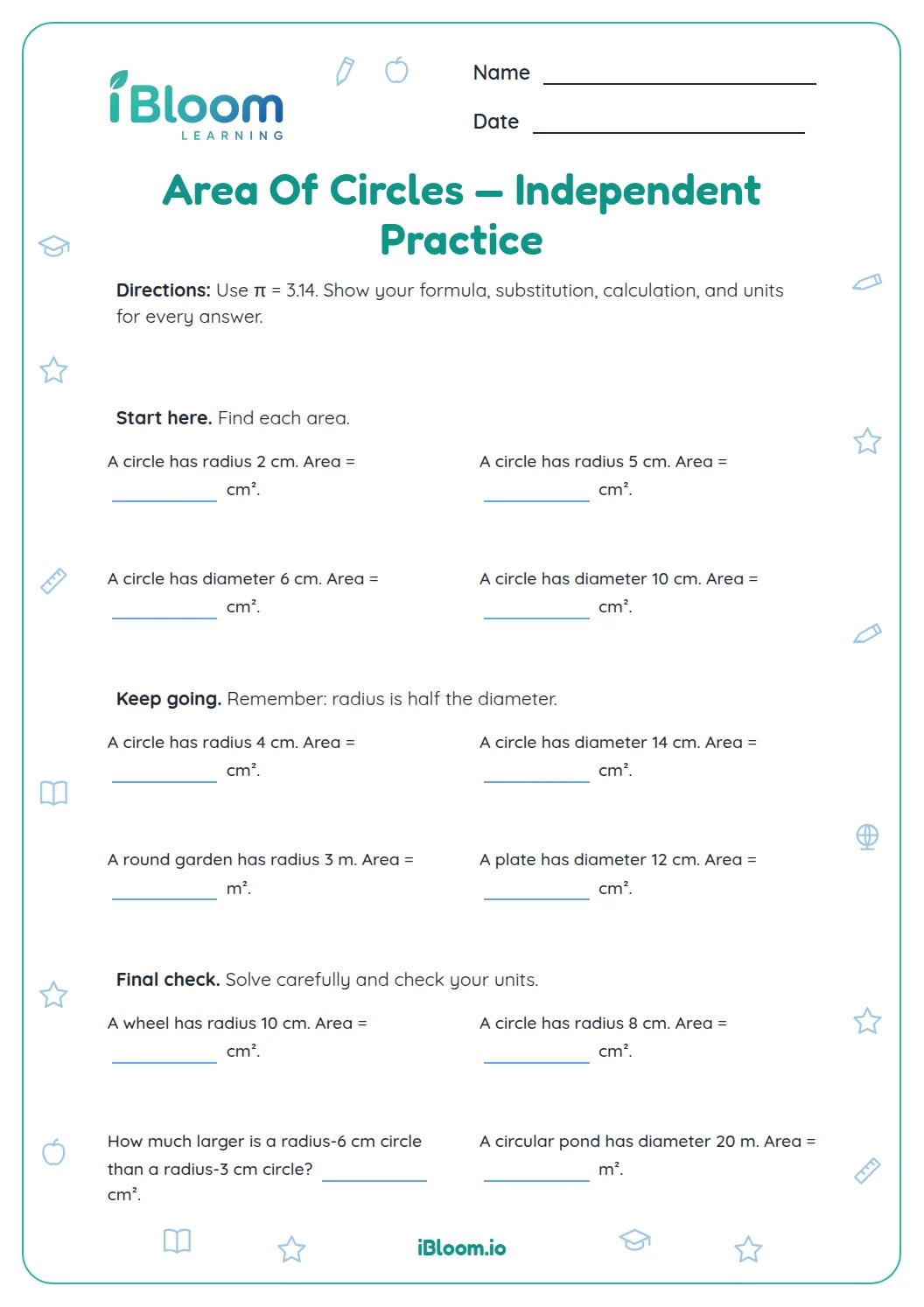
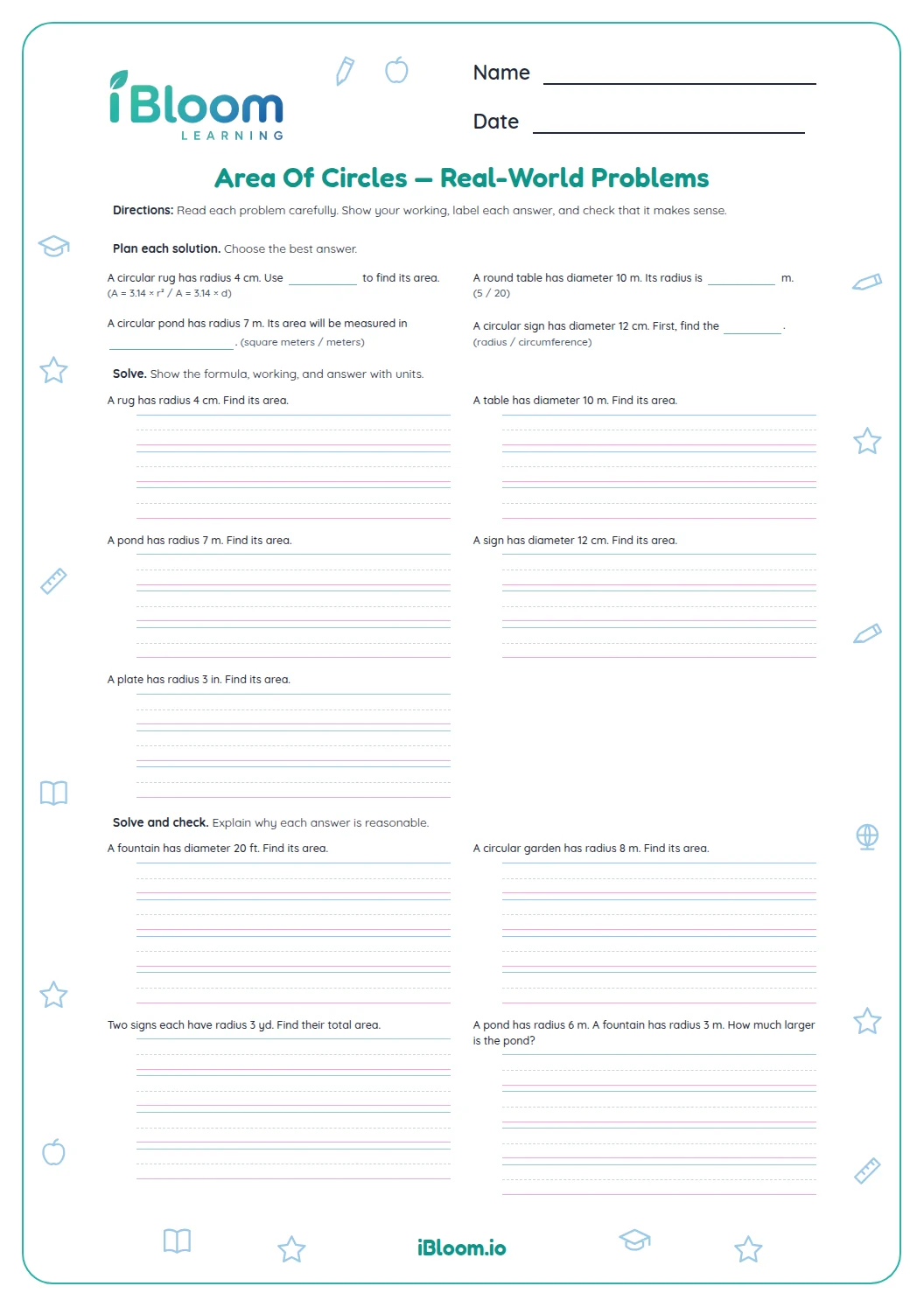
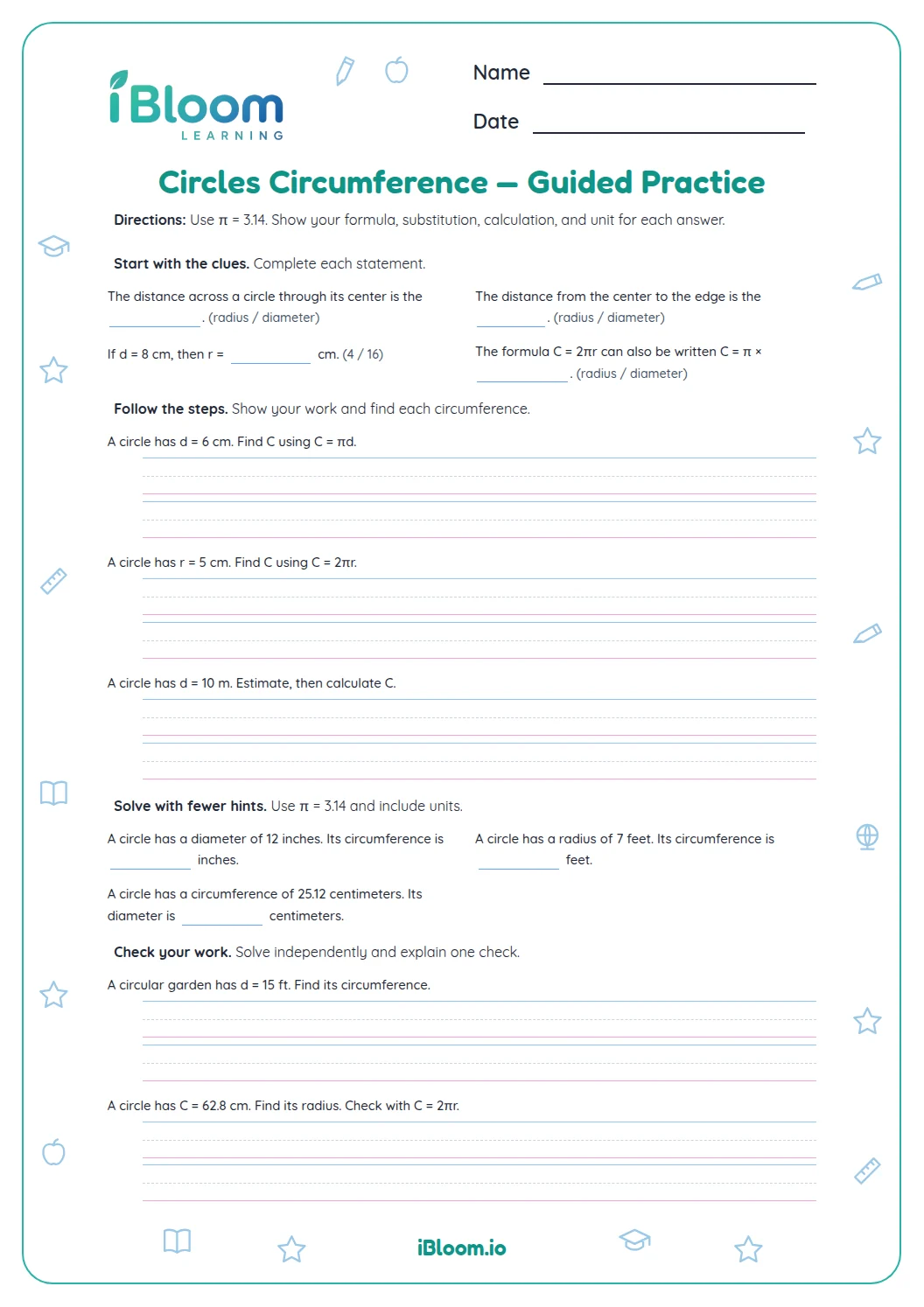
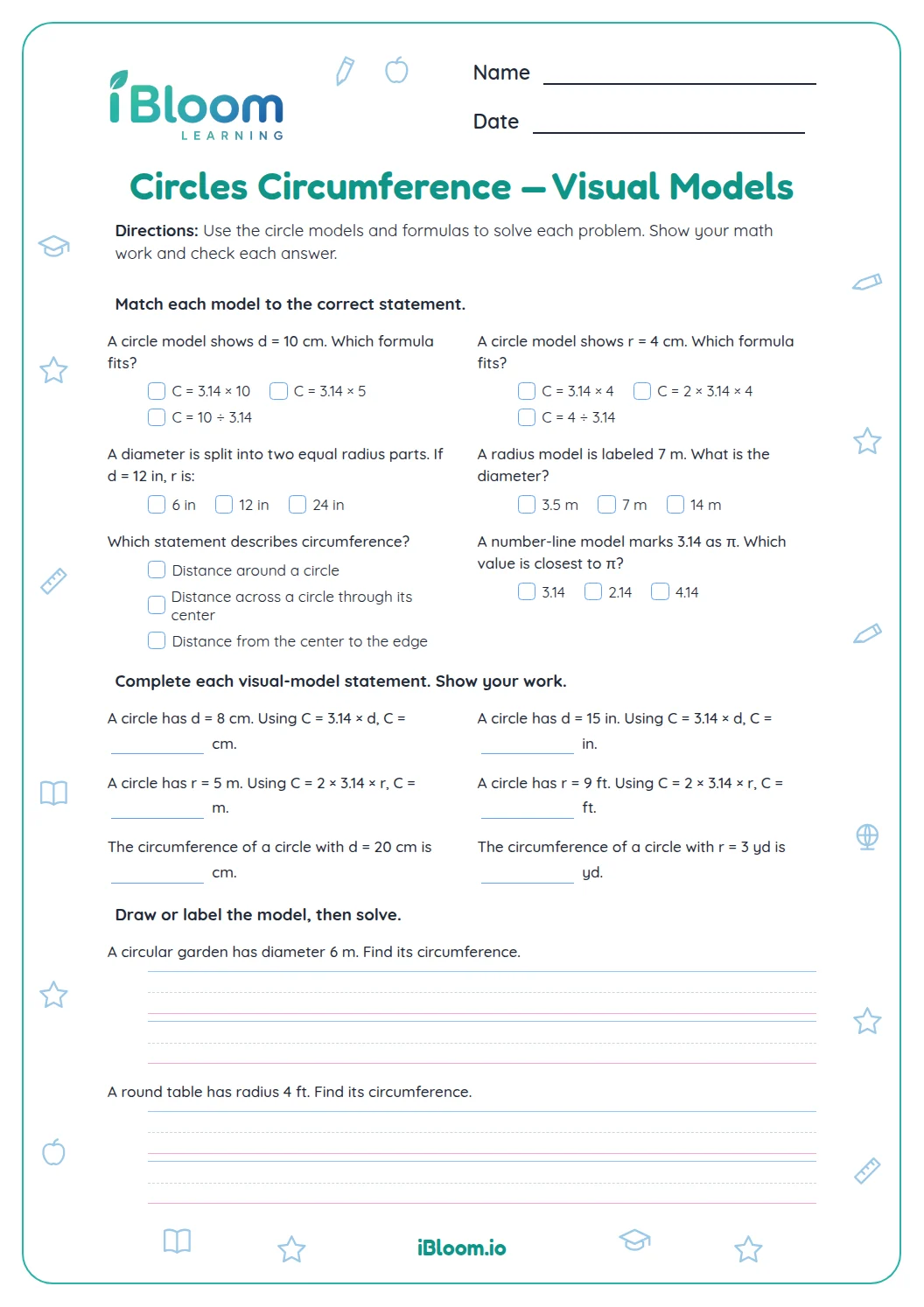
This free worksheet gives Grade 5 students a focused introduction to the area of circles. Students connect a circle’s radius or diameter to A = 3.14 × r × r, calculate areas, and reason about how a changed radius affects area. Circle drawings accompany the numerical models, and a separate answer key supports checking. The content practices CCSS 7.G.B.4.
Aligned to 7.G.B.4
What does the circle-area model show?
For a circle with radius 4 cm, use 3.14 × 4 × 4 to find the area, 50.24 cm². The drawing helps identify the object being measured, while the radius in the prompt supplies the value for the formula.
The radius is the distance from the center to the circle’s edge. The diameter crosses the circle through its center and is twice the radius.
- 1Radius = 1 cm
- 2A = 3.14 × 1 × 1
- 3A = 3.14 cm²
How do you use a diameter to find area?
First halve the diameter to get the radius. A circle with diameter 10 inches has radius 5 inches. Then use 3.14 × 5 × 5 to calculate its area.
Keep the units attached to the result: a radius in centimeters gives an area in square centimeters, and a radius in feet gives square feet.
What happens when the radius changes?
The radius is used twice in the area formula, so doubling it multiplies the area by four. If the radius changes from 3 cm to 6 cm, compare 6 × 6 with 3 × 3: the new area is four times as large.
This relationship helps explain why area does not grow by just the same factor as the radius. The final questions ask students to use this relationship and reverse a simple area calculation.
What will students practice?
Across two parts, the 16 questions move from direct circle-area calculations to radius-from-diameter and area reasoning. Use 3.14 for π throughout. The numerical value is stated in each prompt so students can concentrate on choosing the radius and applying the formula.
A separate answer-key page lists each response. For a decimal area, keep the square unit from the question and check that the radius was squared before multiplying by 3.14.
A step-by-step circle-area routine
- 1Find the radius in the prompt or circle model.
- 2If the prompt gives a diameter, divide it by 2.
- 3Write A = 3.14 × r × r and substitute the radius.
- 4Multiply the radius by itself before multiplying by 3.14.
- 5Write the result in square units when the question gives a unit.
- 6Check whether a comparison or scale question asks for an area or a radius.
Circle-area errors to catch
The mistake
Using the diameter as r in A = 3.14 × r × r.
The fix
Halve the diameter to find the radius before using the formula.
The mistake
Multiplying 3.14 by the radius only once.
The fix
Square the radius: multiply r × r, then multiply by 3.14.
The mistake
Doubling the radius and doubling the area.
The fix
A doubled radius makes the area four times as large because 2r × 2r = 4r².
Common Core alignment
The practice uses a circle-area formula and applies it to measurements and simple comparisons.
Use a circle’s radius or diameter to calculate and reason about its area.
On this sheet: Students apply the circle-area formula with π approximated by 3.14.
Show the official wordingHide the official wording
Know the formulas for the area and circumference of a circle and use them to solve problems; give an informal derivation of the relationship between the circumference and area of a circle.
What to practice next
Make more practice
Further reading
Questions parents and teachers ask
What is the formula for the area of a circle?
Use A = πr², which means multiply pi by the radius and by the radius again. This worksheet uses 3.14 for π, so a circle with radius 2 has area 3.14 × 2 × 2 = 12.56 square units. The drawing is a visual cue; the written measurement supplies the needed value.
What should I do if the question gives the diameter?
Divide the diameter by 2 to find the radius, then use the area formula. For a 10-inch diameter, the radius is 5 inches. The area calculation is 3.14 × 5 × 5, and the result is measured in square inches.
Why does doubling the radius make four times the area?
The radius appears twice in A = 3.14 × r × r. Replacing r with 2r makes both factors twice as large, so the area is multiplied by 2 × 2 = 4. The final scale question asks students to use this relationship.
How many questions are included?
The printable includes 16 questions in two parts across two worksheet pages, followed by a separate answer key. The questions cover area calculations, converting diameter to radius, and reasoning about area comparisons. Work through the formula carefully instead of estimating from circle size alone.
Does the sheet include circle drawings?
Yes. Circle drawings accompany selected prompts to keep the model visible while the radius is named in the question. Students use the stated measurement to choose the formula input, then calculate or reason about the area. The key follows the same value of pi used on the worksheet.
Which standard does this practice align with?
The worksheet aligns with CCSS 7.G.B.4, which includes using circle area and circumference formulas to solve problems. Here students practice circle area with π approximated as 3.14 and reason about changes in radius. The area questions are an introduction to the cited circle formula standard.