
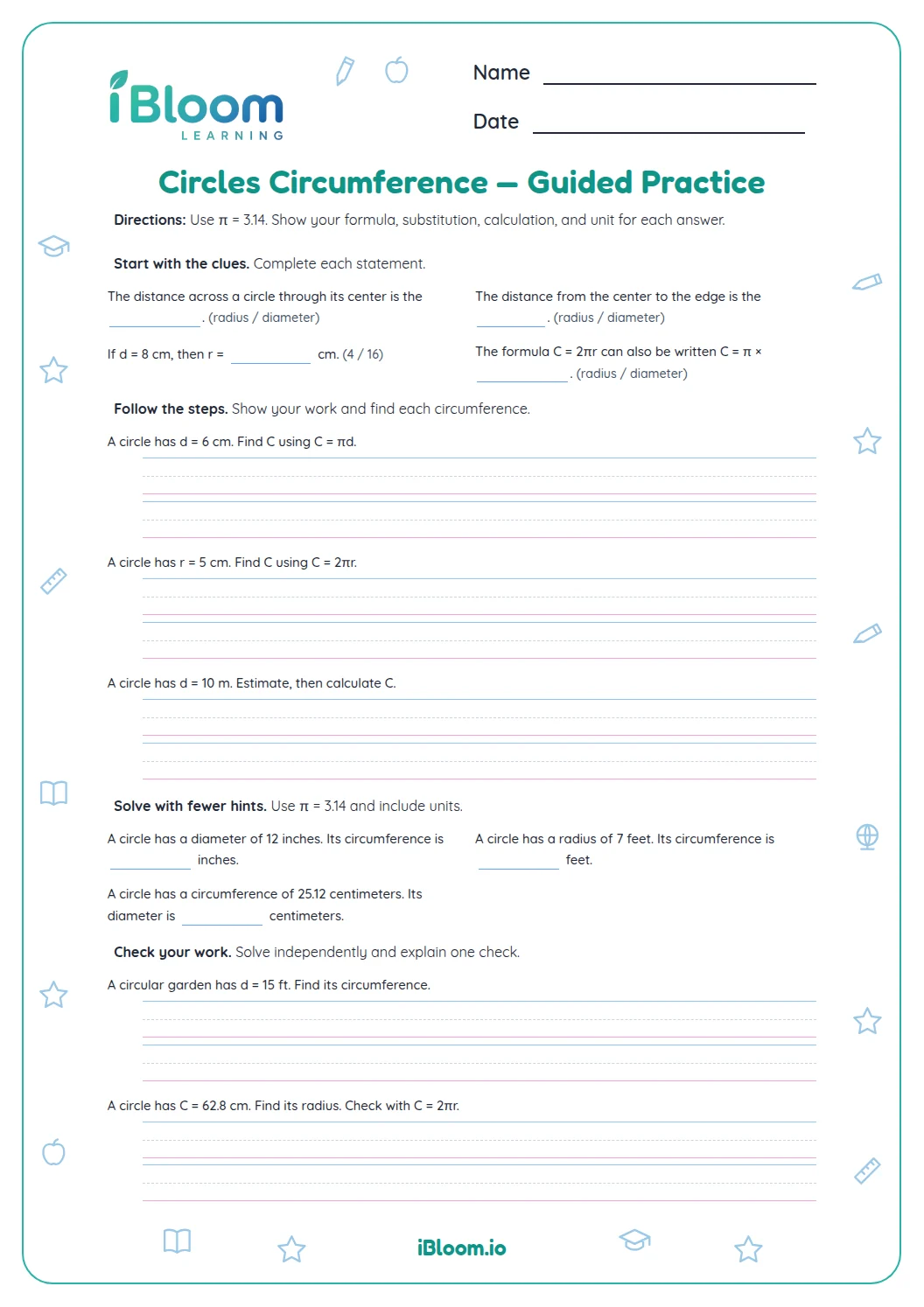
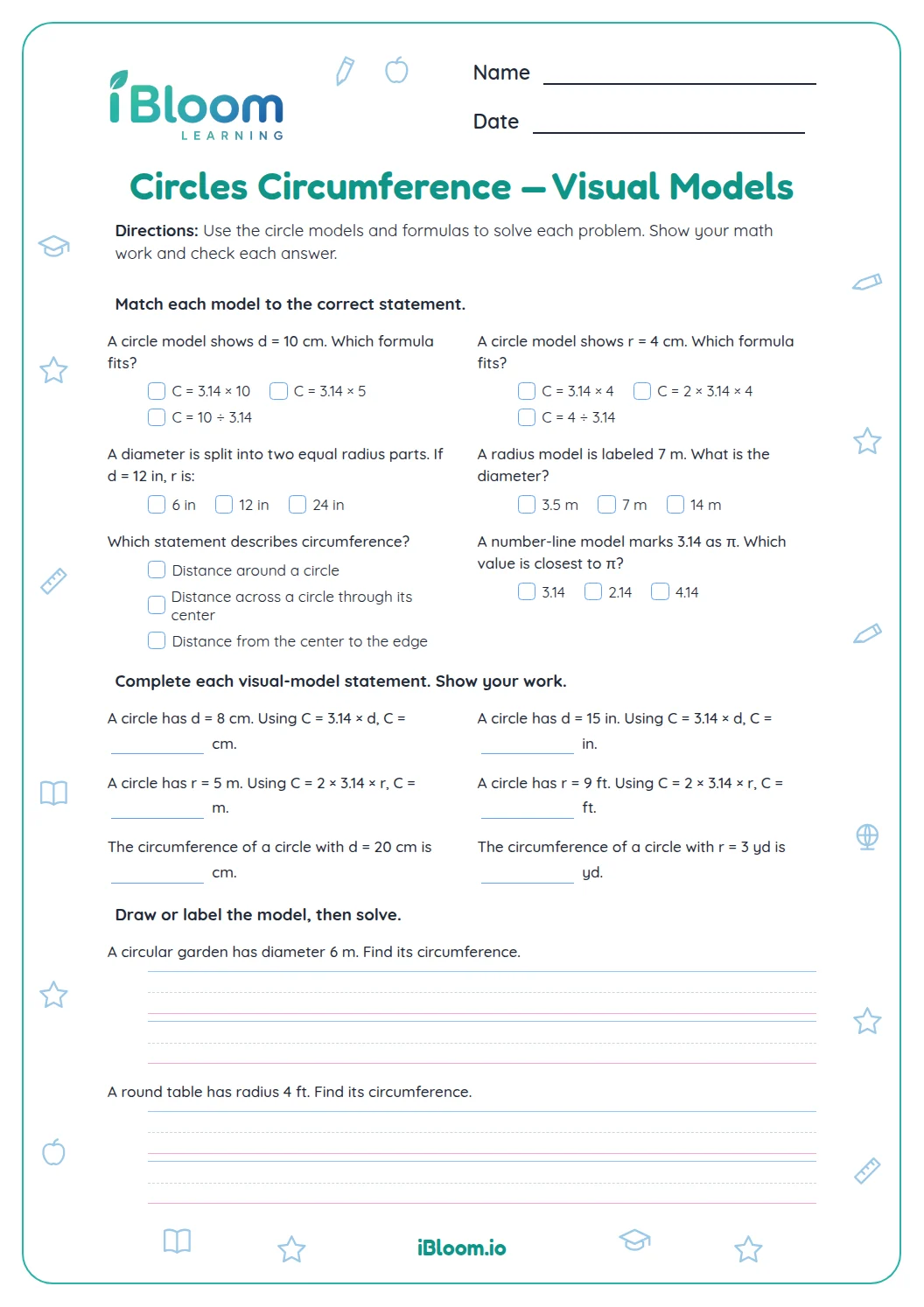
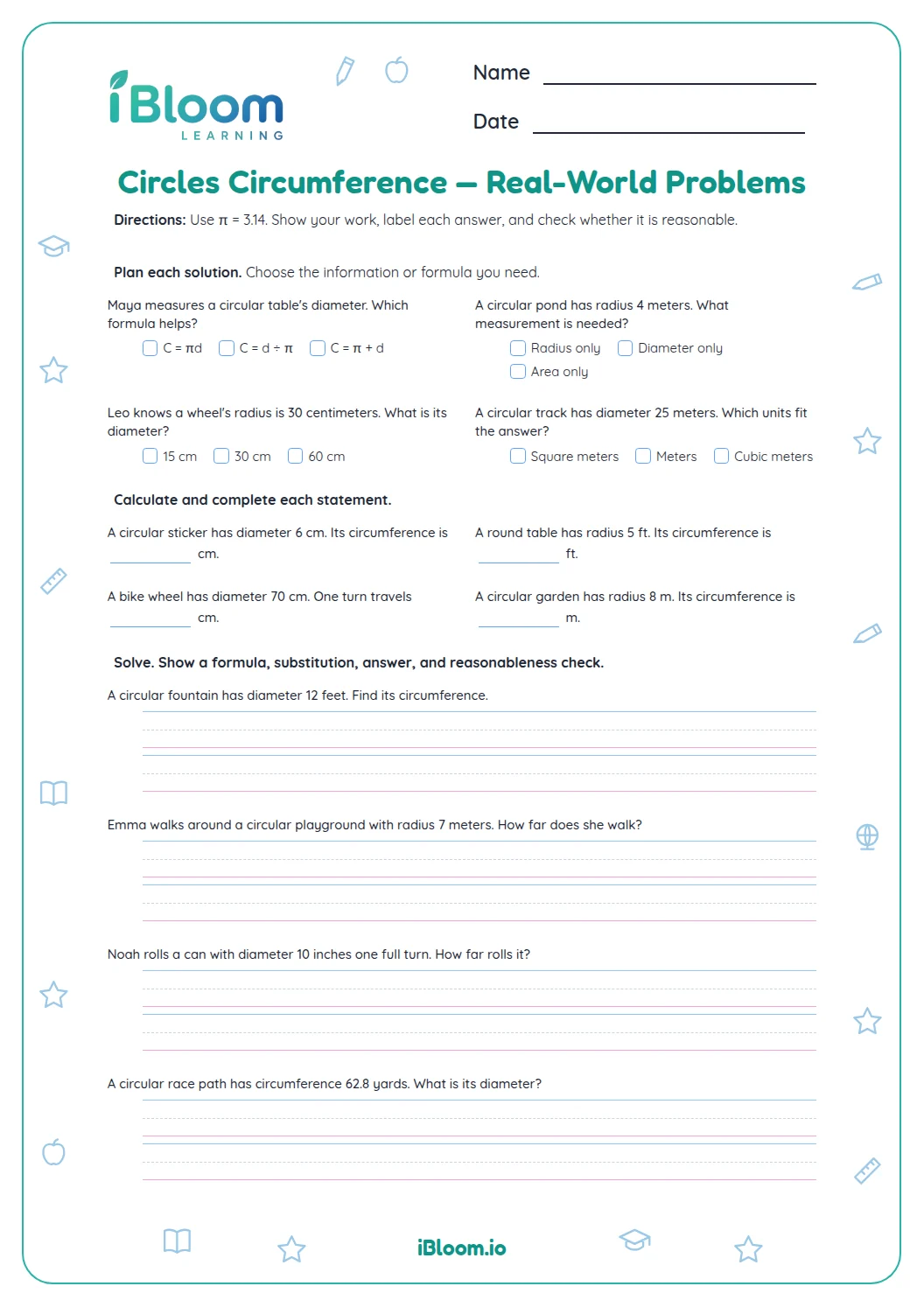
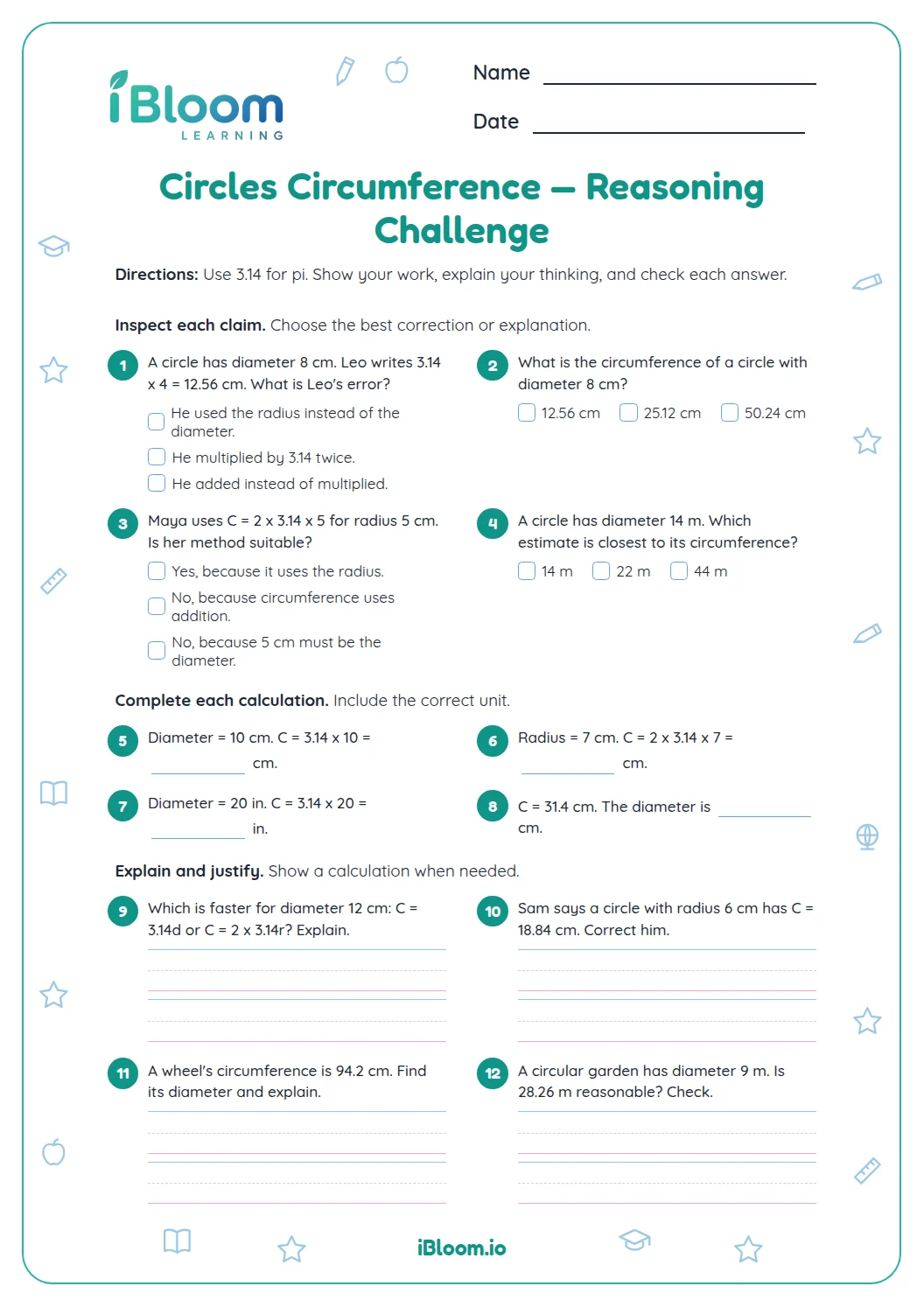
About this worksheet
This free printable gives Grade 5 students 16 circle-measurement problems. Students use the stated value of π to calculate circumference from a radius or diameter, and work backward from circumference to find diameter. The worksheet includes direct calculations and everyday contexts; a separate answer key gives each result with its unit.
Which circle formula should students use?
Circumference is the distance around a circle. Use C = πd when the diameter is given; when the radius is given, first double it or use C = 2πr. Questions 1–8 practice these calculations and finding a diameter from a circumference.
How does a radius give the circumference?
Question 3 gives a radius of 4 cm and π = 3.14. Double the radius to get an 8 cm diameter, then multiply 3.14 × 8.
- 1d = 2 × 4 = 8 cm
- 2C = 3.14 × 8 = 25.12 cm
How do the word problems use circumference?
Part B puts the same measurements into settings such as a pond, plate, track, and garden. “Around” or “edge length” asks for circumference; “across” or a given circumference with a missing diameter asks for the diameter.
Why should every answer include a unit?
Circumference and diameter are lengths, so keep the unit from the problem. A calculation of 3.14 × 6 for a 6 cm diameter gives 18.84 cm, not just 18.84.
How to use this worksheet
- 1Mark whether the problem gives a radius, diameter, or circumference.
- 2If the radius is given, double it to get the diameter.
- 3Choose C = πd or divide C by π to find diameter.
- 4Use the specific π value printed in that question.
- 5Write the result with the original length unit and check the arithmetic.
Common mistakes and quick fixes
The mistake
Using the radius as if it were the diameter.
The fix
Double the radius before using C = πd, or use C = 2πr.
The mistake
Using a different value of π from the one in the problem.
The fix
Copy the stated value, either 3 or 3.14, before calculating.
The mistake
Leaving off the length unit.
The fix
Carry cm, in, m, ft, or yd from the given measure into the answer.
What to practice next
Make more practice
Questions parents and teachers ask
How do you find a circle’s circumference?
Multiply the diameter by π: C = πd. If a problem gives the radius, double it first or use C = 2πr. For example, a 6 cm diameter with π = 3.14 gives 3.14 × 6 = 18.84 cm. The unit stays because circumference measures length.
What is the difference between radius and diameter?
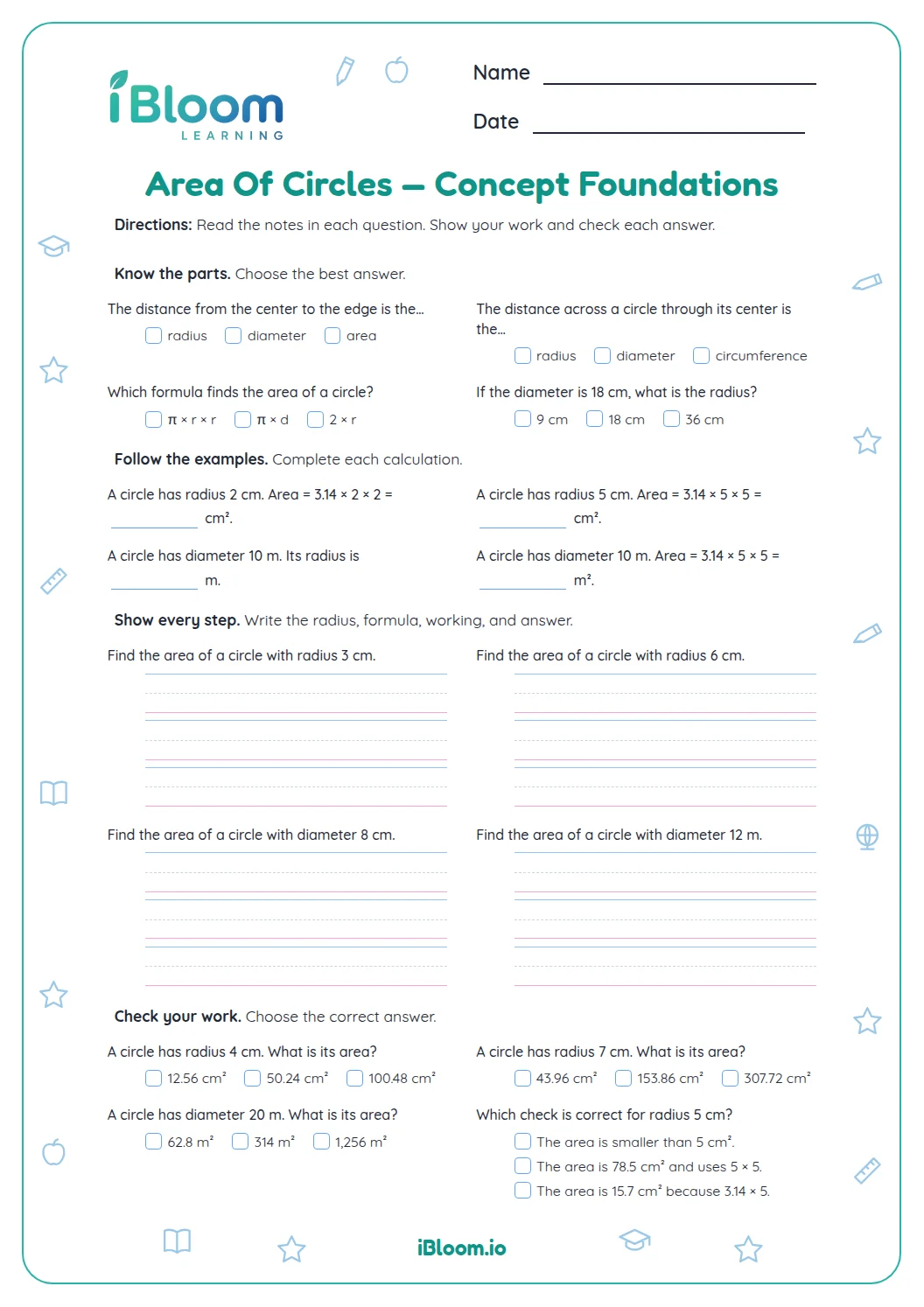
The radius runs from the center to the edge. The diameter crosses the circle through the center and equals two radii. Question 3 gives a radius of 4 cm, so its diameter is 8 cm before multiplying by the stated value of π.
Why do the questions use different values for pi?
Each problem tells students to use π = 3 or π = 3.14. The value 3 makes the arithmetic simpler, while 3.14 gives a more precise decimal result. Follow the value in that particular question so the calculation matches the expected answer.
How can a circumference answer be checked?
Multiply the diameter by the stated π again, or divide the circumference by π to recover the diameter. For example, 18.84 ÷ 3.14 = 6, which checks the 6 cm diameter problem. Keep the unit with the recovered measurement as well.
What does the answer key include?
The key gives all 16 results with units: 12 circumferences and 4 diameters. Students can compare each number and unit, then review whether they used the radius or diameter correctly. Showing the multiplication or division in the worksheet workspace makes that check easier.