

About this worksheet
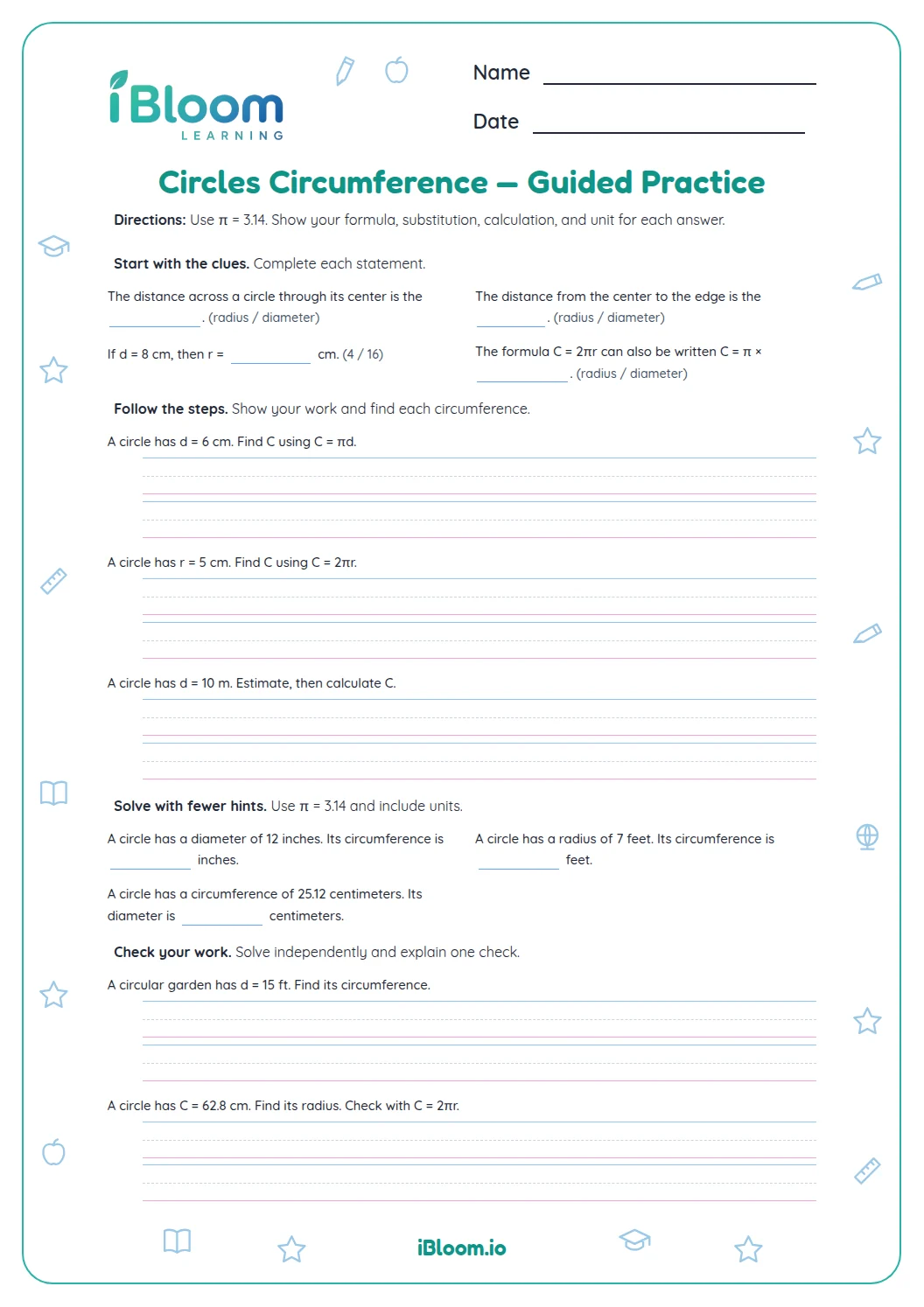
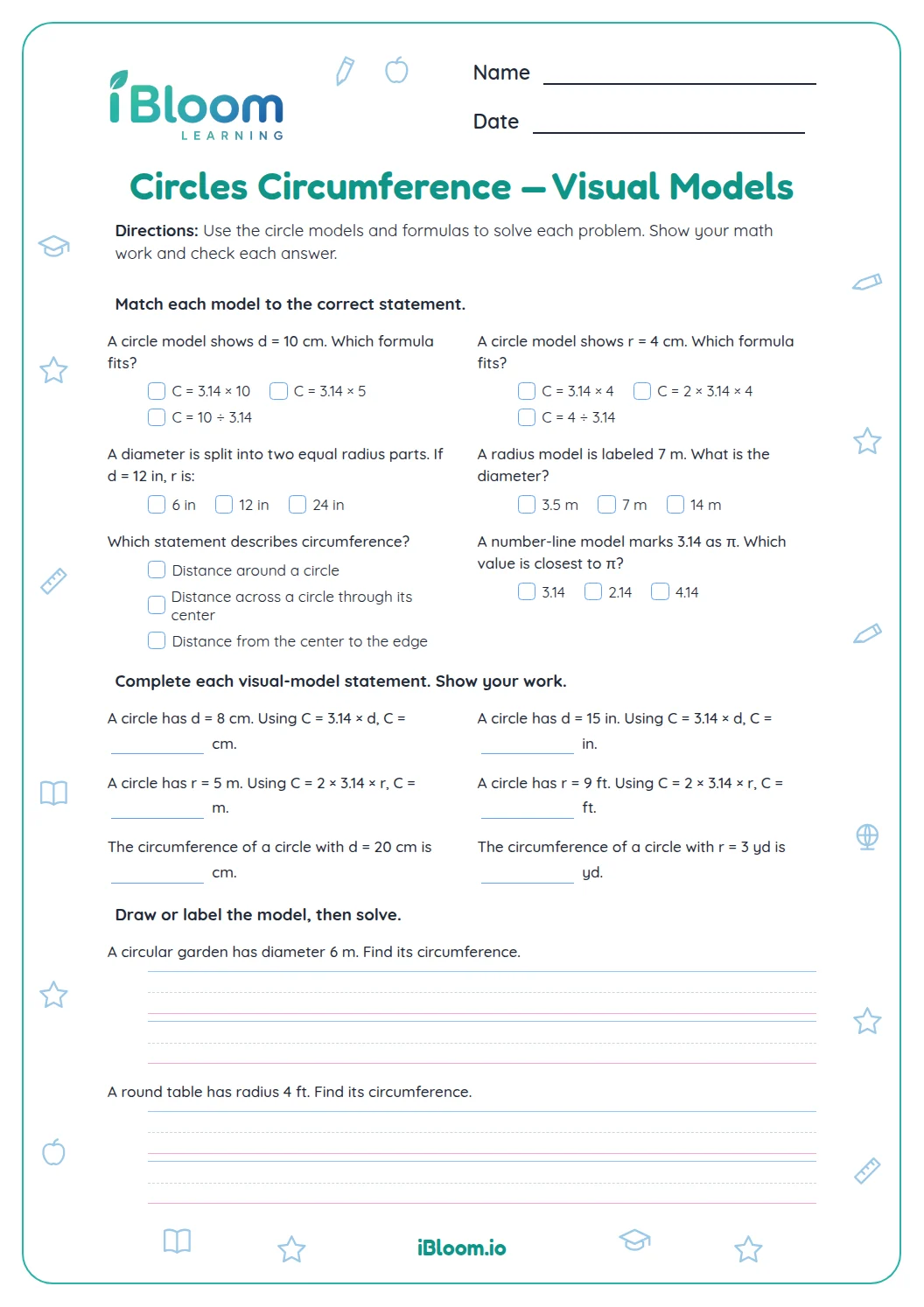
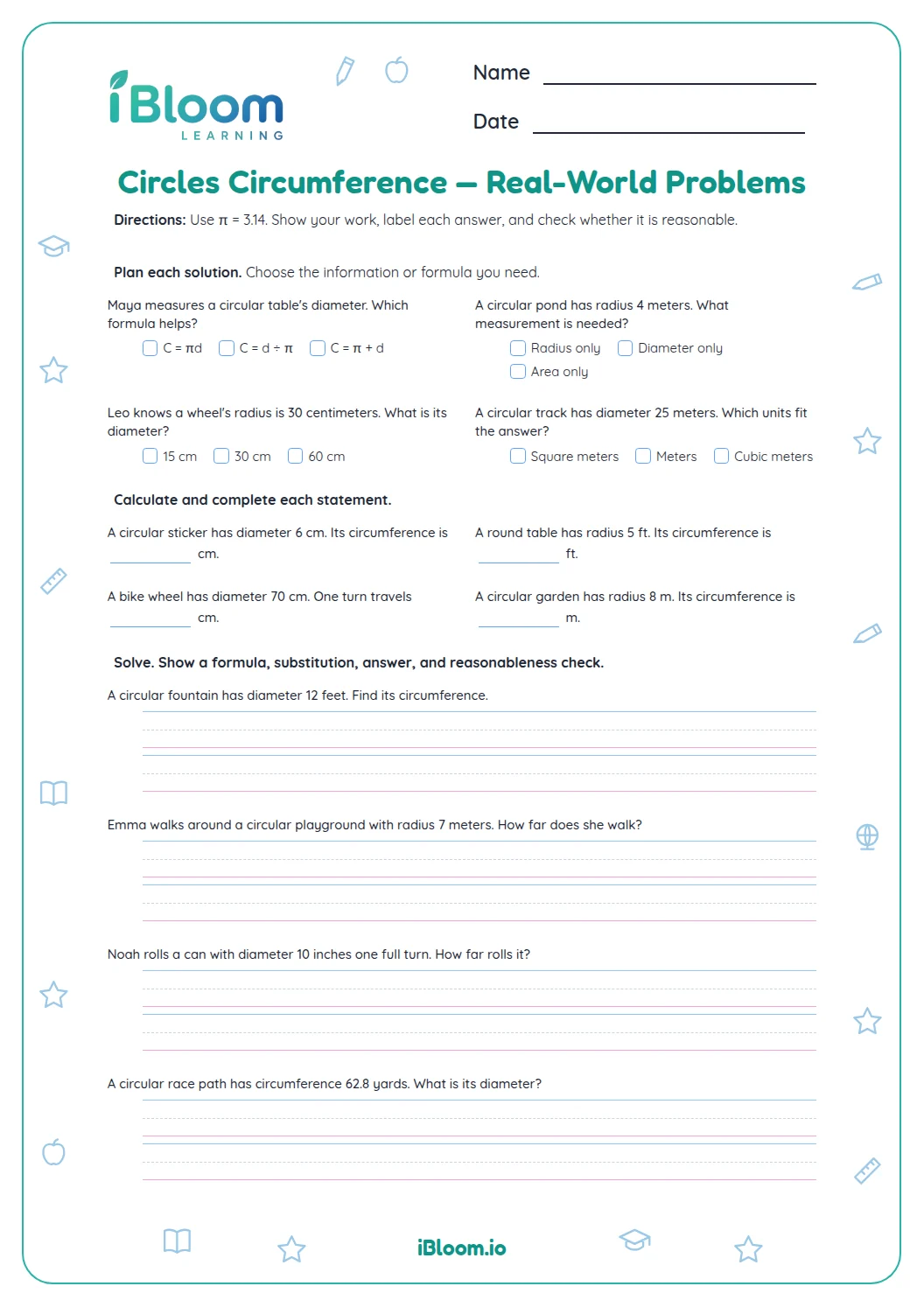
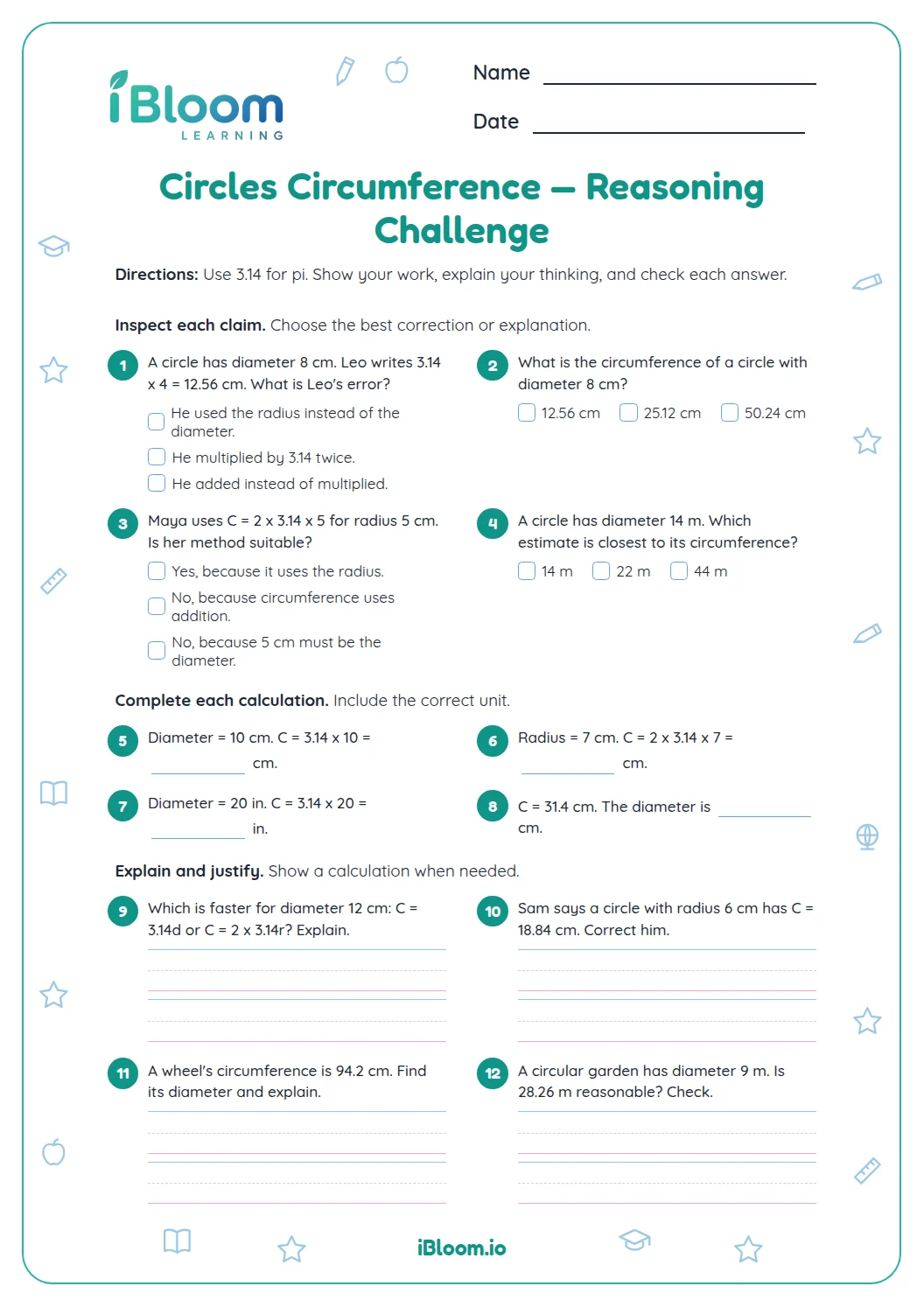
This free two-page worksheet helps Grade 5 students connect circle vocabulary to the distance around a circle. Part A checks the names and units of circle measurements. Part B asks students to choose circumference formulas and substitute a radius or diameter. Part C gives eight calculations using 3.14 for pi, and Part D asks for two explanations. These tasks practice the circumference formula in Common Core 7.G.B.4. A separate answer key includes all eighteen answers and sample explanations.
Aligned to 7.G.B.4
What do circumference, radius, and diameter mean?
Circumference is the length of a circle’s boundary. Imagine wrapping string once around a circular lid, then straightening the string to measure it. That length is the circumference.
A radius reaches from the center to the edge. A diameter crosses the whole circle through its center, so it is twice the radius. Part A distinguishes these three measurements; Part B checks both C = π × d and C = 2 × π × r.
How does a radius become a circumference?
Find the diameter before multiplying by 3.14. Question 13 gives a radius of 3 cm, so the first step is 2 × 3 = 6 cm. The multiplication then uses 6, not 3.
Pi is approximately 3.14. Results calculated with 3.14 are approximate even when the multiplication itself is exact. Keep the length unit, such as cm or m, in the answer.
- 1Radius = 3 cm
- 2Diameter = 2 × 3 = 6 cm
- 3Circumference ≈ 3.14 × 6 = 18.84 cm
How do the final questions check understanding?
Question 17 asks why multiplying a radius directly by 3.14 gives a result that is too small. A useful explanation names the missing step: doubling the radius to get the diameter.
Question 18 compares diameters of 4 cm and 8 cm. Both circumferences use the same multiplier, so doubling the diameter doubles the circumference. Students can explain this relationship without calculating both decimal products.
How to work through the sheet
- 1Say around, center to edge, and across through the center while reviewing circle measurements.
- 2Complete Part A, then use d = 2 × r to check the formula choices in Part B.
- 3For Part C, identify whether each question gives radius or diameter before calculating.
- 4Calculate questions 9–16, writing units and using 3.14 for pi.
- 5Read the explanations in Part D aloud and check that they connect radius, diameter, and circumference.
Mistakes to discuss and fix
The mistake
Using a radius in 3.14 × d.
The fix
Double the radius first; question 13 needs 6 cm in the multiplication.
The mistake
Using square centimeters for circumference.
The fix
Circumference is a length around an edge, so use cm rather than cm².
The mistake
Calling a 3.14-based result exact.
The fix
Say about or approximately because 3.14 is an approximation of pi.
Common Core alignment
Use the circumference formula to find the distance around a circle.
On this sheet: Students identify circumference, connect radius and diameter, and use C ≈ 3.14 × d.
Show the official wordingHide the official wording
Know the formulas for the area and circumference of a circle and use them to solve problems; give an informal derivation of the relationship between the circumference and area of a circle.
What to practice next
Make more practice
Further reading
Questions parents and teachers ask
What should students know before starting?
Students should be able to double a whole number and multiply a decimal by a small whole number. The sheet introduces the circle vocabulary with a word bank before using it in formula choices and calculations. Review the words center and edge, then read the circumference formula at the start of Part C together.
Why does the sheet use 3.14 for pi?
The sheet uses 3.14 so students can calculate approximate circumferences with familiar decimal multiplication. Pi describes the ratio of circumference to diameter, and its decimal continues beyond 3.14. Every circumference calculation here uses the same approximation, which makes answers consistent when families check the key.
What is the difference between radius and diameter?
A radius goes from the center to the circle’s edge, while a diameter goes from one edge to the other through the center. A diameter contains two radii. In question 9, the radius is 4 cm, so doubling 4 gives a diameter of 8 cm.
How can I check the explanation in question 17?
Look for the idea that the radius must be doubled before multiplying by 3.14. The student in question 17 uses 5 instead of the diameter, 10. A clear response explains that this gives only half the circumference; the key provides a sample rather than requiring identical wording.
Can we measure a real circle afterward?
Yes. Wrap a piece of string once around a circular lid, straighten it, and measure its length with a ruler. Measure across the lid through its center as well. Compare the measured circumference with 3.14 times the diameter, allowing for small differences caused by measuring and rounding.