



About this worksheet
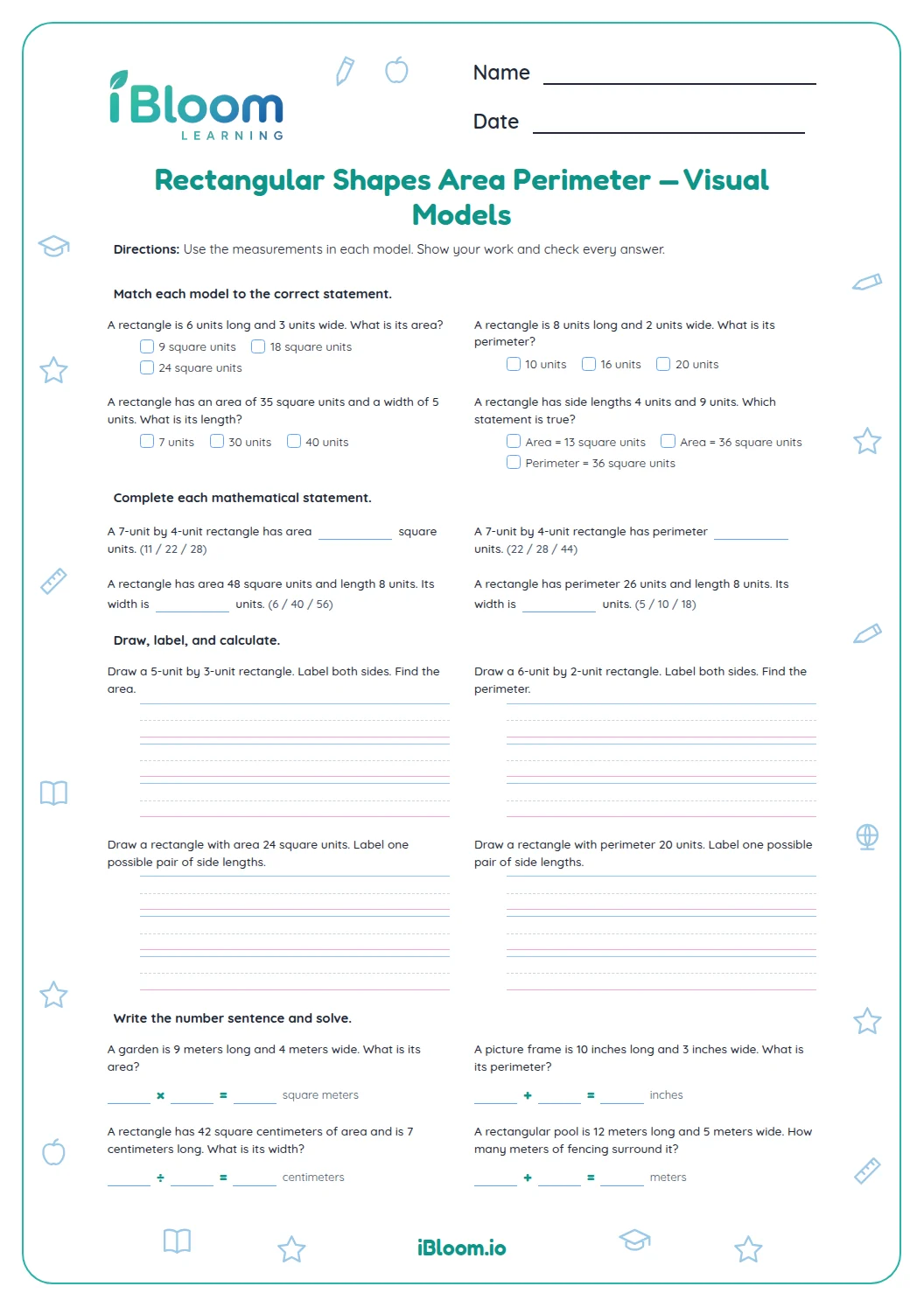
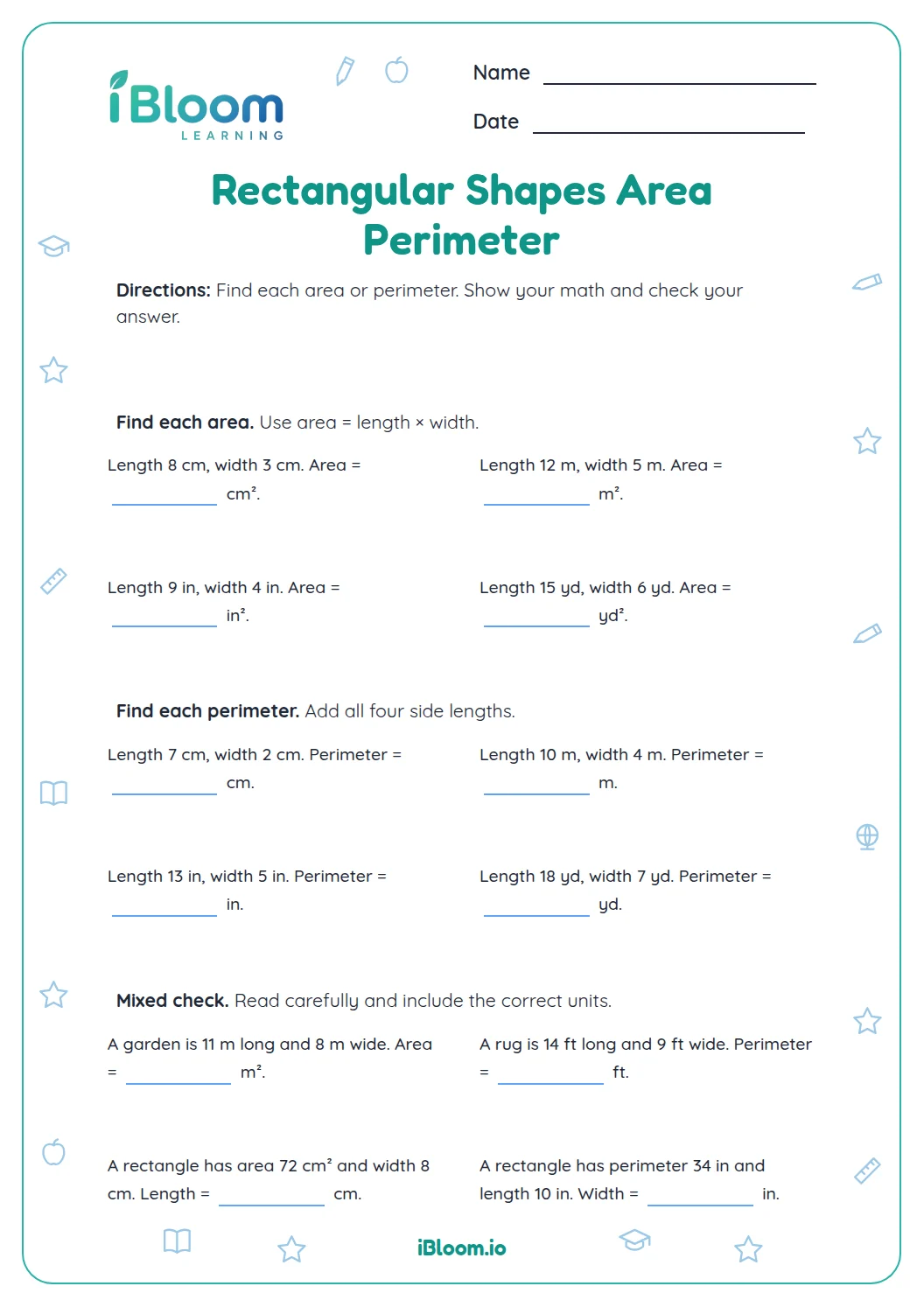
This printable Grade 5 worksheet gives learners focused practice with area and perimeter. The worksheet activity moves from supported examples to independent applications, with clear space to show thinking. A separate answer key helps adults review each response. This set practices rectangle area and perimeter calculations with grids, measurements, and short applications.
How do you find the area of a rectangle?
Area counts square units inside a rectangle. Multiply the number of rows by the columns, or multiply its side lengths. Question 2 has 2 rows of 6 squares, so its area is 12 square units.
- 16 columns × 2 rows = 12 square units
- 2The shaded grid shows 12 equal squares.
How is perimeter different from area?
Perimeter measures the distance around the outside edge. Add all four sides, or double the sum of the length and width. A 5-by-3 rectangle has perimeter 5 + 3 + 5 + 3 = 16 units.
What will learners solve?
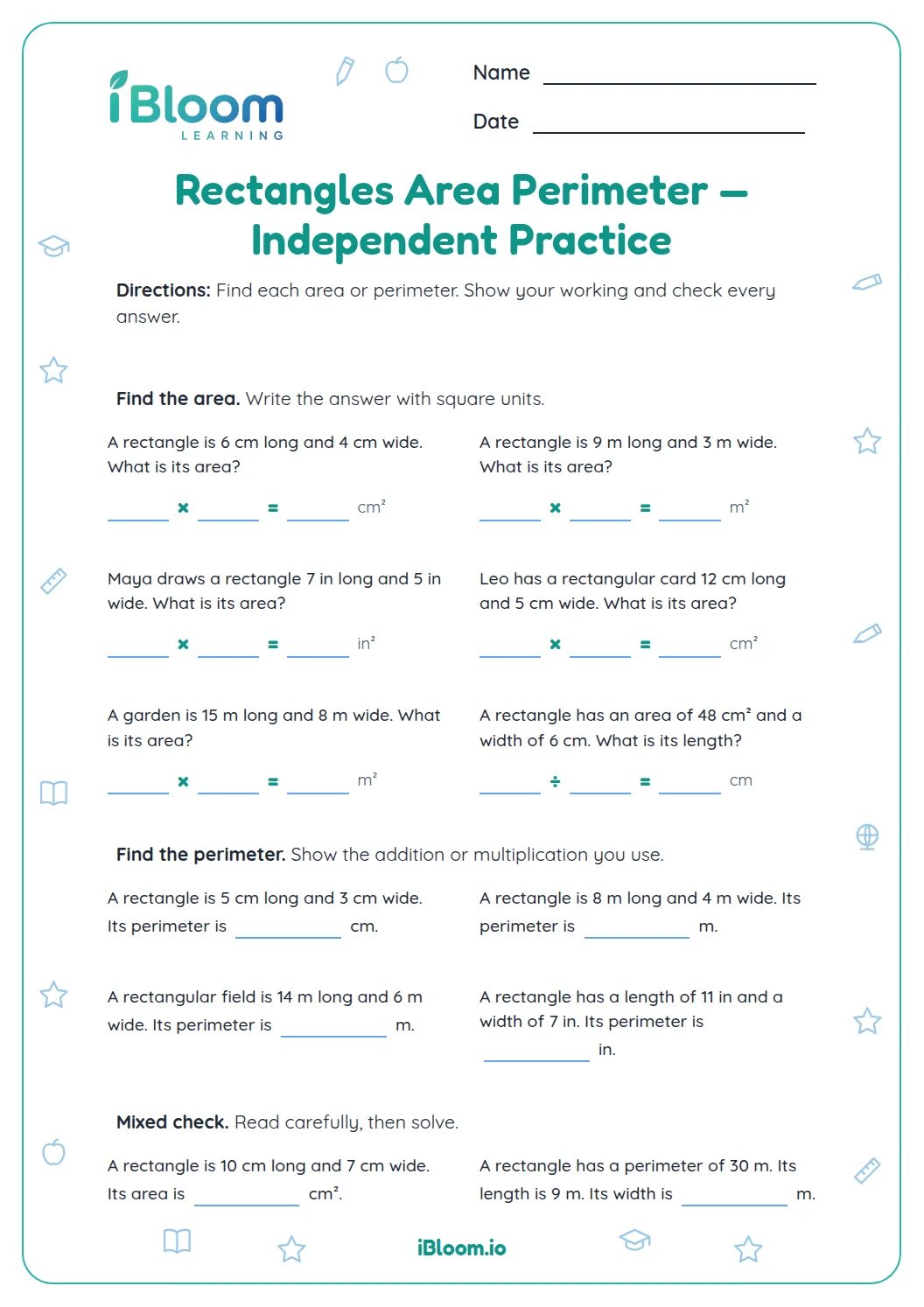
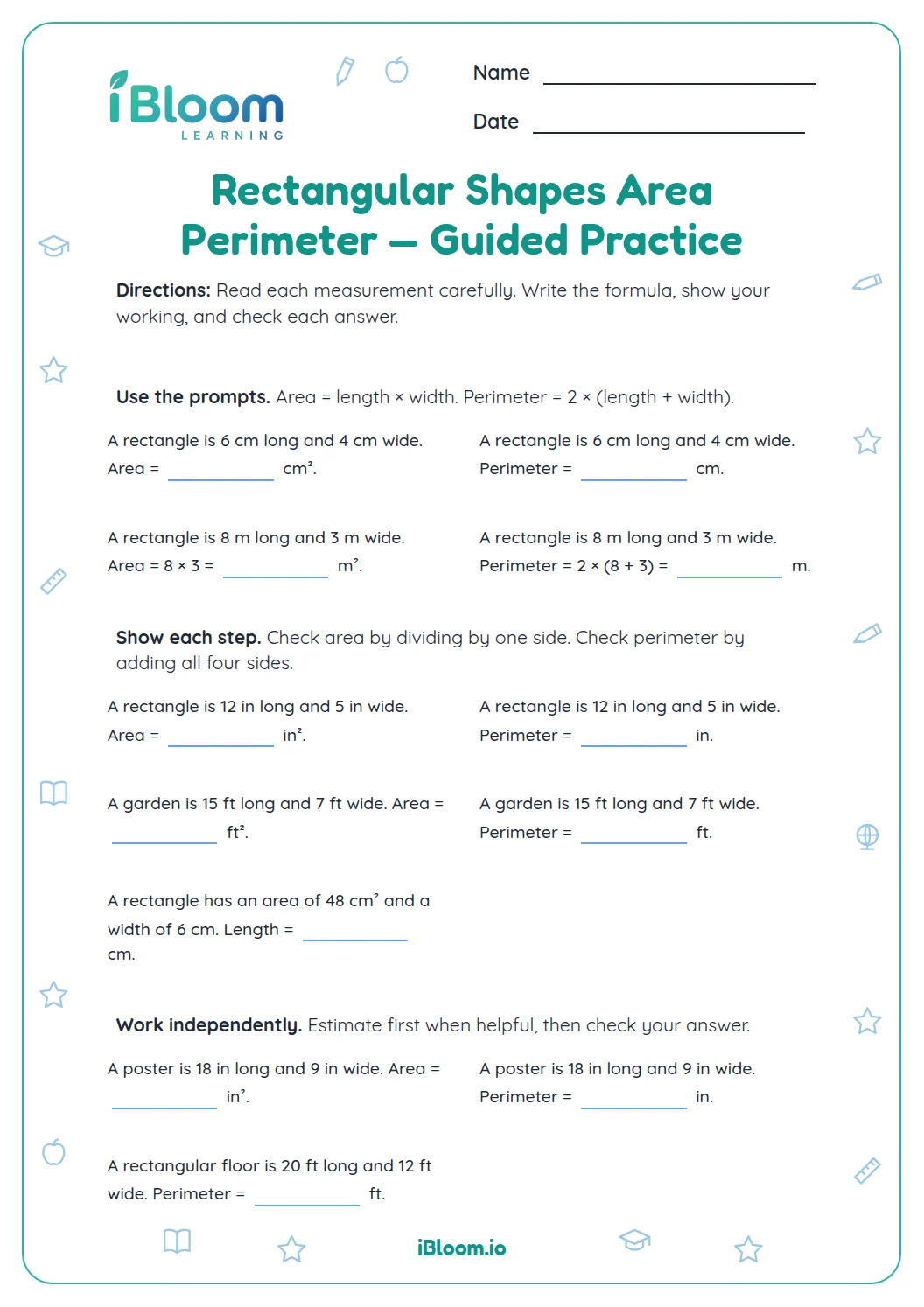
The 14 prompts begin with six rectangle area questions, including two shaded grids, continue with four perimeter calculations, and finish with four garden applications. The key labels area in square units and perimeter in linear units.
- Questions 1–6 find rectangle area; the first two include shaded grids.
- Questions 7–10 find perimeter from side lengths.
- Questions 11–14 apply area or perimeter to garden situations.
How to use this worksheet
- 1Name whether each prompt asks for space inside or distance around.
- 2For area, multiply the side lengths and label the result in square units.
- 3For perimeter, add all four sides or double length plus width.
- 4Use the grid to check an area product by counting rows and columns.
- 5Check that the answer unit matches the measure.
Common mistakes and quick fixes
The mistake
Writing linear units for area
The fix
Count square units inside the rectangle and write square units.
The mistake
Doubling only one side for perimeter
The fix
Add length and width first, then double their sum.
The mistake
Using square units for perimeter
The fix
Perimeter is a distance, so label it in units, not square units.
What to practice next
Make more practice
Further reading
Questions parents and teachers ask
What is the difference between area and perimeter?
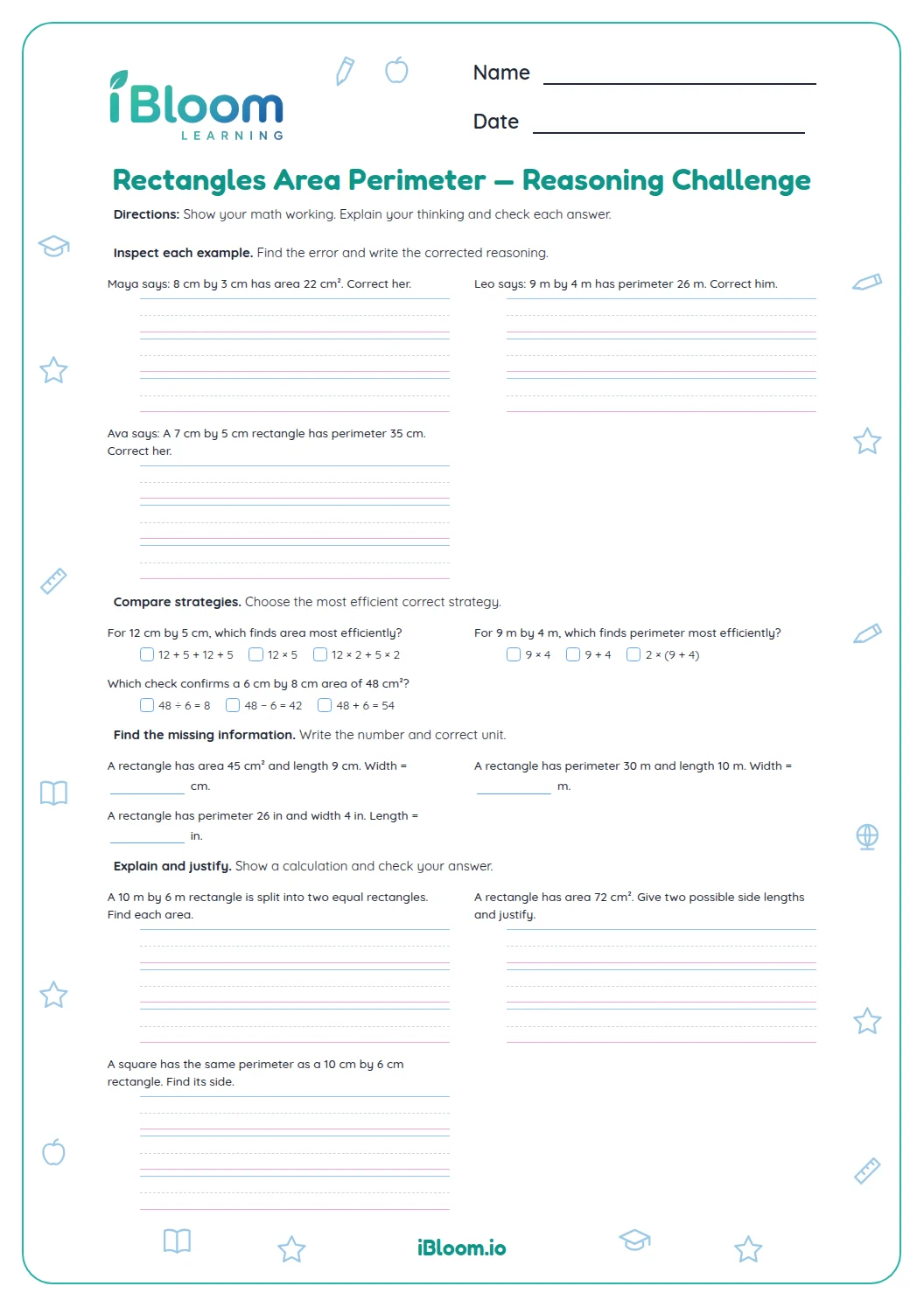
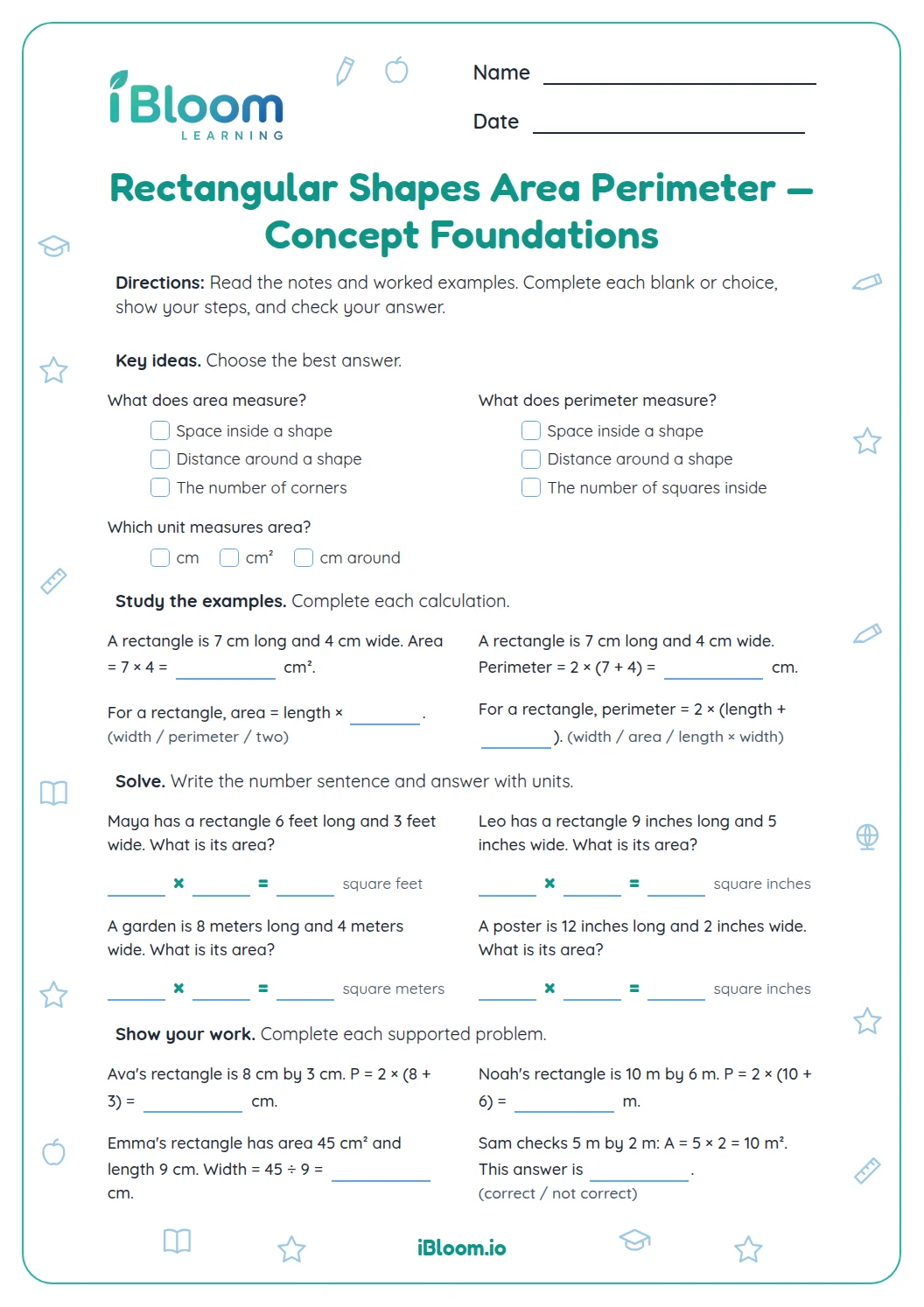
Area is the amount of flat space inside a rectangle, measured in square units. Perimeter is the distance around its boundary, measured in regular units. The worksheet includes both, so learners first identify which measure a question asks for before calculating.
How do you calculate a rectangle’s area?
Multiply its length by its width. The shaded grids on the first two questions show the row and column counts, so learners can also count the unit squares to check a product. For a 6-by-2 grid, 6 × 2 = 12 square units.
How do you calculate a rectangle’s perimeter?
Add the lengths of all four sides. Opposite sides of a rectangle match, so you can also double the sum of its length and width. For a 5-by-3 rectangle, 2 × (5 + 3) = 16 units. The equal opposite sides explain why this shortcut works.
Why does area use square units?
Area counts square units that cover a flat surface. A 1-unit-by-1-unit square is one square unit, and a 6-by-2 rectangle fits 12 of them. Perimeter measures a length, so it uses units without “square.” The unit label tells whether the answer measures coverage or distance.
How many questions and pages are included?
There are 14 questions across two worksheet pages and two answer key pages. Six grid questions practice area, four questions practice perimeter, and four garden situations apply one of those measures. The key gives matching results with the appropriate units.
Can learners use the grid to check their multiplication?
Yes. The first two questions include rectangle grids, so learners can count the shaded squares or multiply the row and column counts. Both methods should give the same area. The remaining area questions use side lengths, letting learners apply the same multiplication rule without a grid.