



About this worksheet
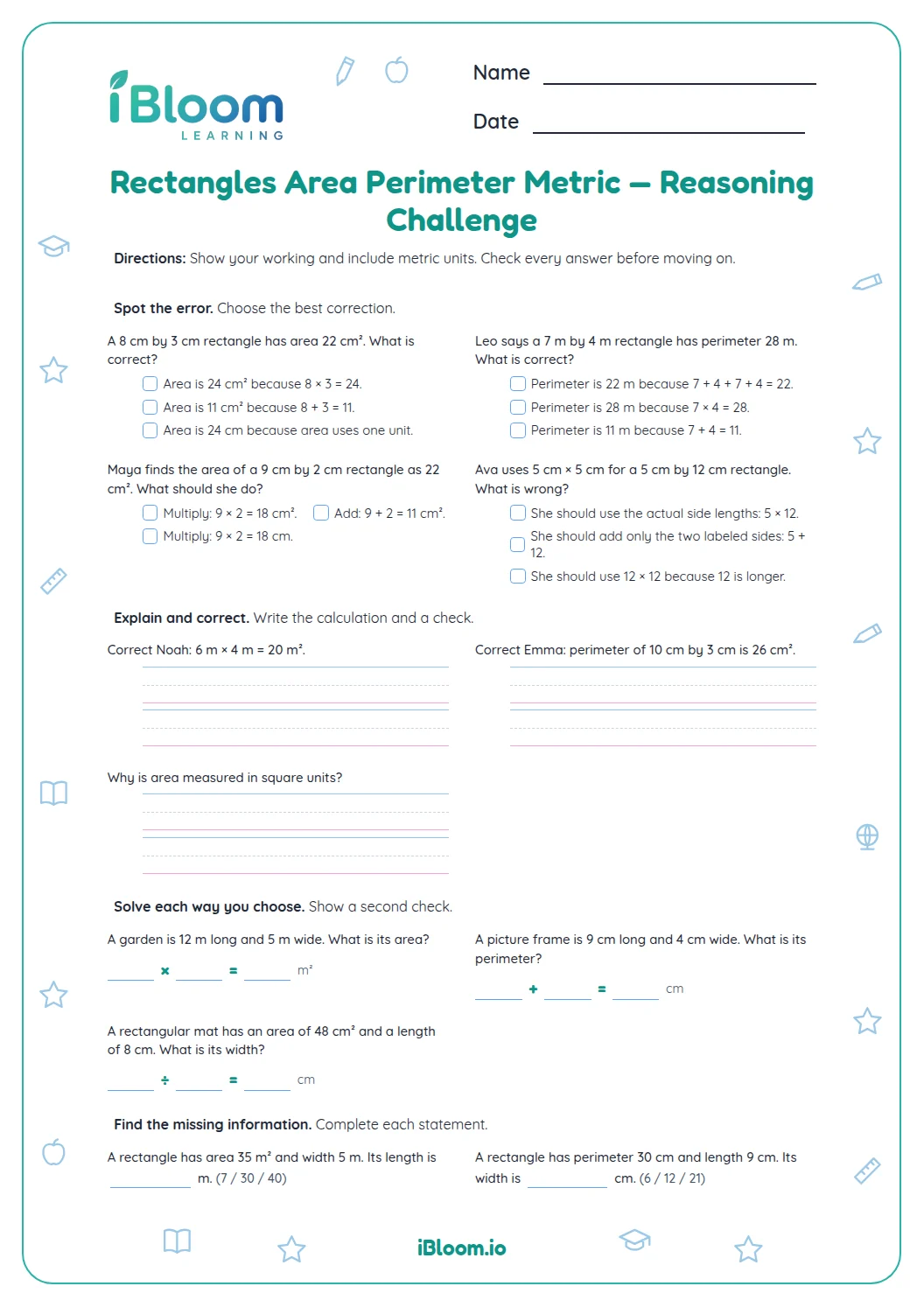
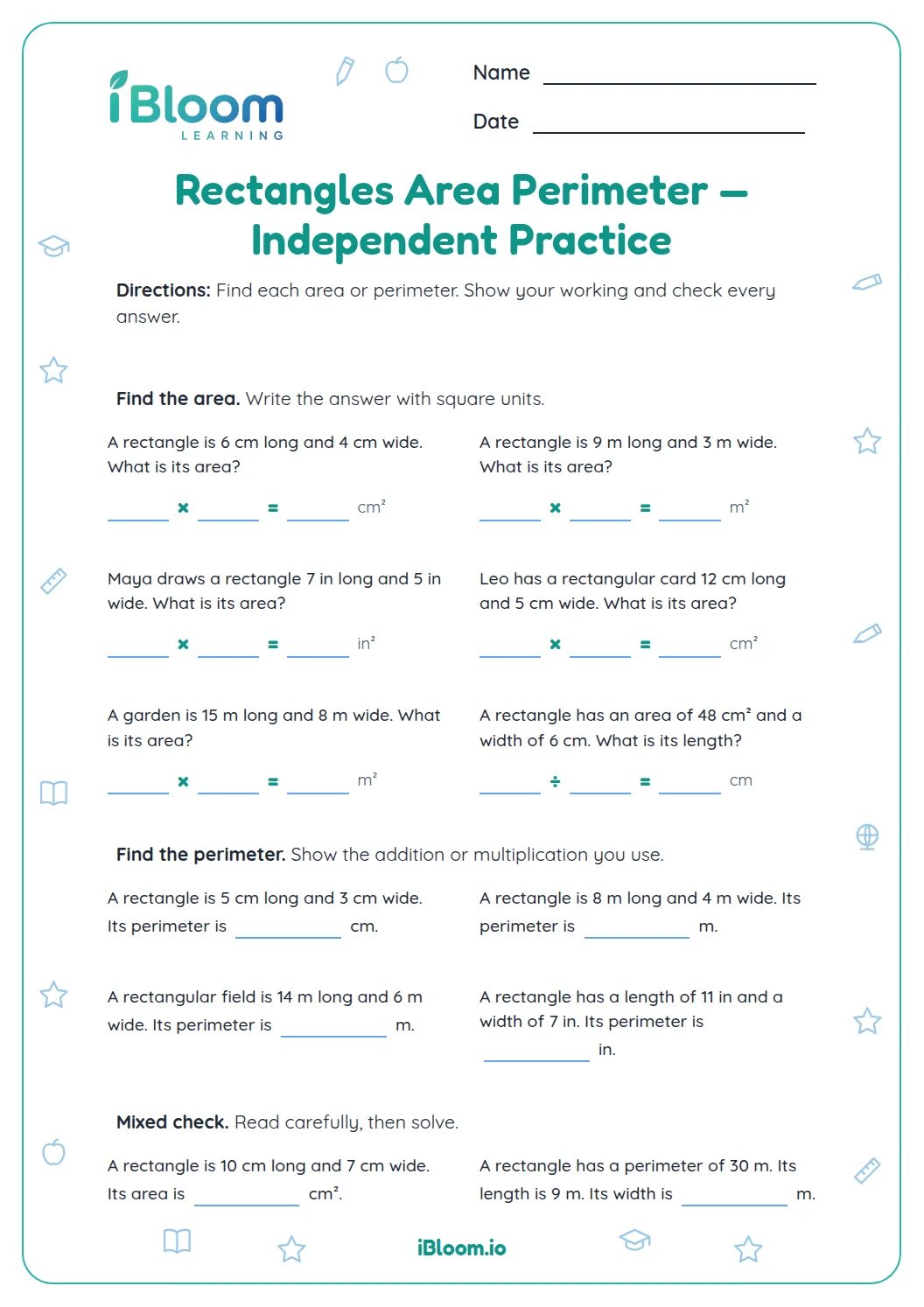
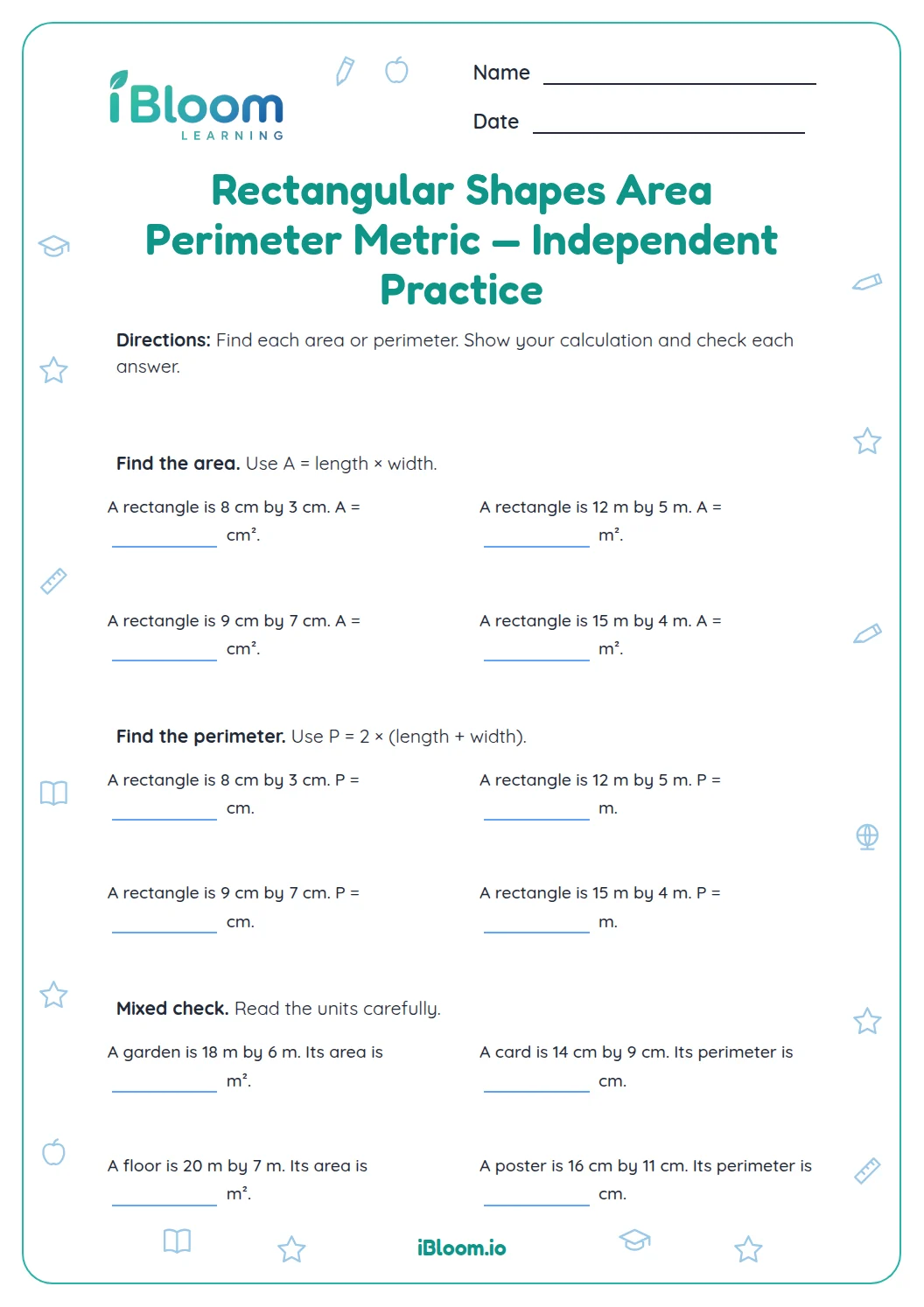
This Grade 5 guided practice sheet helps learners distinguish area from perimeter while working with rectangular measurements in centimeters. Children read shaded grids, choose a suitable equation, find missing side lengths, and solve short contexts such as trim around a frame. Sixteen questions move from visual models to independent calculations. A separate answer key supports checking. The problems connect metric measurement contexts with the Common Core measurement standard 4.MD.A.3.
Aligned to 4.MD.A.3 and 3.MD.C.7
What is the difference between area and perimeter?
Area measures the surface inside a rectangle and uses square units such as cm². Perimeter measures the distance around its boundary and uses linear units such as cm. For a 7 cm by 4 cm rectangle, area is 28 cm² and perimeter is 22 cm.
How can a grid make area easier to see?
Multiply the side lengths to find area. For a 4 cm by 3 cm rectangle, 4 × 3 = 12 cm². To find perimeter, add the four side lengths.
How do missing-side problems work?
Use the relationship that matches the known measurement. If area is 32 cm² and width is 4 cm, divide 32 by 4 to find a length of 8 cm. For a perimeter problem, subtract the known side contributions first.
How to use this worksheet
- 1Read whether the question asks for area or perimeter.
- 2For an area grid, count rows and columns and multiply.
- 3For perimeter, add the four sides or double length plus width.
- 4Use division to find a missing side from area.
- 5Label area in square centimeters and perimeter in centimeters.
- 6Check whether the answer size makes sense.
Common mistakes and quick fixes
The mistake
Writing cm instead of cm² for area.
The fix
Area counts square units, so use cm²; perimeter uses cm.
The mistake
Adding length and width only for perimeter.
The fix
A rectangle has two lengths and two widths: use 2 × (length + width).
The mistake
Multiplying for perimeter.
The fix
Perimeter follows the outside edge, so add the side lengths instead of multiplying them.
Common Core alignment
This sheet practices area and metric measurement relationships.
Apply rectangle area and perimeter formulas to real and math problems.
On this sheet: Problems apply rectangle formulas in metric contexts and include finding an unknown side.
Show the official wordingHide the official wording
Apply the area and perimeter formulas for rectangles in real world and mathematical problems. For example, find the width of a rectangular room given the area of the flooring and the length, by viewing the area formula as a multiplication equation with an unknown factor.
Use multiplication and addition to find and explain rectangle area.
On this sheet: The guided examples calculate rectangular area by multiplying side lengths.
Show the official wordingHide the official wording
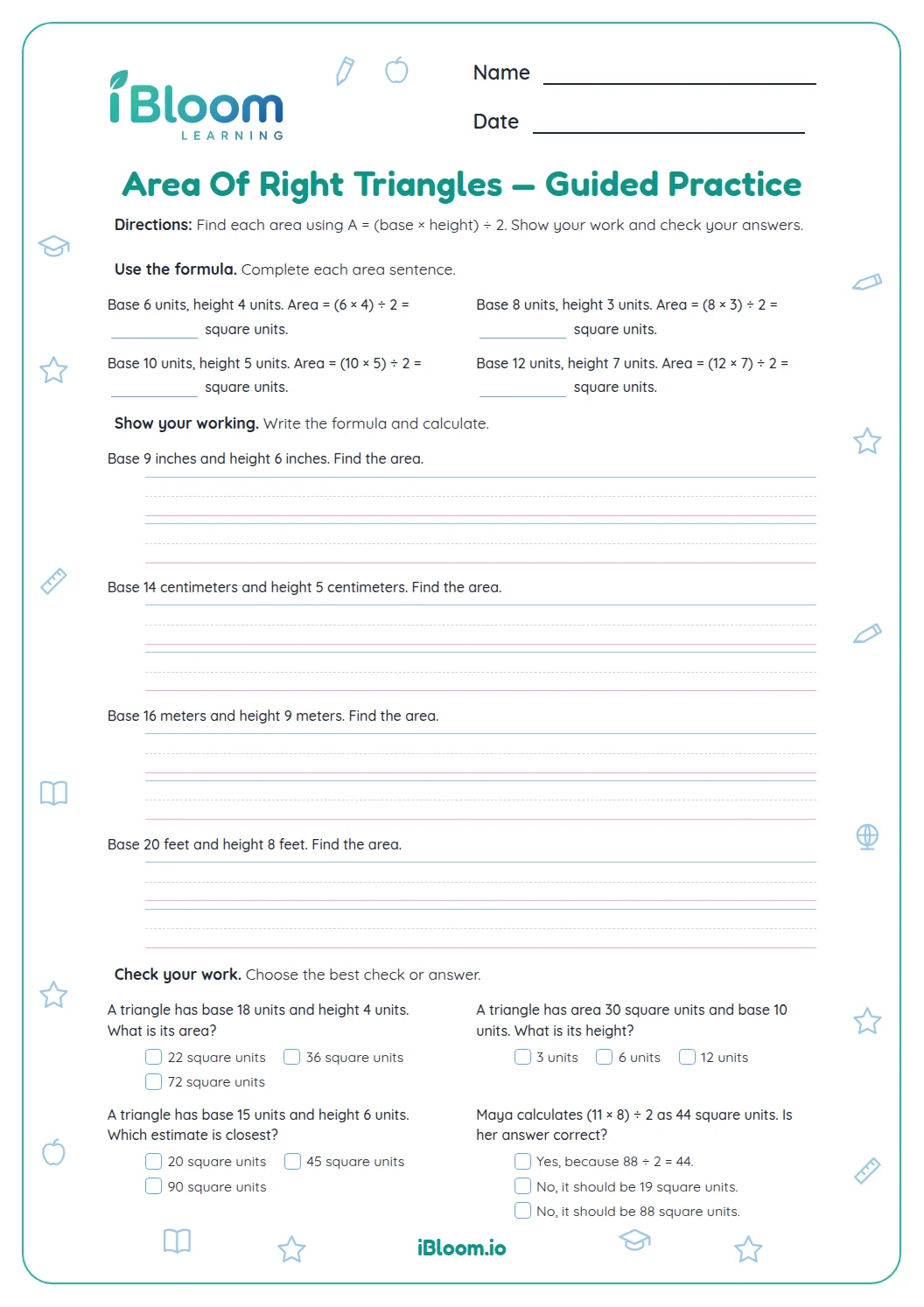
Relate area to the operations of multiplication and addition.
What to practice next
Make more practice
Questions parents and teachers ask
What is the difference between area and perimeter?
Area measures the surface inside a rectangle and is written in square centimeters, such as 28 cm². Perimeter measures the distance around its edges and is written in centimeters. The worksheet asks learners to find both, so checking the requested unit is a useful first step.
How can the shaded grids help?
Each shaded rectangle covers unit squares. Counting rows and columns or multiplying the side lengths gives area. The grid also shows the side lengths needed to find perimeter by adding the outside edges. These models connect the drawing to the calculations used later on the sheet.
How do you find a missing side when area is known?
Divide the area by the known side length. For example, a rectangle with area 42 cm² and length 7 cm has width 42 ÷ 7 = 6 cm. The worksheet includes missing-side questions so learners apply the area relationship in reverse.
How do you find a missing width from perimeter?
Subtract the two equal length sides from the perimeter, then divide what remains by two. For perimeter 26 cm and length 8 cm, subtract 16 to get 10, then divide by 2 for a width of 5 cm.
Which units belong with area and perimeter?
Use square centimeters (cm²) for area because it counts square units covering a surface. Use centimeters (cm) for perimeter because it measures length around the outside. The answer key includes units so learners can check both the calculation and label.
Is an answer key included?
Yes. The separate key lists answers for all 16 rectangle questions, including the appropriate units. Learners can compare their results after trying the grids, missing-side problems, and practical situations, then revisit any calculation that needs checking or a unit label.